


What started in 2005 as a Stanford PhD project to make computers understand music has evolved into one of the most compelling voice AI companies in the world. SoundHound AI, Inc. — founded by Keyvan Mohajer, Majid Emami, and James Hom — has spent two decades building technology that lets machines understand human speech the way humans do: in context, in real time, and across languages.
Today, the company is executing a transformation that its founders likely dreamed of but could not have predicted: from a music-recognition app into a full-stack conversational AI platform powering automotive OEMs, restaurant chains, financial institutions, healthcare organisations, and Fortune 100 enterprises.
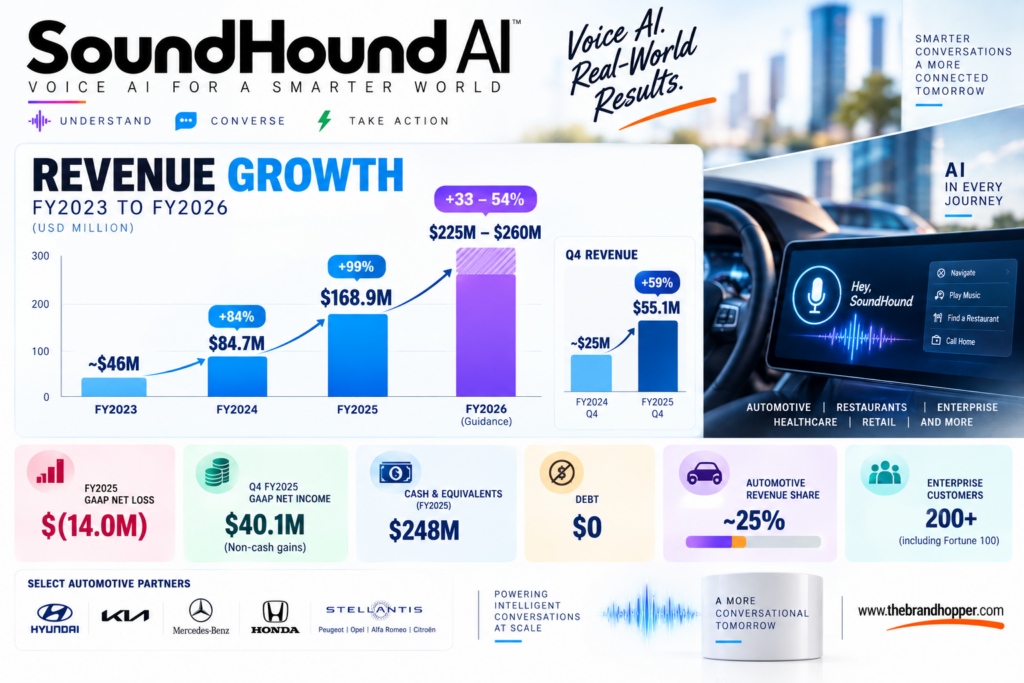
The numbers tell a compelling story. In fiscal year 2025, SoundHound AI reported record annual revenue of $168.9 million — a near-100% increase year-over-year — with Q4 2025 alone contributing $55.1 million at 59% year-over-year growth. The company ended 2025 with $248 million in cash and zero debt, and issued guidance for 2026 revenue of between $225 million and $260 million.
This is not the $30 million startup that nearly ran out of runway after its SPAC listing in 2022. This is a company that has used aggressive M&A, platform expansion, and automotive monetisation to build a multi-hundred-million-dollar voice AI business at a moment when the entire world is finally paying attention to conversational AI.
This article provides a comprehensive, analysis of SoundHound AI’s founders, business model, financial performance, key acquisitions, competitive landscape, and growth trajectory — with all figures verified from official filings and press releases. Whether you are an investor, a business partner, a researcher, or simply curious about one of the most interesting AI companies to emerge from Silicon Valley, this is the most complete account available.

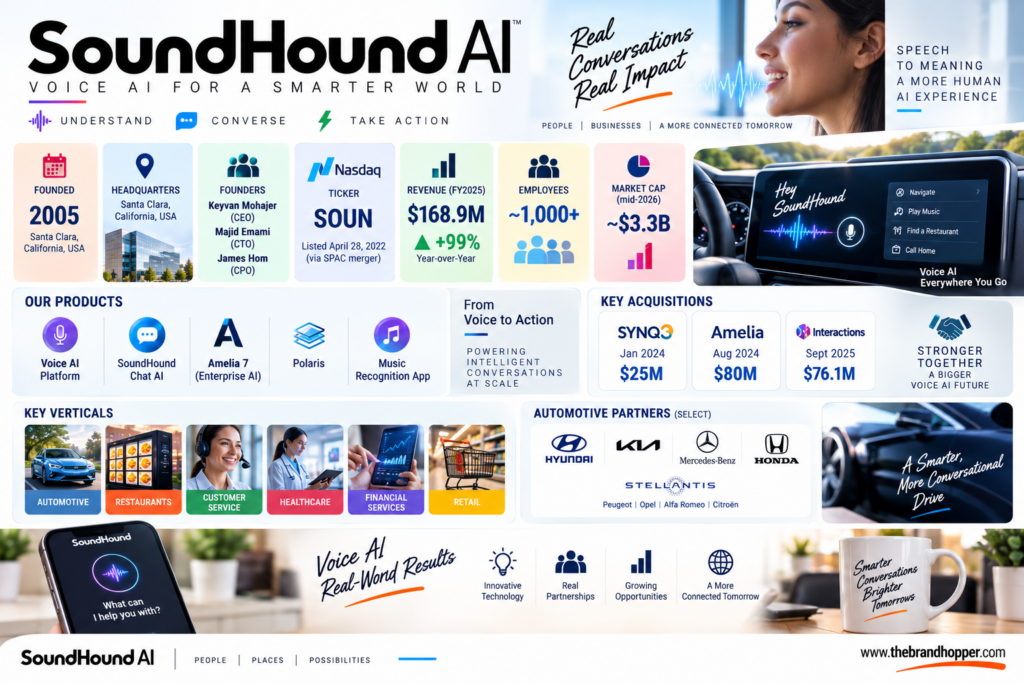
Key Milestones: From Music App to AI Platform
| Year | Milestone |
| 2005 | Founded by Keyvan Mohajer, Majid Emami, and James Hom in Santa Clara, CA |
| 2009 | Midomi app rebranded as SoundHound; music recognition app launched |
| 2015 | First music recognition service integrated into an automobile (Hyundai Genesis) |
| 2016 | 300 million+ users globally on the SoundHound platform |
| 2018 | Automotive partnerships announced with Hyundai, Mercedes-Benz, and Honda |
| 2020 | Won Webby Award for Productivity (Voice) in Apps, Mobile & Voice category |
| Nov 2021 | Announced SPAC merger with Archimedes Tech SPAC Partners Co. |
| Apr 2022 | SoundHound AI, Inc. debuted on Nasdaq under ticker SOUN |
| Dec 2023 | Dynamic Interaction drive-thru technology wins “Best Use of AI” Automation Award |
| Jan 2024 | Completed acquisition of SYNQ3 Restaurant Solutions ($25 million) |
| Early 2024 | NVIDIA revealed as an early investor; SOUN stock surged 1,064% in 2024 |
| Jun 2024 | Acquired Allset (restaurant ordering platform, immaterial amount) |
| Aug 2024 | Acquired Amelia Holdings (enterprise conversational AI) for $80 million |
| 2025 | Expanded Stellantis partnership to Alfa Romeo, Citroën, Peugeot, Opel; automotive = 25% of revenue |
| Sept 2025 | Acquired Interactions Corporation (AI for customer service) for $76.1 million |
| FY2025 Full Year | Record revenue of $168.9 million (+99% YoY); $248M cash, zero debt |
Founders of SoundHound AI
Behind every groundbreaking innovation lies a spark, ignited by the minds and dreams of visionary individuals. In the case of SoundHound AI, that spark came from three Stanford PhD engineers who dared to reimagine the way humans interact with machines through sound and speech.
Keyvan Mohajer — Co-Founder and CEO


Driven by a childhood fascination with science fiction and the promise of human-machine communication, Keyvan Mohajer became the founding architect of SoundHound. Inspired by scenes like Star Trek’s Captain Picard conversing effortlessly with the ship’s computer, Keyvan envisioned a world where natural language interaction with technology would become as intuitive as talking to another person. Armed with a PhD in Electrical Engineering from Stanford University and a relentless entrepreneurial spirit, he led the founding of SoundHound in 2005 and continues to serve as its CEO today.
Under his leadership, SoundHound has evolved from a music recognition application into a multi-vertical enterprise voice AI platform. Mohajer has overseen the SPAC listing, the transformative acquisitions of SYNQ3, Amelia, and Interactions Corporation, and the company’s expansion into automotive, restaurant, healthcare, and financial services markets. His vision has always been about democratising access to voice AI — building technology sophisticated enough for enterprises but deployable at the scale of consumer products.
Majid Emami—Co-Founder


While Keyvan shaped the grand vision, Majid Emami became the master craftsman who translated dreams into deployable technology. A fellow Stanford University PhD graduate in electrical engineering, Majid’s expertise in speech recognition and machine learning formed the technical backbone of SoundHound’s proprietary AI stack. He holds 16 patents related to voice AI technology — a testament to his dedication to pushing the boundaries of what speech recognition and natural language understanding can achieve at scale.
Majid’s contributions to SoundHound’s core technology — the Houndify speech-to-meaning platform, the Polaris conversational AI architecture, and the acoustic models underlying SoundHound’s industry-leading accuracy in noisy environments like automobile cabins and restaurant drive-throughs — represent the intellectual core of the company’s competitive advantage. His work has made SoundHound’s technology some of the fastest and most accurate in real-world deployment conditions.
James Hom — Co-Founder and Chief Product Officer


To bridge the gap between technical brilliance and real-world usability, James Hom brought a deep understanding of user experience to the founding team. With a computer science degree from Stanford University and a keen eye for product design, James serves as the Chief Product Officer, guiding the development of SoundHound’s user-facing products and ensuring that the company’s sophisticated AI is packaged in ways that are intuitive, accessible, and genuinely useful.
James’s product philosophy — that voice AI should feel invisible, making complex actions feel natural rather than technological — has shaped everything from the SoundHound music app’s interface to the enterprise Voice AI deployments in Hyundai vehicles and quick-service restaurant drive-throughs. His approach ensures that when a customer asks an AI assistant for directions in a Stellantis vehicle or orders a burger through a Domino’s voice system, the interaction feels effortless rather than mechanical.
Together, these three founders formed a complementary triad: Keyvan’s vision, Majid’s technical depth, and James’s product instinct. They fostered a collaborative and innovative culture that has attracted over 1,000 engineers, linguists, data scientists, and business specialists who continue to push SoundHound’s technology forward.
Business Model of SoundHound AI
SoundHound AI operates a multifaceted business model spanning consumer products, developer platforms, enterprise software, and deeply embedded automotive integrations. Its revenue strategy combines recurring SaaS subscriptions, per-query royalty arrangements, licensing agreements, and usage-based pricing — with a growing majority of revenue coming from its high-retention enterprise segment.
1. Voice AI Platform (Houndify / SoundHound for Business)
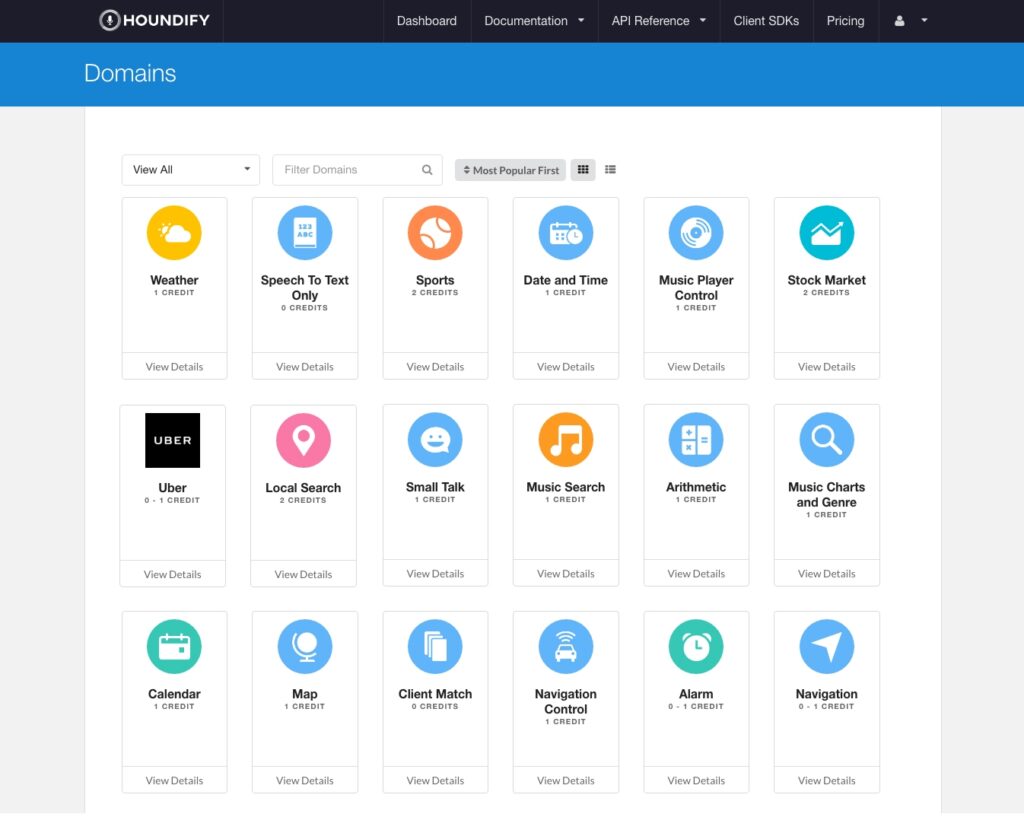
SoundHound provides a comprehensive voice AI developer and enterprise platform, originally launched as Houndify and evolved into SoundHound for Business — a full conversational AI suite for deploying custom voice assistants across applications, devices, and customer service environments. The platform enables businesses to build voice-enabled applications using SoundHound’s proprietary speech recognition, natural language understanding (NLU), and response generation capabilities without building AI infrastructure from scratch.
The platform serves customers across automotive OEMs, quick-service restaurants, hospitality, healthcare, financial services, and retail. Revenue from this segment is primarily recurring — either as annual SaaS contracts or per-query royalties that scale with customer usage, creating strong revenue visibility and retention.

2. SoundHound Chat AI and Voice-Enabled Assistants
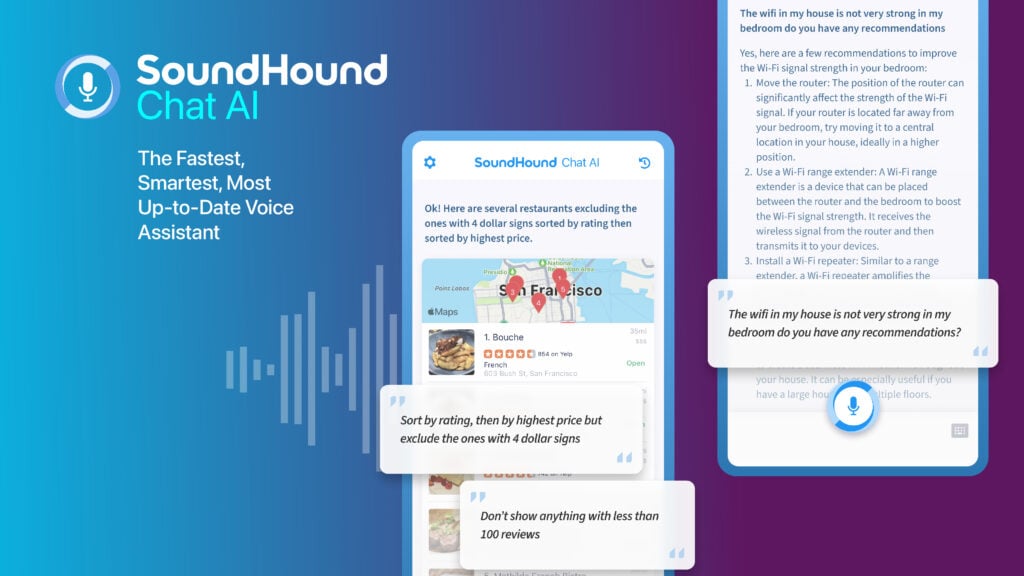
SoundHound offers SoundHound Chat AI — a voice-enabled digital assistant that combines generative AI with SoundHound’s proprietary voice understanding to deliver conversational experiences for consumer and enterprise contexts. Unlike traditional keyword-based voice assistants, SoundHound Chat AI understands full sentences, follow-up questions, and multi-turn dialogue without requiring users to restart queries.
This product powers smart home devices, mobile applications, and in-vehicle assistants. It leverages SoundHound’s proprietary Polaris architecture, which provides on-device and hybrid cloud-edge inference — enabling voice AI functionality even in environments with limited connectivity, a critical feature for automotive deployments where tunnel and underground operation must still function correctly.

3. Music Recognition App — SoundHound
The company’s original flagship product is the SoundHound mobile app, which enables music identification through humming, singing, or playing a song. Unlike its primary competitor Shazam — which requires an existing audio signal — SoundHound can identify a melody even if the user is humming or singing it imperfectly. The app also provides real-time lyrics, song recommendations, and integration with streaming services such as Spotify and Apple Music.
SoundHound monetises this app through advertising partnerships, premium features, and music streaming referral fees. While the music app is no longer the company’s primary revenue driver, it remains a high-awareness consumer product that has reached hundreds of millions of users globally and serves as a brand ambassador for SoundHound’s broader voice AI capabilities. The original Midomi.com web version also remains live.
4. Automotive Voice AI Integration
Automotive represents SoundHound’s largest single industry vertical, accounting for approximately 25% of total company revenue. SoundHound’s technology is deployed in vehicles from Hyundai, Kia, Mercedes-Benz, Honda, and multiple Stellantis brands — including Peugeot, Opel, Alfa Romeo, and Citroën across European and global markets. The company was the first music recognition service integrated into automobiles (Hyundai Genesis, 2015), and has since evolved its automotive offering into a full natural language in-vehicle assistant.
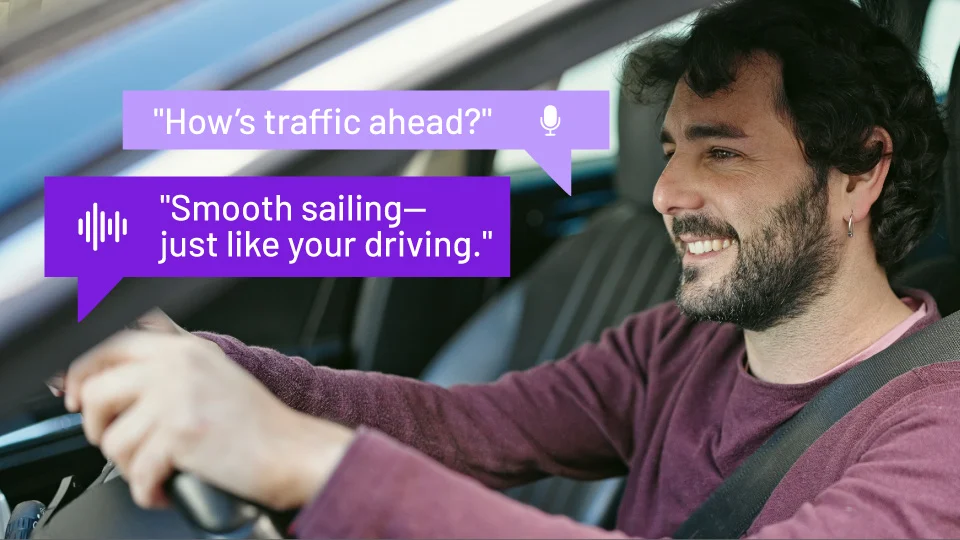
Revenue in this segment comes from licensing and royalty agreements with OEMs, typically structured as multi-year contracts that generate per-vehicle royalties at scale. As SoundHound’s automotive partnerships expand to additional models and markets, the per-vehicle royalty model creates compounding revenue growth without proportional cost increases — one of the most attractive characteristics of the automotive licensing model.
5. Enterprise Agentic AI — Amelia 7 Platform
With the August 2024 acquisition of Amelia Holdings (purchased for $80 million, having raised $189 million from investors including IBM), SoundHound entered the enterprise agentic AI market at scale. Amelia 7 is a low-code / no-code platform that allows enterprises to deploy autonomous AI agents for customer service, workflow orchestration, and process automation across web, mobile, and voice channels.
Amelia 7 has attracted 15 significant enterprise clients who have already migrated to the platform since acquisition, creating upsell opportunities and demonstrating its competitive positioning. The combined SoundHound + Amelia entity now serves over 200 enterprise customers including Fortune 100 companies across financial services, insurance, healthcare, retail, and utilities sectors.


6. Customer Service AI — Interactions Corporation Platform
The September 2025 acquisition of Interactions Corporation ($76.1 million) further extended SoundHound’s enterprise reach into omnichannel customer experience. Interactions Corp. is a pioneer in AI for customer service and workflow orchestration, with a client base including global consumer brands, large technology device companies, insurers, automakers, and Fortune 100 companies across multiple industries.
The integration of Interactions’ technology with SoundHound’s Polaris and Amelia 7 platforms creates a comprehensive enterprise AI stack: SoundHound handles the voice and speech layer, Amelia 7 handles agentic reasoning and decision-making, and Interactions manages the broader omnichannel customer experience workflow. This positions SoundHound as a vertically integrated enterprise AI supplier — a significant differentiation from companies that offer only one layer of the stack.
7. Restaurant Voice AI (SYNQ3 and Allset)
SoundHound entered the restaurant technology vertical with the January 2024 acquisition of SYNQ3 Restaurant Solutions for $25 million, followed by the acquisition of Allset (a restaurant ordering platform) in June 2024. SYNQ3 provides AI-powered phone answering and ordering systems for quick-service restaurants, casual dining chains, and ghost kitchens — automating up to 90% of phone-based order interactions.
This segment reflects SoundHound’s strategy of combining AI voice capability (understanding orders placed in natural language) with business-specific workflow knowledge (menu items, modifications, pricing, location-specific promotions). The result is a voice AI system that can handle the full transaction cycle from greeting to order confirmation — reducing labour costs for restaurant operators while improving order accuracy. SoundHound’s Dynamic Interaction drive-thru technology won the Automation & Self-Service Award for “Best Use of AI” in December 2023, validating the approach.
SoundHound AI’s Acquisition Strategy
A defining feature of SoundHound’s transformation from 2023 to 2025 has been an aggressive but targeted M&A strategy. Each acquisition has added a new vertical, a new customer base, or a new technology capability — building a diversified and defensible enterprise AI platform rather than a single-product company.
| Acquisition | Date | Cost | Strategic Rationale |
| SYNQ3 Restaurant Solutions | January 2024 | $25 million | Restaurant voice AI; phone ordering automation; entry into food service vertical |
| Allset | June 2024 | Immaterial | Restaurant ordering platform; expands restaurant vertical from phone to multi-channel |
| Amelia Holdings | August 2024 | $80 million | Enterprise agentic AI (Amelia 7 platform); 200+ enterprise customers; Fortune 100 access |
| Interactions Corporation | September 2025 | $76.1 million | AI-powered omnichannel customer service; strengthens enterprise stack; major Fortune 100 client base |
Financial Performance of SoundHound AI

Source: SoundHound AI FY2025 Annual Results press release (February 2026); SEC Form 8-K filings; SoundHound AI Investor Relations.
SoundHound AI’s FY2025 performance represents a defining inflection point. Revenue growth of 99% year-over-year is not simply a function of the AI tailwind — it reflects the contribution of acquired businesses (Amelia, SYNQ3) as well as organic growth in the automotive licensing business. The $248 million cash balance with zero debt gives SoundHound significant runway to continue investing in R&D and potential further acquisitions through FY2026 and beyond.
Q4 FY2025’s $40.1 million net income figure warrants context: it was driven primarily by non-cash gains from fair value adjustments on acquisition-related liabilities rather than operating profitability. On an operating basis, SoundHound continues to invest significantly in growth. However, the trajectory is clear: as revenue scales toward the $250M+ range and fixed infrastructure costs remain relatively stable, the path to operating profitability becomes increasingly achievable.
Valuation of SoundHound AI
SoundHound AI’s valuation has been one of the most volatile in the AI sector. At the time of its Nasdaq listing via SPAC merger in April 2022, the company was valued at approximately $2.1 billion. By January 2024 (when the original version of this article was written), its market capitalisation had dropped to approximately $440 million as the post-SPAC revaluation took hold.
The transformation came swiftly. In early 2024, it was revealed that NVIDIA — the world’s most valuable semiconductor company — had quietly accumulated a stake in SoundHound AI. The disclosure triggered a 1,064% surge in SOUN stock through 2024. NVIDIA subsequently divested its position, contributing to a pullback, but the fundamental business improvements underway — accelerating revenue growth, the Amelia and Interactions acquisitions, and expanding automotive contracts — sustained investor interest.
As of mid-2026, SoundHound AI’s market capitalisation is approximately $3.3 billion, with a 52-week trading range of $5.65 to $22.17 per share. At its peak during the AI enthusiasm of late 2024 and early 2025, SOUN exceeded a $4.5 billion valuation.
Key valuation considerations include:
Revenue Growth Rate: At 99% in FY2025, SoundHound is growing faster than nearly all pure-play AI software companies of comparable size. The FY2026 revenue guidance of $225–$260 million implies a continued 33–54% growth rate even as the base scales, which is exceptional for a company of this size.
Path to Profitability: With $248 million in cash and no debt, SoundHound has ample runway. The company’s gross margin profile improves as software and royalty revenue scales faster than the cost of revenue, and the recurring nature of enterprise SaaS contracts provides revenue predictability.
Market Opportunity: The conversational AI market is projected to exceed $500 billion by 2030. SoundHound is one of the few independent players with proprietary speech recognition, NLU, and agentic AI capabilities across automotive, enterprise, and consumer verticals — making it a potential acquisition target or a long-term independent category leader.
Competition Risk: The presence of Google, Amazon, Microsoft, and Apple in the voice AI space remains the most significant long-term valuation overhang. SoundHound’s differentiation through vertical depth (automotive, restaurant, enterprise) and its proprietary technology stack — rather than general-purpose voice APIs — is the primary counterargument to Big Tech displacement.
Competitors of SoundHound AI
SoundHound AI operates across multiple competitive dimensions: music recognition, consumer voice assistants, automotive voice AI, and enterprise conversational AI. Its competitive landscape therefore includes companies ranging from consumer apps to hyperscaler cloud platforms to enterprise software vendors.
1. Shazam


Website: shazam.com
Shazam and SoundHound are both music recognition apps that can identify a song by listening to a short clip. However, the competitive dynamics have evolved significantly. Shazam, now owned by Apple (acquired in 2018 for approximately $400 million), has over 1 billion downloads and benefits from deep integration across iOS and macOS. It is the simpler of the two apps in function — focused on audio fingerprinting of existing recordings — but lacks SoundHound’s ability to identify songs from humming or singing. SoundHound retains a meaningful edge in search capability — particularly for songs that exist only in a user’s head rather than playing in the environment.
However, in SoundHound’s current strategic context, Shazam is no longer the most relevant competitor. SoundHound’s revenue is now driven by enterprise voice AI and automotive rather than music app engagement. The music recognition app serves primarily as a brand awareness and user acquisition channel rather than a primary commercial product. The more meaningful competition now occurs at the enterprise platform and automotive level.
2. Google (Google Assistant / Google Cloud AI)

Website: assistant.google.com
Google poses the broadest competitive threat to SoundHound across multiple product layers. Google Assistant is embedded in most Android phones and smart speakers, with native music recognition through “Hey Google, what’s this song?” directly competing with SoundHound’s app. Google’s Cloud Speech-to-Text and Dialogflow CX compete with SoundHound’s enterprise voice AI platform. And Google’s automotive AI is making inroads through Android Automotive OS — a direct challenge to SoundHound’s licensed in-vehicle assistant business.
Google’s advantages are formidable: unmatched access to training data across Search, YouTube, and Maps; an ecosystem of 3 billion+ Android users; and unlimited engineering resources for AI improvement. Its Gemini large language model integration into both consumer and enterprise products is adding sophisticated conversational capability that narrows the differentiation gap between Google’s general-purpose voice AI and SoundHound’s specialised solutions.
SoundHound’s counterargument is vertical depth: Google offers broad capability while SoundHound offers deep integration with automotive menus, restaurant POS systems, and enterprise workflows. A car manufacturer needs a voice assistant that can deep-dive into vehicle settings, HVAC controls, navigation, and dealer-specific information — a level of customisation that Google’s platform-agnostic approach does not natively provide. For now, that depth advantage sustains SoundHound in the automotive vertical, though Google is investing to close the gap.
3. Nuance Communications (Microsoft)

Website: nuance.com
Nuance Communications — acquired by Microsoft in 2022 for $19.7 billion — is one of SoundHound’s most significant enterprise competitors. Nuance specialises in speech recognition and voice biometrics for enterprise applications including customer service automation, healthcare clinical documentation, and financial services. Its deep integration with Microsoft Azure AI, Teams, and the broader Microsoft 365 ecosystem gives it distribution advantages that are hard to replicate.
Key differences between SoundHound and Nuance/Microsoft:
Target audience: SoundHound targets automotive OEMs, restaurants, and mid-to-large enterprises with voice AI as the primary interaction layer. Nuance/Microsoft targets large enterprises with a broader AI suite where voice is one capability among many within a Microsoft Cloud environment.
Technology focus: SoundHound leads with proprietary on-device voice AI optimised for specific environments (in-vehicle, drive-through). Nuance/Microsoft is strong in cloud-based enterprise transcription, healthcare AI, and compliance-heavy industries.
Market strategy: SoundHound wins through domain specialisation and integration depth. Nuance/Microsoft wins through enterprise IT relationships and the Microsoft distribution moat. Their competitive intersection is most acute in contact centre AI and customer service automation, where SoundHound’s Amelia 7 and Interactions platforms directly compete with Nuance’s Intelligent Engagement solutions.
4. Deepgram


Website: deepgram.com
Deepgram is a developer-focused speech recognition API built on deep learning, offering high-accuracy transcription with extensive customisation options for building voice-powered applications in healthcare, education, media, and enterprise. Unlike SoundHound, Deepgram does not offer pre-built consumer applications or automotive-grade integrations; it is fundamentally a speech infrastructure layer for developers who build their own applications on top.
Deepgram’s competitive advantage lies in its exceptional accuracy, speed, and per-minute pricing model, which makes it accessible to startups and developers. SoundHound’s Houndify platform and enterprise AI stack compete with Deepgram in the developer space, but SoundHound’s natural language understanding layer — which interprets intent, not just transcribes words — positions it at a higher level of the value stack. The two companies are more complementary than directly competing at the product layer, but they compete for developer mindshare and budget when enterprises evaluate speech AI infrastructure.
5. Fano Labs


Website: fano.ai
Fano Labs focuses on creating custom voice-powered solutions for people with disabilities and diverse communication needs, specialising in assistive technology and communication accessibility. Their technology helps users with speech impairments, hearing loss, or developmental differences interact with devices more effectively.
Fano Labs does not directly compete with SoundHound in music recognition, automotive AI, or enterprise customer service. Their competitive intersection exists at the level of voice AI model development, particularly for underrepresented languages and non-standard speech patterns. SoundHound’s Houndify platform supports 100+ languages and is designed to handle accented speech, background noise, and varied speaking styles — capabilities that overlap with Fano Labs’s accessibility mission. However, the two companies operate in largely adjacent rather than directly competing markets.
Other Notable Competitors
Google Cloud Speech-to-Text: Enterprise-grade speech recognition API competing with SoundHound’s voice platform in developer and enterprise contexts.
Amazon Alexa / Alexa for Business: Amazon’s voice AI competes in both consumer smart home and enterprise contexts, with particular strength in retail and logistics workflows.
Cerence: A specialised automotive voice AI company (formerly Nuance’s automotive division, now independent) that is SoundHound’s most direct competitor in the in-vehicle assistant space, with deployments in Toyota, BMW, and GM vehicles.
Kore.ai: An enterprise conversational AI platform competing with SoundHound’s Amelia 7 in the agentic AI and enterprise customer service automation segment.
Otter.ai: Specialises in real-time AI transcription and meeting intelligence, competing with SoundHound’s speech-to-text capabilities in productivity applications.
Microsoft Bing Speech API / Azure Cognitive Services: Part of Microsoft’s broader enterprise AI ecosystem, competing with SoundHound in cloud-based speech processing and enterprise voice applications.
Amazon Lex: AWS-based conversational AI service for building chatbots and voice interfaces, competing with SoundHound’s developer platform in cloud-native environments.
Growth of SoundHound AI
SoundHound AI’s growth story has three distinct chapters.
The first was the 2005–2022 “technology incubation” period in which the company built its core IP, grew its music app to hundreds of millions of users, and made its initial automotive partnerships.
The second was the turbulent 2022–2023 “post-SPAC restructuring” period characterised by staff reductions, a compressed valuation, and a focus on improving unit economics.
The third — and current — is the 2024–2026 “enterprise acceleration” period defined by acquisitions, revenue doubling, and the emergence of SoundHound as a legitimate multi-vertical enterprise AI platform.
1. Revenue Trajectory
The clearest proof of this acceleration is the revenue trajectory. FY2023 revenue of approximately $46 million grew to $84.7 million in FY2024 and then to $168.9 million in FY2025 — a 99% year-over-year increase. Q4 FY2025 alone generated $55.1 million at 59% growth, driven by a record number of enterprise deal closures in the quarter.
The company’s FY2026 guidance of $225–$260 million implies sustained high growth even as the base becomes more substantial.
2. Automotive Expansion
The automotive vertical — SoundHound’s founding commercial strength — has continued to deepen.
The company has expanded its Stellantis partnership across additional European brands including Alfa Romeo and Citroën, moved deeper into Hyundai and Kia’s global vehicle lineup, and is actively integrating its next-generation Chat AI features into in-vehicle systems that were previously limited to music and navigation queries.
Automotive royalties are highly recurring and scale with vehicle production volumes, creating an annuity-like revenue stream that has proven resilient through automotive market cycles.
3. Enterprise Agentic AI
The acquisition of Amelia Holdings in August 2024 was transformational.
With Amelia 7’s enterprise agentic AI platform — which powers autonomous AI agents that can handle complex customer service workflows without human intervention — SoundHound moved from being a voice AI vendor into an enterprise AI software company.
The 15 significant enterprise clients who have already migrated to Amelia 7, and the broader pool of 200+ customers across Fortune 100 companies, give SoundHound a recurring enterprise revenue base that the original Houndify model never achieved at this scale.
4. Restaurant and Customer Service AI
SYNQ3 and Allset have positioned SoundHound as a leader in restaurant voice AI, with phone answering and ordering systems that automate the majority of inbound call volume for restaurant chains.
Combined with the Interactions Corporation acquisition’s enterprise customer service AI, SoundHound now offers end-to-end voice AI automation for the full customer interaction lifecycle in food service — from discovery and ordering to post-purchase support.
5. NVIDIA and Ecosystem Partnerships
SoundHound’s relationship with NVIDIA — which invested in the company in its pre-IPO years and whose public 13F disclosure of ownership triggered the 2024 stock surge — has evolved into a technology partnership.
SoundHound integrates NVIDIA AI Enterprise software to enhance the performance of its voice AI solutions, particularly for on-device inference in automotive contexts where Jetson-based systems are deployed. While NVIDIA subsequently divested its equity position, the underlying technology integration continues and gives SoundHound access to GPU-optimised AI inference infrastructure.
Challenges and Competitive Risks
Despite the momentum, SoundHound faces material challenges. Big Tech competition from Google, Amazon, Apple, and Microsoft remains existential in consumer voice AI — each company has scale, distribution, and data advantages that SoundHound cannot match without vertical specialisation. The path to GAAP operating profitability requires continued revenue scaling, and the company’s history of running at operating losses creates ongoing dilution pressure through equity financing.
Integration risk is also real: three major acquisitions in 18 months (SYNQ3, Amelia, Interactions) must be successfully integrated at the technology, product, and go-to-market levels. Execution of these integrations while sustaining top-line growth requires exceptional management bandwidth. And the automotive industry itself faces cyclical demand fluctuations and a structural shift to software-defined vehicles in which new entrants — including Tesla and Chinese OEMs — may build their own voice AI stacks rather than licensing from third parties.
Frequently Asked Questions (FAQs)
Q1. What does SoundHound AI do?
A: SoundHound AI is a voice and conversational AI company that develops technology enabling machines to understand and respond to human speech. Its products span music recognition (the SoundHound app), enterprise voice AI platforms (Houndify / SoundHound for Business), in-vehicle AI assistants (deployed in Hyundai, Kia, Mercedes-Benz, Honda, and Stellantis vehicles), restaurant phone ordering automation (via SYNQ3), and enterprise agentic AI (via the Amelia 7 platform). The company is publicly listed on Nasdaq under the ticker SOUN. Source: SoundHound AI corporate website; SEC Form 10-K FY2025.
Q2. Who founded SoundHound AI?
A: SoundHound AI was founded in 2005 by Keyvan Mohajer (current CEO, PhD in Electrical Engineering from Stanford), Majid Emami (Co-Founder, PhD in Electrical Engineering from Stanford, holds 16 voice AI patents), and James Hom (Co-Founder and Chief Product Officer, computer science from Stanford). All three founders met at Stanford and were motivated by a shared vision of making natural language interaction with technology as seamless as human conversation. Source: SoundHound AI About page; SEC filings.
Q3. What is SoundHound AI’s revenue?
A: SoundHound AI reported record annual revenue of $168.9 million for fiscal year 2025 (January–December 2025), representing 99% year-over-year growth from $84.7 million in FY2024. Q4 FY2025 alone generated $55.1 million (up 59% YoY). The company has guided for FY2026 revenue of $225 million to $260 million. It ended 2025 with $248 million in cash and zero debt. Source: SoundHound AI FY2025 Annual Results press release, February 2026; SEC Form 8-K.
Q4. What is SoundHound AI’s market capitalisation?
A: SoundHound AI (Nasdaq: SOUN) has a market capitalisation of approximately $3.3 billion as of mid-2026. The stock has a 52-week trading range of $5.65 to $22.17. The company listed via SPAC merger at an initial valuation of approximately $2.1 billion in April 2022. It dropped to approximately $440 million by early 2024, then surged to over $4.5 billion in late 2024 and early 2025 following the revelation that NVIDIA had held a stake, before a subsequent pullback. Source: Nasdaq; companiesmarketcap.com.
Q5. What companies has SoundHound AI acquired?
A: SoundHound has completed four acquisitions: SYNQ3 Restaurant Solutions (January 2024, $25 million) for restaurant voice AI; Allset (June 2024, immaterial amount) for restaurant ordering; Amelia Holdings (August 2024, $80 million) for enterprise agentic AI and the Amelia 7 platform; and Interactions Corporation (September 2025, $76.1 million) for enterprise omnichannel customer service AI. Together, these acquisitions have expanded SoundHound into restaurant technology, enterprise software, and customer experience automation — significantly broadening its revenue base and customer portfolio. Source: SoundHound AI press releases; SEC Form 8-K filings.
Q6. What is SoundHound’s relationship with NVIDIA?
A: NVIDIA invested in SoundHound AI in the pre-IPO period, and the public disclosure of NVIDIA’s stake in early 2024 triggered a dramatic stock price rally (SOUN surged approximately 1,064% in 2024). NVIDIA subsequently divested its equity position in SoundHound, which contributed to a share price pullback. However, the technology partnership between the two companies continues: SoundHound integrates NVIDIA AI Enterprise software to enhance its voice AI platform performance, particularly for GPU-accelerated inference in edge and automotive deployments. Source: Motley Fool; SoundHound AI corporate communications.
Q7. Which automakers use SoundHound AI technology?
A: SoundHound AI’s voice technology is deployed in vehicles from Hyundai, Kia, Mercedes-Benz, Honda, and multiple Stellantis brands including Peugeot, Opel, Alfa Romeo, and Citroën. The company was the first music recognition service integrated into an automobile (Hyundai Genesis, 2015) and has since expanded its in-vehicle product suite to include full natural language Chat AI with on-device inference capability. Automotive accounts for approximately 25% of SoundHound’s total revenue. Source: SoundHound AI corporate announcements; FY2025 earnings call.
Q8. What is Amelia 7 and why did SoundHound acquire it?
A: Amelia 7 is an enterprise agentic AI platform that enables organisations to deploy autonomous AI agents for customer service, workflow automation, and process orchestration across voice, chat, and digital channels using low-code and no-code tools. SoundHound acquired Amelia Holdings for $80 million in August 2024 because it significantly expanded SoundHound’s enterprise capabilities: Amelia’s 200+ enterprise clients including Fortune 100 companies gave SoundHound an immediate enterprise foothold, and Amelia 7’s agentic AI technology complemented SoundHound’s voice recognition stack to create a complete voice-to-action enterprise AI solution. 15 significant enterprise clients have already migrated to the Amelia 7 platform post-acquisition. Source: SoundHound AI / TechCrunch Amelia acquisition announcement; SoundHound AI FY2025 earnings.
Q9. How does SoundHound compete with Google and Amazon in voice AI?
A: SoundHound’s primary competitive strategy against Google Assistant and Amazon Alexa is vertical depth and domain specialisation. Rather than competing as a general-purpose voice assistant — a race it cannot win against companies with 3+ billion user ecosystems — SoundHound focuses on specific use cases where deep integration beats broad capability: in-vehicle control of car functions, menus, and navigation (automotive); full phone-to-order automation for restaurant chains (restaurant AI); and enterprise-specific workflows in financial services, healthcare, and utilities (enterprise AI). Google and Amazon offer breadth; SoundHound offers depth. For OEMs and enterprise clients who need their AI to deeply understand their specific product, workflow, or industry context, SoundHound’s specialisation is a compelling argument.
Q10. What is SoundHound AI’s outlook for future growth?
A: SoundHound AI has guided for FY2026 revenue of $225 million to $260 million, representing 33–54% growth over FY2025’s $168.9 million. Key growth drivers include: continued expansion of automotive partnerships (Stellantis, Hyundai/Kia, and potential new OEM wins); enterprise AI contract growth through Amelia 7 and the Interactions Corp. platform; deeper penetration in restaurant and hospitality via SYNQ3; and incremental revenue from the growing adoption of voice AI across healthcare and financial services. The company’s $248 million cash position provides capital for continued investment and potential M&A. Source: SoundHound AI FY2025 Annual Results; guidance issued February 2026.
Also Read: OutSystems – Founder, Business Model, Funding & Competitors
Conclusion
SoundHound AI’s story is one of the most instructive in the AI sector: a company that spent nearly two decades building genuine technological depth in voice and speech recognition, survived a difficult post-SPAC period, and then executed three major acquisitions at exactly the right moment in the AI adoption cycle to transform itself from a niche music app maker into a multi-hundred-million-dollar enterprise AI platform.
The numbers validate the strategy. Revenue of $168.9 million in FY2025 — up 99% year-over-year — with $248 million in cash and zero debt is not the profile of a company in distress; it is the profile of a company in acceleration. The automotive business provides annuity-like royalty revenue at scale. The Amelia 7 enterprise agentic AI platform gives it Fortune 100 distribution. The Interactions Corporation acquisition deepens its customer service AI moat. And the original SoundHound app continues to remind hundreds of millions of consumers that the brand exists.
The competitive challenge remains real. Google, Amazon, Microsoft, and Apple will not cede voice AI to independent players without a fight, and each has resource advantages that SoundHound cannot match in kind. But SoundHound’s bet — that vertical depth beats horizontal breadth for enterprises that need their voice AI to deeply understand their specific business — has been validated by its customer traction in automotive, restaurants, and enterprise. The next chapter will determine whether that bet scales from $250 million to $1 billion in annual revenue, and whether the company can prove that an independent voice AI specialist can survive and thrive in the age of Big Tech AI dominance.
To read more content like this, subscribe to our newsletter
Go to the full page to view and submit the form.