


In an era defined by software sprawl and mounting technology budgets, a new category of company has emerged to bring order to corporate chaos: the SaaS spend management platform. Among the most compelling stories in this space is Spendbase — a Ukrainian-born startup that turned the adversity of launching during a wartime economy into a powerful origin myth and a laser-sharp product focus. Founded in 2022 and commercially active from early 2023, Spendbase set out to answer a deceptively simple question: why do modern companies keep paying for software nobody uses?
Research consistently shows that organisations waste between 25 and 40 percent of their SaaS budgets on duplicate subscriptions, unused licences, and poorly negotiated vendor contracts. For mid-sized companies this can translate to hundreds of thousands of dollars haemorrhaging out of the business every year — silently, invisibly, and almost entirely avoidably. Spendbase built its entire identity and product philosophy around plugging exactly that leak.
Today, more than 2,000 businesses worldwide — including household names such as Preply, MacPaw, Lemon.io, Provectus, and YouScan — rely on the Spendbase platform to track, govern, and optimise their software and cloud spending. The company has recorded revenue of $11.8 million as of mid-2025, has been backed by Google for Startups among others, and has earned a place on the prestigious Sifted 250 list of Europe’s fastest-growing and most innovative tech ventures. Its story is one of resilience, clarity of purpose, and a business model that only charges customers after delivering real results.
This brand story traces Spendbase’s journey from a bold idea conceived amid extraordinary circumstances to a globally recognised platform reshaping how companies think about software investment.
Founding Story of Spendbase
The story of Spendbase begins in 2022, in the midst of one of the most turbulent periods modern Europe has witnessed. When Russia launched its full-scale invasion of Ukraine in February 2022, the Ukrainian technology ecosystem faced an existential threat. Offices were abandoned, teams were scattered, and the economic uncertainty was overwhelming. It was in this environment — one that would have extinguished most entrepreneurial ambitions — that Andriy Aleksieienko began laying the foundations for what would become Spendbase.
Aleksieienko was no stranger to adversity or to building things from the ground up. As a co-founder of KOLO, Ukraine’s largest volunteer charitable foundation — which has raised over $100 million to support the Ukrainian military — he had already demonstrated an exceptional capacity to mobilise people and resources under pressure. That same DNA of resourcefulness and impact-first thinking permeated Spendbase from its earliest days.
The core insight driving the company was drawn from a very practical pain point. Aleksieienko and his co-founders observed that as companies scaled, their SaaS stacks grew unchecked. Finance teams lacked visibility into what was being subscribed to; IT teams had no single source of truth for licences; and procurement was often reduced to rubber-stamping invoices that arrived at month-end. The result was systemic waste that nobody felt individually responsible for — but that collectively cost businesses dearly.
Spendbase was formally incorporated in 2022 and achieved commercial traction by early 2023. Within its first full year of operation, it had attracted its initial investors, won the Ukrainian stage of the Startup World Cup 2024, and built a client base spanning multiple continents. By 2024, the company had made its first move into the European Union and United States markets, signalling that its ambitions were firmly international from the outset.
The founding narrative is significant not just as backstory but as brand equity. Being built in Ukraine, during wartime, by founders with deep roots in civic leadership gives Spendbase a moral weight that few competitors can match. It is a company shaped by necessity, animated by purpose, and committed to delivering measurable value — because in the environment where it was born, anything less would not have been enough.
Founders of Spendbase
Spendbase was founded by a small but formidable team combining product, technology, and business expertise. The publicly identified lead founder is Andriy Aleksieienko, who serves as CEO. His background spans entrepreneurship, civic leadership, and deep involvement in Ukraine’s technology ecosystem.


| Name | Role | Notable Background |
| Andriy Aleksieienko | CEO & Co-Founder | Co-founder of KOLO charitable foundation (raised $100M+ for Ukraine’s defence); serial entrepreneur with deep roots in Ukrainian tech ecosystem. |
| Co-Founder(s) | Product / Tech Leadership | The broader founding team brings expertise in SaaS product development, financial operations, and B2B go-to-market strategy. |
Aleksieienko’s dual identity — as both a tech entrepreneur and a wartime civic leader — has profoundly shaped the company’s culture. Spendbase prizes transparency, accountability, and impact measurement; values that mirror the operational ethos of the humanitarian work he has led in parallel. The founding team’s collective decision to launch a startup during the most dangerous period in modern Ukrainian history speaks to an appetite for mission-driven risk-taking that resonates powerfully with customers and investors alike.
The company’s 178-strong team, as of early 2026, is distributed across Ukraine and several European markets, reflecting a deliberate strategy to build a globally capable organisation with an authentic Eastern European identity.
Business Model of Spendbase
Spendbase operates on one of the most customer-aligned business models in the enterprise software space: a gain-share or success-based pricing architecture. Rather than charging a flat subscription fee upfront, the platform takes a percentage of the savings it actually delivers to customers. Specifically, Spendbase charges 25 percent of the cost savings it generates — meaning clients are never paying for a promise; they are only paying for a proven result.

This model accomplishes several strategic objectives simultaneously. First, it dramatically lowers the barrier to adoption: there is no risk for the customer in trying the platform, since they only pay once savings materialise. Second, it aligns incentives perfectly — the better Spendbase performs for the customer, the more both parties benefit. Third, it creates a natural, ongoing relationship; as a company’s SaaS stack evolves, Spendbase continues to find new optimisation opportunities, generating recurring value and recurring revenue.

The platform also operates a freemium tier, offering a free-forever plan that gives smaller companies access to core spend visibility features. This serves as a growth lever — companies can discover the value of the product organically before upgrading to full managed services, including procurement negotiations, vendor discounts, and virtual card issuance.
| Model Tier | Target Segment | Revenue Mechanism |
| Free Forever Plan | Small businesses & startups | No charge; serves as top-of-funnel acquisition |
| Gain-Share (Core) | Mid-market companies | 25% of verified savings delivered |
| Managed Procurement | Growth-stage & enterprise | Fee-based vendor negotiation and contract management |
| Virtual Card & Banking | All segments | Interchange fees and financial services margin |
The business model’s genius lies in its simplicity and its trust signal. In a crowded market where SaaS management vendors compete on feature lists, Spendbase competes on outcomes — and puts its own revenue at stake to prove it. This positions the company not as a vendor but as a financial partner, a framing that has proven especially persuasive with CFOs and finance leaders.
Revenue Streams of Spendbase
Spendbase has deliberately diversified its revenue architecture to reduce dependence on any single source while building a progressively stickier product ecosystem. As of 2025, the company reported revenues of $11.8 million, achieved with a team of 107 people — implying a healthy revenue-per-employee ratio indicative of an efficient, scalable operation.
| Revenue Stream | Description | Est. Contribution |
| SaaS Savings Commission | 25% of savings generated through subscription optimisation, licence rightsizing, and renewal negotiations. | Primary |
| Cloud Credit Procurement | Margin earned by securing AWS, GCP, and Azure cloud credits at discounted rates and passing partial savings to clients. | Secondary |
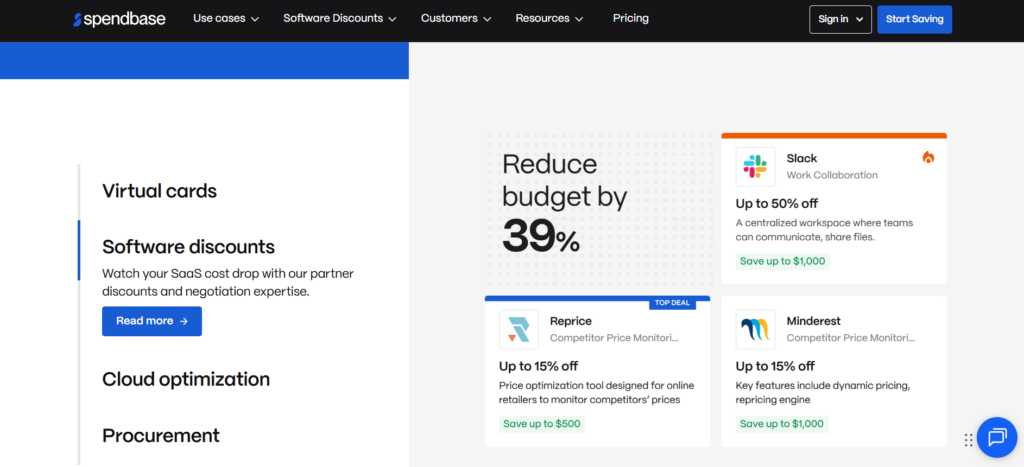
| Vendor Discount Facilitation | Commission from software vendors for routing buyer demand; clients receive discounts, vendors gain qualified leads. | Growing |
| Virtual Card & Fintech Services | Interchange fees on corporate virtual card spend; cashback sharing with clients. | Emerging |
| Managed Procurement Retainer | Fixed advisory fee for ongoing contract management and vendor lifecycle services for enterprise accounts. | Emerging |
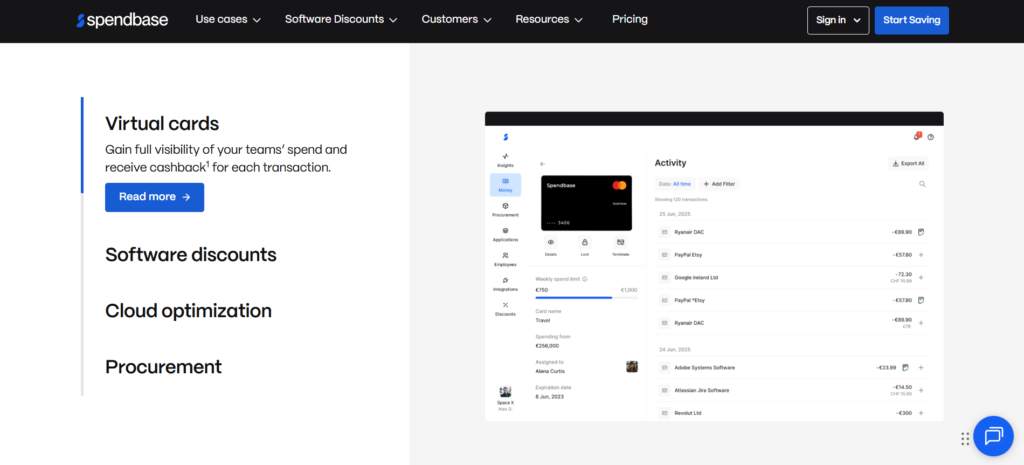
The most strategically exciting of these streams is the virtual card and banking suite, launched as an expansion in 2024–2025. By issuing Spendbase-branded virtual cards tied directly to the platform’s spend tracking engine, the company transforms itself from a cost-reduction tool into an integral piece of the corporate financial stack. Every transaction made on a Spendbase card feeds real-time data back into the platform’s analytics layer, enriching the intelligence available to finance teams and deepening the product’s moat. The longer-term vision — a full financial operating system for businesses — would see Spendbase competing not just with SaaS management tools but with corporate banking platforms, ERP systems, and fintech infrastructure providers.
Funding Overview of Spendbase
Spendbase has pursued a lean but strategically assembled funding strategy, raising capital from investors who bring not just money but meaningful market access and credibility. The company’s total funding stands at approximately $510,000 in equity rounds, supplemented by grants and programme support that have provided both capital and institutional endorsement. While the absolute dollar figure is modest by Silicon Valley standards, it is remarkable context: Spendbase has built an $11.8 million revenue business on capital efficiency that most Western startups would envy.
The composition of Spendbase’s investor base is telling. The presence of Google for Startups as an investor — via its Ukraine Support Fund — provides brand validation of the highest order. Startup Wise Guys, one of Central and Eastern Europe’s most active early-stage accelerators, brings a network of portfolio companies that serve as both customers and distribution channels. TMT Investments adds a publicly-listed investment vehicle with appetite for high-growth technology companies. The involvement of Glovo Startup Lab connects Spendbase to one of Europe’s most successful marketplace ecosystems, opening doors across the continent. The more recent investment from Dnipro VC, announced in August 2025, signals continued confidence in the company’s trajectory and its ability to scale internationally.
Funding Rounds of Spendbase
| Round | Date | Amount | Key Investors / Notes |
| Pre-Seed | 2023 | Undisclosed | TMT Investments; initial bootstrapping by founding team. |
| Accelerator / Grant | 2023 | €50,000 | Seeds of Bravery grant programme supporting Ukrainian tech founders. |
| Accelerator | 2023 | Undisclosed | Startup Wise Guys Growth Ukraine programme. |
| Accelerator | 2023–24 | Undisclosed | Glovo Startup Lab — access to Glovo’s operator network and EU market. |
| Grant | Jun 2024 | $100,000 | Google for Startups Ukraine Support Fund — cash grant plus Google Cloud credits and mentorship. |
| 4YFN Award | 2024 | Prize | 4 Years From Now competition at MWC Barcelona — added international visibility. |
| Seed / Strategic | Aug 2025 | Undisclosed | Dnipro VC — Ukraine-focused fund; validates continued domestic and diaspora investor confidence. |
A central narrative thread running through Spendbase’s funding history is the deliberate cultivation of strategic value beyond the cheque. The Google for Startups investment, for example, arrived with cloud credits that directly reduced Spendbase’s own infrastructure costs — a fitting irony for a company that helps others do exactly the same. The accelerator programmes provided structured go-to-market coaching, peer networks, and credibility in Western European investor circles that would have otherwise taken years to build organically. The Startup World Cup 2024 win — representing Ukraine at the global final — added a media profile that no marketing budget could easily replicate.
This approach to capital raises — smaller amounts from investors with high strategic multipliers — reflects the capital-efficient DNA of a company built in a resource-constrained environment. It also means that Spendbase retains significant equity headroom for a larger institutional round as it pursues its European and North American expansion ambitions.
Competitive Landscape of Spendbase
The SaaS spend management market is one of the fastest-growing segments within the broader enterprise software ecosystem, attracting well-funded players from the United States, Europe, and increasingly Asia. Spendbase operates in a market that analysts estimate will exceed $10 billion globally by the late 2020s. Understanding the competitive landscape is essential to appreciating where Spendbase has carved its differentiated position.
| Competitor | HQ | Key Strength | Pricing Model | Free Tier? |
| Zylo | Indianapolis, USA | Deep enterprise analytics; large Fortune 500 client base | Annual subscription | No |
| Torii | New York, USA | Automated app discovery; IT workflow automation | Subscription (tiered) | Trial only |
| Zluri | San Francisco, USA | Security & compliance focus; identity governance | Subscription | Trial only |
| Spendflo | San Francisco, USA | Procurement negotiation; buying group leverage | Subscription + success fee | No |
| BetterCloud | New York, USA | SaaS security, governance & workflow automation | Subscription | No |
| AlphaSaaS | India / USA | Fastest implementation (6 min); mid-market focus | Freemium + subscription | Yes |
| Spendbase | Ukraine / EU / USA | Gain-share model; vendor discounts; virtual cards; free tier | 25% of savings (success-based) | Yes (Forever) |
The majority of established players target large enterprise accounts with complex pricing structures and lengthy implementation timelines. Spendbase deliberately targets the underserved mid-market segment — companies with 50 to 5,000 employees — where the pain is acute, the decision-making is faster, and the ROI is immediately visible. This positioning allows Spendbase to avoid direct head-to-head battles with better-funded incumbents while building a dominant position in a segment that will eventually grow into the enterprise tier.
Competitive Advantage of Spendbase
Spendbase’s competitive advantage is multi-layered and reinforcing. No single feature differentiates the company; rather, it is the combination of commercial model, product depth, distribution strategy, and brand authenticity that creates a moat difficult for rivals to replicate.
1. Success-Based Pricing — The Trust Moat
The 25-percent gain-share model is Spendbase’s most powerful differentiator. In a market where buyers are increasingly sceptical of software ROI promises, a vendor that only earns revenue when it delivers savings is making a fundamentally different value proposition. This pricing architecture eliminates procurement risk for the buyer, dramatically accelerates sales cycles, and generates word-of-mouth advocacy from satisfied CFOs — a notoriously hard-to-impress audience.
2. Freemium-to-Premium Funnel
Spendbase is one of the very few players in its category offering a free-forever plan. This is not a charity offering; it is a deliberate product-led growth strategy. Smaller companies adopt the platform at zero cost, discover the value of spend visibility, and naturally graduate to paid services as their complexity and savings opportunities grow. This creates a self-filling pipeline that reduces customer acquisition costs and improves lifetime value ratios.
3. Integrated Vendor Discount Network
Unlike pure SaaS management tools that only analyse spending, Spendbase has built an active marketplace capability: it can negotiate software discounts directly with vendors on behalf of clients. This network effect strengthens over time — the more companies Spendbase represents in negotiations, the greater its collective buying power, and the better the discounts it can secure. Clients of Spendbase have reported first-year savings averaging $150,000 for mid-sized accounts, a figure that is compelling in any economic climate.
4. Embedded Fintech Layer
The launch of virtual cards and the announced ambition to build a full financial operating system creates a second competitive moat entirely. As corporate card transactions flow through Spendbase-issued cards, the platform accumulates proprietary spend data that no competitor can access. This data advantage compounds over time, enabling increasingly sophisticated AI-driven recommendations, anomaly detection, and budget forecasting — capabilities that are extremely difficult to replicate without the underlying transaction data.
5. Brand Authenticity & ESG Narrative
In an increasingly values-conscious enterprise buying environment, Spendbase’s origin story — built in wartime Ukraine by a founder who simultaneously led a $100 million humanitarian foundation — resonates at a level that no marketing campaign can manufacture. Customers who choose Spendbase are, in a small way, supporting a company that embodies resilience, purpose, and impact. This soft advantage translates into measurable commercial outcomes: stronger customer loyalty, higher advocacy rates, and a media profile that amplifies every product launch.
Products & Services of Spendbase
Spendbase has evolved from a single-purpose subscription tracker into a comprehensive spend intelligence and financial management platform. Its product suite in 2025–2026 spans four core capability pillars.
| Product / Feature | Description | Key Benefit |
| SaaS Discovery & Tracking | Automatically detects all active software subscriptions across the company, including shadow IT, via SSO and financial data integrations. | Eliminates blind spots; full visibility in hours. |
| Licence Optimisation | Analyses usage patterns to identify unused, underused, and duplicate licences. Flags renewals 60–90 days in advance for renegotiation. | Average 25–35% reduction in SaaS spend. |
| Procurement & Vendor Negotiation | Spendbase negotiates directly with software vendors using collective buying power. Supports linear and branched approval workflows. | Better contract terms; faster procurement cycles. |
| Cloud Credit Procurement | Sources AWS, GCP, and Azure credits at below-market rates, passing savings to clients while earning a margin. | Significant cloud cost reduction for tech-heavy companies. |
| Expense Approval & Budgeting | Automated approval workflows with customisable rules, budget controls, and real-time spend alerts. | Prevents budget overruns; enforces spend governance. |
| Virtual Cards & Banking | Spendbase-issued virtual cards with per-vendor spending limits, cashback, and real-time transaction categorisation. | Closes the loop between authorisation and payment. |
| Analytics & Reporting | Centralised spend dashboard with vendor benchmarking, trend analysis, and ROI reporting for finance and IT leadership. | Data-driven decisions; board-ready reporting. |
| GroüHub Banking Integration | Partnership with GroüHub to simplify EU company banking for global founders — embedded banking services accessible via the Spendbase platform. | One-stop financial hub for EU-operating businesses. |
The product roadmap signals an ambitious trajectory. Spendbase has publicly committed to building treasury management capabilities, settlement automation, and deep accounting integrations — moves that would position it squarely in competition with platforms like Airbase, Brex, and Ramp in the corporate spend management space. The company’s strategic logic is clear: every additional financial workflow that migrates onto the Spendbase platform deepens switching costs, increases data richness, and expands the revenue surface area. By the time a mid-market CFO is managing SaaS licences, cloud credits, vendor contracts, virtual cards, and treasury operations from a single Spendbase dashboard, the platform has become mission-critical infrastructure — not a discretionary add-on.
The GroüHub partnership, announced in 2025, is a particularly shrewd move for a company with European expansion ambitions. EU banking compliance is notoriously complex for non-EU companies. By partnering with a specialist rather than attempting to build EU banking capabilities in-house, Spendbase accelerates its time-to-value for European customers while conserving the engineering resources to focus on core product differentiation.
Conclusion
The story of Spendbase is, at its heart, a story about the power of problem clarity. In a world of increasingly complex enterprise software landscapes, the company identified a single, painful, expensive, and universal problem — corporate software waste — and built its entire identity, product, and commercial model around solving it in the most customer-aligned way possible. The result is a company that has achieved $11.8 million in revenue from a standing start in 2023, attracted backing from Google, TMT Investments, and Dnipro VC, earned recognition as one of Europe’s fastest-growing tech ventures, and built a client community of more than 2,000 businesses across 90-plus countries.
What makes Spendbase genuinely remarkable is not any single achievement but the coherence of its entire narrative. The founding story — born in wartime Ukraine, led by a humanitarian entrepreneur — perfectly primes the value proposition of a company committed to helping businesses eliminate waste. The gain-share business model perfectly embodies the founder’s ethos of delivering real impact before claiming reward. The freemium-to-premium funnel perfectly matches a company that leads with generosity and earns trust through demonstrated results. Each element of the Spendbase brand reinforces every other element, creating a flywheel that grows stronger with every new customer and every dollar of savings delivered.
Looking ahead, the company faces the classic challenges of a high-growth startup: scaling go-to-market operations in geographically diverse markets, maintaining product velocity as the team grows, and managing the complexity of adding fintech capabilities to a SaaS management core. The European and North American markets represent enormous opportunities but also formidable competition from better-capitalised incumbents. Spendbase’s answer to these challenges — its capital efficiency, its outcome-based model, and its authentic brand — will be tested more rigorously as it competes at greater scale.
But if the first three years of Spendbase’s existence have demonstrated anything, it is this: adversity does not diminish this company — it sharpens it. Built during a war, scaled on minimal capital, recognised by the world’s most discerning investors and fastest-growing customer communities, Spendbase is not merely a SaaS management platform. It is proof that when purpose, product, and people align, extraordinary outcomes are not just possible — they are inevitable. The next chapter of the Spendbase story is likely to be the most compelling yet.
Also Read: LinearB – Founders, Business Model, Funding & Competitors
To read more content like this, subscribe to our newsletter
Go to the full page to view and submit the form.