


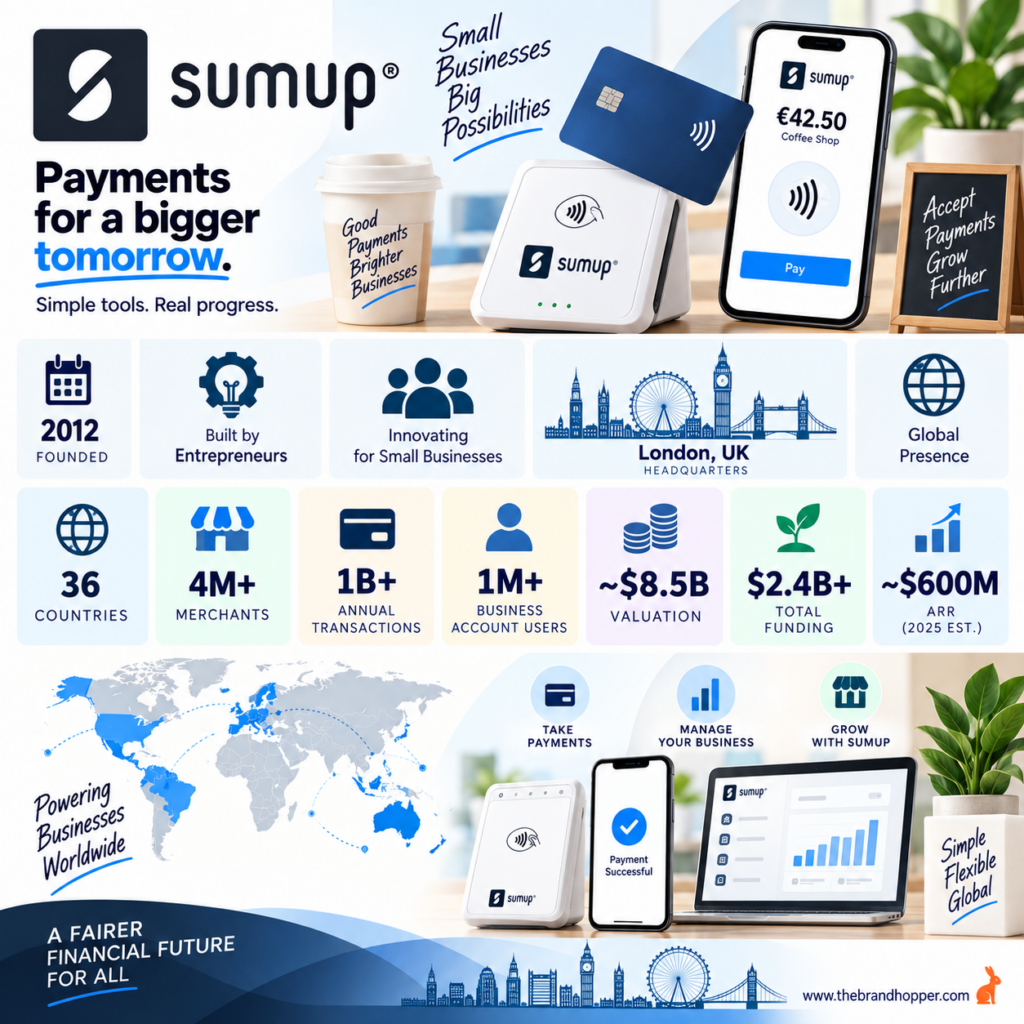
SumUp is a global fintech company on a mission to empower small businesses with simple, affordable, and powerful payment and financial tools. Founded in 2012, the company has grown from a single card reader into a comprehensive financial ecosystem — processing over 1 billion transactions annually and serving more than 4 million merchants across 36 countries.
What began as a solution to a very specific problem — the complexity and high cost of card payment acceptance for small businesses — has evolved into one of Europe’s most valuable private fintech companies. SumUp holds a valuation of approximately $8.5 billion and has raised $2.4+ billion in total funding, backed by the likes of Goldman Sachs, BlackRock, Bain Capital, and Apollo Global Management.
SumUp is EBITDA-positive (since Q4 2022) and has reached positive operating cash flow — a meaningful milestone that distinguishes it from many growth-stage fintechs. Today, its product ecosystem spans card readers, business accounts, point-of-sale software, cash advances, online payments, kiosks, and AI-assisted merchant support — all designed to help small business owners start, run, and grow.

Founding History of SumUp
The story of SumUp begins with a simple frustration shared by small business owners everywhere. In 2012, four entrepreneurs — Daniel Klein, Jan Deepen, Marc-Alexander Christ, and Stefan Jeschonnek — recognized that millions of small businesses were being left behind by traditional payment infrastructure. Accepting card payments required expensive POS terminals, lengthy contracts with merchant banks, and technical expertise that many small traders simply didn’t have.
The founders saw a different future: a world where any merchant — whether a market stall vendor, a plumber, or a small café owner — could accept card payments using just their smartphone and an inexpensive card reader. This vision gave rise to SumUp, which officially launched in 2012 and within a year expanded into the UK, Germany, and Austria.
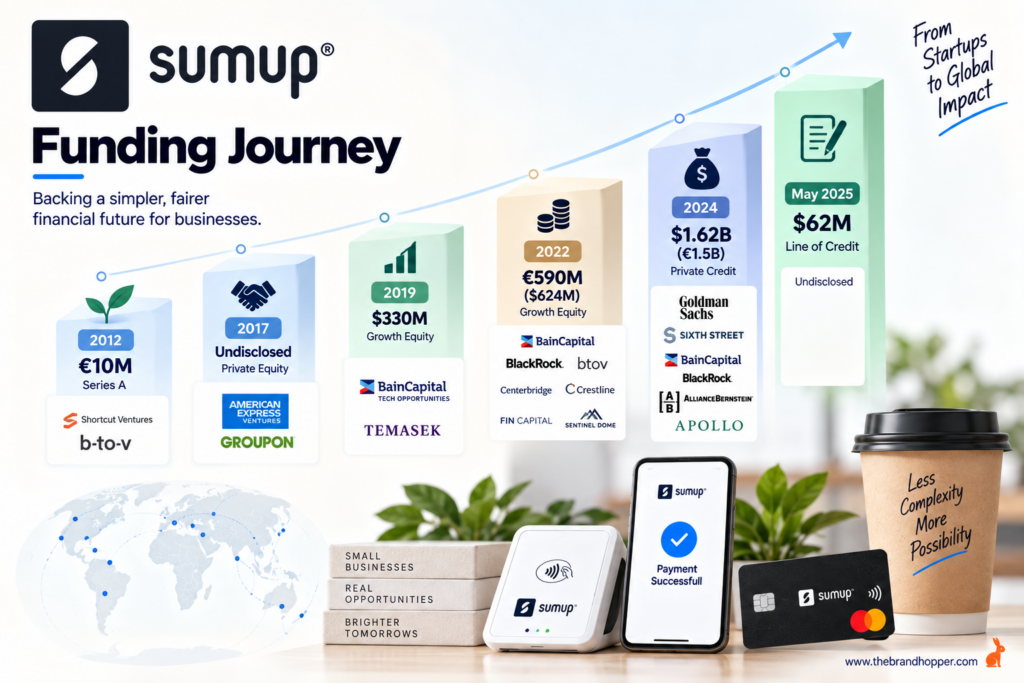
The company raised €10 million in a Series A funding round in 2012, led by Shortcut Ventures and b-to-v Partners. This initial capital funded product development, hardware manufacturing, and the team needed to begin European expansion. The core product — a compact Bluetooth card reader that turned any smartphone or tablet into a payment terminal — was deliberately simple, affordable, and contract-free.
SumUp’s early growth was driven by word of mouth among small business communities. Merchants loved the product because it required no monthly fee, no lengthy setup, and charged only a flat transaction fee per payment. This transparent, merchant-friendly pricing stood in sharp contrast to the opaque fee structures of traditional payment processors.
By 2016, SumUp was active across multiple European markets and had begun expanding into Latin America. The company steadily broadened its product offerings, adding online payment capabilities, invoicing tools, and integrations with e-commerce platforms. Strategic acquisitions — including Goodtill (point-of-sale software), Tiller Systems (restaurant POS), and Fivestars (loyalty and customer engagement) — added capabilities that extended SumUp well beyond card readers.
A landmark moment came in 2022, when SumUp — by then a financial partner for over 4 million small businesses — raised a €590 million ($624 million) funding round that valued the company at approximately €8 billion ($8.5 billion). The round was led by Bain Capital Tech Opportunities, with participation from BlackRock, btov Partners, Centerbridge, Crestline, Fin Capital, and Sentinel Dome Partners. This funding validated SumUp’s decade of disciplined growth and its unique position serving small merchants at global scale.
In 2024, SumUp secured its most significant financing to date: a $1.62 billion (€1.5 billion) private credit facility, led by Goldman Sachs and supported by Sixth Street Growth, Bain Capital Tech Opportunities, BlackRock, AllianceBernstein, and Apollo Global Management. This financing — not a traditional equity round — gave SumUp significant capital for continued growth while preserving the ownership structure of existing shareholders. The company also reached another key milestone in 2024: processing over 1 billion transactions on an annual basis.
Today, SumUp’s founders still guide the company with their original mission intact: to democratize commerce by giving every small business access to the financial tools it needs to thrive. The company continues to expand geographically, deepen its product ecosystem, and explore strategic M&A opportunities as it positions itself as a long-term consolidator in the global fintech space.
SumUp Products & Services
What began as a single card reader has grown into a comprehensive, multi-pillar financial ecosystem. SumUp’s product portfolio now spans hardware, software, financial services, and merchant support — all integrated within the SumUp app and dashboard. At its annual Beacon event in April 2025, SumUp unveiled its most significant product expansion to date.

Payments & Card Readers
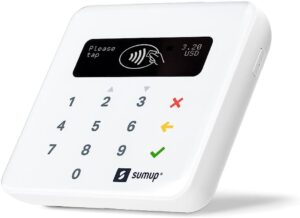
SumUp’s card readers remain the entry point for most merchants. The product line has expanded from the original compact Bluetooth reader to a full family of devices. The SumUp Solo is the company’s most advanced card reader, supporting payment processing in under three seconds, pre-set price management, integrated tipping, printed receipts, offline payments, and API/SDK integration with existing POS systems. The Solo Lite offers a budget-friendly alternative with long battery life, compatible with all SumUp tools.
In 2025, SumUp launched its own in-house Tap to Pay solution for Android — a significant engineering achievement. Unlike iOS Tap to Pay (which relies on Apple’s NFC infrastructure), Android’s fragmented device ecosystem requires a proprietary solution to work reliably across thousands of phone models. SumUp built its own technology to deliver better card detection, PIN support, higher transaction success rates, and no upfront costs. The solution supports MasterCard, Visa, Amex, Discover, Elo, and EftPos, and is rolling out across Europe, Brazil, and expanding to Chile, Colombia, Peru, the US, and Australia.
Point of Sale (POS) Software
SumUp offers a tiered POS software suite. POS Free is the entry-level starter solution available at no cost. POS Plus — launched in 2025 — targets growing retailers, restaurants, and beauty salons with features including PIN-based employee profiles, one-tap promotions, kitchen order management, and stock alerts. POS Pro is the enterprise-grade solution for businesses with advanced operational complexity.
SumUp’s Kiosk product enables self-service ordering for quick-service restaurants and cafés, reducing staff burden and improving throughput. The Kiosk is already deployed in the UK, France, Germany, Switzerland, Spain, and Italy, with additional markets planned. The Kitchen Display System (KDS) — launched in 2025 — is a digital solution that replaces paper order tickets, giving kitchen staff a real-time view of all incoming orders from POS and Kiosk systems combined.
Business Account & Financial Services
SumUp’s Business Account is a free business current account available across Europe and Brazil. Over 1 million merchants now use SumUp Business Account — a milestone that reflects the product’s rapid adoption and the company’s successful transition from single-product hardware company to multi-product financial services provider.
SumUp Business Account Plus — launched in April 2025 — adds features for businesses with more complex needs: multiple balances, the ability to issue and track several cards, and bulk transfers. This upgrade targets growing businesses that have outgrown basic account features but don’t yet need a full corporate banking relationship.
SumUp Cash Advance provides qualified merchants with fast, flexible, and transparent funding, available directly through the SumUp App. Merchants can access working capital based on their SumUp payment history, without the lengthy applications required by traditional banks. Cash Advance is available in Brazil, the UK, Germany, France, Ireland, and the Netherlands, with Spain, Poland, Belgium, and Italy being added in 2025.
Merchant Support & AI Tools
SumUp has deployed AI-assisted merchant care to handle 40% more support interactions, reducing wait times and improving resolution rates. This system is live across all EU markets, Brazil, and Latin America. Priority Support — available to Plus subscribers or merchants with complex needs — offers 24/7 access to live agents, fast-track urgent issue resolution, and unlimited device warranty.
Business Model of SumUp

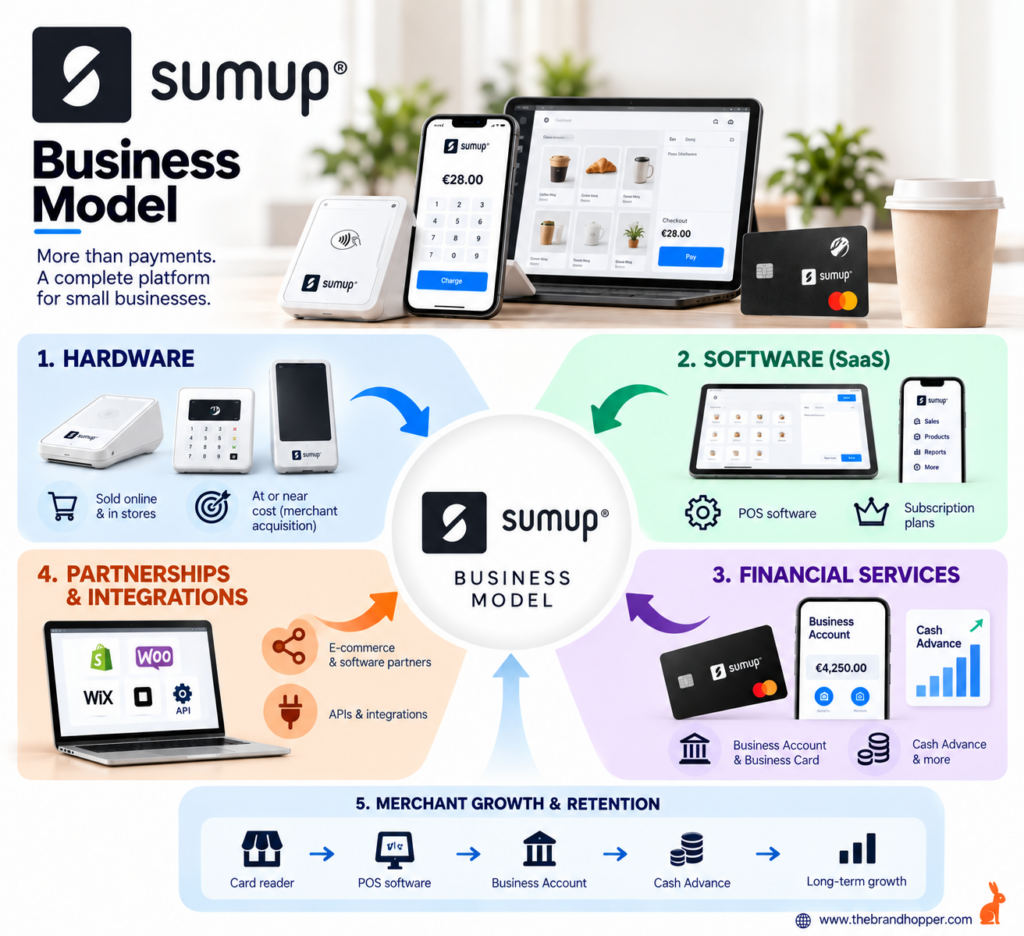
SumUp operates a platform business model built on three interconnected pillars: payment processing, software (SaaS), and financial services. Each pillar reinforces the others — a merchant who starts with a card reader is naturally introduced to the POS software, then to the Business Account, and eventually to Cash Advance and other financial products. This multi-product flywheel drives both revenue growth and customer retention.
Hardware and Software Sales
SumUp sells its card readers directly to merchants, either online or through authorised resellers. Card reader pricing varies by model — from the entry-level Air reader to the advanced Solo terminal. The hardware itself is typically sold at or near cost, since the primary goal is merchant acquisition. Once a merchant has a SumUp device, the ongoing transaction fees, software subscriptions, and financial services generate the long-term revenue.
Beyond hardware, SumUp generates software revenue through its POS software tiers (POS Plus, POS Pro) and through the SumUp One subscription — formerly SumUp Plus — which bundles lower transaction fees, priority support, and extended hardware warranties. This SaaS component of the business provides predictable, recurring revenue that grows with merchant adoption of advanced features.
Transaction Fee Model
The core of SumUp’s revenue model is its per-transaction fee. Every time a customer pays a merchant using SumUp, SumUp charges a percentage of the transaction value. The standard transaction fee in the UK and most European markets is 1.69% per transaction for card-present payments. This flat-rate, transparent pricing is one of SumUp’s key differentiators — merchants always know exactly what they will pay with no surprise charges or monthly minimums.
As SumUp’s merchant base grows and as those merchants process more volume, transaction revenue scales proportionally. With over 1 billion transactions processed annually, even a modest average transaction fee translates into very substantial revenue. The transaction fee model is durable, scalable, and directly aligned with merchant growth — the more a merchant’s business grows, the more SumUp earns.
Financial Services Revenue
SumUp’s expansion into financial services — Business Account, Business Card, and Cash Advance — opens new, high-margin revenue streams. Business Account monetization includes interchange fees from card transactions made on SumUp Business Cards, interest income on float (merchant balances held in the account), and premium subscription fees for Business Account Plus.
Cash Advance generates revenue through a factor rate model: SumUp provides a lump sum to qualified merchants, who repay it through a fixed percentage of future card sales processed via SumUp. This model aligns SumUp’s repayment with merchant cash flow, reducing default risk while generating meaningful net interest income.
Partnerships and Integrations
SumUp forms partnerships with e-commerce platforms, financial institutions, and third-party software providers to extend its reach. Revenue from these partnerships may include referral fees, revenue-sharing arrangements, and API licensing for companies that embed SumUp’s payment infrastructure into their own products. SumUp’s Tap to Pay Android SDK, for example, is available to third-party developers who want to add contactless payment functionality to their apps — a potential B2B revenue stream beyond direct merchant relationships.
Multi-Product Ecosystem and Cross-Selling
SumUp’s most powerful business model advantage is its ecosystem. Each product creates a hook that draws merchants deeper into the SumUp platform. A merchant who uses Cash Advance is more likely to keep their payment volume on SumUp — and less likely to switch to a competitor — because doing so would affect their Cash Advance repayments. A merchant using SumUp’s Business Account consolidates their financial management in one place, increasing switching costs further.
This integrated ecosystem approach is validated by the data: over 1 million merchants now use SumUp Business Account as an additional product alongside their payment solution. As more merchants adopt multiple SumUp products, the company’s revenue per merchant increases, retention improves, and its net revenue retention rate strengthens — all hallmarks of a high-quality SaaS and financial services business.
Revenue Streams of SumUp
SumUp generates revenue across five distinct but interconnected streams. Together, these streams produce an estimated ~$600 million in annual recurring revenue and have supported the company’s path to EBITDA profitability.
1. Hardware Sales
SumUp earns revenue from the direct sale of its card reader hardware. The product line spans from the entry-level Air reader to the feature-rich Solo and Solo Lite. Hardware is sold primarily through SumUp’s own website and app in each country, with select distribution through authorised resellers. While hardware margins are modest, hardware sales drive merchant acquisition and serve as the gateway to higher-margin recurring revenues.
2. Transaction Fees
Transaction fees are SumUp’s largest and most important revenue stream. SumUp charges a percentage-based fee on every card payment processed through its platform — typically 1.69% in European markets, though rates vary by country and payment type. With 1+ billion transactions processed annually, this stream generates the bulk of company revenue and scales naturally as both the merchant count and per-merchant volume grow.
3. Software Subscriptions (SaaS)
SumUp’s subscription products include POS Plus, POS Pro, SumUp One, Business Account Plus, and Priority Support plans. These subscriptions generate monthly or annual recurring fees and provide merchants with capabilities beyond those included in the free tier. The SaaS component of SumUp’s revenue is growing rapidly as more merchants graduate from basic card-reading to advanced multi-function platform users.
4. Financial Services Revenue
Revenue from SumUp’s financial services arm includes net interest income from Cash Advance (the spread between the cost of capital and the effective rate charged to merchants), interchange revenue from SumUp Business Card transactions, and fees on Business Account Plus. This stream is still developing relative to the payments business, but represents significant long-term revenue potential as SumUp expands Cash Advance into new markets.
5. Partnerships, Integrations & Currency Conversion
SumUp earns additional revenue through its partner ecosystem and currency conversion services. Currency conversion fees apply when merchants process payments in foreign currencies. Partner and integration revenue comes from API licensing, white-label payment solutions, and revenue-sharing arrangements with platforms and financial institutions that integrate SumUp’s payment infrastructure into their own products. This stream positions SumUp as a payments infrastructure provider — not just a consumer product.
SumUp Funding History

Key Acquisitions & Strategic Partnerships
SumUp has used strategic M&A to rapidly expand its product capabilities beyond payments. Rather than building every feature from scratch, the company has acquired best-in-class software businesses and integrated them into its ecosystem:
Goodtill
Goodtill was a UK-based cloud POS system for retail and hospitality businesses. The acquisition gave SumUp an established, sophisticated POS platform that it integrated into its broader software offering. Goodtill’s existing merchant base provided immediate cross-selling opportunities for SumUp’s hardware and financial services products.
Tiller Systems
Tiller Systems was a leading French restaurant management POS platform. The acquisition strengthened SumUp’s food and beverage vertical significantly, adding table management, menu engineering, and kitchen order features that underpinned the subsequent launch of SumUp’s own Kitchen Display System (KDS) and restaurant POS offering.
Fivestars
Fivestars was a US-based loyalty and customer engagement platform serving tens of thousands of small businesses. The acquisition gave SumUp a CRM and loyalty capability that its competitors lack at scale, enabling merchants to build customer relationships and drive repeat visits — not just process payments. Fivestars significantly expanded SumUp’s US presence.
Global Footprint — 36 Markets and Growing
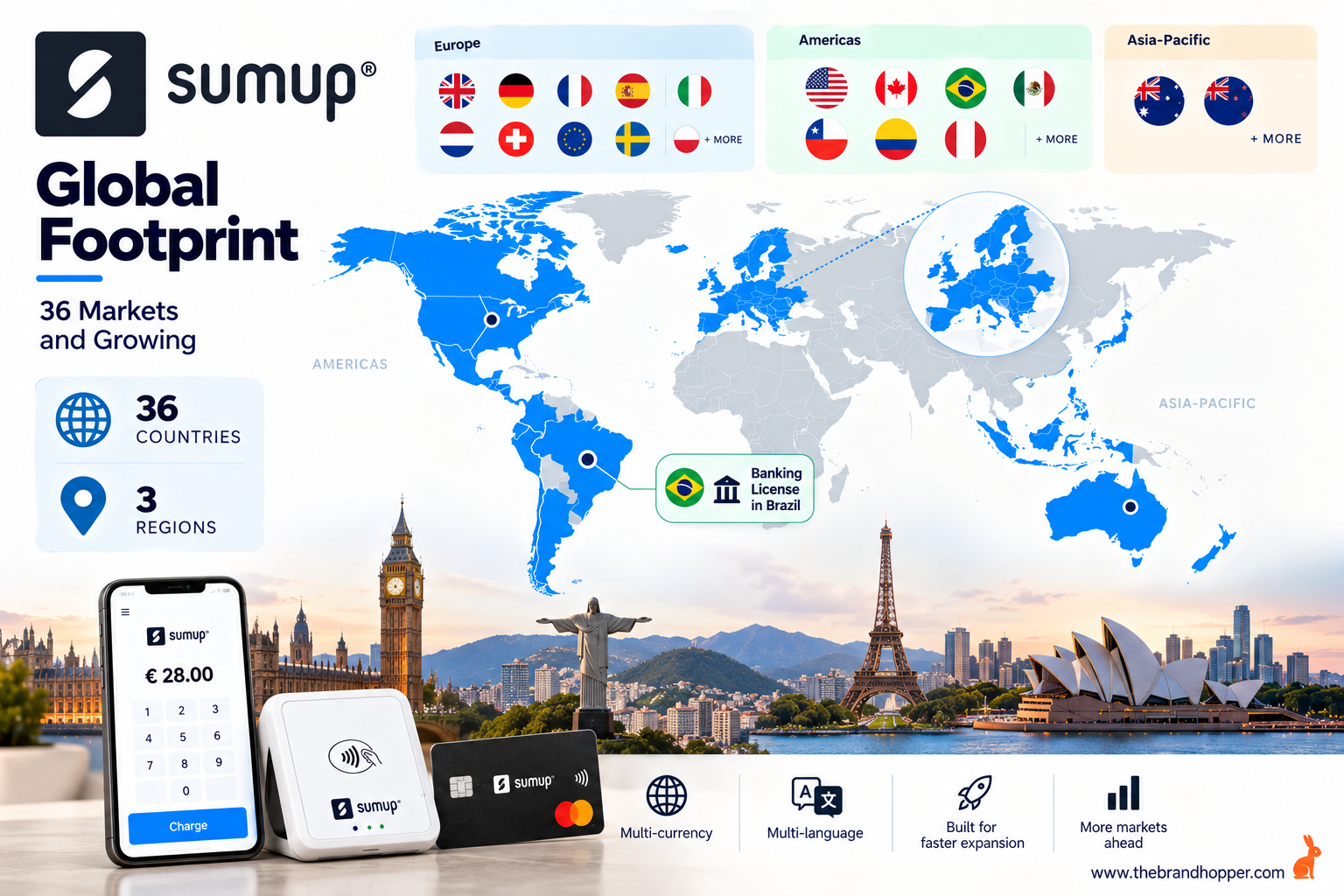
SumUp operates in 36 countries across Europe, the Americas, and Asia-Pacific — making it one of the most geographically diversified fintech companies in the world. Its European core covers major markets including the UK, Germany, France, Spain, Italy, Netherlands, and Switzerland, plus all major EU member states. In Latin America, SumUp has built particularly strong operations in Brazil — where it holds a licensed banking authorization — as well as Mexico, Chile, Colombia, and Peru.
The Americas expansion has accelerated significantly, with SumUp entering Canada and growing its US presence (bolstered by the Fivestars acquisition). Australia and New Zealand represent SumUp’s Asia-Pacific beachhead, with more APAC markets planned. The company’s multi-currency, multi-language platform architecture is purpose-built for rapid market entry, allowing SumUp to launch in a new country far more efficiently than building a domestic fintech from scratch.
In Brazil specifically, SumUp has obtained a banking license — allowing it to offer regulated financial services including business accounts and Cash Advance directly to merchants. This regulatory capability, replicated in European markets through its UK and EU payment institution licenses, gives SumUp the infrastructure to deliver a full financial services proposition rather than just payment acceptance.
SumUp’s IPO timeline has been a topic of investor interest. As of 2024-2025, management has confirmed that an IPO is not a near-term priority. CFO Hermione McKee has stated: “Our priority is growing the business and continuing to innovate for the benefit of our merchants for the long-term, rather than rushing toward a public listing.” With $3B+ in funding and positive cash flow, SumUp has the financial flexibility to remain private while continuing to build scale.

Frequently Asked Questions (FAQs)
Q: Who founded SumUp?
A: SumUp was founded in 2012 by four entrepreneurs: Daniel Klein, Jan Deepen, Marc-Alexander Christ, and Stefan Jeschonnek. Daniel Klein, a co-founder, serves as CEO. The founders built SumUp to solve a problem they observed directly: small businesses were locked out of card payment acceptance due to high fees, complex setups, and prohibitive legacy infrastructure.
Q: How much is SumUp worth?
A: SumUp holds a valuation of approximately $8.5 billion, a figure established during its 2022 €590 million growth equity round and maintained through its 2024 $1.62 billion private credit financing. This makes SumUp one of the most valuable private fintech companies in Europe. The company has not conducted an IPO and has indicated it is in no hurry to pursue one.
Q: How does SumUp make money?
A: SumUp earns revenue through five streams: hardware sales (card readers), transaction fees (typically 1.69% per card payment), software subscriptions (POS Plus, POS Pro, Business Account Plus, SumUp One), financial services revenue (Cash Advance net interest income, Business Card interchange fees), and partnership/API revenue. Transaction fees from the 1+ billion annual transactions processed are the largest revenue contributor.
Q: How many merchants does SumUp serve?
A: SumUp serves over 4 million small and medium-sized businesses across 36 countries. In 2024, the company surpassed 1 billion transactions processed on an annual basis — a major milestone. Over 1 million merchants now use SumUp Business Account in addition to their payment hardware, demonstrating strong multi-product adoption.
Q: In which countries does SumUp operate?
A: SumUp operates in 36 markets including: UK, Germany, France, Spain, Italy, Netherlands, Switzerland, Austria, Belgium, Poland, Portugal, Sweden, Norway, Denmark, Finland, Ireland, Luxembourg, Greece, Romania, Bulgaria, Czech Republic, Hungary, Croatia, Slovenia, Slovakia, Estonia, Latvia, Lithuania, Cyprus, Malta, Brazil, Mexico, Chile, Colombia, Peru, Canada, USA, Australia, and New Zealand, among others.
Q: What products does SumUp offer?
A: SumUp’s product ecosystem includes: card readers (Air, Solo, Solo Lite), Tap to Pay on Android, Kiosk for quick-service restaurants, Kitchen Display System (KDS), POS software (Free, Plus, Pro), Business Account (free), Business Account Plus, Business Card, Cash Advance, online payment tools, invoicing, SumUp Pay (QR contactless), and AI-assisted merchant support. This full-stack ecosystem means merchants can run their entire business on SumUp.
Q: Is SumUp profitable?
A: Yes. SumUp has been EBITDA-positive since Q4 2022 and has also reached positive operating cash flow — a significant milestone for a company of its growth stage. The company has consistently improved its margins throughout 2023-2024 and is reinvesting earnings into product development and market expansion, choosing to grow rather than optimize purely for short-term profit.
Q: How does SumUp compare to Square (Block)?
A: Both SumUp and Square (now Block) serve small businesses with card readers and financial services. Square is larger and US-centric, while SumUp is stronger in Europe and Latin America. SumUp’s flat transaction fee model (no monthly fees for basic service) contrasts with Square’s freemium model with optional paid subscriptions. SumUp has 36 market presences versus Square’s primarily English-speaking markets. Both are now multi-product fintech platforms competing for the same global SMB audience.
Q: What is SumUp’s latest funding?
A: SumUp’s most recent major financing was a $1.62 billion (€1.5 billion) private credit facility closed in 2024, led by Goldman Sachs with participation from Sixth Street Growth, Bain Capital Tech Opportunities, BlackRock, AllianceBernstein, and Apollo Global Management. In May 2025, SumUp added a further $62 million line of credit. Total funding raised exceeds $2.4 billion.
Q: What is SumUp’s Beacon event?
A: Beacon is SumUp’s annual global merchant and product event, held in Berlin. At Beacon 2025 (April 3, 2025), the company unveiled Tap to Pay on Android, Business Account Plus, POS Plus, the Kitchen Display System, Solo hardware upgrades, AI-assisted Priority Support, and Cash Advance expansion to new markets. The event is both a product launch platform and a celebration of the small businesses SumUp serves globally.
Conclusion
SumUp’s journey from a compact card reader launched in 2012 to a $8.5 billion global fintech serving 4 million+ merchants is one of the defining entrepreneurial stories in European tech. The company has scaled globally, built a multi-product financial ecosystem, reached EBITDA profitability, and attracted some of the world’s most sophisticated investors — all while staying true to its founding mission of empowering small businesses.
The transition from a single-product hardware company to a full-service financial platform is now well underway. With 1 billion+ annual transactions, 1 million+ Business Account users, and a product pipeline that spans Tap to Pay, Cash Advance, AI support, and restaurant technology, SumUp has the scale and the tools to sustain growth well into the next decade.
For small businesses everywhere, SumUp represents exactly what the founders envisioned: a simple, affordable, and powerful partner that removes the barriers between a business owner and their ability to get paid. Whether you run a market stall in Berlin, a café in São Paulo, or a hair salon in London, SumUp wants to be the financial infrastructure that lets you focus on what you do best.
Also Read: DevRev: The AI-Native DevCRM Redefining Enterprise Software
To read more content like this, subscribe to our newsletter
Go to the full page to view and submit the form.