


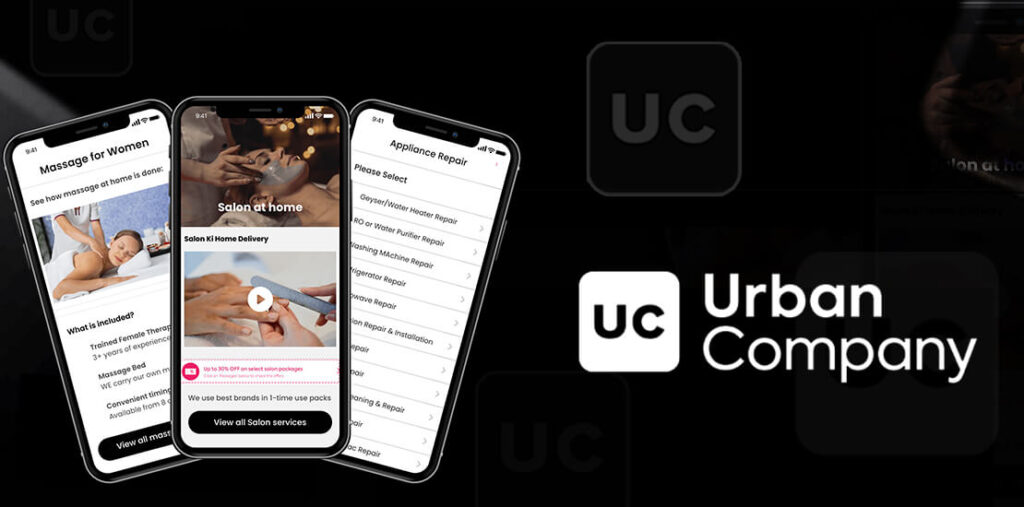
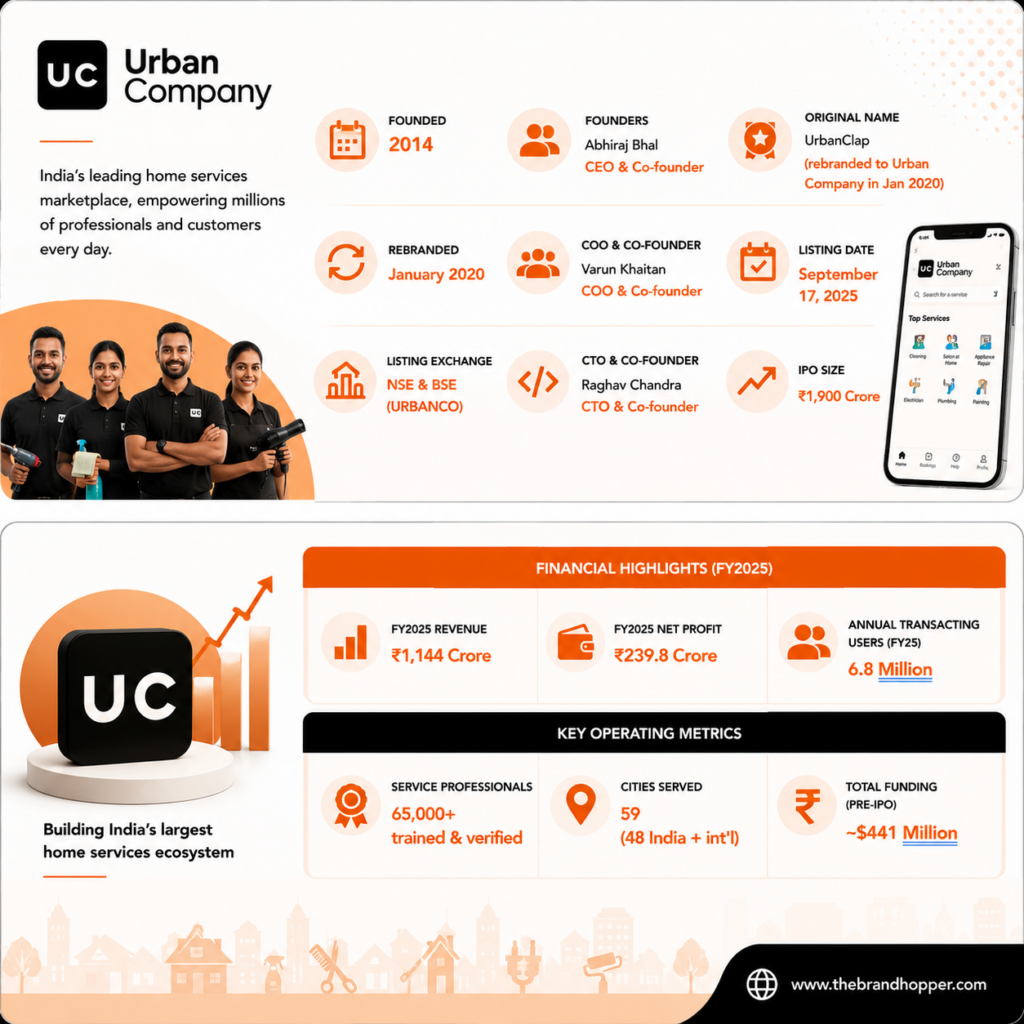
Urban Company is India’s leading managed home-services marketplace—a technology platform that connects customers with trained, background-verified professionals for beauty, wellness, home repairs, cleaning, appliance servicing, and more. What started in 2014 as a scrappy on-demand services startup called UrbanClap has grown into a publicly listed company on India’s NSE and BSE, with a ₹1,144 crore revenue in FY2025, over 65,000 service professionals, and operations across 59 cities in India, the UAE, Singapore, and Saudi Arabia.
The company’s founding story, unusual business model, path to profitability, and successful IPO in September 2025 make it one of the most compelling startup-to-public-company journeys in Indian technology history. This article covers the complete story—from the founding idea to the current business, finances, and future.
Urban Company at a Glance

Founding Story: From UrbanClap to Urban Company
Urban Company was founded in October 2014 by three friends who met at IIT Kanpur—Abhiraj Singh Bhal and Varun Khaitan—and later joined forces with Raghav Chandra, a UC Berkeley computer science graduate. All three had worked at The Boston Consulting Group (BCG) before leaving to build what would become one of India’s most successful consumer internet companies.
The founding idea came from personal frustration. Abhiraj and Varun had tried—and repeatedly failed—to find reliable plumbers, electricians, and beauticians through local recommendations and unorganised directories. They had already attempted one venture together for six months before it folded. When they met Raghav Chandra, who was building technology, they saw the opportunity to solve a problem affecting millions of Indian urban households: the impossibility of finding a trustworthy, skilled professional for everyday home services.
They started UrbanClap in Delhi NCR, manually onboarding service providers and hand-matching them with customers. The early days involved Abhiraj managing the demand side (customers), Varun managing supply (professionals), and Raghav building the technology. As the platform attracted its first wave of users—who loved the reliability and the ease of app-based booking—they raised their first institutional funding and began to scale rapidly across Indian cities.
By 2019, UrbanClap had expanded to the UAE and Australia, added dozens of service categories beyond its initial focus on beauty and home repairs, and become the undisputed market leader in organised home services in India. In January 2020, the company rebranded as ‘Urban Company’—dropping the ‘Clap’ to reflect its broader mission and global aspirations. The new name also aligned better with international markets, where ‘UrbanClap’ had less resonance.


Founders’ Profile
Abhiraj Singh Bhal — CEO & Co-founder
Abhiraj Singh Bhal studied engineering at IIT Kanpur and then pursued an MBA from IIM Ahmedabad, two of India’s most competitive academic institutions. After graduating, he joined The Boston Consulting Group (BCG) where he worked as a management consultant. It was at BCG that he reconnected with Varun Khaitan and developed the concept for what would become UrbanClap. As CEO, Abhiraj has led Urban Company through every major milestone—from its seed funding to its IPO on the NSE and BSE. He remains the primary public face of the company and has been vocal about building a platform that creates genuine economic opportunities for India’s skilled workforce.
Varun Khaitan — COO & Co-founder
Varun Khaitan is also an IIT Kanpur alumnus. After graduating, he moved to California to work at Qualcomm in the United States before returning to India and joining BCG—where he was posted in the New York office. His international technology background has been valuable as Urban Company expanded into the UAE, Singapore, and Saudi Arabia. As COO, Varun oversees operations and the delivery of quality at scale across Urban Company’s growing geographic footprint.
Raghav Chandra — CTO & Co-founder
Raghav Chandra holds a Computer Science degree from UC Berkeley. As the technical co-founder, Raghav built Urban Company’s core technology stack from the ground up—the matching algorithms, scheduling systems, partner training platforms, and customer-facing app infrastructure that underpin the company’s marketplace model. His engineering background has been instrumental in building the ‘full-stack’ capabilities that differentiate Urban Company from simpler listing or lead-generation platforms.
Business Model of Urban Company
Urban Company operates what it calls a ‘managed marketplace’—a more capital-intensive but fundamentally higher-quality model than a pure platform play. Unlike a simple directory or lead-generation service, Urban Company controls the entire service delivery process, from how professionals are trained to what products they use and how they interact with customers.
How the Platform Works
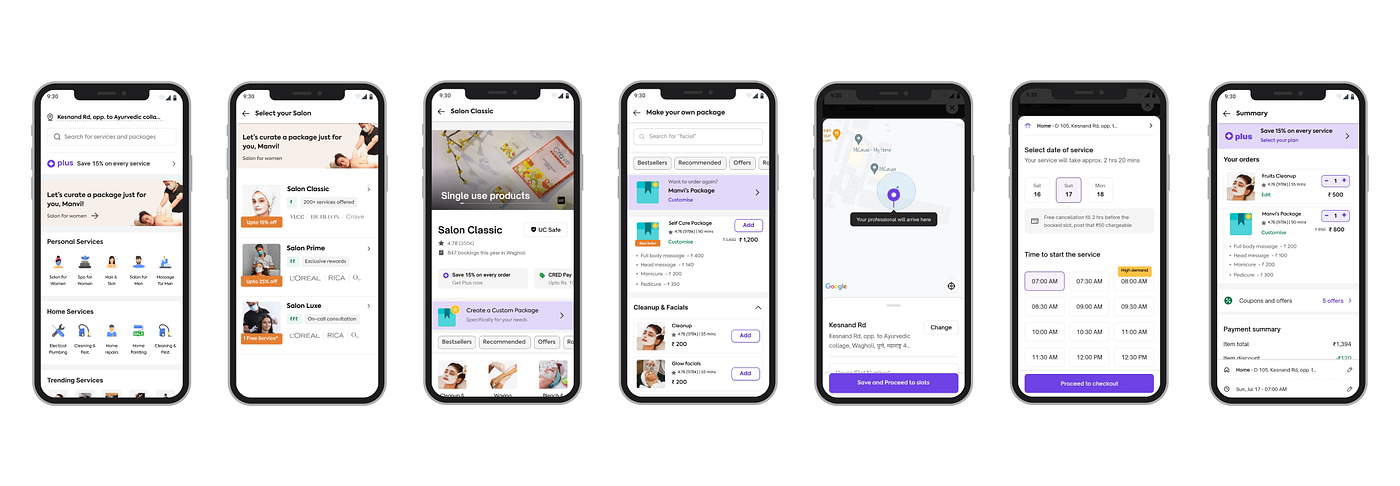
For Customers: Open the Urban Company app or website, select a service (e.g. ‘women’s salon at home’), choose a date and time slot, and a verified professional arrives at your door with all required products and equipment. Payment is handled in-app; you rate the experience afterward.
For Service Professionals (Partners): Applicants go through a rigorous screening process—background check, skill assessment, in-person interview—before being accepted onto the platform. Once accepted, they undergo a structured training programme at Urban Company’s training centres (175+ rooms across 14 cities). Partners use Urban Company’s app to manage their schedule, earnings, and customer communications. They pay a commission on each completed job.
For Urban Company: The company earns a commission on every transaction (commission rates vary by service category and city). It also sells products directly to service professionals (cleaning chemicals, beauty products, RO filters) and to customers (Native RO water purifiers, wall panels). Subscriptions to recurring services (bathroom cleaning, pest control, AC servicing) provide recurring revenue.
Revenue Streams
| Revenue Stream | Share / Detail |
|---|---|
| Platform & Commission Fees | 73.4% of total revenue; commission earned on every service transaction; grew 29% YoY in FY2025. |
| Product Sales (Services) | 26.6% of total revenue; includes cleaning products, beauty kits, Native RO purifiers, and wall panels; grew 72.2% YoY in FY2025. |
| Subscription Plans | Recurring subscriptions for bathroom cleaning, AC servicing, and pest control; improves revenue predictability and customer retention. |
| B2B / International | International operations (UAE, Singapore, and Saudi Arabia) generated ₹147 crore in FY2025, up 63.9% YoY. |
| Partner Services | Includes training fees, kit loans, and insurance facilitation; primarily cost-recovery services rather than a significant revenue source. |
| Urban Company’s key differentiation: Unlike aggregator platforms that merely list professionals, Urban Company trains, equips, and continuously monitors quality—making it a true managed marketplace rather than a lead-gen directory. |
Services & Product Portfolio of Urban Company
Urban Company has expanded from its original two categories (beauty and home repairs) to a comprehensive multi-vertical platform. Its current service portfolio includes:
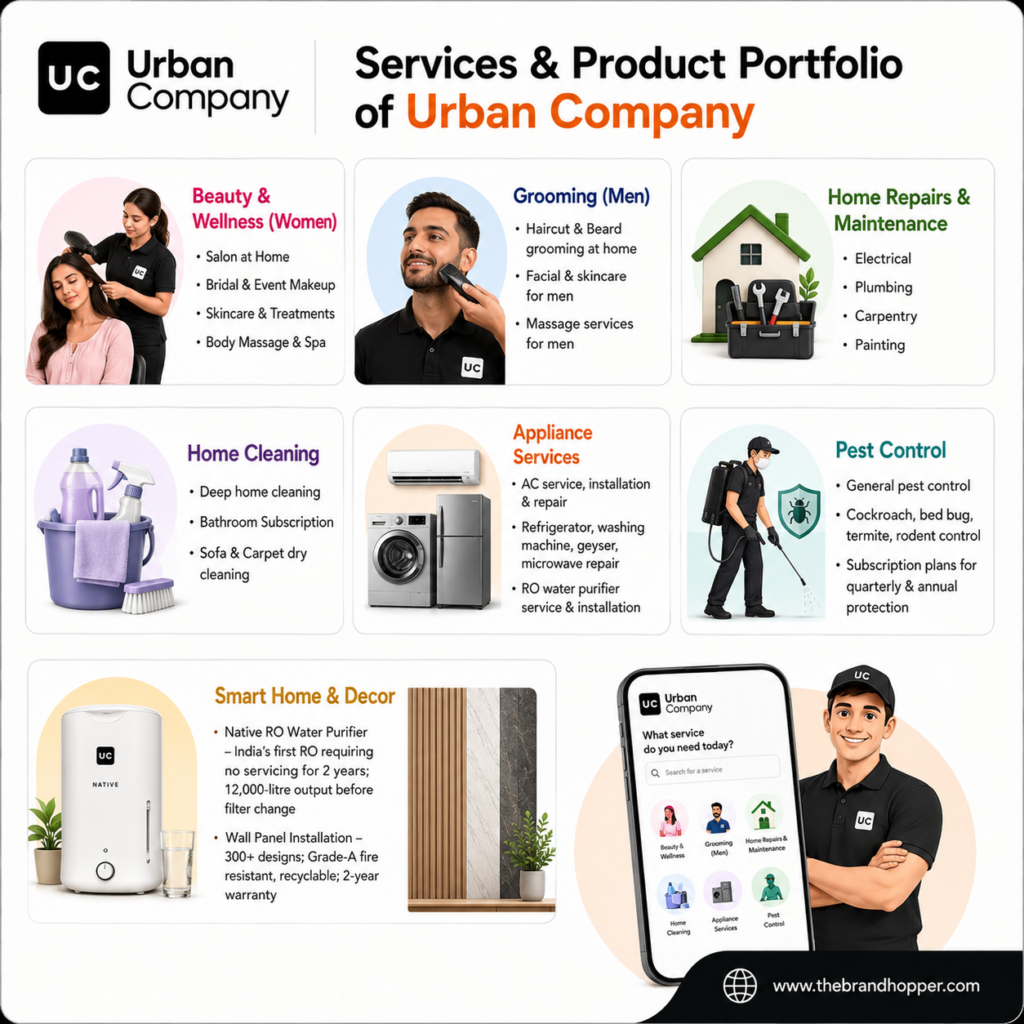
1. Beauty & Wellness (Women)
- Salon at Home: Haircut, blowout, hair colour, hair spa, threading, waxing, facials, manicure, pedicure
- Bridal & Event Makeup: Professional makeup for weddings, engagements, and other occasions
- Skincare & Advanced Treatments: HydraFacial, chemical peels, O3+ facials, vitamin C treatments
- Body Massage & Spa: Swedish massage, deep tissue, aromatherapy, body polishing
2. Grooming (Men)
- Haircut & Beard grooming at home
- Facial & skincare for men
- Massage services for men
3. Home Repairs & Maintenance
- Electrical: Wiring, fan installation, switch/socket replacement, MCB work
- Plumbing: Tap repair, pipeline work, bathroom fitting, water heater installation
- Carpentry: Door/window repair, furniture assembly, drilling, modular installation
- Painting: Interior, exterior, texture, waterproofing
4. Home Cleaning
- Deep home cleaning (full home, kitchen, sofa, carpet, bathroom)
- Bathroom Subscription: 4 cleaning sessions per month at a fixed price
- Sofa & Carpet dry cleaning and shampooing
5. Appliance Services
- AC service, installation, repair, and gas refill
- Refrigerator, washing machine, geyser, microwave repair
- RO water purifier service and installation (including Native RO range)
6. Pest Control
- General pest control, cockroach treatment, bed bug, termite, rodent control
- Subscription plans for quarterly and annual pest protection
7. Smart Home & Decor
- Native RO Water Purifier (launched October 2023): India’s first RO requiring no servicing for 2 years; 12,000-litre output before filter change
- Wall Panel Installation: 300+ design options (stone, wood, geometric, floral); Grade-A fire resistant, recyclable; 2-year warranty



Partner Ecosystem & The Professional Success Model
One of Urban Company’s most distinctive competitive advantages is how it treats its service professionals—not as gig workers to be extracted from, but as micro-entrepreneurs to be developed. This philosophy is reflected in the company’s comprehensive partner support infrastructure.
1. Training & Skilling
- 321,000 sq ft of permanent training space across 14 cities
- 175+ training rooms; 280+ trainers across all service categories
- 35,000 partners trained and upskilled in FY2024
- Total training investment of ₹524 crore to date; ₹138 crore in FY2024 alone
- All partners are Skill India-certified under the company’s MoU with the National Skill Development Council (NSDC), affiliated with the Government of India
2. Earnings
- Average monthly net earnings for partners delivering 30+ services per month: ₹33,469 (audited by JC Bhalla & Company)
- Top 20% of partners earn ₹42,792/month on average—comparable to entry-level IT sector salaries
- Female partners earn 23% more per hour than male counterparts (₹363/hour vs ₹294/hour)
- Urban Company salon partners earn ~₹320/hour net—4 times the ₹80/hour earned by offline salon workers
3. Social Protection
- Life insurance cover of ₹6 lakh and disability cover of ₹6 lakh voluntarily provided to all active partners
- Health insurance plan with ₹1 lakh cover and up to 12 free medical consultations per year
- Over 1,800 service partners benefitted from insurance claims in FY2024
- Total insurance claim disbursals of ₹9.8 crore to date; ₹6.29 crore in FY2024 alone
- Access to formal credit: ₹37.2 crore in personal loans and kit loans disbursed to partners via NBFC partners in FY2024


Investors and Funding Journey of Urban Company
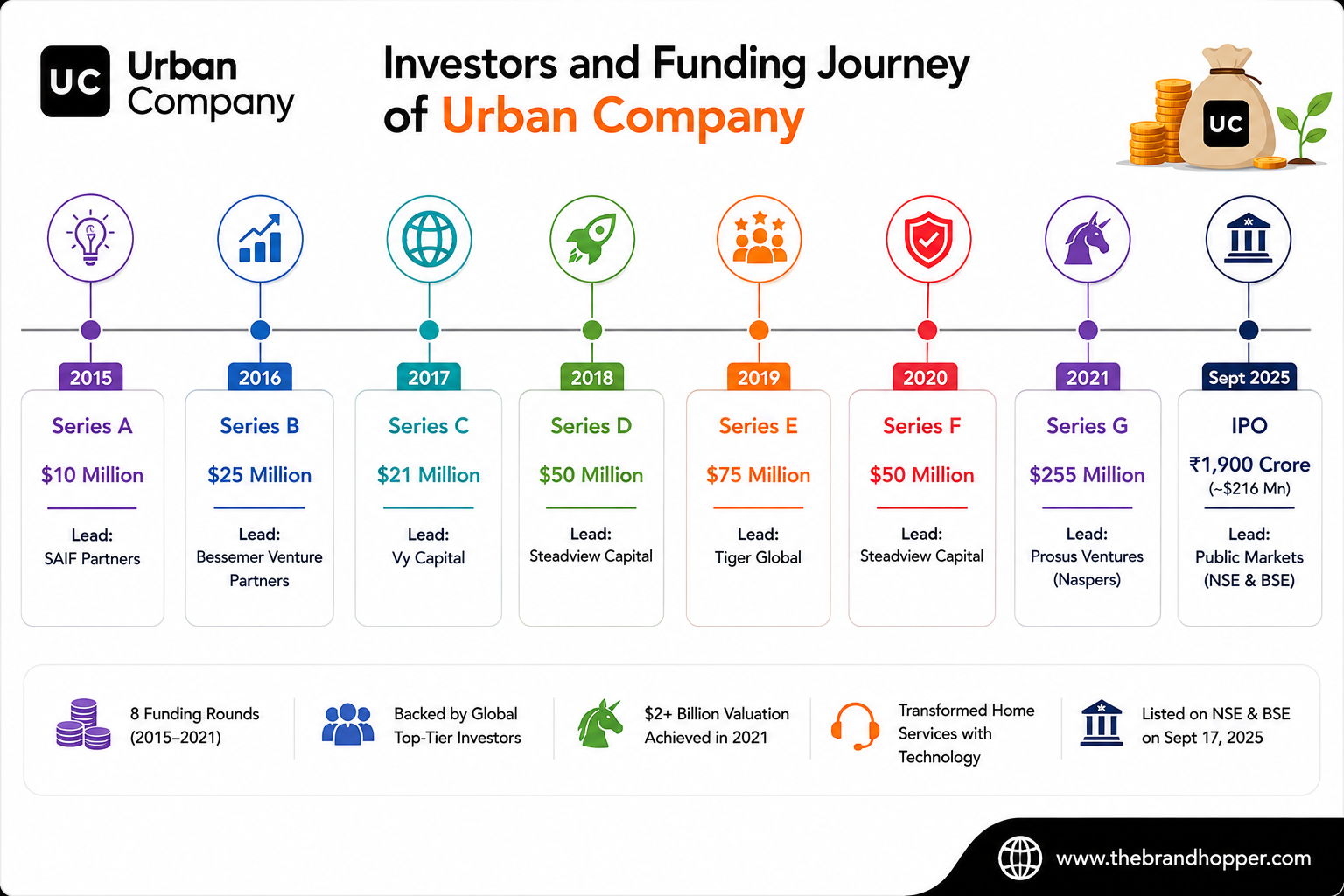
Urban Company has attracted backing from some of the world’s most respected venture capital firms across eight pre-IPO funding rounds, followed by a landmark public market debut in September 2025. Below is the complete funding history.
Urban Company raises $190 million, joins unicorn club as valuation jumps to $2 billion

Revenue and Financial Performance
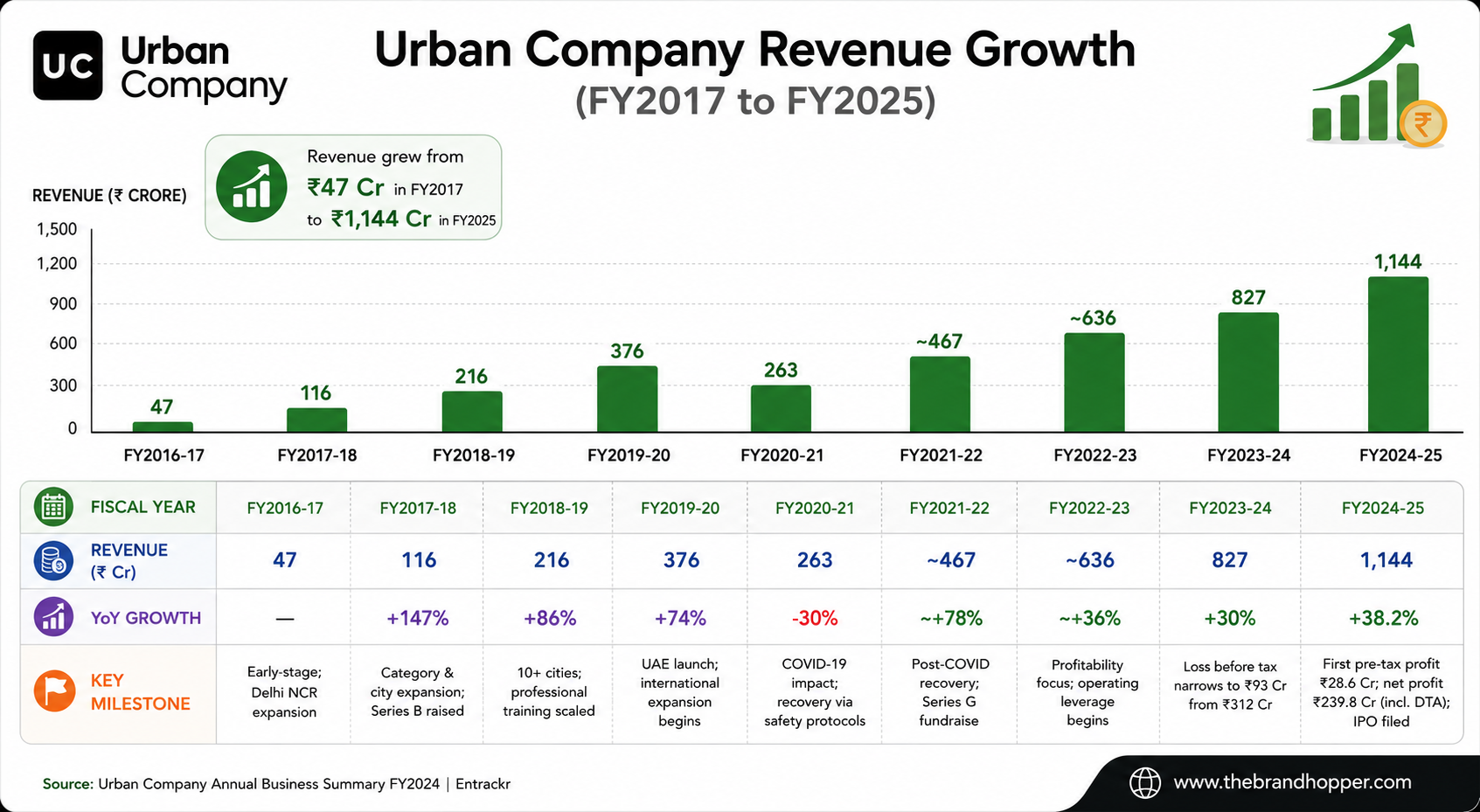
Urban Company has delivered consistent, high double-digit revenue growth since its founding, moving from ₹47 crore in FY2017 to ₹1,144 crore in FY2025—a compound annual growth rate of over 50% across the period. The company achieved its first pre-tax profitability in FY2025, a milestone that preceded its successful IPO.
| Fiscal Year | Revenue (₹ Cr) | YoY Growth | Key Milestone |
| FY 2016-17 | 47 | — | Early-stage; Delhi NCR expansion |
| FY 2017-18 | 116 | +147% | Category & city expansion; Series B raised |
| FY 2018-19 | 216 | +86% | 10+ cities; professional training scaled |
| FY 2019-20 | 376 | +74% | UAE launch; international expansion begins |
| FY 2020-21 | 263 | -30% | COVID-19 impact; recovery via safety protocols |
| FY 2021-22 | ~467 | ~+78% | Post-COVID recovery; Series G fundraise |
| FY 2022-23 | ~636 | ~+36% | Profitability focus; operating leverage begins |
| FY 2023-24 | 827 | +30% | Loss before tax narrows to ₹93 Cr from ₹312 Cr |
| FY 2024-25 | 1,144 | +38.2% | First pre-tax profit ₹28.6 Cr; net profit ₹239.8 Cr (incl. DTA); IPO filed |
| FY2025 milestone: Urban Company reported its first consolidated net profit of ₹239.8 crore in FY2025 (including a deferred tax asset credit of ₹211.2 crore). Excluding the DTA credit, the company delivered a pre-tax profit of ₹28.6 crore — reflecting genuine operating profitability at scale. |

International Expansion
Urban Company’s international operations have grown into a meaningful business unit, contributing ₹147 crore in revenue in FY2025—a 63.9% year-on-year increase—and demonstrating that the company’s managed marketplace model is exportable beyond India.
UAE (United Arab Emirates): Urban Company’s first international market, entered in 2018. Dubai and Abu Dhabi remain the primary markets, with beauty, home cleaning, and appliance services as core categories. The UAE is the most mature international market.
Singapore: Entered as part of the 2019 international push. The Singapore market serves an affluent, service-hungry urban demographic and has proven a good testing ground for the company’s premium pricing and service quality.
Saudi Arabia: The newest international market, reflecting Urban Company’s focus on the Gulf Cooperation Council (GCC) region’s rapidly modernising consumer economy. Saudi Arabia is seen as a significant growth opportunity given its large, tech-savvy urban population and the government’s Vision 2030 investment in services and quality of life.
Australia (Exit): Urban Company entered Australia as part of its early international expansion but subsequently exited the market to focus capital and management attention on higher-potential markets in India and the Middle East.
IPO: Urban Company Goes Public
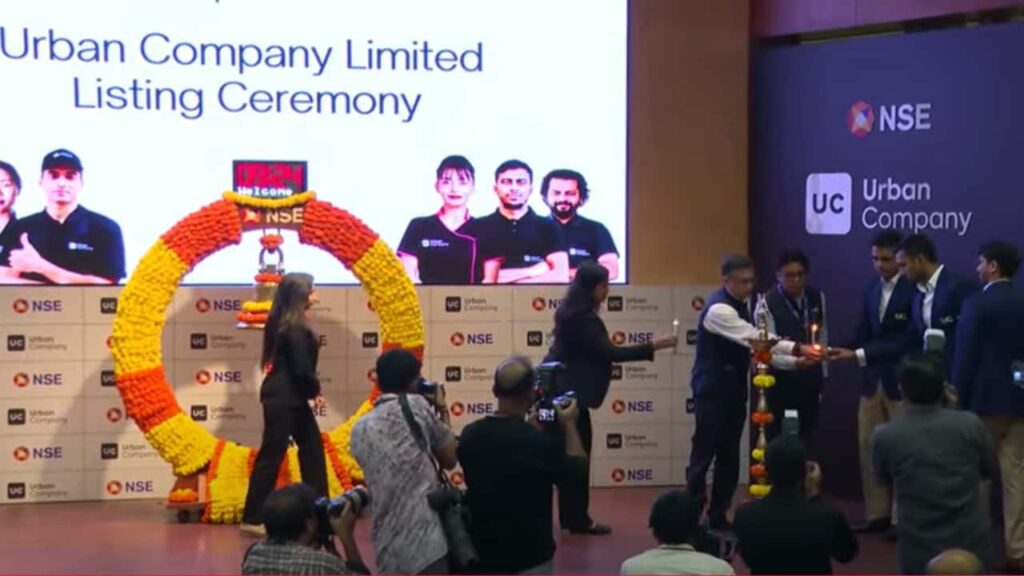
Urban Company’s IPO in September 2025 was one of the most anticipated consumer internet listings in the Indian market since Zomato and Nykaa. The company filed its Draft Red Herring Prospectus (DRHP) with SEBI in April 2025 and received final approval in August 2025.


Competitive Landscape of Urban Company
Urban Company operates in a highly fragmented industry where the majority of India’s home services market is still served by unorganised, individual tradespeople and local service providers. Its primary organised competitors include:
Housejoy: Backed by Amazon India, Housejoy competes directly in home repairs and appliance servicing. Amazon’s backing provides significant distribution advantage through the Amazon Shopping and Alexa ecosystem.
Yes Madam: A direct competitor in the salon-at-home category, Yes Madam has grown aggressively in North India. Unlike Urban Company’s multi-category approach, Yes Madam remains focused on beauty services.
Mr Right: A home repairs specialist operating in major Indian cities, Mr Right focuses on electrician, plumber, and carpenter services.
Local Service Providers (Unorganised): The largest competitive threat is not from organised platforms but from individual tradespeople discovered through WhatsApp groups, housing society recommendations, and local directories. Urban Company’s differentiated value proposition—background-verified, trained, insured professionals—directly addresses this trust deficit.
SWOT Analysis of Urban Company
| 💪 Strengths
• Market leader in organised home services in India • Full-stack managed marketplace model → consistent quality • 65,000+ trained & verified service professionals • Strong brand recall as UrbanClap legacy • First-mover advantage in multiple tier-2 cities • Listed on NSE & BSE — enhanced credibility |
⚠ Weaknesses
• Revenue concentration: 75%+ from top-tier cities • Heavy reliance on gig workers → platform risk • High customer acquisition costs (digital marketing spend) • Relatively thin profitability (pre-tax profit ₹28.6 Cr in FY25 ex-DTA) • Premium pricing limits mass-market penetration |
| 🎯 Opportunities
• India’s home services market projected to exceed $100 Bn • Tier-2 and tier-3 city expansion still untapped • Saudi Arabia & Middle East growth market • AI-powered scheduling and personalisation • B2B commercial services (corporate offices, hospitality) • Subscription model scale (bath, pest, salon bundles) |
⚡ Threats
• Unorganised sector competitors (low-cost local services) • Amazon/Google entering home services via Alexa/Maps • Housejoy backed by Amazon India • Worker reclassification regulatory risk • Macro slowdown → discretionary service spend cuts • Price wars with funded regional platforms |
Technology and Innovation of Urban Company
Technology is foundational to Urban Company’s managed marketplace model. The company’s proprietary platform handles customer matching, professional scheduling, quality monitoring, payment processing, and partner earnings tracking at scale. Key technology capabilities include:
Smart Matching Algorithm: The platform matches customers with the nearest available, highest-rated professional in the requested category—balancing proximity, rating, and schedule availability to minimise booking-to-service time.
Partner App: Urban Company’s partner-facing app manages the professional’s schedule, provides job details, enables navigation, processes payments, and displays earnings in real-time. It also delivers micro-learning modules to keep partners updated on service protocols.
Quality Monitoring: Post-service ratings, in-service photo uploads by partners, and periodic mystery audits enable Urban Company to maintain quality standards at scale without losing visibility to what’s happening in customers’ homes.
Native Product Innovation: Beyond software, Urban Company has moved into hardware product development with the Native RO water purifier (2023)—demonstrating an ambition to capture value across the full home services supply chain. The company has also launched wall panel installation services, extending into home decor.
AI-Powered Recommendations: The company uses machine learning to predict service demand by city and category, optimise dynamic pricing, and personalise the in-app experience for returning customers—increasing repeat purchase rates.
Future of Urban Company
1. Tier-2 and Tier-3 City Expansion
As of FY2025, over 75% of Urban Company’s revenue is concentrated in top-tier metros. India’s rapidly urbanising smaller cities—Jaipur, Lucknow, Indore, Surat, Kochi—represent a massive untapped opportunity for professionally delivered home services. The company has flagged tier-2 expansion as a strategic priority.
2. InstaHelp: High-Frequency Daily Services
In FY2026, Urban Company launched InstaHelp, a new vertical offering on-demand daily housekeeping and cleaning services. Unlike the company’s existing services (which are booked in advance), InstaHelp targets the high-frequency, high-retention daily cleaning segment—competing with traditional maid/domestic worker arrangements and subscription cleaning apps.
3. Middle East & South Asia Scale
Having entered Saudi Arabia, Urban Company sees the GCC region as a high-value growth corridor. Gulf consumers have strong purchasing power, high digital adoption, and growing preference for organised, app-based home services over informal arrangements. The international segment’s 64% YoY revenue growth in FY2025 validates this bet.
4. AI-Enhanced Service Quality
The company is investing in AI and machine learning to further improve professional matching, predict demand fluctuations, automate quality checks, and personalise the customer experience. AI-powered scheduling tools can reduce wait times and partner idle time simultaneously—improving unit economics for both sides of the marketplace.
5. B2B Commercial Services
Urban Company is exploring commercial and B2B extensions—office cleaning, corporate wellness, hospitality partnerships. These segments offer larger order values, predictable recurring demand, and stickier relationships than the consumer market.
6. Product & Hardware Expansion
The Native RO purifier and wall panel range suggest Urban Company’s ambition to become a full-service home brand—not just a marketplace for labour. Owning branded products that require recurring service creates a flywheel: Urban Company sells the product and the service, building customer lifetime value across both dimensions.
Frequently Asked Questions (FAQs)
Q: What is Urban Company and how does it work?
A: Urban Company is India’s leading managed home-services marketplace—an app-based platform that connects customers with trained, background-verified professionals for beauty, home repairs, cleaning, appliance servicing, and wellness services. Customers book a service via the app, select a time slot, and a professional arrives at their home with all required products and equipment. Urban Company earns a commission on each completed transaction and also sells products to both professionals and customers.
Q: Who are the founders of Urban Company?
A: Urban Company was co-founded by Abhiraj Singh Bhal (CEO), Varun Khaitan (COO), and Raghav Chandra (CTO) in October 2014 in New Delhi. Abhiraj and Varun are IIT Kanpur alumni who worked together at The Boston Consulting Group. Raghav Chandra is a UC Berkeley Computer Science graduate who built the company’s core technology platform.
Q: What was Urban Company’s original name?
A: Urban Company was originally named UrbanClap—a name that reflected its focus on the ‘urban’ market and on connecting (‘clap’) customers with service providers. The company rebranded to Urban Company in January 2020 to reflect its expanded service range and international ambitions, and because ‘UrbanClap’ didn’t translate well outside India.
Q: When did Urban Company go public (IPO)?
A: Urban Company filed its DRHP with SEBI in April 2025 and launched its IPO on September 10–12, 2025, with a price band of ₹98–103 per share. The IPO was subscribed 103.63 times. Shares listed on NSE and BSE on September 17, 2025 at ₹162.25—a 57.5% premium over the issue price of ₹103—with a market capitalisation of approximately ₹23,987 crore on listing day.
Q: What is Urban Company’s revenue and is it profitable?
A: Urban Company reported consolidated net revenues of ₹1,144 crore in FY2025, up 38.2% year-on-year. The company reported a consolidated net profit of ₹239.8 crore in FY2025, including a deferred tax asset (DTA) credit of ₹211.2 crore. Excluding the DTA, the company delivered a pre-tax profit of ₹28.6 crore—reflecting genuine operating profitability at scale for the first time. In FY2024, the company had reported revenues of ₹827 crore and a loss before tax of ₹93 crore.
Q: How many service professionals does Urban Company have?
A: Urban Company has over 65,000 trained and verified service professionals (partners) on its platform across India and international markets. In FY2025, the company recorded 47,888 average monthly active service partners. The platform screened 1.2 million applicants and certified 240,000 partners cumulatively. Urban Company has invested ₹524 crore in partner training to date, with 175+ training rooms across 14 Indian cities.
Q: In which cities and countries does Urban Company operate?
A: As of FY2025, Urban Company operates in 59 cities—48 cities in India (spanning metros, tier-1, and select tier-2 cities) and international operations in the UAE (Dubai, Abu Dhabi), Singapore, and Saudi Arabia. The company previously operated in Australia but exited that market to focus on higher-growth opportunities in India and the Middle East.
Q: How much total funding has Urban Company raised?
A: Urban Company raised approximately $441 million in pre-IPO funding across 8 rounds (Series A through Series G) from investors including SAIF Partners, Accel Partners, Bessemer Venture Partners, Vy Capital, Steadview Capital, Tiger Global, Elevation Capital, and Prosus Ventures (Naspers). Its Series G round in 2021 valued the company at over $2 billion, making it a unicorn. The subsequent IPO in September 2025 raised an additional ₹1,900 crore (~$216 million) from public market investors.
Conclusion
Urban Company’s journey from a bootstrapped home services startup in Delhi NCR to a publicly listed company on India’s NSE and BSE is one of the defining entrepreneurial stories of the Indian tech economy. What makes the story unusual—and instructive—is not just the scale achieved, but how it was achieved: by rejecting the easy aggregator model in favour of a harder, more capital-intensive managed marketplace that genuinely improves outcomes for both customers and service professionals.
The company’s ₹1,144 crore FY2025 revenue, first profitable year, 65,000+ professionally trained partners, and a successful IPO subscribed 103 times over demonstrate that a rigorous focus on quality and trust can build a durable, valuable business even in a fragmented, price-sensitive sector like home services. With InstaHelp, Middle East expansion, and a growing product portfolio complementing its core services, Urban Company is entering its next phase of growth as a publicly accountable company with a mission that extends well beyond connecting professionals with customers.
Also Read: The Quirky Marketing Strategies of D2C Beauty Group MyGlamm
Also Read: Rapido – Founding Story, Business Model, Growth & Marketing Strategies
Also Read: Cred – History, Business Model, Marketing, Funding & Growth
To read more content like this, subscribe to our newsletter
Go to the full page to view and submit the form.