


The global electrical equipment and industrial automation industry is one of the world’s most strategically critical sectors — powering data centres, factories, hospitals, power grids, and smart buildings across every geography. As energy transition accelerates and artificial intelligence drives unprecedented demand for power infrastructure, competition among the sector’s giants has intensified sharply.
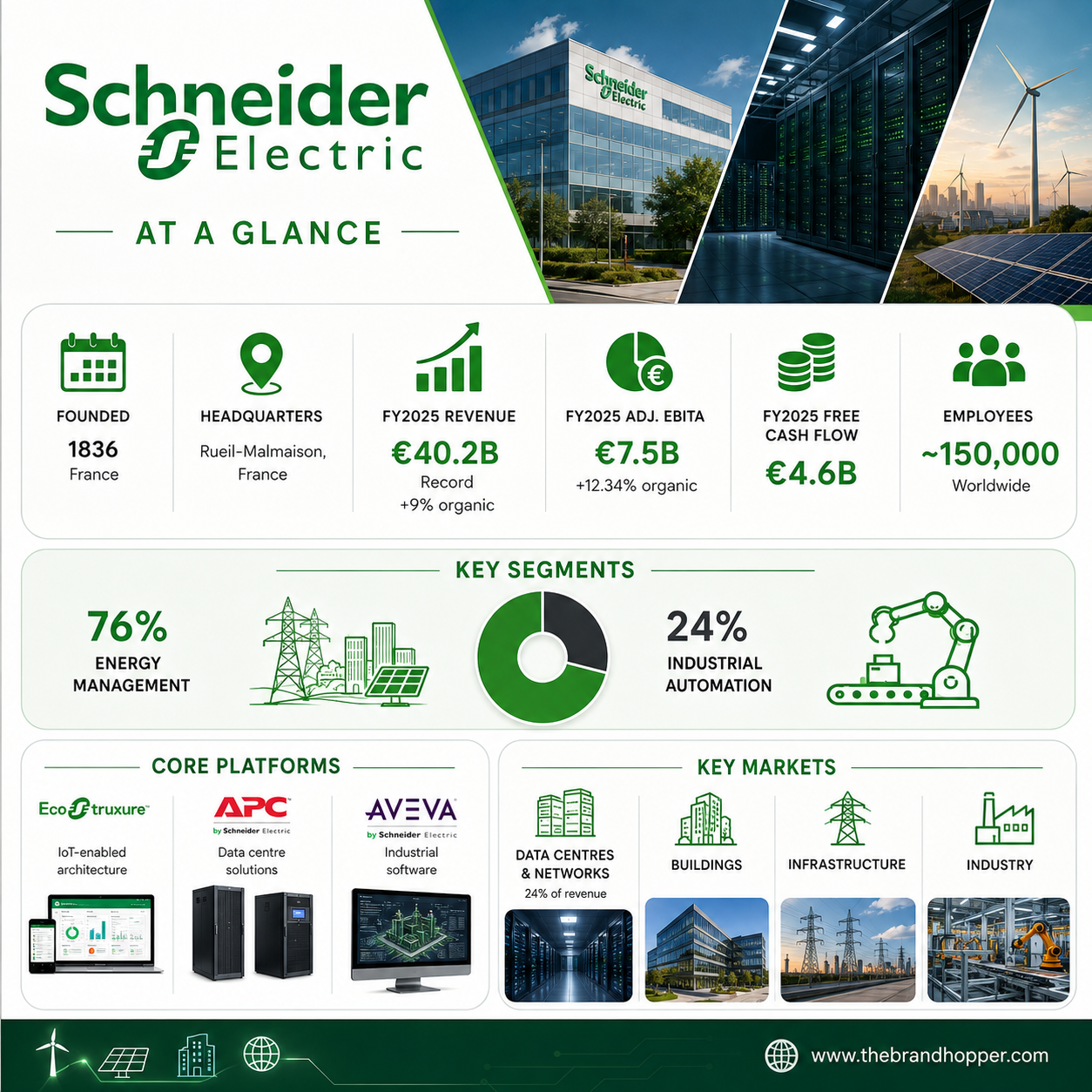
Schneider Electric, founded in 1836 and headquartered in Rueil-Malmaison, France, posted record revenues of €40.2 billion in FY2025 — an 9% organic increase — driven by a 12% surge in its Energy Management segment, partly fuelled by booming data centre infrastructure demand. The company operates in over 100 countries and competes across energy management, industrial automation, smart buildings, data centre infrastructure, and grid management.
This article examines top Schneider Electric’s most significant competitors — from global conglomerates like Siemens and ABB to specialist challengers like Vertiv and Yokogawa — covering their revenues, competitive strengths, and areas of direct overlap with Schneider. All revenue figures are sourced from official annual reports and investor communications.

The Electrical Equipment & Automation Landscape
The global electrical equipment and automation market is expanding rapidly, driven by five structural forces: the energy transition (grid upgrades for renewable integration), the AI-driven data centre boom, accelerating industrial automation and robotics adoption, smart building retrofits, and the electrification of transport. Together, these forces are generating extraordinary capital expenditure — creating large, sustained demand for the products and systems that Schneider Electric and its competitors supply.
The competitive landscape is shaped by a small number of globally diversified incumbents (Siemens, ABB, Honeywell, GE Vernova, Emerson, Eaton) competing across broad product portfolios, alongside more focused specialists in specific segments: Rockwell in discrete manufacturing automation, Legrand in electrical and digital building infrastructure, Vertiv in data centre power and thermal management, Yokogawa in process control, and Johnson Controls in smart commercial buildings. A wave of new entrants leveraging AI and edge computing — including AutoGrid, C3.ai, Stem, and Enlighted — is adding further disruption at the software and analytics layer.
Top 15 Competitors of Schneider Electric
1. ABB Ltd


Website: https://global.abb/group/en
ABB Ltd, formed from the 1988 merger of Sweden’s ASEA and Switzerland’s Brown Boveri, is Schneider Electric’s closest global rival across multiple segments. In FY2025, ABB achieved record revenues of $33.22 billion, growing 9% on a comparable basis — a result driven by strength in its Electrification and Process Automation divisions, partially offset by weakness in Robotics & Discrete Automation. With operations in over 100 countries and approximately 105,000 employees, ABB competes with Schneider across electrification, industrial automation, robotics, and motion.
ABB’s most distinctive competitive strengths relative to Schneider include its market-leading robotics portfolio (including YuMi, the world’s first dual-arm collaborative robot), its ABB Ability™ digital platform, and its commanding position in motion products (motors, drives, and servo systems). ABB’s electrification portfolio — covering switchgear, protection, wiring accessories, and building automation — competes directly with Schneider’s Energy Management segment. The divestment of ABB’s Power Grids business to Hitachi (completed 2020) allowed the company to sharpen its focus on digital industries and electrification, intensifying competition with Schneider in these areas.
Recent ABB initiatives relevant to the competitive landscape include the expansion of its EV infrastructure business (ultra-fast chargers), the development of modular data centre power systems, and continued investment in AI-driven predictive maintenance solutions via ABB Ability. The company maintained an operational EBITA margin of 18.1% in FY2024 — comfortably above Schneider Electric’s margins — reflecting the high-value nature of its automation and robotics mix.
2. Siemens AG

Website: https://www.siemens.com/global/en.html
Siemens AG is the world’s most broadly diversified electrical engineering and industrial automation conglomerate, with group revenues of €78.9 billion in FY2025 (year ending 30 September 2025) and net income of €10.4 billion. Its Industrial Business — comprising Digital Industries, Smart Infrastructure, and Mobility — generated revenues of approximately 25% of the group revenues, placing Siemens comfortably among the largest competitors to Schneider Electric in core segments. The company employs approximately 312,000 people globally.
Siemens competes head-to-head with Schneider in industrial automation (where Siemens’ TIA Portal and SIMATIC ecosystem rival Schneider’s EcoStruxure Plant), smart building infrastructure (Siemens Desigo CC vs. Schneider EcoStruxure Building), and grid automation (Siemens Energy’s grid solutions vs. Schneider’s EcoStruxure Grid). Siemens’ pioneering work on Digital Twin technology and its MindSphere IoT platform represent a direct challenge to Schneider’s AVEVA industrial software platform.
Siemens’ recent strategic moves include the continued scaling of its industrial metaverse capabilities, the Xcelerator platform (combining hardware, software, and a marketplace ecosystem), and the integration of Mendix’s low-code development tools into its industrial software offering. Siemens also holds a majority stake in Siemens Energy — the separately listed power generation and grid solutions business — which competes with Schneider’s grid management and energy transition products.
3. Eaton Corporation


Website: https://www.eaton.com/
Eaton Corporation, an Irish-domiciled multinational power management company, delivered record revenues of $27.4 billion in FY2025 — up 10.3% year-on-year. Net income reached $4 billion. The result was driven by surging demand for electrical infrastructure from data centres, utilities, and industrial customers. Eaton’s Electrical Global and Electrical Americas segments — which together generate the majority of the company’s revenue — compete directly with Schneider Electric’s Energy Management segment across power distribution, circuit protection, UPS systems, and energy storage.
Eaton’s competitive strengths include its dominant position in power distribution and circuit protection, its comprehensive UPS portfolio (including the highly regarded 9PX and 93PM series), its emerging leadership in EV charging infrastructure, and its strong footprint in the aerospace sector (which adds revenue and R&D capability beyond Schneider’s scope). The company achieved record segment margins of 24.0% in FY2024, reflecting strong pricing power and operating leverage as data centre demand surged.
Eaton has been one of the primary beneficiaries of the AI-driven data centre boom. Its hyperscale and colocation data centre customer base has grown rapidly, with data centre-related revenue growing at double-digit rates. The company’s xStorage home energy storage system and microgrid power management solutions compete with Schneider’s residential and distributed energy offerings, while its industrial UPS and power quality solutions rival Schneider’s APC-branded data centre infrastructure portfolio.
4. Emerson Electric Co.


Website: https://www.emerson.com/
Emerson Electric Co., founded in 1890 in St. Louis, Missouri, has transformed itself into a focused industrial automation technology company following a strategic portfolio reshaping that included the acquisition of National Instruments (NI) and the divestiture of its commercial and residential HVAC, tools, and climate technologies businesses. Emerson’s automation-focused continuing operations generate approximately $18 billion in annual revenue in FY2025. Its strengths in process and hybrid industry automation make it a significant competitor to Schneider particularly in oil and gas, chemicals, pharmaceuticals, and power generation markets.
Emerson’s DeltaV distributed control system is one of the world’s most widely deployed process control platforms, competing directly with Schneider’s EcoStruxure Process platform. The company’s Plantweb digital ecosystem — encompassing pervasive sensing, edge controls, and analytics — is a direct rival to Schneider’s EcoStruxure Plant architecture. The integration of National Instruments’ test and measurement capabilities has expanded Emerson’s industrial software portfolio, strengthening its competition with Schneider’s AVEVA industrial software suite.
Key partnerships underpinning Emerson’s competitive strategy include its long-term collaboration with AspenTech (in which Emerson holds a majority stake) for asset optimization software, and its cloud and AI partnership with Microsoft for Industrial Internet of Things applications. These alliances give Emerson a software-led, data-driven competitive positioning that increasingly overlaps with Schneider’s EcoStruxure and AVEVA platforms in process-intensive industries.
5. Honeywell International Inc.

Website: https://www.honeywell.com/us/en
Honeywell International Inc., a multinational conglomerate with roots dating to 1906, reported approximately $37.44 billion in revenues for FY2025. The company competes with Schneider Electric across three primary domains: building automation technologies (HVAC controls, fire safety, security systems), industrial process automation (Honeywell Process Solutions), and safety and productivity solutions. Honeywell’s Forge platform for connected buildings and its Process Solutions automation suite are direct competitors to Schneider’s EcoStruxure Building and EcoStruxure Process platforms respectively.
A significant strategic development is Honeywell’s announced plan to break up into three independent, focused businesses: Honeywell Aerospace Technologies, Honeywell Industrial Automation, and Honeywell Building Automation. This separation — expected to create more focused, higher-margin pure-play companies — will reshape the competitive landscape. The Building Automation and Industrial Automation entities will compete more directly and with greater focus against Schneider’s core segments.
Honeywell’s recent innovations competing with Schneider include its Honeywell Forge Cybersecurity Suite (enhancing security for industrial control systems), Honeywell Forge Energy Optimization (autonomous building energy management), and its expanding quantum computing and sustainability solutions portfolio. Honeywell’s strength in aerospace and defence markets — particularly for environmental control and fuel systems — gives it research and development capabilities that extend well beyond Schneider’s scope.
6. Rockwell Automation, Inc.

Website: https://www.rockwellautomation.com/
Rockwell Automation, headquartered in Milwaukee, Wisconsin, is the world’s largest pure-play industrial automation company. Its FY2025 revenue (fiscal year ending September 2025) was $8.34 billion — a growth of approximately 0.94% only from the prior year’s $8.23 billion, reflecting the cyclical correction in discrete manufacturing automation demand that affected the broader industry. Despite this, Rockwell maintained profitability and significant market share, with net income of $869 million. The company employs approximately 28,000 people globally.
Rockwell’s core competitive strengths include its dominant position in programmable logic controllers (PLCs) and human-machine interfaces (HMIs) for discrete manufacturing — particularly automotive, consumer goods, and life sciences — and its FactoryTalk suite of industrial software (competing with Schneider’s EcoStruxure Plant solutions). Rockwell’s strategic alliance with PTC for industrial IoT and augmented reality and its collaboration with Microsoft for cloud-based manufacturing analytics create an ecosystem that rivals Schneider’s integrated EcoStruxure and AVEVA offering.
In the software dimension, Rockwell has invested heavily in transitioning from a hardware-centric to a software and services-led model, with FactoryTalk software now accounting for a growing share of revenue. The company’s focus on discrete and hybrid manufacturing differentiates it from Schneider’s more balanced coverage of both process and discrete industries. Rockwell is widely regarded as the default choice for North American discrete manufacturers, a competitive moat that Schneider has been attempting to erode.
7. Mitsubishi Electric Corporation


Website: https://www.mitsubishielectric.com/
Mitsubishi Electric Corporation, a core member of the Mitsubishi Group, is a major force in factory automation, power systems, building systems, and electronic devices. The company’s revenues for its fiscal year ending March 2025 were approximately ¥5,521.7 billion (~$37.9 billion), placing it among the world’s largest electrical and electronic equipment manufacturers. Mitsubishi Electric competes with Schneider particularly in Asian markets, factory automation, and electrical power systems — segments where Schneider has been expanding aggressively.
Mitsubishi Electric’s e-F@ctory manufacturing concept — which optimises production through IoT, edge computing, and AI — is a direct competitor to Schneider’s EcoStruxure Plant platform. The company’s MAISART AI framework (Mitsubishi Electric’s AI creates the State-of-the-ART in technology) applies machine learning to manufacturing quality control, predictive maintenance, and energy optimisation — capabilities increasingly essential to industrial customers. In HVAC and building systems (notably elevators and air conditioning), Mitsubishi Electric competes with Schneider’s building automation offerings.
Mitsubishi Electric has been at the forefront of smart grid technologies, developing power distribution automation systems, semiconductor-based power conversion equipment, and grid stabilisation solutions that compete with Schneider Electric’s EcoStruxure Grid platform. The company’s strong domestic position in Japan — the world’s third-largest economy — and its rapidly growing presence in China and Southeast Asia make it a particularly significant competitive threat in Asian manufacturing and infrastructure markets.
8. Legrand SA

Website: https://www.legrand.us/
Legrand SA, a French industrial group founded in 1860, is a global specialist in electrical and digital building infrastructures. The company reported revenues of approximately €9.5billion in FY2025 — an increase of 13% from the prior year. With operations in over 90 countries and approximately 38,000 employees, Legrand competes with Schneider primarily in wiring devices, lighting controls, energy distribution, home systems, and — increasingly — data centre power distribution infrastructure.
In residential and small commercial markets, Legrand outperforms Schneider Electric through its deep catalogue of wiring devices, lighting controls, and home automation products. The acquisition of Netatmo — a connected home device manufacturer — strengthened Legrand’s smart home portfolio, directly competing with Schneider’s Wiser Energy system. The acquisition of Server Technology extended Legrand’s reach into data centre power distribution, where it now competes with Schneider’s APC-branded infrastructure solutions.
Legrand’s Eliot connected device programme demonstrates the company’s commitment to IoT-enabled building infrastructure, with connected products now accounting for a growing share of sales. Free cash flow of €1.3 billion in FY2025 (approximately 14% of sales) reflects Legrand’s strong cash generation, which it channels into an active M&A programme targeting complementary technologies and geographies — a strategy that will likely bring it into more direct competition with Schneider in data centre and digital building infrastructure markets.
9. Johnson Controls International plc

Website: https://www.johnsoncontrols.com/
Johnson Controls International plc, with roots tracing to 1885, reported full-year revenues of $23.6 billion in FY2025 (fiscal year ending September 2025), up 3%. The company has undergone significant portfolio reshaping: its Global Products (residential and light commercial HVAC) business was sold to Bosch in a transaction valued at approximately $8.1 billion that closed in late 2024, refocusing Johnson Controls as a pure-play commercial building technology and HVAC solutions provider. The company competes directly with Schneider Electric in building management systems, HVAC controls, fire detection, security systems, and data centre cooling.
Johnson Controls’ OpenBlue digital platform for connected buildings — offering AI-powered analytics, predictive maintenance, and energy optimisation — is a direct competitor to Schneider’s EcoStruxure Building platform. The company has reported over 20% growth in applied HVAC and controls, driven by hyperscale data centre customers requiring cooling and thermal management at unprecedented scale. This positions Johnson Controls as a significant competitor in the data centre infrastructure market alongside Schneider, Eaton, and Vertiv.
Johnson Controls’ particular competitive strength lies in its mechanical systems heritage — deep expertise in large-scale HVAC design, installation, and maintenance — complemented by its growing digital platform capabilities. This combination of physical infrastructure and digital intelligence is closely aligned with Schneider Electric’s integrated energy and building management philosophy.
10. GE Vernova (formerly GE Power & Grid)
Website: https://www.ge.com/
GE Vernova was spun off from General Electric in April 2024 as a standalone, publicly listed company encompassing GE’s power generation, renewable energy, and electrification businesses. In its first full year of independent trading, GE Vernova reported revenues of $38.1 billion — up 9% — with net income of $4.88 billion and orders of $59.3 billion, indicating strong forward demand. The company competes with Schneider Electric primarily in grid automation and electrification, where its Grid Solutions business — encompassing high-voltage switchgear, power transformers, grid software, and automation — overlaps directly with Schneider’s EcoStruxure Grid platform.
GE Vernova’s Grid Solutions segment (which includes the former Alstom grid assets) is a formidable competitor in transmission and distribution automation — a market experiencing extraordinary growth as governments globally invest in grid upgrades to accommodate renewable energy at scale. The company’s power generation segment (gas turbines, steam turbines, and nuclear systems) provides revenues and R&D capabilities beyond Schneider’s scope, while its Renewable Energy division (onshore and offshore wind) competes with Schneider’s renewable energy integration and management solutions.
GE Vernova’s focus on electrification — delivering hardware, software, and services for power generation, grid transmission, and renewable energy integration — positions it as a direct challenger to Schneider Electric’s grid and energy management businesses. GE Vernova achieved adjusted EBITDA of $3.196 billion in FY2025 and received orders of $44.1 billion (a 7% organic increase), reflecting strong market confidence in its grid and power generation portfolio.
11. Vertiv Holdings Co.
Website: https://www.vertiv.com
Vertiv Holdings Co. is one of the most important emerging competitors to Schneider Electric and the fastest-growing company in the data centre infrastructure market. Founded from Emerson’s Network Power division (acquired by KKR in 2016 and listed publicly in 2020), Vertiv generated revenues of $10.23 billion in FY2025 — a 27.7% year-on-year increase — driven by explosive demand for data centre power and cooling infrastructure associated with AI workload expansion. The company designs and manufactures critical digital infrastructure including UPS systems, precision cooling, data centre power distribution, and IT rack systems.
Vertiv competes most directly with Schneider Electric’s APC by Schneider Electric (data centre power) and EcoStruxure IT (data centre management software) portfolios. Both companies offer integrated solutions for hyperscale data centres, colocation facilities, and enterprise IT rooms. Vertiv’s particular competitive strengths include its thermal management portfolio (liquid cooling for high-density AI compute) and its hyperscale customer relationships — including long-term supply agreements with major cloud providers. The company has been uniquely positioned to benefit from the AI chip cooling challenge, as dense GPU clusters generate heat loads that traditional air cooling cannot efficiently manage.
Vertiv reported approximately $10.2 billion in revenue for FY2025 (a further 28% increase from FY2024), demonstrating the extraordinary velocity of growth in its addressable market. Its strong backlog, rising margins, and rapidly growing orders confirm Vertiv as the most significant new competitive force that Schneider Electric faces in the data centre infrastructure market.
12. Hitachi Energy

Website: https://www.hitachienergy.com
Hitachi Energy — formed from the integration of ABB’s Power Grids business (divested to Hitachi in 2020) with Hitachi’s existing power business — is a focused global provider of power transmission, transformation, and grid automation solutions. Operating as a wholly owned subsidiary of Hitachi (which reported total group revenues of approximately ¥10,586.7 billion in its most recent fiscal year), Hitachi Energy generates revenues of approximately $9-10 billion annually. It competes with Schneider Electric primarily in power grid management, high-voltage equipment, SCADA systems, and energy transition infrastructure.
Hitachi Energy’s product portfolio — spanning power transformers, high-voltage switchgear, flexible AC transmission systems (FACTS), energy storage systems, and grid automation software (including the Symphony Plus and eMule platforms) — overlaps directly with Schneider’s EcoStruxure Grid solutions. The company has benefited strongly from the global grid investment cycle, as utilities and grid operators upgrade ageing infrastructure to accommodate the integration of solar and wind generation, EV charging, and distributed energy resources.
Hitachi Energy’s competitive position is reinforced by its inherited ABB Power Grids technology base — one of the most comprehensive high-voltage and grid automation portfolios in the world — combined with Hitachi’s digital and IoT capabilities. The company is particularly strong in HVDC (high-voltage direct current) transmission, grid stabilisation, and large-scale energy storage — segments where Schneider Electric has a more limited direct presence but in which it competes at the system integration and software layer through EcoStruxure Grid.
13. Yokogawa Electric Corporation

Website: https://www.yokogawa.com
Yokogawa Electric Corporation, headquartered in Tokyo, Japan, is a leading provider of industrial automation, control, and measurement solutions — particularly for the process industries (oil and gas, chemicals, power, pharmaceuticals, and food and beverage). In its most recent fiscal year, Yokogawa achieved record revenues of ¥604.8 billion, a 7.5% year-on-year increase, with operating profit slightly decreasing to ¥82.5 billion. While smaller than Schneider Electric by revenue, Yokogawa is a formidable specialist competitor in process automation, where its CENTUM VP distributed control system and Exaquantum historian software compete directly with Schneider’s EcoStruxure Process platform.
Yokogawa’s competitive differentiation lies in its depth of process industry domain expertise, particularly in high-hazard, high-reliability environments where measurement accuracy, system availability, and functional safety certification are critical. The company’s OpreX product and service brand encompasses automation solutions, advanced solutions (AI, simulation, and analytics), and lifecycle services — providing a comprehensive offering competitive with Schneider’s full process automation lifecycle proposition.
Yokogawa is actively expanding its industrial digital transformation capabilities, investing in AI-driven process optimisation, cloud-connected field instruments, and autonomous plant operations — a strategic direction that places it in increasing competition with Schneider’s AVEVA industrial software suite. The company is particularly strong in chemical, refining, and LNG markets in Asia, the Middle East, and Europe, where Schneider is also aggressively expanding its process industry footprint.
14. Nidec Corporation
Website: https://www.nidec.com
Nidec Corporation, founded in 1973 in Kyoto, Japan, is the world’s largest manufacturer of electric motors and a rapidly growing provider of drives, power electronics, and industrial automation solutions. With revenues approaching approximately ¥2,600 billion annually (~$14 billion), Nidec has transformed from a precision motor specialist into a broad industrial automation and electromobility technology company through an aggressive acquisition strategy spanning hundreds of companies over several decades. Nidec competes with Schneider Electric primarily in variable frequency drives (VFDs), servo systems, and motor-integrated automation solutions.
Nidec’s competitive position in drives and motion is directly relevant to Schneider Electric’s Altivar drive product family, which is one of Schneider’s most important product lines in industrial energy efficiency. As industries globally pursue electrification and energy efficiency, the market for high-efficiency motors, drives, and integrated motor-drive systems is growing rapidly — and Nidec’s manufacturing scale and cost competitiveness in motors make it a formidable challenger to Schneider’s drives and motion portfolio.
Nidec has made major investments in EV drivetrain systems (e-Axles), robotics, and precision manufacturing automation — markets that increasingly intersect with Schneider’s industrial automation and electrification offerings. The company’s Minster, Kyori, Acuity, and Leroy-Somer (acquired from Emerson) brands compete in specific industrial segments, while its growing presence in the automotive and industrial automation software space represents a strategic direction that will intensify competition with Schneider in the longer term.
15. Hubbell Incorporated

Website: https://www.hubbell.com
Hubbell Incorporated, headquartered in Shelton, Connecticut, is a leading manufacturer of electrical and electronic products for commercial, industrial, utility, and telecommunications markets. Hubbell generated approximately $5.8 billion in revenues in FY2025. The company operates through two segments: Electrical Solutions (wiring devices, lighting, wiring systems, controls, and industrial electrical fittings) and Utility Solutions (transmission and distribution components, telecommunications infrastructure, and smart grid equipment). Both segments compete with Schneider Electric’s product portfolios in commercial electrical infrastructure and grid edge equipment.
Hubbell’s Utility Solutions segment is particularly noteworthy from a competitive perspective: its grid edge infrastructure products — including smart meters, distribution automation equipment, and underground distribution components — compete with Schneider Electric’s EcoStruxure Grid platform and distribution automation offerings. As utilities globally invest in grid modernisation, Hubbell’s established utility customer relationships and proven product reliability give it a defensible competitive position against Schneider in the utility infrastructure segment.
In the commercial electrical infrastructure market, Hubbell’s wiring devices, raceways, and cable management systems compete with Legrand and Schneider’s electrical distribution products. The company’s focus on the U.S. market (where it holds strong distribution relationships with electrical distributors such as Rexel, Wesco, and Grainger) gives it a competitive moat in a geography where Schneider is actively seeking to expand its market share. Hubbell’s strong free cash flow generation and disciplined capital allocation strategy support ongoing product development and selective M&A activity.
Emerging Competitors & Market Disruptors
While established players dominate the large-scale electrical equipment and industrial automation market, a cohort of technology-native companies is disrupting the software and analytics layer — competing with Schneider Electric’s EcoStruxure IoT platform, AVEVA industrial software, and energy management analytics offerings.
1. AutoGrid — Specialises in AI-powered flexible energy management, enabling utilities and energy retailers to optimise distributed energy resources and demand flexibility at grid scale. Competes with Schneider’s EcoStruxure Grid analytics and demand response capabilities.
2. C3.ai — Offers enterprise AI applications for utilities, industrial manufacturers, and energy companies. Its predictive maintenance, supply chain optimisation, and energy management AI applications compete with the analytics layer of Schneider’s EcoStruxure and AVEVA platforms.
3. Stem, Inc. — Provides AI-driven intelligent energy storage solutions and clean energy analytics (Athena platform), competing with Schneider’s distributed energy resource management and energy storage integration capabilities.
4. Enlighted (a Siemens company) — Offers IoT smart building solutions that collect data from lighting sensors to optimise space utilisation, energy consumption, and occupant comfort. Competes directly with Schneider’s EcoStruxure Building platform for building intelligence and energy optimisation.
These emerging players represent a structural threat to the traditional hardware-centric competitive model. As the software, analytics, and AI layers of building and industrial management generate increasing customer value — and as cloud-based deployment lowers the barriers to entry for pure-software competitors — established hardware-and-software integrators like Schneider Electric must continue investing in platform differentiation to protect their positions.
Schneider Electric’s Competitive Position: Strengths & Challenges
Core Strengths
Integrated end-to-end platform: EcoStruxure connects field devices, edge control, and app/analytics layers in a unified architecture — a level of integration few competitors fully replicate.
Data centre market leadership: With 24% of FY2024 revenue ($~9B) from data centres and networks, Schneider is a critical infrastructure provider to the world’s largest hyperscale and colocation operators. APC by Schneider Electric is the global UPS market leader.
AVEVA industrial software: The 2023 full acquisition of AVEVA (leading industrial software) gives Schneider a comprehensive industrial SaaS portfolio competing with Siemens Xcelerator and Emerson’s AspenTech investment.
Record FY2024 performance: €38B revenue (+8% organic), €7.1B adjusted EBITA (+14% organic), €4.2B free cash flow — all records — demonstrate strong operational momentum and pricing power.
Sustainability leadership: Schneider has consistently ranked among the most sustainable companies globally (including #1 on Corporate Knights Global 100), creating brand differentiation in an increasingly ESG-conscious customer base.
Competitive Challenges
Pure-play automation pressure: Rockwell Automation, Yokogawa, and Emerson have deeper domain expertise in specific automation verticals (discrete manufacturing, process industries respectively) than Schneider’s more broadly spread portfolio.
Vertiv’s data centre momentum: Vertiv’s faster revenue growth rate in the data centre infrastructure market ($8B to $10.2B in one year) indicates it is gaining share in Schneider’s most strategically important segment.
Siemens’ scale advantage: Siemens’ Xcelerator platform and significantly larger R&D budget provide formidable software and digital capabilities, particularly in industrial automation software.
Industrial Automation segment decline: Schneider’s Industrial Automation segment saw a 4% revenue decline in FY2024, reflecting pricing pressure and demand softness in manufacturing markets — a segment Rockwell, ABB, and Emerson are contesting aggressively.
Key Trends Shaping the Competitive Landscape
Several structural forces are reshaping competitive dynamics in electrical equipment and automation over the next decade:
AI-driven data centre infrastructure boom: The deployment of GPU clusters for generative AI is driving unprecedented demand for power distribution, UPS, and thermal management. This tailwind benefits Schneider, Eaton, Vertiv, Johnson Controls, and ABB most directly.
Energy transition and grid investment: The integration of renewable energy at grid scale requires massive investment in grid automation, high-voltage equipment, FACTS, and HVDC transmission — benefiting GE Vernova, Hitachi Energy, ABB, and Siemens Energy in direct competition with Schneider’s EcoStruxure Grid.
Industrial software consolidation: ERP-to-edge integration, digital twins, and AI-driven process optimisation are driving consolidation among industrial software vendors. Schneider (AVEVA), Siemens (Xcelerator), Emerson (AspenTech), and Honeywell are all competing for the industrial software layer.
Cybersecurity as a differentiator: As OT/IT convergence accelerates, industrial cybersecurity becomes a critical buying factor. Honeywell Forge Cybersecurity, ABB Ability Cyber Security, and Schneider’s EcoStruxure security framework are all competing for this premium capability.
Electrification of transport and industry: The shift from fossil fuels to electricity is driving demand for EV charging infrastructure, electrified industrial drives, and power quality solutions — areas where Eaton, Nidec, ABB, and Schneider are all competing.
Frequently Asked Questions (FAQs)
Q1. Who is Schneider Electric’s biggest competitor?
Schneider Electric’s largest and most broadly based competitor is ABB Ltd, which competes across electrification, industrial automation, robotics, and motion with revenues of $32.9 billion (FY2024). Siemens AG is also a major rival, particularly in industrial automation and smart buildings, with total group revenues of €75.9 billion. In the specific data centre infrastructure segment — Schneider’s most important growth market — Vertiv Holdings is emerging as the most significant competitive threat.
Q2. What is Schneider Electric’s revenue?
Schneider Electric reported record revenues of €40.2 billion in FY2025, representing 8.9% organic growth year-on-year. Its Energy Management segment grew 12% organically, driven partly by booming data centre demand. Adjusted EBITA reached €7.5 billion and free cash flow was €4.635 billion. All figures are sourced from Schneider Electric’s official FY2024 Results communication.
Q3. What is Schneider Electric’s EcoStruxure platform?
EcoStruxure is Schneider Electric’s IoT-enabled, open, and interoperable system architecture. It connects smart devices at the field level, edge control systems (PLCs, UPS, RTUs), and cloud-based apps and analytics — creating a unified digital architecture for energy management and automation. EcoStruxure operates across Schneider’s core markets: data centres, buildings, grid infrastructure, and industrial plants. It competes directly with Siemens’ Xcelerator, ABB Ability™, Honeywell Forge, Emerson’s Plantweb, and Rockwell’s FactoryTalk platforms.
Q4. How does Schneider Electric compare to ABB?
Both companies compete across electrical equipment and industrial automation, but with different emphases. ABB has the world’s leading robotics portfolio (YuMi cobots) and stronger high-voltage power products (before the Power Grids divestiture). Schneider has a more integrated energy management platform (EcoStruxure), stronger data centre infrastructure (APC), and greater software depth following the AVEVA acquisition. ABB reported $32.9B in FY2024 revenues vs. Schneider’s €38B. Both companies are global in scale but Schneider leads in data centre and building segments while ABB leads in robotics and industrial motion.
Q5. Is Vertiv a competitor of Schneider Electric?
Yes — increasingly so. Vertiv Holdings ($8.0B FY2024 revenue, growing rapidly) competes directly with Schneider Electric’s APC and EcoStruxure IT data centre portfolios in UPS systems, precision cooling, and data centre power distribution infrastructure. As AI-driven data centre construction accelerates, this segment overlap is intensifying. Vertiv is widely regarded as the fastest-growing competitor to Schneider in the data centre infrastructure market.
Q6. What happened to GE’s competition with Schneider Electric?
General Electric split into two independent companies in April 2024: GE Aerospace (aviation) and GE Vernova (power, grid, and renewable energy). It is GE Vernova ($34.9B FY2024 revenue) that now competes with Schneider Electric, primarily in grid automation, power generation, and renewable energy integration. GE Vernova’s Grid Solutions business — encompassing high-voltage switchgear, transformers, and grid software — competes directly with Schneider’s EcoStruxure Grid platform.
Q7. What are Schneider Electric’s main product platforms?
Schneider Electric’s core product and platform families include: EcoStruxure (IoT-enabled architecture for all segments), APC by Schneider Electric (data centre power and cooling), AVEVA (industrial software, digital twin, MES), Altivar (variable frequency drives), Acti9 and PowerPact (circuit protection), Galaxy and Smart-UPS (UPS systems), Wiser (smart home energy management), and EcoStruxure Grid (grid management software). These platforms compete with ABB Ability, Siemens Xcelerator, Emerson Plantweb, Honeywell Forge, and Rockwell FactoryTalk.
Q8. Which Schneider Electric competitor is strongest in process industries?
Emerson Electric, with its DeltaV distributed control system and Plantweb digital ecosystem, is considered the strongest specialist competitor in the process industries (oil and gas, chemicals, petrochemicals, pharmaceuticals). Yokogawa Electric’s CENTUM VP DCS is also highly regarded, particularly in Asia, the Middle East, and European refining markets. Honeywell Process Solutions (Experion PKS) is a third major process automation competitor. Schneider competes in these markets through its EcoStruxure Process platform.
Q9. How many countries does Schneider Electric operate in?
Schneider Electric operates in over 100 countries worldwide with approximately 150,000 employees. The company serves customers across four primary end-markets: data centres and networks, buildings, infrastructure, and industry. North America and Europe are its largest geographies by revenue, with Asia-Pacific (particularly China and India) representing its most significant growth markets.
Q10. What is the outlook for the electrical equipment and automation market?
The outlook is strongly positive, driven by the convergence of the AI infrastructure build-out (data centres), global energy transition (grid upgrades, renewable integration), industrial automation adoption, and electrification of transport. Schneider Electric’s own guidance targets 7-10% organic revenue growth for its next fiscal year with continued margin expansion. Analysts broadly expect the energy management and industrial automation sectors to grow at 6-9% annually through the end of the decade, benefiting all the major competitors covered in this article — but rewarding most the companies that successfully integrate hardware, software, and digital services into differentiated platform offerings.
Conclusion
The electrical equipment and industrial automation industry is at an inflection point. The convergence of the AI data centre boom, global energy transition, industrial digitisation, and electrification of transport is driving extraordinary and sustained capital expenditure — creating a competitive arena where Schneider Electric and its 15 rivals are all competing for market share in markets growing faster than at any point in the past decade.
Schneider Electric’s record FY2025 results — demonstrate that the company is executing effectively in this environment. Its integrated EcoStruxure platform, APC data centre leadership, and AVEVA industrial software provide a differentiated competitive moat. The primary risks to its position come from Vertiv’s data centre momentum, ABB’s broad electrification and automation scope, Siemens’ digital platform scale, and the increasingly software-led competitive models of Emerson (with AspenTech) and Honeywell (pre-breakup).
For those interested in how Schneider Electric builds its own competitive identity, see our in-depth analysis: A Deep Dive into the Marketing Strategies of Schneider Electric.
The future of the industry will be shaped by companies that can deliver not just hardware, but integrated hardware-software-services ecosystems — combining physical infrastructure with digital intelligence, data, and AI at every level of the value chain. Companies that master this integration — as Schneider Electric has been doing through EcoStruxure and AVEVA, and as Siemens is doing through Xcelerator — will be best positioned to win the next decade of competition in energy management and industrial automation.
To read more content like this, subscribe to our newsletter
Go to the full page to view and submit the form.