


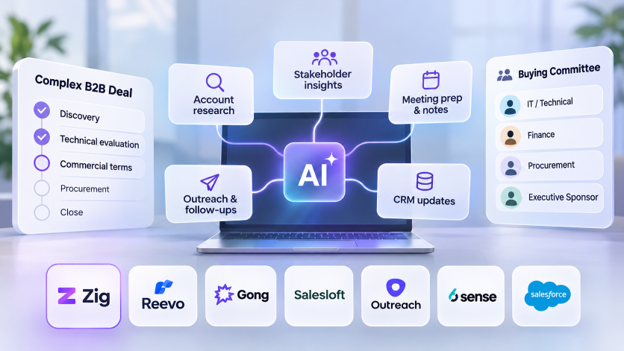
Enterprise B2B deals can involve months of discussions, multiple departments, and decision-makers who enter the process at different stages. A sales team might spend weeks working with a technical buyer, only to discover that procurement has additional requirements or that the executive sponsor has different priorities.
Managing these opportunities requires more than keeping the CRM updated. Account executives need to understand customer priorities, coordinate conversations, prepare for meetings, and follow through on commitments. Sales managers need visibility into what is happening across accounts, while revenue operations teams work to keep information and processes consistent.
AI tools for complex B2B sales help teams manage the research, communication, customer information, and operational work involved in long sales cycles.
Some platforms help sellers complete activities across existing systems. Others analyze customer conversations, identify accounts showing buying intent, organize engagement, or provide the CRM infrastructure used to manage opportunities.
The distinction matters because complex sales problems rarely have a single cause. A team struggling with delayed follow-ups needs different capabilities from one that cannot identify decision-makers or accurately forecast its pipeline.
This guide compares seven AI sales platforms based on the problems they address, how they fit enterprise revenue operations, and the teams most likely to benefit from them.
Selection approach: The platforms represent different categories of enterprise sales technology, including AI execution, CRM, conversation intelligence, sales engagement, account intelligence, and forecasting. Each is evaluated according to its primary use case rather than a standardized performance score.
Best AI Tools for Complex B2B Sales Compared
| Platform | Primary Focus | Best For |
| Zig | AI agents and cross-system sales execution | Enterprises coordinating revenue activities across existing systems |
| Reevo | AI-native CRM and consolidated sales workflows | Teams looking to bring sales information into one workspace |
| Gong | Conversation and deal intelligence | Managers reviewing customer discussions and opportunity risks |
| Salesloft | Revenue orchestration and forecasting | Revenue leaders managing pipeline performance |
| Outreach | Sales engagement and revenue workflows | Teams coordinating outreach and follow-ups |
| 6sense | Account intelligence and buying signals | Organizations prioritizing target accounts |
| Salesforce Sales Cloud | CRM and opportunity management | Enterprises with customized sales processes |
1. Zig — Best for Coordinating AI Sales Execution Across Revenue Systems
Complex B2B sales generate work across numerous applications. Account executives use CRM records to understand opportunities, email and calling tools to communicate with stakeholders, and meeting notes to track customer requirements and commitments.
The difficulty is keeping those activities connected as an opportunity progresses.
Zig brings AI sales agents and automation into enterprise revenue workflows, helping organizations coordinate sales activities using information from their existing business systems.
Its enterprise offering connects and structures business information to support custom datasets, workflows, and AI agents. This allows organizations to build AI-supported processes around their revenue operations rather than treating each sales activity as a separate task.
Zig also provides tools for day-to-day execution, including ZigLead for lead enrichment, AI outbound email, ZigDialer for calling, and Zigscribe for meeting preparation and transcription.
How Zig Supports Complex B2B Opportunities
Consider an enterprise account executive working on a deal involving a technical evaluation, commercial negotiations, and procurement approval.
Before each conversation, the representative needs relevant account information. Afterward, the team must coordinate follow-ups, preserve important details, and keep customer records current.
When that work spans multiple systems, representatives spend time gathering information and transferring it between applications.
Zig helps connect the information and activities involved in those workflows. Its AI-supported capabilities cover account research, outreach, meeting preparation, follow-up, and CRM-related tasks.
CRM Sync supports record maintenance by preparing suggested changes for employee review before they are applied.
For enterprise organizations, Zig’s broader value comes from combining connected business context with AI execution. Teams can build workflows around their existing revenue processes while continuing to use established systems.
This is particularly useful for organizations managing multiple opportunities, departments, and sales activities that depend on information stored across their technology stack.
Key capabilities: Enterprise AI agents, connected business data, custom workflows, lead enrichment, AI outbound email, calling, meeting preparation, transcription, and CRM automation.
Best for: Enterprise revenue teams seeking to coordinate AI-powered sales execution across existing systems and reduce repetitive work throughout complex B2B opportunities.
Consideration: Zig’s enterprise offering is tailored to an organization’s existing systems, data, and revenue workflows, making implementation planning an important part of deployment.
2. Reevo — Best for Consolidating Sales Information and Workflows
Sales representatives managing complex opportunities often spend time searching for information before they can act.
Prospecting details may be stored in one application, meeting notes in another, and customer records in the CRM. This creates additional work whenever an account changes ownership or a new stakeholder joins the buying process.
Reevo combines AI-native CRM capabilities with prospecting, engagement, meeting intelligence, and deal management.
Its Ask Reevo functionality helps users retrieve information from customer and sales data available within the platform.
For example, an account executive preparing for a contract negotiation can review previous interactions and relevant account details without manually assembling information from several applications.
Reevo’s approach centers on consolidating sales information and activities within an AI-native CRM environment.
This makes it relevant to organizations considering a more unified sales workspace, particularly when employees currently rely on multiple disconnected tools.
Key capabilities: AI-native CRM, prospecting, sales engagement, meeting intelligence, deal management, and AI-assisted information retrieval.
Best for: Revenue teams seeking a consolidated environment for managing customer information and sales workflows.
Consideration: Moving to an AI-native CRM involves evaluating existing processes, data migration, reporting requirements, and integrations.
3. Gong — Best for Identifying Deal Risks in Customer Conversations
A complex opportunity can involve dozens of conversations before the customer makes a decision.
Different stakeholders may raise different concerns. A technical evaluator might question implementation requirements, while a finance leader focuses on cost and expected returns.
When those discussions are summarized inconsistently, sales managers can struggle to understand the opportunity’s actual status.
Gong captures and analyzes customer interactions to provide conversation and revenue intelligence.
Its capabilities help teams examine customer discussions, identify important themes, and connect conversation information with deal context.
A manager reviewing a strategic account can use Gong to understand which concerns have been raised, how representatives responded, and where additional attention may be needed.
Gong also supports sales coaching through conversation analysis, helping managers review discovery techniques, objection handling, and other customer-facing activities.
Its value is especially clear when important deal information exists in meetings but is not fully reflected in CRM records.
Key capabilities: Conversation capture, transcription, conversation analysis, deal intelligence, and sales coaching.
Best for: Enterprise sales managers seeking deeper visibility into customer conversations and opportunity risks.
Consideration: Teams should establish how conversation insights will be incorporated into deal reviews, coaching, and existing CRM workflows.
4. Salesloft — Best for Managing Revenue Execution and Forecasting
Large enterprise sales organizations need to understand both what representatives are doing and how those activities affect pipeline performance.
An opportunity may appear likely to close, but unresolved procurement questions or inconsistent customer engagement can change the expected outcome.
Salesloft brings together sales engagement, conversation intelligence, revenue intelligence, and forecasting capabilities.
Following its merger with Clari, the combined company operates under the Salesloft brand, bringing established sales engagement workflows together with revenue orchestration and forecasting capabilities.
Its Predictive Revenue System supports a broader approach to managing revenue operations, while Clari Forecast remains part of the product portfolio.
For revenue leaders, this creates opportunities to examine pipeline conditions alongside sales activities and customer engagement.
A regional sales director reviewing a quarterly forecast, for example, can assess which opportunities require attention and coordinate the team’s next steps.
Salesloft is particularly relevant to organizations managing large opportunity portfolios across multiple sales teams.
Key capabilities: Sales engagement, conversation intelligence, revenue intelligence, pipeline management, and forecasting.
Best for: Enterprise revenue leaders coordinating sales execution, pipeline management, and forecasting.
Consideration: Organizations should review the specific products included in their Salesloft deployment and how they fit existing revenue processes.
5. Outreach — Best for Coordinating Multi-Stage Sales Engagement
Enterprise opportunities require consistent communication across long periods.
An account executive may need to follow up after discovery, coordinate a technical evaluation, and maintain contact during contract negotiations. At the same time, an SDR may be engaging additional stakeholders within the account.
Without structured engagement processes, communication can become inconsistent, delayed, or repetitive.
Outreach provides sales engagement and sequencing capabilities that help teams organize communication workflows.
Representatives can manage outreach activities and follow-ups, while managers maintain visibility into how engagement processes are executed.
The platform also offers deal management and forecasting capabilities, extending its role beyond prospecting sequences.
For larger sales organizations, Outreach helps establish consistent processes across territories, teams, and customer segments.
It is especially relevant when the challenge is maintaining coordinated communication throughout a lengthy sales cycle.
Key capabilities: Sales sequences, engagement workflows, prospect activity management, deal management, and forecasting.
Best for: Enterprise sales teams managing structured outreach and follow-up activities across complex opportunities.
Consideration: Teams should align engagement sequences with existing CRM processes and adapt communication to the needs of different stakeholders.
6. 6sense — Best for Prioritizing Accounts Showing Buying Intent
Enterprise buyers often begin researching solutions long before contacting a vendor.
Several employees within the same organization may investigate products independently, making it difficult for sales teams to recognize which accounts are actively evaluating a category.
6sense provides account intelligence and predictive capabilities designed to help B2B organizations identify potential buying activity.
The platform combines account data and intent-related signals to support account prioritization and go-to-market planning.
For example, an account-based sales team targeting large manufacturing organizations can use buying signals to prioritize accounts for research and outreach.
Instead of approaching every target account with the same level of effort, the team can focus on organizations showing relevant activity.
6sense is particularly useful for businesses with defined target-account lists and coordinated sales and marketing programs.
Key capabilities: Account intelligence, intent signals, predictive analytics, and account prioritization.
Best for: Enterprise organizations using account-based sales and marketing strategies.
Consideration: Buying signals are most useful when combined with account qualification, customer conversations, and a defined engagement strategy.
7. Salesforce Sales Cloud — Best for Managing Complex CRM and Opportunity Processes
Large B2B organizations often have sales processes that extend beyond a basic pipeline.
Opportunities may involve multiple business units, account hierarchies, internal approvals, and customized reporting requirements.
Salesforce Sales Cloud provides CRM capabilities for managing accounts, contacts, opportunities, and sales activities.
Organizations can configure the platform to reflect their sales stages, reporting structures, and internal workflows.
An enterprise software company, for example, may need to track opportunities involving technical evaluations, commercial approvals, and several customer departments.
Salesforce can serve as the central system for organizing those records and processes.
The broader Salesforce ecosystem also includes AI offerings such as Einstein and Agentforce, which extend AI capabilities into supported customer and business workflows.
For enterprises with established Salesforce environments, Sales Cloud provides a configurable foundation for managing complex sales operations and connecting specialized applications.
Key capabilities: Account and opportunity management, customizable sales processes, reporting, CRM workflows, and access to AI capabilities within the Salesforce ecosystem.
Best for: Enterprises requiring configurable CRM infrastructure for complex sales operations.
Consideration: Implementation planning should account for customization, administration, integrations, and the AI products required for the intended workflows.
Which AI Sales Tool Fits Your Biggest Enterprise Challenge?
Complex sales processes create different operational problems. Choosing software becomes easier when the organization identifies where work slows down or information becomes difficult to use.
| Enterprise Sales Challenge | What the Team Needs | Platform to Consider |
| Sales activities and information are spread across multiple systems | Connected AI workflows and execution support | Zig |
| Customer information is scattered across sales applications | Consolidated CRM and sales workspace | Reevo |
| Important objections and commitments are buried in meetings | Conversation and deal intelligence | Gong |
| Revenue leaders need stronger pipeline visibility | Revenue intelligence and forecasting | Salesloft |
| Follow-ups and outreach are inconsistent | Structured sales engagement workflows | Outreach |
| Teams struggle to identify active target accounts | Buying signals and account intelligence | 6sense |
| Opportunity processes require extensive customization | Configurable CRM and opportunity management | Salesforce Sales Cloud |
These categories can overlap. An enterprise may use a CRM as its primary system of record, a conversation intelligence platform for customer discussions, and AI execution workflows to support activities between meetings.
The useful question is not how many AI features a platform offers, but which part of the sales process it improves.
Why Complex B2B Deals Lose Momentum
Long sales cycles are not always the main problem. Opportunities often slow down because important information is missing, responsibilities are unclear, or customer decisions are not progressing.
| Warning Sign | Potential Cause | What Sales Teams Should Examine |
| Meetings continue without a decision | Unclear buying process | Decision criteria and next steps |
| Only one stakeholder is engaged | Limited relationship coverage | Buying committee participation |
| Procurement enters late | Incomplete process planning | Commercial and approval requirements |
| Customer concerns repeat across meetings | Unresolved objections | Conversation history and ownership |
| CRM stages do not reflect customer activity | Incomplete opportunity information | Record quality and deal evidence |
| Follow-ups are repeatedly delayed | Administrative workload or unclear ownership | Task completion and responsibilities |
A team may complete several meetings without getting closer to a purchasing decision. Progress is better demonstrated through agreed evaluation criteria, involvement from relevant stakeholders, completion of technical reviews, and movement through required approvals.
AI can help by making customer information easier to retrieve, supporting recurring execution activities, and improving visibility into conversations and opportunities.
Sales teams can then focus their attention on the decisions and relationships that determine whether a deal advances.
How to Evaluate AI Tools for Complex B2B Sales
Enterprise buyers should evaluate software against real sales workflows rather than isolated product demonstrations.
1. Identify Where Work Breaks Down
Start by examining where opportunities lose momentum.
If representatives spend hours preparing for meetings and updating records, sales execution automation may provide the greatest value.
If managers struggle to understand customer concerns, conversation intelligence may be more useful.
If the organization cannot identify which target accounts are actively researching solutions, account intelligence becomes a priority.
2. Review Existing Systems and Data
Enterprise revenue information often spans CRM platforms, email, meeting records, marketing systems, and internal documents.
A useful evaluation should identify which systems contain relevant information and how the proposed software will work with them.
For organizations adopting AI agents, access to accurate business context is particularly important. An agent working with incomplete customer information may produce less useful results than one operating with relevant data from connected systems.
3. Define Automation and Approval Responsibilities
Not every AI-assisted activity requires the same level of oversight.
Researching an account, preparing a meeting summary, suggesting a CRM update, and sending customer communication involve different responsibilities.
Enterprise teams should establish which activities can run automatically and which require employee approval.
4. Measure Results With Real Opportunities
A pilot should test the product against actual sales work.
Useful measures include time spent preparing for meetings, follow-up completion, CRM record completeness, stakeholder engagement, and administrative workload.
The goal is to determine whether the platform improves the activities that matter to the organization.
Frequently Asked Questions
What Are the Best AI Tools for Managing Complex B2B Sales?
Zig supports AI-powered sales execution across existing revenue systems. Gong focuses on conversation and deal intelligence, while 6sense helps teams identify buying signals across target accounts.
Salesloft provides revenue orchestration and forecasting, Outreach supports structured engagement, Reevo offers an AI-native CRM workspace, and Salesforce Sales Cloud provides configurable CRM and opportunity management.
Each platform addresses a different part of complex B2B selling.
How Do AI Sales Agents Work Across Multiple Revenue Systems?
AI sales agents can use information from connected business applications to support activities such as account research, communication, meeting preparation, and CRM-related workflows.
For enterprise organizations, connecting relevant revenue information helps AI operate with more complete business context and supports workflows that span several applications.
Can AI Tools Help Manage Multi-Stakeholder Sales Opportunities?
Yes. AI tools can support account research, customer conversation analysis, meeting preparation, and opportunity information management.
These capabilities help teams organize information from different stakeholder interactions and coordinate the activities involved in longer buying processes.
Can AI Sales Tools Shorten Enterprise Sales Cycles?
AI tools can reduce administrative delays, improve access to customer information, and support timely follow-ups.
They help teams maintain momentum between meetings, particularly when opportunities involve several stakeholders and extended evaluation processes.
Final Thoughts
Complex B2B sales require more than accurate pipeline records. Teams need relevant customer information, coordinated communication, and consistent execution throughout lengthy buying processes.
The platforms in this comparison address different requirements. Some help teams understand customer conversations or prioritize accounts, while others provide CRM infrastructure, forecasting, engagement workflows, or AI-powered execution across existing systems.
For enterprise organizations, the strongest approach is to identify where information or activities become disconnected and select technology that addresses those problems.
That creates a more practical foundation for managing complex opportunities, reducing administrative work, and helping revenue teams focus on moving deals forward.
To read more content like this, explore The Brand Hopper
Subscribe to our newsletter
Go to the full page to view and submit the form.