


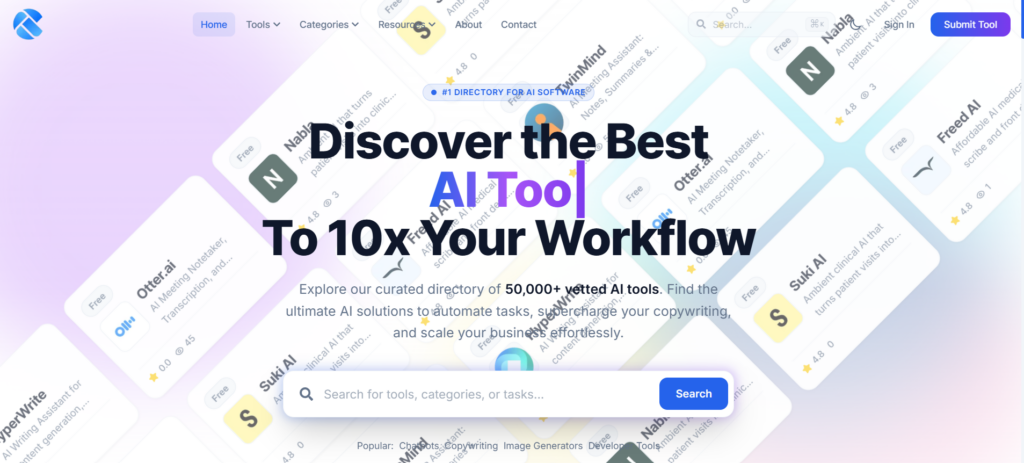
In a market where new AI tools launch faster than anyone can reasonably track them, AI Central Resources has taken a narrower bet than most directories: rather than racing purely on catalog size, it pairs a fast-growing tool listing with editorial content built on actual hands-on testing.
The directory currently spans 197 tools across 24 categories and 150 subcategories — covering everything from AI writing and marketing tools to developer platforms, image generation, and productivity software — and it’s growing quickly, adding new listings at a pace of roughly 11 per week over the past quarter.
What differentiates AI Central from a purely aggregated listing site is its approach to comparison content. Its guide to AI meeting note-takers, for instance, is built on a stated methodology of running each tool through dozens of real meetings over a six-week testing window before ranking it — a level of hands-on scrutiny that’s uncommon in a space where most “best AI tools” roundups are assembled from vendor marketing pages.
This article looks at AI Central’s origins, business model, competitive landscape, and where it fits in a crowded and fast-consolidating AI directory market.
Founding Story of AI Central Resources
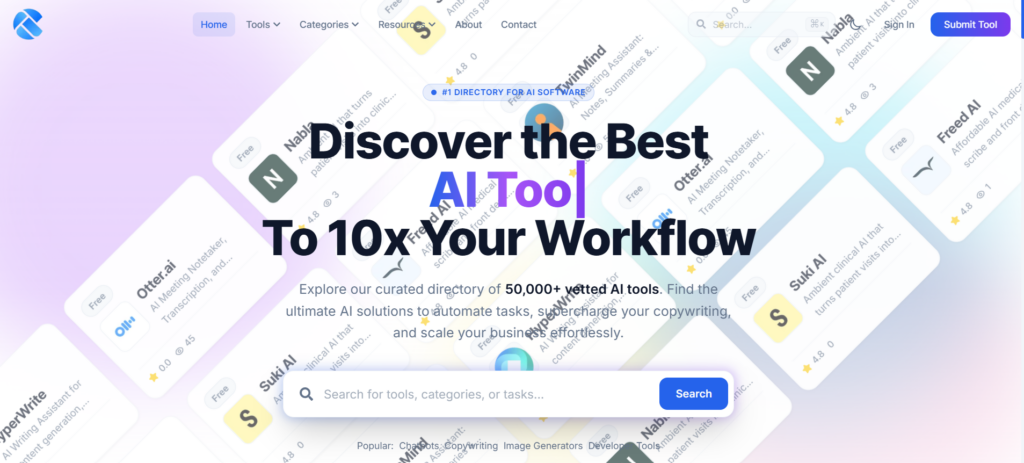
AI Central Resources was built around a straightforward premise: AI tools have real power to change how people work and create, but only if the right one can actually be found. As new AI products launched by the day, that had become a problem in its own right — sorting genuine utility from launch-day noise required more digging than most people had time for.
Founder Hamza Khaliq, an AI generalist and developer, set out to build a directory aimed squarely at that gap — one weighted toward marketers, copywriters, and founders who needed a dependable shortlist rather than an unfiltered feed. That premise still shapes the site’s editorial approach: fewer, better-vetted recommendations over sheer catalog size.
Founders and Leadership of AI Central Resources
| Name | Role | Background |
| Hamza Khaliq | Founder & CEO | AI generalist and senior developer with 4+ years in AI and product application |
| Sarah Williams | Head of Research | Data scientist specializing in AI benchmarking; oversees the evaluation standards every listed tool is measured against |
| Michael Chen | Community Lead | Works to bridge developers and users, building a supportive ecosystem for AI adoption |
Business Model of AI Central Resources
AI Central operates as a content-and-discovery platform rather than a transactional marketplace: it doesn’t sell AI tools directly, but helps buyers narrow a fast-expanding market down to a shortlist worth evaluating.
The model rests on two pillars. The first is the directory itself — free, searchable tool listings organized by category and subcategory, designed for someone who already knows roughly what kind of tool they need (an AI meeting note-taker, a social media scheduler, a writing assistant) and wants to compare options quickly. The second is long-form editorial content — ranked, tested buying guides that go deeper than a listing page can, aimed at readers who need a recommendation rather than just a list.
AI Central describes this positioning directly: editorial evaluation with recurring re-validation and workflow-focused scoring, versus Product Hunt’s launch-day, upvote-driven visibility model, or the broader, lighter-touch discovery approach of directories like Futurepedia and AlternativeTo. The pitch is decision quality for teams choosing tools for ongoing use, not a snapshot of what launched this week.
Revenue Streams of AI Central Resources
AI Central monetizes primarily through paid tool placements — featured listings that surface a vendor at the top of its category page, starting at $99/month — alongside sponsored guest content and contextual link placements within relevant existing articles. The site also earns affiliate commissions on some tool referrals, which it discloses does not influence which tools are recommended. This keeps the core directory and comparison content free for readers while giving vendors a way to buy visibility in a specific, relevant category.
Funding of AI Central Resources
AI Central Resources is self-funded. Its team and public materials make no reference to outside investors, consistent with a lean, founder-led operation rather than a venture-backed one — a profile it shares with several of the smaller directories in the comparison below.
Competitors of AI Central Resources
The AI tools directory space has gotten crowded fast, with players differentiating mainly on catalog size versus curation depth.
| Competitor | Primary Focus | How It Compares to AI Central |
| Futurepedia | Curated directory + AI education platform | Positions itself as the first AI tool directory; pairs ~4,000–5,000 listings with courses and video reviews — broader in scope than AI Central, less focused on hands-on tool testing |
| There’s An AI For That | Task-based search across a very large index | 12,000+ manually vetted tools with search built around “what do you want to accomplish” rather than category browsing |
| Toolify | Large-scale, auto-updated database | 26,000+ tools across 450+ categories — wins on raw scale, with less editorial depth per listing |
| AIChief | Brand-safe, human-edited directory | Claims human-tested, human-edited listings across a similar category spread to AI Central |
| ToolDirectory.ai | Editor-reviewed, quarterly re-tested listings | Closest philosophical match to AI Central’s testing-based approach, tracking tool shutdowns and re-testing on a schedule |
Against these, AI Central is smaller by catalog size but leans into the same “curation over volume” positioning as Futurepedia and ToolDirectory.ai, rather than competing head-on with Toolify or TAAFT on raw breadth.
Competitive Advantage of AI Central Resources
AI Central’s clearest differentiator is methodology: its comparison guides are built around actually using the tools rather than summarizing vendor claims. The meeting note-taker guide is a representative example — every tool in that ranking was run through real meetings over a multi-week window, with an explicit accuracy threshold used to disqualify underperformers, rather than a list assembled from press releases.
The second advantage is category breadth relative to its size: 24 categories and 150 subcategories give it granular coverage — down to specific niches like AI social media management or AI email marketing automation — that smaller directories typically don’t attempt.
Third is growth velocity: the catalog has been expanding at roughly 11 new tools a week, suggesting an operational process built for a market that changes weekly, not quarterly.
Products & Services of AI Central Resources
| Product | Description |
| Tool Directory | Searchable listings across 24 categories and 150 subcategories, covering writing, marketing, productivity, developer tools, image generation, and more |
| Tested Buying Guides | Long-form, ranked comparison articles built on hands-on testing rather than vendor-supplied claims |
| Category Pages | Deep-linked category and subcategory pages for narrower searches (e.g., AI social media management tools specifically, rather than “marketing tools” broadly) |
| Sponsored Placements | Paid guest content, link insertions, and featured listings for tool vendors seeking visibility in a relevant category |
Conclusion
AI Central Resources is competing in a directory market that’s consolidating around two strategies: scale (Toolify, There’s An AI For That) and curation (Futurepedia, ToolDirectory.ai). Its 197-tool catalog and rapid weekly growth put it on the smaller side of that market today, but its testing-driven editorial approach — visible in guides like its AI meeting note-taker ranking — places it closer to the curation camp than the volume camp.
That focus traces back to founder Hamza Khaliq’s original premise: that AI tool discovery should be a shortlist you can trust, not another feed to sift through.
To read more content like this, explore The Brand Hopper
Subscribe to our newsletter
Go to the full page to view and submit the form.