


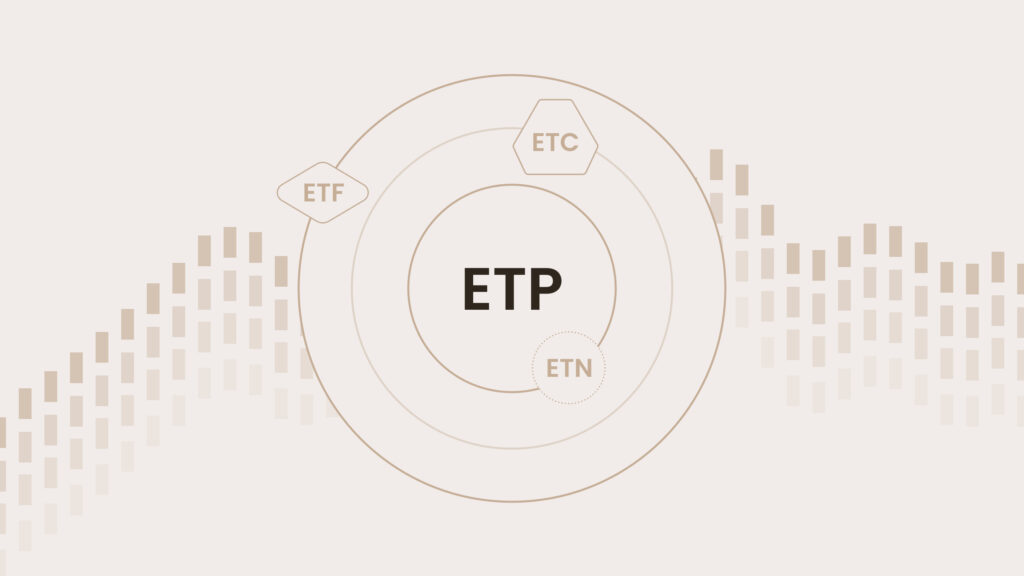
Exchange traded products (ETPs) are financial instruments that you can buy and sell on stock exchanges, much like individual shares. They allow you to gain exposure to various assets, market indices, or investment strategies without necessarily having to purchase the underlying investments individually.
ETPs can appeal to beginning investors because of their accessibility and potential diversification benefits, as well as their convenient trading process. However, not all ETPs work the same way or carry the same degree of risk. Aspects such as their structures and underlying assets can differ significantly, which means that some may be considerably more challenging for newcomers to navigate than others.
So, are ETPs suitable for beginners? Certain products, particularly broadly diversified, low-cost exchange-traded funds (ETFs), can be reasonable starting points. However, their suitability ultimately depends on your financial circumstances, investment objectives, and risk tolerance. Read on for a detailed exploration of how ETPs work, along with their potential benefits and limitations.
How Do Different Types of ETPs Work?
ETPs are traded through brokerage accounts, with prices fluctuating throughout the trading day according to market conditions. Many are designed to track the performance of specific indices, assets, or benchmarks. For instance, an ETP tracking a stock market index aims to provide returns that closely reflect that index’s performance, although fees and other factors can cause differences.
ETFs are among the most common ETPs, often holding baskets of stocks, bonds, or other assets. Exchange-traded notes (ETNs), meanwhile, are debt securities whose returns are linked to an underlying benchmark, exposing investors to the issuer’s credit risk. Exchange-traded commodity products offer exposure to assets such as gold, although their structures vary. These distinctions matter because each product carries different risks, making conventional, diversified ETFs generally easier for beginners to understand.
Why Might ETPs Appeal to Beginning Investors?
One major advantage of certain ETPs is diversification. Instead of investing in just one company, you can purchase shares in a broad-market ETF that provides exposure to numerous businesses through a single transaction. This helps reduce your dependence on any particular company’s performance, although it does not protect you against losses when the wider market declines.
Many index-tracking ETFs also have relatively low management fees compared with actively managed funds, potentially reducing the ongoing cost of investing. Their exchange-traded nature offers additional convenience, allowing you to buy or sell during market hours through a brokerage account. Depending on your broker and the relevant exchange, you may also be able to start with relatively small amounts; many of these products are accessible without requiring substantial initial capital.
What Risks Should You Be Aware Of?
ETPs are not risk-free, and their value can decline when their underlying investments perform poorly. The extent of this risk depends on the product’s exposure. For instance, a broad-market ETF spreads your investment across numerous companies, whereas an ETP focused on a single industry or commodity may experience sharper price fluctuations. Even diversified products remain vulnerable to broader market downturns.
More complex ETPs introduce additional considerations. Leveraged and inverse ETPs, for example, often reset their exposure daily, potentially producing unexpected results when held over longer periods. With ETNs, it’s possible that issuers may fail to meet their obligations, while overseas investments may involve currency risk. As a beginner, it’s generally sensible to avoid products whose structure and potential losses you don’t fully understand.
What Should You Check Before Choosing an ETP?
Start by examining the ETP’s investment objective, underlying assets, and benchmark, if applicable. These details help you determine whether its exposure aligns with your financial goals and risk tolerance. Two ETPs may appear similar but follow very different strategies; reviewing their factsheets and prospectuses can help you identify important distinctions before committing your money. Common ETF risks, for instance, may include tracking errors, which occur when an ETF’s returns differ from its benchmark, and liquidity constraints that can make selling at a fair price difficult. The existence of these risks reinforces the need to assess a product beyond its potential returns.
You should also consider the costs of investing, including management fees, brokerage commissions, bid-ask spreads, and potential currency conversion charges. Trading liquidity matters too, as less actively traded products may be harder to buy or sell at your preferred price.
How Can Beginners Approach ETP Investing?
Before investing, assess your financial readiness and consider how ETPs fit into your broader plans. Have sufficient emergency savings and any existing financial obligations under control; this will help you avoid selling investments prematurely to cover unexpected expenses. Your investment horizon also matters, as money needed in the near future may be better kept in more stable, accessible savings.
Once you’re financially prepared, consider starting with diversified, low-cost ETFs that match your objectives and risk tolerance. You can invest manageable amounts regularly rather than committing a large sum immediately, although this approach doesn’t eliminate the possibility of losses. Review your portfolio periodically to ensure it still aligns with your goals, but avoid making impulsive decisions based on short-term market movements.
You don’t need to understand every aspect of the financial markets you’ll be entering to get started with ETPs. What matters is taking the time to understand the products you’re considering and recognising when an investment may not be right for you. After all, becoming a more confident investor is as much about knowing when to hold back as it is about knowing when to invest.
To read more content like this, explore The Brand Hopper
Subscribe to our newsletter
Go to the full page to view and submit the form.