



Running an SEO agency means keeping retainers, rank-tracking work, link-building projects, and client reporting all moving at once, usually across a pile of tools that share no data with each other. The five platforms below represent the strongest options on the market right now.
Why SEO agencies need management software that scales
SEO work sits in an odd spot among professional services: the same tasks repeat every month, retainer scope drifts without anyone calling it out, and margins shrink quietly before the numbers catch up. A generic project tool won’t flag the moment a client’s retainer starts getting eaten by untracked hours. And a bare-bones invoicing app won’t tell you which accounts are already underwater.
Agencies that grow past five or six clients need software that connects time logged to margin earned, keeps proposals and projects in the same system, and handles the billing flexibility that SEO retainers require: fixed monthly fees alongside ad hoc hourly work, sometimes on the same account.
What SEO agencies actually look for in management software
What matters most shifts with agency size, but a few needs keep showing up regardless. Time tracking that ties directly to retainer budgets. Per-client margin visibility. Proposal tools that can actually scope recurring work without awkward workarounds. And client reporting that doesn’t eat an entire afternoon every billing cycle.
Pricing model matters too. Per-user pricing scales painfully as headcount grows; a few platforms offer flat or modular pricing that’s easier to predict. Most agencies also want native invoicing rather than a third-party export, so the billing record stays connected to actual project delivery.
1. Verbial
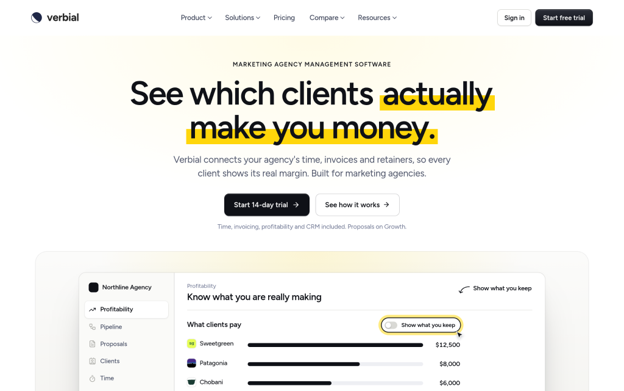

Verbial is purpose-built for marketing agencies, combining CRM, proposals, project delivery, time tracking, invoicing, and margin analysis in one workspace: with specific attention to how SEO and other discipline-specific agencies bill and track margin.
- Who it fits: SEO, PR, social, paid media, and full-service agencies that need retainer pacing alongside hourly and project billing on the same account.
- Standout features:
– Proposal drafting from discovery calls.
– Retainer pacing tools that show budget burn in real time.
– White-label client reporting.
– Utilization and agency valuation calculators available as free resources.
– Handles mixed billing models, fixed retainer, hourly, and project fees, without requiring separate systems for each arrangement.
– Shows margin by client and by team member, so agency owners can spot underpriced accounts before the month closes.
– Free trial available; tiered pricing with a “Start for free” entry point.
2. Scoro
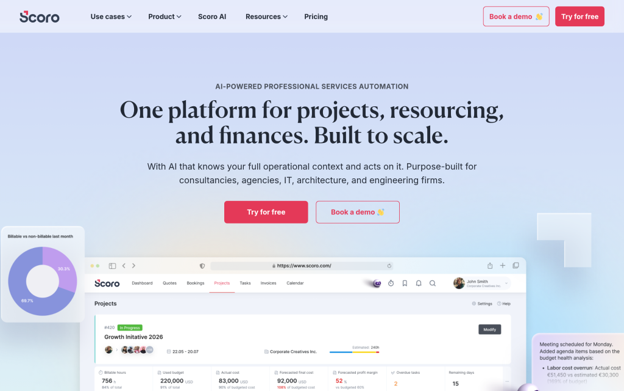
Scoro is a modular professional services automation platform built for agencies, consultancies, and IT firms that want detailed financial reporting without stitching together separate tools.
- Who it fits: Mid-size to large agencies across disciplines; also suits architecture and consulting firms that want scalability to multi-entity operations.
- Standout features: Eight modular apps covering project management, resource planning, time tracking, billing, CRM pipeline, and expense management; ELI, an AI companion embedded across the platform. The modular structure starts from €15 per user per month, and customers pay only for the apps they actually use, though European pricing (EUR) may add friction for US-based agencies comparing costs against USD-priced alternatives.
Scoro is named a Leader in G2’s Professional Services Automation and Time Tracking Grid Reports, and the platform is used in over 60 countries. Scoro’s interlinked data model means a deal closed in CRM flows automatically into project delivery and invoicing, useful for agencies tired of re-entering scope details across tools.
3. Productive
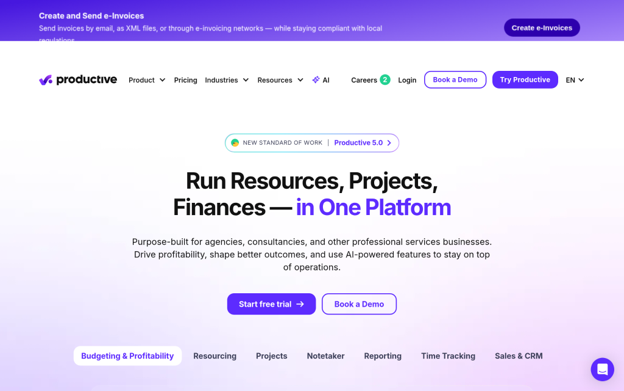
Productive is a self-funded PSA platform built by agency operators, with native resourcing, margin forecasting, and revenue recognition designed around how services businesses actually run.
- Who it fits: Agencies, consultancies, IT services, and software firms, particularly well-suited to teams that want forecasting depth without outside-investor pressure to bloat the product.
- Standout features: Gantt charts, resource planning, time-off management, sales CRM with AI notetaker, scenario builder, and revenue recognition, all within one subscription. A free 14-day trial is available with no credit card required. As of 2026, Productive serves roughly 200 customers, so the ecosystem of integrations and community resources is smaller than more established platforms.
Productive was founded in 2014 by the team behind a 350-person design and development firm and has remained bootstrapped and profitable since.
4. Accelo
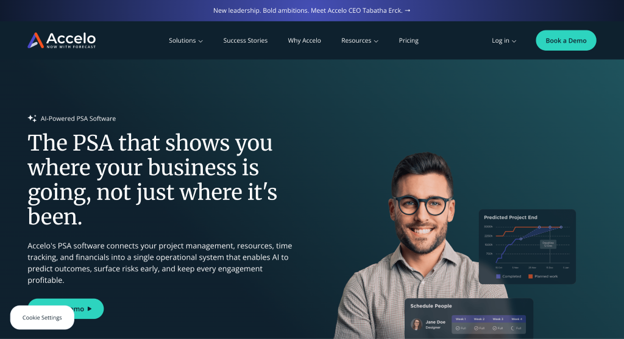

Accelo is an end-to-end client work management platform that covers everything from prospect to payment, with predictive AI that surfaces project risks before budgets are blown.
- Who it fits: Consulting, accounting, agency, IT, and engineering firms; agencies handling high-volume ticket work alongside project retainers will find the ticketing module especially useful.
- Standout features:
– Predictive AI for outcome forecasting.
– Native resourcing and capacity planning.
– Retainer management.
– Built-in timesheets connected to billing.
- Considerations: The interface takes time to set up initially; smaller agencies may find the feature depth harder to configure quickly.
Accelo acquired UK-based Forecast in July 2025, adding deeper predictive planning and resource planning capabilities to the platform. Accelo earned 89 unique G2 badges in 2025 and ranked #1 in User Satisfaction for PSA in the G2 2023 Awards.
5. Kantata
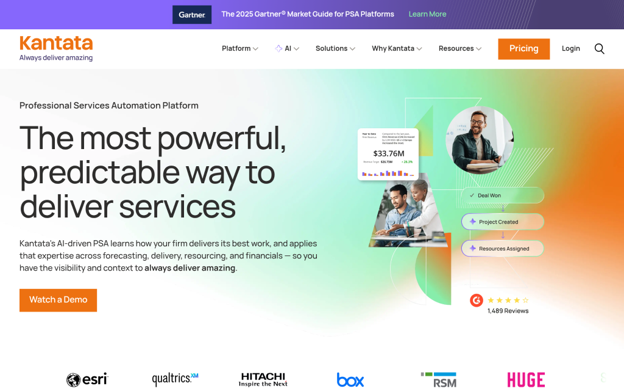
Kantata is a mid-market to enterprise PSA platform built from the 2021 merger of Mavenlink and Kimble, serving over 2,500 professional services organizations with resource planning and financial management.
- Who it fits: Larger agencies and professional services firms with complex multi-project portfolios; Deloitte, Sage, and Hitachi are among its named clients.
- Standout features: An engine that learns from past engagements to improve resource matching and delivery forecasting; business intelligence for revenue and margin risk. Kantata offers two architectures: OX (standalone platform, formerly Mavenlink) and SX (Salesforce-native, formerly Kimble Applications), so agencies already on Salesforce can adopt the SX build without leaving that ecosystem. Pricing is available on custom quotes only, with a 50-seat minimum requirement.
- Considerations: The 50-seat minimum and enterprise-tier pricing make Kantata a poor fit for agencies under around 40 people.
Bottom Line
Picking the best agency management software for SEO agencies in 2026 really comes down to two questions: how complicated is the billing model, and how much margin visibility does the team genuinely need each month? Kantata and Scoro are the right fit for larger shops running complex operations. Productive and Accelo work well for mid-size agencies that want real forecasting depth without signing an enterprise contract. Smaller and growth-stage SEO agencies, especially those juggling mixed retainer and hourly arrangements, should look closely at platforms built around agency billing from the ground up rather than generic PSA tools adapted after the fact.
To read more content like this, explore The Brand Hopper
Subscribe to our newsletter
Go to the full page to view and submit the form.