


Key Takeaways:
- Healthcare organizations face the highest compliance bar in video translation: HIPAA, GDPR, and clinical accuracy on every line of patient-facing or staff-training content.
- Leading platforms now combine voice cloning across 30+ languages with SOC 2 certification and customizable medical glossaries, removing the historical trade-off between localization speed and regulatory safety.
- Multi-speaker detection matters for scenario-based clinical training and patient-provider role-plays, where a single video typically contains three or more voices.
- Translation dictionary control for medication names, diagnostic terminology, and treatment protocols is the single most important feature for clinical content where mistranslation creates real patient risk.
- AI workflows have cut localization cost by 80–90% versus traditional medical translation services, putting multilingual patient education within reach of community hospitals and large health systems alike.
Why Healthcare Needs Specialized AI Video Translation
Healthcare video content sits in a different risk category than marketing or general training. A mistranslated dosage instruction, an unclear consent video, or a culturally insensitive patient education clip carries direct clinical consequences — which is part of why more health systems and research teams are shifting toward eConsent to keep the consent process itself documented and auditable. The result has been that most health systems either delivered patient-facing content in English only (reducing comprehension by 30–50% for non-native speakers) or paid $400 to $800 per minute for specialized medical translation services with 6–10 week turnaround.
AI workflows in 2026 have shifted the cost and time math without lowering the compliance bar. Leading platforms now produce HIPAA-aligned, fully dubbed multilingual videos in 130+ languages within 24 to 48 hours, at $3 to $30 per minute, with voice cloning preserving the clinician’s voice and authority across every target language.
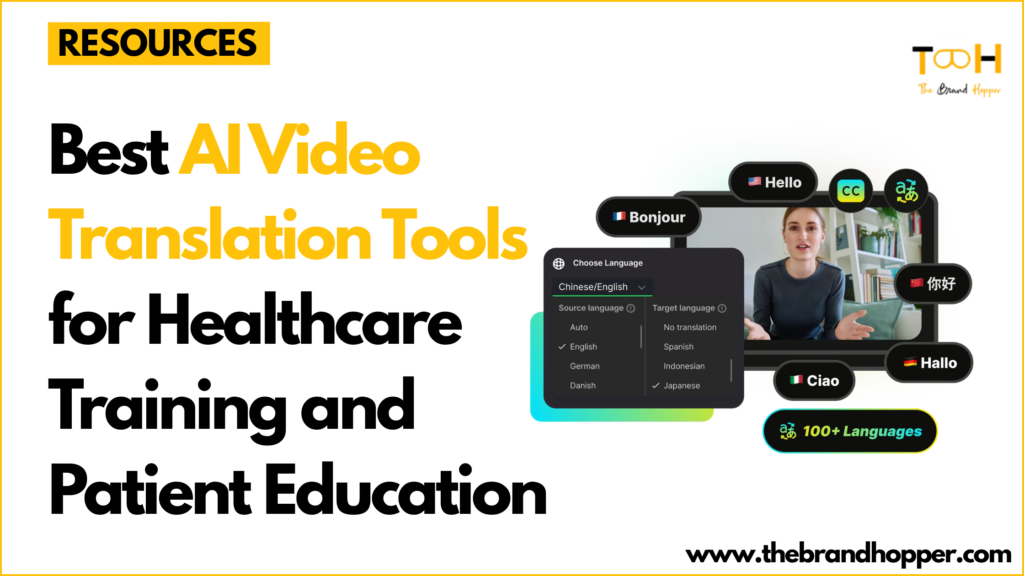
Healthcare leaders evaluating AI video translation for healthcare should weigh six criteria before standardizing on a platform. AI video translation tools such as Rask AI now combine voice cloning, multi-speaker detection, medical glossary control, and SOC 2 compliance in one workflow. This piece reviews the leading platforms healthcare organizations are using in 2026 for staff training, patient education, and continuing medical education.
What Healthcare Teams Should Look For in a Video Translation Tool
Six criteria separate clinically appropriate platforms from creator-focused ones.
Medical glossary and translation dictionary control. Medication names, drug interactions, diagnostic terminology, dosing schedules, and treatment protocols must stay consistent across every language version. A central translation dictionary that applies to all future uploads is the single most important feature for clinical accuracy.
Voice cloning quality for clinician voices. Patients and staff recognize their attending physician, head nurse, or chief medical officer within seconds. A generic AI voice on the Spanish version of a patient education video erodes trust. Tools that clone the clinician’s voice across 30+ languages with emotional inflection preserved are the standard for sustained patient education programs.
Multi-speaker detection for scenario content. Clinical training mixes physician, nurse, patient, family member, and interpreter voices in scenario-based learning. Tools that automatically detect and tag each speaker save substantial time on QA versus manual tagging.
Compliance posture. SOC 2 Type II, GDPR for European patient data, HIPAA-aligned data handling for U.S. systems, and clear policies on PHI exposure during processing. Tools without these will not pass clinical procurement.
Audit trail and version control. Every translated patient-facing asset needs a documented review trail. Platforms with transcript editor, version history, and reviewer sign-off features integrate with clinical governance workflows.
Language coverage including less-resourced patient languages. Community health systems serve patient populations whose primary languages may not be in the top 20 globally. Tools with 130+ languages, including indigenous and refugee-population dialects, fit U.S. county hospital and global health context.
Comparison Table: Top 6 Tools for Healthcare Video Localization
| Tool | Best For | Languages | Voice Cloning | Multi-Speaker | SOC 2 / GDPR | Starting Price |
| Rask AI | Patient education + clinical training | 130+ | 30+ languages | Yes | Yes / Yes | $60/mo |
| Synthesia | Avatar-led patient explainers | 140+ | Limited | No | Yes / Yes | $30/mo |
| HeyGen | Short avatar wellness content | 175+ | Limited | No | Yes / Yes | $24/mo |
| HappyScribe | Subtitle accuracy for clinical content | 120+ | No | N/A | Yes / Yes | $9/mo |
| ElevenLabs | Audio-only patient instructions | 30+ | Yes | No | Custom / Custom | $5/mo |
| Papercup | Hybrid AI + human medical review | 60+ | Limited | Limited | Yes / Yes | Custom |
Platform Reviews
1. Rask AI
Best for: Health systems, hospitals, and pharmaceutical organizations localizing patient education videos, clinical training, and continuing medical education content at scale, with full localization (translation, dubbing, voice cloning, lip-sync) in one SOC 2 certified platform.
Strengths: Voice cloning across 30+ languages preserves the clinician’s voice and authority across every language version, which matters for patient trust and staff training engagement. Multi-speaker detection handles scenario-based clinical training automatically. The Translation Dictionary locks medication names, diagnostic terms, and treatment protocols across every video and every refresh cycle, the single most important feature for clinical accuracy. Coverage of 130+ languages handles the long tail of community health system patient populations including indigenous and refugee dialects. SOC 2 certification and GDPR-compliant handling clear clinical procurement. API and Teamspaces support multi-department deployment across hospital networks.
Limitations: HIPAA Business Associate Agreement requires direct discussion with the vendor; verify current BAA status before deploying for PHI-containing content. Premium pricing scales with content minute volume.
Pricing: Plans start at $60/month for small clinics; enterprise plans with API and BAA available for hospital networks.
2. Synthesia
Best for: Health systems creating new avatar-led patient explainers and wellness content where no original clinician footage exists.
Strengths: 140+ avatar languages, clean lip-sync on avatar output, enterprise compliance and brand-asset controls.
Limitations: Avatar-focused. Wrong tool for localizing existing clinician footage where preserving the attending physician matters most. Voice cloning options narrower than dedicated platforms.
Pricing: From $30/month; enterprise plans on request.
3. HeyGen
Best for: Short avatar-led wellness, marketing, or general-health content for hospital outreach.
Strengths: 175+ avatar languages, fast workflow, easy onboarding for non-technical clinical communications teams.
Limitations: Avatar-focused workflow does not preserve clinician authority. Less suited for clinical training or patient education where attending recognition matters.
Pricing: From $24/month.
4. HappyScribe
Best for: Clinical content with subtitle-first multilingual strategy and audit-trail requirements.
Strengths: Hybrid AI plus human review delivers near-99% subtitle accuracy across 120+ languages. SOC 2 and GDPR certified. Trusted by major healthcare publishers and academic medical centers.
Limitations: Subtitle and transcript platform. No dubbing or voice cloning. Right tool only when subtitles are the explicit strategy for the content type.
Pricing: From $9/month or $12 per 60 minutes pay-as-you-go.
5. ElevenLabs
Best for: Audio-only patient instructions, post-visit summaries, and clinical podcasts.
Strengths: Industry-leading voice cloning quality, strong emotional preservation across 30+ languages.
Limitations: Audio only. No video workflow, no lip-sync, no multi-speaker. Requires combining with separate video tools for clinical training.
Pricing: From $5/month for starter tier; enterprise pricing for higher volume.
6. Papercup
Best for: High-stakes pharmaceutical regulatory content where hybrid AI plus human medical reviewer is mandatory.
Strengths: Excellent translation quality, human linguist review on every project, broadcast-quality output.
Limitations: Slow turnaround (1–3 weeks per language). Highest cost tier. Limited voice cloning. Right tool only for the narrow high-stakes regulatory submissions where human review is non-negotiable.
Pricing: Custom enterprise pricing only.
Cost and ROI for Healthcare Video Localization
The economics of healthcare video translation have shifted decisively in favor of AI workflows.
| Workflow | Per minute | 200 patient education videos × 8 languages |
| Specialized medical translation | $400–$800 | $2,400,000–$4,800,000 |
| Hybrid (AI + human medical review) | $80–$200 | $480,000–$1,200,000 |
| Full AI workflow | $3–$30 | $18,000–$180,000 |
For a regional health system with a 200-video patient education library localizing into 8 languages, AI workflows save $300,000 to $1,000,000 annually versus hybrid production, and several million versus specialized medical translation. The ROI argument shifts from “can we afford multilingual patient education?” to “can we afford the comprehension gap of English-only delivery?”
Which Tool Fits Which Healthcare Use Case
For patient education and clinical training localization at scale across health system networks: Rask AI. Voice cloning preserves clinician authority, glossary control protects clinical accuracy, SOC 2 compliance clears procurement.
For avatar-led patient explainers and wellness content with no clinician footage: Synthesia or HeyGen. Avatar workflow when there is no original presenter.
For subtitle-first compliance training and audit-heavy CME content: HappyScribe. Highest subtitle accuracy with enterprise compliance.
For audio-only post-visit summaries and patient podcast content: ElevenLabs. Highest voice quality in audio-only workflows.
For high-stakes pharmaceutical regulatory content requiring human medical review: Papercup. Slower and more expensive, but adds linguist oversight.
Conclusion
Healthcare video localization in 2026 no longer requires choosing between speed, cost, and compliance. Voice cloning preserves clinician authority, multi-speaker detection automates scenario-based clinical training, glossary control protects clinical accuracy, and SOC 2 plus GDPR coverage clears procurement at hospital network scale. Cost has dropped 80–95% versus specialized medical translation, with turnaround compressed from weeks to days.
For health systems weighing platforms, the right answer depends on content type (patient-facing vs clinician-facing), regulatory exposure, and whether human medical review is mandatory. According to G2’s video translation software category, the segment is now one of the fastest-growing in healthcare communications technology, with the quality and compliance gap between leading and lagging platforms widening sharply over the past 12 months.
To read more content like this, explore The Brand Hopper
Subscribe to our newsletter
Go to the full page to view and submit the form.