


Quick Answers
The fastest way to sell cryptocurrency and withdraw fiat is to convert volatile altcoins or native tokens into high-liquidity stablecoins (USDT or USDC), then execute an instant debit card cash-out, a same-day local bank transfer, or a verified peer-to-peer (P2P) transaction. Your optimal platform depends entirely on your legal residence and preferred payment infrastructure:
- Best Overall for Sell Crypto Fast and Withdraw Local Fiat with lowest fee: MEXC
- For Global Regional P2P Local rails: Binance
- For Direct Regulated U.S. Bank Infrastructure: Coinbase
- For Transparent EUR, GBP, & USD Bank Networks: Kraken

The Core Problem: Navigating Volatility, Liquidity, and Payment Channels
When locking in crypto returns, users prioritize speed and safety. However, a major issue is slippage, the discrepancy between an asset’s expected price and its actual execution price in the order book. Selling massive amounts into thin liquidity dumps prices abnormally.
Furthermore, processing times are dictated by localized banking channels rather than the blockchain. The industry relies on two primary cash-out mechanisms:
- Direct Exchange Fiat Gateways: The platform routes funds via institutional clearing networks directly into the banking sector (e.g., ACH and Fedwire in the U.S., SEPA in Europe, and Faster Payments in the U.K.).
- Peer-to-Peer (P2P) Networks: The exchange holds the digital asset in a secured escrow system while an individual buyer transfers local fiat currency directly to your personal bank, e-wallet, or mobile account.
What Makes an Exchange Good for Fast Fiat Withdrawals?
Choose an exchange that supports your local currency, legal region, and preferred withdrawal method. The best platforms offer strong liquidity, clear fees, reliable bank or card payouts, and safe P2P options.
Key factors to check:
- Supported fiat currencies and countries
- Bank transfer, card, e-wallet, or P2P options
- Liquidity for BTC, ETH, USDT, and major assets
- Trading fees, withdrawal fees, and FX spreads
- KYC requirements and withdrawal limits
- Security features such as escrow, 2FA, and Proof of Reserves
Global Exchange Comparison Matrix
| Exchange | Main Cash-Out Route | Typical Speed | Spot Trading Fees | Key Limitation |
| MEXC | Stablecoin conversion, P2P, bank transfer, card, Quick Buy, fiat gateways | Minutes to next-hop, depending on network and payment method | 0.00% maker / 0.05% taker on standard spot pairs | Direct fiat rails vary by region and payment partner |
| Binance | P2P, bank transfer, card, local payment methods | Minutes via P2P/card to 1–3 business days via bank | Around 0.10% maker/taker before discounts | Availability changes by country and regulation |
| Coinbase | ACH, wire, Visa Fast Funds, Mastercard Send | Instant card cash-out to several business days | Tier-based Advanced Trade fees | Simple retail trades may include higher spreads |
| Kraken | SEPA, FedWire, ACH, Faster Payments | Minutes to 2 business days | Entry Kraken Pro tiers around 0.25% maker / 0.40% taker | Fiat rails depend on region and account requirements |
| OKX | P2P, Express Sell, e-wallets, local bank apps | Real-time to hours | Tier-based spot fees | Users need to screen P2P merchants carefully |
| Bybit | Convert, P2P, selected fiat channels | Instant to 24 hours | Varies by market type and VIP tier | Fiat access depends heavily on region |
| Bitget | Card, P2P, bank transfer, third-party processors | Minutes to 2 business days | 0.10% maker / 0.10% taker base spot fees | Fiat fees vary by route and processor |
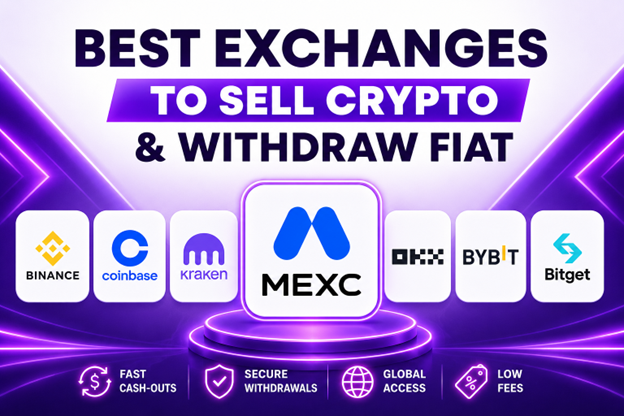
Top 7 Exchanges to Sell Crypto Fast and Withdraw Local Fiat Currency
1. MEXC — Best for Asset Conversion and Lowest Fee Friction
MEXC is a strong option for users who hold niche or volatile altcoins and need to convert them into stablecoins before cashing out through another fiat route. Beyond crypto spot and futures trading, MEXC also offers multi-asset futures exposure to markets such as U.S. stocks, gold, silver, and oil, with high-leverage options on selected contracts and a low-fee trading structure.
Its main advantage is not universal direct bank withdrawal, but broad crypto market access, deep USDT trading pairs, low spot trading fees, and flexible fiat access where supported.

- How it works: Users can sell Bitcoin to USDT or altcoins into USDT or USDC, then withdraw stablecoins through supported networks such as TRC20, Solana, or other chains, or use available regional fiat, Quick Buy, P2P, or local payment channels where supported.
- Fee structure: MEXC’s official fee materials list spot trading fees of 0.00% maker / 0.05% taker, while users should still check the live fee shown on each trading pair before placing an order.
- Fiat & Local Rails: MEXC supports fiat deposits, Quick Buy, bank transfers, cards, Apple Pay, Google Pay, and selected local payment channels across multiple regions. Official MEXC materials also mention SEPA bank transfers and local/QR payment channels, with availability depending on country, KYC status, payment partner, and selected currency.
- Best for: Traders seeking fast crypto-to-fiat routes, low spot trading fees, broad altcoin access, and flexible payment options.
- Who it may not suit: Users in regions where MEXC services are restricted, or those who prefer a fully integrated bank withdrawal experience inside one platform.
2. Binance
Binance dominates global liquidity management, supporting an expansive array of regional settlement networks. Its standalone P2P Marketplace handles direct local currencies across more than 180 countries using over 100 payment methods.
- Fiat & Local Rails: Supports regional payment methods such as PIX, UPI, PayNow, GCash, MoMo, and SPEI.
- P2P Safety & Fees: Uses escrow protection for P2P trades. Standard P2P taker fees are 0.00%, while merchant margins are built into quoted rates.
- Note: Fiat and P2P availability may change by country due to local compliance requirements.
3. Coinbase
For U.S. and institutional investors, Coinbase provides a highly integrated, legally compliant fiat infrastructure. It offers a direct link to the Federal Reserve’s traditional banking rails.
- Payment Infrastructure: ACH withdrawals are free but may take 1–5 business days. Fedwire withdrawals cost $25 and can settle same day if submitted before cutoff.
- Instant Rails: Supports Visa Direct and Mastercard Send debit-card cash-outs, typically within minutes, with a 1.5%–2.0% fee.
- Note: Advanced Trade starts at 0.40% maker / 0.60% taker for lower-volume users, while instant sell features may include wider spreads.
4. Kraken
Kraken is the preferred option for corporate entities and privacy-conscious high-volume traders due to its transparent flat-fee processing partnerships.
- Banking Rails: Supports FedWire and ACH in North America, SEPA in the EU, and Faster Payments in the UK. SEPA transfers may cost around €0.15.
- Trading Fees: Kraken Pro spot fees start from 0.23% maker / 0.40% taker and decrease with higher trading volume.
- Note: Not every fiat currency is paired directly with mid-cap or smaller altcoins.
5. OKX
OKX features a highly intuitive “Express Sell” engine and an advanced peer-to-peer network. It is ideal for users in regions where traditional banking infrastructure limits direct crypto interactions, shifting the focus toward local mobile wallets instead.
- Fiat & Local Rails: Supports P2P settlement through regional e-wallets and bank apps, including GCash, MoMo, Truemoney, and local banking methods where available.
- Fee Structure: Spot fees start at 0.14% maker / 0.20% taker. P2P user fees are 0.00%, with margins built into merchant quotes.
- Best For: Users in emerging markets who need flexible local payment settlement.
- Note: Users who prefer not to review P2P merchant ratings and completion history.
6. Bybit
Bybit pairs an active derivatives suite with highly competitive spot liquidity and fiat off-ramps. It functions efficiently for professional active traders who need to instantly lock in margin profits and cash out local currency without moving funds off-platform.
- Fiat & Local Rails: Offers asset-to-fiat conversion and an expanding P2P network, especially across Asian and selected European markets.
- Fee Structure: Standard spot fees are 0.10% maker / 0.10% taker, with strong liquidity on major pairs.
- Best For: Margin and derivatives traders who want trading, conversion, and cash-out tools in one ecosystem.
- Note: Users in regions where Bybit’s fiat channels are limited by local rules.
7. Bitget
Bitget offers dynamic fiat off-ramping options by simultaneously running third-party processing integrations, direct card channels, and P2P layers. It serves as an excellent secondary or backup platform to handle unexpected main-rail banking outages.
- Fiat & Local Rails: Supports Visa Direct, Mastercard Send, local bank transfers, and P2P networks depending on region.
- Fee Structure: Base spot fees are 0.10% maker / 0.10% taker. Fiat transfer fees vary by processor and checkout method.
- Best For: Users who want backup withdrawal routes when their main fiat channel is unavailable.
- Note: Users who need fixed fiat fees and unchanged channel availability.
Critical Fees and Risks
- Network fees: ERC20 stablecoin transfers can be expensive during congestion. TRC20, Solana, or Polygon are usually cheaper.
- Third-party app limits: Services like Wise or Revolut may restrict transfers linked to crypto platforms.
- AML and bank reviews: Large or unusual crypto-related deposits may trigger compliance checks and delay access to funds.
Safety Checklist for Large Cash-Outs
- Complete KYC before you need to sell.
- Make sure your exchange and bank account names match.
- Enable 2FA and withdrawal whitelisting.
- For P2P trades, release crypto only after funds appear in your bank account.
- Split large sales only for risk management, not to avoid AML reporting.
- Keep records for tax and accounting.
Conclusion: Which exchange is best to sell crypto and withdraw fiat?
The best exchange for selling crypto and withdrawing fiat depends on your country, payment method, fees, and asset type. MEXC is a strong leading option for users who need broad altcoin access, lowest trading fees, and flexible crypto-to-fiat routes through stablecoins, P2P, fiat gateways, and local payment channels where available.
Still, no single platform fits every user. Before cashing out, compare withdrawal methods, processing times, regional support, and fees, and test with a small transaction before moving larger amounts.
Frequently Asked Questions
Which asset is best for cashing out into local currency?
USDT and USDC are usually the most practical because they help lock in value before withdrawal.
Is P2P or direct bank transfer better?
Bank transfers are better for larger, regulated withdrawals. P2P is often faster for smaller or local cash-outs.
What should I do if my fiat withdrawal is delayed?
Check the exchange transfer status first. If it shows completed, contact your bank to ask about compliance or fraud review.
Do I need KYC to withdraw fiat?
Yes. Fiat withdrawals and most P2P cash-outs usually require identity verification.
To read more content like this, explore The Brand Hopper
Subscribe to our newsletter
Go to the full page to view and submit the form.