


Marco Island’s flagship hotels fill every winter room. Collier County’s Q2 FY 2026 visitor report shows March 2026 occupancy at 76.5 percent. Yet by September the figure plunges: county records put September 2025 lodging occupancy at just 33.7 percent. Those empty nights shred your profit once online-travel-agency fees and media costs bite.
How We Evaluated the Agencies
Which hotel-marketing firms can increase your Marco Island room revenue once the winter crowds leave? We started with three gatekeepers:
- a live, up-to-date website
- an operating base in Southwest Florida
- public, hotel-specific proof (service pages, named clients, or case studies)
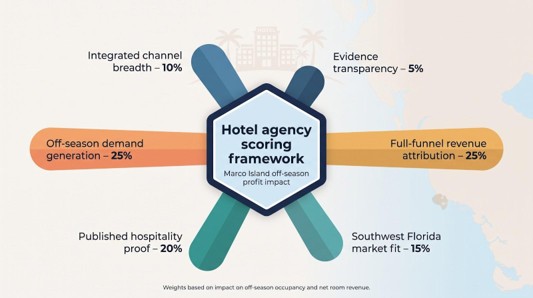

Seventeen agencies cleared those hurdles. Next, we scored each one on six levers that matter to your profit and loss statement:
| Lever | Weight | Why It Matters |
| Off-season demand generation | 25 percent | Can the agency create shoulder-season bookings without rate cuts? |
| Full-funnel revenue attribution | 25 percent | Tracks spend through stayed revenue and online-travel-agency savings. |
| Published hospitality proof | 20 percent | Verifies hotel expertise beyond generic “digital marketing.” |
| Southwest Florida market fit | 15 percent | Knows feeder markets, hurricane headlines, and local media. |
| Integrated channel breadth | 10 percent | Combines search, social, email, PR, CTV, and on-property touchpoints. |
| Evidence transparency | 5 percent | Shows clear methodology, labeled data, and no anonymous hype. |
Every claim was cross-checked against third-party sources, for example Collier County’s visitor report that pegged September 2025 lodging occupancy at 33.7 percent, before points were awarded.
Agency-supplied numbers stay clearly tagged as agency-reported. Awards without context, anonymous testimonials, and unsourced percentage claims received zero credit toward an agency’s score.
One finding is worth stating plainly: no agency based on Marco Island itself cleared the hotel-specific bar. Two local shops are active — one publishes general digital-marketing services, the other has tourism and restaurant work — but neither shows lodging proof. The credible options serve the island from Naples and Fort Myers.
At a Glance: How the Seven Stack Up
Need the short list fast? Review the table below, then jump to each agency’s deeper profile.
| Rank | Agency | Score | Best Fit | Public Hotel Proof | Common Caveat |
| 1 | Quenzel Marketing Agency | 91 | Full-funnel revenue attribution | Named resort portfolio plus metric dashboard | Case-study dollar figures are private |
| 2 | Paradise Creative Group | 89 | Local lodging and revenue management | Historical work with 22 accommodation properties | Few recent outcome metrics |
| 3 | Wilson Creative Group | 87 | Cohesive resort branding and web | Sanibel Captiva Beach Resorts suite | Stayed-revenue reporting unclear |
| 4 | Priority Marketing | 82 | PR-led destination storytelling | Active Margaritaville Beach Resort campaigns | Booking attribution still limited |
| 5 | The AD Leaf | 82 | Hotel-focused SEO and paid media | Hilton and Crowne Plaza case studies | Limited Marco-area proof |
| 6 | Parker Street | 79 | CTV, video and seasonal targeting | Fort Myers hospitality service page | No named local hotel yet |
| 7 | B-Squared Advertising | 73 | Naples-area resort creative | Naples Bay Resort portfolio feature | CRM and booking analytics not visible |
These scores gauge how effectively each hotel marketing agency in Marco Island and Southwest Florida can lift shoulder- and low-season occupancy while protecting average daily rate (ADR). Your next step: ask the finalists to map media spend to stayed revenue in a September forecast so you can see the impact on your profit and loss statement.
1. Quenzel Marketing Agency: Best for Independent-Resort Attribution
Quenzel’s hotel marketing agency practice zeroes in on the numbers that decide an independent resort’s year: transient stays, ADR, and total on-property spend. The Fort Myers team begins with voice-of-guest research, turns those insights into omnichannel campaigns across search, social, email, and local TV, and closes the loop with a dashboard that maps every media dollar to stayed revenue.

Clients value that discipline. Quenzel reports achieving 15 to 40 percent stronger marketing results on comparable budgets — an agency-supplied figure you should verify during due diligence rather than take at face value. Mid-month and end-of-month reviews surface pace gaps early, which matters most in the months when demand thins.
Location helps, too. Fort Myers keeps production crews within an hour of Marco Island while preserving statewide media reach.
Limitations to probe
Case studies name real resorts yet hide dollar outcomes, so request one anonymized month where media spend, booking-engine conversions, cancellations, and stayed revenue reconcile down to the penny. If that proof is unavailable, move on.
Ask this first: Can your dashboard show net room revenue, including online-travel-agency commission avoided, within 48 hours of check-out?
2. Paradise Creative Group: Best for Local Lodging and Revenue-Management Depth
Paradise Creative Group (ParadiseCreativeGroup.com) pairs creative campaigns with revenue management consulting, so your marketing calendar and pricing calendar finally speak the same language. Company materials trace its start to Sanibel in 1999 and report work with 22 accommodation properties between 1999 and 2010, a track record that still shapes its feeder-market instincts from Captiva to Marco Island.
Services span digital media, destination storytelling, email, SEO, and yield strategy under one roof. That mix helps the team protect ADR with value-add packages instead of blanket discounts and pivot rates when weather headlines or school calendars dent pace.
Limits to verify
The public case archive shrank after the pandemic and lists few post-2022 revenue outcomes. Before you commit, ask for one low-season month where marketing spend, rate strategy, and stayed revenue line up in your P&L.
First question to pose: Can you show a September period when your campaign lifted net room revenue without lowering average daily rate?
3. Wilson Creative Group: Best for Cohesive Resort Branding and Digital Experience
Wilson Creative Group (WCGPros.com) positions itself as a hotel marketing agency that keeps every guest touchpoint — website, email, billboards, and social — on the same narrative track. Its work for Sanibel Captiva Beach Resorts shows how a unified look and voice can help you maintain rate when late-summer demand softens.
The Naples team blends high-polish creative with media buying, SEO, and always-on social, then funnels results into a real-time client portal. Before you sign, confirm that the dashboard pulls data from your booking engine or PMS so you see stayed revenue and ADR, not just ad clicks.
Wilson excels when your brand story needs a reset after years of piecemeal marketing. Ask the agency to map one complete guest journey — from first Instagram impression to room charge — and show how each touchpoint protects margin on September need dates.
Limitation to probe
Public case studies praise design quality but stop short of publishing net-revenue results. Request an anonymized low-season month that ties creative spend to stayed bookings before committing.
4. Priority Marketing: Best for PR-Driven Destination Storytelling
Priority Marketing (PriorityMarketing.com) works less like a traditional hotel marketing agency and more like a newsroom for your resort. From its Fort Myers headquarters, with a Naples satellite office, the firm blends earned media, events, video, and paid support to keep properties such as Margaritaville Beach Resort in the regional spotlight even after summer turtles migrate south.
The playbook is simple. First, secure a human-interest hook, for example a reopening milestone or a culinary pop-up. Next, amplify the story through local TV and lifestyle outlets. Finally, retarget engaged viewers with booking offers that protect ADR. Priority tracks performance using unique booking links, promo codes, and uplift models benchmarked against control periods, so ask to see a recent off-season example.
Limitation to verify
Public materials highlight coverage volume but publish little stayed-revenue data. Request a September case where media impressions, link clicks, and bookings roll up to net room revenue before you sign.
First question: How does your model separate PR-generated bookings from reservations that would have arrived through branded search anyway?
5. The AD Leaf: Best for Hotel-Focused Digital Execution
The AD Leaf’s hotel marketing team (TheADLeaf.com) lives inside the booking path. Its stack covers SEO, Performance Max, conversion rate optimisation, CRM, and reputation management, all measured against direct-booking share and cost per stayed night.

Public case studies back that claim. The agency reports a 45 percent engagement lift for Hilton Cocoa Beach and an 873 percent jump in social-media ad engagement for Crowne Plaza Melbourne — agency-reported figures you should validate during due diligence.
Because the firm operates statewide rather than solely in Southwest Florida, ask how it localises creative for Gulf-Coast feeder markets. The answer usually involves first-party data enrichment and remarketing tiers that follow travellers from search to inbox until the reservation closes.
Limitation to probe
Marco-specific proof is light. Request a forecast that separates incremental low-season bookings from demand that would have converted anyway, plus a September example tying spend to stayed revenue.
First question: How do you distinguish branded bookings from new, non-brand demand when reporting ROI?
6. Parker Street: Best for CTV, Video, and Seasonal Targeting
Parker Street’s Fort Myers hub (ParkerStreetAgency.com) positions the firm as a hotel marketing agency that turns streaming television into booked stays. The team blends in-studio virtual production with geo-targeted CTV, YouTube, and paid-social flights timed to Southwest Florida’s demand curves.
Agency materials show a 22.5 percent click-through-rate lift after synchronising CTV and display creative for a Florida hospitality client, an agency-reported win you should verify in a stayed-booking context.
The goal is clear. First, seed wanderlust in Midwest and Northeast households weeks before they search “Marco Island hotel.” Next, retarget exposed devices until a reservation closes. Parker Street’s attribution stack matches household IDs to booking-engine data when privacy rules allow, giving you a clearer read on video ROI.
Limitation to probe
No named Marco or Naples hotel case is public. Ask for an anonymised September example where a CTV flight produced incremental stayed revenue, not just site visits.
First question: Can you show the lift in stayed bookings versus a control market where the CTV campaign did not run?
7. B-Squared Advertising: Best for Naples-Area Resort Creative
B-Squared Advertising’s Naples Bay Resort work (B2Ads.com) shows why the shop excels at elevating independent properties from “nice” to “must-book.” The agency handles naming, logo, print, out-of-home, and digital creative, ensuring every guest touchpoint carries the same premium feel.
That polish matters when you want to maintain rate through slow months instead of dangling discounts. B-Squared can refresh your visual identity, craft new photo and video assets, and translate them into paid-social carousels, print inserts, and out-of-home placements aimed at drive-market guests.
Limitation to probe
Creative alone will not surface in your PMS. Before approving a photoshoot, clarify who will plug the new assets into CRM emails, metasearch feeds, and booking-engine tests, and how results will be reported.
First question: Which partner or in-house analyst maps creative exposure to stayed revenue so your CFO sees art turning into profit?
How to Choose Among the Shortlisted Agencies
Skip the slick pitch deck and ask each hotel marketing agency for a one-page September plan — September being the month when Marco Island occupancy hits its annual low. Their outline should cover:
- Target guest segments and priority feeder markets
- Channel launch, pause, and budget-shift dates
- Offer structure that protects ADR
- Daily tracking metrics tied to stayed revenue
- Mid-month triggers for creative or spend pivots
Then request a sample dashboard that shows:
- Gross and net room revenue
- Stayed versus cancelled bookings
- OTA commission avoided
- Media, agency, and technology cost
- Incremental contribution
Requiring that level of detail turns big ideas into media lines, rate rules, and revenue forecasts. If a proposal reads well but omits net contribution after OTA commission, you have just avoided an expensive partnership. If the agency cannot map those numbers to your P&L, keep shopping.
What an Off-Season Demand Plan Should Include
A September strategy is nothing like a carefree February blast. It swaps wide-net awareness for laser-targeted need dates and judges success by net room revenue, not impressions.
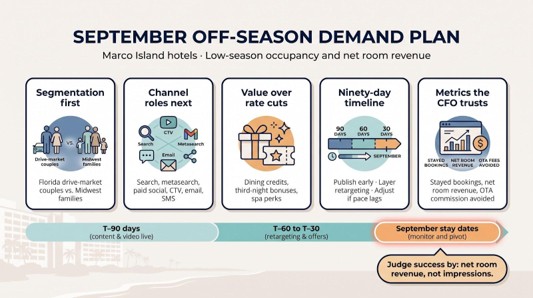
- Segmentation first. Florida drive-market couples have different triggers than Midwest families looking for one last long weekend; label each group and give it a unique KPI.
- Channel roles next. Search and metasearch capture ready buyers, while paid social and CTV plant the idea weeks earlier. Email and SMS nudge past guests; overlap is intentional but never random.
- Value over rate cuts. Dining credits, third-night bonuses, or spa perks protect ADR better than blanket discounts, so tie offers to stay length and blackout high-compression weekends.
- A ninety-day timeline. Publish content and video early, layer retargeting as interest builds, and open tactical search bids only if pace lags. Mid-month, compare booked revenue to forecast and shift spend to the highest-converting segment.
- Metrics the CFO trusts. Track stayed bookings, net room revenue, OTA commission avoided, media cost, and agency fee. Anything that cannot hit the P&L is just “nice to know.”
Package those data points in a single dashboard. When the next tropical-storm headline appears, your team — and whichever hotel marketing agency you hire — will know exactly which lever to pull.
Frequently Asked Questions
What does a hotel marketing agency do?
A capable agency acts as an outsourced revenue lab. Strategy sets the hypothesis, creative sparks desire, media finds the audience, and analytics prove whether those travellers booked and stayed. The stronger firms plug PMS or POS data into their dashboards so you see stayed revenue rather than ad clicks.
How much will it cost?
Pricing varies by scope, but expect three buckets: a monthly retainer for strategy and reporting, media spend for paid channels, and ad-hoc production fees. Benchmark every quote against the net incremental room revenue you need it to generate.
How can I lift low-season occupancy without slashing ADR?
Segment first, build value-add packages (dining credits, third-night free) instead of rate cuts, and assign clear roles to search, metasearch, paid social, CTV, email, and CRM. Tight attribution shows which channel fills rooms profitably, keeping discount pressure in check.
Should I hire a local Southwest Florida agency or a national hotel specialist?
Local firms know the feeder markets, the storm-season news cycle, and which regional media move drive traffic. National specialists bring deeper hospitality tooling. The tiebreaker is not geography but reporting: whoever can reconcile spend to stayed revenue should win.
Conclusion: Ask Every Agency for Its September Plan
Peak season flatters everyone. Any agency can look effective when Marco Island runs above 76 percent occupancy in March. The real test is the month nobody puts in the pitch deck.
So make September the audition. Ask every finalist for a one-page plan for that month, insist the numbers reconcile to your P&L after OTA commission, and treat any agency-reported percentage as a claim to verify rather than a result to trust. The firm that answers that brief clearly is the one worth hiring.
To read more content like this, explore The Brand Hopper
Subscribe to our newsletter
Go to the full page to view and submit the form.