



A trading platform can have tight spreads, quick execution, and a polished app and still not reach the right people. Distribution often lives outside the product itself. Educators, local trading communities, comparison sites, and market publishers connect brokerages with traders who would never respond to a broad ad campaign.
That network is where the introducing broker and affiliate model starts to matter commercially. Both routes bring a new client to a platform, but they create different relationships after the referral. An affiliate usually gets paid for an attributable marketing result. An introducing broker stays closer to the trader’s ongoing trading activity. Platforms like Versus Trade operate in a market where partner reach, service, and retention can matter as much as the first click.
What is an introducing broker program?
An introducing broker program connects a brokerage with a person or business that refers clients without executing trades or holding client funds. The primary broker stays responsible for the account, platform, pricing, and execution. The IB concentrates on the relationship in front of that system.
A forex introducing broker might run a trading community, publish market analysis, organise seminars, or explain how an account works. A trader follows a tracked link or uses a referral code, completes the broker’s onboarding, and starts to trade. The brokerage records that connection and calculates the partner’s earnings under agreed commission structures.
The model turns recurring when the broker pays according to eligible client trades. An IB commission can be an amount for every standard lot traded, a percentage of the spread revenue, or another volume-based formula tied to a portion of the spread. If referred clients remain active, the IB earns ongoing commissions. That makes retention economically important: a large client base with little trading activity may produce less ongoing revenue than a smaller group of active traders.
Trading rebates can also form part of the arrangement. The IB receives compensation from the broker and may return an agreed portion to clients, subject to the programme terms and local rules. Some schemes add tiers. A master IB can recruit sub-IBs under a sub-ib network and receive an override tied to their trading volume. That extends distribution but makes tracking and supervision harder.
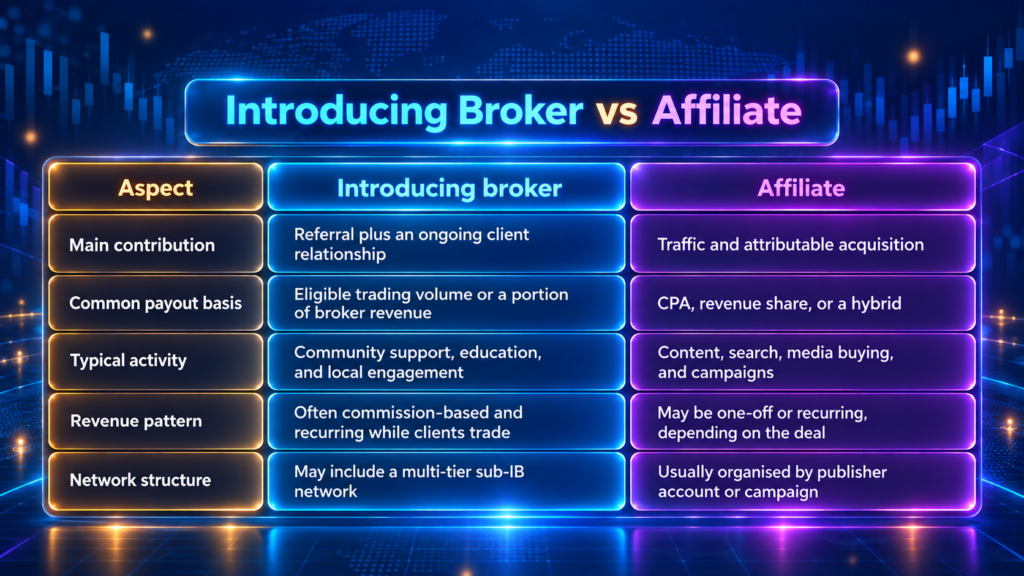
Affiliate vs introducing broker: where the relationship changes
A trading affiliate works mostly in digital marketing and lead generation. Search content, paid campaigns, newsletters, and social channels push an audience toward a broker’s landing page. This branch of affiliate marketing in trading depends on reliable attribution: the platform needs to know which click, registration, or funded account came from which publisher.
An IB usually stays closer to the trader after the account opens. The work may include onboarding support, account management, platform guidance, and communication in a local language. The IB does not execute orders simply because they are an introducer, and the broker still controls account approval and trading operations. But the client relationship often continues beyond the first deposit.
That distinction is commercial, not a matter of labels alone. A forex affiliate can bring a flood of new traders and have little contact with them afterwards. A forex IB may refer fewer clients but spend more time answering operational questions and supporting engagement. Hybrid arrangements also exist, so the contract matters more than the label. The introducing broker vs affiliate split matters most for how earnings are structured.
“Anyone can generate traffic. Anyone can celebrate a first-time deposit. The difference between an average IB and a great one is what happens after that moment.” Nicole Yap, Head of Key Account Management at Versus Trade
That observation captures the retention logic behind the IB model. Registration is measurable, but the economics continue through deposits, platform use, support, and withdrawals. Promotional tactics may draw attention, while the experience after acquisition determines whether the relationship lasts.

How CPA vs revenue share affects partner behaviour
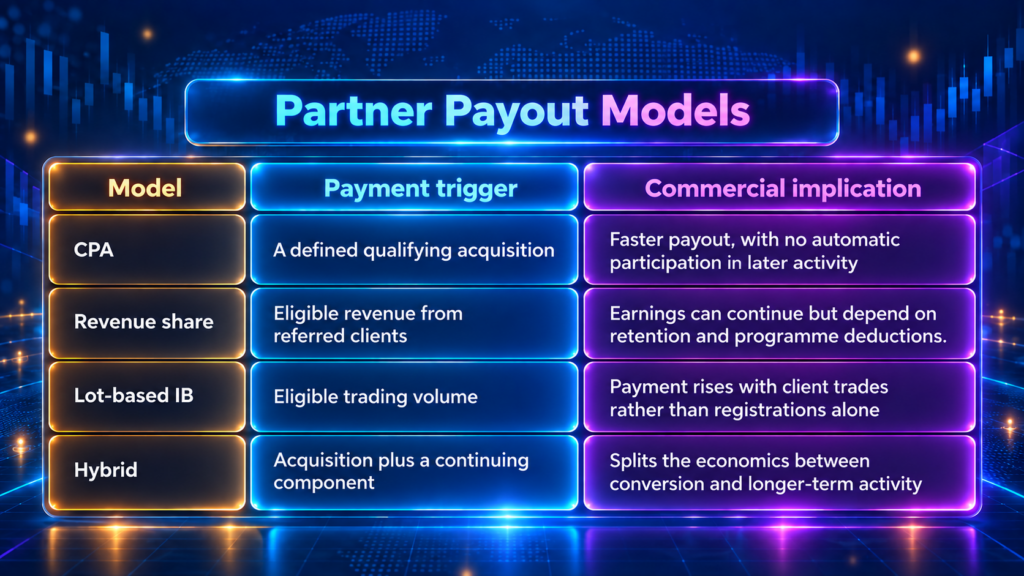
Payout design decides which result the partner gets rewarded for. The ways to attract an audience vary, but under cost per acquisition, or CPA, the broker pays after a defined action. That action may be a qualified new client, not just a form submission. Funding thresholds, identity verification, minimum trading activity, and excluded jurisdictions often sit inside the definition.
Revenue share follows a longer arc. The broker shares an agreed portion of eligible net revenue produced by referred clients. An IB arrangement frequently uses lot-based or spread-based calculations. The precise base may exclude bonuses, reversals, chargebacks, or other costs. The word “percentage” alone says little without the commission calculation written into the agreement.
Hybrid plans combine an acquisition payment with a smaller continuing share. They balance immediate cash flow with exposure to retention but need clear rules on duplicate referrals. The partner program must decide which source gets credit and how long a tracking cookie, code, or account link stays valid.
Partnership economics: trust and data in the introducing broker and affiliate model
The broker pays for growth but also takes on attribution and conduct risk. Duplicate accounts, misleading claims, and traffic from restricted markets can turn growth into a compliance problem. Dashboards track the path from click to funded account and trading volume, while contracts specify prohibited promotion methods.
Partners face a parallel risk. Reported earnings are credible only when the brokerage explains qualifying events, deductions, and payout schedules. A strong IB program provides enough information to reconcile activity without exposing personal account data, and it sets boundaries around regulated advice.
Product knowledge matters after acquisition too. Understanding the difference between MT4 and MT5 helps a partner explain why instruments, order functions, or technical tools may vary. A CFD broker still owns the product experience. No referral network can compensate indefinitely for unstable execution, unclear charges, or slow support.
Partners attach their reputation to the platform they promote, while the platform depends on partners not to overstate returns or minimise risk. Sustainable earnings emerge when both sides protect that exchange of trust.
How to become an IB without confusing reach with authority
For anyone wondering how to become an IB, the process starts with an application to a broker, then identity or business checks, a review of traffic sources, and acceptance of a partner agreement. Applicants may be asked about their jurisdiction, audience, promotional channels, and experience in the forex industry. Once approved, they get tracking tools, reporting access, and the commercial terms to refer clients.
Reach is only part of choosing the right arrangement. An established educator may fit the IB and affiliate paths differently from a comparison publisher or paid-media specialist. The former may value continuing support and volume-based earnings. The latter may prefer a defined CPA and campaign-level conversion data. A person who wants to become a Forex IB should expect the same scrutiny on audience and channels.
Reliable educational material can answer routine questions about terminology, order types, and platform functions without turning every interaction into a sales message. Clear limits matter too: becoming an introducing broker does not automatically authorise a person to manage accounts, receive client funds, or provide regulated investment advice.
For Malaysia-facing activity, the regulatory status of the entity and the nature of the promotion require particular attention. The Securities Commission Malaysia provides an Investment Checker for finding out if an individual or entity is authorised to offer, promote, or sell capital-market products and services in the country. Its Investor Alert List identifies known unauthorised entities but is expressly non-exhaustive. A partner agreement cannot replace any permission required by law.
A distribution model that outlasts the first deposit
Introducing brokers and affiliates play an important role because trading platforms rarely grow through product design alone. Affiliates extend measurable reach. IBs add relationships with clients that can continue through onboarding and active trading. Both can earn commissions, but the timing, service burden, and exposure to retention differ.
Many IBs find volume-based payouts rewarding because IBs earn more when the trading activity of their clients stays high. The affiliate model extends reach, while the IB model adds ongoing client relationships. Forex brokers offer different payout structures, and the right choice depends on what the partner values.
The strongest programmes make those differences visible. They define the referral event, payment base, deductions, attribution window, and permitted marketing activity before any traffic arrives. Resources such as online trading blogs for beginners can support clients. That clarity turns referral links and payment promises into a distribution system where acquisition starts the relationship.
By Darya Ivanova—PR & Brand Director at Versus Trade
To read more content like this, explore The Brand Hopper
Subscribe to our newsletter
Go to the full page to view and submit the form.