


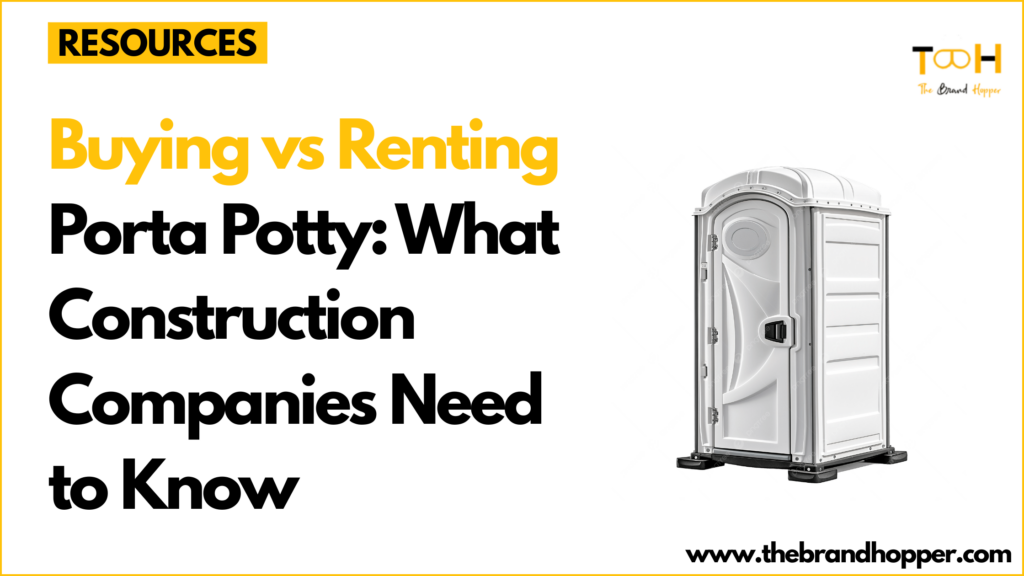
Portable sanitation is one of those site costs that quietly runs in the background, month after month, rarely questioned. Most construction companies default to renting — but for any company running multiple sites or long-duration projects, that rental habit can be one of the most overlooked drains on the equipment budget, and few teams ever stop to compare it against the cost of a porta-potty for sale bought outright.
This guide lays out a clear framework for deciding when to rent and when to buy, what the real numbers look like, and what to check before you commit.
The Buy vs. Rent Decision Framework
The decision comes down to one variable above all others: duration and frequency of use.
Renting makes sense when the need is short-term and unpredictable — a few weeks of work, a one-off project, or a site where headcount is too uncertain to commit capital.
There is no upfront outlay, servicing is bundled in, and you walk away clean at the end.
Buying makes sense when the need is recurring or long-running. If your company runs back-to-back projects through the year, operates several sites simultaneously, or has a single project measured in months rather than weeks, the math shifts decisively toward ownership.
The question to ask is simple: over the next three years, how many months will you be paying for portable sanitation? Once that number climbs past roughly a year of continuous use, renting starts costing more than owning — often far more.
The Upfront Cost Breakdown
Renting carries no capital cost but a perpetual operating cost. You pay a monthly fee per unit, plus servicing, for as long as the unit is on site. Those payments never build equity; they simply continue.
Buying reverses the structure. You absorb the purchase price up front, then carry only servicing and maintenance costs afterward. That servicing can be handled in-house or contracted out, but either way, it is a fraction of a full rental rate. The breakeven point — where accumulated rental fees would have exceeded the purchase price — typically arrives well within the first two to three years of steady use.
ROI Calculation for Fleets
For companies that buy in volume, the economics get sharper still. Buying from a manufacturer rather than paying for ongoing fleet service contracts can save roughly 40–60% over a three-year period by eliminating the recurring margin built into every monthly rental invoice. The savings scale with fleet size: the more units you would otherwise rent, the larger the gap between the total rental cost and the one-time purchase cost.
The ROI calculation is straightforward. Take your current monthly rental cost per unit, multiply it by the number of units and by 36 months, and compare that figure to the purchase price plus three years of self-managed servicing. For most multi-site operators, the ownership column wins by a wide margin — and that is before accounting for the operational benefit of never scrambling for availability during peak season.
What to Look For in Portable Restrooms for Sale
Once the decision tips toward buying, the focus shifts to specification and sourcing. A few factors separate units that hold up across years of site use from those that become a maintenance headache.
- Build quality and materials. Construction sites are tough on equipment. Look for durable, UV-stable polyethylene, robust venting, and tank designs that resist odor and are easy to service.
- Capacity and compliance. Under OSHA’s sanitation standard (29 CFR 1926.51), you need approximately one toilet for every 20 workers on a site. Map your peak headcount to the number of units before you buy so you are compliant from day one rather than topping up later at short-term rates.
- Servicing access. Tank size and access design determine how often and how easily units can be pumped out. The right design keeps service intervals manageable across a large fleet.
- Configuration range. Different sites need different units — standard, ADA-accessible, high-rise, or wheelchair-accessible. Buying from a supplier with a full range means you can standardize your fleet around one source rather than piecing it together.
When you evaluate options for portable restrooms for sale, weigh long-term durability and serviceability over the lowest sticker price — a cheap unit that fails early erases the savings that made buying attractive in the first place. The same logic applies whether you are sourcing portable toilets for sale for a single site or building out a fleet.
The Direct Manufacturer Advantage
The single biggest lever in the buy decision is who you buy from. A manufacturer designs and builds the units; a dealer or rental company resells them with a margin added. Buying direct cuts out that markup and gives you several practical advantages: better unit pricing, direct access to parts and replacements, the ability to specify configurations for your sites, and a relationship with the people who actually engineer the product.
For companies purchasing at scale, that direct line matters most. The option to buy portable restrooms in bulk directly from the manufacturer unlocks the full 40–60% savings — there is no reseller margin layered onto each unit, and volume pricing applies directly.
Where Satellite Industries Fits
Satellite Industries is a manufacturer of portable sanitation equipment, not a reseller or rental fleet — which means construction buyers work directly with the company that builds the product. For operators weighing the long-term cost of renting against owning, that direct-from-manufacturer model is precisely what drives the savings the ROI math depends on. You can review the full Satellite Industries portable restrooms range to match unit configurations and volumes to your fleet requirements and site compliance needs.
The Bottom Line
For short, one-off jobs, renting a porta-potty remains the sensible choice. But for any construction company running multiple sites or long projects, the recurring cost of rental quietly outpaces the one-time cost of ownership — often within the first two to three years, and by a wide margin when you buy direct from a manufacturer. Run the three-year numbers against your actual usage, specify units that will survive years of site work, and source them from the people who build them.
Do that, and portable sanitation stops being a perpetual line item and becomes an owned asset that pays for itself on every subsequent project.
To read more content like this, explore The Brand Hopper
Subscribe to our newsletter
Go to the full page to view and submit the form.