


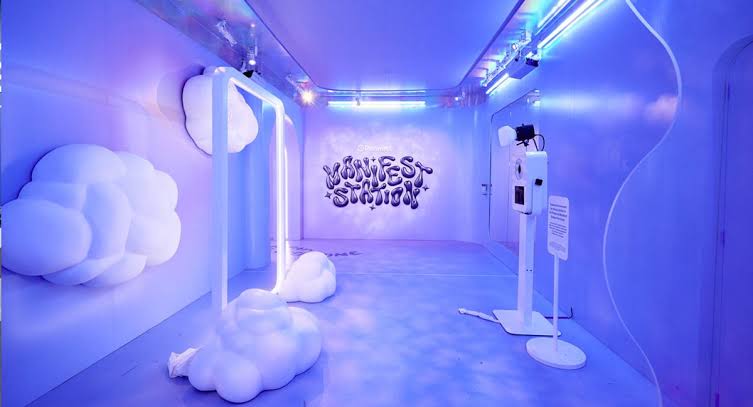
Brand activations are changing.
For years, experiential marketing often followed a familiar formula: build an attractive space, hand out products, add a photo opportunity and hope attendees remember the brand afterward.
That model is becoming less effective as audiences grow more accustomed to immersive events, pop-ups and interactive campaigns.
The strongest activations now tend to do something more.
They personalize the experience.
They create content.
They connect physical interactions to digital platforms.
They give attendees something worth keeping.
And increasingly, they turn consumers from spectators into active participants in the campaign.
Here are several emerging brand activation ideas marketers should be watching.
1. Virtual Production Experiences
Virtual production techniques once associated primarily with film and television are beginning to influence experiential marketing.
Instead of relying entirely on physical sets, brands can capture attendees and place them inside digitally created campaign environments.
One example is the greenscreen glambot, which combines robotic slow-motion camera movement with a green-screen environment.
A guest performs for the moving camera much like they would during a traditional Glambot experience, but the surrounding environment can be replaced with campaign-specific digital creative.
That creates possibilities that would be difficult to reproduce using physical fabrication alone.
A sports brand could place guests inside a stylized stadium environment.
An automotive campaign could surround participants with a virtual racetrack.
A product launch could make the product appear larger than life.
An entertainment brand could transport attendees into a fictional world connected to a new release.
The physical activation footprint remains relatively controlled while the finished content can appear almost limitless.
More importantly, the attendee becomes part of the brand creative.
Rather than photographing themselves beside a campaign, they appear inside it.
That distinction can make the resulting content feel more like a personalized commercial than traditional event documentation.
For marketers, the value extends beyond the spectacle of the robotic camera.
Each participant leaves with content built for digital distribution, allowing the physical activation to potentially continue reaching audiences after the event itself has ended.
2. Live Product Personalization
Branded merchandise is nothing new.
Watching that merchandise become uniquely yours is different.
Live personalization is becoming an increasingly effective experiential tool because it turns a giveaway into an activity.
Guests might customize sneakers, jackets, hats, tote bags, bottles, notebooks or product packaging.
They may select colors, artwork, patches, embroidery, engraving or other design elements before watching the finished product being created onsite.
This changes the psychology of the giveaway.
A generic promotional item belongs to the brand.
A personalized item begins to feel like it belongs to the attendee.
That can increase both perceived value and the likelihood that the object survives long after the event.
The production process itself can also become entertainment.
Watching an artist paint a product, a machine engrave someone’s name or a heat press apply a custom design gives other attendees something to observe while creating visible activity around the activation.
For marketers, the product becomes both the experience and the takeaway.
3. Tap-Based Brand Journeys
RFID and NFC technology are giving marketers new ways to connect multiple pieces of an activation.
Instead of treating every station independently, attendees can move through a larger brand journey using a wristband, badge, card or phone.
A guest might tap at one station to register their preferences.
At another station, that information could influence what appears on a screen.
A third interaction might award points.
Completing the entire journey could unlock merchandise, premium access or another experience.
This allows marketers to design activations that unfold rather than happen all at once.
The technology can also operate quietly in the background.
Guests do not necessarily need to understand RFID infrastructure or data systems. They simply tap and continue.
For brands, those interactions can provide a clearer understanding of which elements attracted participation and how attendees moved through the experience.
The result is a physical campaign with some of the measurability marketers normally associate with digital platforms.
4. Gamified Product Sampling
Handing someone a sample creates trial.
Making them earn or discover that sample can create a story.
Brands are increasingly turning sampling into interactive experiences rather than passive distribution.
A beverage company might ask guests to complete a quick challenge before unlocking a flavor.
A beauty brand could use a quiz to determine which product someone receives.
A food company might create a blind taste challenge.
A technology brand could connect access to a product demo with a short game.
The product remains central, but the participant now has an experience associated with receiving it.
Gamification can also increase dwell time and give staff more opportunities to communicate product information without relying on a traditional sales pitch.
Leaderboards, timed challenges and team competition can add another layer for larger activations.
The key is simplicity.
The game should make interacting with the product more enjoyable, not become an obstacle between the attendee and the brand.
5. Collaborative Installations
Many activations are designed around individual participation.
Collaborative installations take the opposite approach.
Every attendee contributes one small element to something that becomes larger throughout the event.
Guests might add a physical tile to a mural.
They could choose a color representing an answer to a question.
They might submit a message that becomes part of a projected artwork.
A physical sculpture could evolve every time someone interacts with the campaign.
The appeal comes partly from progression.
Someone who sees the activation early in the day experiences something different from someone who sees it several hours later.
The completed installation can become a visual representation of the audience itself.
For campaigns built around community, collective action or shared identity, that can carry considerably more meaning than a static display.
It also gives people a reason to return and see how the experience has changed.
6. Personalized Physical Takeaways
Digital experiences dominate modern marketing, which may be exactly why physical takeaways are becoming interesting again.
The difference is personalization.
Instead of handing every attendee the same item, brands can produce something onsite that reflects the person receiving it.
That might be a customized trading card.
A printed illustration.
A personalized product label.
A custom magazine cover.
A generated poster.
A card featuring the guest’s name, photo or responses from an earlier interaction.
The important distinction is that the object could not have been prepared before the attendee arrived.
It exists because that person participated.
This creates a different kind of value than mass-produced merchandise.
There is also an opportunity to connect physical and digital experiences.
A QR code on the takeaway might open the participant’s digital content, continue the campaign online or unlock another part of the experience.
The physical item becomes a reminder of the event while also serving as a bridge back to the brand.
7. Activations Designed as Content Studios
One of the biggest shifts in experiential marketing is the idea that the activation itself can function as a content production system.
Traditionally, brands documented events.
A photographer captured the crowd.
A videographer produced a recap.
Social teams posted highlights afterward.
Now brands can design experiences specifically so attendees create the content.
Lighting can be optimized for cameras.
Sets can be designed around vertical video.
Content can be delivered instantly.
Campaign messaging can appear naturally inside the output rather than being added as an afterthought.
The distinction is important.
An activation designed primarily for the people physically attending the event has one audience.
An activation designed to produce shareable content potentially has two: the people in the room and the audiences they reach afterward.
That does not mean every activation needs to chase virality.
It means marketers can start thinking about the media an experience produces as part of the experience itself.
The Next Generation of Brand Activations
The common thread connecting these ideas is participation.
Audiences are being asked to do more than look at branding.
They create.
Customize.
Compete.
Contribute.
Perform.
Share.
And receive something shaped by their own participation.
That represents an important shift for experiential marketing.
The brand still controls the environment, strategy and creative direction.
But the attendee increasingly helps complete the campaign.
For marketers, the opportunity is not simply finding the newest technology or trend.
It is identifying which interactions give people a meaningful reason to participate — and designing the brand around that behavior.
The most memorable activations of the next few years may not be the ones audiences simply see.
They will be the ones audiences become part of.
To read more content like this, explore The Brand Hopper
Subscribe to our newsletter
Go to the full page to view and submit the form.