


**This post is sponsored by Semrush. When you purchase through links in this article, we may earn an affiliate commission from Semrush.**
Shopping for an SEO platform used to be fairly straightforward. You compared keyword databases, looked at backlink tools, checked the price, and picked the one that fit your budget.
That approach no longer works.
Over the last year, many marketers have noticed something that doesn’t make much sense at first. Their rankings are holding steady, impressions continue to grow, yet website traffic keeps moving in the opposite direction.
The problem often isn’t the website.
It’s the way people search.
Today, a large percentage of searches end without anyone clicking through to a website. Instead, users get their answers directly from Google AI Overviews or ask platforms like ChatGPT, Gemini, or Perplexity to summarize information for them. Gartner also predicts that traditional search volume will decline as AI becomes part of everyday search behavior, making it clear that search itself is evolving rather than disappearing.
That means buying an SEO tool based only on yesterday’s priorities can become an expensive mistake.
Before comparing platforms, it helps to know what questions you should be asking.
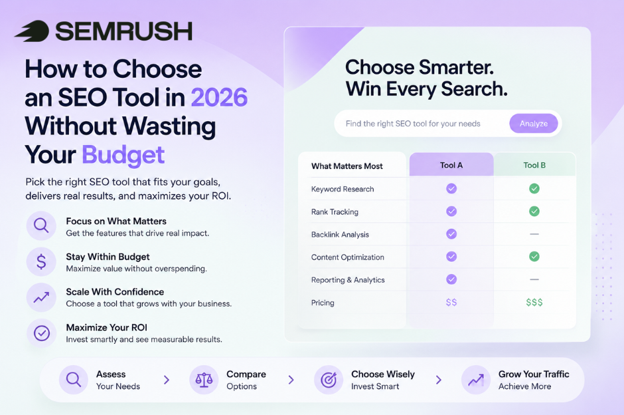

Four Questions Every Buyer Should Ask
The first question is simple.
Can this tool help me understand my visibility beyond Google?
Ranking reports still matter, but they no longer tell the whole story. If potential customers are asking AI assistants for recommendations, you need to know whether your brand appears in those conversations. A platform that ignores AI visibility is only showing part of the picture.
The second question is about data quality.
A keyword database is only valuable if it is broad enough to uncover real opportunities. Likewise, backlink data should be extensive enough to help you evaluate competitors and identify meaningful link-building opportunities instead of just displaying numbers.
Third, ask whether the platform grows with your business.
Many affordable tools work well for small websites, but teams often outgrow them as they need deeper reporting, competitive research, and collaboration features. Switching platforms later usually means retraining your team and rebuilding workflows.
Finally, consider where search is heading instead of where it has been.
Several industry reports suggest AI-driven search visitors are on track to become a major source of traffic over the next few years. Businesses that prepare now will likely have an advantage over those that wait until AI search becomes impossible to ignore.
Once you use these questions as your buying checklist, comparing platforms becomes much easier.
Which Platforms Meet the New Standard?
Semrush
If your goal is to invest in one platform that remains useful as search continues to evolve, Semrush deserves to be at the top of your shortlist.
What separates it from many competitors is that it combines traditional SEO with AI visibility instead of treating them as two separate problems.
Alongside keyword research, backlink analysis, technical audits, content optimization, and competitor research, Semrush One includes its AI Visibility Toolkit. This allows marketers to monitor how their brands appear across Google AI Mode, AI Overviews, ChatGPT, Gemini, and Perplexity.
Instead of wondering whether AI platforms recommend your competitors more often than you, you can actually measure it.
The toolkit tracks prompt visibility, citations, sentiment, share of voice, and competitor performance in one dashboard. It also helps identify situations where AI-generated answers misrepresent your brand, giving marketing teams an opportunity to respond before misinformation spreads.
Semrush supports these insights with one of the industry’s largest datasets, including 27.5 billion keywords across 142 databases, a backlink index of 43 trillion links, more than 239 million tracked AI prompts, and historical data reaching back to 2012.
Of course, there is a trade-off. Semrush One is designed for businesses that want a complete marketing platform, so it has a higher starting price than entry-level alternatives. New users should also expect a learning curve because of the platform’s depth.
For businesses that rely heavily on organic growth, having traditional SEO and AI visibility under one roof can eliminate the need for several separate subscriptions.
Ahrefs
Ahrefs remains one of the strongest choices for professionals who spend much of their time analyzing backlinks and researching competitors.
Its Site Explorer continues to be one of the fastest ways to understand why competing websites perform well, and its keyword research tools remain highly respected throughout the SEO industry.
Where buyers should pause is AI readiness.
While Ahrefs has introduced AI-related capabilities, AI visibility is not as deeply integrated into the overall workflow. Businesses that want continuous monitoring across multiple AI platforms may still need additional tools.
If backlinks are your biggest priority, Ahrefs continues to be an excellent investment. If your strategy includes both search engines and AI discovery, Semrush One currently provides a more complete solution.
Moz Pro
Moz has always appealed to beginners because it is approachable.
Its interface is easy to learn, the reports are straightforward, and it covers the essentials without overwhelming new users.
That simplicity is also its biggest limitation.
As businesses become more dependent on competitive analysis, larger keyword datasets, and AI search monitoring, many eventually find themselves needing capabilities that extend beyond Moz’s core strengths.
For freelancers, local businesses, or teams just getting started with SEO, it remains a solid option. Growing organizations may eventually need a platform with broader capabilities.
Buy for Tomorrow, Not Yesterday
An SEO platform is rarely something you replace every few months. Most businesses build processes, reports, and entire marketing strategies around the software they choose.
That is why the cheapest option is not always the most affordable in the long run.
Before making a decision, think about where your customers will be searching next year instead of where they searched last year.
The strongest platforms are no longer just helping businesses rank on Google. They are helping brands understand how they appear across the expanding world of AI-powered search.
If you are investing in a platform for the future rather than simply replacing your current SEO tool, Semrush is well worth exploring. It combines trusted SEO capabilities with practical AI visibility insights, giving businesses a clearer understanding of their online presence wherever people choose to search.

Choosing the right platform today can save far more than money. It can save months of missed opportunities as search continues to evolve. Before making your final decision, take a closer look at what Semrush offers and decide whether it is the solution that best prepares your business for the next generation of search.
To read more content like this, explore The Brand Hopper
Subscribe to our newsletter
Go to the full page to view and submit the form.