


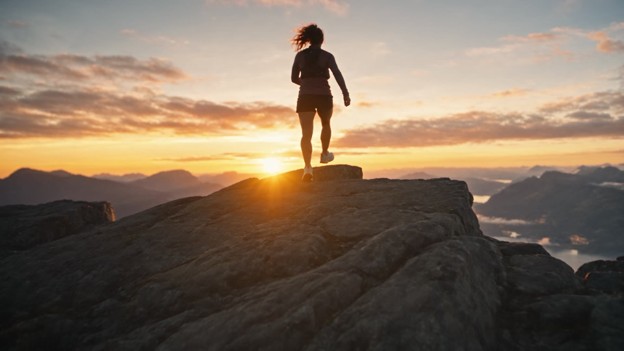
A frame from the 1080p final of our 30-second spot for the fictional trail shoe brand STRATA, generated in a single take.
Most AI-generated brand films you see online are not really generated films. They are edits: a dozen five-second clips, each generated separately, cut together with music. That approach works, but it has a cost that is easy to overlook. Every cut is a place where the product can change shape, the light can jump and the story can lose its thread. Keeping a shoe, a jacket or a bottle identical across twelve separate generations takes many attempts and a lot of editing.
Seedance 2.5 offers a different approach. It can generate up to 30 seconds in one request and take up to 30 reference images. In principle, that means a complete brand spot, with a beginning, a middle and an end, can be generated as a single continuous take with the real product in it. We tested that principle with a fictional trail running shoe brand, STRATA, three reference images and one ambitious prompt. We then tested the variations a brand team would actually need: a 15-second cut, a vertical version, a version without references, a logo transition, and the draft workflow for producing a high-resolution final.
Seven clips cost $34.66, almost half of it for one 1080p final. Here is what each one showed, and what it cost.
The brand and its references
STRATA is invented for this test. Its product is a minimalist trail shoe with an off-white upper and a burnt orange sole and laces, and its brand line is “Built for the ridge”. We created three reference images: a clean studio shot of the shoe, a photo of a runner on a rocky ridge at sunrise wearing it, and a simple brand card with the name and the line.

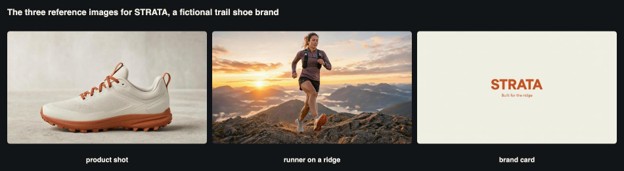
All three were passed to Seedance 2.5 as reference images, using the image_with_roles field with the role reference_image, and the request was set to reference mode. Unlike a first frame, a reference does not fix the opening shot; it tells the model what the product, the person and the brand look like, and leaves the model free to stage new scenes around them.
{
“model”: “seedance-2.5”,
“prompt”: “A 30-second single-take commercial for a trail running shoe brand called STRATA…”,
“image_with_roles”: [
{“url”: “https://…/shoe.jpg”, “role”: “reference_image”},
{“url”: “https://…/runner.jpg”, “role”: “reference_image”},
{“url”: “https://…/brand-card.jpg”, “role”: “reference_image”}
],
“omni_reference_task_type”: “reference”,
“size”: “16:9”, “resolution”: “720p”, “duration”: 30
}
Test 1: the 30-second single take
The prompt described the whole spot, start to finish, as one continuous shot:
A 30-second single-take commercial for a trail running shoe brand called STRATA. The camera starts on the off-white shoe with the burnt orange sole resting on a rock at dawn, then follows a female trail runner wearing those shoes as she climbs a rocky ridge, crosses a stream and reaches the summit at sunrise, ending on a close-up of the shoes and the STRATA brand card from the reference. Cinematic, natural sound of footsteps, wind and breathing, an uplifting music bed.

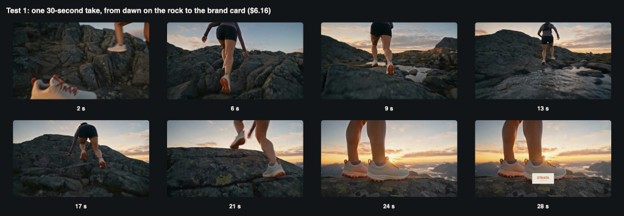
Seedance followed the story in order and without a cut. The take opens close to the ground on the rock, with the shoe in the foreground, then follows the runner from behind as she climbs, scrambles over rock with her hands, crosses shallow water and reaches the top. The last third shows the sun rising over a sea of cloud and ends on a low close-up of the shoes on the summit rock with the brand card beside them.
The product was the most important thing to check, and it held up. The shoe kept its off-white upper and burnt orange sole from the first frame to the last, through changing light, motion blur and close-ups. The runner was seen mostly from behind and below, which suits a product film and avoids the face consistency problems that longer clips often have. The camera moved like a handheld follow shot, with natural speed changes as the terrain changed.
The 30-second take cost $6.16 at 720p, about 20.5 cents per second, and took ten minutes to arrive. That is the cost of one complete spot, not one shot of it.
Test 2: how each version ended
An ad that does not end on the brand is not an ad. We checked the final frame of every version we generated with the brand card as a reference.

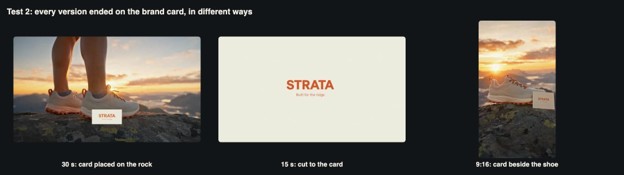
Every version ended on the brand, but each staged it differently. In the 30-second take, the model turned the card into a physical object, a small white card propped against the rock next to the shoes in the sunrise. The 15-second version cut from the summit to the card itself, full screen, with “STRATA” and “Built for the ridge” exactly as in the reference. The vertical version placed the card upright beside the shoe on the rock. The 30-second draft, which we discuss below, also cut to a full-screen card at the end.
The model’s interpretation is not something you can fully control from the prompt, but all three endings are usable, and having the brand card as a reference guarantees the name and line are rendered correctly. If you need a specific end frame, generate the spot and add the end card in the edit, or use the first-and-last-frame mode described in Test 5.
Test 3: the same prompt without references
To show what the references were doing, we generated the same story at 15 seconds with no images at all, only the text prompt.

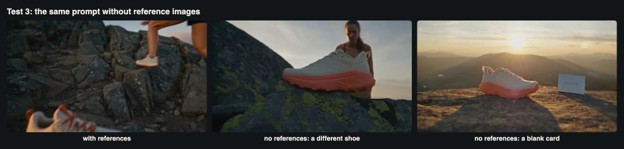
Test 3: without references, the shoe changed and the brand card was blank.
The film was still beautiful: a runner lacing up on a mossy rock, climbing, and a final shot of the shoe at sunset. But it was not STRATA’s film. The shoe was a different design, chunkier, with a thick bright orange midsole instead of the slim burnt orange sole of the real product. And the brand card at the end was blank: the model placed a white card next to the shoe, as the prompt asked, but without the reference it had no brand to put on it. The text-only clip cost the same as the reference version, $3.09 for 15 seconds.
That comparison is the clearest argument for references in brand work. The words “off-white shoe with a burnt orange sole” describe thousands of shoes; the reference image describes one.
Test 4: a vertical cut
A brand spot now needs a 9:16 version for stories and short-form feeds. We generated the 15-second version with the same references and the size set to 9:16.

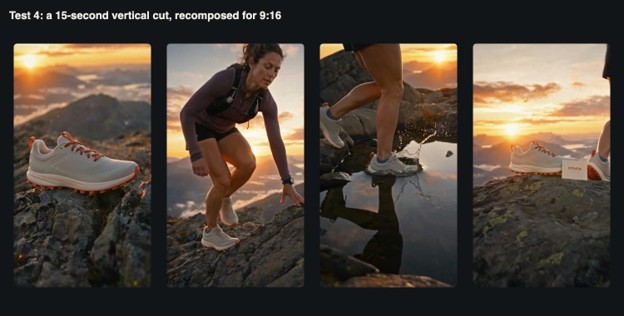
The model recomposed the spot for the tall frame rather than cropping a landscape version. It opened on the shoe on a rock with clouds below, then showed the runner, this time partly from the front, scrambling over rocks, a close-up of a foot splashing through a puddle that reflected the sky, and the shoe with the brand card on the summit. The shoe matched the reference throughout. Because the composition was designed for vertical from the start, nothing important was lost at the edges. It cost $3.09 for 15 seconds, the same as the landscape version.
Test 5: a logo transition with first and last frames
For a precise ending, Seedance 2.5 can take a first frame and a last frame and generate the motion between them. We used the studio shot of the shoe as the first frame and the brand card as the last.
The shoe on the concrete surface lifts into the air and transforms into the brand card, smooth elegant motion.

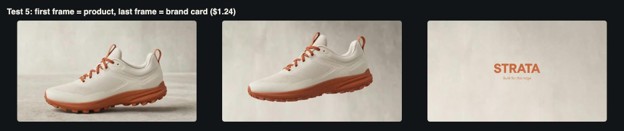
The six-second transition lifted the shoe off the surface, rotated it slightly and resolved into the brand card, with both the first and the last frame matching the images exactly. It cost $1.24. As an end card for any of the longer versions, or as a standalone bumper before a video, this is the most controllable tool in the set. Note that first-and-last-frame mode requires the size to be set to adaptive; the output takes its shape from the images.
Test 6: draft first, then a 1080p final
A 30-second take at 1080p is expensive, and you only want to pay for it once. Seedance 2.5’s draft mode lets you generate a cheap 480p draft, review it, and then produce a 1080p final from the same task without resending the prompt.
Step 1: same request as Test 1, with “draft”: true (480p)
Step 2: {“model”: “seedance-2.5”, “draft_task_id”: “<task id from step 1>”, “resolution”: “1080p”}

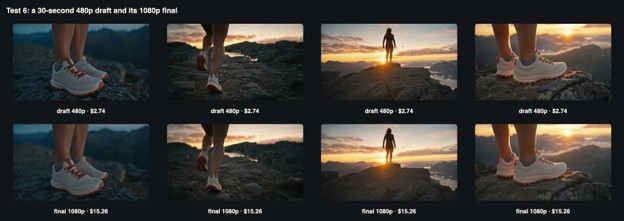
The 30-second draft cost $2.74 and took four minutes. It was a different take from our 720p version, because every generation is new, with a slightly different sequence: shoes on the rock, the runner on a stony path, a silhouette on the summit against the sun, and a close-up of the shoes before a cut to the brand card. We liked it, so we sent it for a final.
The 1080p final took only three minutes, faster than the draft, and cost $15.26. It reproduced the draft shot for shot: the same compositions, the same timing, the same runner and shoes, simply sharper and more detailed. That is the point of the workflow. You approve the creative decisions at 480p, at less than a fifth of the price, and pay for resolution only once you know exactly what you are getting.
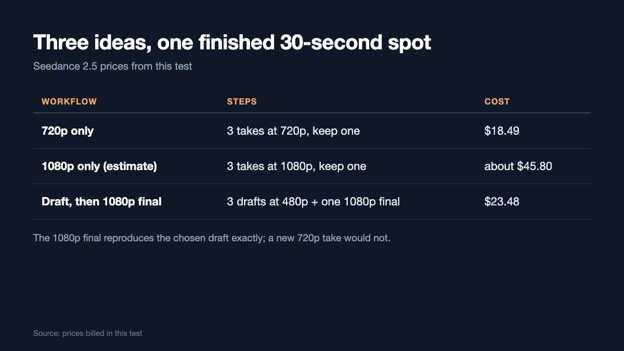
If a team explores three ideas and finishes one, the draft workflow costs $23.48 for a 1080p spot: three drafts at $2.74 and one final at $15.26. Generating three full 1080p takes and keeping one would cost around $45.80, based on the final’s price. Staying at 720p is cheapest, $18.49 for three takes, but you lose the sharpness of 1080p and the guarantee that the version you approved is the one you get.
What it costs
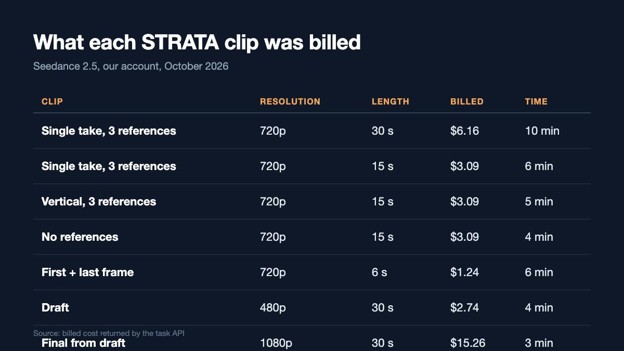
We made every clip through the Seedance 2.5 API, which accepts reference images, first and last frames, draft mode and draft-to-final upgrades on one asynchronous endpoint, and returns the billed cost of each task. In our account, 720p cost about 20.5 cents per second regardless of whether we used references, 480p drafts about 9 cents and 1080p finals about 51 cents. Turning sound off did not change the price in an earlier test, so we left it on.
How the single take changes the workflow
Generating a spot in one take changes what the creative team spends its time on. In a clip-by-clip workflow, most of the effort goes into consistency: regenerating shots until the product matches, and hiding the joins in the edit. In a single-take workflow, consistency comes almost for free, and the effort moves to the prompt. The prompt becomes a shot list: where the camera starts, what happens in what order, where the brand appears. Writing it is closer to writing a storyboard than to writing an image prompt.
The trade-off is control over timing. In our 30-second take, the stream crossing came earlier and the summit later than we might have chosen, and we could not move them without generating a new take. If precise timing matters, for example to match a voiceover, a hybrid works well: one long take for the main action, a first-and-last-frame transition for the logo, and the edit to fine-tune the length.
One more practical detail. Because every clip has a generated sound track, the single take comes with one continuous track rather than a dozen separate ones, which is another thing a clip-by-clip edit has to stitch together. You can hear the generated sound of the 1080p final in the walkthrough video below; replace it with licensed music if the brand has a sonic identity.
The walkthrough video
Walkthrough, including the full 30-second 1080p spot with its generated sound (about 3 minutes).
Recommendations for brand teams
- Always use references. Without them, the shoe changed design and the brand card was blank.
- Write the prompt as a shot list. Seedance followed our sequence of events in order across 30 seconds.
- Shoot the product from angles that flatter consistency. Following the runner from behind and low kept the shoe in view and avoided face changes.
- Use first and last frames for the logo. It was the most precise tool for a controlled ending.
- Draft at 480p, finalise at 1080p. The final matched the draft exactly, so approval decisions can be made cheaply.
- Generate the vertical version separately. A dedicated 9:16 take was recomposed for the format at no extra cost.
- Plan for long generation times. A 30-second take at 720p took ten minutes; submit versions in parallel.
From one take to a campaign
A single 30-second take is the hero asset of a campaign, not the whole campaign. In practice a brand needs a 6-second bumper, a 15-second cut and a vertical version as well. Our test suggests an efficient order of work.
Generate the 30-second take first, as a draft, and approve the story. Then generate the 15-second and vertical versions from the same references, rather than cutting them down from the 30-second film: the model stages each length for its duration and its frame, as our vertical version showed. Use the first-and-last-frame transition as the bumper and as the end card for every cut, so that every version ends identically. Finally, finalise only the approved 30-second draft at 1080p, and keep the shorter cuts at 720p, where most of them will be seen on phones.
Sound needs a decision too. Every clip came with a generated sound track, which can serve as a starting point for the mix. For a brand with a sonic identity, replace it with licensed music in the edit, and keep any parts of the generated track that suit the picture underneath at a low level.
One editorial check is worth building into the process. In our 30-second take, the brand card appeared as a physical card on a rock. That is charming, but it is a creative decision the model made on its own. Before a spot is published, someone should watch it specifically for decisions like this and confirm they suit the brand.
Limitations
We generated one take of each version, so we cannot say how often the same prompt would produce a usable spot. Our references were clean, generated images; real product photography with complex branding or packaging text might behave differently. We did not formally assess the generated sound; listen to it in the walkthrough video and judge for yourself.
Appendix: the prompts we used
For anyone who wants to repeat these tests, here are the prompts as we sent them, grouped by clip. Parameters such as duration and resolution are listed after each prompt.
s1-30s-720 (model: seedance-2.5, size: 16:9, resolution: 720p, duration: 30)
A 30-second single-take commercial for a trail running shoe brand called STRATA. The camera starts on the off-white shoe with the burnt orange sole resting on a rock at dawn, then follows a female trail runner wearing those shoes as she climbs a rocky ridge, crosses a stream and reaches the summit at sunrise, ending on a close-up of the shoes and the STRATA brand card from the reference. Cinematic, natural sound of footsteps, wind and breathing, an uplifting music bed.
s1-15s-720 (model: seedance-2.5, size: 16:9, resolution: 720p, duration: 15)
A 15-second single-take commercial for a trail running shoe brand called STRATA. The camera starts on the off-white shoe with the burnt orange sole resting on a rock at dawn, then follows a female trail runner wearing those shoes as she climbs a rocky ridge, crosses a stream and reaches the summit at sunrise, ending on a close-up of the shoes and the STRATA brand card from the reference. Cinematic, natural sound of footsteps, wind and breathing, an uplifting music bed.
s1-firstlast (model: seedance-2.5, size: adaptive, resolution: 720p, duration: 6)
The shoe on the concrete surface lifts into the air and transforms into the brand card, smooth elegant motion.
s1-vertical (model: seedance-2.5, size: 9:16, resolution: 720p, duration: 15)
A 15-second vertical single-take commercial for a trail running shoe brand called STRATA. The camera starts on the off-white shoe with the burnt orange sole resting on a rock at dawn, then follows a female trail runner wearing those shoes as she climbs a rocky ridge, crosses a stream and reaches the summit at sunrise, ending on a close-up of the shoes and the STRATA brand card from the reference. Cinematic, natural sound of footsteps, wind and breathing, an uplifting music bed.
The bottom line
Seedance 2.5 can generate a complete 30-second brand spot in a single take, with the real product consistent from the first frame to the last, for about six dollars at 720p. Reference images are what make it a brand film rather than a generic one, and draft mode makes a 1080p final affordable by letting you approve the creative at 480p first. The remaining work is the part only people can do: writing a clear shot list and deciding which take tells the brand’s story best. If you want to make your own spot, or compare Seedance 2.5 with other video models through one account and API key, all of them are available on APIMart.
To read more content like this, explore The Brand Hopper
Subscribe to our newsletter
Go to the full page to view and submit the form.