


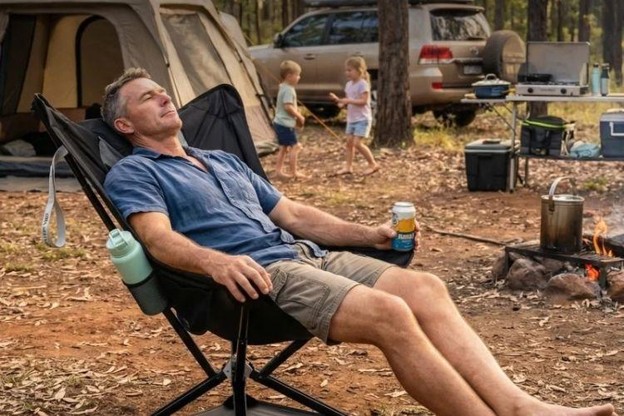
Australia’s camping sector remains large, but the way people travel is changing. The Caravan Industry Association of Australia reported 17.3 million caravan and camping trips in 2025, accounting for 57.9 million visitor nights and $12.6 billion in expenditure. Average trip length fell to 3.4 nights, while travellers increasingly chose shorter, closer-to-home breaks and placed greater emphasis on value. With 87% of caravan and camping trips occurring in regional Australia, equipment that is easy to store, carry, and deploy has a clear role in this travel pattern.
Adelaide-based Ozzi Gear operates in that portability-focused part of the outdoor market. OZZI GEAR GROUP PTY LTD has held an active Australian Business Number since February 2024, with its main business location listed in South Australia. Its range includes compact chairs, loungers, a Mini Table, ground sheets, seat covers, and camping bundles. The brand says it was created by two outdoor enthusiasts seeking lighter, more practical equipment for regular trips.
Compact Dimensions Address a Practical Packing Problem
Ozzi Gear’s main distinction is packed size. The Ozzi Outdoor Chair packs down to about 35cm, roughly comparable with a large water bottle, while weighing 1.7kg according to current product specifications. Its one-piece folding system also avoids separate poles or connectors that need to be assembled or stored.
Those dimensions matter across several outdoor settings. Hikers and motorbike travellers have strict space and weight limits, while festival-goers and parents at sports events may need to carry seating considerable distances.
The broader camping market provides useful context. Australia’s registered recreational vehicle fleet grew by 4% to about 937,000 vehicles, according to the Caravan Industry Association’s 2026 industry reporting. Caravan parks also generated a record $3.3 billion in revenue during 2025. For shorter trips, compact furniture can reduce the amount of equipment that has to be loaded, unloaded, and stored without removing seating from the packing list.
Low Weight Doesn’t Mean Low Stated Capacity
Portability is only useful if furniture remains stable enough for regular use. The Outdoor Chair uses an aviation-grade alloy frame and ripstop nylon seat fabric. Ozzi Gear rates the chair at 150 kg despite its 1.7kg packed weight. The larger Lounger weighs 3kg and is advertised with a capacity of up to 170 kg on current product material, although one FAQ on the company’s site lists 150 kg, an inconsistency buyers may want to note.
This strength-to-weight approach places the products closer to lightweight adventure equipment than traditional steel-framed folding chairs. It also helps explain the brand’s premium positioning. Customers are paying for reduced packed volume and weight rather than simply for a place to sit.
The Ozzi Gear range extends the same approach beyond the standard chair. The Lounger packs to about 52 cm and adds a higher back, integrated neck pillow and ExtendaFrame™ system. The company also sells a compact Mini Table, ground sheets, seat covers, and multi-item bundles for couples and families.
Faster Setup Supports Shorter, More Flexible Stops
Setup time is another part of Ozzi Gear’s design proposition. The company states that its standard chair opens in about 10 seconds, with no loose parts. The Lounger is promoted with a five-second setup through its ExtendaFrame™ design, although other product-page copy also refers to a 10-second opening time.
In practical terms, rapid deployment can matter beyond campsites. Portable seating is commonly used at beaches, festivals, roadside stops, fishing locations, and children’s sporting events. A simpler mechanism may also be useful for older customers or people who prefer not to handle multiple poles and fabric sleeves.
Demand for camping accommodation remains visible in industry data. In December 2025, national caravan park cabin occupancy reached 64%, powered-site occupancy reached 49%, and unpowered-site occupancy reached 26%. Each figure represented a record December result for its category.
Comfort Broadens the Use Case Beyond Minimalist Camping
Compact camping equipment often involves a trade-off between packability and comfort. Ozzi Gear has attempted to address that through two seating formats. The standard Outdoor Chair uses a hammock-style seat and supportive back, while the Lounger is designed for longer sitting periods with a higher back and neck pillow.
That distinction widens the potential customer base. A 1.7 kg chair may suit hikers and festival visitors who prioritise carrying weight. The 3 kg Lounger is more relevant to customers who can accept additional weight in exchange for more back and neck support. Parents spending hours beside sports fields, road travellers and campers staying at one site for several days may fall into the latter group.
Customer feedback provides another, though imperfect, indicator. As of September 2026, Ozzi Gear held a 4.5 out of 5 Trustpilot score from more than 1,100 reviews. Recent reviewers frequently mention compactness, comfort, and responsive customer service, while some report initial stiffness, delivery delays, or product faults. As with any review platform, individual experiences vary and shouldn’t be treated as controlled product testing.
Warranty Coverage Adds a Longer-Term Ownership Argument
Ozzi Gear’s current website states that all products carry a lifetime warranty and a 45-day return window. This is broader than earlier information that described a three-year chair warranty with an optional lifetime upgrade. The current policy is therefore the more relevant reference for prospective buyers.
The company also says it supports more than 45,000 customers worldwide. Its website currently lists shipping to Australia, New Zealand, the United Kingdom, Europe, and Canada, with shipping offered free to those markets. That is more specific than the broader “worldwide shipping” language sometimes used in third-party descriptions.
For Ozzi Gear, the market position is relatively clear: compact outdoor furniture aimed at customers willing to pay more to reduce bulk and carrying weight. The brand’s specifications, product range and warranty structure all reinforce that focus. In a camping market shaped by shorter trips, regional travel and value-conscious purchasing, its proposition centres less on adding equipment and more on making familiar outdoor furniture easier to take along.
To read more content like this, explore The Brand Hopper
Subscribe to our newsletter
Go to the full page to view and submit the form.