


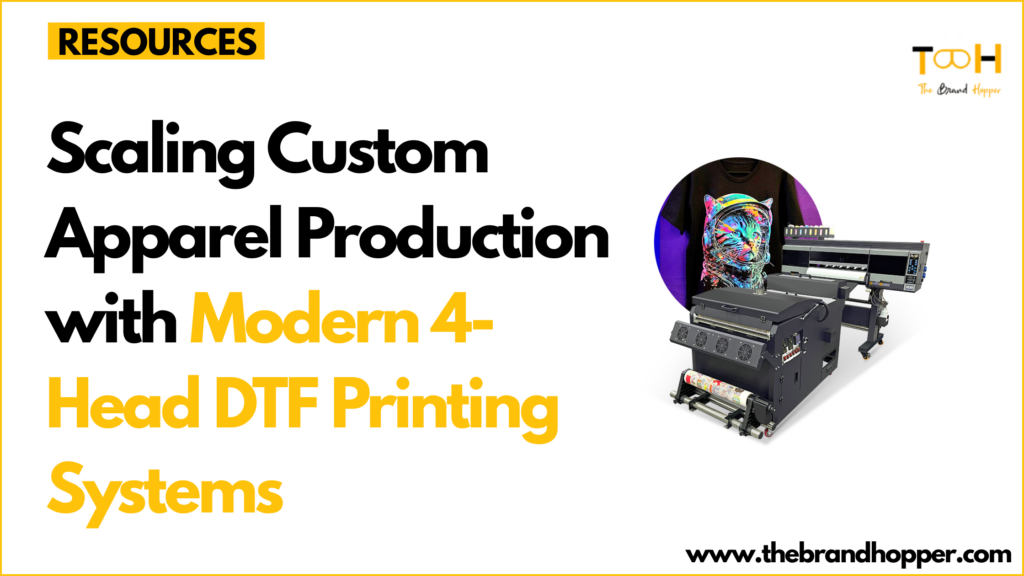
The custom apparel industry has evolved significantly over the past decade. What once required large minimum orders and complex screen setups can now be accomplished with greater flexibility and speed. Direct-to-Film (DTF) printing has emerged as one of the most efficient technologies for garment decoration, especially for businesses looking to balance quality and scalability.
For small and mid-sized print shops in the United States, the key challenge is not simply printing designs — it is producing them consistently at volume while maintaining margins. As order sizes fluctuate and custom requests increase, equipment capability becomes the foundation of sustainable growth.
In this context, many growing apparel businesses are transitioning toward multi-head systems designed for commercial use rather than hobby-grade machines.
Why Production Capacity Defines Competitive Advantage
When businesses begin exploring DTF printing, they often start with entry-level machines. These systems can be effective for low-volume work, but as production demand increases, several limitations become apparent:
- Slower throughput
- White ink bottlenecks
- Reduced stability during long print runs
- Higher labor dependency
Scaling beyond these constraints requires a more production-focused setup. This is where investing in a true commercial DTF printer system becomes strategically important.
A commercial-grade system is designed to handle continuous daily output, ensuring consistent color density, reliable white underbase performance, and stable print head operation across longer runs.
The Power of a 4-Head Configuration
One of the most impactful upgrades in DTF technology is the move toward multi-head architectures. A properly configured 4 head DTF printer significantly increases throughput while maintaining high-resolution detail.
Instead of relying on a single print head to manage all ink channels sequentially, a four-head setup distributes workload more efficiently. This improves:
- Production speed
- White ink layering
- Color accuracy
- Print consistency across large batches
For print businesses servicing wholesale clients or corporate contracts, this increased efficiency directly translates into faster turnaround times and higher profit margins.
Multi-head systems also reduce production stress during peak seasons, where delayed fulfillment can damage customer relationships.
Balancing Investment and Long-Term ROI
Purchasing a professional DTF system is a significant investment. However, focusing solely on upfront cost often leads to underpowered purchases that limit growth potential.
Smart buyers evaluate:
- Cost per transfer
- Monthly production capacity
- Maintenance reliability
- Ink efficiency
- Downtime risk
A stable commercial setup helps businesses accept larger orders confidently, reducing the need for outsourcing and increasing operational control.
For many apparel brands, upgrading equipment is less about expansion and more about survival in a competitive market.
Integration with Complete Production Workflow
A commercial DTF system typically operates within a structured workflow that includes:
- Film printing
- Powder application
- Curing
- Heat transfer finishing
When paired with proper curing units and industrial heat presses, production becomes streamlined and repeatable.
As order volume grows, automation and stability become increasingly important. Businesses that adopt reliable multi-head configurations position themselves to compete nationally rather than locally.
Building a Brand Around Production Reliability
In today’s digital marketplace, brands are judged not just by design but by delivery speed and consistency. Equipment reliability directly influences reputation.
Many print businesses evaluating production upgrades research suppliers that offer scalable equipment tailored for commercial environments. Platforms such as DTF Bank provide production-oriented systems designed specifically for growing apparel operations in the U.S. market.
Choosing a solution that balances speed, durability, and long-term support can significantly impact business performance over time.
Future-Proofing Apparel Printing Operations
The demand for custom apparel is expected to continue expanding, particularly among:
- Small clothing brands
- Influencer merchandise lines
- Corporate promotional suppliers
- Team and event apparel providers
Businesses investing in modern multi-head DTF systems are preparing not just for current demand but for future scalability.
A well-structured production setup ensures that growth does not create operational chaos.
Conclusion
Direct-to-Film printing has redefined how custom apparel is produced. For businesses aiming to scale, the transition from entry-level equipment to professional multi-head systems is often the turning point.
A carefully selected commercial-grade printer allows for:
- Higher output
- Better print consistency
- Improved white ink performance
- Stronger operational stability
In competitive markets, production efficiency is the ultimate differentiator. Businesses that invest in scalable systems today position themselves for sustainable growth tomorrow.
To read more content like this, explore The Brand Hopper
Subscribe to our newsletter
Go to the full page to view and submit the form.