


The pilot sitting behind a commercial aircraft windscreen is separated from an environment that would kill an unprotected human in minutes. At cruising altitude the air temperature outside can be below minus 50 degrees Celsius. The pressure differential between the cabin and the outside world is around 8 psi, roughly equivalent to having a small car parked on every square foot of the glass. And the aircraft is travelling at speeds where a bird strike carries the energy of a rifle shot.
The window that handles all of that is not glass in any conventional sense. It is an engineered laminate assembly whose construction took decades of material science to develop and whose replacement, when it fails or is damaged, costs an airline tens of thousands of dollars per pane. Understanding what it is made of, why it is made that way, and why the chemistry of the cleaning products used on it is a genuine safety concern: that is what this article covers.

What an Aircraft Windscreen Is Actually Made Of
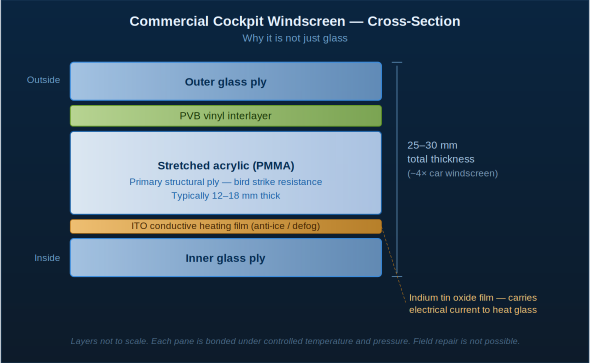
Commercial cockpit windscreens are laminated assemblies, typically combining five or more distinct layers. No single material provides everything the window needs, which is why the design has evolved into a carefully engineered stack.
The outer glass ply
The outermost layer is toughened or tempered glass. Glass earns its place on the outside because of properties that polymer alternatives cannot match at that exposure level: it resists abrasion from windscreen wipers and rain erosion, it tolerates chemical attack from de-icing fluids and hydraulic fluid that might spray onto it, and it does not develop the surface micro-cracking that ultraviolet radiation and environmental chemicals can cause in acrylic over time.
According to the FAA’s Advisory Circular AC 25.775-1, which governs windshield and window panel design for transport category aircraft, glass has good resistance to scratching and chemical attack including solvents and de-icing fluid. The outer ply also carries the primary pressure load in many designs, transferring it through mounting straps to the airframe rather than through the plastic layers beneath.
The vinyl interlayer
Between the glass and acrylic structural plies sit one or more layers of polyvinyl butyral (PVB) or polyurethane bonding material. These interlayers perform several functions simultaneously. They bond the dissimilar materials together. They absorb energy during a bird strike, preventing brittle fracture propagation from the outer glass into the structural acrylic. And when heated (as these windows are during flight), the vinyl layers become less brittle, dramatically improving impact resistance compared to a cold, rigid assembly.
Free aviation study materials describe the effect directly: heating the vinyl layers makes them less brittle, allowing them to withstand an impact with much less chance of penetration than they would when cold. The windscreen heating system serves both anti-icing and structural purposes simultaneously.
The stretched acrylic core
The thickest layer in most commercial windscreen assemblies is stretched acrylic, also known by the chemical name polymethyl methacrylate (PMMA). This is the primary structural ply. Its job is to resist penetration from bird strikes and maintain the pressure boundary of the cabin.
Stretched acrylic is not ordinary acrylic sheet. The stretching process, applied under heat and controlled tension, re-orients the polymer chains in a way that significantly increases tensile strength and fracture toughness compared to un-stretched PMMA. The Brainbound aviation windshield guide notes that stretched acrylic provides exceptional clarity, low density, and high tensile strength, and for high-stress applications layered structures incorporating polycarbonate panels are strategically employed for their superior puncture resistance.
A typical commercial windscreen has a stretched acrylic ply of 12 to 18 millimetres. Add the glass plies on each side and the interlayers, and total assembly thickness runs from 25 to 30 millimetres, roughly four times thicker than a car windscreen, as the Aeropeep flight deck windshield analysis notes.
The ITO heating film
Between the acrylic structural ply and the inner glass lies a transparent conductive film. In most modern commercial aircraft this is an indium tin oxide (ITO) coating, a transparent metallic oxide deposited onto the inner surface of the outer glass ply by a physical vapour deposition process. Electrical current passes through the film, generating heat across the entire glass surface uniformly.
The system operates automatically at engine start on most commercial aircraft, maintaining windscreen temperature within a controlled range, typically between 40 and 49 degrees Celsius according to published aircraft systems data. Separate circuits for the pilot and co-pilot windscreens are standard, providing redundancy in case one circuit fails. The temperature is monitored by embedded sensors, and the control unit prevents overheating that could damage the interlayer bonds.
ITO replaced earlier designs that used fine resistance wires embedded in the laminate. Both approaches remain in service on different aircraft types, but ITO provides more uniform heating across the glass surface and avoids the optical distortion that wire elements can produce at certain viewing angles.
The inner glass ply
The innermost layer is another glass ply, providing the clean, hard surface that faces the flight deck. Glass is used here for the same reasons as the outer ply: scratch resistance and chemical tolerance. The inner surface is the one that crew members are most likely to contact during cleaning, and it needs to withstand that contact without degrading.
Why the Assembly Costs What It Does

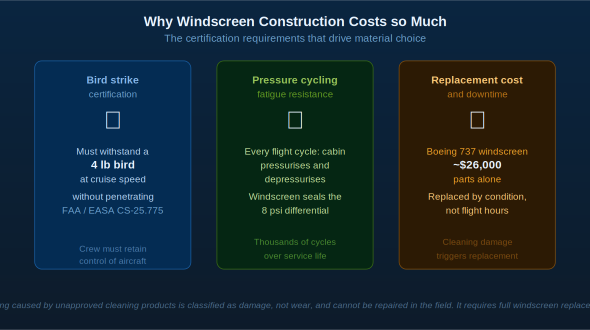
A Boeing 737 cockpit windscreen costs around $26,000 per unit in parts, according to trade export records published by The Points Guy. That figure does not include installation labour, which adds further cost. Wide-body windscreens are more expensive still, and the price continues to rise as materials and coating processes become more sophisticated.
The cost reflects several interlocking factors that are each non-negotiable.
Bird strike certification requirements
Under FAA regulations (14 CFR 25.775) and the equivalent EASA CS-25.775, transport category aircraft windscreens must withstand a bird strike from a four-pound bird at the aircraft’s design cruising speed without penetrating the inner ply. The crew must retain control of the aircraft after the strike. In practice, this means the assembly must absorb and distribute an impact energy that, at high cruise speeds, is in the range of several thousand joules.
Certification testing uses either real birds or gelatine projectiles of equivalent mass. The windscreen must pass without penetration, and the crew field of view must not be unacceptably impaired. That testing, and the material engineering required to pass it, is embedded in the cost of every production unit.
Pressure cycling fatigue
Every flight puts the windscreen through a pressurisation and depressurisation cycle. Over the typical service life of a commercial aircraft, that adds up to thousands of cycles. Each cycle loads and unloads the glass plies, the bonding interlayers, and the interface between dissimilar materials with slightly different thermal expansion coefficients.
The laminate construction is designed to distribute these stresses rather than concentrate them. But the design requires precise quality control in manufacturing, controlled cure temperatures for the interlayer bonds, and careful handling throughout the assembly’s life. All of that is reflected in price.
No field repair
Unlike many aircraft components, windscreen assemblies cannot be repaired in the field. The Brainbound guide notes that the complexity of manufacturing, integrating structural acrylic, polycarbonates, specialised anti-abrasion coatings, and transparent conductive heating layers, makes localized field repair virtually impossible. When a windscreen is damaged, the answer is replacement, not patch repair. That means the cost of any damage event is always the full unit cost.
Why Cleaning Chemistry Matters as Much as the Cleaning Itself

The surface that aircrew and maintenance engineers typically interact with during cleaning is the inner glass ply of the windscreen. That surface is glass, and glass can tolerate more chemical exposure than the acrylic structural ply beneath it. So why does product choice matter so much?
Two reasons. First, liquids can reach the acrylic through gaps at frame seals and panel edges if applied carelessly. Second, and more importantly, many aircraft have side windows, cockpit glass panels, and cabin windows made of acrylic or polycarbonate rather than glass, and these are frequently cleaned with the same products used on the windscreen without distinguishing between the substrates.
The mechanism of chemical crazing
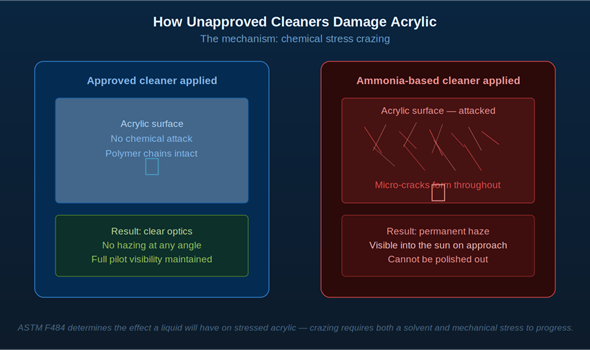
Crazing in acrylic is not a surface scratch. It is a bulk failure of the polymer structure, caused by the combination of two factors: mechanical stress and chemical attack. An acrylic panel under bending stress, as all aircraft windows are to some degree simply from pressure loading, has regions of elevated tensile stress at its surfaces. Certain solvents, when they contact those stressed regions, penetrate the polymer and lower the energy required for crack propagation. The cracks that form are microscopic, but they scatter light, creating the characteristic haze that pilots call crazing.
Aviation Week’s windscreen distortion analysis summarises the chemical trigger list from actual aircraft maintenance manuals, noting that chlorinated hydrocarbon cleaners such as trichloroethane can cause crazing damage on acrylic surfaces. The Challenger service manual cited in that article adds: do not use gasoline, alcohol, benzene, acetone, carbon tetrachloride, fire extinguisher or de-icing fluids, lacquer thinners, or window cleaning sprays because they will soften the plastic and cause crazing.
Ammonia deserves specific attention because it is the active ingredient in most household glass cleaners and many general-purpose surface cleaners. Aviation maintenance forums and pilot guidance documents are consistent on this point: ammonia causes crazing in thousands of microscopic cracks in short order. Even a single application of an ammonia-based cleaner to a stressed acrylic surface can initiate the damage that accumulates into visible hazing over subsequent cycles.
What approved products do differently
Products formulated specifically for aviation acrylic and polycarbonate substrates are tested against the material under stress conditions before they are approved for use. The relevant standard is ASTM F484, which determines the effect a liquid will have on transparent acrylic material subjected to bending stress. As Techspray’s aircraft chemical damage analysis describes, the test applies a stressed acrylic sample to a jig and exposes it to the test liquid, then monitors at 30 minutes, 1 hour, 2 hours, 4 hours, and 8 hours for any crazing or degradation. A product that passes this protocol has been verified, under standardised conditions, not to cause the failure mode that unapproved solvents produce.
Products that carry Boeing Specification D6-7127 approval have been through material compatibility testing against the substrates used in Boeing aircraft. Alglas products, for example, have been evaluated against the specific acrylic and polycarbonate specifications used in both Boeing and Airbus aircraft and are listed in both manufacturers’ maintenance manuals. That approval trail is not a marketing credential. It is the documented evidence that the product will not cause the failure mode that an unapproved cleaner might.
The opacity problem and pilot safety
The practical safety argument for approved cleaning products on cockpit glass comes down to what crazing does to pilot visibility. Mild crazing is invisible in flat, even lighting. It becomes apparent when the pilot is looking into the sun, during a low-sun approach or departure, or during a night approach toward bright runway lighting. In those conditions, a crazed windscreen scatters the incoming light, creating a bright haze across the pilot’s field of view precisely in the conditions where optical clarity matters most.
A windscreen that passed its previous inspection can become a visibility problem in a matter of weeks if cleaned with the wrong product. And because the damage is invisible in most inspection conditions, it often goes undetected until a pilot reports degraded forward visibility during a challenging approach.
| What cleaning products must not contact acrylic aircraft surfaces
Ammonia-based cleaners (all household glass cleaners). Acetone and ketone solvents. Alcohols, including isopropyl alcohol. Chlorinated hydrocarbons (trichloroethane, carbon tetrachloride). Lacquer thinners and paint solvents. Fire extinguisher discharge. De-icing fluids applied directly to acrylic. Gasoline or aviation fuel. Any product not tested to ASTM F484 or listed in the aircraft manufacturer’s approved product documentation. |
How Windscreens Are Maintained and Replaced
Commercial windscreens are replaced by condition, not by flight hours or calendar time. There is no fixed interval after which a windscreen is automatically removed from service. It stays in service until it shows damage, delamination, electrical faults in the heating circuit, or optical degradation that fails the specified clarity criteria.
Typical removal triggers include: crazing or hazing that reduces forward visibility below the minimum visual angle requirements, delamination between plies detected by ultrasonic inspection, electrical faults in the ITO heating layer, and physical damage from bird strikes or ground equipment contact.
The Aeropeep analysis notes that the environment is severe and the outer surface is often damaged due to particulate impacts, scratching, or bond failures at interlayer interfaces and electrical faults in anti-icing heater coatings caused by cyclical thermally and mechanically induced stresses. Those failure modes are all structural or electrical in origin. Chemical crazing from cleaning products adds a damage pathway that is entirely preventable, which is why maintenance manual product restrictions exist.
Replacement is done at a maintenance base with appropriate facilities. A cured, bonded windscreen cannot be installed at a gate. The process involves removing the mounting frame, disconnecting the heating circuit, installing the new assembly, reconnecting the electrical bus, and performing a pressure test before the aircraft returns to service.
Frequently Asked Questions
Why can’t you use ordinary glass cleaner on a cockpit windscreen?
Most household glass cleaners contain ammonia, which attacks the acrylic and polycarbonate layers in aircraft window assemblies. Ammonia causes chemical stress crazing: thousands of microscopic cracks that scatter light and create permanent hazing. Once crazing is established, it cannot be polished out and the affected panel requires replacement.
What is stretched acrylic and how is it different from regular acrylic sheet?
Stretched acrylic (PMMA) is manufactured by applying heat and controlled tension to an acrylic sheet, which re-orients the polymer chains. This process increases tensile strength and fracture toughness compared to unstretched acrylic of the same thickness, allowing thinner, lighter panels to carry higher structural loads. It is the primary structural ply in most commercial cockpit windscreens.
How does the windscreen heating system work?
A transparent conductive film, typically indium tin oxide (ITO), is deposited on the inner surface of the outer glass ply. Electric current passes through this film, generating heat across the entire glass surface uniformly. Temperature sensors embedded in the assembly feed back to a control unit that maintains glass temperature within a set range, preventing both icing on the outer surface and overheating of the interlayer bonds.
How much does a commercial aircraft windscreen replacement cost?
According to trade records published by The Points Guy, a Boeing 737 windscreen costs around $26,000 in parts. Labor and installation add to that. Wide-body aircraft windscreens are more expensive. The figure assumes no additional damage to the mounting frame or heating circuit, which may add further cost.
What is the ASTM F484 standard?
ASTM F484 is the standard test method that determines the effect a liquid or semi-liquid compound will have on transparent acrylic material subjected to bending stress. A stressed acrylic sample is exposed to the test product and monitored for crazing or degradation at intervals over up to eight hours. Products that pass this protocol without causing crazing have been verified compatible with stressed acrylic surfaces under standardised conditions. It is one of the key qualification standards for aircraft windscreen cleaning products. Aviation Week’s windscreen distortion analysis covers this and related aircraft transparency maintenance guidance in detail.
Glass Is the Easy Part
A cockpit windscreen is not a pane of glass with a wiper motor. It is a laminated assembly engineered to survive bird strikes at cruise speed, thousands of pressure cycles, and decades of thermal cycling, all while maintaining the optical clarity a pilot needs in a low-sun approach. The acrylic and polycarbonate layers at its core are the structural heart of that assembly, and they are chemically vulnerable in ways that glass is not.
The product approval system for aircraft cleaning chemicals exists precisely because the failure modes are invisible until they matter. A cleaned windscreen looks the same whether it was treated with an approved product or a household window spray. The difference shows when the sun is low and the pilot needs a clear view, and by then the damage has already been done.
Sources: FAA Advisory Circular AC 25.775-1 (faa.gov); Brainbound aviation windshield guide (brainbound.blog); Aviation Week windscreen distortions analysis (aviationweek.com); The Points Guy aircraft parts cost (thepointsguy.com); Aeropeep flight deck windshields (aeropeep.com); Techspray aircraft chemical damage (techspray.com); Diamond Coatings ITO heated windows (diamondcoatings.com); FAA free aviation study materials (aviationstudys.blogspot.com); Alglas aerospace cleaning products (alglas.com).
To read more content like this, explore The Brand Hopper
Subscribe to our newsletter
Go to the full page to view and submit the form.