


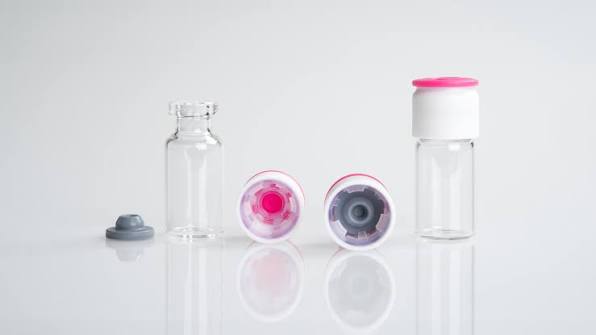
A freeze-dried peptide is characterised, certified and sealed. From that point the only things in contact with it are the glass, the stopper and whatever gas occupies the space above the cake. Those three components determine how much of the certified quality survives to the bench, and none of them normally appears on the certificate.
The headspace is a reservoir
A vial containing a few milligrams of peptide has a headspace volume thousands of times larger than the solid. If that space contains air, it contains oxygen, and that oxygen is available to the cake for the entire storage period.
For sequences containing methionine, cysteine or tryptophan, that is a slow oxidation experiment running in the dark. The quantity of oxygen in a few millilitres of air is small in absolute terms but is not small relative to a few micromoles of peptide, and over a storage period measured in years it is sufficient to generate a measurable oxidised fraction.
The standard mitigation is to backfill with an inert gas before stoppering. Nitrogen is usual, argon is better because it is denser and displaces air more reliably from an open vial. A vial backfilled with nitrogen and properly sealed removes the largest part of this pathway at negligible cost, and whether it was done is a reasonable question to put to a supplier.
The residual moisture in the headspace matters for the same reason. Water vapour in the sealed space equilibrates with the cake, and as discussed in the lyophilisation literature the resulting moisture content governs the glass transition temperature and therefore physical stability. A vial sealed in a humid environment carries that humidity for its shelf life.
Stoppers are permeable
An elastomeric closure is not a barrier in the way glass is. Oxygen and water vapour permeate through the rubber at a rate determined by the formulation, the thickness and the compression. Over months the permeated quantity becomes comparable to the original headspace content, which means an inert backfill degrades over time rather than lasting indefinitely.
Formulation differences are substantial. Butyl and halobutyl rubbers have low permeability and are standard for materials requiring long-term protection. Natural rubber and some silicone formulations are considerably more permeable. A stopper chosen for cost or availability rather than for barrier properties is a shelf-life decision taken by default.
Coated stoppers, usually with a fluoropolymer film on the product-contact face, serve a second purpose: they reduce extractables and reduce peptide adsorption onto the elastomer surface. Both matter for low-concentration material.
Extractables and leachables
Elastomer formulations contain more than rubber. Vulcanisation agents, accelerators, antioxidants, fillers and processing aids are all present, and some migrate into the contents.
Two consequences follow for peptide work. Trace transition metals from catalyst residues and fillers catalyse oxidation and thiol-disulfide exchange, which is the same mechanism described for contaminated water and no less effective for arriving from the closure. And ultraviolet-absorbing organic leachables appear as peaks in a chromatogram of the reconstituted material, where they are readily misattributed to the peptide.
The diagnostic is a blank vial: a closure of the same lot, sealed with reconstitution solvent and no peptide, held for the same period and then analysed. Any peak present is a container contribution. This takes one extra sample and settles an entire class of ambiguity.
Seal integrity and the failure that is invisible
A crimped aluminium seal holds the stopper in compression against the glass flange. Insufficient compression leaves a gas path; excessive compression can deform the stopper and also leave one. Either failure admits atmospheric oxygen and moisture continuously, which defeats both the backfill and the moisture specification.
Seal failure is not visually obvious. The usual industrial checks are headspace analysis, where a laser measures oxygen or moisture in the sealed space non-destructively, and a vacuum or dye ingress challenge. Neither is available to most receiving laboratories, but one proxy is: a cake that has shrunk, collapsed or changed appearance relative to how it was described at release is evidence of moisture ingress, and the seal is the likeliest route.
Practical handling follows from the same logic. Do not remove and re-seat a stopper if the vial is going back into storage, because the backfill is gone and the compression will not be what it was. Where a vial must be used across several sessions, the better practice is to reconstitute once and divide the material into sub-volumes in appropriate containers, accepting the solution-state stability penalty in exchange for not repeatedly breaching the seal.
Why blends raise the stakes
A single-component vial has one oxidation-sensitive population. A multi-component preparation has as many as it has components, and they do not degrade at the same rate. Oxygen ingress that oxidises one component faster than the others changes the ratio between them, and the ratio is part of what was purchased.
For a preparation such as a GLOW research blend, where three sequences share a vial, a shared headspace and a shared closure, the container specification is doing work that no amount of release testing can substitute for. Differential degradation is a change in composition, not just a drop in purity.
What to ask
Four questions. Was the vial backfilled with inert gas, and with which? What is the stopper formulation and is it coated? Was seal integrity verified, and how? Is there extractables data for the closure?
Most research-grade suppliers will not have all four answers. The ones who have any have thought about the container as part of the product.
The certificate describes the cake. The vial decides how long the description stays true.
For laboratory research use only. Not for human or veterinary use.
To read more content like this, explore The Brand Hopper
Subscribe to our newsletter
Go to the full page to view and submit the form.