


There is a measurable gap between how American players respond to a fully dubbed AAA title and how they respond to one shipped with subtitles laid over foreign-language audio. Survey data, and the purchasing behavior behind it, consistently suggests US buyers rate dubbed releases higher – they finish them more often, recommend them more freely, and forgive their rough edges more readily. Yet voice-over remains the most expensive layer of localization a studio can commission, and the slowest to produce. It is the one part of the pipeline that cannot be rushed in the final sprint without the seams showing.

That tension defines the decision in front of any producer planning a US launch: when is dubbing worth the cost and the calendar, and when are well-crafted subtitles enough to carry the experience? The answer is rarely obvious, and it almost never reduces to budget alone.
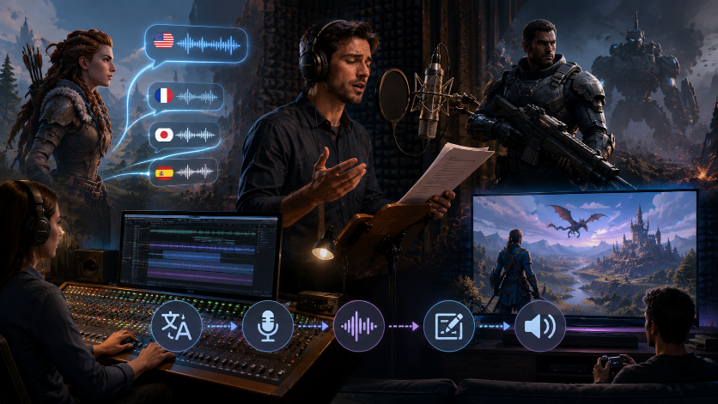
It helps to picture voice-over as the visible tip of a much larger iceberg. Beneath the audible English performance sit script translation, casting, recording, audio engineering, lip-sync, and engine integration – each a discipline with its own failure modes. The English dub a player hears is downstream of a prior translation layer, and the quality of that layer caps everything above it. No amount of studio talent can rescue a weak script. Treating voice-over as a procurement line item, rather than the endpoint of disciplined game translation, is where most US dubs go wrong before a single actor steps to the mic.
Why Subtitles Alone Are Not Enough for AAA US Releases
For a AAA release, full English audio is no longer a premium feature in the US market – it is the baseline expectation. American buyers who spend sixty or seventy dollars on a marquee title assume the characters will speak to them in English, and the absence of a dub registers as a quality signal long before anyone evaluates the writing or the performances. Skipping voice-over tells the audience, fairly or not, that the game was localized on a budget.
Streaming has sharpened this. A streamer playing through a story campaign does not pause to read subtitles aloud, and their viewers – often tens of thousands of them – hear the original-language audio while watching English text scroll past. The game looks imported, even when the localization is otherwise excellent. For titles that depend on Twitch and YouTube momentum during launch week, that perception carries real commercial weight.
Accessibility deepens the case. Subtitles exclude players with low vision, those prone to motion sickness who cannot track fast-moving text, and anyone for whom reading speed is a barrier. A dub is not merely a preference upgrade; it is a question of who can play the game at all.
Then there is the harder-to-name factor: cultural intimacy. A familiar American voice, carrying the cadence and idiom of the player’s own region, creates an emotional closeness that even flawless subtitles cannot replicate. The performance feels native rather than translated, and that feeling is difficult to engineer any other way.
The Anatomy of US Voice-Over Localization
A US dub is built in stages, and each stage constrains the next. Understanding the order clarifies where the money and the time actually go.
- Script translation and adaptation. The source dialogue is rewritten in English not just for meaning but for timing, mouth movement, and register. A line must fit the on-screen animation and sound like something a person would actually say.
- Studios choose between SAG-AFTRA union talent and non-union performers, between recognizable celebrities and seasoned character actors, and between in-house direction and an external casting studio. Each path carries cost and scheduling consequences.
- Sessions run on location or remotely, and may include ADR (automated dialogue replacement) and pairing with motion-capture performances so that voice and body read as one character.
- Audio engineering. Recorded lines are mixed for the game engine, balanced across dynamic ranges, and processed so that pluralized or variant lines – the dozens of versions of a single combat bark – sit consistently in the mix.
- Engine integration. Audio is wired into the runtime through middleware such as Wwise or FMOD, Unity’s built-in audio system, or a studio’s custom pipeline, with triggers, attenuation, and localization variants all configured.
- Quality assurance. Finally, QA checks lip sync, line length, and emotional consistency across thousands of files recorded over many sessions.
The pivotal truth sits at the top of that list. Most dub failures originate in the script translation phase, not the booth. A mediocre English script produces a mediocre English dub no matter how gifted the cast, because actors can only perform the words in front of them. The adaptation layer is the foundation that every later stage of game translation inherits, and it deserves the same scrutiny a studio gives its own narrative design.
What US Voice-Over Actually Costs
Voice-over budgets vary enormously, and most of the variation is structural rather than negotiable. The first fork is union versus non-union. SAG-AFTRA work follows a published scale with session minimums, residual structures, and rules around session length and the number of lines per session; the exact figures shift with each contract cycle, so producers should treat any quoted rate as a moving target and confirm against current agreements. Non-union studios offer a lower-cost path, trading the union’s protections and talent pool for budget flexibility.
Pricing models differ too. Some studios charge per recorded line, others per session or per studio hour, and the right model depends on whether a project has many short barks or fewer long narrative passages. Recording-studio time, direction, and engineering are typically billed separately from talent.
As a rough frame, indie projects often land somewhere between five and twenty-five thousand dollars for a focused English dub. Mid-size titles commonly run from twenty-five thousand into the low hundreds of thousands. Full AAA productions, with large casts, celebrity talent, and sprawling scripts, can range from a hundred and fifty thousand dollars to two million or more.
One proportion is worth internalizing. Script translation typically accounts for only five to fifteen percent of a voice-over budget, yet it tends to determine the majority – perhaps sixty to eighty percent – of the final perceived quality. Underfunding it to save a few percent is the most common false economy in the discipline. AI voice synthesis is reshaping the lower end of this market, though it has not yet matched human performance where it matters most.
How Voice-Over Connects to the Broader Localization Pipeline
Voice-over does not exist in isolation. It is the audible surface of a deeper localization pipeline that begins long before anyone books a booth – with text translation, terminology management, and contextual review of how each line appears in the game. The audio is only ever as coherent as the text and the glossary underneath it.
Increasingly, studios run voice-over as a downstream stage of a structured translation workflow rather than as a separate contract. A script change made in the writing tool flows through a translation management system to the recording studio, with version control connecting all three. When a writer revises a mission’s dialogue at week ten, the system propagates that change to the translated script and flags the affected lines for re-recording, instead of leaving a producer to chase the edit by email.
The discipline of game translation is no longer just text on a screen – modern platforms increasingly coordinate script handoff, voice-over assignment, and recording QA in one integrated workflow, which reduces the kind of miscommunication that produces awkward dubs. Several established platforms now offer versions of this connected approach, including Crowdin, Lokalise, Phrase, Smartcat, and LocDirect, each linking text-based translation to downstream audio and review stages.
Voice-over vendors fit into the same picture. Studios such as Side Global, Keywords Studios, Formosa Interactive, and PCB Productions frequently work directly inside or alongside these localization platforms when handling US dubs – pulling scripts, returning recorded assets, and logging QA against the same version-controlled source the text team uses. That shared spine keeps a large cast and a shifting script from drifting out of sync.
Common Mistakes That Ruin US Dubs
Most botched dubs fail in predictable ways, and nearly all of them are avoidable with earlier discipline.
- Translating the script literally. A line rendered word-for-word from the source reads as stilted in English and breaks the illusion of a real character. The fix is to adapt for spoken American English, prioritizing how the line sounds over how faithfully it mirrors the original syntax.
- Casting against the visual. A voice that contradicts the character’s apparent age, energy, or accent creates a dissonance players feel even when they cannot articulate it. The fix is to cast to the on-screen design, with reference art and animation in front of the casting director.
- Recording blind. Actors who never see the in-game animation cannot match the timing of mouth movement, and lip sync becomes guesswork. The fix is to record to picture wherever the budget allows, or at minimum to supply accurate timing reference.
- Treating voice-over as an afterthought. Bolting the dub onto the final weeks of production guarantees compressed schedules and uncorrected errors. The fix is to schedule voice-over as a tracked dependency from the start, not a procurement task at the end.
- Skipping linguistic QA after recording. Across dozens of sessions, accents drift, line lengths overflow their UI and audio slots, and emotional tone slips between days. The fix is a dedicated linguistic QA pass that checks consistency against the source once the booth work is done.
None of these mistakes is exotic. They recur because voice-over is commissioned late and reviewed lightly, and both habits are correctable.
The AI Voice Question: Where It Helps and Where It Hurts
AI voice synthesis is no longer hypothetical. Tools from companies such as ElevenLabs, Replica Studios, and Resemble.ai produce usable English speech quickly and cheaply, and they are increasingly viable for specific, bounded jobs.
The honest case for AI sits in the places where volume outpaces budget and emotional stakes are low. Generic NPC chatter, placeholder dialogue during development, prototype builds that need temporary voices, and ambient lines that fill out a world without carrying it are all reasonable candidates. Used there, synthesis frees human budget for the lines that actually matter.
The honest case against it appears everywhere the performance has to land. Flagship emotional beats, signature character roles, and any scene carrying narrative weight still expose the limits of synthetic delivery – the micro-timing, breath, and restraint of a trained actor remain hard to fake. Players notice, and on a major release they say so publicly.
There is also a reputational dimension producers should weigh explicitly. Ongoing SAG-AFTRA negotiations over AI usage, and a vocal segment of players who react poorly to synthetic voices in premium titles, mean that leaning on AI for a flagship role carries risk beyond the audio itself. That risk belongs in the decision, not just the budget line.
Conclusions
Voice-over is the most expensive and most visible layer of game localization for the US market, and the decision to invest has to match the title’s scope and ambition rather than a generic checklist. A narrative-driven AAA release aimed at streamers and a small systems-driven indie are not the same problem, and they should not arrive at the same answer.
The studios that consistently ship strong US dubs share a habit: they treat voice-over as an extension of a disciplined game translation and localization pipeline, not as a standalone purchase made after the game is otherwise finished. The script, the glossary, the version control, and the recording all belong to one connected process.
Before committing to a full dub, run a translation pilot on a single critical scene, cast and record two minutes of finished audio, and play it back inside the game engine. Hearing the character speak in context, against the animation, makes the decision obvious in a way no spreadsheet can.
To read more content like this, explore The Brand Hopper
Subscribe to our newsletter
Go to the full page to view and submit the form.