


There’s a moment in every product-based business when someone holds your product for the first time. Before they read a word of copy, before they hear your pitch, before they engage with your social media, they’re already forming an opinion. In many cases, that opinion starts with your label.
Product labeling rarely gets the same strategic attention as logos, brand colors, or website design because it’s often treated as a production task rather than a branding decision. Yet it sits at one of the most critical touchpoints in the customer journey: the physical moment of encounter. A label that looks inconsistent, cheap, or misaligned with the brand communicates something, and it’s rarely what the business intended.
This is especially true for growing businesses scaling their product lines and for companies navigating a rebrand or physical relocation. When a business moves, everything from inventory to packaging gets reassessed. Even the practical task of sourcing roll labels during a transition reflects a real strategic decision: does the new label carry the updated brand identity forward, or does it carry over the old one by default?
The Label Is the Last Word Before the Purchase Decision
Walk through any retail aisle, and the pattern becomes obvious. A product’s label is doing constant work. It competes with dozens of adjacent products, communicates quality signals in a fraction of a second, and either earns the customer’s attention or loses it to the next shelf.
Research consistently shows that packaging influences purchasing decisions at the point of sale. According to the U.S. Small Business Administration, physical branding materials, including labels and signage, remain one of the most direct ways small businesses build recognition with local and retail customers. The guidance is worth reviewing in full at sba.gov/business-guide/manage-your-business/marketing-sales.
For startups and growing brands, the label is often the highest-frequency brand touchpoint. A customer may see a social media post once a week. They may see the label every single time they use the product.

Why Consistency Across Labels Matters More Than Any Single Design Choice
One of the most common label mistakes isn’t bad design. It’s inconsistency. A brand that uses three slightly different shades of its primary color across different product lines or that changes its logo treatment between small and large format labels creates a fragmented perception without meaning to.
Consistency doesn’t require every label to look identical. A product family can have visual variation while maintaining a coherent identity through shared typography, color logic, and logo treatment. The underlying system is what makes a brand feel intentional rather than improvised.
This is where roll labels offer a practical advantage over individual cut labels. A roll format allows businesses to print in volume with tight specification control, meaning every unit in a batch looks identical. For food brands, cosmetics, candles, and any product that ships regularly, that consistency compounds over time into real brand recognition.
What Makes a Strong Product Label Strategy
Strong label strategy doesn’t require a large budget. It requires clarity about a few key decisions made early and applied consistently.
Material selection matters more than most brands realize. A label printed on glossy film stock communicates differently than one on matte kraft paper. The material choice should reflect the brand’s positioning, not just the production cost. A premium skincare brand using a cheap, easily smudged label undermines every other brand investment.
Size and placement should be intentional. A label that wraps awkwardly around a container or that obscures key product information creates friction at the point of use. Labels that are sized for the specific container and placed where the eye naturally lands during use perform better in practice.
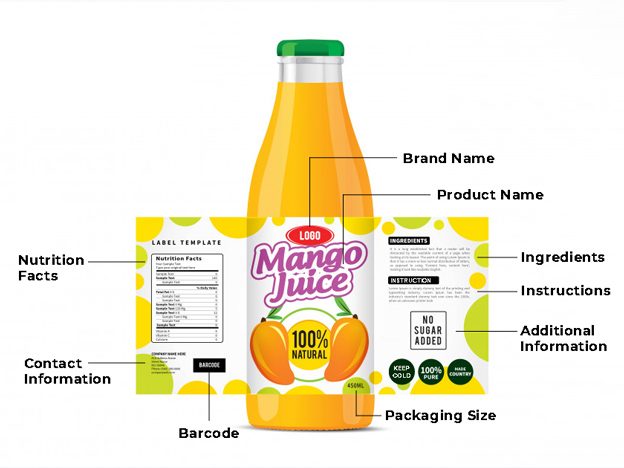
Information hierarchy needs clear prioritization. The brand name should dominate. Product variant or flavor comes second. Regulatory or informational content sits below. Every element competing for equal visual weight makes none of them easy to process.
Readability at arm’s length is the real test. Designers often work at screen zoom levels that don’t reflect how a customer actually reads a label in a store or at home. Proofing labels at actual printed size before a full production run catches legibility issues that are invisible at 200% zoom.
Roll Labels and the Scaling Advantage
As a product business grows, the unit economics of labeling shift. Small-batch production often relies on sheet labels or cut-to-order runs, which work well at low volume but become expensive and time-consuming as order quantities increase.
Roll labels change that calculation. They’re compatible with most automated label application systems, which reduces labor cost per unit at higher volumes. They allow for longer print runs with consistent quality across the batch. And for businesses that ship direct-to-consumer, they integrate cleanly into fulfillment workflows without the handling friction of individually cut labels.
StickerYou vinyl roll labels offer a practical option for product businesses at this stage, combining customizable sizing with durable vinyl material that holds up through shipping, storage, and everyday handling. For brands moving from low-volume label runs to higher-output production, that combination of durability and flexibility is worth factoring into the sourcing decision.
The transition from sheet labels to roll format is often one of the first infrastructure upgrades a growing product brand makes. It’s not a visible upgrade, but it’s the kind of operational decision that directly affects margin and output capacity.
The Rebrand Case: Labels as a Signal of Change
Rebrands are communication events as much as design events. A new logo or color system doesn’t fully land until it appears on every physical touchpoint, and for product businesses, that means labels.
Customers who encounter a rebrand mid-purchase cycle, receiving a product with the old label after seeing new brand assets online, often experience the transition as inconsistency rather than evolution. Rolling out updated labels in sync with other brand materials closes that gap.
A rebrand often coincides with other operational changes, whether a supplier switch, a new distributor relationship, or even a physical office move. During this transition, businesses sourcing new inventory, including something as practical as moving boxes for relocated stock, are already mid-reassessment. That’s the right moment to audit label accuracy too, not after the new inventory is already shelved.
This is worth planning for explicitly rather than treating as an afterthought. A phased rollout approach, where existing label inventory is depleted before the new version enters circulation, is often more practical for small businesses than a hard cutover. The key is that the plan exists before the new brand assets are finalized, not after.
The reason labels are overlooked is simple: they sit at the intersection of operations and branding, and in most businesses, operations wins. Procurement handles the reorder, production sets the spec, and the brand team rarely gets a seat at that table. The result is labels that are functional but not strategic, compliant but not compelling.
Product labels occupy a modest position in most brand conversations. They’re not as visible as campaigns, as shareable as social content, or as discussed as packaging design. But they’re present at every single moment a customer physically interacts with a product. Repeated across hundreds or thousands of touchpoints, that presence is where brand recognition is built over time.
Getting labels right is less about a single design decision and more about treating them as the ongoing branding system they actually are.
To read more content like this, explore The Brand Hopper
Subscribe to our newsletter
Go to the full page to view and submit the form.