


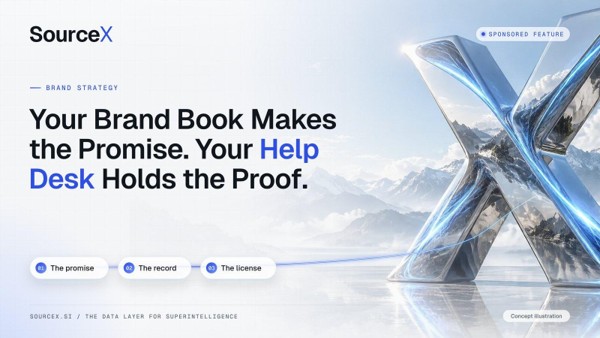
Every brand book has a line like it. “We answer like a friend would.” It gets printed on the office wall, quoted in onboarding and repeated on the careers page.
Then there is the help desk. Somewhere inside it, years of conversations show whether the team actually did. The late shipment handled with grace. The refund that took three escalations. The agent who bent a policy because the customer was clearly right, and the manager who rewrote the policy a month later because of it.
Brand strategists have always known the second record is the truer one. What has changed is that it now has value outside the company. For AI developers, a business’s recorded work, de-identified and properly licensed, is some of the most useful training material left. That shift is quietly changing how brands should think about their data, and it is worth understanding before anyone treats it as a simple revenue line.
Your brand book is public, your brand behavior is not
Public brand content is designed to be consistent. Taglines, product pages, campaign copy and help center articles all describe how things should go. That is their job.
Operating records describe how things went. A support thread captures the problem, the response and the resolution. A CRM history shows how a deal moved, stalled and finally closed. Workflow records show which tasks were done, which decisions were made and what came of them. Engineering tickets and code reviews show how a product promise became something shippable.
For a marketing student, this is the old distinction between brand identity and brand experience, written down in everyday software. For an AI model, it is the difference between reading a company’s brochure and watching the company work.
Why AI developers want the unpolished version
Much of the openly available text on the web has already been used to train AI systems, and what remains public skews toward polished copy. There is also a cost to filling the gap with synthetic text. Researchers writing in Nature in 2024 showed that models trained recursively on generated data degrade over successive generations, gradually losing the rarer patterns found in real human data.
Real work is full of exactly those rarer patterns: exceptions, judgment calls, awkward handoffs. Most of it lives inside businesses and has never been public. That is why AI developers are looking for new sources of real-world data, and why many of them prefer data licensed with the owner’s agreement. In 2023, OpenAI announced Data Partnerships, inviting organizations to work with it on public and private datasets, a clear sign of how seriously the industry takes the question.[4] That is industry context, not a SourceX relationship.
What counts here, and what does not
This is about records of work, not audiences. A brand’s email list, ad audiences or customer profiles are not the asset, and access to them does not grant a right to license them for AI. The real question is whether a company holds years of support, workflow, document, sales or engineering history that it owns and can legitimately license, within the limits of its own customer and vendor contracts.
Knowledge-work companies that reached 50 or more full-time employees at their peak are the strongest fit. Operating, acquired and wound-down companies can all qualify, though not every company does. The US is the priority market, with Canada, the EU and several other markets in scope when at least 90% of the data is in English.
How a record becomes a licensed dataset
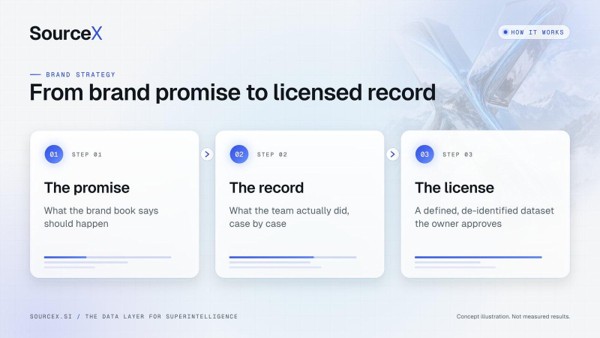
SourceX licenses business data directly from companies for AI training and evaluation, and pays them for it. The company signs with SourceX, not with an AI lab, and SourceX handles the agreement, data preparation and payout.
It starts with a fit check: a few quick questions, no uploads, no commitment. If there is a fit, the company decides which systems, records and date ranges are in scope, and a rights review confirms that it owns the records and can license them. One Master Supplier Licensing Agreement follows qualification, and a short Dataset Deal Confirmation fixes the exact dataset, net payout and terms for each deal. Nothing is delivered until both are signed and SourceX gives the go-ahead.
Data is de-identified through approved processing routes before it is used or shared. No method is perfect, and the agreement records that re-identification may still be possible. Large datasets can stay in the company’s own storage or ship on encrypted drives. Access is controlled at the organization level, files sit in private storage with short-lived links, and every action leaves an audit trail. SOC 2 Type II, ISO/IEC 27001 and ISO/IEC 27701 are all in progress, not yet issued.
On money, the SourceX headline is “Earn up to $4M by licensing your data.” That is an upper bound for the largest enterprise datasets, not a typical or guaranteed outcome, and estimates are indicative. Most agreements are a one-time fee per agreed dataset, and some provide for recurring deliveries.
Questions a strategist should ask first
Preparation choices shape the result. If de-identification strips the link between a customer’s problem and how it was solved, the record loses the very context that made it useful. If it keeps too much, it may reveal too much. Sometimes the right call is to leave a collection out entirely.
Rights deserve the same scrutiny. The originals stay with the company, but a license can grant exclusive AI-training rights for a set term and lasting rights over the prepared dataset. A brand team planning its own AI assistant should know how a license would sit beside that roadmap. Everyone involved should also know the company can back out at any point before signing, at no cost.
The exercise pays off even if no license follows. Mapping what your systems actually record about how the brand behaves is a strategy audit most companies have never done, and it tends to surface the gap between the promise and the practice faster than any focus group.
Brands curious whether their operating history is worth licensing can start with SourceX and its no-upload fit check. The brand book says what you promise. The records show what you did.
About the founder
Noah Loul is a four-time founder and the founder and CEO of SourceX, which licenses business data directly from companies for AI training and evaluation. He previously founded B2B Rocket, acquired by Blackpearl Group. His work focuses on building permission-based data infrastructure for AI.
To read more content like this, explore The Brand Hopper
Subscribe to our newsletter
Go to the full page to view and submit the form.