


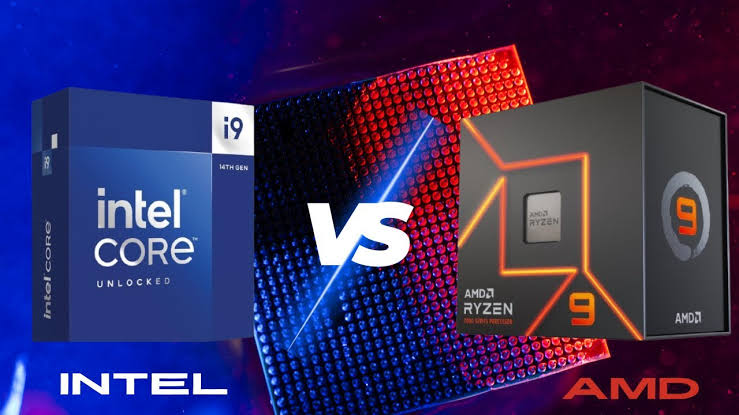
Quick answer: AMD currently has the performance and momentum edge — its Ryzen chips lead in gaming thanks to 3D V-Cache technology, and its EPYC server chips are gaining share faster than any point in company history. Intel still commands the larger installed base and leads in laptops and enterprise relationships, and its 2026 comeback in market share and stock price shows it’s far from finished. For most new builds today, AMD is the stronger default pick, but Intel remains a very reasonable choice, especially for laptops and mainstream office PCs.
Intel and AMD have been trading blows in the CPU market for over 50 years, and 2026 has been one of the most competitive stretches in that entire rivalry. Both are massive, publicly traded American semiconductor companies, but they differ sharply in how they’re structured, owned, and positioned right now. Here’s a deep, fact-based comparison.
A Shared Silicon Valley Origin
Intel and AMD aren’t just rivals — they’re practically siblings.
Intel was founded in 1968 by Robert Noyce and Gordon Moore, two veterans of Fairchild Semiconductor and pioneers of the integrated circuit.
AMD followed in 1969, founded by Jerry Sanders and seven co-founders, several of whom also came out of Fairchild.
Both companies build x86-64 processors under a decades-old cross-licensing agreement, which is precisely why the same Windows software runs identically on either brand.


Business Model: Intel’s Own Fabs vs AMD’s Fabless Approach
This is one of the most important, and least understood, differences between the two.
Intel is an Integrated Device Manufacturer (IDM): it designs and manufactures its own chips in its own fabs, and is now opening those fabs to outside customers through its Intel Foundry division as part of a strategy known as IDM 2.0. Its newest process node, Intel 18A, introduces RibbonFET gate-all-around transistors and backside power delivery (PowerVia), with an enhanced 18A-P version promising further efficiency gains.
AMD, by contrast, has been fabless since spinning off its manufacturing arm (which became GlobalFoundries) in 2009. AMD designs its chips but outsources manufacturing entirely to contract foundries, primarily TSMC, which builds AMD’s current Ryzen chips on advanced 4nm and 5nm nodes. This lets AMD move fast without the enormous capital cost of running fabs, but it also means AMD’s fortunes are tied to TSMC’s capacity and pricing.

Who Owns Intel and AMD?
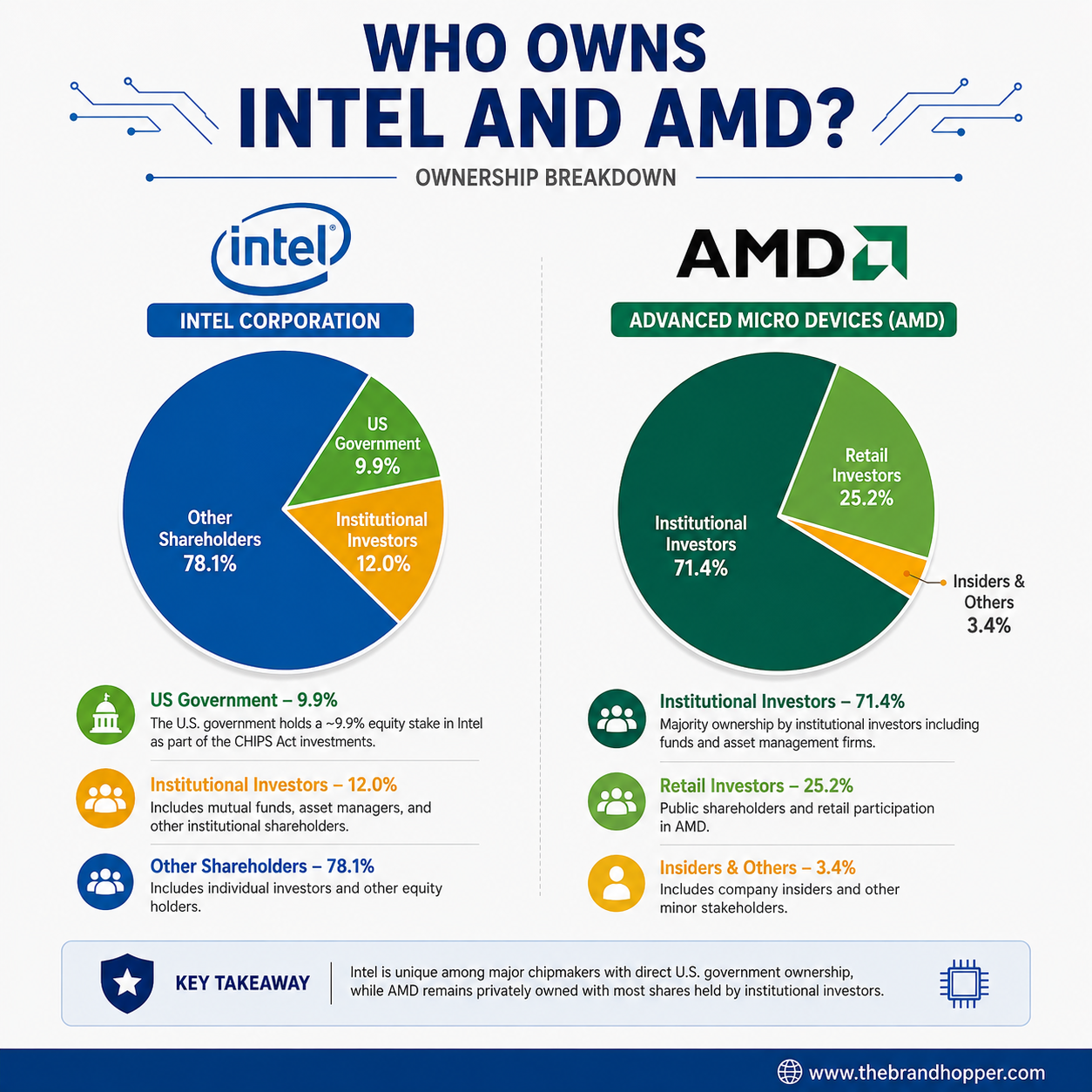
Both companies are publicly traded American corporations: Intel on Nasdaq (INTC) and AMD on Nasdaq (AMD). Neither has a controlling family or founder-owner; both are governed by boards answering to public shareholders.
Intel’s ownership took an unusual turn in 2025, when the U.S. government converted $8.9 billion in CHIPS Act grants and Secure Enclave funding into equity, taking a roughly 9.9% stake in the company — about 433.3 million shares at $20.47 each. It’s one of the largest direct government stakes in a private American tech company in modern history.
Thanks to Intel’s stock rally through 2026, that stake’s value has since ballooned to an estimated $36 billion, netting the government a substantial unrealized gain. AMD has no comparable government ownership.

Market Share: Intel Still Leads, AMD Is Closing Fast
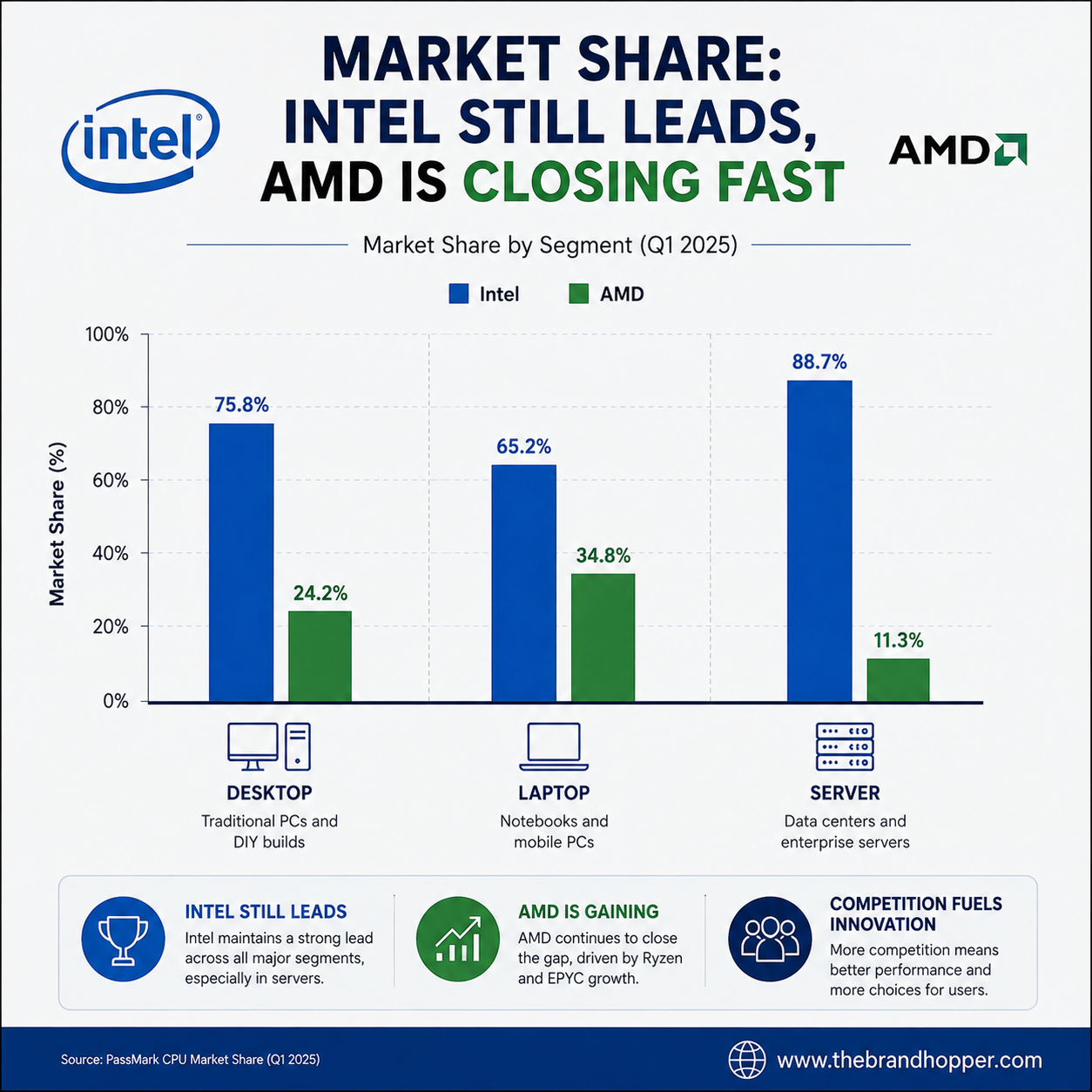
Despite years of AMD gains, Intel remains the larger x86 CPU maker by volume. As of Q4 2025 into Q1 2026, Intel held roughly 70% of the overall x86 CPU market, with AMD at a record-high near 29-30%. Segment by segment: Intel holds about 66-67% of desktop CPUs to AMD’s roughly 33-36%; in laptops, Intel leads more comfortably at around 72% to AMD’s record 28.3%.
The server segment tells a different story. AMD’s EPYC processors have surged to roughly 35% of server unit shipments and over 41-46% of server CPU revenue — both all-time highs — and some analysts expect AMD’s EPYC revenue share to reach parity with or overtake Intel’s Xeon by late 2026. Because server chips carry the highest margins in the industry, this is arguably AMD’s most financially significant gain.
Revenue & Financial Momentum
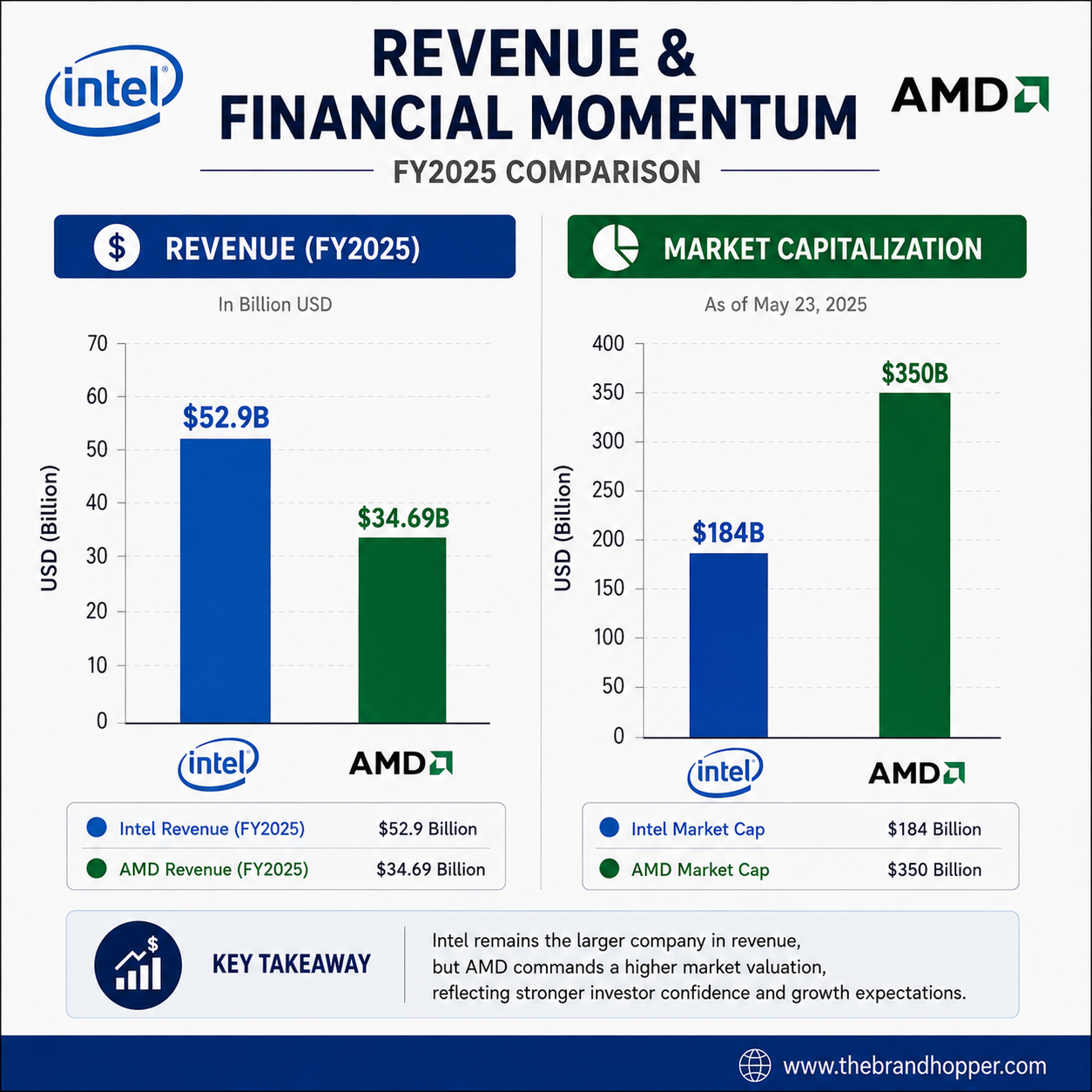
Intel generated $52.85 billion in revenue for fiscal 2025, essentially flat versus $53.1 billion in 2024. AMD posted record full-year 2025 revenue of $34.6 billion, with Q4 alone up 34.1% year over year, a 50% gross margin, and $4.3 billion in net income, powered by record Data Center revenue of $16.6 billion (EPYC CPUs plus Instinct AI GPUs) and record Client revenue of $3.1 billion from Ryzen.
The market has rewarded that momentum dramatically: as of August 2026, AMD’s market capitalization stands at roughly $763.6 billion, comfortably ahead of Intel’s approximately $478.4 billion, even though Intel still generates more total revenue. That valuation gap reflects investor enthusiasm for AMD’s data-center and AI GPU growth story against Intel’s slower, foundry-heavy turnaround.
Product Lineups Compared
Intel’s current consumer lineup centers on the Core Ultra series, including Arrow Lake desktop chips and Lunar Lake/Panther Lake mobile chips, alongside Xeon processors for servers and workstations.
AMD’s lineup runs Ryzen (built on its Zen 5 architecture) for desktops and laptops, Ryzen AI chips for AI-accelerated mobile computing, and EPYC for servers, plus Instinct accelerators competing directly with Nvidia in AI data centers.
Performance: Gaming, Productivity & Efficiency
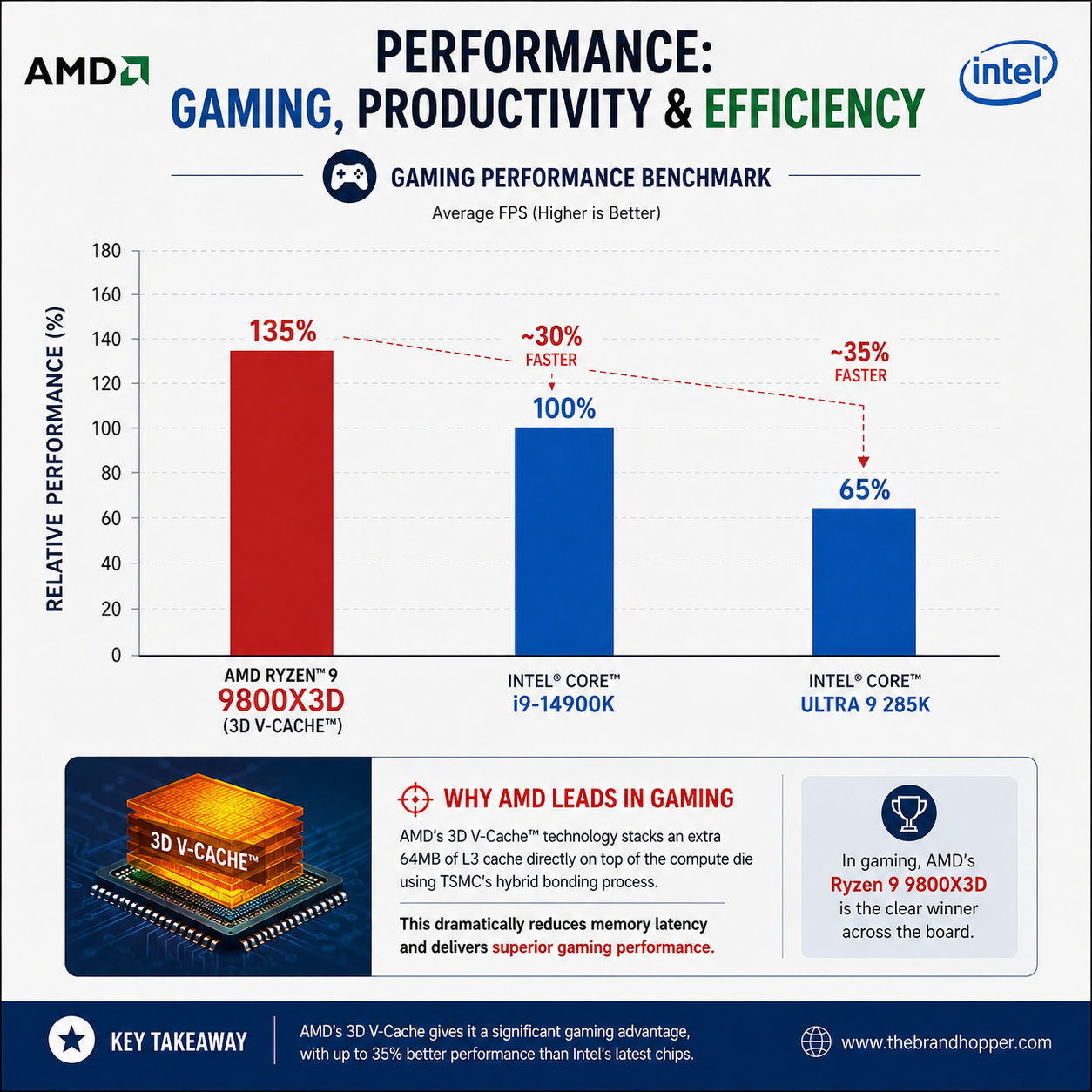
In gaming specifically, AMD currently holds a clear technical edge. Its Ryzen 9 9800X3D reportedly outperforms Intel’s Core i9-14900K by around 30% and the newer Core Ultra 9 285K by around 35% in gaming workloads.
The advantage comes from AMD’s 3D V-Cache technology, which stacks an extra 64MB of L3 cache directly on top of the compute die using TSMC’s hybrid bonding process, dramatically reducing memory latency in games.
Intel remains highly competitive in multi-threaded productivity and content-creation workloads, where its architecture and higher core counts on certain SKUs still hold their own.
Value & Price-to-Performance
AMD’s gaming-focused X3D chips generally deliver more frames per dollar than Intel’s closest competitors, reinforcing AMD’s reputation — first built with the original Ryzen launch in 2017 — as the value-driven challenger.
Intel typically counters with more aggressive platform pricing (motherboards and chipsets) and stronger bundled enterprise support, which can offset its per-chip performance disadvantage for budget and business builds.
Which Brand Is Best for You?
- For gaming-first builds: AMD’s Ryzen X3D chips are currently the benchmark to beat.
- For laptops and battery life: Intel’s mobile lineup still holds the larger share and a broad range of efficient, well-supported options.
- For servers and enterprise workloads: AMD’s EPYC is gaining fast and now leads on revenue share, but Intel’s Xeon still offers the deepest enterprise relationships and software validation.
- For AI and data-center compute: AMD’s Instinct GPUs are its fastest-growing segment, though Nvidia remains the dominant AI accelerator overall.
- For budget or first-time builders: Both brands offer strong value; compare specific chip generations rather than brand loyalty alone.
Intel vs AMD at a Glance
| Category | Intel | AMD |
| Founded | 1968 | 1969 |
| Ownership | Public (Nasdaq: INTC); ~9.9% held by the U.S. government | Public (Nasdaq: AMD); no government stake |
| Manufacturing model | IDM — designs and fabricates its own chips (Intel Foundry, 18A node) | Fabless — designs chips, outsources fabrication mainly to TSMC |
| FY2025 revenue | $52.85 billion | $34.6 billion (record) |
| Market cap (Aug 2026) | ~$478.4 billion | ~$763.6 billion |
| Overall x86 market share | ~70% | ~29–30% (record high) |
| Server market share (revenue) | ~54–58% | ~41–46% (rapidly rising) |
| Flagship product lines | Core Ultra, Xeon | Ryzen, EPYC, Instinct |
| Gaming performance edge | Competitive, strong multi-threaded workloads | Leads via 3D V-Cache (Ryzen X3D) |
Final Verdict
Intel and AMD are no longer a story of one dominant leader and one scrappy underdog — they’re two enormous, well-capitalized rivals pulling ahead in different arenas. AMD currently leads on gaming performance, server momentum, and market valuation.
Intel still leads on overall volume, laptop market share, and manufacturing independence, backed now by an unprecedented U.S. government ownership stake tied to domestic chip production.
Buy AMD if you want today’s best gaming performance and fastest-growing server technology; buy Intel if you value its broader laptop ecosystem, enterprise track record, and its bet on being America’s chipmaking backbone.
Frequently Asked Questions
Q: Is AMD better than Intel in 2026?
A: For gaming and server workloads, AMD currently has the performance and market-share momentum edge, led by its Ryzen X3D chips and EPYC processors. Intel remains stronger in laptop market share and enterprise relationships, so “better” depends on the use case.
Q: Who owns Intel?
A: Intel is a publicly traded company (Nasdaq: INTC). Its largest recent ownership development is a roughly 9.9% stake acquired by the U.S. government in 2025, converted from CHIPS Act funding, now worth an estimated $36 billion.
Q: Who owns AMD?
A: AMD is a publicly traded company (Nasdaq: AMD) with no controlling shareholder or government stake, governed by its board on behalf of public investors.
Q: Why is AMD’s market cap higher than Intel’s if Intel makes more revenue?
A: Investors are pricing in AMD’s faster growth, particularly in AI data-center GPUs and server CPU share gains, while Intel’s valuation reflects a slower, capital-intensive turnaround centered on its foundry business.
Q: Does Intel or AMD make better gaming CPUs?
A: AMD currently leads in gaming — its Ryzen 9 9800X3D outperforms Intel’s top consumer chips by roughly 30-35% in gaming benchmarks, largely due to its 3D V-Cache technology.
Q: What’s the difference between Intel and AMD manufacturing?
A: Intel designs and manufactures its own chips in its own factories (an IDM model) and is now opening that capacity to outside customers. AMD designs its chips but outsources manufacturing to contract foundries, mainly TSMC.
Q: Which company has more market share, Intel or AMD?
A: Intel still holds the larger overall x86 CPU market share, around 70% versus AMD’s record 29-30%, though AMD has been steadily gaining share for several consecutive years, especially in servers.
Also Read: PayPal vs Stripe: Which Payment Processor Wins in 2026?
To read more content like this, subscribe to our newsletter
Go to the full page to view and submit the form.