


Uniqlo vs Zara is one of the biggest rivalries in global high-street fashion.
Zara, the flagship brand of Spain’s Inditex, is known for translating runway and street-style trends into store-ready collections quickly. Uniqlo, owned by Japan’s Fast Retailing, follows a different approach through its LifeWear philosophy: functional, well-designed everyday clothing that prioritises comfort and practicality over rapidly changing trends.
Both brands have delivered strong financial results, although their latest reporting periods are different.
In this guide, we compare Uniqlo and Zara across ownership, size, financial performance, design philosophy, product range, quality, pricing, sustainability, shopping experience.

Who Owns Uniqlo and Zara?
Uniqlo: Fast Retailing and the Yanai family

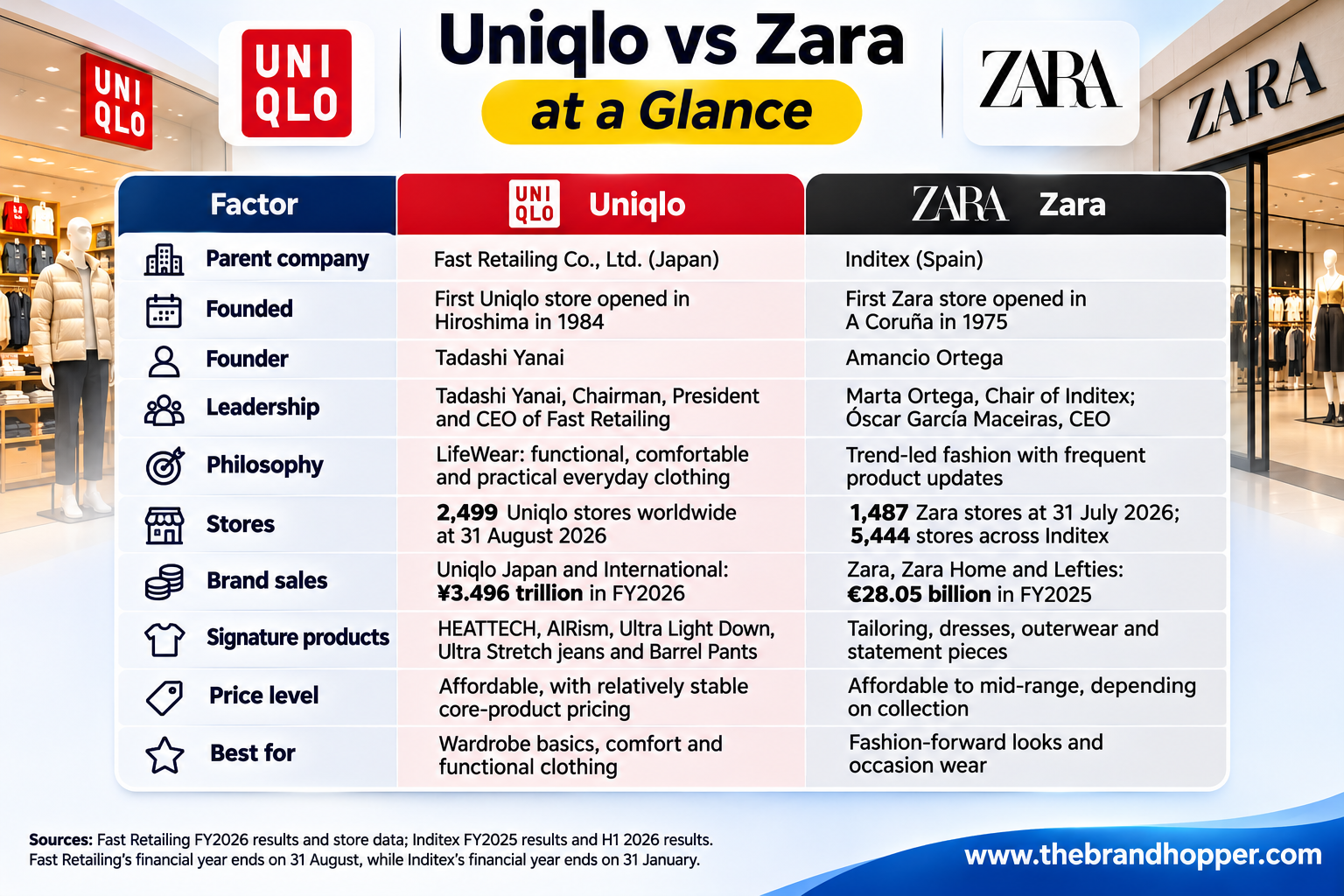
Uniqlo is owned by Fast Retailing Co., Ltd., a Japanese company listed on the Tokyo Stock Exchange (9983) and the Hong Kong Stock Exchange (6288). The business traces its roots to a men’s clothing store operated by Tadashi Yanai’s father, and Yanai opened the first Uniqlo store in Hiroshima in 1984.
Yanai remains Chairman, President and CEO of Fast Retailing. He is also the company’s largest individual shareholder, with his family and related investment vehicles holding a significant stake. Fast Retailing’s other brands include GU, Theory, PLST and Comptoir des Cotonniers.
Zara: Inditex and the Ortega family

Zara is owned by Inditex, a Spanish fashion group listed on the Spanish stock market. Founder Amancio Ortega opened the first Zara store in A Coruña, Galicia, in 1975, and Inditex went public in 2001.
Ortega remains the controlling shareholder, holding approximately 59.3% of Inditex’s voting rights through his holding companies, Pontegadea Inversiones and Partler Participaciones. His daughter Sandra Ortega holds a further 5.05% stake through Rosp Corunna.
Marta Ortega has served as Chair of Inditex since April 2022, while Óscar García Maceiras is the group’s CEO. Inditex also owns Pull&Bear, Massimo Dutti, Bershka, Stradivarius, Oysho, Zara Home and Lefties.
Bottom line: Both companies are publicly listed, but their ownership structures are different. Inditex is controlled by Amancio Ortega, while Fast Retailing is led by founder Tadashi Yanai, who remains its largest individual shareholder.
Size and Financial Performance
Both groups have delivered strong results, but their reporting periods differ. Fast Retailing’s FY2026 ran from 1 September 2025 to 31 August 2026, while Inditex’s FY2025 ran from 1 February 2025 to 31 January 2026.
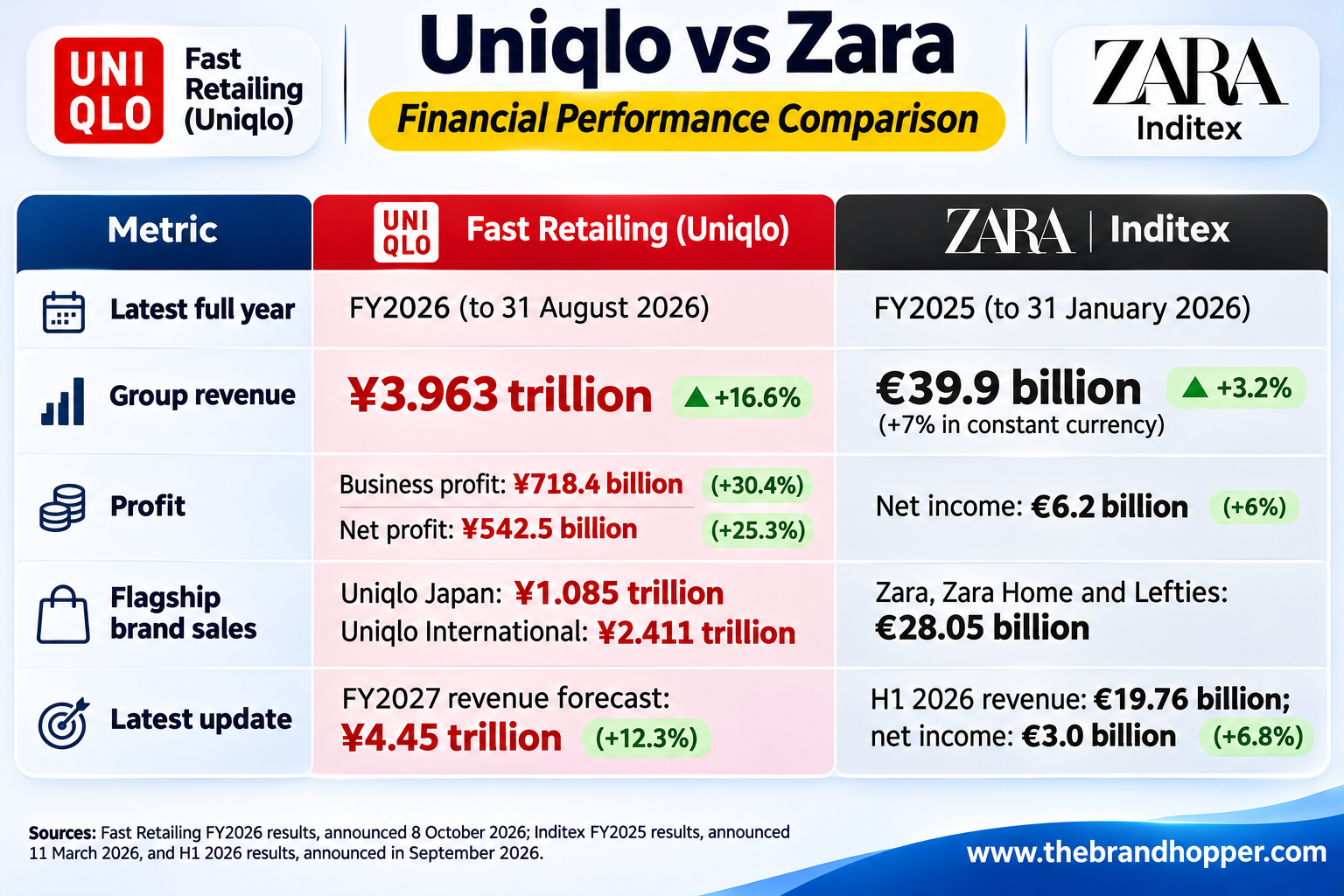
In absolute group revenue, Inditex remains larger. However, Fast Retailing is growing faster, having recorded its fifth consecutive year of record performance in FY2026. Uniqlo International’s revenue increased 26.2%, while its business profit rose 44.1%.
Uniqlo’s international expansion has been particularly strong. In FY2026, Uniqlo International generated ¥2.411 trillion in revenue, compared with ¥1.085 trillion for Uniqlo Japan. Fast Retailing reported double-digit revenue and profit growth across several international regions, including India and Australia, Southeast Asia, North America and Europe.
Inditex, meanwhile, continues to combine substantial scale with strong profitability. Its FY2025 gross margin was approximately 58.3%, while online sales reached €10.7 billion, an increase of 4.8%. In H1 2026, Inditex reported revenue of €19.76 billion and net income of approximately €3.0 billion.
Winner, momentum: Uniqlo for revenue growth; Inditex for overall group scale and profitability.
Design Philosophy: LifeWear vs Fast Fashion
This is the most important difference between the two brands, and it should influence your choice.
Uniqlo’s LifeWear philosophy focuses on everyday essentials, including T-shirts, knitwear, jeans, outerwear and innerwear. Rather than constantly replacing its collections, the brand aims to improve its core products through better materials, functionality and design.
Uniqlo invests in fabric technology, including products developed with Japanese materials company Toray. Its signature ranges include HEATTECH thermal wear, AIRism cooling fabrics and Ultra Light Down jackets.
The brand also collaborates with designers on collections such as Uniqlo U, led by Christophe Lemaire, and Uniqlo : C, led by Clare Waight Keller. These collaborations introduce new design perspectives while remaining connected to Uniqlo’s everyday-wear positioning.
Zara’s model is built around speed, trend awareness and frequent product updates. Its design teams at Inditex’s headquarters in Arteixo, Galicia, monitor fashion trends and customer demand, with new products arriving in stores and online throughout the season.
Inditex’s integrated supply chain, which includes production close to its Spanish base as well as suppliers in other regions, helps Zara respond to changing demand. The brand can introduce new styles in smaller batches and adjust production based on customer response.
The result is a constantly changing assortment of tailoring, dresses, outerwear and statement pieces.
Winner, style: Zara for trend-led fashion; Uniqlo for timeless wardrobe staples.
Product Range and Quality
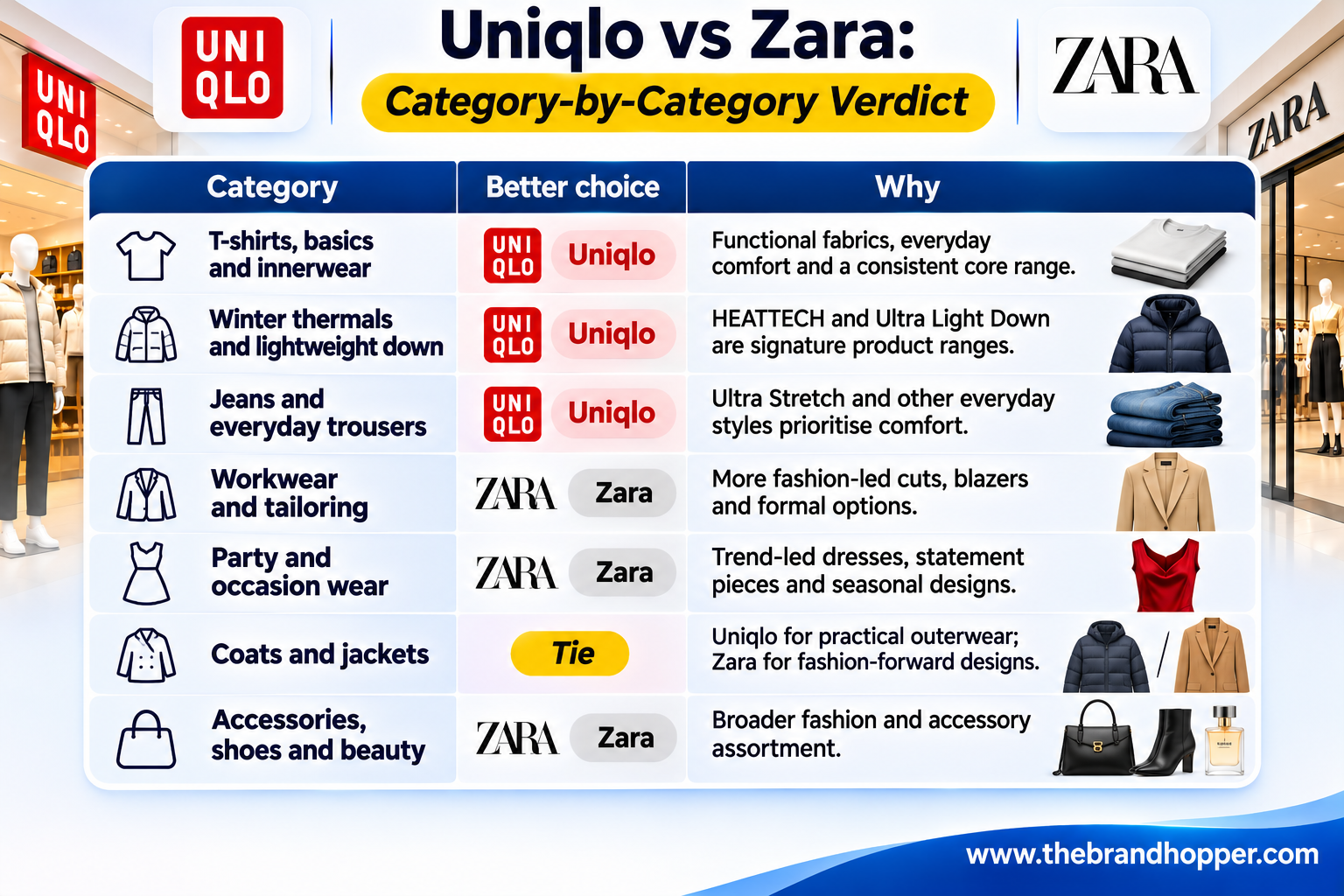
Uniqlo’s product range is more focused than Zara’s, with an emphasis on core categories for women, men and children. Many products are available in multiple colours, sizes and fits, making the brand useful for building a consistent everyday wardrobe.
Its reputation is based on functional design and consistency. Products such as Supima cotton T-shirts, merino sweaters and HEATTECH innerwear are designed around comfort and repeat use, although durability still depends on the specific garment and how it is cared for.
Zara offers a broader fashion assortment, covering women’s, men’s and children’s clothing, footwear, bags, accessories, beauty and fragrances. Its sister brand Zara Home also sells home furnishings and lifestyle products.
Quality can vary considerably across Zara’s collections. Its tailoring, coats and selected premium pieces can offer strong design and construction, while some trend-focused items are intended for shorter seasonal use.
Pricing: Which Brand Is Cheaper?
Both brands operate in the affordable fashion segment, but their pricing strategies differ. Uniqlo generally maintains relatively consistent prices for its core products, while selected items are offered through seasonal promotions and limited-time discounts.
Zara’s pricing varies more significantly by collection, product category and market. Its premium and limited-edition pieces can cost noticeably more than comparable Uniqlo basics, while its seasonal sales offer opportunities to purchase selected items at lower prices.
In terms of everyday value, Uniqlo can offer a stronger cost-per-wear proposition for shoppers who regularly use its basics and functional clothing. Zara may offer better value when the priority is a specific trend, occasion or fashion-led look without paying luxury-brand prices.
Shopping tip: Prices differ between countries because of currency movements, import duties, taxes and local pricing strategies. Always compare current prices on each brand’s local website or app before buying.
Winner, value: Uniqlo for everyday essentials; Zara for affordable fashion statements.
Sustainability and Ethics
Both companies face scrutiny over the environmental impact of large-scale clothing production. They have introduced sustainability programmes and set targets covering emissions, materials, resource use and product life cycles.
Fast Retailing achieved its target of reducing greenhouse gas emissions from its own operations (Scope 1 and 2) by 90% against its FY2019 baseline in FY2025, four years ahead of its original FY2030 target. This achievement relates to its stores and offices, not the full emissions footprint of its supply chain.
The company has also set targets for reducing supply-chain emissions and increasing the use of lower-impact and recycled materials. Through RE.UNIQLO, customers can return used Uniqlo clothing for reuse or recycling, while RE.UNIQLO STUDIO services in selected markets offer repair and remake options.
Inditex has committed to reaching net-zero greenhouse gas emissions by 2040. Its 2030 materials strategy aims to use 100% lower-impact textile fibres, including recycled and next-generation materials.
In 2025, Inditex reported that 88% of the textile fibres used in its garments were classified as lower-impact fibres, with 47% sourced from recycled materials. Zara also operates Zara Pre-Owned in selected markets, offering services such as resale, repair and donation.
Critics argue that high-volume clothing production and frequent product turnover can encourage overconsumption. This criticism is often directed at Zara because of its trend-led business model, although Uniqlo’s large-scale production also has environmental consequences.
Uniqlo’s focus on functional essentials and repair initiatives may appeal to shoppers seeking longer product use. However, neither brand should automatically be considered sustainable based on its stated targets or product positioning alone.
Winner, sustainability: Uniqlo has an advantage in its durability-focused positioning and early achievement of its operational-emissions target. However, both companies still face significant challenges in reducing the environmental impact of their supply chains and overall production.
Shopping Experience: Stores, Online and Tech
Both brands continue to invest in their store networks and digital shopping experiences. Uniqlo had 2,499 stores worldwide at the end of August 2026, including 782 in Japan and 1,717 overseas.
The brand continues to expand internationally through large-format stores and flagship locations. Its store experience generally focuses on organised product displays, clear categories, functional clothing and a relatively consistent layout across markets.
Inditex is also optimising its store network, focusing on larger and more efficient locations. Zara had 1,487 stores at 31 July 2026, while the wider Inditex group operated 5,444 stores across its brands.
Zara is also investing in retail technology. Its Zara Try-On experience uses artificial intelligence to generate images of customers wearing selected products through synthetic avatars. Inditex reported that the service had been deployed in 43 markets and generated more than seven million sessions.
Winner, shopping experience: Zara for its AI-powered virtual fitting experience and fashion-led digital tools; Uniqlo for a straightforward, consistent store experience.
Uniqlo vs Zara: Which Should You Choose?
The Bottom Line
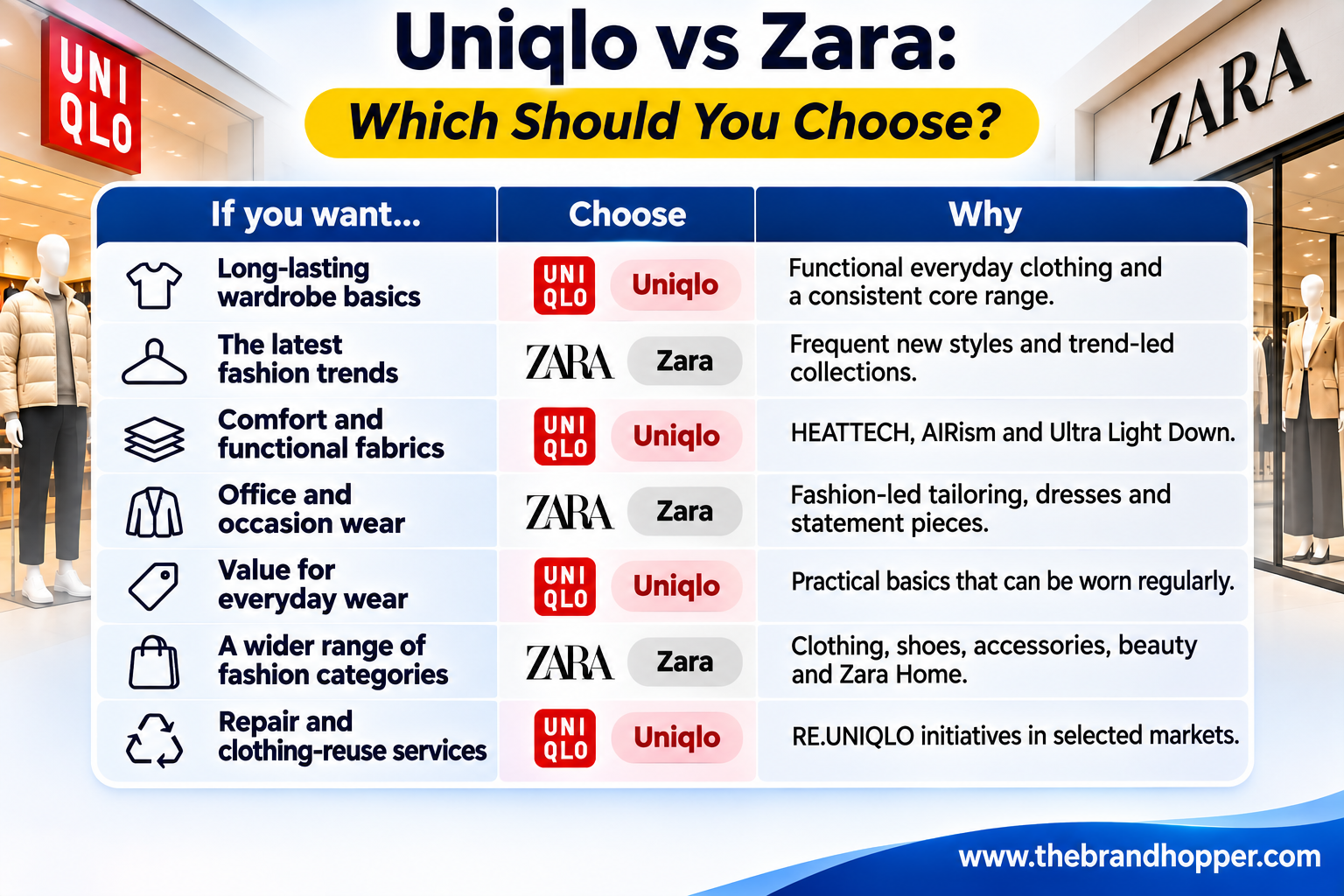
There is no single winner in the Uniqlo vs Zara comparison because the brands serve different fashion needs. Uniqlo is the stronger choice for functional basics, comfort and everyday value, while Zara is better suited to shoppers who prioritise trends, variety and occasion wear.
Uniqlo is also expanding rapidly in international markets, including India, Europe and North America. Zara, meanwhile, benefits from Inditex’s scale, established global presence and ability to respond quickly to changing fashion demand.
For most wardrobes, the two brands can complement each other: Uniqlo for everyday essentials and Zara for fashion-led additions.
Frequently Asked Questions
Q: Is Uniqlo or Zara better quality?
A: Uniqlo is generally a strong choice for consistent basics, knitwear and functional clothing. Zara’s quality varies more by product, with some tailoring and coats offering good construction while certain trend-led pieces are designed for shorter seasonal use.
Q: Which is cheaper, Uniqlo or Zara?
A: Uniqlo is usually more affordable for everyday basics and functional clothing. Zara’s prices vary by collection, and its premium lines can cost more than comparable Uniqlo products.
Q: Who owns Uniqlo?
A: Uniqlo is owned by Fast Retailing Co., Ltd., a Japanese publicly listed company founded by Tadashi Yanai. Yanai remains its Chairman, President and CEO and is its largest individual shareholder.
Q: Who owns Zara?
A: Zara is owned by Inditex, a Spanish publicly listed fashion group. Its founder, Amancio Ortega, holds approximately 59.3% of the company’s voting rights, and his daughter Marta Ortega is its Chair.
Q: Is Zara fast fashion?
A: Yes. Zara is widely associated with the fast-fashion business model, using trend monitoring, frequent product updates and an integrated supply chain to respond to changing customer demand.
Q: Is Uniqlo fast fashion?
A: Uniqlo is generally positioned differently from traditional trend-led fast-fashion retailers. Its LifeWear concept focuses on functional everyday clothing and the gradual improvement of core products rather than frequent trend-driven collection changes.
Q: Which is bigger, Uniqlo or Zara?
A: Inditex, Zara’s parent company, is larger by group revenue, reporting €39.9 billion in FY2025 sales. Fast Retailing reported ¥3.963 trillion in FY2026 revenue, while Uniqlo’s own operations generated ¥3.496 trillion.
Q: Are Uniqlo and Zara available in India?
A: Yes. Zara operates 22 stores in India through its joint venture with Trent, while Uniqlo had 20 stores at the end of August 2026. Both brands also sell their products online in India.
Also Read: Zara vs H&M: Which Fast Fashion Brand Really Wins?
Also Read: Who Owns H&M? Ownership & Shareholders
To read more content like this, subscribe to our newsletter
Go to the full page to view and submit the form.