


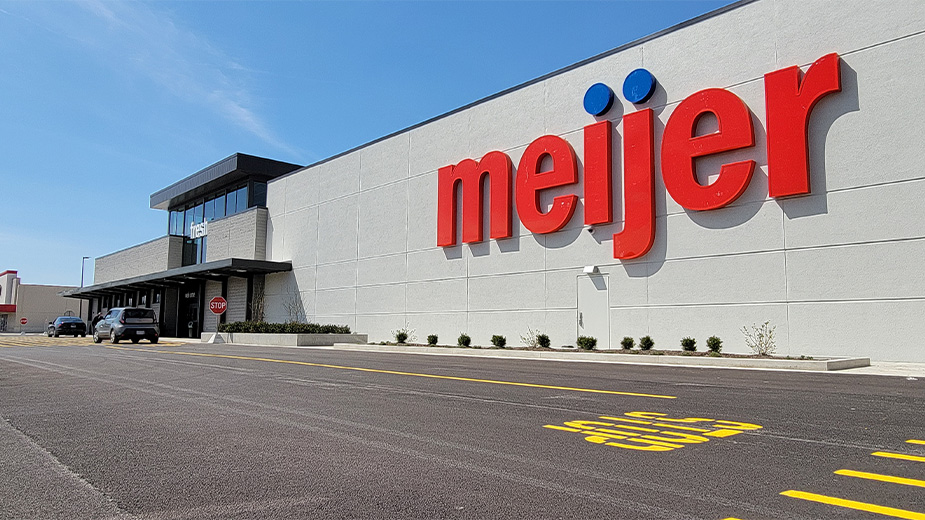
Meijer is not just a retailer—it is a Midwest institution. Founded in 1934 by Hendrik Meijer, a Dutch immigrant barber, and his 14-year-old son, Frederik (Fred) Meijer, the company has grown from a small grocery store in Greenville, Michigan, into one of the largest privately held retail enterprises in the United States.
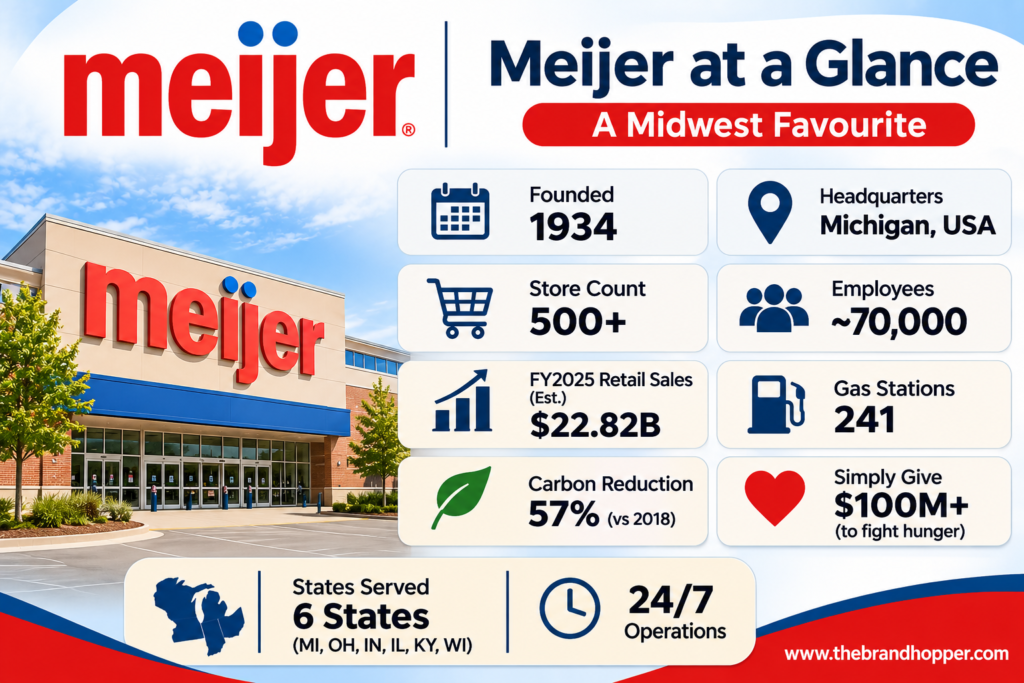
Meijer operates more than 500 supercenters, grocery stores, neighborhood markets, and express locations across six Midwest states, employs more than 70,000 team members, and generated estimated U.S. retail sales of approximately $22.8 billion in 2025.
In 2024, the company celebrated its 90th anniversary—a milestone that reinforced what makes Meijer distinctive: its ability to operate at significant scale while maintaining a strong connection with the communities it serves.
Meijer changed the retail landscape in 1962 when it opened the first Thrifty Acres store in Grand Rapids, Michigan, combining a full grocery store with a general merchandise department under one roof. This format helped establish the modern supercenter concept and preceded the later expansion of similar formats by major U.S. retailers.
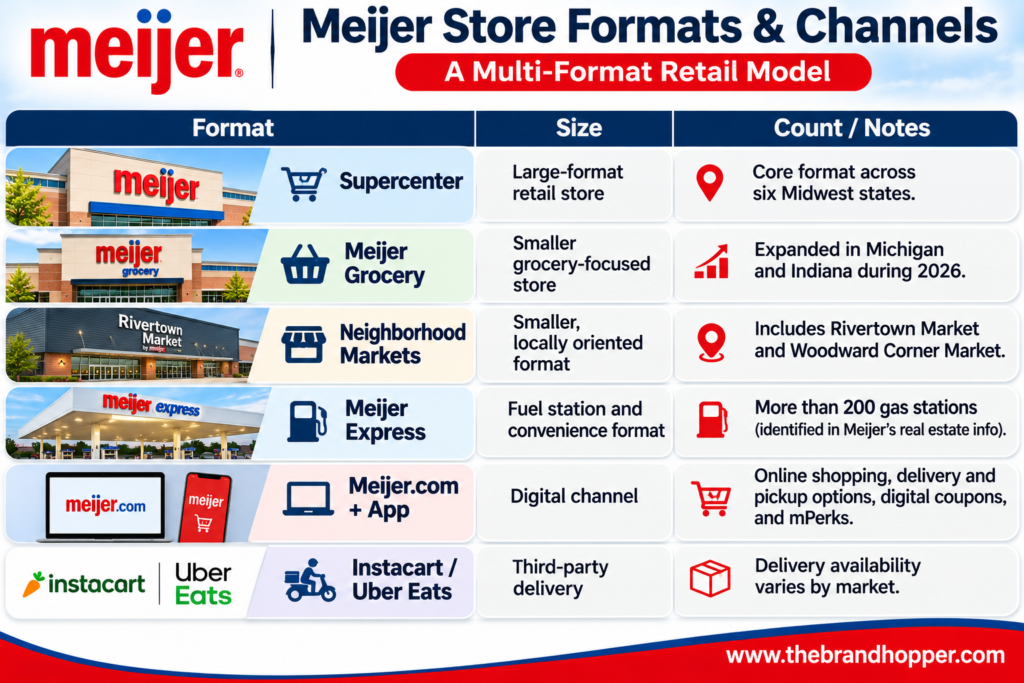
Today, Meijer’s large-format supercenters are complemented by smaller Meijer Grocery stores, neighborhood-focused markets, and Meijer Express fuel stations, allowing the company to serve different shopping needs and locations. The retailer continues to be privately owned and family-operated, with its headquarters in the Grand Rapids area.
Meijer competes in one of the most intensely contested retail markets in the country—the Midwest—where it faces pressure from Walmart, Kroger, Amazon, Costco, Aldi, and a growing range of online and hybrid competitors.

Its ability to maintain a strong regional presence is supported by a marketing strategy that combines competitive pricing, loyalty rewards, community investment, private-label development, and omnichannel convenience.
This article examines the core pillars of Meijer’s marketing approach, the campaigns and programs that bring each pillar to life, and the 4Ps marketing mix that underpins its retail model.
Marketing Strategies of Meijer
Meijer’s marketing success stems from a disciplined blend of community-rooted authenticity and modern retail technology. Rather than relying solely on national brand positioning, Meijer emphasizes value for Midwest families, support for local communities, and a convenient shopping experience.
Its marketing strategy connects everyday retail activities with customer loyalty, regional identity, and digital engagement. Here is a detailed breakdown of the ten marketing strategies that define the brand.
1. mPerks Loyalty Program: The Engine of Personalised Value
At the heart of Meijer’s customer retention strategy is the mPerks loyalty program—a digital rewards platform designed to encourage repeat purchases and make savings more relevant to individual shoppers.
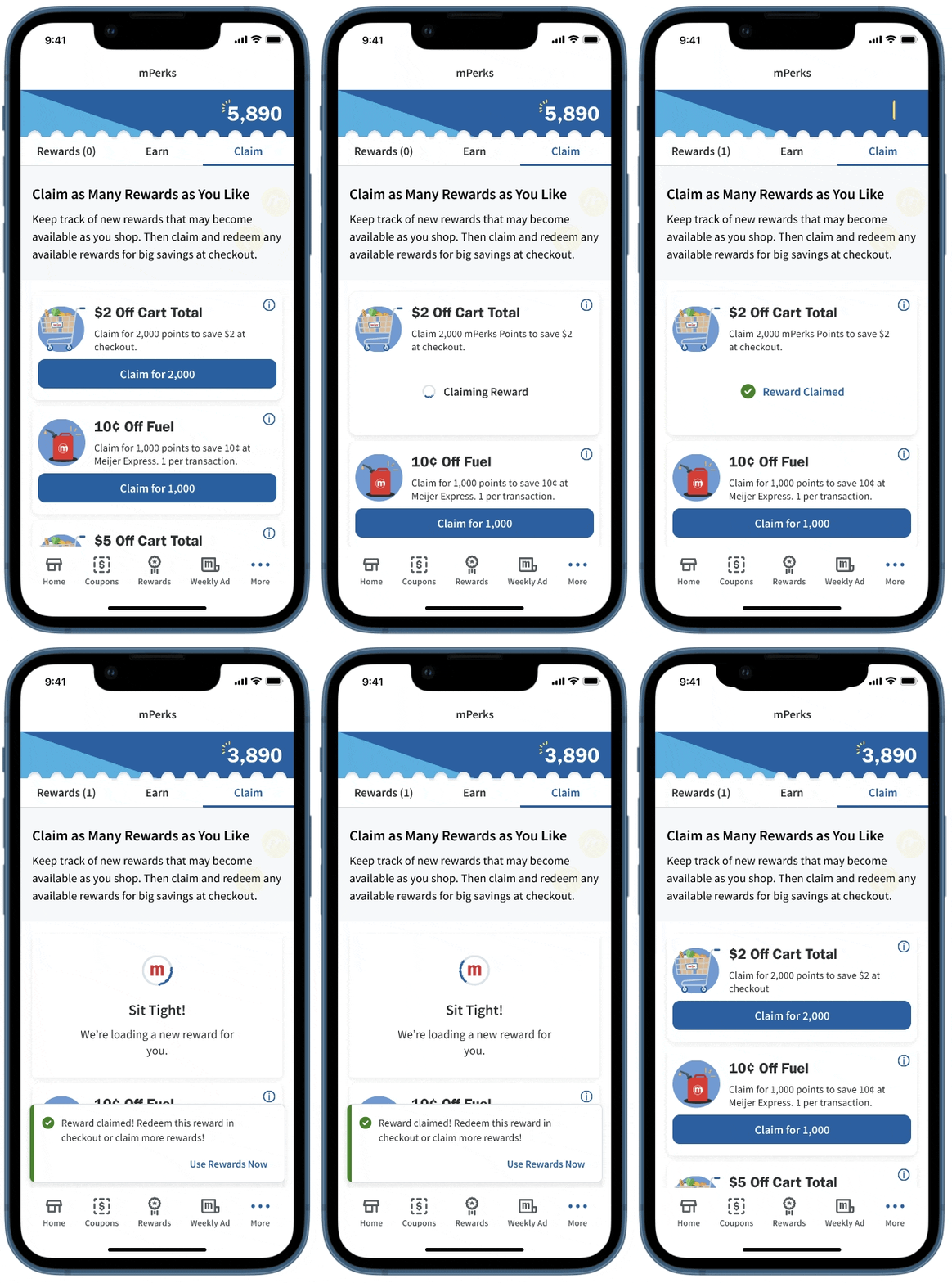
Free to join through the Meijer app or website, mPerks offers digital coupons, personalized offers, points on qualifying purchases, and rewards that customers can redeem for savings on future purchases. Members can also earn points on qualifying prescriptions and use eligible rewards for fuel discounts at participating Meijer Express stations.
Meijer enhanced the mPerks program in 2023, introducing a points-based rewards structure that gives customers more flexibility in how they use their savings. Under the current program, members earn 10 points for every dollar spent on qualifying in-store and online purchases, while bonus-point opportunities provide additional ways to accumulate rewards.
Earned points are generally valid for 90 days, while rewards claimed using those points have a separate 45-day redemption period.
The commercial impact of mPerks is visible in the savings it generates for shoppers. In June 2025, Meijer reported that customers in Michigan had saved nearly $200 million through the program over the preceding year.
The company also introduced Quick ID, which allows customers to link a credit card to their mPerks account, simplifying the process of earning rewards at Meijer Express fuel stations.
The program’s value extends beyond discounts. It supports Meijer’s omnichannel strategy by connecting in-store and online purchases with digital offers, shopping activity, and customer rewards.
mPerks also provides a first-party customer engagement platform that can support Meijer Media’s advertising solutions for consumer brands. The loyalty program is therefore both a retention tool and an important part of Meijer’s digital marketing ecosystem.

2. Everyday Value & Savings-Led Advertising
Meijer’s core market positioning rests on delivering value across its product range, and its advertising consistently reinforces this message. The retailer promotes everyday low prices alongside targeted promotional activity, including weekly sales, Buy One Get One Free offers, multi-buy discounts, and seasonal promotions.
These offers are communicated through television and radio advertising, printed and digital weekly ads, email communications, social media, and the Meijer app.
One of Meijer’s recurring promotional formats is its Black Friday sales program, which extends deals across multiple days rather than restricting promotions to a single shopping day.
Meijer’s 2026 weekly-ad materials, for example, feature Black Friday deals running from November 22 through November 28, alongside a separate three-day sale from November 26 through November 28. This structure gives shoppers multiple opportunities to access seasonal offers and encourages store and online visits during the holiday shopping period.
The company also runs seasonal and event-specific promotions throughout the year. These include back-to-school offers, holiday savings, Thanksgiving-related community initiatives, and fuel promotions for mPerks members.
In 2025, Meijer offered a summer fuel promotion through which eligible mPerks members could earn 30 points per gallon at Meijer Express stations for a limited period. Such campaigns connect the retailer’s value proposition with specific shopping occasions and customer needs.
Meijer’s pricing communications also emphasize the availability of digital coupons and member-exclusive offers. Rather than relying on a single promotional mechanism, the company combines everyday price positioning with time-limited discounts and loyalty rewards.
This allows Meijer to appeal to shoppers who prioritize predictable value as well as those who actively seek additional savings through promotions.
3. Localized Marketing & Community Sourcing
Meijer’s scale is regional by design, and its marketing reflects that focus. The annual Meijer Localization Summit provides small and mid-sized businesses in the Midwest with an opportunity to present their products for potential placement on Meijer’s shelves.
The initiative serves a commercial purpose by introducing regional products to Meijer shoppers and a marketing purpose by demonstrating the retailer’s connection with local entrepreneurs and suppliers.
Meijer also highlights locally produced goods through its stores and merchandising initiatives. Local product displays and dedicated shelf sections help customers discover products made in their own communities, while giving smaller suppliers access to a large retail network.
This approach supports Meijer’s regional identity and differentiates its assortment from retailers that rely more heavily on standardized national product selections.
The retailer also adapts its store formats to local shopping patterns. Rivertown Market in Detroit and Woodward Corner Market in Royal Oak, Michigan, are examples of smaller, neighborhood-oriented stores with curated assortments.
Meijer’s newer Meijer Grocery format provides another option for communities where a traditional supercenter may not be the most suitable format.
The company’s expansion of Meijer Grocery continued in 2026. New stores opened in Rochester Hills and Livonia, Michigan, and Fishers, Indiana, while the retailer continued to operate its established supercenter and neighborhood-market formats.
These different store concepts allow Meijer to serve customers in suburban, urban, and other local markets with formats suited to their shopping requirements.
4. Fresh Products & Private Label Brand Strategy
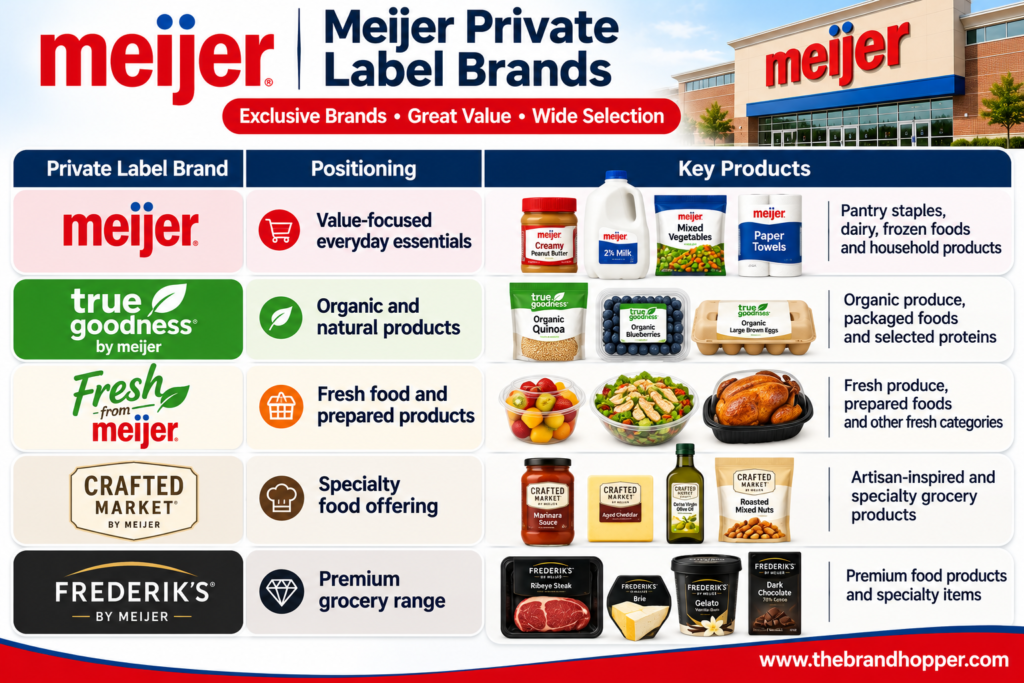
Meijer has developed a broad private-label portfolio that addresses different shopper needs, product categories, and price points. Its own-brand architecture includes Meijer Brand for everyday essentials, True Goodness by Meijer for organic and natural products, Fresh from Meijer for fresh and prepared foods, Crafted Market by Meijer for specialty products, and Frederik’s by Meijer for premium grocery offerings.

This portfolio allows the retailer to compete with national brands while giving shoppers alternatives across different quality and price preferences.
A major recent development in Meijer’s private-label strategy is its focus on nutrition-oriented products. In April 2026, the company announced plans to introduce more than 300 new products aligned with consumer interest in fiber and protein.
Meijer reported that more than 120 of its exclusive products contained at least five grams of fiber per serving, including more than 20 products under the True Goodness brand.
The retailer also reported that its private-label portfolio included more than 700 products with at least 10 grams of protein per serving. These products span multiple brands, including Fresh from Meijer, Meijer Brand, Crafted Market, True Goodness, and Frederik’s by Meijer.
Examples of products highlighted by the company included Frederik’s sesame protein pasta salad, Meijer protein puffs, and True Goodness grass-fed and finished double-smoked beef sticks.
Meijer markets its private-label brands through in-store displays, digital coupons, product merchandising, and online content. True Goodness, in particular, is positioned around organic and natural products, while Frederik’s offers a more premium grocery proposition.
By expanding its own-brand range and responding to changing food preferences, Meijer can strengthen customer loyalty and offer products that are exclusive to its retail ecosystem.
5. Digital, App & Omnichannel Experience
Meijer has continued to invest in its omnichannel infrastructure, integrating digital tools with its physical store network. The Meijer app brings together shopping lists, mPerks rewards, digital coupons, pharmacy services, and online shopping features.
Customers can use Meijer’s digital channels to place orders for delivery or pickup, subject to service availability in their area.
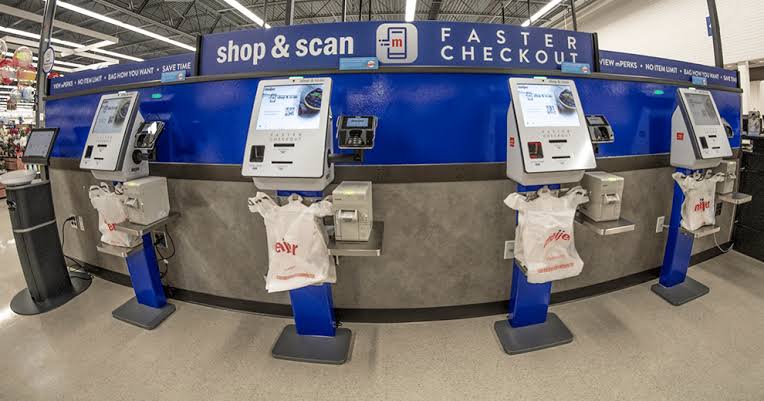
The company’s Shop & Scan technology allows customers at participating stores to scan product barcodes using the Meijer app and bag items as they shop. The feature is designed to reduce checkout friction and give shoppers more control over their in-store experience.
Meijer also offers self-checkout and staffed checkout options, allowing customers to choose the checkout method that best suits their shopping trip.

Meijer has also experimented with digital experiences that connect product discovery with in-store shopping. One example was the Meijer Find-the-Misfits augmented reality activation associated with its imperfect-produce initiative.
The campaign used a mobile game concept to introduce shoppers to the idea of purchasing cosmetically imperfect produce, linking digital engagement with a product and sustainability message.
Home delivery and curbside pickup are additional components of Meijer’s omnichannel strategy. Customers can access these services through Meijer’s own digital channels and, where available, third-party delivery platforms.
Meijer has worked with delivery partners such as Uber Eats and Instacart to broaden the ways customers can shop its assortment without visiting a store.
6. Meijer Media: Building a First-Party Retail Media Network
One of the most commercially significant developments in Meijer’s marketing strategy is the growth of Meijer Media, its retail media network. The platform allows consumer brands to reach Meijer shoppers through digital advertising solutions supported by the retailer’s first-party customer and transaction data.
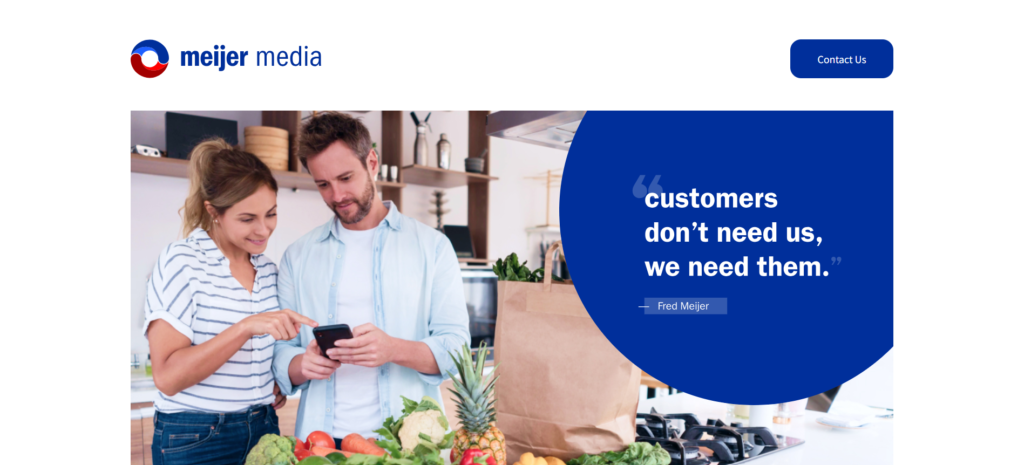

This positions Meijer not only as a retailer but also as an advertising partner for brands seeking to connect with shoppers across the purchase journey.
The network’s capabilities expanded in March 2024, when Meijer introduced closed-loop measurement for display advertising. The capability helps brand partners assess the relationship between advertising activity and actual online or in-store sales.
Meijer said that, following the introduction of the new measurement solutions, partner activations in the first quarter of fiscal 2024 increased by more than 53%, while campaign volume rose by 76% compared with the average in the fourth quarter of fiscal 2023.
In January 2025, Meijer Media expanded its digital advertising options by adding Pinterest and Online Video (OLV) and Connected TV (CTV) capabilities.
Pinterest campaigns use Meijer’s first-party data to support personalized product discovery and connect brand content with relevant shopping occasions, including back-to-school and holiday shopping.
The addition of OLV and CTV gives brand partners further opportunities to use video advertising to build awareness and communicate product stories to Meijer shoppers. Together with display advertising and Meijer’s existing digital channels, these capabilities give advertisers more ways to engage customers at different stages of the shopping journey.
7. Sustainability & Corporate Responsibility as a Marketing Platform
Meijer has incorporated sustainability and social responsibility into its operational and community identity. One of its most significant environmental milestones came in September 2024, when the company announced that it had reduced its Scope 1 and Scope 2 greenhouse gas emissions by 57% compared with its 2018 baseline.
This exceeded its target of a 50% reduction by 2025, which the company achieved a year ahead of schedule.
Meijer attributed the reduction to initiatives that included renewable-energy agreements, LED lighting upgrades, and improvements to building operations and energy management. The company has also highlighted its work on transportation efficiency and waste reduction as part of its broader environmental efforts.
These initiatives provide the retailer with tangible sustainability achievements that can be communicated to customers, suppliers, and other stakeholders.
Meijer’s recycling initiatives also involve customers directly. The retailer has offered in-store collection points for plastic bags and other eligible plastic film, giving shoppers a way to participate in recycling while visiting its stores.
Meijer has also stated a commitment to making its own-brand product packaging reusable, recyclable, or compostable, although progress toward this goal should be assessed against the company’s latest published reporting.
Food-waste reduction is another part of the retailer’s sustainability narrative. Meijer has worked with Flashfood, a digital platform that connects shoppers with discounted food approaching its best-before or sell-by dates.
The partnership gives customers access to lower-priced products while helping retailers reduce food waste. Meijer’s imperfect-produce initiative has also helped communicate the idea that cosmetically imperfect fruits and vegetables can still be suitable for consumption.
These initiatives connect environmental responsibility with practical customer benefits, particularly lower prices and more efficient use of food and packaging. This makes sustainability part of Meijer’s customer proposition rather than a separate corporate communications theme.
8. Simply Give & Community-Led Brand Building
Meijer’s Simply Give program is one of the retailer’s best-known community investment initiatives. Launched in 2008, the program supports local food pantries across Meijer’s six-state operating region.
Customers can purchase a $10 Simply Give donation card at checkout, and the contribution is converted into a Meijer food-only gift card for the food pantry selected by the participating store.
Meijer also runs special Double Match Days during which it increases the value of customer contributions. Under the program’s announced 2026 structure, a $10 customer donation on a Double Match Day becomes $30 for the participating local food pantry.
Meijer said the program supports nearly 600 food pantries and includes six Double Match Days throughout the year.
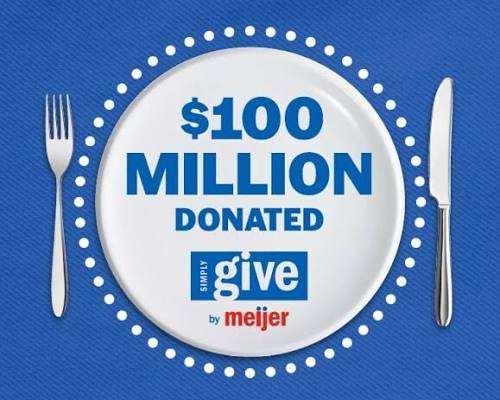
In September 2026, Meijer reported that Simply Give had generated more than $100 million in donations since its launch and helped provide more than 940 million meals across the Midwest. The program’s year-round structure and local pantry partnerships allow customers to support food access in their own communities, while giving Meijer a consistent platform for community engagement.
The Simply Give model is an important part of Meijer’s brand positioning because it encourages customers to participate directly in a community initiative. The program is promoted through stores and digital channels, while special matching periods give customers additional reasons to contribute.
Its long-running presence also reinforces Meijer’s identity as a retailer with strong regional ties.
The Meijer LPGA Classic for Simply Give is the program’s signature sports and fundraising platform. The annual professional women’s golf tournament is held at Blythefield Country Club in Belmont, Michigan, and combines an LPGA Tour event with fundraising for hunger relief.
The 2026 edition was the tournament’s 12th year and raised $1.5 million for the Simply Give program, with more than 1,400 volunteers supporting the event.

9. In-Store Experience, Team Members & Brand Storytelling
Meijer’s physical store experience is a marketing vehicle in its own right. The supercenter format brings together grocery departments, general merchandise, apparel, household products, health and beauty products, pharmacies, and other services.
The retailer’s stores are designed to make Meijer a convenient one-stop shopping destination, allowing customers to complete multiple shopping missions during a single visit.
Meijer stores are listed as operating 24 hours a day, 364 days a year, with Christmas Day as the annual closure. This extended operating model supports the company’s convenience proposition and gives customers flexibility in when they shop.
Store services and department availability can vary by location, but the broad supercenter format remains central to Meijer’s retail identity.
One of Meijer’s distinctive advertising campaigns is “Quality Is No Accident,” launched in 2019. The campaign featured actual Meijer team members in television commercials rather than relying exclusively on professional actors.
Employees from departments such as meat, produce, bakery, and pharmacy shared their knowledge and responsibilities, helping the retailer communicate its quality standards through the people who work directly with its products.
This approach creates an authenticity advantage by allowing employees to explain the work behind product quality and customer service. The campaign also reflects Meijer’s broader emphasis on its team members as an important part of the customer experience.
By using employees in its advertising, the company connects its internal culture with its external brand identity.
Meijer also uses its family heritage and community involvement in its brand storytelling. Its annual Family Day initiative celebrates the people who support Meijer team members and contribute to the company’s communities.
The 2026 event continued this approach by recognizing the families and loved ones behind its workforce. These activities reinforce Meijer’s identity as a family-operated retailer with longstanding relationships across the Midwest.
10. Strategic Partnerships & Collaborative Marketing
Meijer uses strategic partnerships to extend its marketing reach, improve customer convenience, and strengthen its community and sustainability initiatives. Its delivery partnerships, including work with Uber Eats and Instacart, give customers additional ways to access Meijer’s products.
These arrangements help the retailer reach shoppers through established digital platforms while complementing its own app and e-commerce services.
In sustainability, Meijer has worked with Dow on initiatives involving recycled plastic shopping bags made using post-consumer plastic film collected through store recycling programs. Such collaborations connect the retailer’s in-store recycling activity with the production of new materials, making the circular-economy concept more tangible to customers.
Meijer also collaborates with suppliers and local businesses to develop products and create regionally relevant shopping experiences. Its Localization Summit provides smaller Midwest businesses with a route to present products for potential distribution through Meijer’s retail network.
Local product features and supplier stories then help the retailer communicate its commitment to the communities in which it operates.
Community partnerships are another important element of Meijer’s collaborative marketing approach. Through Simply Give, the company works with hundreds of local food pantries, while the Meijer LPGA Classic brings together sponsors, volunteers, players, and community organizations around hunger relief.
These partnerships extend the reach of Meijer’s community initiatives and reinforce its position as a regional retailer with a strong local presence.
Marketing Mix of Meijer (4Ps Analysis)
Meijer’s marketing mix is the operational foundation of its retail strategy—the specific decisions about what to sell, how to price it, where to make it available, and how to communicate its value to shoppers. The company’s 4Ps combine a broad product assortment, value-oriented pricing, a multi-format store network, and an integrated promotional strategy.
Here is a detailed examination of each element.
1. Product
Product Assortment and Supercenter Format
Meijer’s product range is one of the broadest among regional U.S. retailers. A typical supercenter brings together fresh groceries, meat, seafood, bakery, deli, dairy, frozen food, health and beauty products, apparel, electronics, home goods, garden supplies, automotive accessories, toys, sporting goods, and pet supplies.
This one-stop-shop breadth is a fundamental part of Meijer’s product strategy, allowing customers to combine grocery shopping with general merchandise purchases during the same trip.
Private Label Portfolio
Meijer’s own-brand portfolio spans several product tiers: Meijer Brand for everyday essentials; True Goodness by Meijer for organic and natural products; Fresh from Meijer for fresh and prepared foods; Crafted Market by Meijer for specialty products; and Frederik’s by Meijer for premium grocery offerings.
Each brand serves a different product proposition and helps Meijer compete with national brands across multiple categories.
The portfolio is also evolving in response to changing consumer preferences. In April 2026, Meijer announced plans to introduce more than 300 new products aligned with growing interest in fiber and protein.
The retailer also reported more than 120 exclusive products with at least five grams of fiber per serving and more than 700 private-label products with at least 10 grams of protein per serving.
Fresh, Organic & Local Sourcing
Meijer emphasizes fresh food quality through its produce, meat, seafood, bakery, and deli departments. The retailer serves customers across Michigan, Ohio, Indiana, Illinois, Kentucky, and Wisconsin, and uses local product displays and supplier relationships to highlight regional products where available.
The True Goodness brand anchors much of Meijer’s organic and natural product positioning, while its broader private-label portfolio provides alternatives across different price points.
The retailer has also used its imperfect-produce initiative to introduce shoppers to cosmetically imperfect fruits and vegetables, connecting affordability with efforts to reduce food waste.
2. Price
Everyday Low Pricing
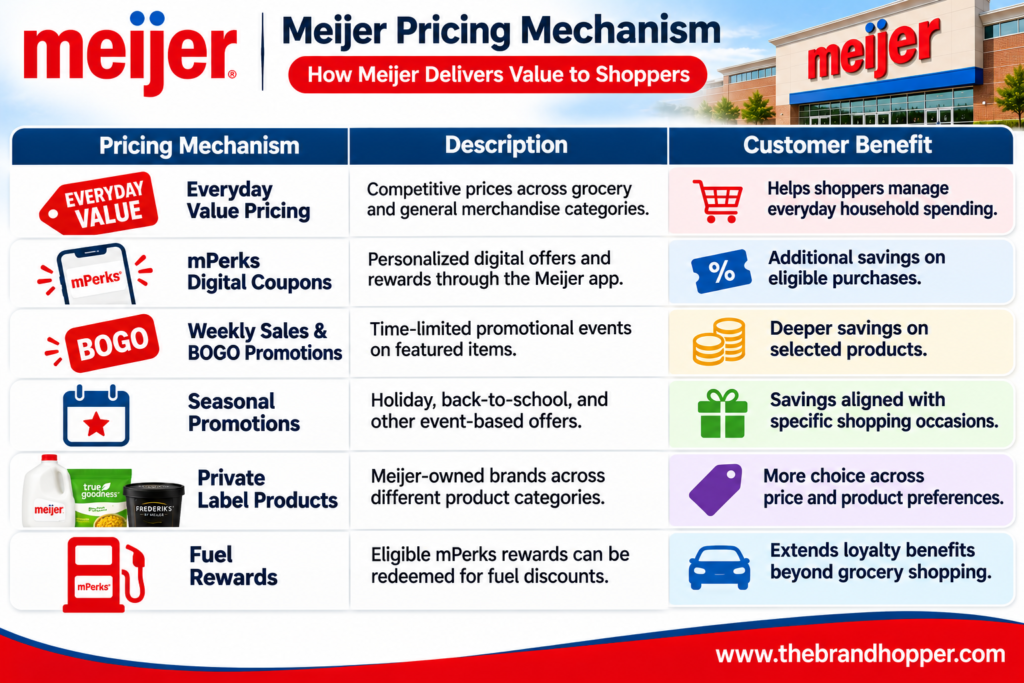
Meijer’s pricing proposition emphasizes everyday value and competitive prices across its product range. The company uses this positioning to appeal to shoppers who want to manage household budgets without depending entirely on limited-time promotions.
Everyday low prices are an important part of its competition with Walmart, Kroger, Aldi, and other grocery and general merchandise retailers.
Digital Coupons & mPerks Overlay
Meijer’s everyday pricing proposition is supported by mPerks digital coupons and rewards. Members can access personalized offers, earn points on qualifying purchases, and redeem accumulated points for rewards.
This creates an additional savings layer for customers who participate in the loyalty program.
Weekly sales, BOGO offers, and seasonal promotions provide further opportunities for customers to save on selected products. The combination of regular price positioning, digital offers, and time-limited promotions allows Meijer to appeal to both value-conscious shoppers and customers who actively look for promotional deals.
Private Label Price Positioning
Meijer’s private-label brands provide alternatives to national brands across grocery and general merchandise categories. These products allow the retailer to offer different price and quality propositions within its own assortment, giving customers more options when comparing products.
The precise savings vary by product and category, so a single percentage discount should not be applied across the entire private-label portfolio.
3. Place
Supercenter Network
Meijer’s primary physical format is the supercenter—a large store combining full grocery and general merchandise departments. The retailer operates across Michigan, Ohio, Indiana, Illinois, Kentucky, and Wisconsin, with a network of more than 500 supercenters, grocery stores, neighborhood markets, and express locations.
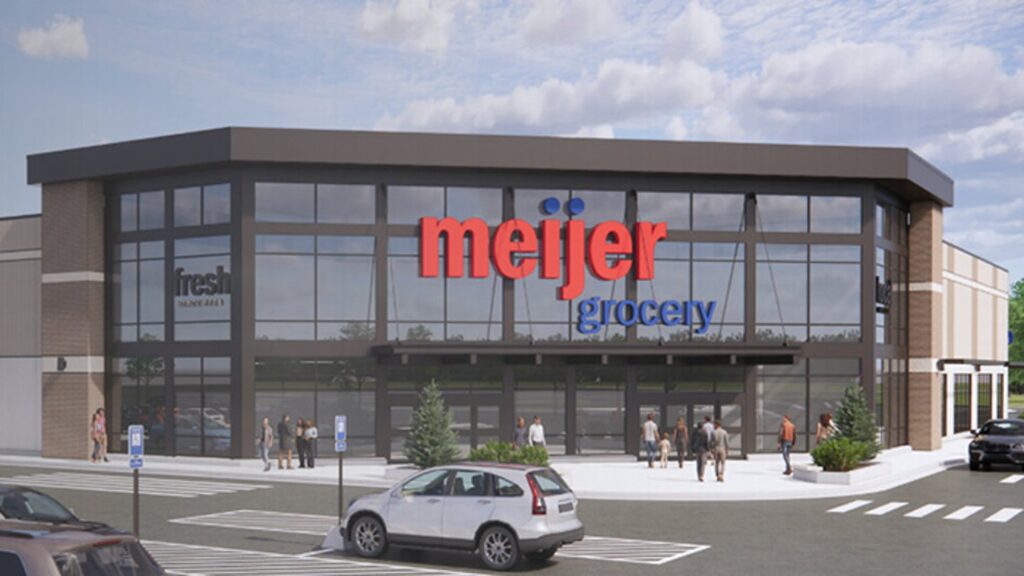
Michigan remains Meijer’s home-state stronghold. In September 2026, the company opened a new supercenter in Plymouth Township, bringing its Michigan store count to 130.
Meijer also continued to expand in other states, including Ohio and Indiana, with new supercenter openings during 2026.
Neighborhood Markets & Express Formats
Meijer has developed smaller store formats to serve communities where a full-size supercenter may not be the most suitable option. Its Meijer Grocery format offers a more food-focused shopping experience in a smaller footprint, while neighborhood-oriented stores such as Rivertown Market and Woodward Corner Market provide curated assortments for their local communities.
The Meijer Grocery format expanded during 2026, with new stores opening in Rochester Hills and Livonia, Michigan, and Fishers, Indiana. These locations demonstrate how the retailer is adapting its physical footprint to different shopping needs while retaining its emphasis on fresh groceries, convenience, and value.
Meijer Express locations extend the brand into fuel and convenience retail. The retailer’s real estate information identifies more than 200 gas stations, while its broader network includes more than 500 locations across its different store formats.
Digital & Omnichannel Presence
Meijer’s omnichannel strategy connects its physical stores with its digital shopping platforms. Customers can shop through meijer.com and the Meijer app, access digital coupons and mPerks rewards, and use delivery or pickup services where available.
These services allow shoppers to choose between visiting a store, collecting an online order, or arranging delivery.
Third-party delivery partnerships, including Instacart and Uber Eats, provide additional routes to Meijer’s assortment in participating markets. The integration of digital ordering, loyalty rewards, and store-based fulfillment helps maintain a consistent customer experience across channels.
4. Promotion
Advertising & Media Mix
Meijer’s promotional mix spans traditional and digital media. Television commercials help communicate the retailer’s value proposition, seasonal promotions, product quality, and community initiatives to a broad Midwest audience.
Radio advertising, printed weekly ads, and in-store signage reinforce these messages and direct shoppers toward current offers.
Digital channels—including email newsletters, app notifications, social media, and Meijer Media—play an important role in communicating with shoppers and loyalty members. The combination of broad-reach advertising and personalized digital promotions allows Meijer to communicate both brand-level messages and offers relevant to individual customers.
Campaign Examples
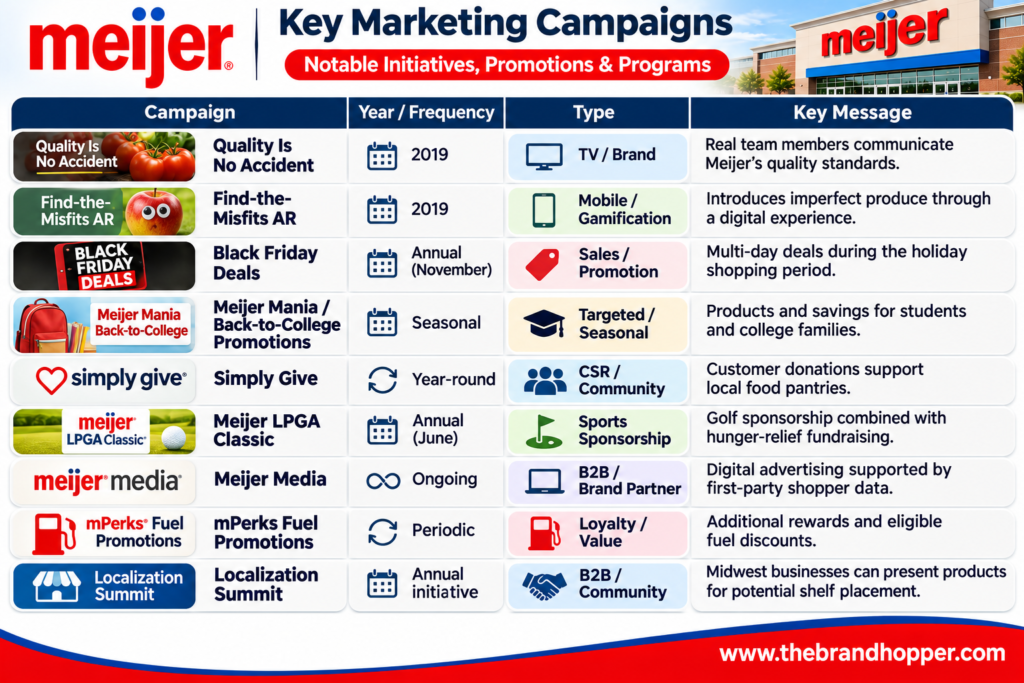
“Quality Is No Accident” (2019): The campaign featured actual Meijer team members in television commercials, highlighting their knowledge and responsibilities across departments such as meat, produce, bakery, and pharmacy. It helped the retailer communicate product quality through the employees who work directly with its products.
“Meijer Find-the-Misfits” AR Campaign (2019): An augmented reality mobile activation associated with Meijer’s imperfect-produce initiative. The campaign used a game-based concept to introduce shoppers to the idea of purchasing cosmetically imperfect produce and reducing food waste.
“Black Friday Deals” (Annual): Meijer’s Black Friday promotions extend across several days in November, with weekly-ad campaigns and separate short-duration sales. The 2026 program includes a Black Friday deals period from November 22 to November 28, alongside a three-day sale from November 26 to November 28.
“Meijer Mania” Back-to-College Promotions: Seasonal back-to-college offers position Meijer as a convenient shopping destination for students and families purchasing groceries, dorm essentials, clothing, and other supplies. Promotional activity and product availability can vary by market.
“Simply Give” Hunger Relief Program (Year-round): Meijer’s community giving program encourages customers to purchase $10 donation cards that are converted into food-only gift cards for local food pantries. Special Double Match Days increase the value of customer donations, with the 2026 program supporting nearly 600 food pantries.
“Meijer LPGA Classic for Simply Give” (Annual, June): The retailer’s sports sponsorship combines professional women’s golf with community fundraising. The 2026 tournament raised $1.5 million for hunger relief through Simply Give, continuing the event’s role as a major community engagement platform.
“Meijer Media” (Ongoing): Meijer’s retail media network enables consumer brands to reach shoppers through digital advertising solutions supported by first-party data. Its offerings include display, Pinterest, Online Video, and Connected TV advertising capabilities.
Social Media & Digital Engagement
Meijer maintains an active digital presence through social media, its website, and the Meijer app. Its communications include weekly deals, seasonal campaigns, product information, recipes, community initiatives, and sustainability-related stories.
These channels help the retailer maintain customer engagement between store visits and promote products and offers relevant to different shopping occasions.
The mPerks program strengthens this digital relationship by giving members access to rewards, digital coupons, and personalized offers. Email marketing and app notifications provide additional ways to communicate with opted-in customers, while Meijer Media extends the company’s digital capabilities to brand partners seeking to reach Meijer shoppers.
Frequently Asked Questions: Meijer Marketing Strategy
Q: What is Meijer’s overall marketing strategy?
Meijer’s marketing strategy combines everyday value, a digital loyalty program through mPerks, community investment through Simply Give, private-label product development, and omnichannel shopping capabilities.
Its brand communication also emphasizes family heritage, team members, and its longstanding connection with Midwest communities. This combination is designed to encourage repeat purchases while reinforcing Meijer’s regional identity.
Q: How many members does the mPerks loyalty program have?
Meijer has not published a current total membership figure for mPerks. However, the company reported in June 2025 that Michigan customers had saved nearly $200 million through the program during the preceding year.
mPerks provides digital coupons, points on qualifying purchases, personalized offers, and rewards that can be redeemed for eligible purchases and fuel discounts.
Q: What is Meijer’s Simply Give program and how much has it raised?
Meijer Simply Give is a hunger-relief program launched in 2008. Customers can purchase $10 donation cards at checkout, with the contributions converted into Meijer food-only gift cards for local food pantries.
During Double Match Days, Meijer increases the value of customer contributions.
In September 2026, Meijer reported that Simply Give had generated more than $100 million in donations and helped provide more than 940 million meals across the Midwest. The program supports nearly 600 food pantries through its local partnerships.
Q: What sustainability goals has Meijer achieved?
In September 2024, Meijer announced that it had reduced its Scope 1 and Scope 2 greenhouse gas emissions by 57% compared with its 2018 baseline, exceeding its 50%-by-2025 target a year early.
The company has also highlighted renewable-energy agreements, LED lighting upgrades, recycling initiatives, and food-waste reduction partnerships as part of its environmental efforts.
Q: How is Meijer expanding its store network?
Meijer operates more than 500 supercenters, grocery stores, neighborhood markets, and express locations across Michigan, Ohio, Indiana, Illinois, Kentucky, and Wisconsin. Recent expansion activity includes new Meijer Grocery stores in Rochester Hills, Livonia, and Fishers during 2026, as well as new supercenters in Ohio, Indiana, and Michigan.
The company is using smaller grocery-focused formats alongside its traditional supercenters to serve different types of communities. Its Meijer Grocery openings in 2026 demonstrate this strategy of adapting store size and assortment to local shopping needs.
Q: What is Meijer Media and why does it matter?
Meijer Media is the retailer’s retail media network, a first-party data-supported advertising platform that allows consumer brands to reach Meijer shoppers through digital channels. Its capabilities include display advertising, Pinterest, Online Video, and Connected TV.
Meijer introduced closed-loop measurement for display advertising in 2024, helping brand partners assess the relationship between advertising campaigns and sales. The company reported that partner activations increased by more than 53% and campaign volume rose by 76% in the first quarter of fiscal 2024 compared with the average in the previous quarter.
Q: Is Meijer still family-owned?
Yes. Meijer remains a privately owned and family-operated company. It was founded in 1934 by Hendrik Meijer and his son Fred Meijer, and the business continues to be led by members of the Meijer family alongside an experienced management team.
The company’s family ownership and regional roots remain important parts of its brand identity.
Conclusion
Meijer’s marketing success is closely connected to its identity as a community-focused Midwest retailer. The company that Hendrik Meijer and his son Fred started in 1934 with a small grocery store has grown into a major regional retail business with more than 500 locations across six states.
Its estimated U.S. retail sales reached approximately $22.8 billion in 2025, reflecting the scale of a business that has continued to build on its regional roots.
The ten marketing strategies examined in this article—from mPerks loyalty and everyday value pricing to Meijer Media, the Simply Give program, the LPGA Classic sponsorship, and local supplier partnerships—share a common theme.
Each strategy seeks to deliver value to shoppers, support the communities Meijer serves, or communicate the retailer’s identity through its products and people. This connection between brand positioning and marketing execution helps Meijer differentiate itself from larger national competitors.
As Meijer moves through its tenth decade, its strategic priorities include expanding its store formats, improving its digital and omnichannel experience, developing private-label products that respond to changing nutrition preferences, and strengthening its retail media capabilities.
Continued investment in community initiatives such as Simply Give also helps the retailer maintain the local relationships that have shaped its brand since 1934.
Also Read: Target’s Top 20 Competitors in Retail: Complete Analysis
To read more content like this, subscribe to our newsletter
Go to the full page to view and submit the form.