


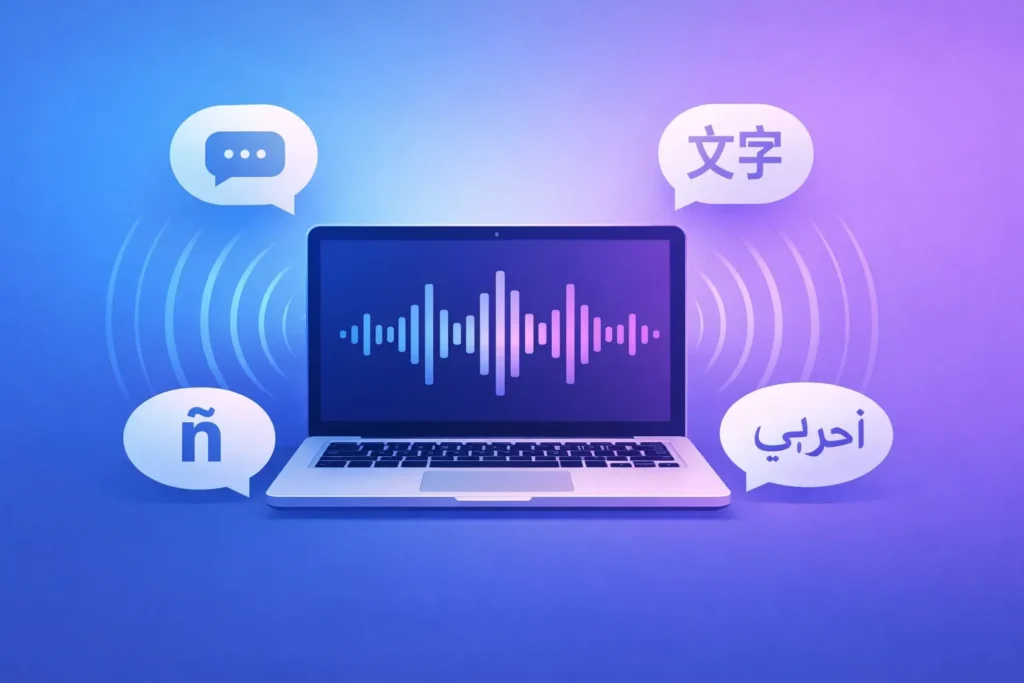
A listener queues up a business audiobook narrated in a warm, unhurried voice that pauses in all the right places and never once sounds like a machine — except it is one, generated overnight from a manuscript for a fraction of what a studio narrator would charge. A few tabs over, a solo podcaster dubs their English-language show into Spanish, French, and Hindi using their own cloned voice, expanding into three new markets without learning a word of any of those languages. Somewhere else, a call center’s IVR system handles a return request in a voice so natural the caller never asks to speak to a person. None of this required a recording booth, a voice actor, or a translator. This is what AI text-to-speech has quietly become: infrastructure for anyone who needs a voice, at a scale no human production pipeline could match.
This category has exploded now because neural text-to-speech finally crossed the uncanny valley. Older synthetic voices were instantly recognizable — flat, robotic, badly timed. The current generation, trained on massive voice datasets with models that understand prosody and emotion, produces speech that blind listening tests increasingly can’t distinguish from a human recording. That leap arrived exactly as demand for scalable voice content exploded: YouTubers and course creators need voiceover faster than they can record it, global brands need dubbing into a dozen languages without a dozen studio bookings, and enterprises need IVR systems that sound less like a phone tree and more like a person. The global AI voice generators market is projected to grow from roughly $7.7 billion in 2026 to $21.8 billion by 2030, a nearly 30% compound annual growth rate, with the voice cloning segment alone on pace to reach $9.6 billion by 2030. That’s a category moving from novelty to default.
What separates today’s leaders is less about whether a voice sounds human — most serious tools clear that bar now — and more about control: how precisely you can clone a voice, direct its emotion, license it for commercial use, and plug it into a production pipeline instead of a one-off demo. Picking the wrong tool usually means discovering too late that your ideal voice isn’t licensed for the commercial project you actually need it for. Here’s a comprehensive guide to the best ones available in 2026.
What Makes a Great AI Text-to-Speech Tool?
Voice realism and naturalness is the baseline test — does the output have believable pacing, breath, and inflection, or does it still carry that telltale synthetic flatness once a sentence runs longer than a few words.
Voice cloning and customization determines whether you’re limited to a library of stock voices or can create a genuinely unique, ownable voice from a short sample — the single biggest differentiator between tools built for hobbyists and tools built for serious production.
Language and accent coverage decides whether a tool can actually support dubbing and global content strategy, since real multilingual work needs not just many languages but convincing accents within them.
Emotional range and tone control is what separates a monotone reader from a tool that can deliver an excited ad read, a calm meditation script, or a stern IVR warning — exposed through style tags, sliders, or direction prompts rather than one flat setting.
Integration and API access matters the moment you move past one-off exports and need voice generation wired into an app or content pipeline running thousands of lines a day without manual intervention.
Pricing and licensing for commercial use is where many creators get burned — a shockingly cheap plan is often unlicensed for monetized content, and character- or credit-based billing can make a “cheap” tool balloon in cost once a real production scales up.
The Best AI Text-to-Speech Tools
1. ElevenLabs

ElevenLabs has become the name most people mean when they say “AI voice” — founded to close the gap between synthetic and human speech, it’s now the tool creators and developers benchmark every competitor against.
Generation works off deep neural models trained across huge multilingual voice datasets, and its Professional Voice Cloning feature lets you build a highly accurate clone from a few minutes of clean audio, with style and stability sliders to shape delivery.
Its standout differentiator is sheer realism combined with speed of iteration — few tools produce output this convincing this fast, which is why it’s become the default for dubbing, narration, and conversational AI voice layers alike.
| Plan | Price | Key Features |
|---|---|---|
| Free | $0 | 10,000 credits/mo (~10 min speech), no commercial rights |
| Starter | $6/mo | 30,000 credits, commercial license unlocked |
| Creator | $22/mo | 121,000 credits, Professional Voice Cloning |
| Pro | $99/mo | 600,000 credits |
| Scale | $299/mo | 1.8M credits/mo, 3 workspace seats, 3 Professional Voice Clones |
| Business | $990/mo | 6M credits/mo, 10 workspace seats, low-latency TTS from $0.05/min |
Overage pricing drops from $0.06 to $0.02 per generation as you move up tiers, so heavy users are rewarded for committing to a higher plan rather than paying pay-as-you-go rates.
Best for: Creators and studios who need the most realistic voice cloning available and are willing to pay for commercial-grade output.
2. Murf

Murf built its platform around business use cases — training videos, product demos, e-learning modules — with a studio-style editor that treats voiceover as part of a larger presentation workflow rather than a standalone audio file.
Its voice engine draws from a curated library of professional voices, and users adjust pitch, speed, and emphasis directly in a timeline editor synced to slides or video, rather than working purely from a text prompt.
Its differentiator is that production-studio interface — Murf feels built for someone assembling a full corporate video or course, not just generating a clip, which shows in its built-in slide sync and collaboration tools.
| Plan | Price (annual) | Key Features |
|---|---|---|
| Free | $0 | 10 minutes of generation, no downloads |
| Creator | $19/mo | 24 hours/year generation, commercial rights, 1 seat |
| Business | $66/mo | 96 hours/year, priority support |
| Enterprise | Custom | Unlimited generation, voice cloning, compliance certifications |
| API | $0.03/1,000 characters | Independent of Studio subscription |
Costs stay reasonable for a training or marketing team producing regular but not massive volumes of content, and climb toward Enterprise once voice cloning or unlimited generation becomes a requirement.
Best for: L&D and marketing teams producing training videos and e-learning content who want voiceover built into a presentation workflow.
3. WellSaid Labs


WellSaid Labs, spun out of the Allen Institute for AI, built its reputation on studio-quality voice avatars licensed and tuned for consistent brand use across large volumes of content — less a general tool, more a controlled brand asset.
Its avatars are pre-built, professionally recorded voice models rather than user-cloned voices, refined with deep tuning for pacing and inflection, giving each avatar a highly consistent, broadcast-ready quality across long-form scripts.
Its differentiator is that broadcast-grade consistency at scale — brands producing hundreds of training or marketing videos value a voice that sounds identical in script one and script two hundred, which is harder to guarantee with looser, user-cloned voice tools.
| Plan | Price (annual) | Key Features |
|---|---|---|
| Trial | Free | 3 download minutes/mo, no commercial rights |
| Starter | $10/mo | 240 download minutes/year, unlimited generation, full commercial rights |
| Pro | $33/mo | 2,160 download minutes/year, unlimited projects, Adobe Express integration |
| Business | $160/mo/seat | 2,880 download minutes/year/user, up to 5 seats, team workspace |
| Enterprise | Custom | Custom minutes, all languages, SSO, dedicated CSM |
Pricing is negotiable at higher volume, but the per-seat Teams tier makes this considerably pricier than creator-focused tools once more than one person needs access.
Best for: Enterprises and agencies that need a consistent, brand-owned voice across hundreds of pieces of content.
4. Google Cloud Text-to-Speech

Google Cloud TTS is the text-to-speech arm of Google’s cloud AI suite, built less as a creative studio and more as an API-first utility for developers embedding voice into apps, IVR systems, and accessibility tools at scale.
It generates speech through several model tiers — Standard, WaveNet, Neural2, and the newer Chirp 3 HD — called directly via API with fine-grained SSML control over pronunciation, pauses, and emphasis rather than a visual editor.
Its differentiator is tiered pricing that scales from nearly free to premium, letting developers choose cheap, serviceable Standard voices for high-volume, low-stakes use and reserve expensive Studio-quality voices for customer-facing moments that need to sound polished.
| Voice Tier | Price per 1M characters | Free Tier |
|---|---|---|
| Standard | $4 | 4M characters/mo |
| WaveNet | $4 | 4M characters/mo |
| Neural2 | $16 | 1M characters/mo |
| Chirp 3 HD | $30 | 1M characters/mo |
| Studio | $160 | Not included |
| Instant Custom Voice | $60 | Not included |
An hour of Standard or WaveNet narration costs roughly $0.22, making this dramatically cheaper than consumer tools at genuine scale, provided you have the engineering resources to integrate it.
Best for: Developers building voice into apps or IVR systems who need API-first control and usage-based pricing that scales down to near-zero cost.
5. Amazon Polly


Amazon Polly is AWS’s text-to-speech service, built to slot into the same ecosystem as S3, Lambda, and the rest of the AWS stack, making it the default choice for any team already running infrastructure on Amazon’s cloud.
Polly generates speech across four engine tiers — Standard, Neural, Generative, and Long-Form — each trading price for realism, with output delivered as audio files or streamed directly into an application via API.
Its differentiator is that tight AWS integration combined with genuinely competitive per-character pricing, which makes it an easy default for teams that don’t want to manage a separate vendor relationship outside their existing cloud bill.
| Engine | Price per 1M characters | Free Tier (12 months) |
|---|---|---|
| Standard | $4 | 5M characters/mo |
| Neural | $16 | 1M characters/mo |
| Generative | $30 | 100K characters/mo |
| Long-Form | $100 | 500K characters/mo |
Hidden costs creep in through data transfer ($0.09/GB outbound) and S3 storage for generated audio files, which matter at genuine production scale but are negligible for smaller projects.
Best for: Teams already building on AWS who want text-to-speech billed and managed inside their existing cloud infrastructure.
6. Microsoft Azure AI Speech

Microsoft’s speech service, recently folded into the Azure AI Foundry umbrella, positions itself as the most customizable enterprise option of the major cloud providers, with the largest voice and language catalog among them.
It generates speech through prebuilt Neural and Neural HD voices, plus custom neural voice training for enterprises that want a fully proprietary voice, all controllable through detailed SSML markup and tight integration with the rest of Azure’s AI services.
Its differentiator is sheer breadth — over 500 voices across 140+ languages, more than double what Google or Amazon offer — plus commitment-tier pricing that rewards enterprises willing to forecast volume in advance.
| Tier | Price per 1M characters | Notes |
|---|---|---|
| Neural (pay-as-you-go) | $16 | Free tier: 500K characters/mo |
| Neural HD | $22 | Reduced from $30 in March 2026 |
| Commitment tiers | As low as $7.50/1M | Up to 53% discount for pre-committed volume |
The commitment-tier discount makes Azure genuinely cost-effective for large, predictable enterprise workloads, but pay-as-you-go pricing sits in the middle of the pack rather than being a clear bargain.
Best for: Enterprises needing the widest language and voice coverage with deep customization inside a Microsoft-centric tech stack.
7. PlayAI

PlayAI positions itself as a flexible middle ground between consumer voiceover apps and full developer APIs, popular among podcasters and app builders who want realistic voices without committing to a full cloud platform.
It offers both a web-based Studio for generating and editing narration directly and a straightforward API for developers who want to pipe generated speech into an app or content pipeline programmatically.
Its differentiator is that dual accessibility — the same underlying voice engine serves a no-code creator interface and a genuine developer API, which lets a project graduate from manual generation to automated pipeline without switching tools.
| Plan | Price | Key Features |
|---|---|---|
| Free | $0 | Limited words/month, watermarked or restricted output |
| Creator | ~$31/mo | ~3M characters/year, commercial use |
| Unlimited | ~$49/mo | Unlimited voice generation |
| Enterprise | Custom | API access, team features, priority support |
Pricing has shifted repeatedly since the PlayAI rebrand, so it’s worth confirming current word and character limits directly before committing to a plan for a high-volume project.
Best for: Podcasters and app developers who want one tool that covers both manual narration and API-driven automation.
8. Speechify
Speechify started as a text-to-speech reading app — turning articles, PDFs, and books into audio for people who prefer listening to reading — before expanding into a full Studio product for creators generating voiceover, not just consuming it.
The Reader side converts any text into natural narration for personal listening, while Studio adds commercial-use voice generation, cloning, and editing aimed at podcasters and video creators producing content for an audience.
Its differentiator is that split identity — few competitors serve both a mass-market reading-accessibility audience and a professional voiceover audience from the same underlying voice engine, which gives Speechify unusually broad brand recognition for a TTS company.
| Plan | Price | Key Features |
|---|---|---|
| Reader Free | $0 | 10 basic voices, TTS-only |
| Reader Premium | $29/mo (up to 60% off annually) | 1,000+ voices, 60+ languages, AI podcasts |
| Studio Free | $0 | 600 Studio credits/mo, no commercial rights |
| Studio Starter | $19/mo | 7,200 Studio credits/mo, voice cloning, commercial rights |
| Studio Creator | $49/mo | 28,800 Studio credits/mo, everything in Starter |
The Reader and Studio products are priced and sold separately, so a creator wanting both accessibility reading and commercial voiceover may end up paying for two distinct subscriptions.
Best for: Individual creators and students who want an accessible reading tool that can also double as a lightweight voiceover studio.
9. Coqui TTS


Coqui TTS remains the most technically capable open-source text-to-speech framework available, even after the company behind it shut down in 2024 — its codebase lives on through a community fork maintained by the Idiap Research Institute.
Running it means self-hosting the model, feeding it a voice sample for cloning through its XTTS v2 architecture, and generating speech locally or on your own servers rather than calling a hosted API — a fundamentally different mode of use than every other tool on this list.
Its differentiator is complete control and zero per-character cost — once set up, there’s no metered billing, no vendor lock-in, and full ownership of the pipeline, though the tradeoff is real engineering effort and a licensing catch worth knowing about upfront.
| Component | Cost | Notes |
|---|---|---|
| Framework/code | Free | Open source, actively maintained |
| Compute | Self-hosted (GPU cost) | No per-character fees |
| XTTS v2 pretrained weights | Free for non-commercial use | Commercial use requires a separate Coqui Public Model License |
The framework itself is free and open, but teams planning commercial deployment need to budget for either licensing the pretrained weights or training their own models from scratch.
Best for: Technical teams that want full control over voice generation infrastructure and are prepared to self-host rather than pay per character.
Building Your AI Voice Stack
The right tool tracks closely with what you’re producing and at what scale. A solo podcaster or YouTuber dubbing into new languages or cloning their own voice should start with ElevenLabs, while one who mainly needs accessible reading with light voiceover fits Speechify better. An e-learning or corporate training team assembling full video courses will get more from Murf’s slide-synced workflow, and a brand needing one consistent voice across hundreds of assets should look at WellSaid Labs despite its steeper per-seat cost. App developers and enterprises building voice into a product belong on the cloud APIs — Google Cloud TTS or Amazon Polly for cost-efficient scale, Azure AI Speech when language breadth and customization matter more than price. Technical teams wanting full ownership of their pipeline, with no per-character billing, should go straight to Coqui TTS and accept the self-hosting tradeoff.
None of this needs to be decided from a spec sheet alone — voices are subjective in a way pricing tables can’t capture. Take the actual script you need to record, run it through two or three shortlisted tools, and listen critically for pacing and emotion on a longer paragraph, not just a punchy one-liner. The tool that wins that side-by-side test, not the one with the flashiest demo reel, is the one that belongs in your stack.
Also Read: Best AI Chatbot Builders for Websites
To read more content like this, subscribe to our newsletter
Go to the full page to view and submit the form.