


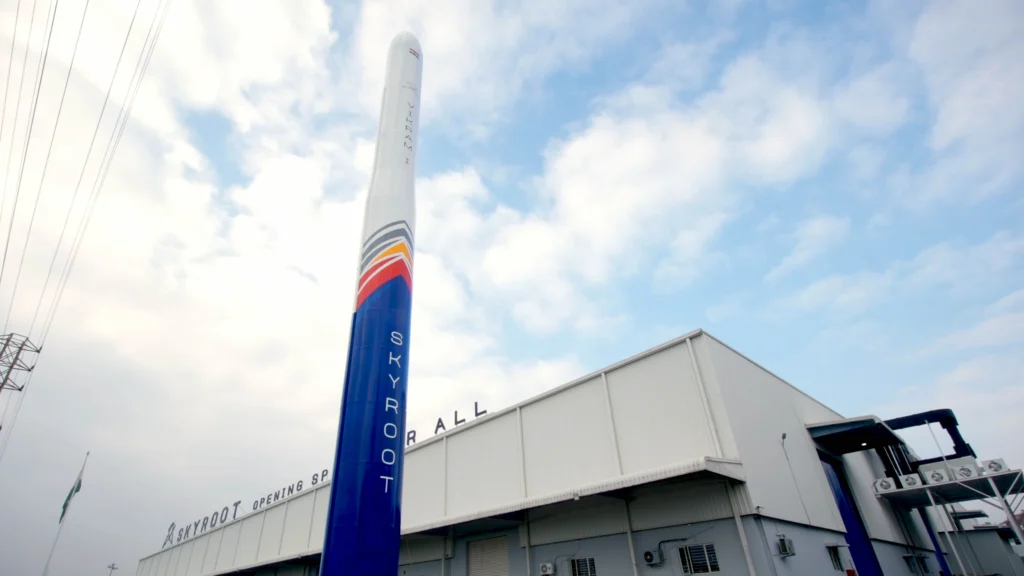
Introduction: The Rocket Scientists Who Left ISRO to Build India’s SpaceX
In 2018, two of ISRO’s best rocket scientists walked away from the most prestigious institution in Indian science to start a company in a Hyderabad garage. Pawan Kumar Chandana, who had spent years working on ISRO’s LVM3 — the Bahubali rocket that carried India’s Chandrayaan missions — and Naga Bharath Daka, an avionics and electronics specialist, had a simple but audacious question: What if launching a satellite into space could be as accessible and routine as booking a commercial flight?

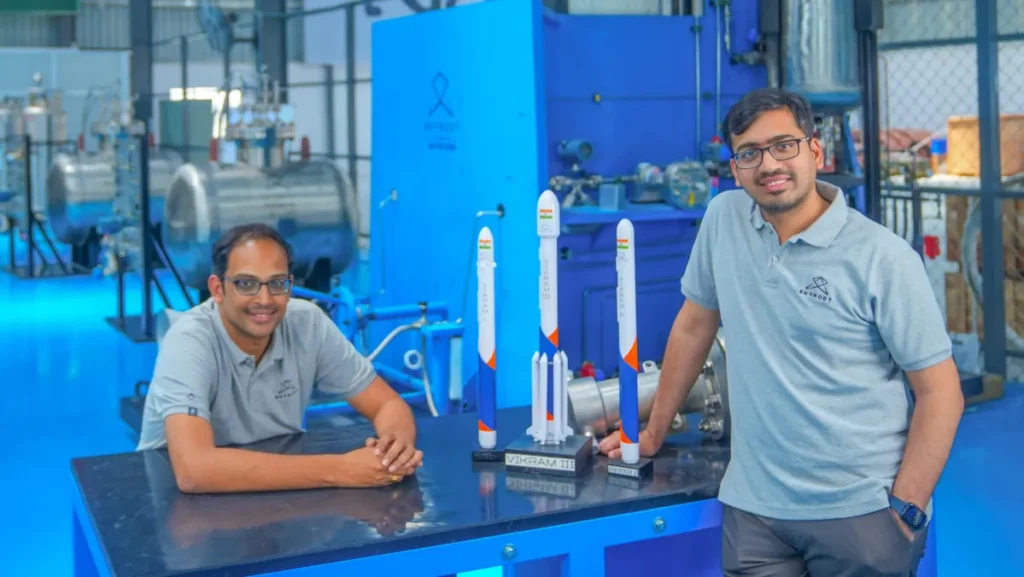
Eight years later, the answer is becoming clear. On November 18, 2022, Skyroot Aerospace launched Vikram-S — India’s first-ever rocket built and flown by a private company — from the Satish Dhawan Space Centre in Sriharikota. In July 2026, Vikram-1 achieved another historic first: India’s first privately developed orbital launch, making Skyroot the first company after ISRO to place a payload in orbit from Indian soil. In May 2026, a $60 million Series C funding round valued the company at $1.1 billion — making it India’s first space-tech unicorn.
The story of Skyroot Aerospace is the story of India’s private space revolution — a transformation driven by policy reform, ISRO’s accumulated technical knowledge, and a new generation of entrepreneurs who believe that affordable, reliable, on-demand access to space is not just achievable but imminent. This comprehensive 2026 profile covers Skyroot’s founding story, its rocket technology, its funding journey, its market position, and its vision for the future of Indian space commerce.
India’s Private Space Revolution: The Context Behind Skyroot
To understand Skyroot Aerospace, you must first understand the extraordinary transformation of India’s space sector that made it possible.
ISRO’s Legacy and the Private Sector Opening
The Indian Space Research Organisation, established in 1969, spent five decades building one of the world’s most capable — and cost-efficient — space programmes. From Chandrayaan to Mangalyaan (Mars Orbiter Mission) to the Chandrayaan-3 lunar south pole landing in August 2023, ISRO has demonstrated that India can execute world-class space missions at a fraction of Western costs. What ISRO could not do was scale commercially — its mandate was national science, not global commercial launch services.
In 2020, the Indian government made a historic policy decision: it opened the space sector to private players for the first time. The creation of IN-SPACe (Indian National Space Promotion and Authorisation Centre) as the regulatory body for private space companies unlocked a new era. Companies could now access ISRO facilities, use government-developed technologies, and receive regulatory approval to build and launch rockets.

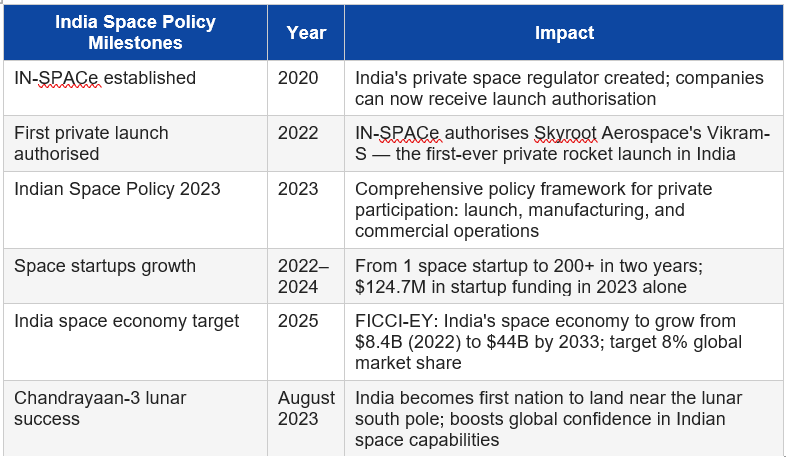
India’s space sector is undergoing the fastest transition from government monopoly to private ecosystem in the world. With ISRO’s accumulated 50+ years of technical knowledge being transferred to private companies, and a $44 billion economy target by 2033, India is positioning itself as a global space hub — and Skyroot is leading that charge.
The Global Small Satellite Launch Market
Skyroot’s business exists at the intersection of two powerful global trends: the miniaturisation of satellites and the exploding demand for affordable launch services.
| Market Metric | 2024 | 2030 Projection |
| Global Space Launch Services Market Size | $15.2 billion | $35 billion |
| Small Satellite Market Size | ~$8 billion | $22+ billion |
| Satellites to be launched 2024–2033 (global estimate) | 5,000+ | 10,000+ |
| Typical small satellite launch cost (global average) | $20–40M | Reducing with competition |
| Skyroot Vikram-1 launch price | $12–18M | — |
| India’s share of global commercial launches (2022) | ~2% | Target: 8% by 2033 |
The global satellite industry is being transformed by the rise of small satellites — CubeSats, nanosatellites, and microsatellites — used for earth observation, communication, weather monitoring, maritime tracking, and defence. These small satellites need small rockets: affordable, dedicated, and on-demand. This is precisely the market Skyroot is targeting.\
The Founding Story of Skyroot: Two ISRO Scientists and a Big Question
Pawan Kumar Chandana — CEO & Co-Founder


Pawan Kumar Chandana grew up fascinated by India’s space programme — a child of the ISRO era who went on to study aerospace engineering at IIT Kharagpur, one of India’s most prestigious technical institutions. After graduating, he joined ISRO and spent years contributing to some of the organisation’s most ambitious programmes, including the LVM3 — the heavy-lift rocket nicknamed ‘Bahubali’ that powered India’s Chandrayaan lunar missions.
Inside ISRO, Chandana was a high performer. But as India’s private space sector began to open up post-2020, he saw an opportunity that ISRO’s institutional structure could not pursue: building a nimble, cost-competitive, commercially focused launch company that could offer satellite operators around the world the kind of fast, affordable, dedicated access to orbit that a government organisation could never provide.
In 2018 — two years before IN-SPACe even existed — Chandana and his co-founder Naga Bharath Daka bet their careers on that vision. Their pitch was simple: ISRO had proven India could build rockets efficiently. A private company, freed from bureaucratic constraints and motivated by commercial incentives, could do it faster, cheaper, and at the scale the global market needed.
Naga Bharath Daka — COO & Co-Founder


Naga Bharath Daka brings a complementary technical profile to Chandana’s propulsion expertise. An electrical engineer with a Master’s in Microelectronics and VLSI design, Daka’s specialisation at ISRO was avionics — the electronics and guidance systems that tell a rocket where it is, where it’s going, and how to get there. As COO of Skyroot, he oversees operations, manufacturing, and the systems engineering that holds the rocket together as an integrated vehicle.
Daka has emphasised that Skyroot’s approach to avionics — designing modular, digital, software-defined systems rather than the bulky, bespoke hardware common in legacy rocket programmes — is a key factor in the company’s cost efficiency. Skyroot’s avionics can be updated in software, tested on the ground in months rather than years, and reused across the Vikram rocket family with minimal hardware changes.
The Early Days: 2018–2019
Skyroot was founded in 2018 with a team of ten individuals. The early months were spent in a fundamental engineering challenge: how do you build a competitive launch vehicle with a fraction of the budget and workforce of established players?
The answers that Chandana and Daka arrived at would define Skyroot’s technical differentiation:
- Solid propulsion first: Using solid-fuel rocket stages (simpler, cheaper, and storable than liquid stages) for the primary launch vehicle stages — following a path pioneered by ISRO’s PSLV programme, but designed for private commercial economics.
- Carbon composite structures: Building rocket bodies from carbon fibre composites rather than metals — significantly reducing structural weight and improving payload fraction, a critical factor in launch economics.
- 3D-printed engines: The liquid upper stage uses 3D-printed Raman engines, dramatically reducing manufacturing time and cost compared to conventionally machined engines.
- Modular avionics: Software-defined, digitally integrated avionics systems that can be tested faster and updated more cheaply than bespoke hardware.
- ISRO facilities access: Leveraging India’s policy reform to access ISRO’s test facilities at Sriharikota and Mahendragiri, reducing the infrastructure investment that would otherwise require billions in capital.
‘What if launching into space could be as accessible and routine as commercial air travel?’ — Pawan Kumar Chandana, CEO, Skyroot Aerospace
The Vikram Rocket Family: Technical Deep Dive
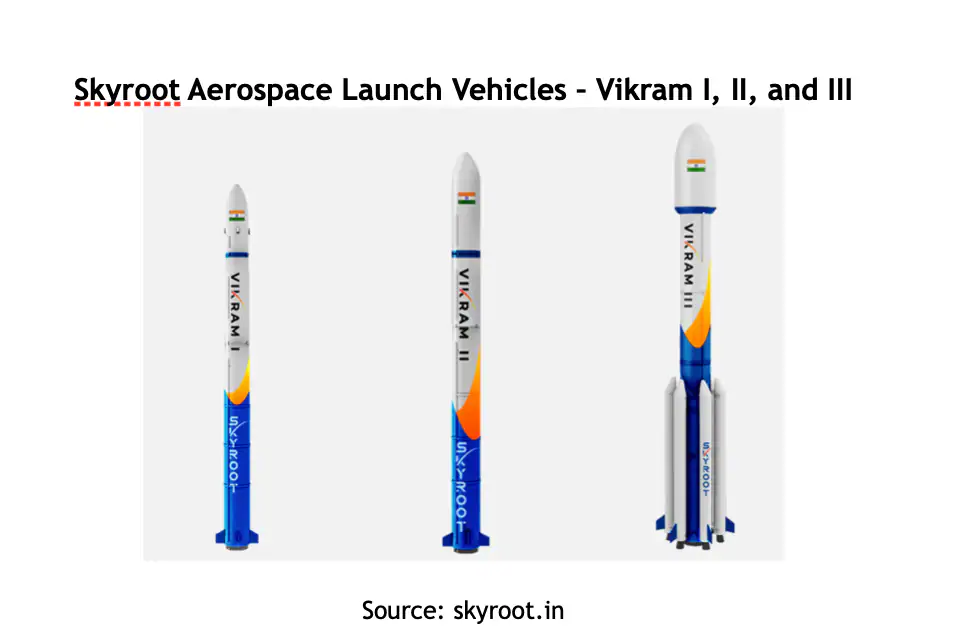
Skyroot’s launch vehicles are collectively called the Vikram family — named after Dr. Vikram Sarabhai, the father of the Indian space programme and the founder of ISRO. The family is designed as a progression from simple suborbital validation to heavy-lift orbital capability, with each variant building on the technical and manufacturing lessons of its predecessor.
The Three Engine/Motor Families
| Engine/Motor | Type | Stage Used In | Key Spec | Named After |
| Kalam-1200 | Solid rocket motor | Vikram-1 Stage 1 | 1,200 kN peak vacuum thrust; 11m long; 30 tonnes; 110-second burn | Dr. APJ Abdul Kalam — former President of India, rocket scientist |
| Kalam-250 | Solid rocket motor | Vikram-1 Stage 2 | ~250 kN thrust; carbon composite casing | Dr. APJ Abdul Kalam |
| Kalam-100 | Solid rocket motor | Vikram-1 Stage 3 | ~100 kN thrust; 102-second burn validated; flex-nozzle TVC | Dr. APJ Abdul Kalam |
| Raman-1 | Liquid bipropellant (MMH/NTO) | Vikram-1 Stage 4 (×4 cluster) | 3.4 kN total cluster thrust; 3D-printed; orbital insertion and manoeuvres | C.V. Raman — India’s Nobel Prize-winning physicist |

Vikram-S: The Proof of Concept
| Specification | Detail |
| Vehicle Type | Single-stage solid-propellant suborbital sounding rocket |
| Purpose | Technology validation flight — not intended for orbit |
| Launch Date | November 18, 2022 at 11:30 a.m. IST |
| Launch Site | Satish Dhawan Space Centre (SDSC SHAR), Sriharikota, Andhra Pradesh |
| Mission Name | Prarambh (Sanskrit: ‘The Beginning’) |
| Apogee Altitude | 88.8 km (above the Kármán line by ISRO definition; below von Kármán line of 100 km) |
| Maximum Velocity | Mach 5.07 |
| Flight Duration | 301.4 seconds (approx. 5 minutes) |
| Downrange Distance | Splashdown approximately 125 km downrange in the Bay of Bengal |
| Payloads Carried | 3 customer payloads: BazoomQ (Armenia), Space Kidz India, N-Space Tech India |
| Technologies Validated | Solid propulsion, carbon composite structures, avionics, telemetry, stage flight dynamics |
| Historic Significance | First-ever launch of a rocket built by a private company in India; first use of IN-SPACe authorisation for a private launch |

Vikram-1: India’s First Private Orbital Rocket
| Specification | Detail |
| Vehicle Type | Four-stage orbital small satellite launch vehicle |
| Height | Approximately 20 metres |
| Diameter | 1.7 metres |
| Stage Configuration | 3 solid stages + 1 liquid upper stage |
| Stage 1 | Kalam-1200 solid motor: 1,200 kN peak thrust; 110-second burn; 11m long; 30-tonne motor; India’s largest privately developed solid rocket stage |
| Stage 2 | Kalam-250 solid motor: ~250 kN thrust; carbon composite casing; ~90-second burn |
| Stage 3 | Kalam-100 solid motor: ~100 kN thrust; flex-nozzle thrust vector control; validated in April 2025 static fire |
| Stage 4 | Liquid upper stage: 4 × Raman-1 engines (3D-printed, MMH/NTO propellant); 3.4 kN total thrust; orbital insertion and plane-change capability |
| Payload to 500 km SSO | 290 kg (Sun-Synchronous Polar Orbit) |
| Payload to 500 km LEO | 480 kg (45° inclination, Low Earth Orbit) |
| Structure | Carbon composite airframes — lightweight, high-strength |
| Fairing | Payload fairing separation mechanism validated in June 2025 |
| Launch Cost | $12–18 million per launch (30–50% cheaper than comparable US options) |
| Mission Aagaman | July 18, 2026 — first orbital flight from Pad 1, Satish Dhawan Space Centre, Sriharikota |
| Payloads Carried | SCOPE (Skyroot in-house); Grahaa Space (earth observation nanosatellite); Cosmoserve (space debris removal); DCubed (space components) |
| Commercial Readiness | 2027 — after 3 planned development flights total |


Vikram-1U: Upgraded Variant (2027)
Vikram-1U is an upgraded version of the Vikram-1 baseline vehicle, planned for introduction in Q1 2027. The key enhancement is the addition of strap-on solid boosters to Stage 1, increasing payload capacity from 480 kg to approximately 550 kg to LEO. Vikram-1U maintains the same upper stages and avionics as Vikram-1, allowing manufacturing and operations teams to leverage existing infrastructure. The upgrade is intended to meet demand from satellite customers who require slightly larger payload capacity than the baseline Vikram-1 can deliver.
Vikram-2: The Cryogenic Future (2027+)
Vikram-2 represents Skyroot’s entry into the heavier-lift market. Designed as a one-ton-class launch vehicle, it will introduce a cryogenic upper stage — using liquid oxygen and liquid hydrogen or a similar high-performance propellant combination — that will enable more complex orbital insertions, higher altitudes, and GTO (Geostationary Transfer Orbit) capability. Vikram-2 is expected to debut in 2027 and will dramatically expand Skyroot’s addressable market, allowing it to compete for medium-class satellite launch contracts alongside Rocket Lab’s Neutron and other emerging global platforms.
MISSION AAGAMAN — JULY 18, 2026: INDIA’S FIRST PRIVATE ORBITAL LAUNCH
On July 18, 2026, Skyroot Aerospace launched Vikram-1 from Pad 1 at the Satish Dhawan Space Centre in Sriharikota — making India the third nation after the US and China to have a private company achieve orbital launch capability. Mission Aagaman (Sanskrit: ‘Arrival’) marks the beginning of India’s commercial orbital launch era.
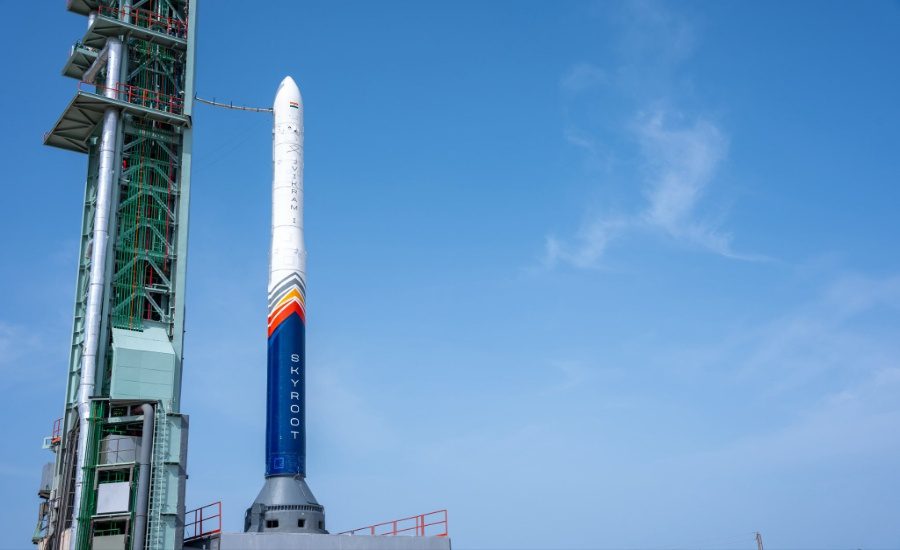

Mission Aagaman: The Launch That Changed India’s Space Story
The name was deliberate. ‘Aagaman’ — ‘Arrival’ in Sanskrit — was chosen not as a celebration of completion but as an announcement of presence. India had arrived as a commercial orbital launch nation. Skyroot had arrived as an orbital launch provider. And a new chapter in the story of private space commerce had arrived.
At 11:30 a.m. IST on July 18, 2026, after years of engine tests, structural validations, avionics checks, and two launch window delays due to weather, Vikram-1 lifted off from the first launch pad at Satish Dhawan Space Centre in Sriharikota, Andhra Pradesh. Seven stories tall, carrying 290 kg of payloads including Skyroot’s own SCOPE technology demonstration satellite, the rocket carried the aspirations of India’s entire emerging private space industry.
The flight was the first of three planned development missions for Vikram-1 before Skyroot begins commercial operations in 2027. Each flight in the development sequence is designed to progressively validate the vehicle’s full performance envelope — stage separations, guidance accuracy, orbital insertion, and upper stage operations. Mission Aagaman was Skyroot’s first full orbital attempt.
| Mission Aagaman — Key Facts | Details |
| Mission Name | Aagaman (Sanskrit: Arrival) |
| Launch Date & Time | July 18, 2026, 11:30 a.m. IST |
| Launch Vehicle | Vikram-1 (four-stage: 3 solid + 1 liquid) |
| Launch Site | Pad 1, Satish Dhawan Space Centre (SDSC SHAR), Sriharikota, Andhra Pradesh |
| Target Orbit | Low Earth Orbit (LEO), approximately 500 km altitude |
| Primary Payload | SCOPE (Skyroot in-house technology demonstration satellite) |
| Customer Payloads | Grahaa Space (earth observation nanosatellite, India); Cosmoserve (space debris removal tech, India); DCubed (space component demonstrator) |
| Mission Objective | Validate propulsion, guidance, navigation & control, stage separation, and orbital insertion in a real flight environment |
| Flight Sequence | Stage 1 ignition → Stage 1 separation → Stage 2 ignition → Stage 2 separation → Stage 3 ignition → Stage 3 separation → Stage 4 (liquid) ignition → Orbital insertion → SCOPE and payload deployment |
| Development Flight | First of three planned development flights before commercial operations begin (2027) |
| Historic Significance | India’s first private orbital launch; first company after ISRO to attempt orbit from Indian soil; India becomes third nation with private orbital launch capability (after US and China) |

The Road to Aagaman: Critical Milestones (2023–2026)
| 2023 | Skyroot raises $27.5M Pre-Series C led by Temasek Holdings. Total funding reaches approximately $95M. Focus shifts to Vikram-1 engineering validation. Manufacturing facilities at two Hyderabad campuses scaled up. |
| Apr 2025 | Kalam-100 (Vikram-1 third stage) completes successful static fire test exceeding 102 seconds. Flex-nozzle Thrust Vector Control (TVC) system validated — critical for steering the rocket in the upper atmosphere where aerodynamic fins are ineffective. |
| Jun 2025 | Payload fairing (PLF) separation mechanism test completed successfully. The fairing — the nose cone that protects the satellite during ascent through the atmosphere — must separate cleanly at altitude to expose the payload. Flawless separation test clears a critical milestone. |
| Aug 2025 | Historic Kalam-1200 static fire test at ISRO’s Satish Dhawan Space Centre. India’s largest privately developed solid rocket motor — 11 metres long, 30 tonnes — burns for 110 seconds, delivering 1,200 kN of peak vacuum thrust. Equivalent to ~10× the thrust of a Boeing 737 Max engine. Named after Dr. APJ Abdul Kalam. |
| Mar 2026 | BlackRock provides ₹100 crore ($10.75M) in debt financing via Non-Convertible Debentures — Skyroot’s first-ever debt raise. Marks institutional capital market confidence in Skyroot’s commercial trajectory. |
| May 2026 | $60M Series C funding round closes, co-led by GIC (Singapore’s sovereign wealth fund) and Sherpalo Ventures. Participation from BlackRock, Greenko founders, Arkam Ventures, Playbook Partners, Shanghvi Family Office. Total funding: ~$155M. Valuation: $1.1 billion — India’s first space-tech unicorn. |
| Jul 2026 | Vikram-1 integrated on Pad 1, Sriharikota. Final vehicle checks, roll-out to launch pad. Launch window opens. Brief technical delay resolved. Mission Aagaman countdown. Liftoff at 11:30 a.m. IST on July 18. |
Funding Journey of Skyroot: From Garage Startup to India’s First Space Unicorn
| Round | Date | Amount | Lead Investor(s) | Key Participating Investors | Cumulative Total |
| Seed | 2019–2020 | Undisclosed | Angel investors | Early believers including Mukesh Bansal (Myntra founder), Solar Industries India | < $5M |
| Pre-Series A | 2021 | ~$11M | GIC (first investment) | Various angels and early VCs | ~$15M |
| Series A | Late 2021 | ~$11M | GIC | Existing investors | ~$26M |
| Series B | August 2022 | $51M | GIC (Singapore SWF) | Solar Industries, Mukesh Bansal, others | ~$77M |
| Pre-Series C | October 2023 | $27.5M | Temasek Holdings (Singapore) | Existing investors | ~$95M (equity) |
| Debt Round | March 2026 | ₹100 crore (~$10.75M) | BlackRock | Non-Convertible Debentures — first debt raise in Skyroot history | ~$105M |
| Series C | May 2026 | $60M | GIC + Sherpalo Ventures | BlackRock, Greenko founders, Arkam Ventures, Playbook Partners, Shanghvi Family Office | ~$155M+ |
India’s First Space Unicorn: Skyroot’s $1.1 billion valuation following the May 2026 Series C round makes it the first space-tech company in India to achieve unicorn status — defined as a private startup valued at over $1 billion. This milestone reflects investor confidence that India’s private space sector is commercially viable at scale.
Investor Significance — Why This Investor Set Matters
| Investor | Type | Why Their Participation Matters |
| GIC (Government of India Cooperation) | Singapore’s sovereign wealth fund | Largest institutional backer; participated in both Series B and Series C — extraordinary repeat commitment from a conservative sovereign fund |
| Temasek Holdings | Singapore’s state-owned investment company | Led Pre-Series C; Asia’s most respected tech investor backing India’s space sector |
| BlackRock | World’s largest asset manager | Both debt (NCD) and equity participant; signals Skyroot has graduated from venture risk to institutional investability |
| Sherpalo Ventures | VC firm of Ram Shriram (Google’s first board member, early Sequoia advisor) | Technology credibility from Silicon Valley’s most connected early-stage investor |
| Solar Industries India | India’s largest explosives manufacturer | Strategic investor with propellant and energetics expertise directly relevant to solid rocket motor manufacturing |
| Mukesh Bansal | Myntra founder / Flipkart CXO | India’s most respected consumer-tech founder; signals cross-sector belief in Skyroot |
| Greenko Group founders | India’s largest renewable energy unicorn founders | Experience scaling deep-tech infrastructure companies in India |
Use of Capital
- Scale manufacturing capacity at two Hyderabad campuses — targeting one rocket per month production cadence
- Fund two additional Vikram-1 development flights before commercial launch operations begin in 2027
- Accelerate development of Vikram-1U (strap-on upgraded variant, Q1 2027) and Vikram-2 (cryogenic, 1-ton class, 2027+)
- Expand global sales and customer acquisition — targeting 80% of payload customers from international markets
- Build launch support infrastructure and mission operations capability
Business Model: How Skyroot Makes Money
Launch Services — Core Revenue
Skyroot’s primary business is selling dedicated launch services to satellite operators. Unlike rideshare services (where multiple customers share a single large rocket), Skyroot’s small launch vehicles offer dedicated missions — meaning a single customer’s satellites get the rocket to themselves, choosing the orbit, timing, and inclination. This is the key value proposition for small satellite operators who cannot afford the inflexibility of rideshare scheduling and orbital constraints.
| Revenue Stream | Description | Price Point | Target Customers |
| Dedicated LEO Launch (Vikram-1) | Full Vikram-1 rocket dedicated to a single customer’s payload(s) up to 290–480 kg | $12–18 million per launch | Earth observation operators, communications constellation builders, defence/intelligence agencies, research institutions |
| Rideshare Slots | Partial payload capacity on a Vikram-1 flight; multiple customers share the rocket | $2–5M per 50–100 kg slot | Small satellite startups, university researchers, international government customers |
| Vikram-1U Dedicated Launch (2027+) | Upgraded capacity (550 kg to LEO); strap-on booster variant | $15–22M per launch | Larger small satellite operators; constellation builds |
| Vikram-2 Heavy (2027+) | 1-ton class cryogenic vehicle; GTO-capable; heavier missions | $25–40M per launch (estimated) | MEO and GTO satellites; larger earth observation systems |
| Mission Services | Orbit management, LEOP (Launch and Early Orbit Phase) support, mission design consultation | Value-added per contract | International customers needing end-to-end support |
Pricing Advantage: At $12–18 million per Vikram-1 launch, Skyroot is priced approximately 30–50% below comparable US small launch vehicles. This pricing reflects India’s lower manufacturing and labour costs, solid propellant technology efficiency, and the competitive advantage of ISRO-trained engineers with world-class technical skills at a fraction of Western salary costs.
Target Customer Segments
| Segment | Global Market Size | Skyroot’s Offer | Examples |
| Earth Observation Startups | Fast-growing; hundreds of companies building LEO imaging constellations | Dedicated LEO insertion; precise orbital targeting | Pixxel (India), Planet Labs, Satellogic |
| IoT/Communications Constellations | Billions in investment; AIS/ADS-B/IoT networks | Rideshare slots; on-demand scheduling | Kepler Communications, Lacuna Space |
| Government / Defence | National security agencies in 40+ countries building ISRO-independent launch options | Dedicated, classified-friendly missions | Indian Ministry of Defence; global government agencies |
| International Research Institutions | Universities and space agencies seeking affordable access | Budget rideshare options | IITs, international universities, ESA partners |
| Indian New Space Startups | 200+ Indian startups building satellites with no domestic launcher | Domestic launch option — no export compliance complexities | Grahaa Space, Digantara, Pixxel |
Chandana has stated that approximately 80% of Skyroot’s target payload customers will be global — not domestic. This is a critical strategic point: India is not Skyroot’s primary market; India is Skyroot’s manufacturing and launch cost advantage in a global market. The Indian domestic satellite market is growing but nascent; the global market for small satellite launches is worth tens of billions and is where Skyroot sees its primary commercial opportunity.
Technology Edge: What Makes Skyroot Different
1. Carbon Composite Structures
Skyroot builds its rocket airframes from carbon fibre-reinforced polymer composites rather than traditional aluminium alloys. Carbon composites are significantly lighter than metals while maintaining or exceeding their structural strength. For a launch vehicle, where every kilogram of structural mass is a kilogram of payload lost, this translates directly into competitive advantage. Skyroot’s composite fabrication is done in-house at its Hyderabad facilities.
2. 3D-Printed Raman Engines
The Raman-1 liquid engines that power Vikram-1’s fourth stage are 3D-printed using advanced metal additive manufacturing. Traditional rocket engines require hundreds of machined parts, each requiring precision tooling, long lead times, and expensive skilled labour. A 3D-printed engine can be produced in days rather than months, with fewer parts, less waste, and dramatically lower tooling costs. Skyroot can iterate engine designs rapidly — testing, printing, and improving in cycles that would take legacy manufacturers years.
3. Solid Propellant Stages — Simplicity as Strategy
The decision to base three of Vikram-1’s four stages on solid propellants reflects both a technical philosophy and a commercial strategy. Solid propellant motors are simpler than liquid engines — no turbopumps, no propellant lines, no cryogenic handling. They can be manufactured in controlled facilities and transported to the launch site already fuelled. They start reliably with an igniter, require minimal pre-launch preparation, and are highly predictable in their performance. This simplicity translates to faster launch operations, lower launch site infrastructure requirements, and higher reliability — critical factors for commercial operators who cannot afford mission failures.
4. Modular Digital Avionics
Skyroot’s avionics architecture is built around a modular, software-defined philosophy. Rather than designing bespoke hardware for each mission, the avionics core is the same across the Vikram family — updated in software for different missions, orbits, and payload requirements. This dramatically reduces the time and cost of preparing each vehicle for launch and allows the engineering team to accumulate software maturity across missions rather than starting from scratch with each hardware design.
5. ISRO Integration and Facility Access
Perhaps Skyroot’s greatest structural advantage is something that no competitor outside India can replicate: the ability to test and launch from ISRO facilities. The Satish Dhawan Space Centre at Sriharikota is one of the world’s best-equipped launch facilities, with launch pads, vehicle assembly buildings, range safety systems, and tracking infrastructure built over 50 years of ISRO operations. Skyroot accesses these facilities under agreements with IN-SPACe and ISRO, significantly reducing the capital investment required to operate a launch company — costs that run into billions of dollars for competitors who must build their own facilities.
Competitive Landscape: India, Asia, and the Global Small Launch Market
India: The Emerging Private Launch Market
| Indian Space Startup | Focus | Stage (2026) | Key Product | Differentiation vs Skyroot |
| Skyroot Aerospace | Small satellite launch vehicles | Operational: Vikram-1 orbital launch achieved (July 2026) | Vikram-1 (orbital), Vikram-2 (cryogenic, 2027) | Market leader; India’s first space unicorn; furthest ahead commercially |
| Agnikul Cosmos | Small satellite launch vehicles | Development: SOrTeD suborbital test; Agnibaan in development | Agnibaan (25 kg to SSPO initially) — world’s first fully 3D-printed engine (Agnilet) | Single-piece 3D-printed semi-cryogenic engine; Chennai base; IIT Madras incubated |
| Pixxel | Hyperspectral Earth observation satellites | Operational: Firefly constellation | Firefly satellite: hyperspectral imaging for agriculture, climate, defence | Satellite manufacturer (not a launch company); Skyroot customer, not competitor |
| ISRO / NSIL | All mission types including small satellites via SSLV | Fully operational | SSLV (Small Satellite Launch Vehicle): 500 kg to LEO at $14–17M | Government operator; no commercial urgency; SkyRoot’s launchpad host, not primary competitor |
| Dhruva Space | Satellite services and propulsion | Early stage | Satellite operations, ground stations, orbital transfer vehicles | Different segment — on-orbit services, not primary launch |
| Bellatrix Aerospace | Electric propulsion and in-space propulsion | Development | Electric Hall-effect thrusters; green propulsion | In-space propulsion only — not a launch vehicle company |
Global Competition
| Global Competitor | Country | Flagship Vehicle | Payload Capacity (LEO) | Price per Launch (est.) | vs Skyroot |
| Rocket Lab | USA/New Zealand | Electron | 300 kg | ~$8–10M (Electron); developing Neutron (8 tonnes) | Most direct global competitor; operationally proven (40+ launches); more expensive per kg |
| SpaceX | USA | Falcon 9 / Starship | 22,800 kg (F9) | ~$67M (F9); Starship TBD | Heavy-lift; different segment. Transporter rideshare competes at smaller scales |
| Relativity Space | USA | Terran-R (reusable, in dev) | 20,000 kg | $50M+ (estimated) | Under development; US-only launch |
| ABL Space Systems | USA | RS1 | 1,350 kg | ~$12M | Programme challenged; direct competitor |
| Exos Aerospace | USA | SARGE | Suborbital only | $— | Suborbital only |
| Launcher (acquired) | USA | Orbiter (rideshare) | Up to 400 kg | Rideshare pricing | Acquired by Vast |
| Galactic Energy (China) | China | Ceres-1 | 350 kg | $5–8M (est.) | Most direct price competitor; geopolitical restrictions limit global access |
| iSpace (China) | China | Hyperbola-1 | 260 kg LEO | $5–8M (est.) | China-based; geopolitically limited export market |
Skyroot’s competitive position: In the global small satellite launch market, Skyroot competes on price (30–50% cheaper than US alternatives), flexibility (dedicated launches with customisable orbits and timing), and geopolitical neutrality (India is a trusted partner for customers in the US, Europe, and Asia who are restricted from using Chinese launch services).
Leadership Team of Skyroot
| Name | Role | Background |
| Pawan Kumar Chandana | CEO & Co-Founder | IIT Kharagpur; former ISRO rocket scientist; worked on LVM3 Bahubali (Chandrayaan programmes); co-author of Skyroot’s founding vision |
| Naga Bharath Daka | COO & Co-Founder | B.E. Electrical Engineering; M.S. Microelectronics & VLSI; former ISRO avionics specialist; leads operations, manufacturing, systems integration |
| Srinath Ravichandran | CFO | Financial leadership; fundraising strategy; investor relations; manages Skyroot’s treasury and capital allocation |
| Abhishek Vasudev | VP, Engineering | Leads the engineering team; propulsion and structures; key architect of Vikram vehicle design |
| B. S. Chandrashekar | Head of Propulsion | Senior propulsion engineer; leads Kalam solid motor and Raman liquid engine development teams |
Complete Skyroot Aerospace Timeline: 2018–2026
| 2018 | Company founded in Hyderabad by Pawan Kumar Chandana (CEO) and Naga Bharath Daka (COO). Both leave ISRO careers to build India’s first private launch company. Initial team of 10. Core philosophy established: solid propulsion + carbon composites + 3D-printed engines = affordable orbital access. |
| 2019 | First successful static fire tests of early Raman engine prototypes. Seed funding secured. Engineering foundations laid at first Hyderabad campus. First government interactions for regulatory pathway (pre-IN-SPACe). |
| 2020 | IN-SPACe established by Government of India — the regulatory body that will authorise private rocket launches. Skyroot’s regulatory pathway becomes viable for the first time. Major angel and early institutional funding secured. |
| 2021 | Series A ($11M). Kalam-250 solid motor successfully tested — the second-stage motor for Vikram-1. Carbon composite structures validated. Engineering team grows significantly. First commercial payload agreements signed. |
| 2022 | Series B ($51M, led by GIC) in August. November 18, 2022: Mission Prarambh — Vikram-S successfully launched from Sriharikota. India’s first-ever private rocket achieves 88.8 km altitude and Mach 5.07. Three customer payloads carried. Historic milestone: IN-SPACe’s first authorised private launch. |
| 2023 | Pre-Series C ($27.5M, led by Temasek). Total funding reaches ~$95M. Vikram-1 development accelerates. Kalam-1200 first-stage motor manufacturing begins. Second Hyderabad campus opened for increased production capacity. |
| Apr 2025 | Kalam-100 (third stage, Vikram-1) static fire test — 102+ seconds, flex-nozzle Thrust Vector Control validated. First stage-specific milestone on path to orbital flight. |
| Jun 2025 | Payload fairing separation mechanism tested successfully. Full vehicle integration milestones being cleared systematically. |
| Aug 2025 | Kalam-1200 static fire — India’s largest privately developed solid rocket motor tested. 11m, 30 tonnes, 1,200 kN peak thrust, 110-second burn. Landmark test validates Vikram-1’s most critical stage. |
| Mar 2026 | BlackRock provides ₹100 crore ($10.75M) debt via NCDs — Skyroot’s first debt financing. Signals institutional capital market maturity. |
| May 2026 | Series C: $60M raised at $1.1B valuation. India’s first space-tech unicorn. Co-led by GIC and Sherpalo Ventures. BlackRock, Greenko founders, Arkam Ventures, Playbook Partners, Shanghvi Family Office participate. |
| Jul 18, 2026 | MISSION AAGAMAN: Vikram-1 launches from Pad 1, Sriharikota. India’s first private orbital rocket flight. Payloads: SCOPE (Skyroot), Grahaa Space, Cosmoserve, DCubed. India becomes third nation with private orbital launch capability after US and China. |
| 2027 (planned) | Vikram-1 commercial operations begin. Vikram-1U (strap-on boosters, 550 kg LEO) introduced in Q1. Vikram-2 (cryogenic, 1-ton class) development flights begin. Target: one rocket per month production cadence. |
Financial Performance: The Pre-Revenue Scale-Up Story
Skyroot Aerospace is in the capital-intensive, pre-commercial-revenue phase typical of launch vehicle companies at its stage of development. Its financial story is one of investment ahead of revenue — a pattern seen at every successful launch company before commercial operations begin.
| Financial Metric | FY2022 | FY2023 | FY2024 (est.) | FY2025 | FY2026 (projection) |
| Revenue (₹ Cr) | ~₹8 Cr | ~₹15 Cr | ~₹25 Cr (est.) | — | Commercial revenue beginning; early mission contracts |
| Net Loss (₹ Cr) | — | — | — | ₹99.7 Cr | Growing as investment in manufacturing and team accelerates |
| Total Equity Funding | ~$26M | ~$77M | ~$95M | ~$105M (with debt) | ~$155M+ (post Series C) |
| Valuation | — | — | — | ~$600M (est. pre-C) | $1.1 Billion (post Series C, May 2026) |
| Employees | ~50 | ~150 | ~200 | ~300 | ~400+ (growing rapidly) |
| Rockets Produced | — | 1 (Vikram-S) | — | Vikram-1 (in production) | Vikram-1 (operational); scaling to 1/month target |
Revenue composition will shift fundamentally from 2027 as commercial launch services begin. At Skyroot’s target launch cadence (one Vikram-1 per month = 12 launches annually) and price ($12–18M per launch), the company has a potential $144–216 million annual revenue run rate from dedicated launches alone, before rideshare pricing, Vikram-1U, and Vikram-2 revenues are added.
India’s Space Policy & the IN-SPACe Framework
The regulatory and policy environment is inseparable from Skyroot’s story. Without IN-SPACe and the Indian Space Policy 2023, Skyroot could not legally operate as a private launch company in India.
| Policy/Institution | Role | Skyroot’s Benefit |
| IN-SPACe (Indian National Space Promotion and Authorisation Centre) | Regulates and authorises all private space activities in India; approves launches, frequency allocation, and foreign satellite licensing | Provides Skyroot’s launch authorisation; enables access to ISRO facilities; creates legal framework for private operations |
| Indian Space Policy 2023 | Comprehensive framework allowing private participation in launch, satellite manufacturing, ground stations, and space applications | Clarifies the full scope of permissible private activity; provides investor confidence; establishes IP and licensing framework |
| ISRO Technology Transfer | ISRO can transfer technologies, processes, and know-how to private sector under the new policy | Allows Skyroot to benefit from ISRO’s 50+ years of propulsion and avionics R&D without reinventing the wheel |
| NSIL (NewSpace India Limited) | Government commercial arm of ISRO; can commercially market ISRO launches and act as a customer for private launch services | Potential customer and co-operator for Skyroot on certain government payloads |
| SDSC-SHAR Access | Skyroot launches from ISRO’s Satish Dhawan Space Centre — the world-class launch facility with 50+ years of infrastructure | Avoids billions in launch site capital expenditure; benefits from ISRO’s range safety, tracking, and recovery systems |
Policy as Competitive Moat: India’s progressive space policy, combined with ISRO’s infrastructure access, gives Indian private launch companies a structural cost advantage that competitors in less policy-supportive environments cannot replicate. This ‘policy moat’ is one of the most underappreciated elements of Skyroot’s investment thesis.
National Impact, Jobs, and India’s ‘New Space’ Vision
Skyroot’s significance extends far beyond its own commercial trajectory. As the pioneer of India’s private launch sector, it has catalysed an entire ecosystem:
Talent pipeline: Skyroot has demonstrated that world-class rocket engineering careers exist outside of ISRO, creating a new career path for India’s aerospace engineering talent pool. Over 200 space startups now exist in India, many founded by teams inspired by Skyroot’s success.
Supply chain development: Skyroot sources carbon composites, propellants, electronics, and mechanical components from an emerging Indian aerospace supplier ecosystem. Solar Industries India (a Skyroot investor) is one example of a traditional Indian defence company transitioning into the commercial space supply chain.
Foreign exchange: Commercial launch services are high-value exports priced in US dollars. As Skyroot scales to target 80% international customers, it will contribute meaningfully to India’s high-tech export economy.
STEM inspiration: Skyroot’s public launches — livestreamed, celebrated, and covered extensively across Indian media — have created a generation of young Indians who see private space entrepreneurship as achievable. The Mission Prarambh livestream was watched by millions.
India’s $44B target: India’s government has set a target to grow the national space economy from $8.4 billion (2022) to $44 billion by 2033, capturing 8% of the global space market. Skyroot is the most visible private commercial driver of this ambition.
Frequently Asked Questions (FAQs)
Q: What is Skyroot Aerospace?
A: Skyroot Aerospace is India’s first private space launch company and the country’s first space-tech unicorn (valued at $1.1 billion as of May 2026). Founded in 2018 in Hyderabad by former ISRO scientists Pawan Kumar Chandana (CEO) and Naga Bharath Daka (COO), the company develops small satellite launch vehicles under the ‘Vikram’ brand — named after Dr. Vikram Sarabhai, the father of the Indian space programme. Skyroot’s mission is to provide cost-effective, on-demand access to orbit for the rapidly growing global small satellite industry.
Q: Who are the founders of Skyroot Aerospace?
A: Skyroot Aerospace was co-founded by Pawan Kumar Chandana and Naga Bharath Daka, both former scientists at the Indian Space Research Organisation (ISRO). Chandana (CEO) is an IIT Kharagpur alumnus who worked on ISRO’s LVM3 ‘Bahubali’ heavy-lift rocket that powered India’s Chandrayaan lunar missions. Daka (COO) specialised in avionics and microelectronics at ISRO. Both left established careers at India’s premier space institution in 2018 to build a commercially focused private launch company — a decision that, with hindsight, has proven to be one of India’s most consequential entrepreneurial bets.
Q: What was Mission Prarambh?
A: Mission Prarambh (Sanskrit: ‘The Beginning’) was Skyroot Aerospace’s first rocket launch, conducted on November 18, 2022, from the Satish Dhawan Space Centre in Sriharikota, Andhra Pradesh. The vehicle — Vikram-S, a single-stage solid-propellant rocket — reached a peak altitude of 88.8 km and a maximum speed of Mach 5.07, carrying three customer payloads (BazoomQ from Armenia, Space Kidz India, and N-Space Tech India). Mission Prarambh was authorised by IN-SPACe and marked the first-ever launch of a rocket built by a private Indian company, making Skyroot the first private entity after ISRO to send a rocket into near-space from Indian soil.
Q: What is Vikram-1 and what happened at Mission Aagaman?
A: Vikram-1 is Skyroot Aerospace’s flagship orbital small satellite launch vehicle — a four-stage rocket approximately 20 metres tall, using three solid propellant stages (Kalam-1200, Kalam-250, Kalam-100) and a liquid upper stage (four 3D-printed Raman-1 engines). It can carry 290 kg to a 500 km sun-synchronous orbit or 480 kg to a 45° inclination LEO. Mission Aagaman (Sanskrit: ‘Arrival’) was the Vikram-1’s maiden orbital launch on July 18, 2026, from Pad 1 at Sriharikota.
Carrying Skyroot’s SCOPE technology demonstrator and three customer payloads, Mission Aagaman marked India’s first privately developed orbital rocket launch — making India the third nation after the US and China to have a private company achieve orbital launch capability.
Q: How much has Skyroot Aerospace raised, and what is its valuation?
A: Skyroot Aerospace has raised approximately $155 million in total funding across eight rounds, as of May 2026. The largest single round was the Series C in May 2026: $60 million co-led by GIC (Singapore’s sovereign wealth fund) and Sherpalo Ventures, with participation from BlackRock, the Greenko Group founders, Arkam Ventures, Playbook Partners, and Shanghvi Family Office. This round valued Skyroot at $1.1 billion — making it India’s first space-tech unicorn.
Earlier rounds include a $51M Series B led by GIC (August 2022), a $27.5M Pre-Series C led by Temasek Holdings (October 2023), and a ₹100 crore ($10.75M) debt round from BlackRock via Non-Convertible Debentures (March 2026) — Skyroot’s first-ever debt raise.
Q: Who are Skyroot Aerospace’s main competitors?
A: In India, Skyroot’s closest competitor in the launch vehicle segment is Agnikul Cosmos, a Chennai-based startup developing the Agnibaan small rocket powered by the world’s first single-piece 3D-printed semi-cryogenic engine (Agnilet). Agnikul is further behind commercially and targets a lower initial payload capacity. Globally, Skyroot competes primarily with Rocket Lab (New Zealand/USA, Electron rocket), which is the most operationally proven small launch company with 40+ launches.
Skyroot’s pricing advantage ($12–18M vs. Rocket Lab’s higher pricing) and geopolitical neutrality (preferred over Chinese providers) are its key differentiators. ISRO’s SSLV (Small Satellite Launch Vehicle, $14–17M, 500 kg to LEO) is a potential domestic competitor, though ISRO is a launch partner and facility provider as much as a competitor.
Q: When will Skyroot begin commercial launch operations?
A: Skyroot plans to begin commercial Vikram-1 launch operations in 2027, after completing three development flights to validate the vehicle’s full performance envelope. Mission Aagaman (July 2026) is the first of these development flights. The company targets a launch cadence of one Vikram-1 per month from its two Hyderabad manufacturing campuses, sufficient to generate $144–216 million in potential annual launch revenue at current pricing. An upgraded variant, Vikram-1U (with strap-on boosters increasing payload to 550 kg), is expected in Q1 2027, followed by Vikram-2 (a 1-ton class cryogenic vehicle) later in 2027.
Q: How does Skyroot compare to SpaceX?
A: Skyroot and SpaceX occupy different but complementary market segments. SpaceX’s Falcon 9 (payload: 22,800 kg to LEO; price: ~$67M) and Starship target large payloads and reusability-at-scale; its Transporter rideshare programme competes at smaller payload sizes. Skyroot’s Vikram-1 (290–480 kg to LEO; $12–18M) targets the dedicated small satellite market — customers who need their own rocket, their own orbit, and their own schedule, which a SpaceX rideshare cannot provide.
The comparison is more accurately Skyroot vs. Rocket Lab: both are small dedicated launchers, with Skyroot having a significant price advantage and Rocket Lab having operational experience. Skyroot has explicitly positioned its offering as ‘the Uber to space’ — on-demand, affordable, and dedicated — rather than ‘the freight train to space’ that a SpaceX represents.
Q: What is IN-SPACe and why does it matter for Skyroot?
A: IN-SPACe (Indian National Space Promotion and Authorisation Centre) is the regulatory body established by the Government of India in 2020 to oversee and authorise private sector participation in the space sector. Before IN-SPACe, no private company could legally launch a rocket from India.
IN-SPACe gives companies like Skyroot the authorisation to conduct launches, access ISRO facilities (like the Satish Dhawan Space Centre), use government-developed technologies, and commercially operate launch services. It also provides investor assurance that there is a stable regulatory framework for private space businesses. IN-SPACe authorised Mission Prarambh in 2022 and Mission Aagaman in 2026 — both of Skyroot’s launches.
Q: What is the Kalam-1200, and why is it significant?
A: The Kalam-1200 is the first-stage solid rocket motor of Skyroot’s Vikram-1 launch vehicle, named after Dr. APJ Abdul Kalam — former President of India and one of the most revered rocket scientists in ISRO’s history. The Kalam-1200 is 11 metres long, weighs approximately 30 tonnes when fuelled, and delivers 1,200 kN (kilonewtons) of peak vacuum thrust during its approximately 110-second burn — equivalent to roughly 10 times the thrust of a Boeing 737 Max aircraft engine. It is India’s largest monolithic solid rocket motor ever developed by a private company. The Kalam-1200 was successfully static-fire tested at ISRO’s Satish Dhawan Space Centre in August 2025 — a landmark validation milestone on Vikram-1’s path to orbital flight.
Conclusion: Skyroot and the New Space India
When Pawan Chandana and Naga Bharath Daka left their ISRO careers in 2018, India had one rocket company: ISRO. Today, India has over 200 space startups. When Mission Prarambh launched in November 2022, India’s private rocket industry was one launch old. In July 2026, with Mission Aagaman successfully placing payloads into orbit, India’s private space industry has come of age.
Skyroot Aerospace’s journey from a ten-person garage startup to India’s first space unicorn — achieved in less than eight years — is one of the defining startup stories of modern India. It is a story of technical brilliance built on ISRO’s legacy, commercial ambition enabled by progressive policy reform, and entrepreneurial courage from two scientists who bet their careers on the conviction that affordable, on-demand orbital access was not a distant dream but an engineering challenge with a known solution.
The challenge now is execution at scale. Commercial launch operations require not just the ability to build and fly rockets but the ability to do so reliably, repeatedly, and profitably in a competitive global market. Vikram-1’s development flight programme, the planned scale-up to one rocket per month, the introduction of Vikram-1U and Vikram-2, and the targeting of 80% international customers all point to a company that is thinking beyond India’s domestic market toward a global commercial opportunity.
The global space economy is being transformed by the miniaturisation of satellites and the multiplication of applications — from climate monitoring to broadband internet to precision agriculture to national security. Every one of those applications needs satellites. Every one of those satellites needs a rocket. And in a world where the demand for dedicated, affordable, on-demand orbital access is growing faster than any single launch company can satisfy, there is room for a well-capitalised, technically credible, cost-competitive Indian launch company to build a significant global business.
Skyroot Aerospace is positioning itself to be that company. Mission Aagaman was, as its name suggests, not an ending — it was an arrival. The rocket business is just beginning.
Also Read: SpaceX Revolution: Transforming Space Exploration as We Know It
To read more content like this, subscribe to our newsletter
Go to the full page to view and submit the form.