


What does it take to turn a $35 logo, a converted waffle iron, and the trunk of a car into a $46 billion global empire? That is precisely the story of Nike—a brand that began in 1964 as a distribution outlet for Japanese running shoes and evolved into the world’s most recognized sportswear company, present in over 170 countries and touching virtually every dimension of athletic life, from the shoes on a marathon runner’s feet to the jersey on a basketball icon’s back.
Nike’s journey is not merely a business case study—it is a masterclass in brand building, innovation, cultural storytelling, and the relentless belief that human potential is limitless. The brand’s identity—rooted in the Greek goddess of victory, its name chosen in a pre-dawn moment of inspiration—has become shorthand for aspiration itself. When people see the Swoosh, they don’t just see a shoe company; they see possibility.
Yet even the mightiest empires face recalibration. After reaching $51.4 billion in revenue in FY2024, Nike reported $46.3 billion in FY2025—a 10% decline reflecting strategic missteps that new CEO Elliott Hill is actively correcting through his “Win Now” turnaround strategy. Understanding Nike’s enduring success factors is therefore more relevant today than ever: the forces that built the Swoosh are the same forces being harnessed to restore it. This deep dive examines all of them.
“We are off our game. When we’re at our best, we’re always on the offense. We know who we are—we are Nike, and we are going to bring that energy back.” — Elliott Hill, CEO, Nike Inc.
The Nike Origin Story: From Track Meets to Global Domination


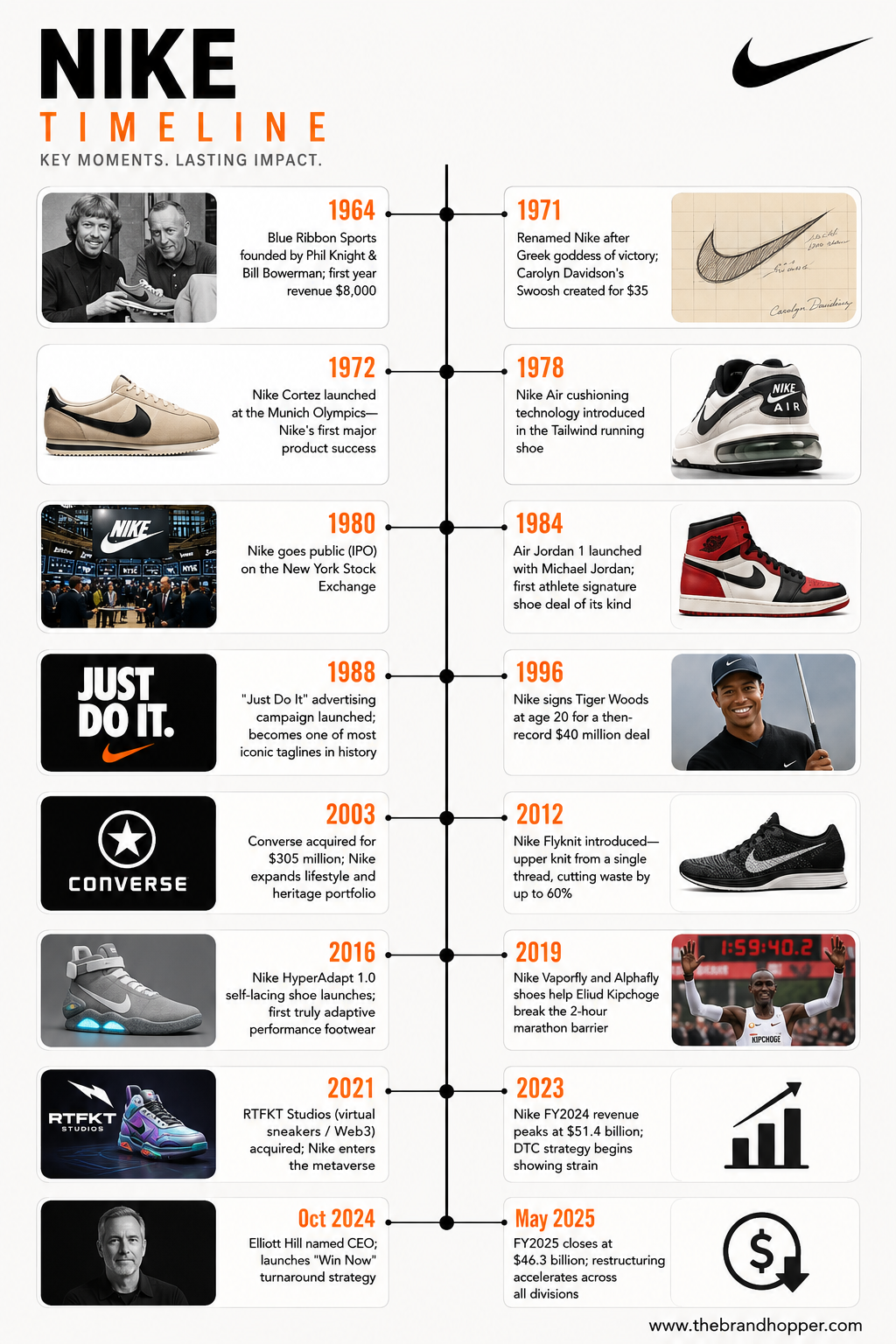
In 1962, a young MBA student from the University of Oregon named Phil Knight traveled to Japan with a bold hypothesis: that high-quality Japanese athletic shoes could disrupt the US market the same way Japanese cameras had disrupted the camera industry. He visited Onitsuka Tiger (now ASICS) in Kobe and struck a deal to import their shoes to America. Back in Oregon, he partnered with his former track coach Bill Bowerman—a man obsessed with making athletes go faster—and in 1964 they registered Blue Ribbon Sports (BRS). Their first year, selling shoes from the trunk of Knight’s car at track meets, generated $8,000 in revenue.
Bowerman’s tinkering instinct immediately distinguished BRS from a simple import business. He disassembled every shoe he received, studied the components, and sent Onitsuka Tiger detailed modification notes. When he melted rubber onto his wife’s waffle iron in 1971 to create a new outsole with better grip and lighter weight, the “waffle trainer” sole was born—a genuine technological breakthrough in athletic footwear design. That spirit of restless improvement from an athlete’s perspective would become the genetic code of everything Nike would later build.
In 1971, BRS ended its distribution agreement with Onitsuka Tiger and decided to manufacture its own shoes. The company was renamed Nike, after the Greek goddess of victory—a name reportedly arrived at by Jeff Johnson, BRS’s first employee, who saw the name in a dream. A graphic design student at Portland State University, Carolyn Davidson, was commissioned to create a logo. She charged $35 for what became the Swoosh, one of the most recognizable brand marks in human history. (Nike later gave Davidson 500 shares of company stock in 1983 in gratitude—shares now worth several million dollars.)
Nike’s Defining Milestones: A Brand Built Decade by Decade

The 10 Driving Forces Behind Nike’s Success
Nike’s rise to global dominance was not accidental. Behind the iconic Swoosh lies a precise, compounding set of strategic choices that have created one of the most enduring competitive advantages in consumer goods. Each of the ten factors below has been a conscious, sustained commitment—not a campaign or a quarter’s priority, but an institutional belief. Understanding them is understanding why Nike, even in a period of deliberate reset, remains the world’s most powerful sports brand.
1. Unshakeable Brand Identity: The Swoosh, “Just Do It,” and the Power of Belonging

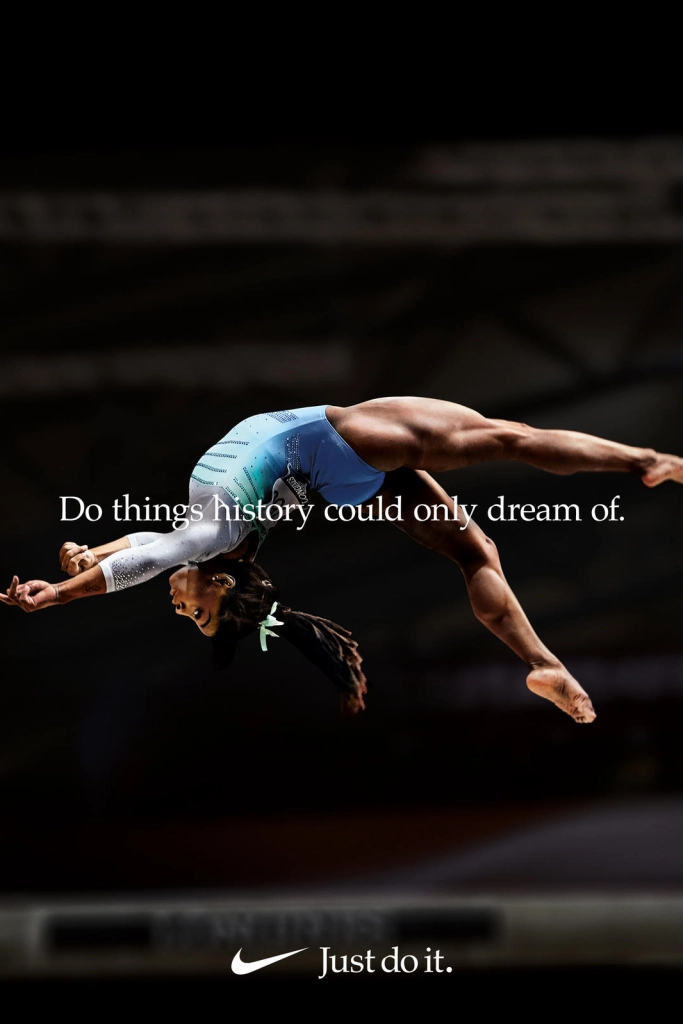
Brand identity is often discussed in marketing textbooks as a set of design decisions—logo, color, typography. Nike’s brand identity is something fundamentally different: it is an emotional contract with the human aspiration to improve. The Swoosh communicates motion, forward momentum, and victory without using a single word. “Just Do It”—three words coined by advertising executive Dan Wieden of Wieden+Kennedy in 1988, reportedly inspired by the last words of convicted killer Gary Gilmore—cuts across every culture, language, age group, and athletic level on Earth. It does not say “buy our shoes.” It says: stop making excuses.
Nike’s brand storytelling is as important as its logo. The company’s advertising campaigns have consistently taken positions—celebrating athlete greatness, challenging social norms, and humanizing sporting achievement. The 2018 Colin Kaepernick campaign (“Believe in something. Even if it means sacrificing everything.”) generated immediate controversy but ultimately drove a measurable 31% spike in Nike online sales in the days after launch, and the brand’s stock hit an all-time high within weeks. It remains one of the boldest brand moves of the modern era.
Under Elliott Hill’s leadership, Nike is doubling down on sport-rooted storytelling, centering campaigns around athletic performance rather than lifestyle fashion. The “Winning Isn’t Comfortable” platform—and campaigns tied to the Paris Olympics and Los Angeles 2028—return the brand’s narrative to what it does best: making athletes feel seen, challenged, and inspired. This recalibration of brand identity back to sport is a key pillar of the “Win Now” strategy, recognizing that Nike’s most powerful cultural moments have always come from authentic athletic storytelling rather than fashion positioning.
2. Product Innovation: Technology That Makes Athletes Better

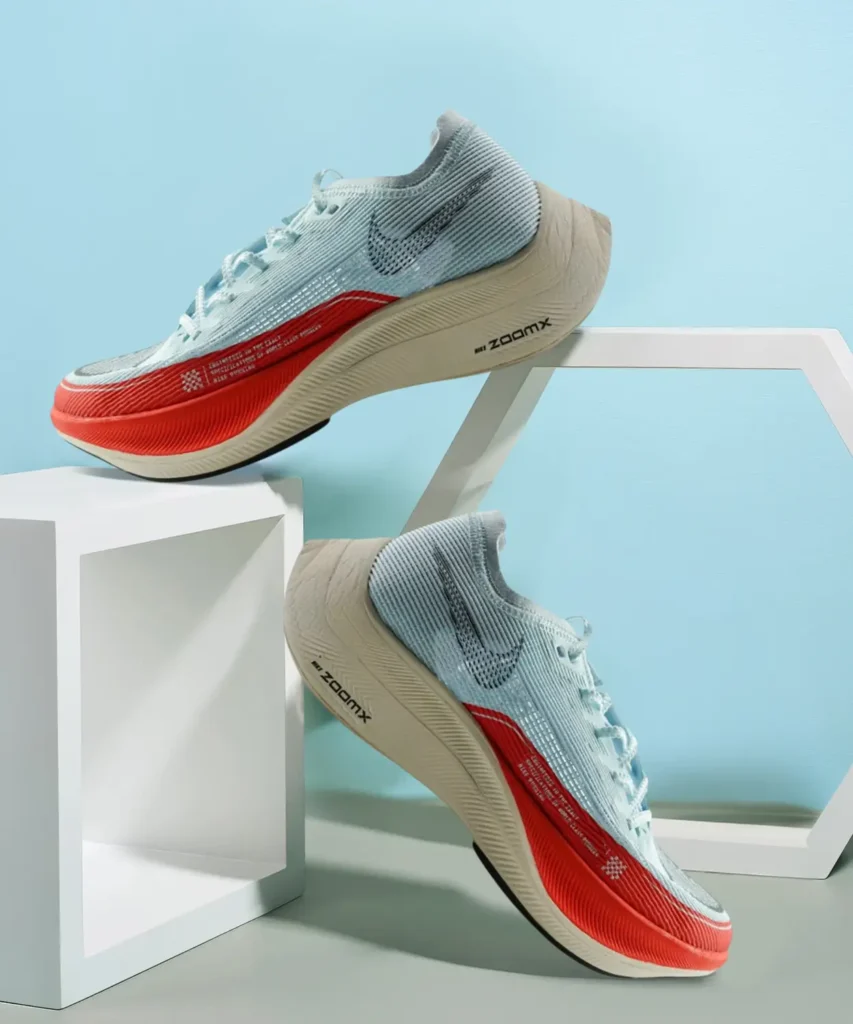
Nike’s product innovation philosophy begins with a simple principle: design for the athlete, and the design will speak for itself. This athlete-first ethos has produced some of the most consequential product breakthroughs in the history of sporting goods. The Air cushioning system—introduced in the 1978 Nike Tailwind through pressurized gas encapsulated in polyurethane—was so radical that Nike literally had to educate retailers and consumers on what it was. Today, Air Max’s visible air unit is a cultural icon with $1 billion+ in annual sales.
Nike Flyknit (introduced 2012) revolutionized shoe construction by engineering an entire upper from a single strand of yarn—cutting manufacturing waste by up to 60% versus traditional cut-and-sew methods while delivering a sock-like fit that outperformed anything previously possible. Nike ZoomX foam, derived from aerospace technology, powers the Vaporfly and Alphafly running shoes that are used by nearly every elite marathon world record holder. When Eliud Kipchoge ran the first sub-2-hour marathon in history in Vienna in October 2019 as part of the Breaking2 project, he wore Nike Alphafly prototypes—a moment that reshaped what human athletic potential means.
Nike’s digital product innovation is equally ambitious. In 1972, the company introduced the Cortez running shoe, which laid the foundation for Nike’s identity as a performance-first brand. Today, the Nike Fit app uses augmented reality and AI to scan a consumer’s foot in 13 points in under 10 seconds, providing size recommendations that reduce returns and increase satisfaction. The HyperAdapt self-lacing technology—first introduced in 2016 and now embedded in the Nike Adapt line—uses sensors to tighten and loosen automatically. Nike’s “Unconstrained Prototyping” culture, which funds experimental design labs working years in advance of commercial launch, ensures a steady pipeline of boundary-pushing products.
3. Masterful Marketing: Athlete Partnerships That Define Culture

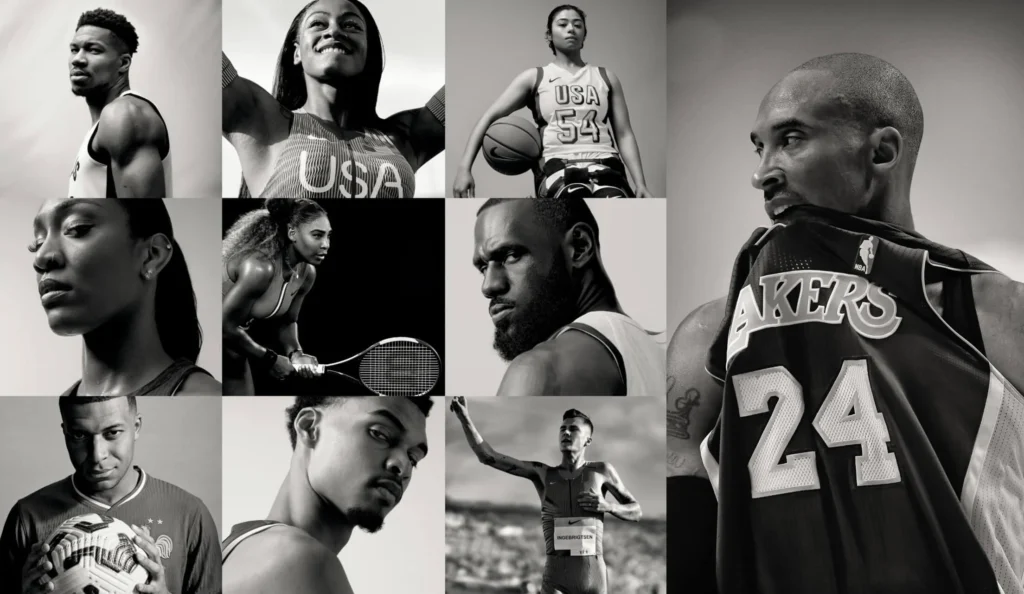
Nike’s marketing strategy has always understood a fundamental truth: in sports, credibility comes from association with the greatest. When Nike signed a 21-year-old Michael Jordan in 1984 for a then-unprecedented $500,000 per year—against Jordan’s own preference for Adidas—it launched not just an endorsement deal but an entire sub-brand. Nike’s marketing strategies built Air Jordan into a cultural movement: in its first year, the Air Jordan 1 generated $126 million in sales. Jordan Brand today generates approximately $5+ billion in annual revenue, four decades after that initial handshake.
The Jordan playbook—find an athlete at the intersection of performance excellence and cultural transcendence, build a signature product line around their identity, and create a community of belonging around it—has been replicated across generations. LeBron James holds a lifetime deal with Nike reportedly valued at over $1 billion, making it the largest athlete endorsement in the company’s history. Cristiano Ronaldo has been a Nike partner since 2003 and wears Nike football boots through his CR7 partnership. In 2024, Nike signed Caitlin Clark—the WNBA phenomenon and college basketball record-holder—to a groundbreaking endorsement deal that reflects Nike’s commitment to women’s sport at a moment of extraordinary cultural energy.
Nike’s marketing also understands the power of the unexpected. Collaborations with designers like Virgil Abloh (Off-White x Nike “The Ten” collection), Travis Scott (Air Jordan 1 Travis Scott), and Sacai have elevated limited-edition drops into cultural events that drive demand, resale markets, and brand credibility far beyond traditional advertising reach. The SNKRS app—Nike’s dedicated sneaker release platform—has turned product launches into community experiences that generate genuine excitement and drive direct digital sales without a single traditional advertisement.
4. Omnichannel Retail Strategy: From DTC Overcorrection to Balanced Marketplace

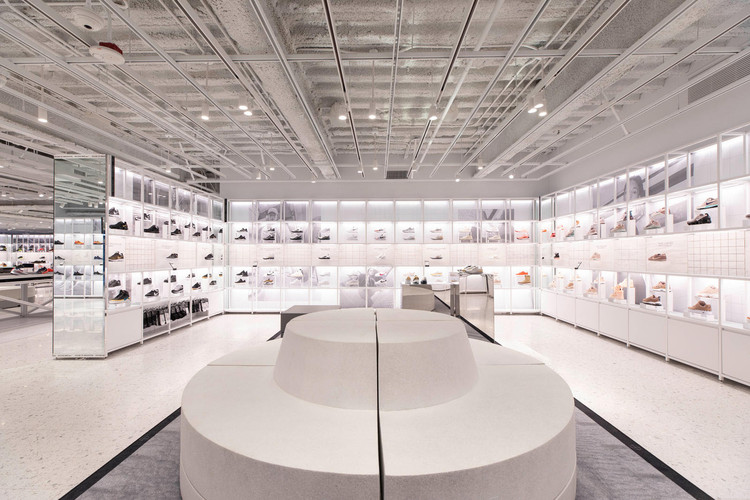
One of the most instructive chapters in Nike’s recent history is its retail strategy evolution—a journey that illuminates both the boldness and the dangers of strategic overcorrection. Under CEO John Donahoe (2020–2024), Nike made the audacious decision to aggressively accelerate its direct-to-consumer (DTC) model: pulling products from wholesale partners like foot Locker, DSW, and smaller specialty retailers, cutting the number of wholesale accounts from approximately 30,000 to around 40 strategic partners, and redirecting investment toward Nike.com and Nike-owned stores. The logic was sound—DTC yields higher margins and richer consumer data. But the execution created a distribution gap that competitors like On Running, HOKA, and New Balance filled with remarkable speed.
Elliott Hill’s “Win Now” strategy acknowledges this over-rotation explicitly. Nike is actively rebuilding its wholesale relationships, returning products to key retail partners, and investing in a more balanced channel architecture. The company’s “Connected Partnership” model—pioneered with JD Sports and select key accounts—uses shared data, co-created experiences, and exclusive product access to make wholesale relationships strategically valuable rather than merely transactional. Nike Direct (including Nike.com and Nike-owned stores) generated $18.8 billion in FY2025, representing approximately 42% of Nike Brand revenue—a significant scale even as the company rebalances toward wholesale.
Nike’s flagship “House of Innovation” stores in New York, Shanghai, and Paris represent the apex of the brand’s omnichannel ambition: physical spaces where consumers can customize shoes on-demand (Nike By You), scan their feet for perfect fit, pick up digital orders, and engage with sport through immersive experiences. These destinations generate disproportionate brand equity relative to their direct revenue contribution—serving as living brand showcases that reinforce why Nike products are worth their premium pricing, wherever consumers ultimately choose to buy them.
5. Sustainability: Move to Zero and the Race Toward a Circular Future

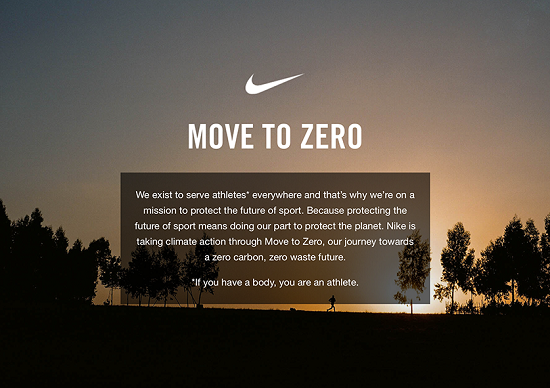
Nike’s “Move to Zero” is the brand’s headline sustainability commitment: a journey toward zero carbon and zero waste to help protect the future of sport. The stakes are genuine—climate change threatens the sporting seasons, outdoor venues, and natural surfaces on which athletic culture depends. Nike frames sustainability not as a compliance obligation but as an existential issue for sports, giving its environmental commitments the same urgency and athlete-facing language as its product marketing.
On materials, Nike has made measurable progress: 78% of all Nike, Jordan, and Converse products currently contain some recycled material. Recycled polyester—used in Dri-FIT performance fabrics—reduces carbon emissions by up to 30% versus virgin polyester. Nike Flyknit generates up to 60% less waste than traditional cut-and-sew manufacturing. The Nike Grind program, which collects used athletic shoes and worn-out manufacturing scraps and converts them into material for sports surfaces, running tracks, and new Nike products, has processed over 140 million pairs of shoes to date. Nike Refurbished gives returned or lightly worn shoes a second life through professional restoration and resale at reduced prices.
Nike’s Science Based Targets initiative (SBTi)-validated climate commitments include reducing Scope 1 and 2 (direct and purchased energy) emissions by 65% and Scope 3 (supply chain) emissions by 30% by FY30, against a FY15 baseline, on a pathway to net zero by 2050. The company has reached 96% renewable electricity across its owned and operated facilities—short of its 100% target but demonstrating genuine institutional commitment. Nike’s “Environmentally Preferred Materials” (EPM) metric covers approximately 48% of materials—progress, though the 50% target has not yet been met. These honest acknowledgments of shortfall against stated targets reinforce Nike’s sustainability credibility, distinguishing it from competitors who simply set aspirational targets without public progress reporting.
6. Digital Ecosystem: Data, Apps, and the Connected Athlete

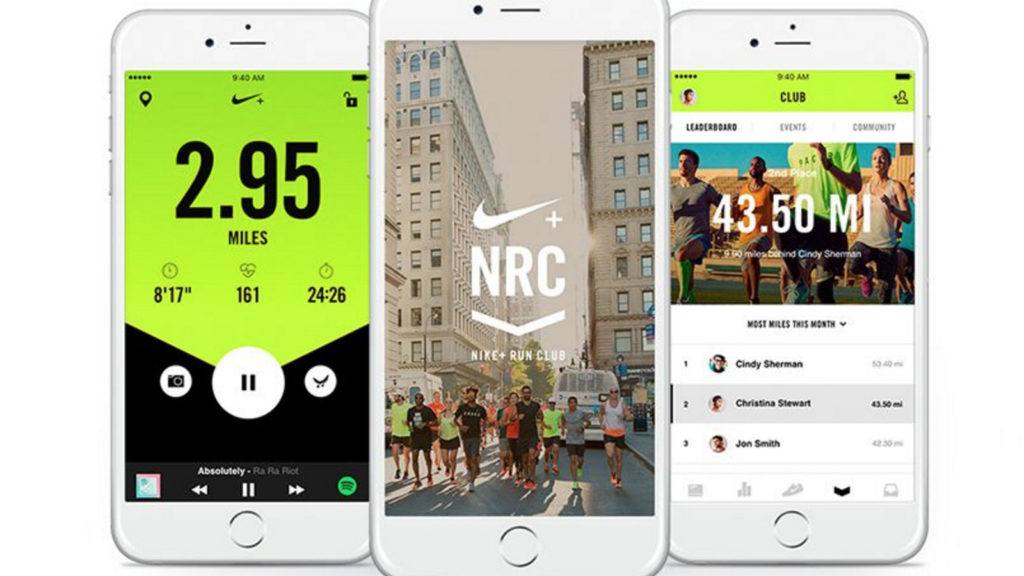


Nike’s digital ecosystem is one of the most sophisticated in consumer goods—not because it runs great apps, but because those apps generate actionable consumer intelligence at a scale that fundamentally changes how Nike designs products, allocates inventory, and builds community. The Nike Run Club (NRC) and Nike Training Club (NTC) apps have tens of millions of monthly active users, providing Nike with extraordinary insight into how, when, where, and for what purpose its core consumers engage in sport. This data informs product development before a single prototype is built.
SNKRS, Nike’s dedicated sneaker release platform, has become a category-defining application that transforms product launches into cultural events. SNKRS uses exclusive access, digital queues, augmented reality try-ons, and community storytelling to build anticipation for limited-edition releases—creating genuine demand scarcity that drives resale markets and brand desirability far beyond what traditional retail shelf placement could achieve. The platform also provides Nike with precise data on which styles drive the most passion, informing future design and production planning. The Nike App—the brand’s primary commerce and membership interface—personalizes experiences based on location, purchase history, workout data, and browsing behavior, making every interaction feel individually tailored.
AI and machine learning are embedded throughout Nike’s operations, from demand forecasting (Celect acquisition technology) to customer lifetime value modeling (Zodiac acquisition), computer vision foot analysis (Nike Fit), and supply chain optimization. Nike’s Beaverton, Oregon headquarters and India Technology Center are being positioned as the twin hubs of Nike’s tech operations following the FY2025 restructuring—consolidating engineering talent and creating platforms that will support the company’s long-term digital competitive advantage.
7. Collaborative Culture: Where Athletes, Designers, and Engineers Co-Create

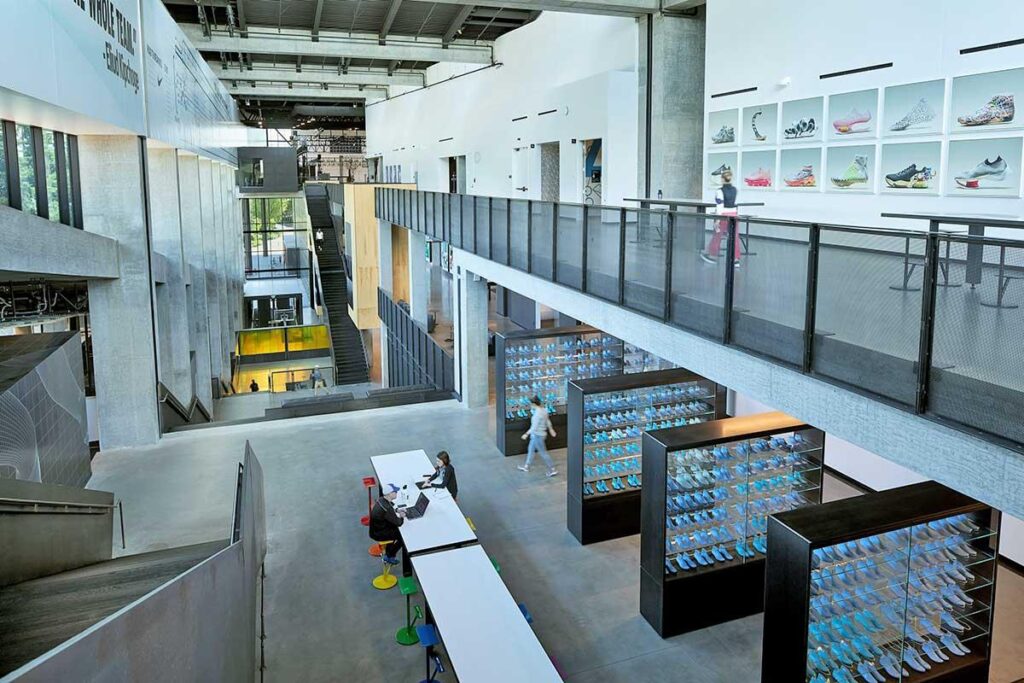
At the 286-acre Nike World Headquarters campus in Beaverton, Oregon—named for icons including Michael Jordan, Mia Hamm, Bo Jackson, Tiger Woods, and others—the physical architecture is designed to provoke collaboration. Buildings connect via walking paths that encourage chance encounters between designers, engineers, data scientists, marketers, and athletes. The Nike Innovation Kitchen, a working kitchen environment where experimental products are prototyped and destroyed without commercial pressure, embodies the “unlearning” philosophy that Bowerman modeled with his waffle iron: the willingness to question every existing assumption about how a product should work.
Under Elliott Hill’s restructuring, Nike has reorganized from a men/women/kids category structure into sport-specific teams: Nike Running, Nike Basketball, Nike Football, Nike Training. This change is deliberately designed to bring the consumer athlete’s perspective to the center of every product and marketing decision. Instead of asking “what do women want in a shoe?”, teams ask “what does a female marathon runner need in her 18th mile?” The specificity of the question produces better answers—and better products.
Nike’s external collaborations extend this philosophy outward. Partnerships with Apple (Nike Run Club integration into Apple Watch), Travis Scott (Jordan Brand), Sacai, Off-White, Acronym, and New York fashion houses bring genuinely different creative perspectives into product development. These aren’t licensing arrangements; they are genuine co-creation exercises where outside designers have substantive input into materials, construction, and concept. The resulting products often define cultural moments that transcend the athletic footwear category entirely.
8. Strategic Portfolio Management: Knowing What to Keep, Buy, and Let Go
Nike’s acquisition and divestiture history reveals a disciplined portfolio philosophy: own what strengthens the core athletic brand, divest what creates distraction. The company’s most enduring acquisition is Converse (purchased in 2003 for $305 million), which generated $1.69 billion in FY2025 and has remained a cultural cornerstone of Nike’s lifestyle portfolio for over two decades—a genuine heritage brand with its own distinct identity and consumer community. Converse operates independently within Nike’s portfolio, maintaining its retro aesthetic and downtown-cool positioning without being Swoosh-branded.
Nike’s acquisition of RTFKT Studios in 2021 signaled an ambitious entry into Web3 and virtual sneakers at the height of the NFT boom. However, as the NFT market contracted sharply, Nike closed RTFKT in January 2024—a disciplined exit that reflects portfolio discipline: when a strategic bet’s thesis doesn’t materialize at sufficient scale, exit quickly rather than persisting out of sunk-cost logic. Similarly, Nike divested Hurley International (surf brand) in 2020, and had earlier divested Cole Haan (luxury footwear) and Umbro (UK football) in 2012—recognizing that managing non-core brands consumes management attention disproportionate to their contribution to Nike’s core competitive position in sports performance.
On the acquisition side, Nike’s technology investments have generated durable capabilities: Celect (demand sensing and inventory optimization), Zodiac (customer lifetime value modeling), and Invertex (3D foot scanning, which became Nike Fit) are all now integrated into Nike’s core operations rather than operating as separate entities. This “acquire to integrate” model—buying capabilities rather than brands—reflects a sophisticated view of where Nike’s competitive advantage actually resides: in data intelligence, manufacturing innovation, and consumer insight rather than in brand proliferation.
9. Global Reach: The Engine of a $46 Billion Revenue Machine

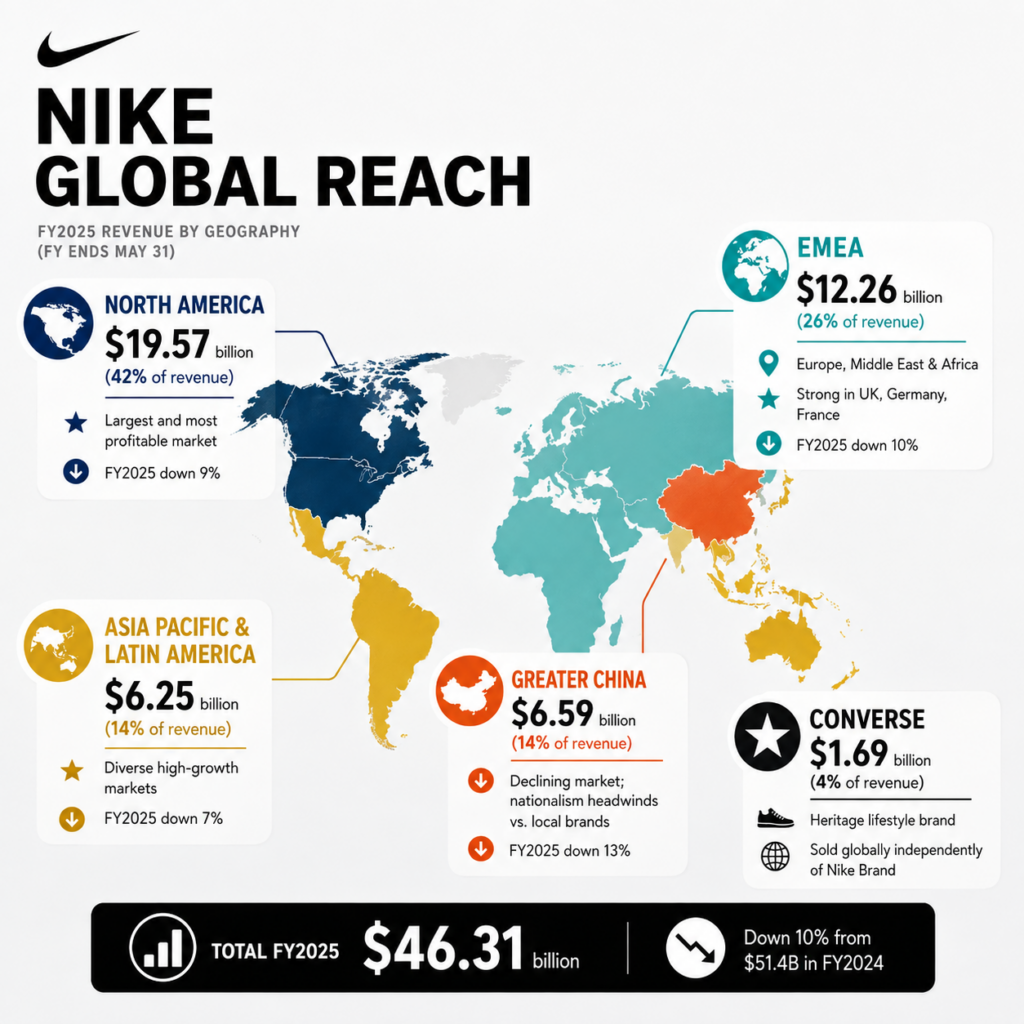
Nike operates in more than 170 countries, supported by over 700 factories across more than 40 countries that collectively employ nearly 1 million workers. This global manufacturing network—centered primarily in Vietnam (responsible for approximately 50% of footwear), Indonesia, and China—gives Nike extraordinary scale advantages in cost, speed-to-market, and supply chain flexibility. The company’s logistics network moves product from factory floor to retail shelf with a precision that reflects decades of operational investment and supplier relationship management.
Nike’s most complex strategic geography is Greater China, where the company faces a confluence of challenges: the rise of Chinese domestic brands like Anta Sports and Li-Ning (both of which have benefited from nationalistic consumer sentiment following controversies around Xinjiang cotton sourcing), changing youth culture preferences, and slower economic growth than the hyper-growth decade of the 2000s and 2010s. Despite a 13% revenue decline in China in FY2025, Nike remains the largest international sports brand in the country and is actively investing in local athlete partnerships, localized design, and community sport programs to rebuild its cultural standing. Beijing is one of the five priority cities in Elliott Hill’s “Win Now” strategy, underscoring the importance Nike places on its Chinese business recovery.
In North America—Nike’s home market and financial backbone at $19.57 billion—the brand is battling an unusual set of challengers: On Running (Swiss brand, extraordinary growth driven by high-performance running), HOKA (Deckers-owned, trail and road running), New Balance (Boston-based resurgence driven by “dad shoe” lifestyle credibility), and Brooks Running. Each of these brands benefited from Nike’s wholesale pullback under Donahoe—filling shelf space and consumer mindshare that Nike deliberately vacated. Rebuilding this ground is a central objective of the “Win Now” plan.
10. Financial Performance & the “Win Now” Turnaround
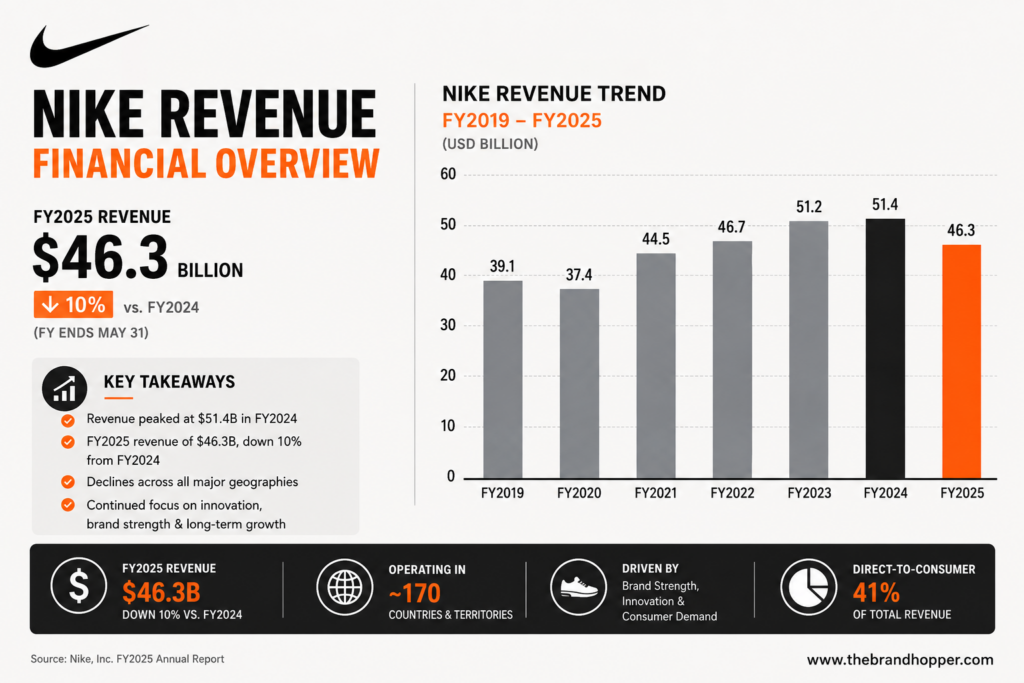
Nike’s financial performance reflects both the extraordinary scale it has built over 60 years and the strategic recalibration currently underway. At $46.3 billion in FY2025 (fiscal year ending May 31, 2025), Nike remains the world’s largest athletic footwear and apparel company by a significant margin—approximately 60% larger than its next largest competitor. However, the 10% revenue decline from FY2024’s $51.4 billion is the most significant annual revenue contraction Nike has experienced in its public company history outside of the COVID-19 pandemic year, and it reflects conscious strategic decisions as much as market conditions.
| FY2025 Total Revenue | $46.31 billion (down 10% from FY2024) |
| FY2024 Total Revenue | $51.36 billion |
| FY2025 Gross Margin | 42.7% (down 190 basis points from FY2024) |
| FY2025 Nike Direct Revenue | $18.8 billion (~42% of Nike Brand revenue) |
| FY2025 Wholesale Revenue | Balance of Nike Brand revenue (~58%) |
| Shareholder Returns (FY2025) | $5.3 billion returned via dividends and share buybacks |
| Employees | Approximately 79,500 (following FY2024 and FY2025 restructuring rounds) |
| NYSE: NKE | Publicly listed since December 2, 1980 |
The margin compression—gross margin declining 190 basis points to 42.7%—reflects the cost of the reset: higher discounts to clear excess inventory, an unfavorable shift in channel mix (wholesale is lower margin than DTC), and inventory obsolescence reserves. These are transitional costs, not structural deterioration. As Nike rebuilds its brand heat through sport-rooted storytelling, restores premium pricing discipline, and optimizes its channel mix over the coming years, margin recovery is the expected outcome of the “Win Now” strategy.
CEO Elliott Hill’s “Win Now” strategy centers on five fields of play (running, basketball, football/soccer, training, and sportswear), three priority countries (United States, United Kingdom, and China), and five key cities (New York, Los Angeles, London, Paris, and Beijing). This concentrated geographic and category focus represents a deliberate narrowing of strategic ambition in the near term—doing fewer things with more commitment rather than spreading resources thinly across every market and category simultaneously. The early signals from this strategy—stronger performance in running specialty channels, renewed wholesale partner enthusiasm, and revitalized product storytelling—are encouraging, though the full financial impact will take multiple fiscal years to fully materialize.
Nike’s Strategic Reset: “Win Now” and the Road Back to Growth

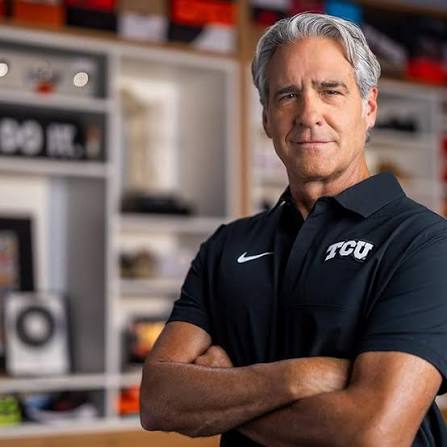
When Elliott Hill took over as Nike CEO in October 2024—returning to the company after a 32-year career at Nike followed by a brief retirement—he inherited a brand at a crossroads. Revenue was declining. Wholesale partners felt alienated. Competitors who had previously been afterthoughts were gaining serious market share. The brand that had defined “sport” was being accused of losing its sports soul in favor of fashion and lifestyle.
Hill’s diagnosis was direct: “We simply drifted from what makes Nike great.” The solution he prescribed was a return to first principles—putting sport, athletes, and performance back at the center of every product, marketing, and channel decision. The “Win Now” strategy that emerged from his first months as CEO is built around five priority actions: reignite brand momentum through sport-rooted storytelling; accelerate product innovation in the five key sport categories; rebuild marketplace health by restoring wholesale relationships and managing channel conflict; drive operating efficiency to fund the turnaround; and invest in the capabilities and leadership structure needed for sustained performance.
The leadership reorganization that followed was significant: Nike’s Consumer, Product, and Brand functions were divided into three areas—Consumer and Sport, Marketing, and Product Creation (including Innovation and Design)—all reporting directly to Hill. The reorganization eliminated the men’s/women’s/kids divisional structure in favor of sport-specific teams, ensuring that every product decision is made by people who think in terms of what a runner needs, what a basketball player demands, what a footballer wants. Early responses from retail partners, athletes, and consumers have been positive, though the financial proof of the turnaround will take time to fully appear in reported results.
Nike vs. the Competition: Holding the Lead in a Shifting Market
Despite its revenue reset, Nike maintains commanding competitive leadership in global sportswear. The brand’s scale—$46.3 billion in FY2025 revenue—dwarfs every competitor: Adidas reported approximately €23.7 billion in 2024, making it less than half of Nike’s size. Under Armour generates approximately $5.2 billion annually. The global sportswear market is estimated at approximately $102 billion in 2024, with Nike and Adidas together accounting for roughly 21% of total market revenue—reflecting the extraordinary breadth of a fragmented market that includes everything from mass-market private label athletic wear to luxury performance gear.
| Brand | Revenue (Latest FY) | Core Strength | Key Challenge | Global Presence |
| Nike (NKE) | $46.3B (FY2025) | Brand power, innovation, athlete endorsements, global scale | Revenue decline; channel reset; China headwinds | 170+ countries |
| Adidas (ADS) | ~€23.7B (2024) | Heritage, Originals/lifestyle, Samba/Gazelle moment, Yeezy revenue mgmt. | Rebuilding profitability post-Kanye; Yeezy wind-down | 160+ countries |
| On Running (ONON) | ~CHF 2.8B (2024) | Premium performance running; Roger Federer-backed credibility; rapid growth | Scaling premium positioning as volume grows | Expanding rapidly from Europe/US base |
| New Balance | ~$7.5B est. (private) | Heritage lifestyle resurgence; performance running (FuelCell); US manufacturing story | Private; limited data; scaling D2C | Major markets; growing globally |
| HOKA (Deckers) | ~$2.2B (FY2025) | Maximalist running cushioning; trail running; rapid premium growth | Dependent on single category; wholesale over-distribution risk | US, Europe, growing in Asia |
| Under Armour (UAA) | ~$5.2B (FY2025) | Performance fabric tech; strong in North American team sports | Revenue decline; brand repositioning; losing ground to On/HOKA | Americas-centric |
| Puma | ~€8.8B (2024) | Football (soccer) partnerships; fast fashion athleticwear; Rihanna Fenty collab legacy | Smaller scale; limited premium positioning | Global; strong in EM |
The most significant competitive threat to Nike is not Adidas—a peer at scale—but rather the rapid growth of performance-focused brands like On Running, HOKA, and the resurgent New Balance. These brands have captured significant share in the running specialty channel and premium athletic retail precisely because Nike’s wholesale pullback created space for them. Each has built strong brand identities and loyal performance communities that will not dissolve simply because Nike is back at the table—making the task of market-share recovery genuinely challenging rather than merely a question of distribution restoration.
Conclusion
Nike’s story is ultimately about the courage to commit—to a $35 logo, to a brash young basketball player, to a tagline that told the world to stop making excuses, and today, to a difficult but honest strategic reset after a period of drift. The ten driving forces examined in this article—brand identity, product innovation, marketing mastery, omnichannel strategy, sustainability, digital intelligence, collaborative culture, portfolio discipline, global reach, and financial resilience—are not independent pillars; they are an interconnected system, each reinforcing the others.
The “Win Now” strategy under Elliott Hill is not a new Nike—it is a return to the original Nike: sport-first, athlete-obsessed, innovation-led, and unapologetically competitive. The revenue decline of FY2025 is real, and the rebuild will take time. But Nike’s structural advantages—its brand equity, its manufacturing scale, its digital ecosystem, its athlete relationships, and its 60-year cultural legacy—remain intact. History suggests that when Nike commits fully to being Nike, the Swoosh wins.
Also Read: Just Do It Right: Analyzing Nike’s Timeless Marketing Strategies — a deep dive into the specific campaigns and tactics that built Nike into a marketing powerhouse.
Frequently Asked Questions About Nike’s Success
Q: What is Nike’s annual revenue?
A: Nike reported total revenues of $46.3 billion for fiscal year 2025 (ending May 31, 2025), down 10% from $51.4 billion in FY2024. Nike’s revenue peaked at $51.4 billion in FY2024. The company’s FY2025 decline reflects a deliberate strategic reset under new CEO Elliott Hill, including inventory clearance, channel rebalancing, and organizational restructuring. (Source: Nike FY2025 Annual Report, investors.nike.com)
Q: Who founded Nike and when?
A: Nike was founded by Phil Knight (a University of Oregon track athlete and Stanford MBA graduate) and Bill Bowerman (Knight’s track coach at Oregon) in 1964, initially under the name Blue Ribbon Sports (BRS). The company was renamed Nike in 1971, taking the name of the Greek goddess of victory. Nike went public on the New York Stock Exchange in December 1980.
Q: What does “Just Do It” mean and where did it come from?
A: “Just Do It” was coined in 1988 by advertising executive Dan Wieden of the Portland agency Wieden+Kennedy, reportedly inspired by the last words of convicted murderer Gary Gilmore before his 1977 execution. The tagline was created for a Nike commercial and quickly became one of the most recognized advertising slogans in history. It communicates that athletic achievement—and self-improvement—require action, not planning. The campaign is widely credited with transforming Nike from a performance footwear brand into a cultural phenomenon.
Q: Who is Nike’s CEO?
A: Elliott Hill has been Nike’s President and CEO since October 14, 2024. He is a 32-year Nike veteran who rejoined the company after a brief retirement to lead its “Win Now” turnaround. He replaced John Donahoe, who led Nike from 2020 to 2024. Before his CEO tenure, Hill held several senior leadership roles at Nike, including President of Consumer & Marketplace.
Q: What is Nike’s “Win Now” strategy?
A: Nike’s “Win Now” strategy, developed by CEO Elliott Hill and his leadership team beginning in late 2024, is a turnaround plan centered on five priority actions: reigniting brand momentum through sport-rooted storytelling; accelerating innovation in five key sport categories (running, basketball, football/soccer, training, and sportswear); rebuilding marketplace health by restoring wholesale relationships; driving operational efficiency; and restructuring leadership around sport-specific teams. The strategy also focuses on five priority cities (New York, Los Angeles, London, Paris, Beijing) and three countries (USA, UK, China).
Q: What is Nike’s biggest market?
A: North America is Nike’s largest market, generating $19.57 billion in FY2025—approximately 42% of total Nike revenues. The United States alone is Nike’s single largest country market by revenue. Nike also has significant operations in Europe, Middle East & Africa (EMEA, $12.26B), Greater China ($6.59B), and Asia Pacific & Latin America (APLA, $6.25B).
Q: What are Nike’s most innovative products?
A: Nike’s most significant product innovations include: Nike Air (pressurized gas cushioning, 1978); Nike Air Jordan (1984, the first athlete signature shoe that created a sub-brand); Nike Flyknit (2012, yarn-engineered upper that cuts manufacturing waste by 60%); Nike ZoomX foam with carbon-fiber plate (powering Vaporfly and Alphafly marathon racing shoes, used to break multiple world records); Nike Fit (AR foot scanning app for perfect sizing); Nike Adapt (auto-lacing technology, introduced via HyperAdapt 1.0 in 2016); and Nike React foam (responsive and lightweight cushioning across training and running categories).
Q: Is Nike the largest sportswear company in the world?
A: Yes. Nike is the world’s largest athletic footwear and apparel company by revenue. At $46.3 billion in FY2025, Nike’s revenues are approximately double those of its nearest competitor, Adidas (approximately €23.7 billion in 2024). Nike’s Jordan Brand, Converse, and Nike Brand collectively cover more consumer athletic occasions than any competitor. The global sportswear market was approximately $102 billion in 2024, with Nike holding the leading market share position.
Q: What is Nike’s “Move to Zero” sustainability initiative?
A: Nike’s “Move to Zero” is the company’s sustainability framework, targeting zero carbon and zero waste to protect the future of sport. Key achievements include: 78% of Nike, Jordan, and Converse products contain some recycled material; 96% renewable electricity across owned and operated facilities; Nike Grind has processed over 140 million pairs of shoes into recycled materials for sports surfaces; and Flyknit manufacturing cuts waste by up to 60% versus traditional methods. Long-term targets include reducing Scope 1 and 2 emissions by 65% and Scope 3 by 30% by FY2030, on a pathway to net zero by 2050.
Q: Why did Nike’s revenue decline in FY2025?
A: Nike’s 10% revenue decline in FY2025 (from $51.4B to $46.3B) reflects a combination of strategic and market factors: (1) Nike had over-indexed on direct-to-consumer channels under CEO John Donahoe, alienating wholesale partners and creating distribution gaps that competitors like On Running, HOKA, and New Balance filled; (2) Greater China declined 13% due to nationalistic consumer sentiment favoring local brands like Anta and Li-Ning; (3) inventory clearance required elevated discounting that pressured both revenue and margins; and (4) the restructuring and leadership transition itself created some organizational disruption. New CEO Elliott Hill’s “Win Now” strategy is designed to address each of these factors.
Also Read: Who Owns Nike? Parent Company, Revenue & Key Facts
To read more content like this, subscribe to our newsletter
Go to the full page to view and submit the form.