


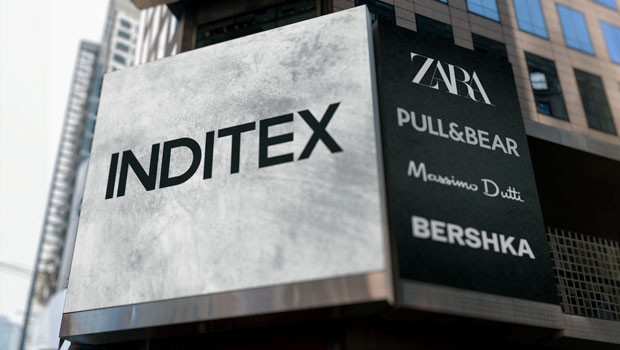
The global apparel market is one of the most fiercely contested industries on earth, valued at well over $1.5 trillion and shaped by a handful of titans who set the pace for design, pricing, supply-chain speed, and sustainability. At the top of that hierarchy sits Inditex—the Spanish parent company of Zara, Pull&Bear, Massimo Dutti, Bershka, Stradivarius, Oysho, Zara Home, and Uterqué—with net sales of €38.6 billion in its fiscal year ended January 2025 and a store network spanning 96 markets worldwide. No other pure-play fashion retailer comes close to that combination of scale, speed, and profit margin.
Yet Inditex does not operate in a vacuum. From Swedish legacy giants like H&M to Chinese ultra-fast-fashion disruptors like Shein and Temu, from UNIQLO’s technology-driven basics to Mango’s Mediterranean style, and from Gap’s all-American heritage to Zalando’s European marketplace model—the competitive landscape around Inditex has never been more crowded or more dynamic. Each rival deploys a distinct playbook: different price points, different target demographics, different digital strategies, and increasingly different sustainability commitments.
Understanding who Inditex’s real competitors are—and how each is positioned—matters equally to investors, brand strategists, retail professionals, and informed shoppers. Knowing that Primark refuses to sell online while Shein adds up to 10,000 new styles daily tells you something profound about the spectrum of competitive strategies at work in global fashion. This article profiles all 18 major Inditex competitors in depth: their latest financial performance, competitive differentiators, strategic moves, and how they individually stack up against the Zara juggernaut.
Inditex: The Global Fashion Titan
Inditex traces its roots to 1963, when Amancio Ortega began making quilted bathrobes in a small workshop in A Coruña, Spain. The company formally incorporated in 1985 as the holding entity for Zara and its associated manufacturing operations. Today, led by Executive Chairman Amancio Ortega and CEO Oscar Garcia Maceiras, Inditex stands as the world’s largest fashion retailer by revenue, market capitalisation, and store count—a position it has held since surpassing H&M in the mid-2000s.
The company’s core competitive moat is vertical integration combined with near-real-time supply chain responsiveness. Inditex designs, manufactures, distributes, and retails its own clothes—keeping roughly 50-60% of production in or near Spain, Portugal, Morocco, and Turkey to enable rapid replenishment. A new design can travel from concept to store shelf in as few as 15-20 days, compared to the industry average of 4-6 months. This means Inditex reacts to emerging trends rather than forecasting them months in advance—a structurally superior model.

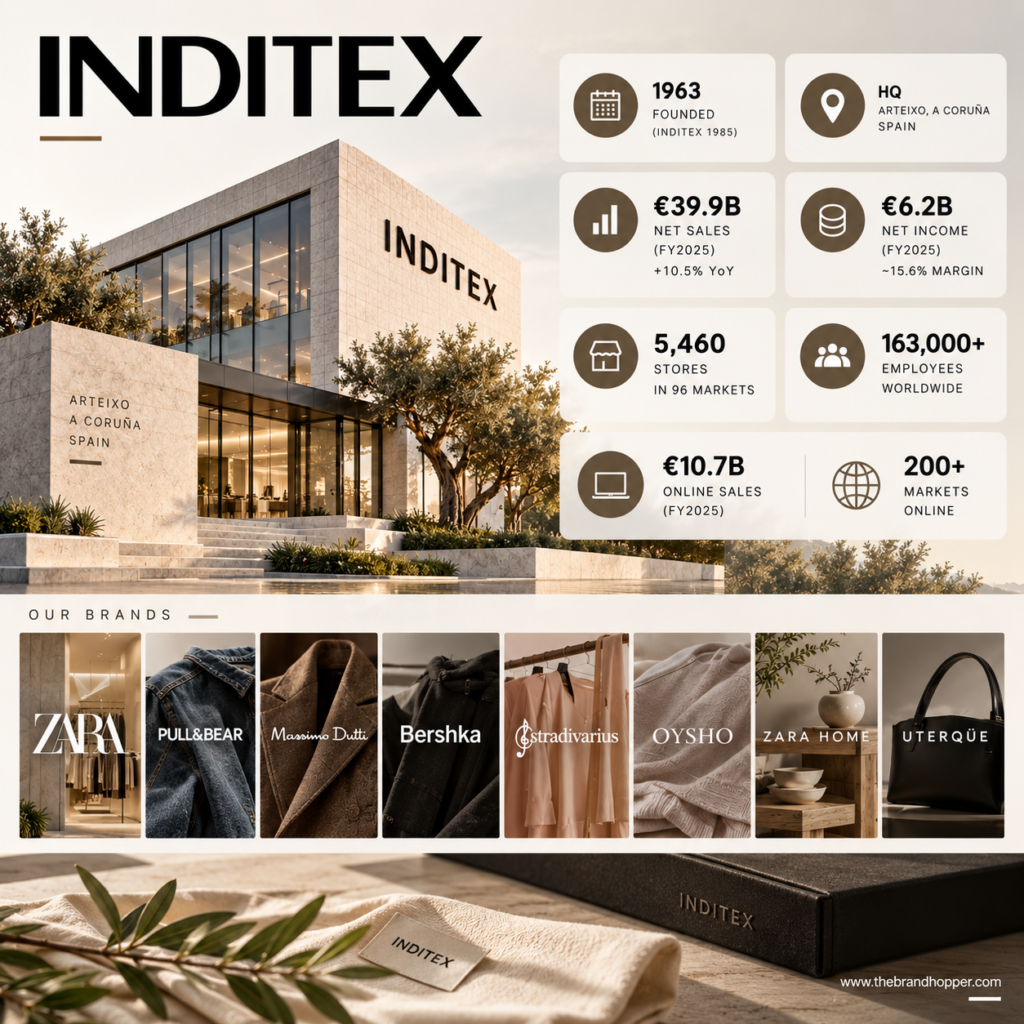
Zara alone generates roughly 69% of Inditex’s group revenue, making it far and away the most commercially significant brand in any fashion conglomerate. Zara’s secret is its deliberate scarcity model: limited quantities per style, high design velocity, and a store experience calibrated to create urgency. Customers learn that an item may be gone within days, which drives repeat store visits and lowers the need for discounting—a meaningful structural advantage over competitors forced to mark down unsold inventory.
The Competitive Landscape: Why Inditex Faces Intense Rivalry
Despite its dominance, Inditex faces pressure from multiple directions simultaneously. At the value end, ultra-fast-fashion platforms Shein and Temu have disrupted the price floor with algorithmically generated micro-collections and Chinese manufacturing economics. At the premium end, aspirational brands like Ralph Lauren, PVH Corp (Calvin Klein, Tommy Hilfiger), and Tapestry (Coach) compete for consumers willing to pay for brand equity. In the middle—Inditex’s traditional territory—H&M, UNIQLO, Primark, Gap, Mango, Bestseller, and Marks & Spencer each contest a slice of the mass-market fashion consumer’s wallet. And pure-play digital challengers—ASOS, Zalando, Boohoo, and Fashion Nova—compete without the overhead of physical real estate.
The following 18 competitor profiles, organised from largest by revenue to most disruptive by model, give a complete picture of the forces shaping global fashion retail today. Each section includes the competitor’s latest verified financials, key strategic pillars, direct comparison to Inditex, and forward-looking assessments.
Top Competitors of Inditex Groups
1. H&M Group: The Swedish Fast Fashion Giant

Official Website: hmgroup.com
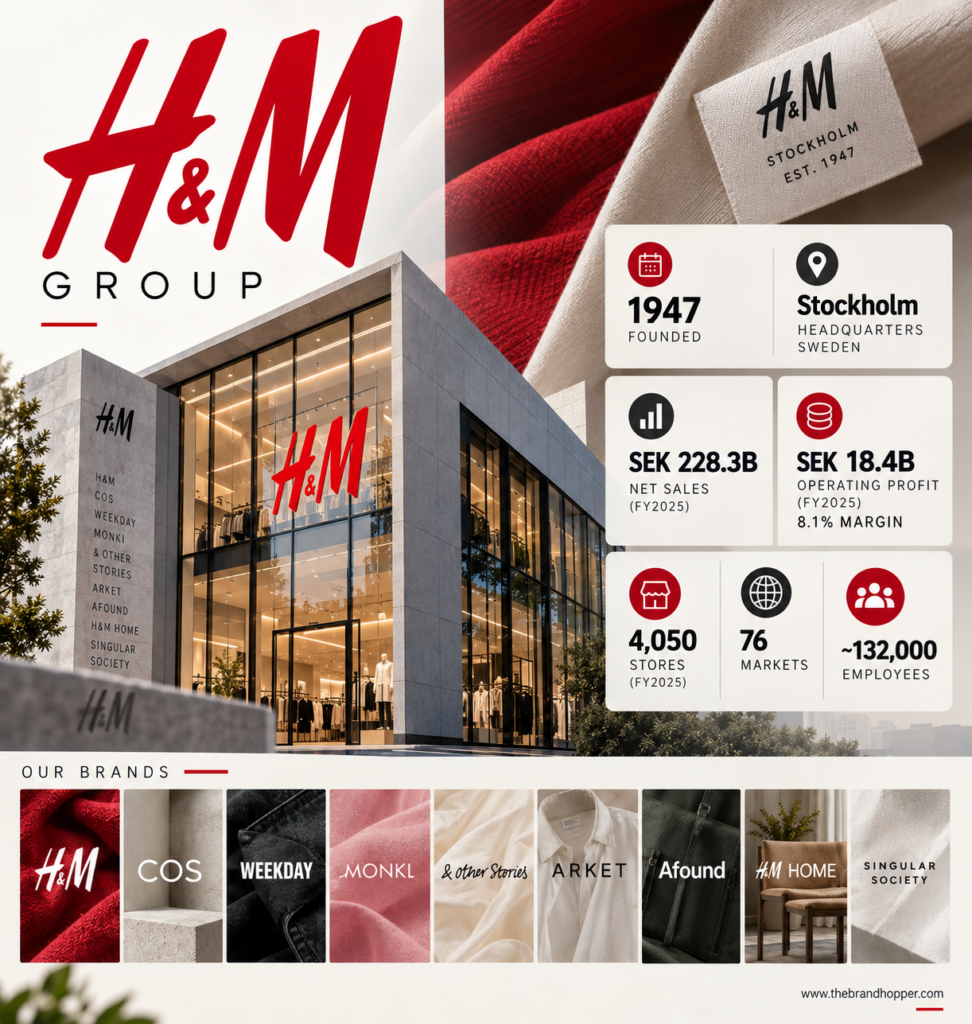
H&M Group is the world’s second-largest fashion retailer by revenue, and Inditex’s closest direct competitor across virtually every product category, geography, and price tier. Founded in 1947 by Erling Persson as a single womenswear store in Västerås, Sweden, H&M now operates nine distinct brands serving consumers from budget-conscious teenagers through to sustainability-minded professionals. Its flagship H&M brand pitches prices roughly 10-20% below Zara in most markets, while COS and &Other Stories address shoppers who want considered design at a middle price point. With revenues of approximately SEK 234.5 billion ($21.6 billion) in fiscal year 2024, H&M remains the benchmark against which Inditex measures its competitive position.
H&M competes on brand diversity where Inditex competes on supply-chain speed. The group’s nine-brand portfolio allows it to address demographic segments Inditex cannot serve within Zara’s brand identity alone. H&M has also differentiated on sustainability more visibly than Inditex, launching its Conscious Collection programme, a global garment-collection initiative, and a target to use 100% recycled or sustainably sourced materials by 2030. Its loyalty programme now includes over 175 million members worldwide, providing first-party data that fuels AI-driven personalisation and inventory optimisation. Digital sales represent approximately 30% of H&M Group’s total revenue and continue to grow.
H&M’s structural challenge is profitability. Its operating margin of 6.3% in FY2024 compares unfavourably to Inditex’s ~17.5%, reflecting H&M’s lower average selling prices, higher markdown rates, and heavier fixed-cost base from its larger store estate. Management under CEO Daniel Ervér has accelerated store closures in underperforming markets while expanding selectively in Southeast Asia and the Middle East. The group is also investing heavily in digital infrastructure—including virtual fitting rooms, AI-powered trend forecasting, and omnichannel returns—to close the gap with Inditex’s superior demand-sensing capabilities. The strategic question for H&M over the next five years is whether its multi-brand model can generate the margin improvement investors expect without sacrificing the inclusive, affordable positioning that defines the H&M brand promise. Visit
H&M Group Investor Relations for the latest annual report and strategic updates.
2. Fast Retailing Co. (UNIQLO)

Official Website: fastretailing.com
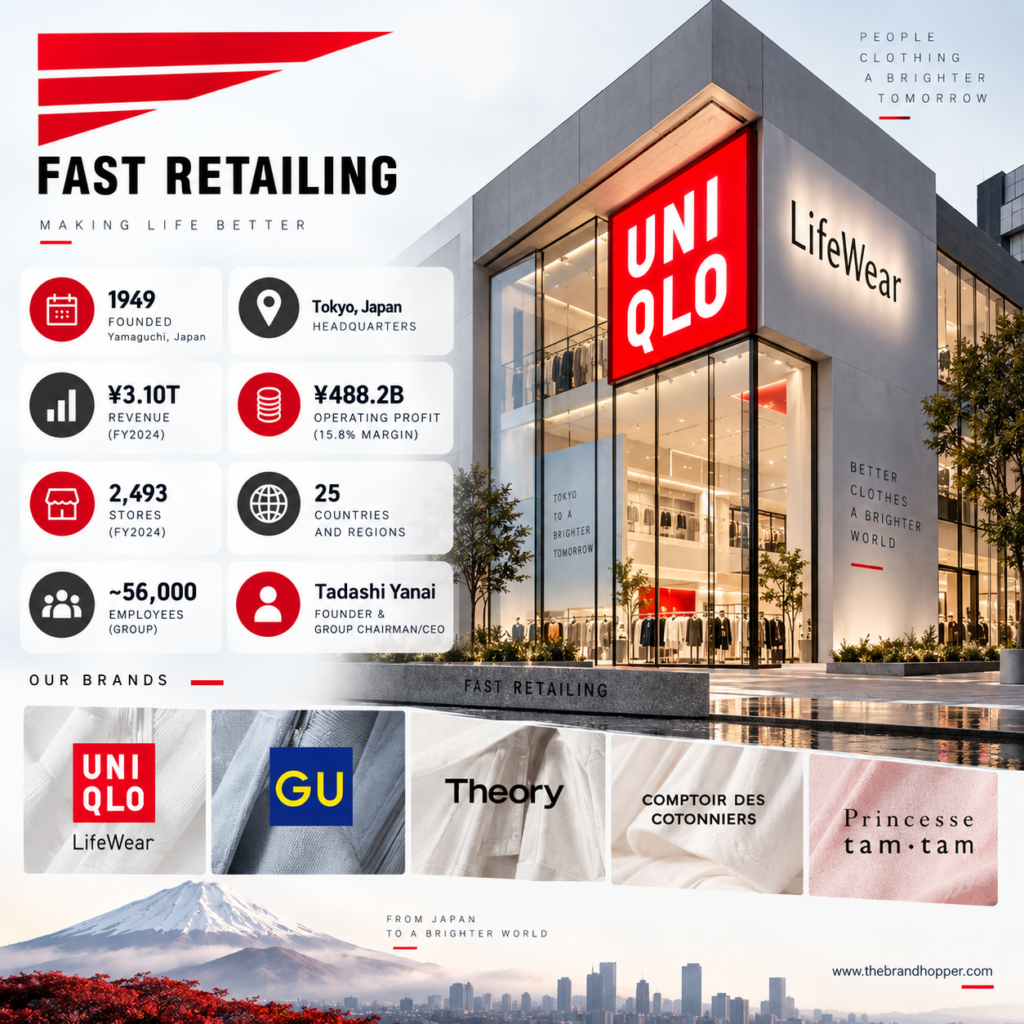
Fast Retailing, the Tokyo-based parent of UNIQLO, occupies a strategically distinct position in global fashion: where Inditex and H&M compete on trend-led collections that rotate every few weeks, UNIQLO competes on what its founder Tadashi Yanai calls “LifeWear”—high-quality, functional basics designed to last seasons, not weeks. UNIQLO’s signature fabrics—HEATTECH (thermal underlayers), AIRism (moisture-wicking), and Ultra Light Down—are developed through proprietary technology partnerships and command genuine consumer loyalty in a way that few fashion brands can match. Revenue reached ¥3.10 trillion ($20.9 billion) in fiscal year 2024, making Fast Retailing the world’s third-largest fashion retailer by sales.
UNIQLO directly challenges Inditex’s Zara on price-to-quality ratio rather than speed-to-trend. A UNIQLO cashmere crewneck is competitively priced versus Zara’s equivalent but built to last multiple seasons—a proposition that resonates with increasingly value-conscious and sustainability-aware consumers. UNIQLO is growing fastest in Greater China (2,000+ locations in the region including mainland China, Hong Kong, and Taiwan) and Southeast Asia, where middle-class expansion is driving first-time purchasers of quality basics. In North America—Inditex’s most lucrative market—UNIQLO is still a minor player by store count but growing rapidly through flagship openings and e-commerce.
Fast Retailing’s operating margin of 15.8% is the closest to Inditex’s 17.5% among any major fashion competitor—a remarkable achievement given UNIQLO’s lower average selling price. The margin is powered by scale purchasing from Asian manufacturers and relentless inventory discipline. UNIQLO has also invested in automated fulfilment: its Ariake Project headquarters in Tokyo integrates AI-powered product planning, warehouse robotics, and data analytics into a single supply-chain nerve centre. For Inditex, UNIQLO represents the only competitor that matches its profit quality; for consumers, it represents the only brand that can credibly challenge Zara on the “wardrobe essentials” segment. See
Fast Retailing Group Strategy for the latest UNIQLO expansion roadmap and sustainability commitments.
3. Gap Inc.
Official Website: gapinc.com
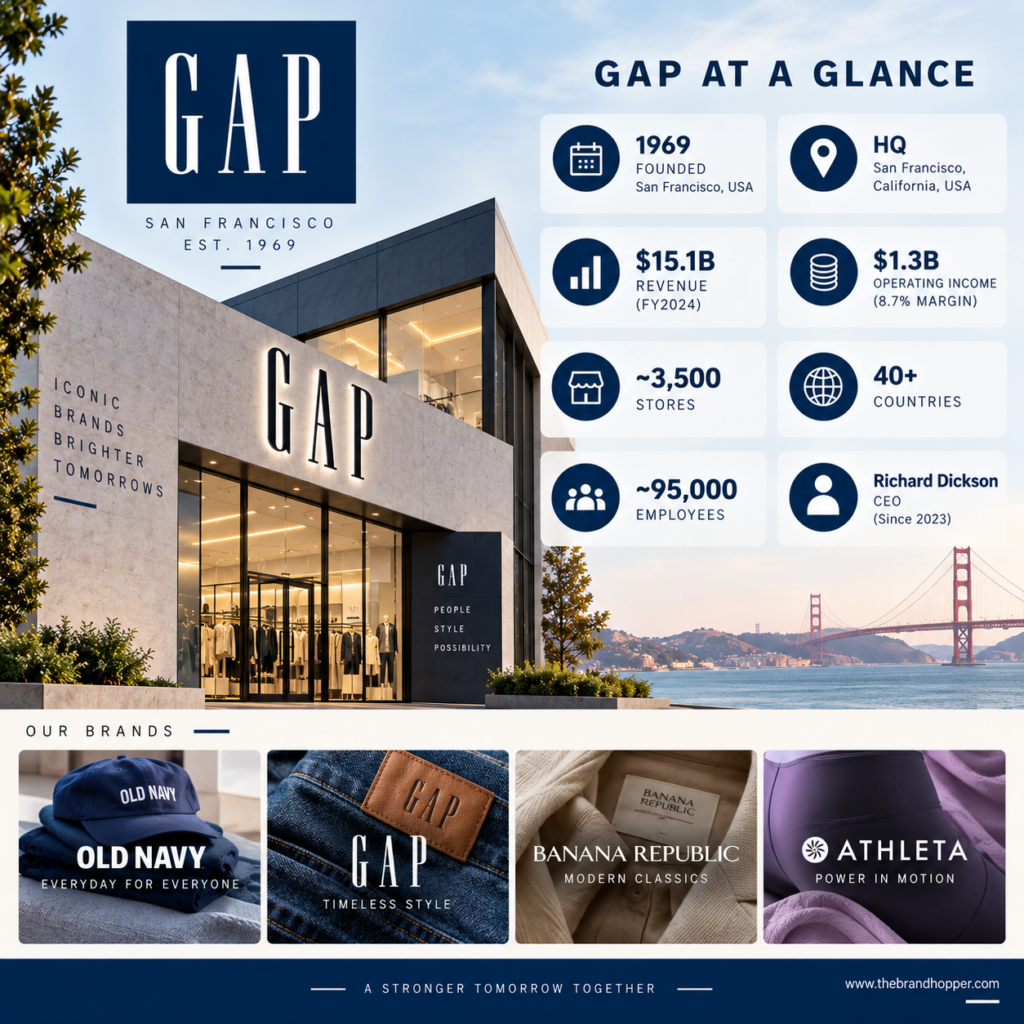
Gap Inc.—the all-American retailer behind Old Navy, Gap, Banana Republic, and Athleta—recorded $15.1 billion in net sales for fiscal year 2024, comfortably outpacing its immediate US fashion peers and making it the largest American-headquartered apparel retailer. Under CEO Richard Dickson, who joined from Mattel in August 2023, the company has undergone a meaningful brand repositioning: Gap itself has recaptured cultural relevance through collaborations (including a high-profile Denim Tears partnership), while Old Navy continues to dominate the value-family-clothing segment in the US, and Athleta has strengthened its positioning in the premium women’s activewear category against Lululemon.
Gap competes with Inditex primarily in the mid-market casual segment in North America and increasingly online globally. Its structural advantage over Zara is American heritage and brand loyalty, particularly for Old Navy, where parents reliably return season after season for children’s clothing. Its structural disadvantage is speed: Gap operates on a traditional seasonal buying cycle (12-16 week lead times) versus Inditex’s 2-4 week replenishment window, meaning Gap is more exposed to markdown risk when trends shift. The company has been investing in AI-driven demand forecasting and tighter supplier relationships to shrink that gap, with encouraging early results in inventory turns.
Old Navy remains the group’s commercial engine, contributing approximately 50% of total revenue and generating above-average operating margins. Athleta, despite slower growth than anticipated post-COVID, occupies an important strategic position: it competes in the fast-growing women’s activewear market where Inditex is underrepresented, giving Gap a segment-specific growth lever that Zara cannot easily replicate. Banana Republic has repositioned upmarket, targeting the premium workwear consumer with mixed success. The clearest opportunity for Gap Inc. over the next cycle is international digital expansion—its e-commerce platform now ships to 90+ countries, but brand awareness outside North America remains low compared to Zara. Explore Gap’s investor resources at
Gap Inc. Official Investor Relations.
4. Primark
Official Website: primark.com
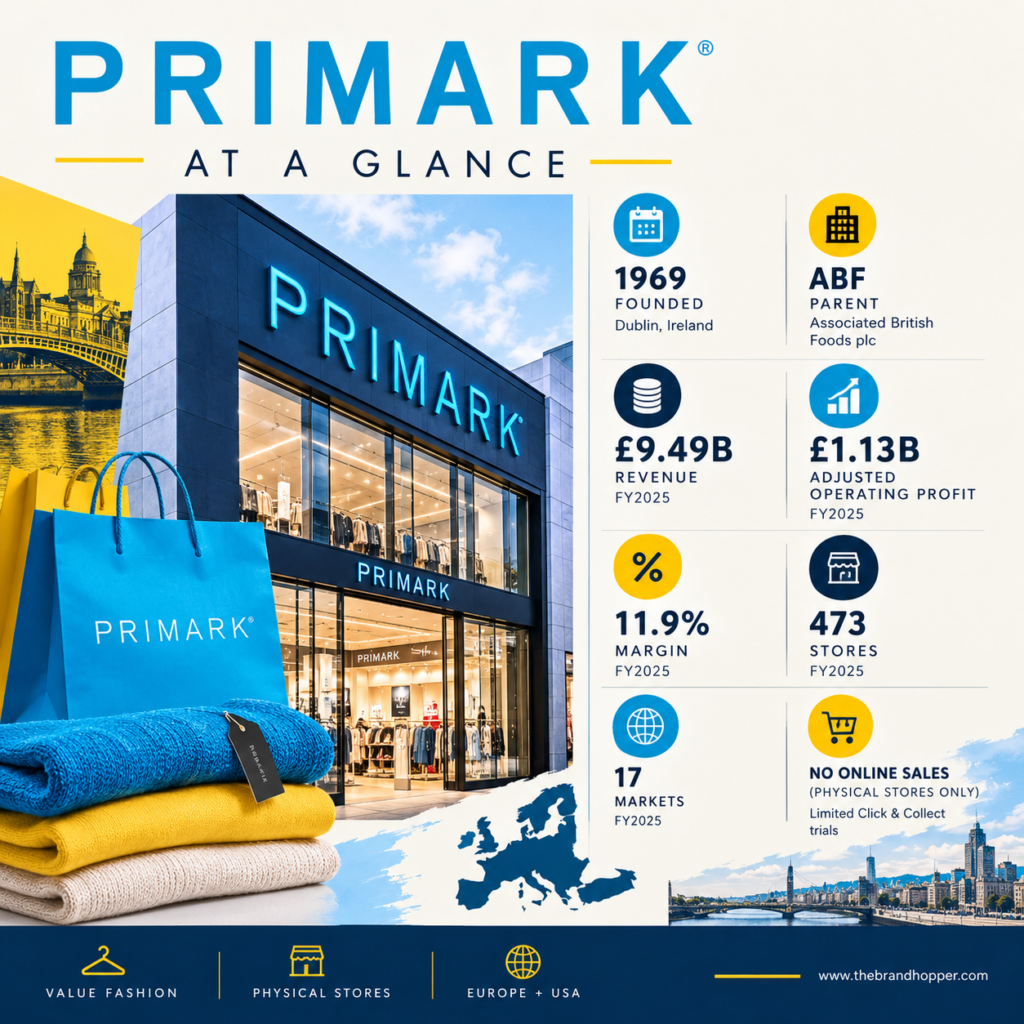
Primark occupies a uniquely contrarian position in global fashion retail: it is one of the fastest-growing large-format fashion chains in Europe and the United States, yet it has no e-commerce sales—not even a shopping basket on its website. This brick-and-mortar-only strategy, which would seem suicidal in the post-pandemic era, actually reinforces Primark’s singular competitive advantage: by eliminating logistics, returns-processing, and fulfilment infrastructure costs, Primark can price clothes at a level no e-commerce competitor can match. A basic t-shirt costs under £4, a dress under £10, and a full school uniform under £16. These price points are genuinely disruptive—and unlike Shein or Temu, Primark operates in large, accessible high-street stores that shoppers can browse without algorithm anxiety.
Primark’s relationship with Inditex is one of non-overlapping customer occasions rather than head-to-head rivalry. Primark wins on “planned low-cost replenishment” (school uniforms, holiday basics, children’s clothing), while Zara wins on “inspired fashion discovery.” But as Primark has expanded upmarket with more fashion-forward collections and curated collaborations—including licensed lines with Disney, Marvel, and Barbie—the two brands increasingly compete for the same shopping trip. Primark’s US expansion is its most ambitious growth initiative: from 4 stores in 2015, it now operates 32 US stores and has identified 60 additional target markets. In the UK and Ireland, Primark is a genuine national institution—consistently ranked among the country’s top-10 most-visited retail destinations.
Primark’s operating margin of approximately 12% is strong relative to most fashion peers (though below Inditex’s 17.5%), achieved through razor-thin product costs, minimal marketing spend (Primark spends almost nothing on paid advertising—its stores are the media), and high sales density per square metre. Its sustainability journey is the principal area of reputational vulnerability: Primark has signed up to the Sustainable Apparel Coalition’s Higg Index and launched its “Primark Cares” initiative targeting 40% recycled or sustainably sourced materials by 2030—but consumer scepticism persists given its ultra-low price points and high-volume model. Visit
Primark Corporate Website for the latest store-opening updates and Primark Cares sustainability targets.
5. ASOS
Official Website: asos.com
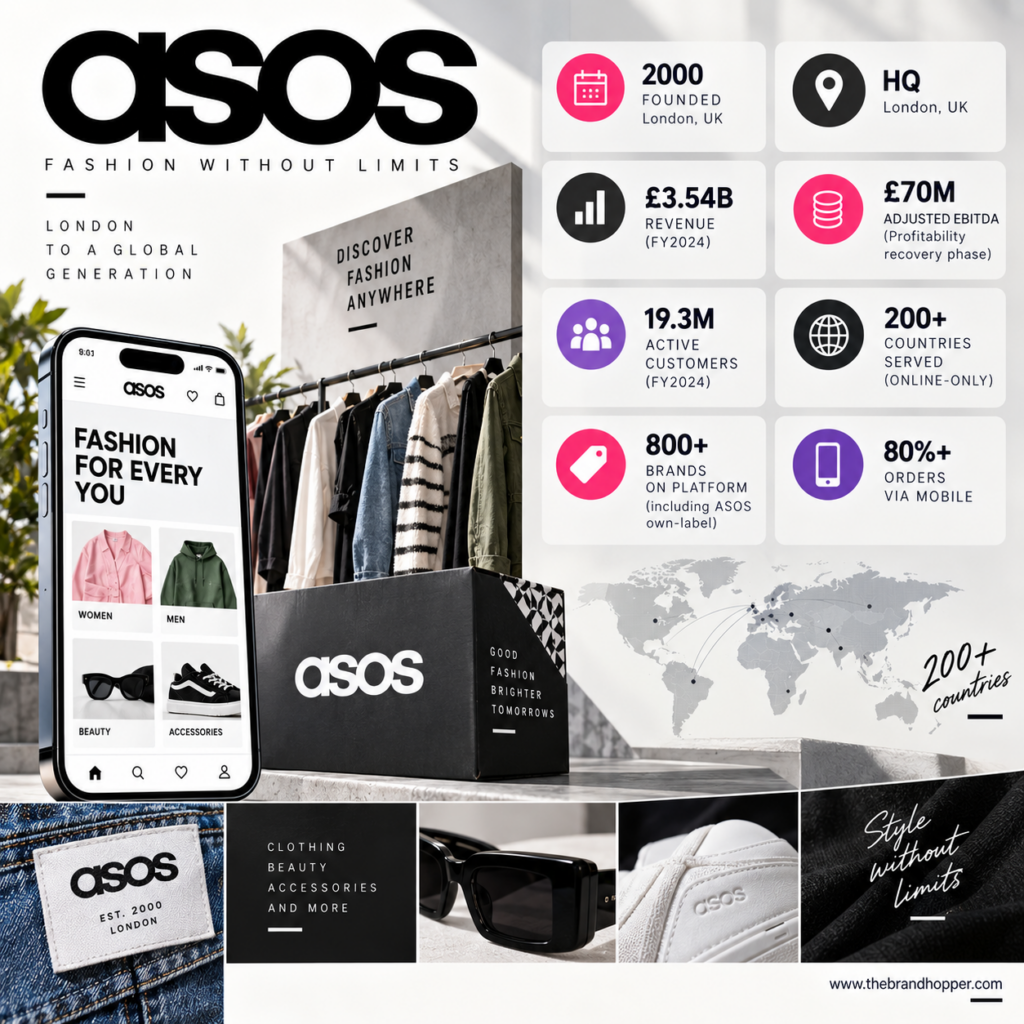
ASOS—originally “As Seen On Screen”—is the UK’s largest pure-play online fashion and beauty retailer, founded in 2000 and now serving 19.3 million active customers across 200+ markets. Its defining characteristic is breadth: ASOS carries over 800 brands alongside its own-label collections, giving it the widest fashion selection of any single digital destination. The platform targets 18-35-year-old fashion consumers with an algorithm-driven discovery experience, same-day and next-day delivery in key markets, and size-inclusive ranges across Curve, Tall, Petite, and Maternity. ASOS has no physical stores—an asset-light model that enables massive SKU depth impossible for any bricks-and-mortar retailer to replicate.
ASOS competes with Inditex’s Zara on trend-led fashion for young adults, but with a fundamentally different fulfilment model. Where Zara controls design, manufacturing, and retail end-to-end, ASOS is primarily a marketplace and distributor—its margin structure is consequently lower (revenue per active customer), but its network effect (more brands attracting more customers attracting more brands) creates a flywheel that is difficult for Inditex to replicate without building the same platform infrastructure. ASOS’s “Fit Assistant” AI tool—which recommends sizes based on a customer’s body measurements and purchase history—has meaningfully reduced returns rates and is a genuine technological differentiator. ASOS also partners with tools like Fashion Diffusion’s
AI Model Generator, which helps brands on its platform create realistic on-model imagery at scale without organising traditional photoshoots—accelerating time-to-listing and reducing imagery costs for small fashion brands.
ASOS’s FY2024 was a year of painful but necessary restructuring. Revenue declined 16% year-on-year as the company dramatically reduced inventory, exited unprofitable SKUs, and improved return rates. Active customers fell from a peak of 26 million to 19.3 million—a sign of the platform’s ongoing challenge in retaining customers who migrated to Shein and Temu during the cost-of-living squeeze. CEO José Antonio Ramos Calamonte’s “Driving Profitable Growth” strategy focuses on fewer, better products; tighter brand partnerships; and improved EBITDA margins. ASOS has significant untapped international expansion opportunity—particularly in the US, where it is the second-largest online fashion destination but still trails Amazon and Shein by wide margins. Its social commerce integration with TikTok Shop is the most promising near-term growth lever. Visit
ASOS.com for the latest collections and delivery options in 200+ markets.
6. Zalando
Official Website: corporate.zalando.com
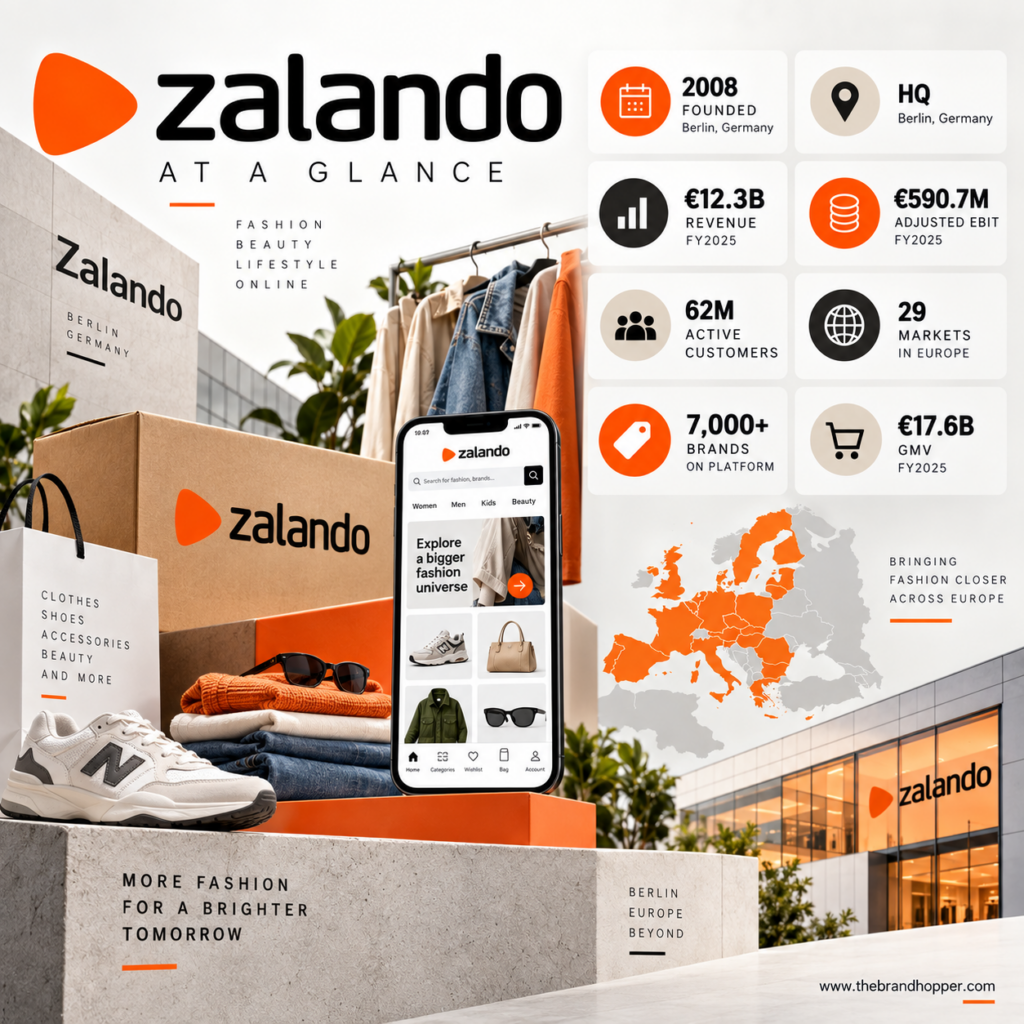
Zalando is Europe’s largest online fashion and lifestyle marketplace, founded in Berlin in 2008 and now serving 50 million active customers across 25 European markets with revenues of €10.6 billion in FY2024. Unlike ASOS, which operates a hybrid wholesale/marketplace model, Zalando has made a decisive strategic pivot toward a pure marketplace platform: brands sell directly to consumers through Zalando’s infrastructure, and Zalando earns a commission while controlling the logistics, returns, and customer experience. Over 3,000 partner brands now sell on Zalando—including Zara itself, which joined the platform, signalling Inditex’s recognition that marketplace presence is essential for digital discovery in Europe.
Zalando’s competitive differentiation from Inditex lies not in design but in curation and convenience. Zalando’s “Fashion Store” model surfaces a vastly broader assortment than any Zara store or Zara.com can offer, with advanced filtering, fit prediction, and free returns in most markets. Its “Zalando Zircle” resale platform addresses the secondary fashion market—a growing segment that neither Inditex nor H&M can address at scale within their own channels. Zalando has also invested in its “Connected Retail” programme, which enables physical fashion stores (including some Inditex-brand stores) to fulfil online Zalando orders from their local inventory—a model that turns Inditex stores into Zalando fulfilment nodes, creating an interesting collaborative-competitive dynamic.
Zalando’s path to sustainable profitability has been challenging: the company only consistently broke into meaningful EBIT profitability from 2023 onward after scaling back aggressive marketing spend and logistics investments from the COVID growth era. For Inditex, Zalando represents the clearest illustration that a multi-brand marketplace can aggregate consumer demand more broadly than any single brand—making Zalando both a competitive threat and a valuable distribution partner. Zalando’s investment in sustainability—including its commitment to halve emissions by 2030 and its Living Wage programme for supply chain workers—positions it as the most credibly responsible fashion platform in Europe.
7. Boohoo (Debenhams Group)
Official Website: debenhamsgroup.com
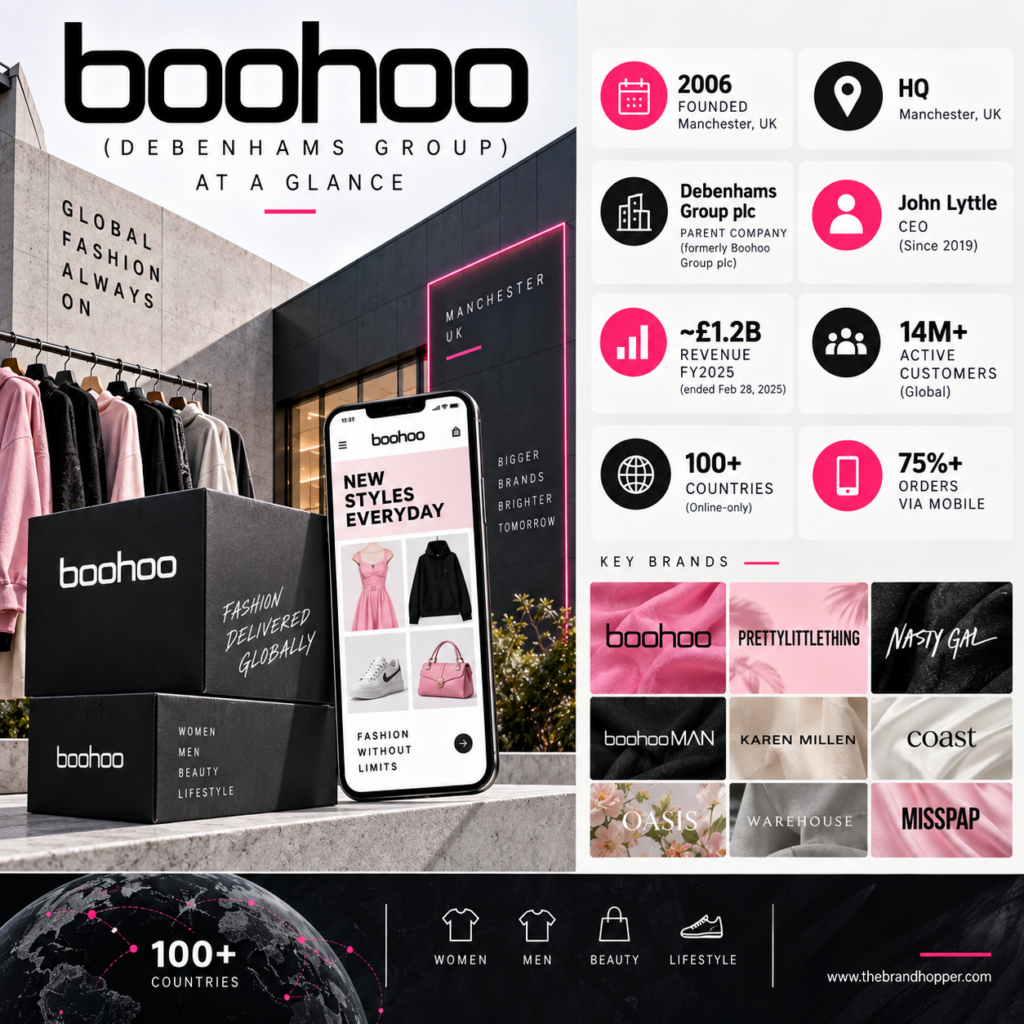
Boohoo—owned by Debenhams Group plc (formerly Boohoo Group plc, rebranded after acquiring the Debenhams brand)—is the Manchester-based online fashion conglomerate that built its empire through radical social-media integration, celebrity influencer collaborations, and price points so accessible they make fast fashion feel slow by comparison. With a portfolio of nine brands—spanning Boohoo (core value-fashion), PrettyLittleThing (partywear), Nasty Gal (vintage-edgy), and acquired brands Karen Millen and Coast (premium positioning)—the group generated approximately £1.2 billion in revenue in FY2025. Boohoo’s business model is built around influencer marketing: it works with thousands of macro and micro-influencers on TikTok and Instagram, generating organic-feeling content that drives direct purchase intent.
Boohoo’s competitive challenge to Inditex operates at a different price tier and demographic layer. Where Zara targets a 25-40-year-old consumer with aspirational fashion at accessible-premium prices, Boohoo primarily targets the 16-30 demographic with ultra-cheap, trend-driven pieces where unit economics are driven by volume rather than margin per item. Boohoo’s challenge is that it entered FY2025 after three consecutive years of revenue decline—from a peak of £1.98 billion in FY2022—as the cost-of-living crisis, rising returns costs, and intensifying competition from Shein eroded its customer base. The company has responded with a “fewer, better” product strategy and tighter focus on its strongest brands.
Boohoo has faced significant reputational scrutiny over supply-chain ethics, following a 2020 investigation into below-minimum-wage working conditions at a Leicester supplier. The company has since implemented a comprehensive Agenda for Change programme, including regular supplier audits, a Living Wage commitment for UK manufacturers, and greater supply-chain transparency. This matters competitively because younger fashion consumers increasingly factor brand ethics into purchase decisions—an area where Boohoo is rebuilding trust. Visit
Boohoo Group plc investor site for the latest trading updates and brand portfolio performance.
8. Shein
Official Website: shein.com / us.shein.com
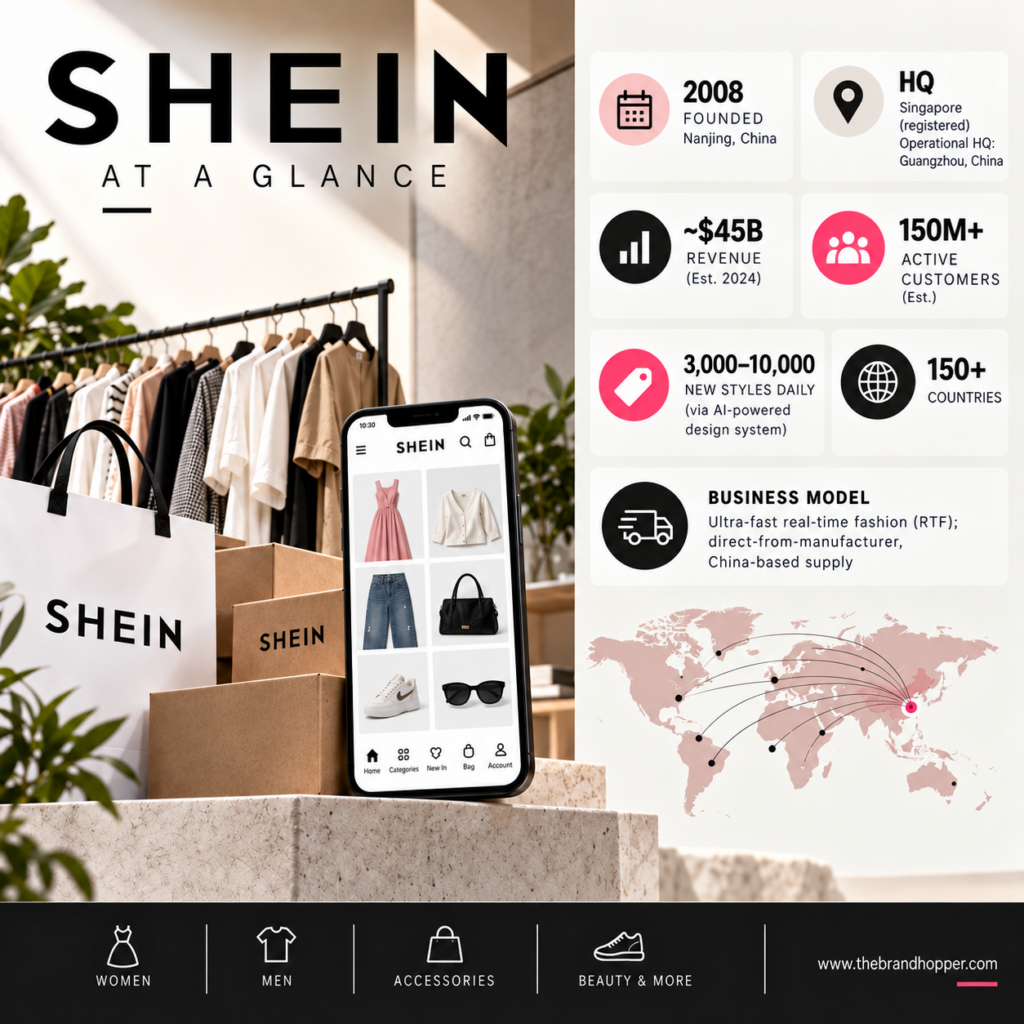
Shein is arguably the most strategically disruptive force in global fashion over the last decade—a Chinese-founded, Singapore-registered ultra-fast fashion platform that has redefined the speed, price, and volume parameters of the industry. Shein’s “Real-Time Fashion” (RTF) model uses AI-powered design tools and demand-sensing algorithms to identify micro-trends from social media, generate design briefs, and ship finished products from Guangzhou suppliers in as few as 3-7 days. With an estimated $45 billion in revenue in 2024 (making it larger than H&M on revenue, though privately held and unaudited), Shein has achieved in 15 years what it took H&M and Inditex decades to build—by eliminating inventory risk almost entirely through micro-batch production.
Shein’s competitive model is fundamentally different from Inditex’s. Where Inditex controls design, manufacturing, and retail vertically, Shein operates as an asset-light intermediary connecting independent Chinese manufacturers to a global consumer base via a gamified, algorithm-driven app. Prices run 60-80% below Zara on equivalent product categories—a chasm that no traditional fashion retailer can close through operational efficiency alone. Shein adds 3,000-10,000 new styles daily, testing each in micro-batches of 50-100 units, only reordering bestsellers—an inventory model that reduces unsold stock risk to near-zero. The platform has over 150 million active customers globally, with particularly deep penetration among Gen Z females in the US, UK, and Southeast Asia.
Shein’s core vulnerabilities are regulatory and reputational. Its de minimis import exemption advantage in the US (duty-free shipments under $800) is under sustained congressional pressure, and the EU is implementing Digital Services Act obligations that will require greater transparency on product safety and supply-chain practices. Shein faces ongoing scrutiny over intellectual property (copying independent designers’ work), environmental impact (ultra-fast fashion’s carbon intensity), and labour conditions at its supplier base. To address these concerns ahead of a planned IPO, Shein has announced multi-million-dollar sustainability funds, launched a resale platform (“Shein Exchange”), and committed to third-party supply-chain audits. Visit
Shein US for current collections and the latest sustainability disclosures.
9. Fashion Nova
Official Website: fashionnova.com
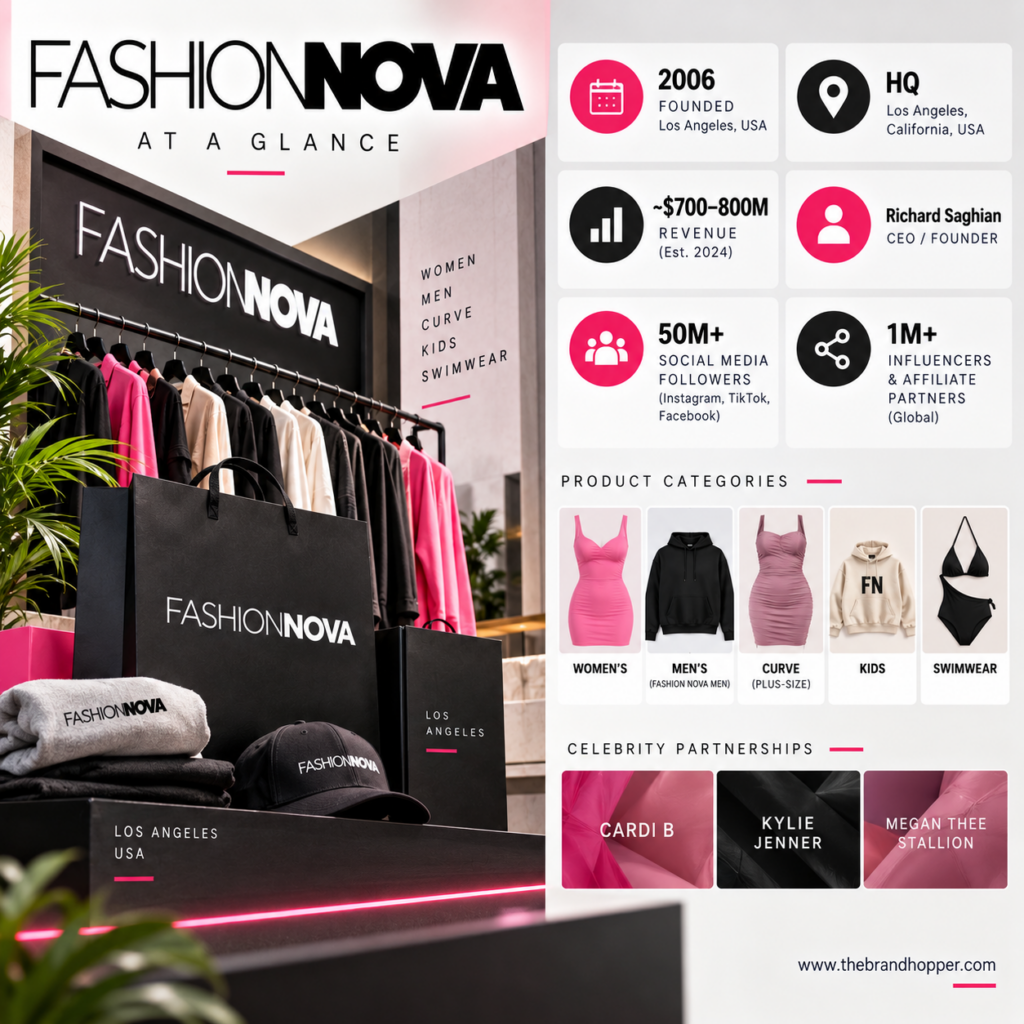
Fashion Nova is the Los Angeles-born fast-fashion brand that turned Instagram into a retail channel before the term “social commerce” had been coined. Founded by Richard Saghian in 2006 as a single small boutique in the Los Angeles area, Fashion Nova pivoted entirely to e-commerce and influencer marketing by 2013—becoming, by some measures, the most-searched fashion brand on Google in the US by 2018. Its formula is elegantly simple: work with thousands of influencers (from A-list celebrities like Cardi B and Megan Thee Stallion to micro-influencers with 10,000 followers), flood their feeds with affordable, figure-flattering pieces, and fulfil orders with 24-hour turnaround from LA-area domestic manufacturers. At an estimated $700-800 million in annual revenue, Fashion Nova punches well above its size in cultural influence.
Fashion Nova competes with Inditex at the intersection of price, social currency, and size inclusivity. Its Curve collection—which launched as a standalone product line, not a grudging add-on—has made Fashion Nova the aspirational brand for plus-size consumers underserved by Zara and most other fast-fashion peers. Fashion Nova Men, launched in 2017, extends the model to male streetwear—a segment where Inditex’s Bershka and Pull&Bear compete but without the influencer authenticity that Fashion Nova brings. Where Zara creates aspiration through minimalist design and store experience, Fashion Nova creates aspiration through celebrity adjacency: wearing the same Cardi B-collab dress as your Instagram idol for $35 is a powerful emotional proposition.
Fashion Nova’s growth challenges include an FTC settlement over fake reviews and delayed refunds (resulting in a $4.2 million penalty in 2022), ongoing IP disputes with luxury brands over design copying, and growing pressure from Shein and Temu at the ultra-low price tier. The brand has responded by strengthening its influencer roster, launching Fashion Nova x Cardi B as a permanent collaborative line, and investing in its own fashion app to reduce dependence on Instagram’s algorithm. Unlike Inditex or H&M, Fashion Nova has no retail stores—a feature, not a bug, in its cost structure. Visit
Fashion Nova Official Website for current collections and influencer collaboration updates.
10. Temu
Official Website: temu.com
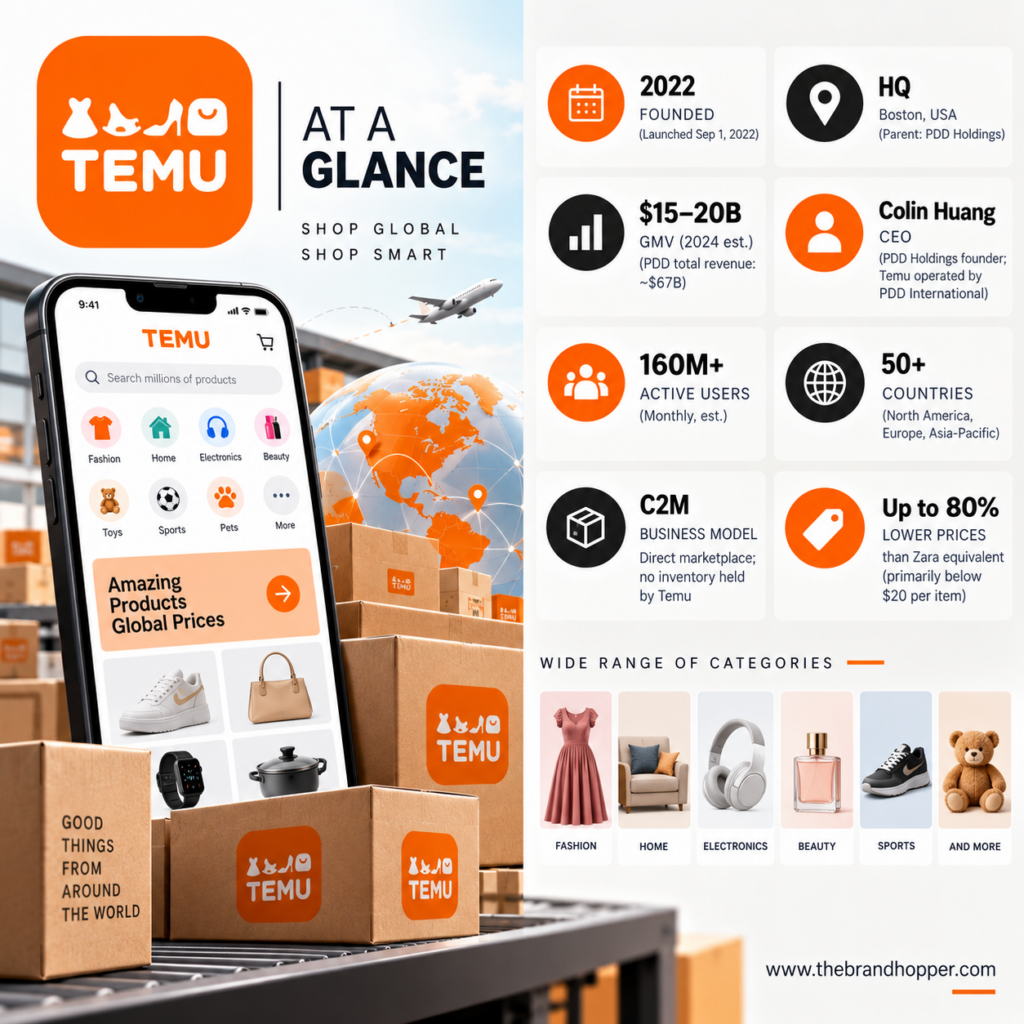
Temu—launched in September 2022 by Chinese e-commerce giant PDD Holdings—is the fastest-growing shopping platform in history, reaching 82 million downloads in the US within its first year and accumulating an estimated 160 million monthly active users globally within 24 months of launch. Its model is structurally different from Shein: rather than owning a supply chain of partner manufacturers, Temu is a pure marketplace connecting Chinese manufacturers directly to global consumers via a gamified, hyper-promotional app experience. Spin-to-win discounts, flash deals, group-buying mechanics, and seemingly irrational free-shipping offers on $3 orders are funded by PDD Holdings’ estimated $67 billion annual revenue base and its willingness to subsidise user acquisition.
For Inditex and virtually every fashion retailer, Temu represents an existential pricing challenge at the low end of the market. An item that Primark sells for £5 retails on Temu for £1.50; a basic dress Zara prices at €30 can be found in a similar silhouette on Temu for €4. The platform sells far more than fashion (home goods, electronics, tools), but clothing and accessories account for a substantial portion of its assortment—and its presence has measurably suppressed consumer willingness to pay across the fast-fashion category. Temu’s de minimis import advantage (sub-$800 duty-free shipments to the US) is similar to Shein’s and faces similar regulatory scrutiny from the US and EU.
Temu’s quality and authenticity challenges are well-documented: product listings that misrepresent materials, IP violations, and inconsistent sizing have driven high return rates and mixed reviews. The platform has invested in trust mechanisms (buyer protection, product reviews, return guarantees) but remains a “discovery and impulse” destination rather than a brand-loyalty one. For established fashion retailers, the most important strategic response to Temu is not price-matching (impossible) but reinforcing brand, quality, and in-store experience differentiation that platform marketplaces cannot replicate. Inditex’s quality positioning and Zara’s physical store experience—absent from any marketplace—remain durable competitive assets against the Temu model.
11. Mango
Official Website: mangogroup.com
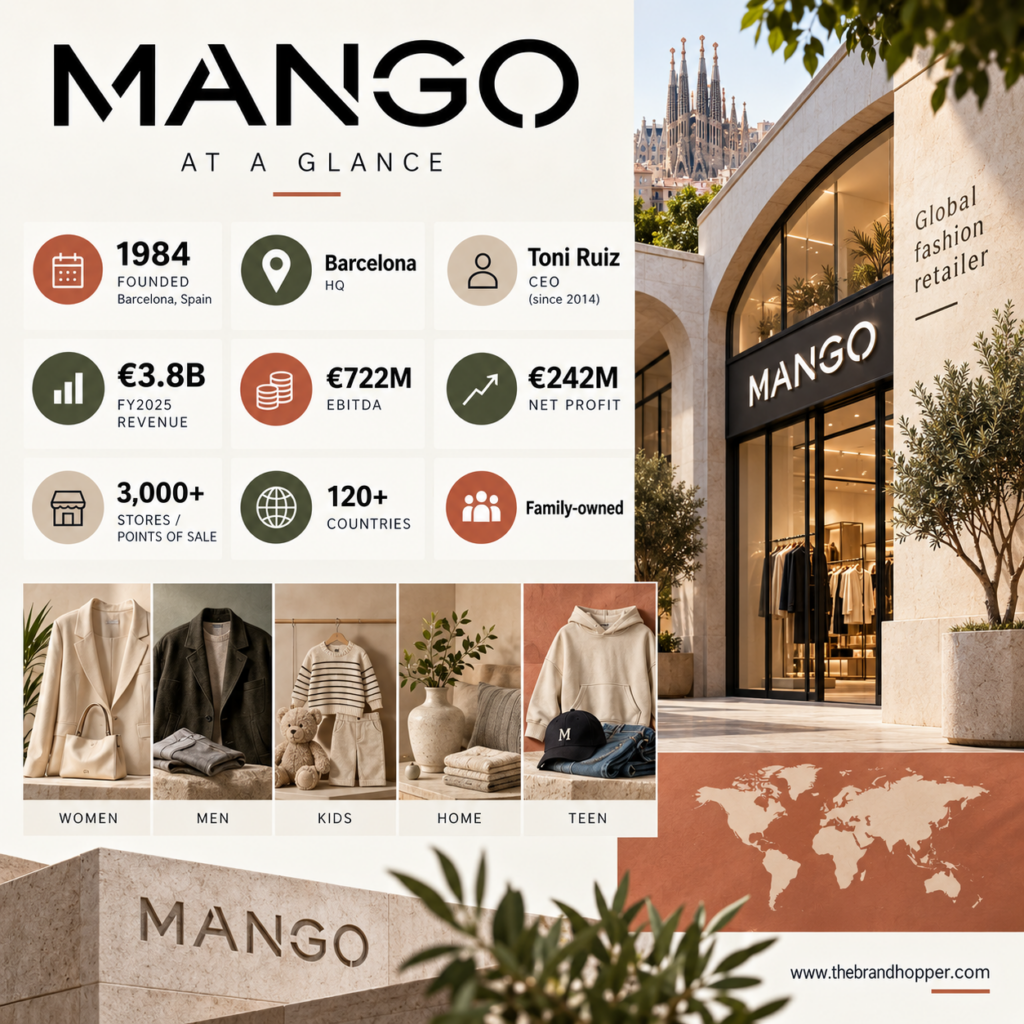
Mango is Barcelona’s answer to Zara—and arguably the most credibly fashionable of all Inditex’s direct Spanish rivals. Founded in 1984 by Isak Andic, Mango has grown from a single Barcelona boutique into a €3.1 billion fashion group with 2,700+ points of sale across 120 countries. Mango’s aesthetic occupies a distinctive niche: Mediterranean sophistication at accessible-premium prices, typically 10-20% above Zara but below premium brands like Massimo Dutti or Banana Republic. The brand is particularly strong in women’s workwear, linen, and tailoring—categories where Zara competes but Mango has sharper design authority. Mango’s FY2024 revenue of €3.1 billion (+12% YoY) demonstrates that mid-priced fashion can still grow healthily when the product and customer experience are well-calibrated.
Mango competes with Inditex across multiple fronts: it shares Inditex’s Spanish heritage, its Barcelona-to-manufacturer supply chain, and its Mediterranean design aesthetic. Its collections are developed in Barcelona and regularly interpreted as direct responses to Zara’s season—sometimes within weeks of Zara’s releases. Mango has accelerated its digital investment significantly: its target is for digital to represent over 40% of total revenue by 2026 (it was approximately 35% in FY2024). Mango has also leaned into celebrity and designer collaborations—including partnerships with Camille Charriere, Nina Ricci, and various Spanish designers—to elevate its fashion credibility and generate press coverage disproportionate to its marketing budget.
Mango’s strategic strength is its franchise model, which accounts for approximately 60% of its store network and allows rapid international expansion with minimal capital investment—a model Inditex does not use for its flagship Zara brand. Mango’s plus-size line “Violeta by Mango” has been relaunched as “Mango Curves” and demonstrates the brand’s commitment to size inclusivity, a growing expectation among fashion consumers globally. Mango’s key challenge is translating its European brand equity into the North American market, where brand awareness remains lower than in Western Europe and the Middle East. Its 2024 US store expansion programme—targeting 40 new US stores by 2026—is its most ambitious growth bet.
12. Bestseller
Official Website: bestseller.com
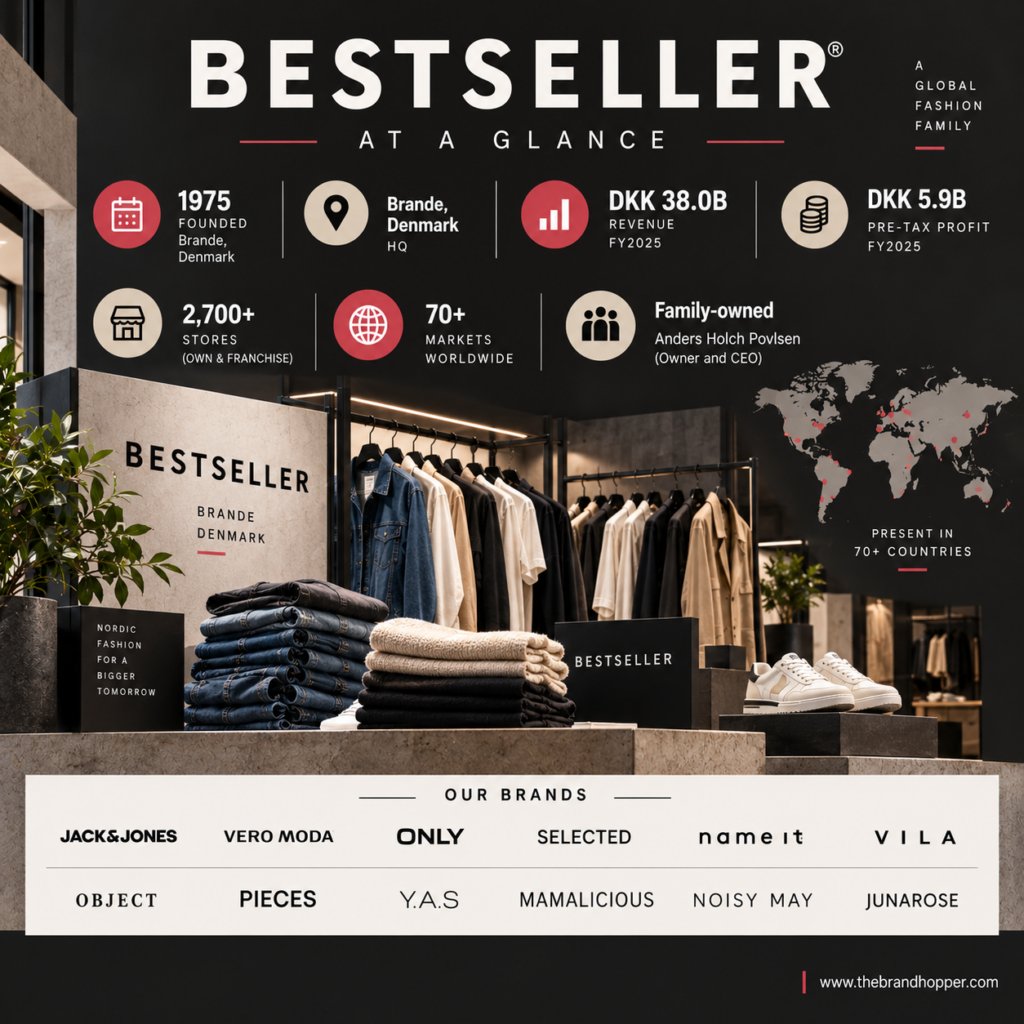
Bestseller is Scandinavia’s largest fashion company—a quietly powerful DKK 32.2 billion ($4.6 billion) conglomerate that most international consumers have never heard of, yet whose brands (Jack & Jones, Vero Moda, ONLY) are ubiquitous in European high streets and shopping centres. The company is 100% privately owned by Anders Holch Povlsen—also the largest private landowner in Scotland and a major shareholder in ASOS—giving it a strategic patience and investment freedom that listed competitors cannot match. Bestseller’s portfolio of 13+ brands covers the full spectrum from affordable youth basics (NOISY MAY) to premium casualwear (Selected Homme), allowing it to compete with Inditex’s multi-brand strategy using a Danish lens.
Bestseller’s primary competitive advantage over Inditex is its deep wholesale infrastructure: while Zara is predominantly direct-retail (own stores, own website), Bestseller brands are sold through department stores, independent boutiques, and franchise partners worldwide—giving them distribution reach that Inditex’s capital-intensive owned-store model cannot replicate at the same speed. Bestseller has also moved aggressively into China, where Jack & Jones is one of the most recognised Western menswear brands among middle-class consumers. The company has positioned its Fashion FWD sustainability programme—targeting 100% sustainable materials by 2025—as a genuine differentiator in markets where textile sustainability is increasingly regulated.
Bestseller’s digital transformation is ongoing: it was historically slower to invest in e-commerce than ASOS or Zalando, but has since built robust direct-to-consumer webstores for all major brands and partnered with Zalando and other platforms for European digital distribution. The company has also established the “Invest FWD” initiative, a dedicated fund backing sustainable fashion start-ups—positioning itself as a sustainability thought leader among European fashion groups. For Inditex, Bestseller is a meaningful competitor primarily in Europe and China, where brand overlap with Bershka, Pull&Bear, and Stradivarius is most direct. Visit
Bestseller Group website for the full brand portfolio and Fashion FWD sustainability targets.
13. Next plc
Official Website: nextplc.co.uk
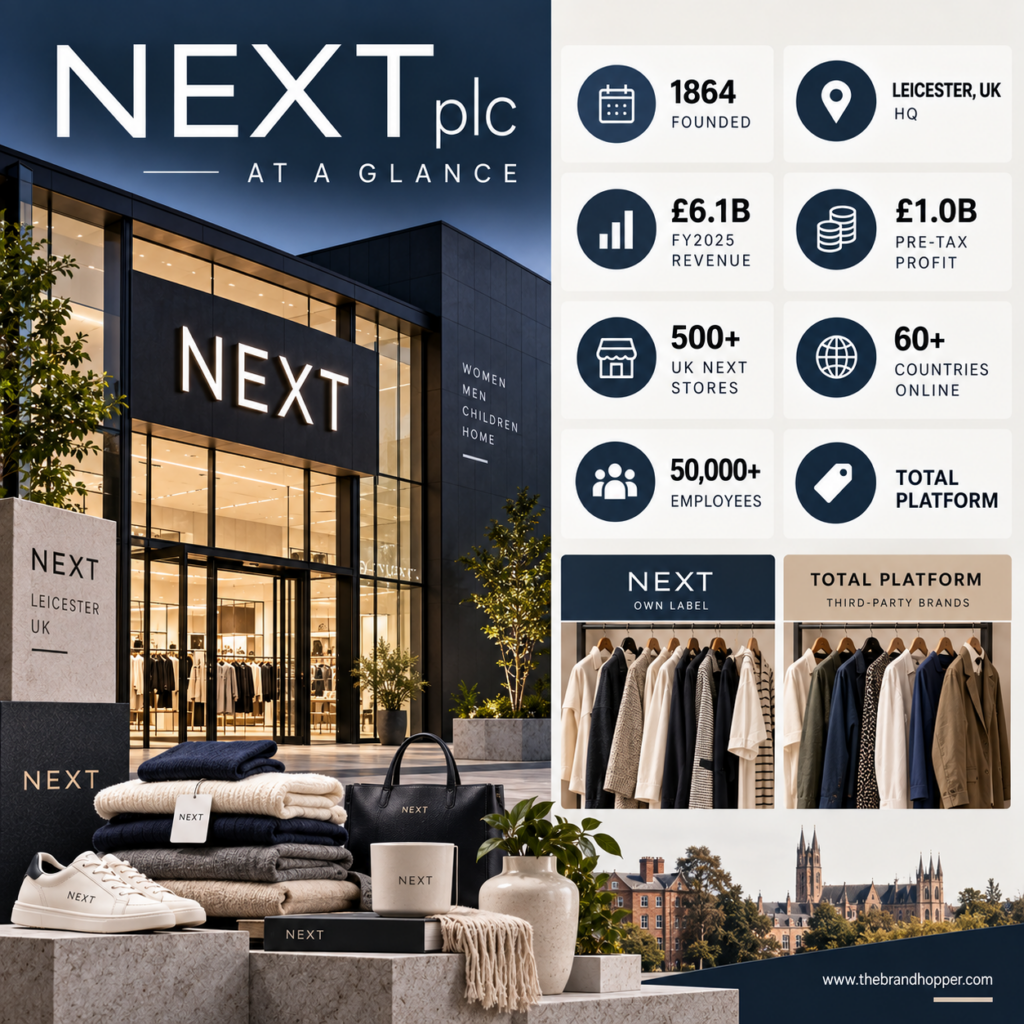
Next plc is the UK’s most profitable mid-market fashion retailer and one of the most sophisticated omnichannel operators in global fashion. Founded in its current form in 1982, Next has evolved from a traditional high-street clothing chain into a genuinely hybrid business: its Next.co.uk website is one of the UK’s most-visited fashion destinations, its NEXT stores maintain market-leading sales density, and its “Total Platform” business now provides end-to-end e-commerce, warehousing, and customer fulfilment services to third-party brands including Reiss, Laura Ashley, FatFace, Gap UK, and numerous others. This platform model is unique in UK fashion retail and creates a revenue stream that is structurally insulated from Next’s own consumer brand performance.
Next’s pre-tax margin of 16.1% is the closest of any major European fashion retailer to Inditex’s 17.5%—an extraordinary achievement for a brand competing at Next’s price point. CEO Lord Simon Wolfson has driven margin discipline across the business through rigorous stock management, controlled promotional activity (Next is one of the few UK fashion retailers that resists deep seasonal discounting), and constant reinvestment in supply-chain efficiency. Next competes with Inditex primarily in the UK womenswear and childrenswear segments, where its combination of quality, value, and convenience (Click & Collect from 500+ stores with next-day turnaround) makes it the default choice for family fashion purchasing.
Next’s most strategically interesting development is its Total Platform international expansion: it now licenses its e-commerce and fulfilment infrastructure to brands in Asia, the Middle East, and Continental Europe—effectively becoming a white-label ASOS for premium brands that want digitally sophisticated DTC capabilities without the capital investment. This positions Next as more of a technology and logistics platform than a pure fashion retailer—a transformation that significantly expands its addressable market beyond UK fashion consumers. For Inditex, Next is the competitor with the most structurally similar operational DNA (own design, own stores, own online, disciplined inventory), making it the most instructive UK-market benchmark.
14. Marks & Spencer
Official Website: marksandspencer.com
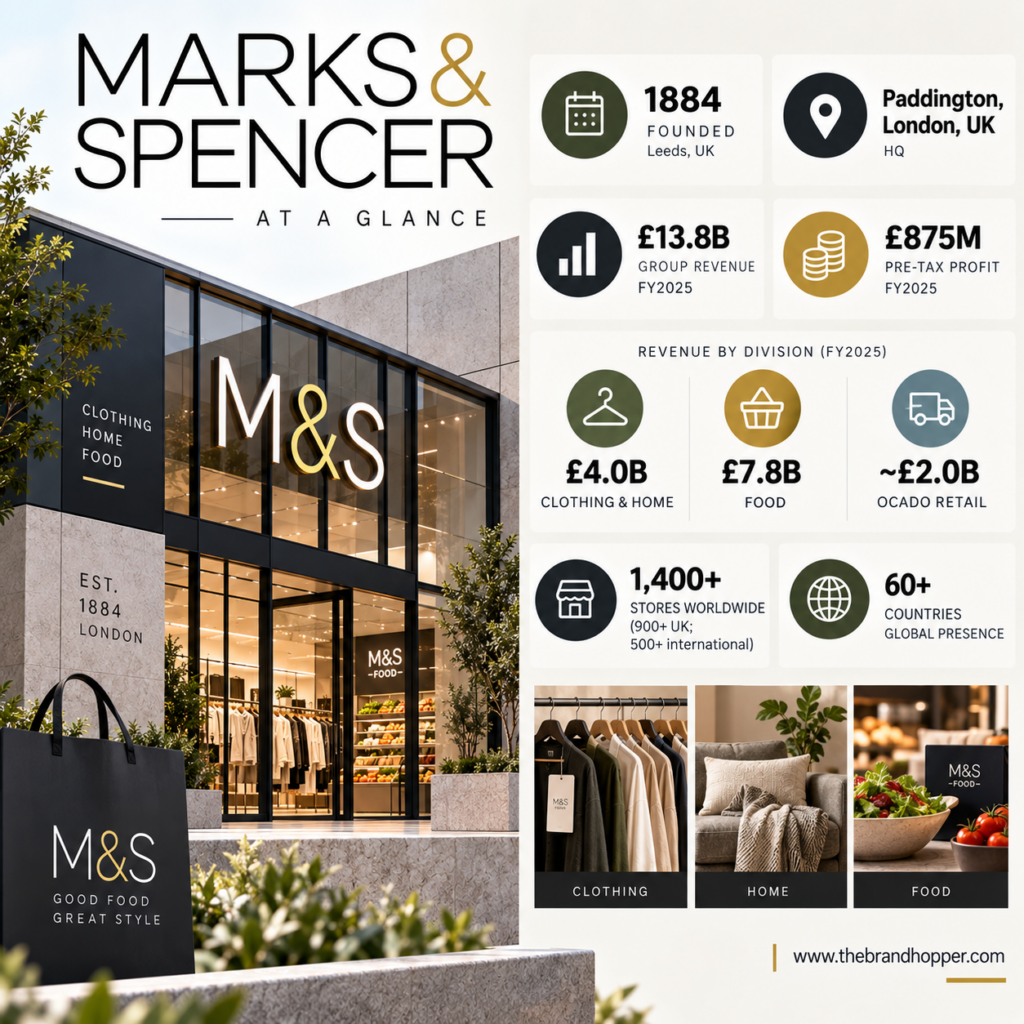
Marks & Spencer is the British retailer that needed no introduction—until about 2015, when it suddenly did. After a decade of declining market share and strategic drift in its clothing division, M&S has executed one of UK retail’s most remarkable turnarounds under CEO Stuart Machin. M&S’s Clothing & Home division grew revenue to £4.0 billion in FY2024/25, with womenswear, lingerie, and childrenswear all gaining market share. The group’s total revenue of £13.8 billion (including its Ocado Retail joint venture) makes it the UK’s third-largest retailer behind Tesco and Sainsbury’s—a scale that provides significant supply-chain, brand, and marketing leverage even outside the clothing category.
M&S competes with Inditex on quality basics, occasion wear, and womenswear in the UK market and across its international franchise markets in the Middle East, India, and Asia. M&S’s competitive advantage is trust: British consumers reliably associate M&S with quality materials, ethical sourcing, and accurate sizing in a way that fast-fashion brands cannot match. Its “Womenswear Edit”—a curated monthly drop of fashion-forward pieces at accessible prices—directly challenges Zara’s seasonal collection model. M&S has also benefited from the “lipstick index” phenomenon in the cost-of-living era: consumers trading down from premium brands often choose M&S as the credibly stylish mid-market option.
M&S’s digital transformation has been accelerated by its partnership structure with Ocado, giving it access to sophisticated AI-powered demand forecasting and fulfilment technology that few fashion retailers can match. M&S’s online fashion sales now represent approximately 35% of Clothing & Home revenue, with particularly strong performance through its app. The brand’s culturally resonant “Percy Pig” confectionery and food-hall status give M&S a cross-category brand affinity that lets it attract clothing shoppers who might not visit a Zara on the same trip. For Inditex, M&S represents a distinctly British competitive threat in the UK’s essential fashion segment—one that is also growing its international franchise footprint in markets where both brands operate.
15. River Island
Official Website: riverisland.com
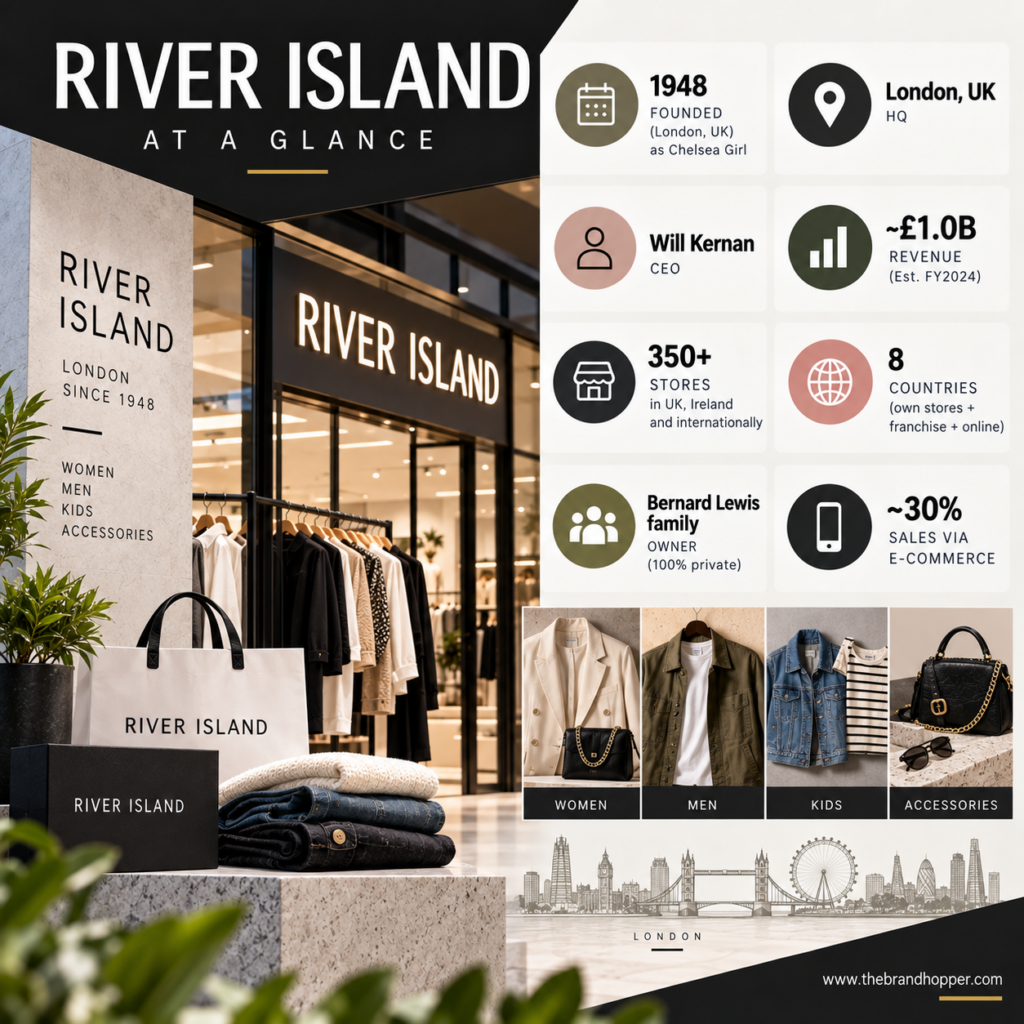
River Island is one of the UK’s most recognisable mid-market fashion brands—a 350+ store chain built on accessible trend-led clothing that has competed with Zara and H&M on British high streets for four decades. Founded in 1948 as Chelsea Girl and rebranded in 1988, River Island has remained in the Lewis family’s private ownership throughout, giving management the freedom to invest in brand and product without quarterly earnings pressure. At an estimated £1.0 billion in annual revenue, River Island occupies the middle ground between Primark’s ultra-value positioning and Zara’s aspirational fast fashion—targeting a 16-35 female shopper who wants trend-forward pieces at accessible prices without the disposability of ultra-fast fashion.
River Island competes with Inditex’s Zara and Bershka directly in the UK high street, where the brands often occupy the same shopping centres and target overlapping demographics. River Island’s competitive differentiator is its bold aesthetic—brighter colours, more overt trend references, and more daring prints than Zara’s typically more restrained palette—and its celebrity and designer collaborations, which generate significant press and social media coverage. The brand has grown its online presence to approximately 30% of sales and launched partnerships with ASOS, Zalando, and Next Total Platform for extended digital reach without additional store investment.
River Island’s sustainability journey reflects the broader challenge for mid-market fashion: its “We Are RI” sustainability programme targets 80% sustainable or recycled materials in its collections by 2030, and the brand has committed to living wages in its supply chain. Its strategic opportunity lies in international digital expansion, where its brand equity is underdeveloped relative to its UK market share. International stores (Ireland, Middle East, Asia) are operated primarily through franchise, allowing River Island to test new markets with limited capital commitment. For Inditex, River Island is a meaningful UK-specific competitor but not a global strategic threat—making it a useful case study in how strong regional brand positioning can sustain a mid-sized fashion business.
16. Ralph Lauren
Official Website: ralphlauren.com
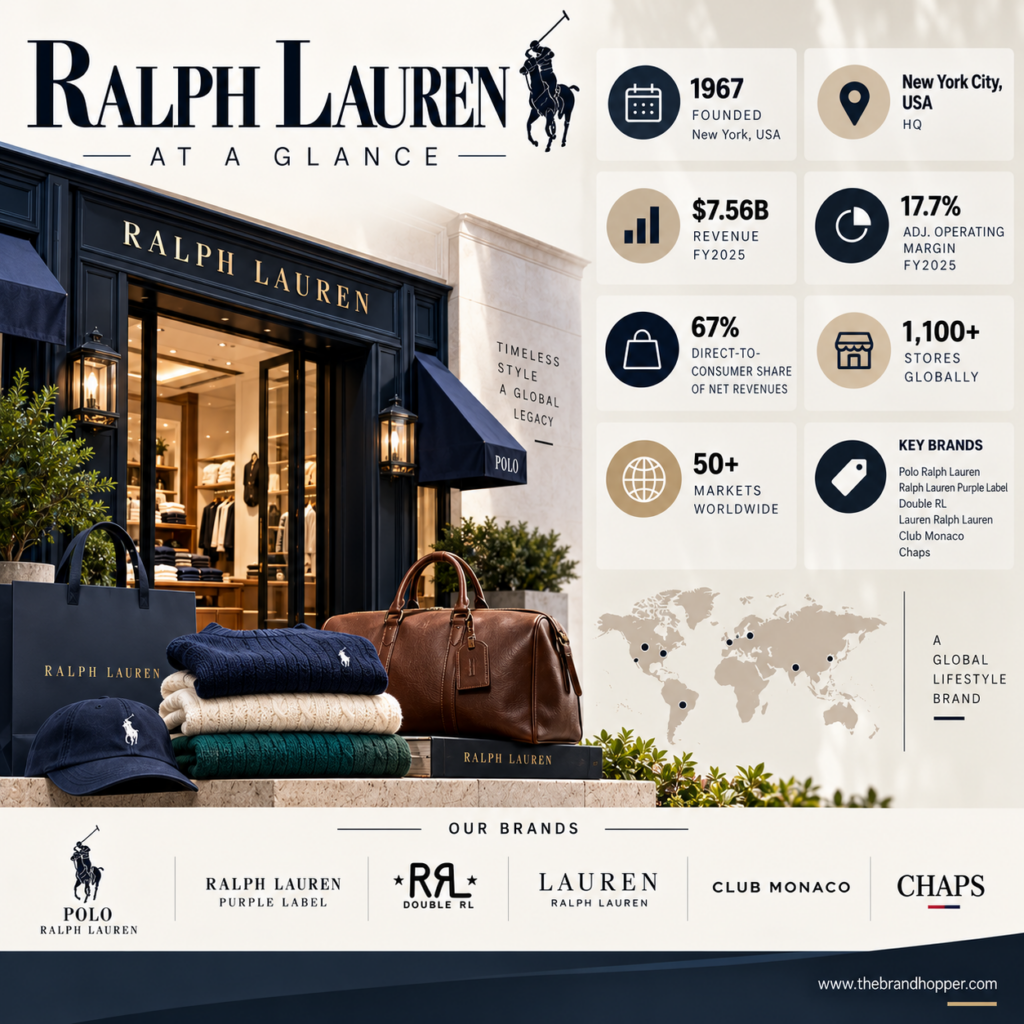
Ralph Lauren Corporation is one of the world’s great premium lifestyle brands—a $7.56 billion fashion empire that has been selling aspirational Americana since Ralph Lauren stitched his name on a necktie in 1967. The Polo pony logo is one of the most recognisable brand marks globally, carrying associations of preppy elegance, country-club aspiration, and New England affluence that no amount of fast fashion can replicate. Ralph Lauren’s FY2025 revenue of $7.56 billion and adjusted operating margin of 17.7%—essentially matching Inditex’s margin—demonstrate that the brand’s DTC-led, premium-positioning strategy generates superior economics to most fashion peers.
Ralph Lauren competes with Inditex’s Massimo Dutti and Zara at the upper-mid and premium tiers of the market, targeting consumers who are trading up from fast fashion. Its 67% direct-to-consumer revenue share—built through its own stores, Ralph Lauren.com, and the Polo app—means Ralph Lauren has deep control over the customer relationship and pricing integrity. The brand has been particularly strong in North Asia (Japan, South Korea, China), where Western heritage fashion commands premium premiums from affluent younger consumers. Ralph Lauren’s FY2025 performance was underpinned by Core brands (Polo, Lauren) growing in mid-single digits, and its digital business growing faster than its physical store base.
Ralph Lauren’s strategic “Next Great Chapter: Accelerate” plan through FY2028 targets 5-7% annual revenue growth, sustained operating margins above 15%, and significant expansion in Asia-Pacific and direct digital channels. The company has invested in experiential retail (its Ralph’s Coffee cafes, gallery-like flagship stores in New York, Paris, and Tokyo) that position the brand as a cultural destination rather than just a clothing retailer—a model that Inditex’s Zara cannot easily replicate. For value-oriented shoppers, Ralph Lauren’s Polo brand at mid-tier department stores and outlet channels creates overlap with Zara’s premium segments; for aspirational shoppers, it represents the natural next step up from Zara’s highest price tier.
17. PVH Corp
Official Website: pvh.com
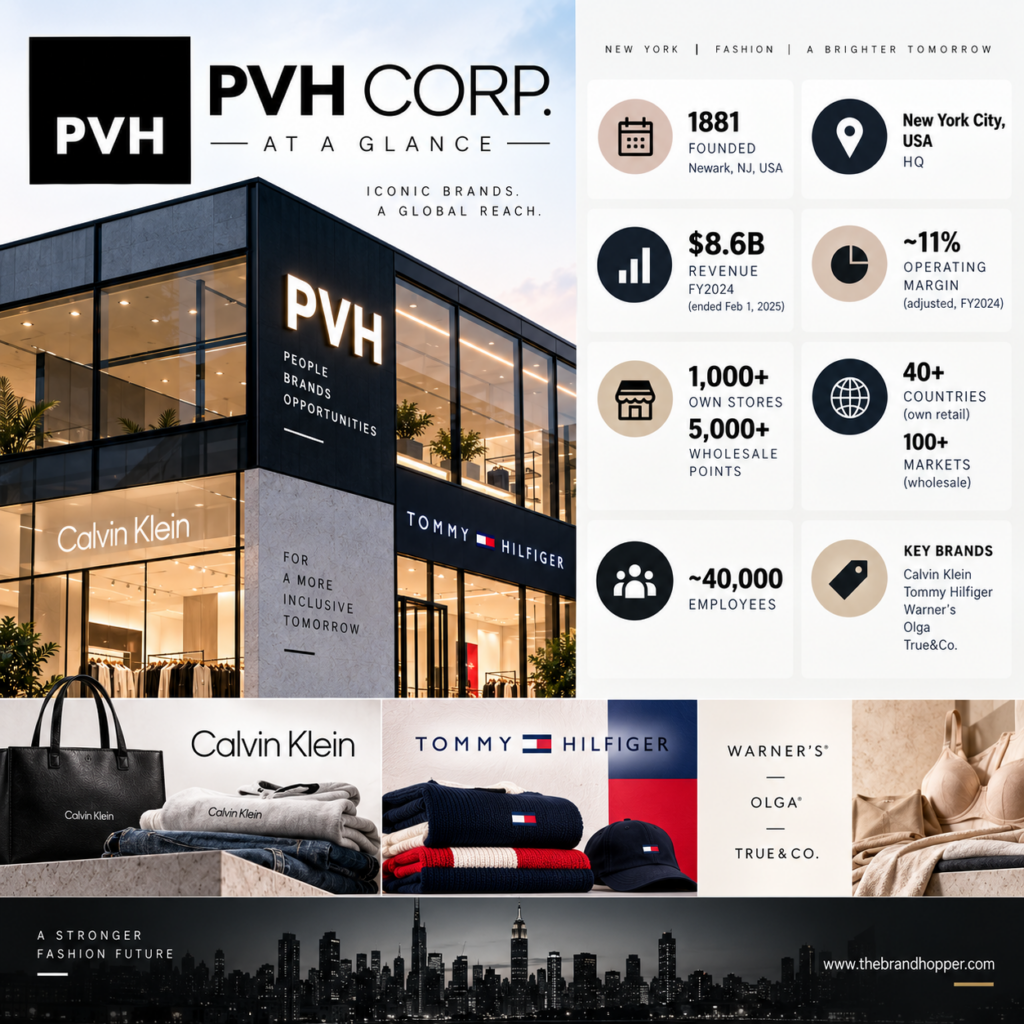
PVH Corp is the New York-based fashion conglomerate that owns Calvin Klein and Tommy Hilfiger—two of the world’s most culturally resonant fashion brands—with combined global revenues of $8.6 billion in fiscal year 2024. Calvin Klein, founded in 1968 and acquired by PVH in 2003, is the more youth-skewing and premium of the two brands, renowned for its minimalist aesthetic and provocative advertising heritage (think the iconic Brooke Shields jeans campaign, and the more recent Jeremy Allen White Calvin Klein underwear campaign of 2024 that became a genuine cultural moment). Tommy Hilfiger, acquired by PVH in 2010, is the more accessible American lifestyle brand—preppier, wider distribution, and with particular strength in Europe and Asia.
PVH competes with Inditex at multiple price points and across different product categories. Calvin Klein Jeans and Calvin Klein Performance compete directly with Zara’s jeans and activewear collections at similar price points, but with the additional premium of brand cachet that Zara’s own-label cannot fully replicate. Tommy Hilfiger’s core casualwear—especially its polo shirts, chinos, and outerwear—competes with Massimo Dutti and the higher tier of Zara in European markets. PVH’s global wholesale distribution network (department stores, multibrand retailers, specialty stores) gives it a reach in markets where Inditex has not yet built direct retail presence—a meaningful competitive advantage in emerging markets.
CEO Stefan Larsson’s “PVH+” strategic plan focuses on elevating the Calvin Klein and Tommy Hilfiger brands as premium lifestyle propositions, reducing dependence on wholesale, and building DTC revenue. PVH divested its Heritage Brands portfolio (Van Heusen, IZOD, Arrow) in 2022 to focus exclusively on Calvin Klein and Tommy Hilfiger—a decisive sharpening of strategic identity. The Jeremy Allen White Calvin Klein underwear campaign of early 2024 demonstrated PVH’s ability to create brand heat through a single cultural moment at virtually no media-buy cost, generating hundreds of millions of earned media impressions and driving measurable sales uplift. For Inditex, PVH is the competitor most capable of converting fast-fashion customers into aspirational brand loyalty. Visit
PVH Corp official website for the latest PVH+ strategic plan updates and brand news.
18. Tapestry Inc.
Official Website: tapestry.com
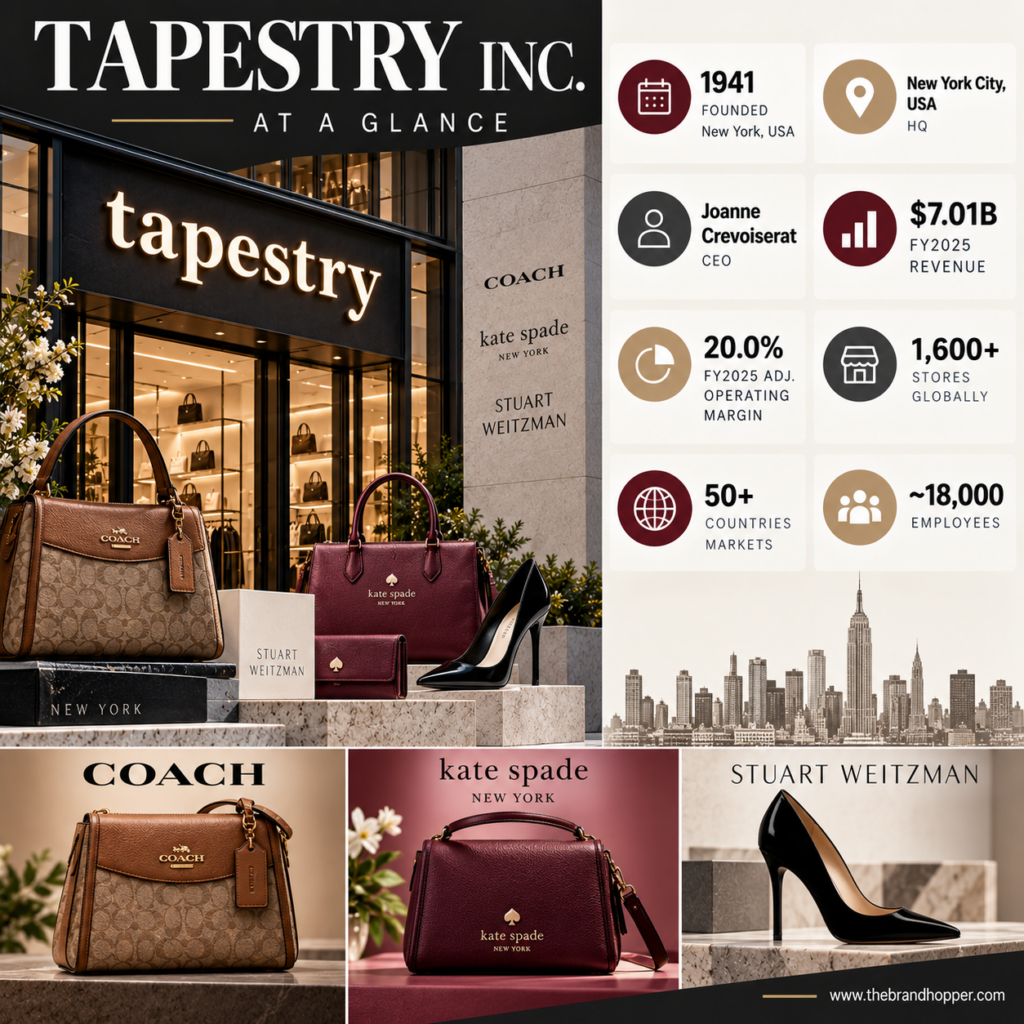
Tapestry Inc.—the New York-based accessible luxury group behind Coach, Kate Spade, and Stuart Weitzman—competes with Inditex in a critically important adjacent market: the consumer who has outgrown fast fashion and is reaching for their first genuine luxury purchase. Coach handbags, Kate Spade accessories, and Stuart Weitzman shoes each occupy the “aspirational luxury” tier (roughly $200-$500 per piece) that represents the natural graduation for a Zara shopper entering their late 20s or 30s. With FY2024 revenues of $6.7 billion and an operating margin of 17.8%—marginally above Inditex’s own margin—Tapestry demonstrates that accessible luxury can generate exceptional returns.
Tapestry’s competition with Inditex is asymmetric: Tapestry doesn’t compete directly on price (its products are 5-10x more expensive than Zara), but it competes fiercely for the same consumer’s wallet—and for brand loyalty at a moment when consumers are deciding whether to remain in the fast-fashion ecosystem or graduate to aspiration. Coach’s deliberate “Coachtopia” circular fashion sub-brand—using only recycled or repurposed materials—and Kate Spade’s vibrant, playful aesthetic both speak to a fashion-forward consumer who values design and sustainability alongside price accessibility. Tapestry’s North America business (60%+ of revenue) is where the competition with premium-seeking Zara shoppers is most intense.
Tapestry’s strategic trajectory was significantly shaped by the failure of its attempted $8.5 billion acquisition of Capri Holdings (Michael Kors, Versace, Jimmy Choo), which was blocked by the FTC in October 2024 on antitrust grounds. Post-Capri, Tapestry refocused on its existing three-brand portfolio—accelerating Coach brand elevation, Kate Spade’s global expansion, and Stuart Weitzman’s repositioning as a fashion-forward footwear brand. For Inditex, the Tapestry ecosystem represents where its most successful and loyal consumers eventually migrate to as their incomes and aspirations grow—making Tapestry both a competitive threat and a useful indicator of where the fashion market’s most commercially valuable consumers are heading.
What Makes Inditex Genuinely Difficult to Beat?
After reviewing 18 of the world’s most capable fashion competitors, it becomes clear that Inditex’s dominance is not accidental—it rests on a combination of structural advantages that are extraordinarily difficult to replicate simultaneously.
First is its vertical integration: by owning design, fabric sourcing, manufacturing (for the fastest-turning 60% of production), distribution, and retail, Inditex eliminates the information latency that creates inventory risk in competitors’ systems. When Zara’s store managers flag that a particular trouser silhouette is selling out in Paris, the Arteixo design team can have a refined version in production within 48 hours—something no brand using external wholesale suppliers can do.
Second is Inditex’s real estate strategy. By consistently securing prime locations in top-performing shopping streets and malls globally—and continuously upgrading store formats to maintain experiential relevance—Inditex ensures that the physical Zara store remains a cultural fixture in cities from London to Seoul to São Paulo.
Third is brand architecture: Inditex’s eight brands allow it to compete across demographics and price points from Oysho (lingerie and activewear) to Massimo Dutti (premium) without any single brand feeling overstretched or diluted.
Fourth—and perhaps most defensible in the long run—is Inditex’s data flywheel: every sale in every store feeds back into a centralised intelligence system that informs design, allocation, and replenishment decisions with a granularity no competitor has yet replicated at comparable scale.
The Future of Global Fashion Retail: Trends Shaping the Next Decade
The global apparel market is being reshaped by six macro-forces that every competitor—including Inditex—must navigate: (1) The AI design revolution, in which platforms like Shein generate styles algorithmically from social data, compressing trend cycles from weeks to days; (2) Sustainability regulation, with the EU’s Green Claims Directive, Extended Producer Responsibility legislation, and Digital Product Passport requirements forcing every fashion brand to demonstrate material traceability; (3) Resale and circular fashion, now a $200+ billion global market (ThredUp, Vinted, Depop, and brand-operated resale programmes) that redirects consumer spending from new clothes to used ones; (4) Social commerce dominance, as TikTok Shop, Instagram Shopping, and live-stream retail in Asia redirect discovery and purchase away from brand-owned channels; (5) Supply-chain near-shoring, as geopolitical risk and rising Asia logistics costs push brands to increase production in Europe, North Africa, and Central America; and (6) AI-powered personalisation, which is transforming digital fashion discovery from editorial curation to hyper-individualised recommendation at scale.
For Inditex specifically, the most significant strategic challenge over the next five years is defending its speed advantage against AI-native competitors like Shein whose design cycle is structurally faster. Inditex’s response includes substantial investment in AI-powered design tools, digital fitting room technology, and in-store RFID inventory intelligence—but the company must also continue building its sustainability narrative as regulatory disclosure requirements intensify.
Zara’s “Zara Pre-Owned” resale and repair programme is an early signal that Inditex is taking the circular fashion opportunity seriously. Companies best positioned to lead in this new landscape will be those that combine operational speed with brand trust, sustainability transparency with price accessibility, and digital intelligence with physical retail excellence—a formula that Inditex has practised longer than any competitor.
Frequently Asked Questions (FAQs)
Q1: Who are Inditex’s biggest competitors?
A: Inditex’s biggest competitors by revenue are H&M Group (~$21.6B), Fast Retailing/UNIQLO (~$20.9B), and Gap Inc. ($15.1B). Its most disruptive competitive threats come from ultra-fast-fashion platforms Shein (~$45B est.) and Temu (~$15-20B GMV est.), which compete on price and speed rather than brand. In Europe, Primark, Zalando, Mango, and Bestseller are the most significant regional challengers.
Q2: Is H&M bigger than Inditex?
A: No. Inditex is significantly larger than H&M by revenue (€38.6B vs H&M’s SEK 234.5B/$21.6B), by store count (7,489 vs 4,381), by number of markets (96 vs 77), and by profitability (operating margin ~17.5% vs H&M’s ~6.3%). Inditex has maintained its position as the world’s largest fashion retailer by revenue since the mid-2010s.
Q3: What is Inditex’s annual revenue?
A: Inditex’s net sales were €38.6 billion in its fiscal year ended January 31, 2025 (FY2025), representing growth of approximately 10.6% versus the prior fiscal year. Net income for the same period was approximately €5.5 billion, and the operating margin was approximately 17.5%. These figures are sourced from Inditex’s official annual results published March 2025.
Q4: How does Zara compare to Shein?
A: Zara and Shein compete at opposite ends of the fast-fashion spectrum. Zara operates 7,489 physical stores, uses vertically integrated supply chains based in Spain and nearby countries, and offers around 10,000-12,000 new styles per season. Shein operates entirely online, adds 3,000-10,000 new styles per day via AI-powered design systems, prices products 60-80% below Zara, and generates an estimated $45 billion in annual revenue with no physical retail. Zara’s competitive advantage is brand prestige, quality, and physical experience; Shein’s is price and algorithmic trend speed.
Q5: What is Inditex’s main competitive advantage?
A: Inditex’s primary competitive advantage is its vertically integrated, near-real-time supply chain. By controlling design, fabric sourcing, manufacturing (for approximately 50-60% of production volume), distribution, and retail, Inditex can move a new design from concept to store in 15-20 days—compared to the industry average of 4-6 months. This eliminates most forecasting risk and allows the company to respond to real-time demand signals from its 7,489 stores. Its data intelligence system—which feeds every sale back into design and allocation decisions centrally—amplifies this advantage at scale.
Q6: Is ASOS a competitor to Zara?
A: Yes, ASOS is a direct competitor to Zara for 18-35-year-old fashion shoppers in the digital channel. ASOS generates approximately £3.54 billion in annual revenue and serves 19.3 million active customers globally through an online-only model offering 800+ brands plus its own ASOS-label collections. Where Zara competes through store experience and design exclusivity, ASOS competes through breadth of choice, AI-powered fit recommendation, and 24-hour delivery in the UK. The two brands overlap most directly on women’s trend fashion in the £15-60 per item range.
Q7: How many brands does Inditex own?
A: Inditex owns eight retail brands: Zara (which generates approximately 69% of group sales), Pull&Bear, Massimo Dutti, Bershka, Stradivarius, Oysho, Zara Home, and Uterqué. Each brand has its own distinct identity, design team, and target demographic. Zara is the flagship and by far the most commercially significant; Massimo Dutti serves the premium segment; Bershka and Stradivarius target younger fashion consumers; Oysho specialises in lingerie and activewear.
Q8: Which country is Inditex’s biggest market?
A: Spain remains Inditex’s home and largest single market, but the Americas (led by the United States) and China are its two most strategically significant growth markets by revenue. Inditex operates in 96 markets globally, with significant presence across Europe (its largest region by revenue), the Americas, and Asia-Pacific. China is one of its fastest-growing markets by store openings.
Q9: What is the difference between Inditex and H&M’s business model?
A: Inditex is vertically integrated—it controls design, manufacturing (60%+ near its Spain headquarters), logistics, and retail end-to-end—and reacts to demand signals in near-real-time (2-4 week replenishment). H&M uses a more traditional buyer-supplier model with longer lead times (4-8 weeks minimum) and competes primarily on price, brand diversity (nine brands), and sustainability communications rather than supply-chain speed. Inditex’s operating margin (~17.5%) is nearly three times H&M’s (~6.3%), primarily reflecting the higher average selling price, lower markdown rate, and superior inventory turns that vertical integration enables.
Q10: Is Mango owned by Inditex?
A: No, Mango is not owned by Inditex. Mango is an independent, family-owned Spanish fashion company, founded by Isak Andic in 1984 and still 100% owned by the Andic family. Its headquarters are in Palau-solitarà i Plegamans near Barcelona, Spain. Despite the shared Spanish origin and similar Mediterranean aesthetic, Mango and Inditex are entirely separate, directly competing companies. Mango generated €3.1 billion in revenue in FY2024—making it one of the few Spanish fashion brands that can credibly claim to be in the same conversation as Zara.
Q11: How does Inditex compete with ultra-fast fashion brands like Shein and Temu?
A: Inditex’s response to ultra-fast fashion platforms focuses on brand differentiation, quality positioning, and physical retail experience—areas where Shein and Temu cannot compete. Zara’s store environment, tactile product quality, and design authority create an experiential premium that digital platforms cannot replicate. Inditex has also launched “Zara Pre-Owned”—a resale, repair, and donation platform—to address the sustainability concerns that Shein and Temu amplify among ethically-minded consumers. Inditex does not attempt to compete on price with ultra-fast platforms; instead, it focuses on moving faster within its existing quality and price tier by investing in AI-assisted design tools and further reducing time-to-market.
Q12: What is Inditex’s sustainability strategy?
A: Inditex’s sustainability framework, called “Join Life” and updated through its “2030 sustainability commitments,” targets 100% of products meeting sustainability standards by 2030, net-zero emissions across the value chain by 2040, and 100% renewable electricity across all its facilities by 2025 (largely achieved in Scope 1 and 2). Zara Pre-Owned—a resale, repair, and donation programme available in the UK, Spain, France, and other markets—is the most consumer-facing sustainability initiative. Inditex is a signatory to the UN Fashion Industry Charter for Climate Action and publishes an annual sustainability report audited by an independent third party, available at inditex.com.
Conclusion
The global fashion retail industry is more competitive, more complex, and more consequential—environmentally and economically—than at any point in its history. Inditex, with €38.6 billion in annual revenues and 7,489 stores across 96 markets, holds a genuine structural advantage in supply-chain speed, brand architecture, and operational profitability. But its 18 major competitors each bring credible strengths: H&M’s brand diversity and sustainability commitment, UNIQLO’s technology-driven quality, Primark’s price discipline, Shein’s AI-native design velocity, Zalando’s European marketplace scale, and Ralph Lauren’s brand equity—to name a few.
The key takeaway for anyone tracking global fashion competition is that no single model has won definitively. Inditex dominates today because it combines speed with quality at a price point the majority of consumers worldwide can access. But the terrain is shifting: AI is flattening the speed advantage, sustainability regulation is raising the compliance bar, and ultra-value platforms are compressing price expectations among younger consumers. The fashion companies that will thrive over the next decade are those that can hold design authority, build genuine brand trust, demonstrate credible sustainability practices, and leverage data intelligently—whether they operate 7,000 stores or zero.
Also Read: Inditex Group: All 8 Brands Explained — Zara & Beyond
To read more content like this, subscribe to our newsletter
Go to the full page to view and submit the form.