


Shein’s ownership story has been one of the most closely watched in global retail, thanks to its low-profile founder, China-based origins, Singapore headquarters, complex private-investor base and long-running effort to enter the public markets. That process finally culminated in September 2026, when Shein completed its Hong Kong Stock Exchange listing.
Understanding who owns Shein today requires looking at two different dimensions: economic ownership and voting control. After the IPO, founder and CEO Yangtian Xu — widely known as Sky Xu — owns approximately 30.3% of the company, while the four co-founders collectively retain close to 60% of the economic interest. More importantly, their weighted-voting-rights structure gives the founding group approximately 90% of Shein’s voting power.
The company is now publicly traded under ticker 0625, but public investors own only a small portion of the total share capital. Shein’s first post-listing financial report, released on September 28, 2026, also provides a much clearer picture of the business: first-half 2026 revenue was $20.13 billion, while second-quarter revenue reached $11.08 billion.
How Shein Began: From a Nanjing E-Commerce Business to Global Fast Fashion
Shein’s corporate history is best dated to 2012, when Yangtian Xu founded the business in Nanjing, China. Shein itself states that its journey began in China in 2012 and that the SHEIN brand was introduced in 2013.
Xu had previously been involved in international e-commerce and search-engine marketing. Earlier ventures associated with him date back to 2008, but the company that became the modern SHEIN business was formally established in 2012.
The business initially focused on cross-border e-commerce, including women’s fashion and wedding-related products, before expanding into a much broader apparel assortment. The SHEIN brand was introduced in 2013 and the company subsequently developed a highly data-driven approach to fashion merchandising.
Rather than relying primarily on traditional seasonal fashion forecasting, SHEIN built a system around identifying consumer demand, testing products in small quantities and rapidly reordering products that performed well. This operating model eventually became known as LATR — Large-scale Automated Test-and-Reorder.
The model combines consumer data, technology, supplier integration and small-batch production. It allows SHEIN to test demand before committing significant inventory, helping the company maintain a very large assortment while limiting inventory risk.

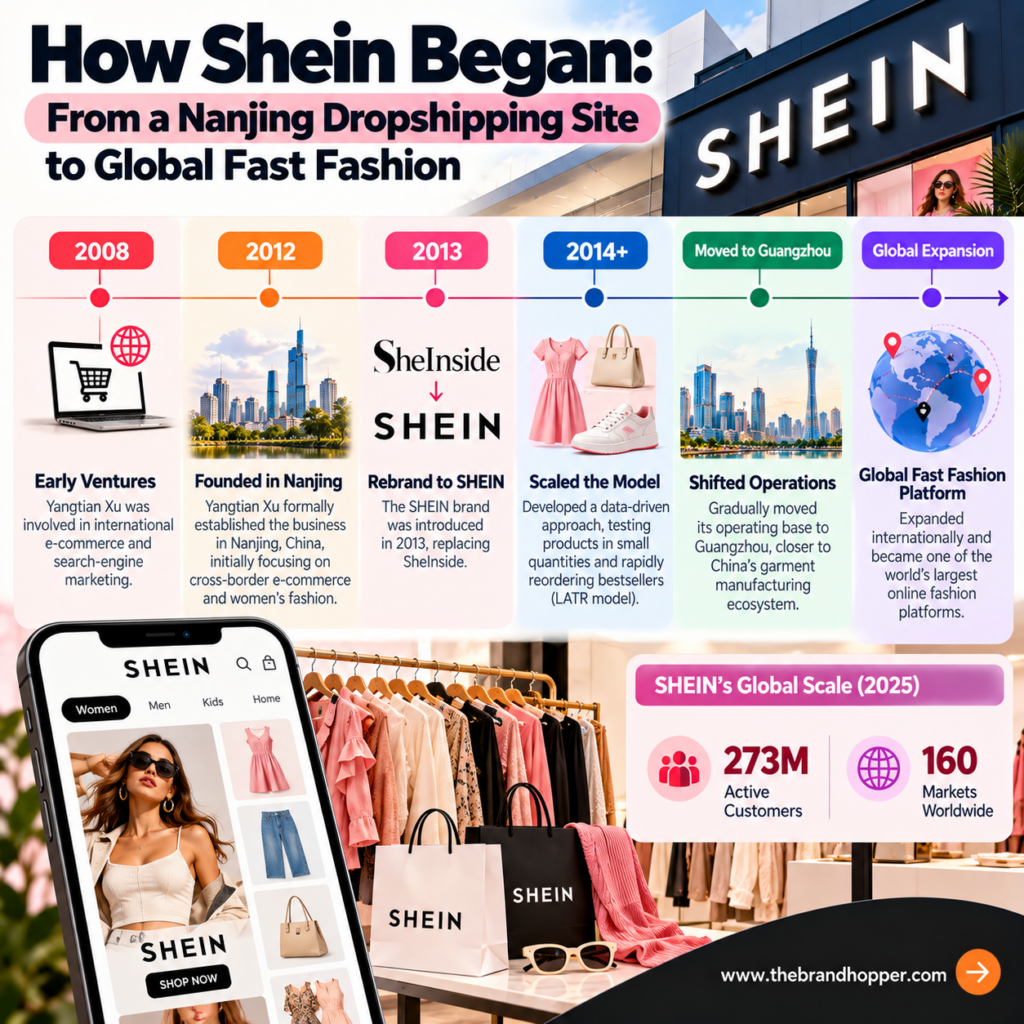
The company eventually moved its operating base from Nanjing toward Guangzhou, placing it closer to the dense garment-manufacturing ecosystem in China’s Guangdong province. It later expanded internationally and became one of the world’s largest online fashion platforms.
SHEIN said it served approximately 273 million active customers across about 160 markets during 2025, illustrating the scale the company had reached before becoming publicly traded.
The Move to Singapore: A Deliberate Corporate Restructuring
One of the most consequential developments in SHEIN’s corporate history was its move of its headquarters to Singapore.
The company was founded in China and continues to rely heavily on manufacturing and supply-chain partners in mainland China, but its corporate structure became increasingly international as SHEIN expanded into the United States, Europe and other markets.
SHEIN is now widely described as Singapore-headquartered, while its listed holding company, SHEIN Global Holdings Limited, is incorporated in the Cayman Islands. The company’s 2026 interim report identifies its Cayman Islands registered office, its principal place of business in mainland China in Guangzhou, and its Hong Kong business address.
The relocation helped SHEIN establish itself as a more internationally structured business as it pursued expansion outside China and explored public-market listings.
However, the corporate relocation did not fundamentally change the company’s manufacturing footprint. A substantial portion of SHEIN’s supply chain remains concentrated in mainland China, particularly around Guangzhou and other manufacturing centres in Guangdong.
That distinction is important: SHEIN is China-founded and heavily connected to China’s manufacturing ecosystem, but its corporate headquarters and listed holding structure are now international.
Major Shareholders and Investors
SHEIN’s ownership is divided between its founding team and a group of major institutional investors that financed the company through several private funding rounds.
Before the IPO, the four founders collectively owned approximately 65% of the company. Following the Hong Kong offering, their combined economic ownership declined to roughly 59.7%, while their weighted voting rights remained around 90%.
Yangtian Xu remains the largest individual shareholder. Following the IPO, his economic interest is approximately 30.3%.
The other three co-founders — Miao Miao, Xiaoqing Gu and Xiaoqing Ren — hold approximately 16%, 6.7% and 6.7%, respectively, according to IPO ownership disclosures.
SHEIN’s post-listing disclosures also identify several substantial institutional shareholders. Its 2026 interim report lists interests associated with IDG Capital, Sequoia Capital, HongShan and Greenwoods, among others.
The IPO also brought in a group of cornerstone investors. These included Boyu Capital, Tiger Global Management, General Atlantic, Tencent, Greenwoods, Taikang Life Insurance and UBS Asset Management Singapore.
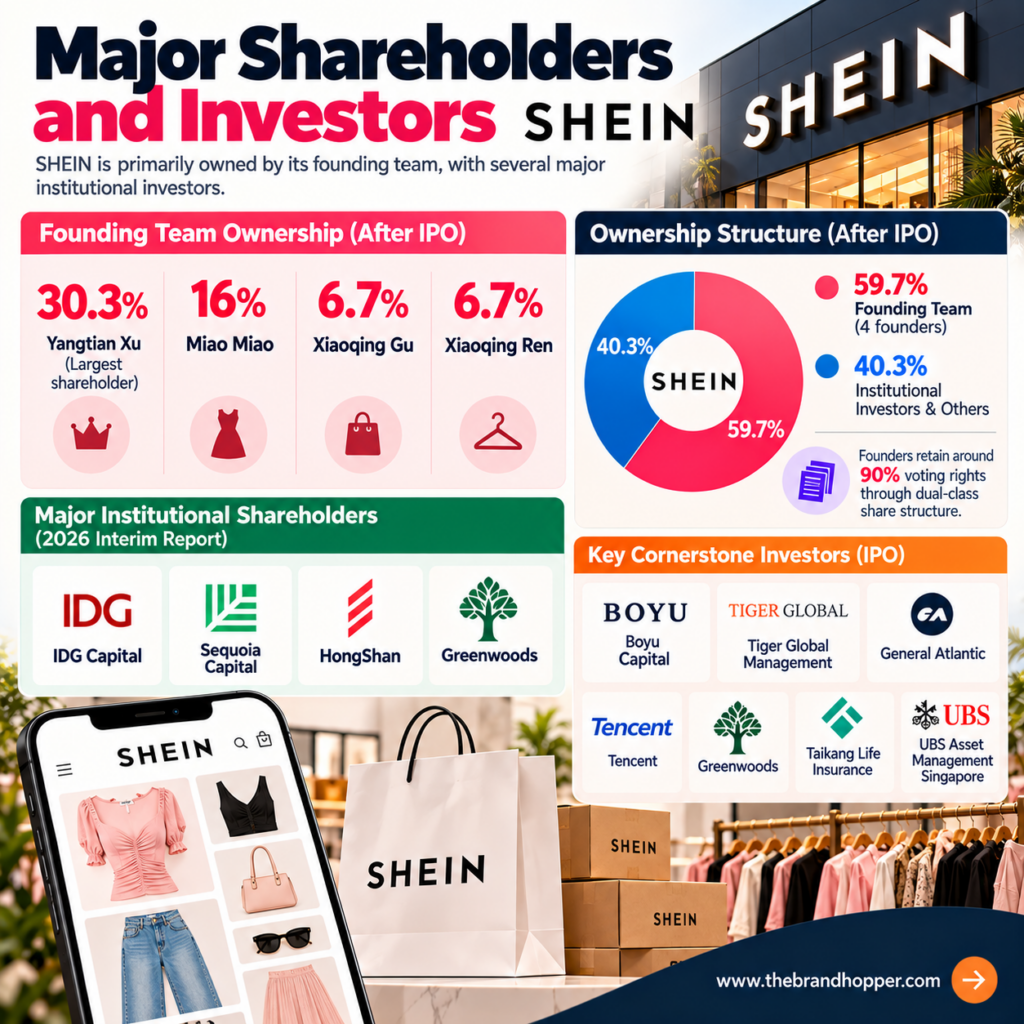
The important distinction is that these investors may hold meaningful economic interests without having comparable voting influence to the founders. SHEIN’s dual-class share structure concentrates voting power with the founding team.
The Long Road to Going Public: New York, London, and Finally Hong Kong
SHEIN’s route to the public markets stretched across several years and multiple potential listing venues.
The company initially pursued a United States listing, but the process encountered significant political, regulatory and supply-chain scrutiny. Concerns included the company’s China connections, labor practices and sourcing issues.
SHEIN subsequently explored a London Stock Exchange listing. That route also faced regulatory and political scrutiny before the company ultimately shifted its focus to Hong Kong.
The Hong Kong route moved forward after China’s securities regulator completed the relevant filing process in July 2026. SHEIN then launched its Hong Kong IPO in August.
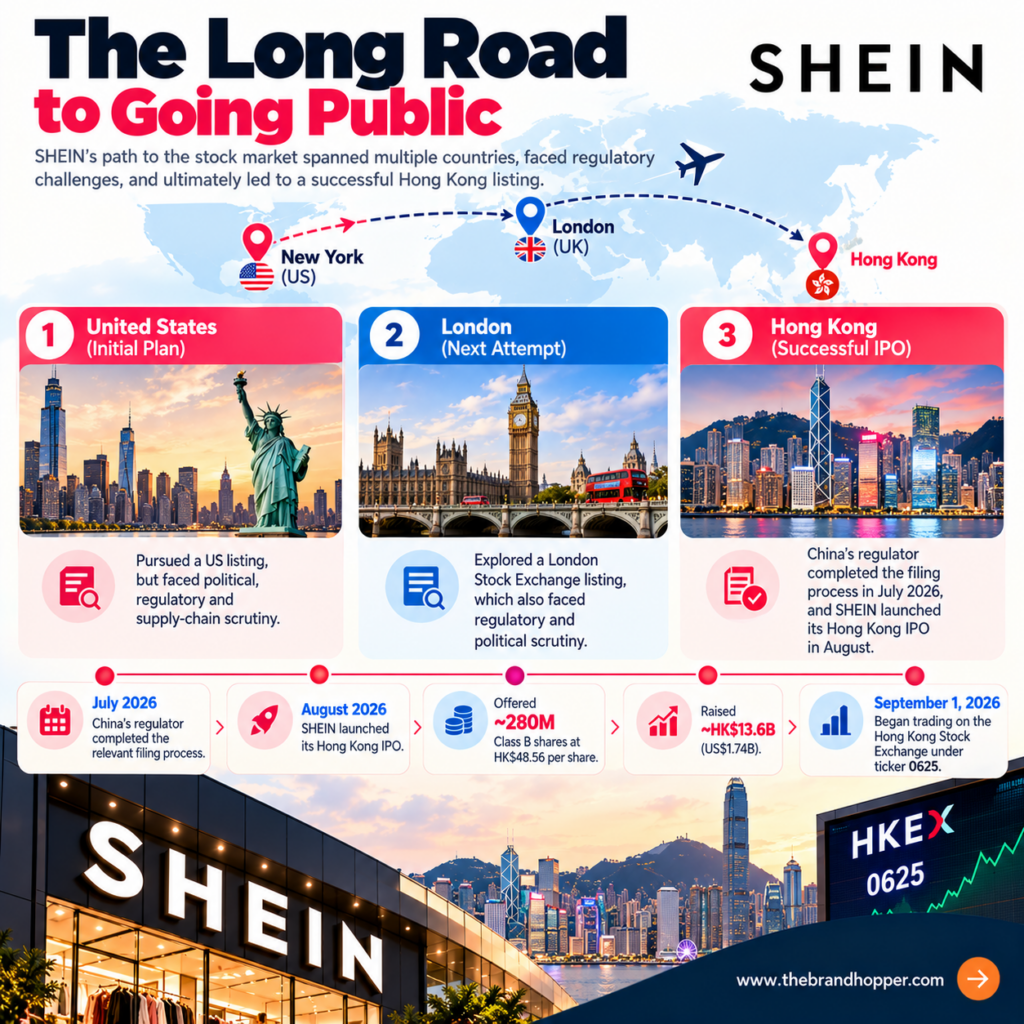
The company offered approximately 280 million Class B shares at a final IPO price of HK$48.56 per share. The offering raised approximately HK$13.6 billion, or about US$1.74 billion.
SHEIN began trading on the Hong Kong Stock Exchange on September 1, 2026, under ticker 0625.
Shein’s Hong Kong IPO: A Dramatic Valuation Reset
SHEIN’s IPO represented a major reset from its private-market valuation.
The company had reached a valuation of approximately $100 billion in 2022 during its private funding period. Its 2023 private-market valuation was approximately $64 billion.
At the final Hong Kong IPO price of HK$48.56, SHEIN was valued at approximately $26.5 billion. The IPO therefore valued the company at roughly one-quarter of its 2022 peak private valuation.
The IPO itself represented only about 6.6% of the company’s enlarged share capital, leaving the vast majority of the company’s shares with founders and existing investors.
SHEIN’s first trading day was volatile. Shares fell as much as 10% intraday before recovering some of the losses.
The decline continued after the listing. On September 29, 2026, following the company’s first post-IPO earnings report, SHEIN shares fell as much as 14% and the company’s market value dropped to approximately $17 billion, according to Reuters.
That means the company’s public-market value had fallen substantially below even its $26.5 billion IPO valuation within the first month of trading.
The valuation reset reflects a combination of slower revenue growth, pressure on profitability, higher fulfilment and freight costs, U.S. and European trade-policy changes, and increasing scrutiny of SHEIN’s business model.
Shein’s Financial Performance
SHEIN’s IPO disclosures provided the first detailed public look at its financial performance, showing that the company’s rapid growth had slowed considerably.
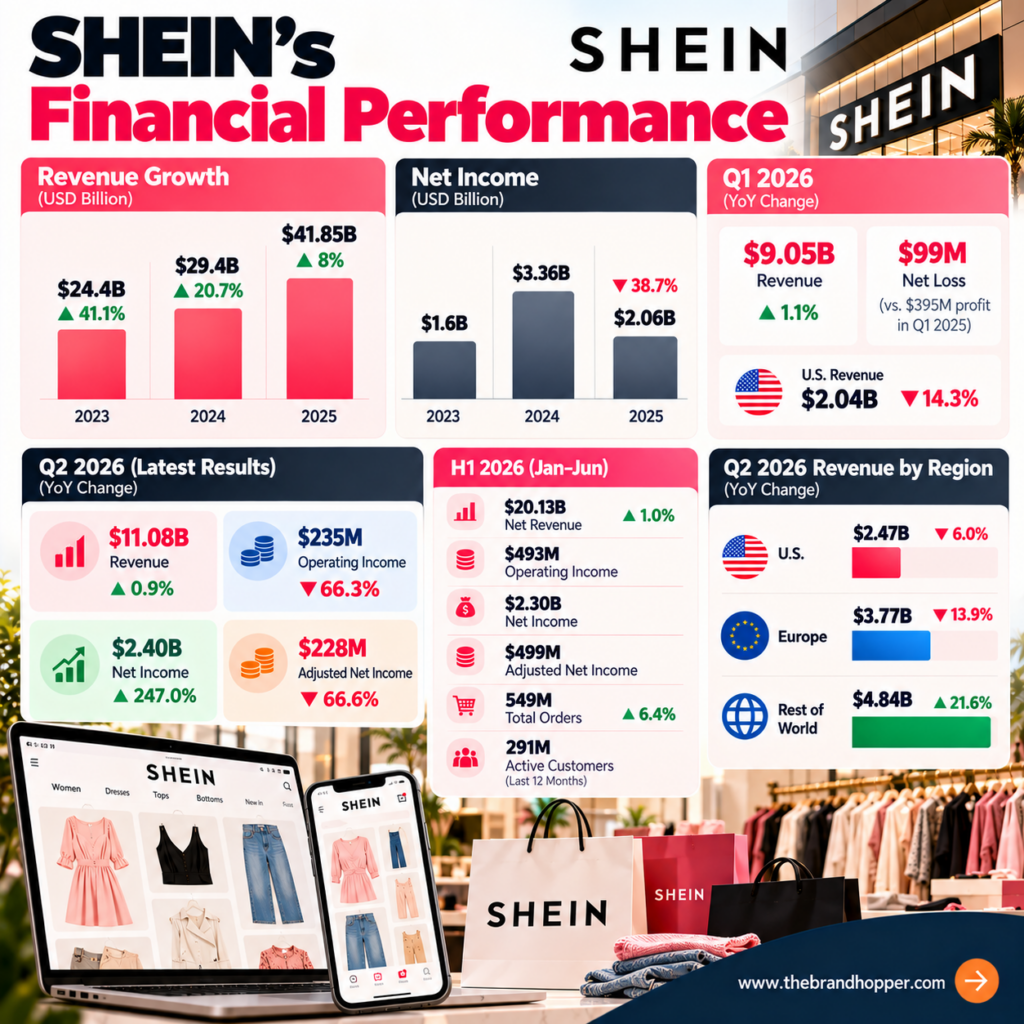
SHEIN attributed the European decline partly to higher prices and lower online advertising ahead of the removal of the EU’s €150 customs-duty exemption for low-value consignments from July 1, 2026.
The company’s fulfilment expenses also increased 18.1% year over year in Q2, with SHEIN citing higher order volumes as well as elevated oil and freight costs linked to geopolitical tensions in the Middle East.
The latest results therefore show a business that continues to generate more than $11 billion in quarterly revenue, but with significantly lower adjusted profitability than a year earlier.
Why Shein’s Ownership Structure Matters
SHEIN’s ownership structure is unusual because economic ownership and voting control are heavily separated.
The company operates with a dual-class share structure in which founder-controlled Class A shares carry substantially greater voting rights than the Class B shares sold to public investors.
The four co-founders — Yangtian Xu, Miao Miao, Xiaoqing Gu and Xiaoqing Ren — collectively control approximately 90% of the company’s voting rights after the IPO. Class B shares held by public investors carry only one-tenth of the voting power of the founders’ Class A shares.
At the same time, the founders’ combined economic ownership is considerably lower, at approximately 60% after the IPO.
Yangtian Xu alone holds approximately 30.3% of the company’s economic interest.
The structure therefore means that SHEIN is publicly traded, but the founders retain overwhelming voting control over the company.
The ownership structure is also important because the public float is relatively small. Only about 6.6% of the enlarged share capital was initially offered to public investors, while existing investors and founders retained the majority of the company.
As of September 29, 2026, the market’s valuation of SHEIN had fallen further to approximately $17 billion following its first public-company earnings report.
Shein Ownership at a Glance
| Category | Detail |
|---|---|
| Founded | 2012, Nanjing, China |
| SHEIN brand introduced | 2013 |
| Founder / CEO / Chairman | Yangtian Xu (Sky Xu) |
| Co-founders | Miao Miao, Xiaoqing Gu, Xiaoqing Ren |
| Corporate headquarters | Singapore |
| Listed holding company | SHEIN Global Holdings Limited, incorporated in the Cayman Islands |
| Xu’s economic stake after IPO | ~30.3% |
| Founders’ combined economic stake | ~59.7% |
| Founders’ combined voting power | ~90% |
| Major disclosed institutional holders | IDG Capital, Sequoia Capital, HongShan, Greenwoods, among others |
| Major IPO cornerstone investors | Boyu Capital, Tiger Global, General Atlantic, Tencent, Greenwoods, Taikang Life, UBS Asset Management Singapore |
| Public listing | Hong Kong Stock Exchange |
| Ticker | 0625 |
| Listing date | September 1, 2026 |
| IPO shares offered | ~280 million Class B shares |
| IPO price | HK$48.56 per share |
| IPO proceeds | ~HK$13.6 billion / US$1.74 billion |
| IPO valuation | ~US$26.5 billion |
| Initial public float | ~6.6% of enlarged share capital |
| 2025 revenue | $41.85 billion |
| 2025 net income | $2.06 billion |
| H1 2026 revenue | $20.13 billion |
| Q2 2026 revenue | $11.08 billion |
| Q2 2026 adjusted net income | $228 million |
| Q2 2026 reported net income | $2.40 billion |
| Latest reported market value | Approximately $17 billion during September 29, 2026 trading |
Key Takeaways
SHEIN’s ownership changed significantly when the company completed its Hong Kong IPO on September 1, 2026, but the public listing did not result in a transfer of control away from its founders.
Founder and CEO Yangtian Xu holds approximately 30.3% of SHEIN’s economic interest, while the four founders collectively retain approximately 60% of the company’s economic ownership. More importantly, the dual-class structure gives the founding team approximately 90% of the voting power.
Institutional investors remain important shareholders. Post-listing disclosures identify substantial interests associated with IDG Capital, Sequoia Capital, HongShan and Greenwoods, while the IPO’s cornerstone investors included Boyu Capital, Tiger Global, General Atlantic, Tencent, Greenwoods, Taikang Life Insurance and UBS Asset Management Singapore.
The IPO also marked a substantial valuation reset. SHEIN was valued at approximately $26.5 billion at its IPO, compared with the roughly $100 billion private-market valuation associated with its 2022 funding round.
The public-market reset continued after listing. On September 29, 2026, following the release of its first post-IPO financial results, SHEIN’s market value fell to approximately $17 billion during trading as the stock reached a new low.
Financially, SHEIN remains a very large global fashion platform, generating $20.13 billion of revenue in the first half of 2026. However, growth has slowed sharply. Q2 revenue increased only 0.9% year over year, while adjusted net income fell 66.6% to $228 million.
The headline $2.40 billion Q2 net-income figure was substantially affected by fair-value gains on convertible redeemable preferred shares, making adjusted net income a more useful measure of the quarter’s underlying profitability.
SHEIN therefore enters its public-company era with a distinctive combination: a founder-controlled voting structure, a broad institutional investor base, a relatively small public float, global scale, and significantly slower growth and profitability than during its private-market expansion phase.
Frequently Asked Questions
Q: Who owns Shein?
A: SHEIN is a publicly traded company listed on the Hong Kong Stock Exchange. Founder and CEO Yangtian Xu owns approximately 30.3% of the company’s economic interest, while the four co-founders collectively hold approximately 59.7%. Through the dual-class share structure, the founders collectively control approximately 90% of voting rights.
Q: Did Shein go public?
A: Yes. SHEIN completed its Hong Kong IPO and began trading on the Hong Kong Stock Exchange on September 1, 2026, under ticker 0625.
Q: Who founded Shein?
A: SHEIN’s corporate history dates to 2012, when Yangtian Xu founded the business in Nanjing, China. The SHEIN brand was introduced in 2013. Xu’s co-founders include Miao Miao, Xiaoqing Gu and Xiaoqing Ren.
Q: Is Shein a Chinese company or a Singapore company?
A: SHEIN was founded in China and continues to have a substantial manufacturing and supply-chain footprint there. Its corporate headquarters are now in Singapore, while SHEIN Global Holdings Limited, the listed holding company, is incorporated in the Cayman Islands.
Q: What was Shein’s IPO valuation?
A: SHEIN’s final Hong Kong IPO price of HK$48.56 valued the company at approximately $26.5 billion. This was substantially below the approximately $100 billion private-market valuation associated with its 2022 funding round.
Q: How much of Shein is publicly owned?
A: The initial Hong Kong offering represented approximately 6.6% of SHEIN’s enlarged share capital. The founders and existing investors therefore retained the overwhelming majority of the company’s shares after the IPO.
Q: Who are Shein’s major investors?
A: SHEIN’s major disclosed institutional shareholders include interests associated with IDG Capital, Sequoia Capital, HongShan and Greenwoods. The Hong Kong IPO also attracted cornerstone investors including Boyu Capital, Tiger Global Management, General Atlantic, Tencent, Greenwoods, Taikang Life Insurance and UBS Asset Management Singapore.
Q: How much revenue does Shein generate?
A: SHEIN reported $41.85 billion of revenue in 2025, representing approximately 8% year-over-year growth.
For the first half of 2026, revenue reached $20.13 billion, up 1.0% year over year. Q2 2026 revenue was $11.08 billion, up 0.9%.
Q: Is Shein profitable?
A: Yes, but profitability has come under significant pressure.
SHEIN generated $2.06 billion of net income in 2025, down approximately 38.7% from 2024.
In Q1 2026, the company recorded a $99 million net loss. It returned to reported profitability in Q2, recording $2.40 billion of net income. However, Q2 adjusted net income was only $228 million, down 66.6% year over year, because reported net income was heavily affected by fair-value gains on convertible redeemable preferred shares.
Q: Why did Shein’s valuation fall from $100 billion to its IPO valuation?
A: The valuation reset occurred alongside a sharp slowdown in revenue growth, declining profitability, increased regulatory and trade-policy pressure, and changing economics for low-value cross-border shipments.
SHEIN’s revenue growth slowed from approximately 41.1% in 2023 to 20.7% in 2024 and 8% in 2025. In Q1 2026, growth slowed to 1.1%.
The U.S. removal of the de minimis exemption affected low-value shipments, while changes in European import rules created additional pressure in 2026. In Q2, SHEIN’s U.S. revenue declined 6% and European revenue declined 13.9%.
The IPO therefore took place against a very different financial backdrop from the company’s 2022 private-market peak.
Q: What is Shein worth now?
A: SHEIN was valued at approximately $26.5 billion at its September 2026 IPO price. Following the release of its first post-IPO earnings report, the company’s market value fell to approximately $17 billion during September 29 trading, according to Reuters. Market capitalization can change throughout the trading day.
Also Read: Who Owns Adidas? Parent Company & Brand Portfolio
Also Read: Who Owns L’Oréal? Ownership & Brand Portfolio
To read more content like this, subscribe to our newsletter
Go to the full page to view and submit the form.