


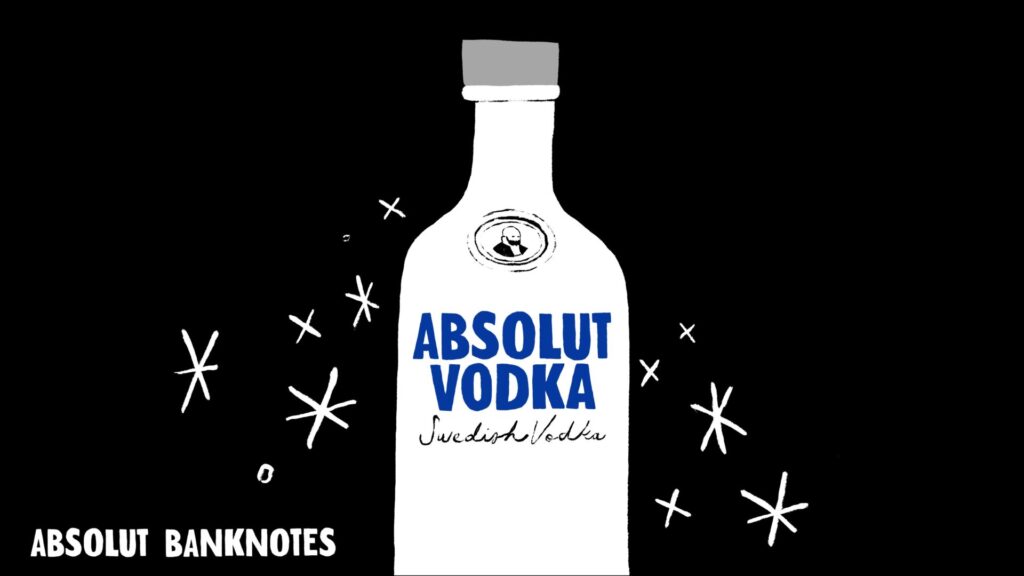
In the 1970s, Swedish drinkers were being actively encouraged to stop drinking hard liquor entirely — a government-backed campaign called “Spola kröken” was designed to push people toward wine instead.
It’s an unlikely starting point for what became, by most measures, the longest-running print advertising campaign in history: 1,500-plus executions over roughly 25 years, an idea so durable it turned a pharmacy-shaped bottle into one of the most recognized packaging silhouettes in the world.
This case study traces the full arc of Absolut’s “bottle” campaign, from a chance find in a Stockholm antique shop to its 2007 retirement, its museum-scale art collection, and Absolut’s very different marketing playbook in 2026.
| Quick Answer: What Was the Absolut Bottle Campaign?
• Launched with “Absolut Perfection” in 1980 by New York agency TBWA, though Absolut Vodka itself entered the U.S. market in 1979. • Ran for roughly 25 years and produced over 1,500 individual print ads before being retired in 2007. • Grew U.S. sales from 10,000 cases in 1980 to 4.5 million by 2000, taking Absolut to roughly 50% of the imported vodka market. • Spawned an 850-plus-piece art collection through collaborations starting with Andy Warhol in 1985; Absolut’s current 2025-2026 marketing runs under the newer “Born to Mix” platform. |
The Unlikely Origins: A Swedish Anti-Drinking Campaign
Absolut’s origin story starts with a real 19th-century figure: L.O. Smith, who set out in the 1870s to produce an “absolutely pure vodka” at a distillery on Reimersholme, a small island in Stockholm.
That heritage is why every bottle of Absolut sold today still carries a small portrait seal of Smith on its label — a direct, deliberate link between a 21st-century global spirits brand and a 19th-century founder most drinkers have never heard of.
A century after Smith’s original venture, with Swedish spirits sales declining under government-backed anti-drinking campaigns like “Spola kröken” (loosely, “flush the bend,” referring to pouring liquor down the drain), Vin & Sprit CEO Lars Lindmark saw an opportunity in exporting Swedish vodka to the United States, where imported vodka carried genuine premium cachet that the same product couldn’t command domestically.
He brought in marketer Gunnar Broman of the agency Carlsson & Broman — the same team behind the Pripps Blå beer brand, which had captured roughly 40% of the Swedish beer market — to design both the bottle and the go-to-market concept, betting that the same instincts that built a domestic beer leader could translate into an entirely different category and an entirely different country.
Finding the Bottle: An Antique Shop in Stockholm
The bottle itself came from an antique shop in Stockholm’s Old Town, where Broman found an old pharmacy bottle and recognized its potential: clear glass, no gold or silver trim, a shape unlike anything else on a liquor shelf crowded with ornate packaging.
The connection to pharmacies wasn’t incidental — vodka had historically been sold as medicine in the 16th and 17th centuries, and Broman leaned into that heritage by designing the label to read like an old apothecary advertisement, with the product name as a headline and historical text printed directly onto the glass, topped with a silver seal bearing L.O. Smith’s portrait.
At a pitch meeting with the creative team at New York agency Ayer, Broman presented five different bottle concepts; at a time when premium spirits were routinely dressed up with gold foil, ornate embossing and elaborate labeling, his instinct to go the opposite direction — low-key, transparent, almost clinical — was a genuine departure from category convention, and it paradoxically drew more attention precisely because it refused to compete on decoration.
Even the name required a fight: “Absolute Pure Vodka,” the original choice, couldn’t be trademarked in the U.S. because “absolute” and “pure” were both considered non-distinctive, so the team shortened it to the Swedish spelling “Absolut” and added “Country of Sweden” to preserve the geographic story.
Launch: New Orleans, Boston, and an Award-Winning Design
Absolut Vodka launched at a trade fair in New Orleans in spring 1979, and in April 1979 the first shipment — 700 crates, 6,300 liters — sailed to Boston, marking the true start of its U.S. export business.
Getting there took real persistence: Vin & Sprit representatives Peter Ekelund and Curt Nycander spent months convincing American liquor distributors to take on an unproven Swedish spirit, at one point walking into New York liquor stores without a finished bottle or product sample and simply asking shelf owners to imagine how the design might look.
The offer was eventually picked up by Al Singer, CEO of the small importer Carillon Importers, previously best known for distributing the French liqueur Grand Marnier — a relatively minor company taking a bet that would come to define its business.
Early traction came from an unlikely place: Manhattan’s trendy cocktail bars, where curious drinkers ordered “Absolut on the rocks” partly because bartenders hadn’t heard of it yet, which only added to its cachet.
In December 1980, the bottle itself won first prize from the Art Directors Club of New York — a striking early acknowledgment for a piece of packaging design, not an ad campaign, and notably an award that could legally only go to the American agency of record rather than the original Swedish design team at Carlsson & Broman.
TBWA and the Birth of “Absolut Perfection”
The advertising concept that made Absolut famous came together at New York agency TBWA.
Art director Geoff Hayes and his copywriter partner Graham Turner developed the format that would define the account for the next 25 years: the bottle, shot cleanly, paired with a two-word pun built around the brand name.
The first ad, “Absolut Perfection” — the bottle rendered with a halo — ran in 1980 and established the template instantly.
From there, TBWA and Absolut built out what became the largest print campaign in advertising history by volume: over 1,500 individual executions between 1980 and the campaign’s retirement in 2007, including “Absolut Manhattan” (the bottle’s shape formed by Central Park within a satellite image of the city) and “Absolut Glasnost” (referencing the political thaw in the late-1980s Soviet Union).
The format’s genius was its combination of rigid consistency and near-infinite adaptability: because every execution followed the same two-part structure, the campaign could comment on current events, specific cities, seasons, or holidays almost as fast as the culture moved, without ever needing to explain the joke or reintroduce the brand.
Richard W. Lewis, TBWA’s creative director on the Absolut account for many years, later documented the entire run in two books, The Absolut Book and Absolut Sequel — themselves now treated as primary references on the campaign’s creative history, alongside academic case studies examining how the format sustained novelty across such an unusually long run.
The Art Collaborations: From Warhol to an 850-Piece Collection
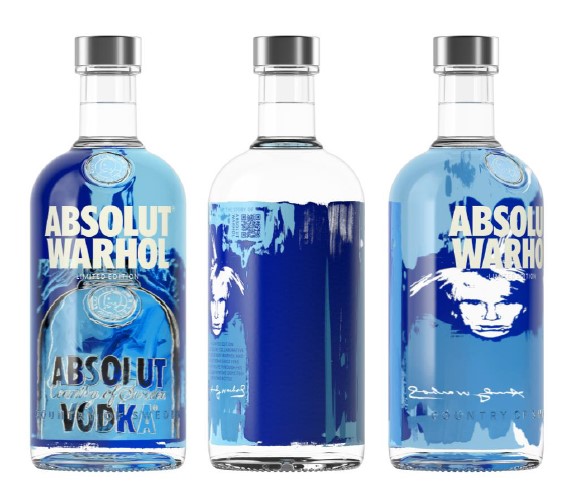
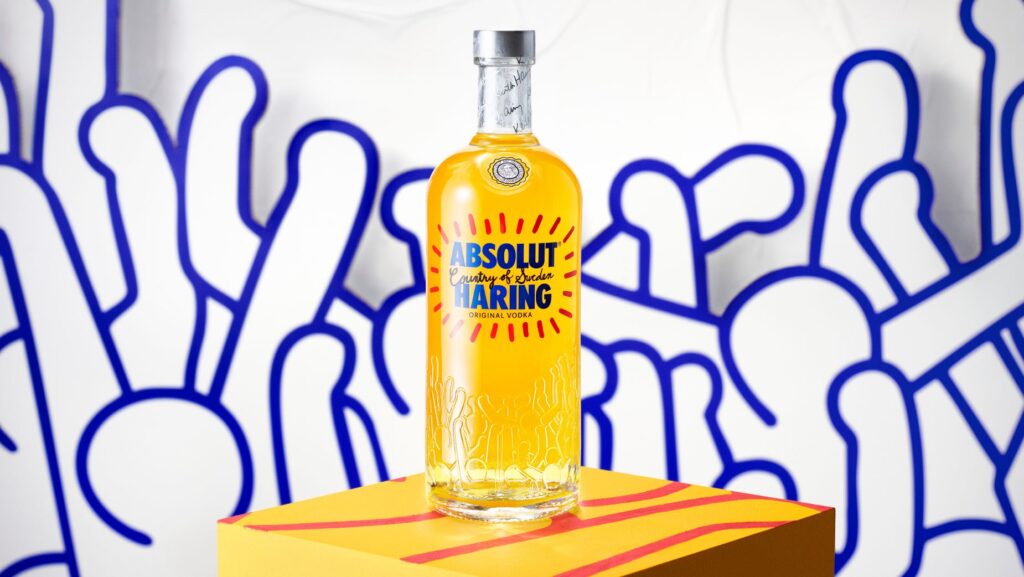
The campaign’s most consequential turn came through nightlife, not advertising strategy. Carillon Importers CEO Michel Roux was a regular at Studio 54, where his friendship with Andy Warhol led to a 1985 painting of the Absolut bottle; “Absolut Warhol” was presented in 1986.
Warhol then encouraged fellow artists Keith Haring and Kenny Scharf to create their own Absolut interpretations, and the roster grew from there to include Ed Ruscha and Damien Hirst, among many others.
What began as a single celebrity endorsement became an entirely new marketing category: brand-commissioned fine art, years before ‘brand collaboration’ became a standard marketing term.
The commercial logic was subtle but effective — rather than paying a celebrity to simply appear in an ad, Absolut was commissioning genuine creative work from artists whose reputations depended on the work being taken seriously as art, which lent the brand a level of cultural credibility that a straightforward endorsement deal never could have.
The resulting body of work — the Absolut Art Collection — now includes more than 850 pieces, owned and exhibited by the Museum of Spirits foundation, a scale that turns what could have been a marketing footnote into a genuine, catalogued art history archive that outlived the ad campaign that originally inspired it.


The Results: From 10,000 Cases to Market Leader
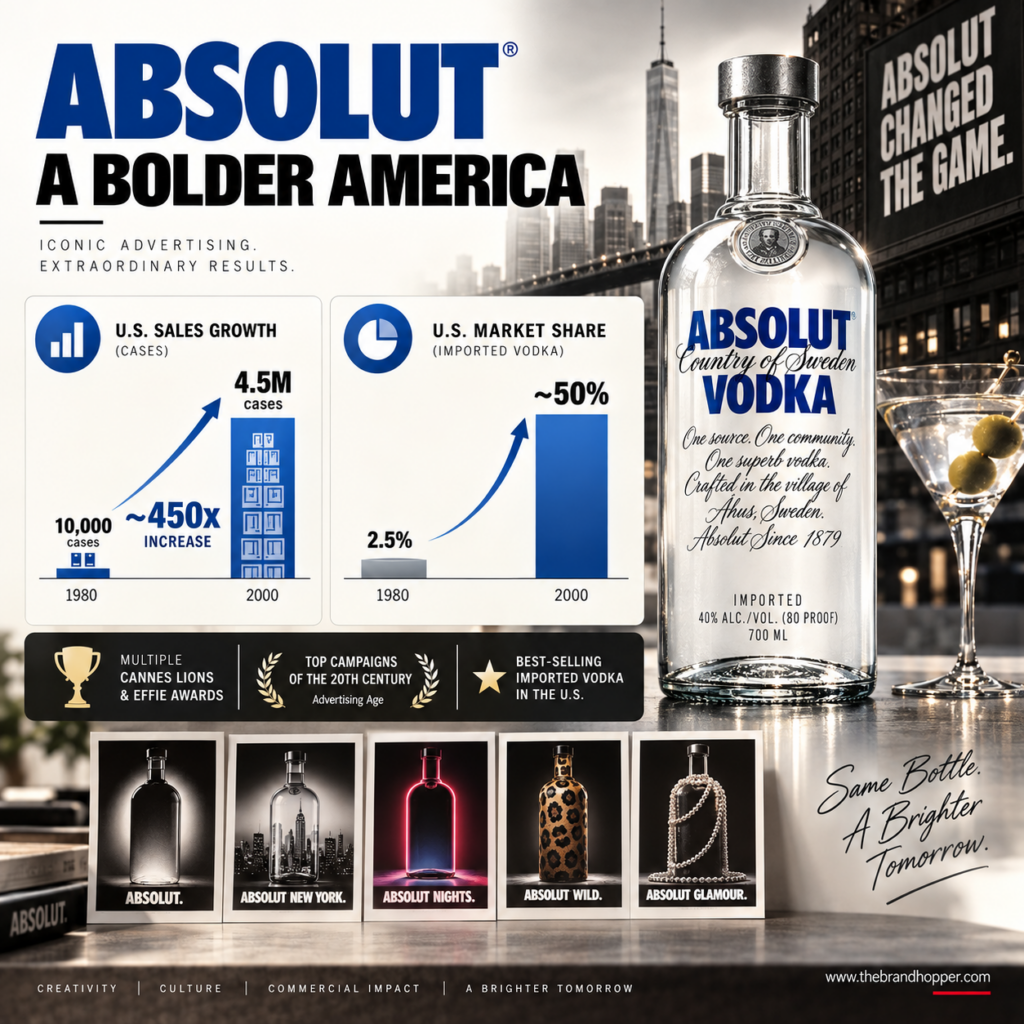
The commercial results are among the most cited in advertising case studies for good reason. U.S. sales grew from 10,000 cases in 1980 to 4.5 million cases by 2000 — a roughly 450-fold increase.
Absolut’s U.S. vodka market share grew from 2.5% in 1980 to roughly 50% of the imported vodka segment by 2000, and the brand became the best-selling imported vodka in the United States, outselling Russian vodkas in their own category, a genuinely striking outcome for a Swedish product competing in a category still culturally associated with Russia.
The campaign collected multiple Cannes Lions and Effie Awards over its run and was later named to Advertising Age’s list of the top campaigns of the 20th century — recognition for both creative distinctiveness and, more unusually for an arts-driven campaign, sustained commercial effectiveness over a quarter-century.
That combination is worth underlining: plenty of campaigns win creative awards without moving sales, and plenty of effective campaigns are creatively forgettable; Absolut’s bottle campaign is repeatedly cited specifically because it delivered on both fronts simultaneously, and did so for far longer than almost any comparable case study in the category.

2007: Retiring the Campaign at Its Peak
Absolut retired the bottle campaign in 2007, replacing it with “In an Absolut World,” developed by TBWA\Chiat\Day and Great Works AB.
Rather than continuing to build ads around the bottle’s silhouette, the new platform asked a broader question — what if the world itself were as absolute (in the sense of ideal, uncompromising) as the brand’s namesake — and used the answer to explore more expansive, values-driven creative territory across print, TV, mobile, and guerrilla marketing.
It was a deliberate acknowledgment that a format built for a fragmented, pre-digital print media landscape needed to evolve for a multi-channel one, even if it meant retiring one of the most successful visual templates in advertising history.


Absolut’s Marketing Today: 2025-2026
Absolut’s marketing today, under parent company Pernod Ricard, looks nothing like the print-bound bottle campaign but still carries its cultural-collaboration DNA.
In 2025, Absolut rolled out “Born to Mix,” a global campaign spanning social media, broadcast video-on-demand and online video, built around the idea that mixing different people, perspectives, and cocktails produces something better than any of them alone — including partnerships tied to the pop group Sugababes’ 2025 tour.
Where the original bottle campaign relied on print and a handful of TV spots, ‘Born to Mix’ is built for a fragmented, platform-native media environment, running as short-form social content and influencer-adjacent partnerships rather than a single unifying print format.
On the product side, Absolut has been developing the Absolut Paper Bottle, a sustainable-packaging initiative aligned with Pernod Ricard’s 2030 sustainability roadmap, and in 2024 announced a planned ready-to-drink partnership with The Coca-Cola Company to launch an Absolut Vodka and Sprite canned cocktail — a notable shift toward convenience-format products that didn’t exist as a category when the bottle campaign was designed around a single, fixed glass shape.
Sustainability commitments now sit alongside creative marketing as a core brand narrative: Absolut’s distillery in Åhus, Sweden runs on renewable energy with CO2 emissions per liter reported at roughly 98% below the industry average, part of Pernod Ricard’s broader push toward fully recyclable, compostable, reusable or bio-sourced packaging by 2025.

Lessons for Marketers
1. A strong, distinctive physical product design can carry an entire ad campaign for decades — the bottle itself, not any single tagline, was the real long-term brand asset.
2. Constraint breeds creativity. Restricting every execution to “the bottle plus a two-word pun” forced 25 years of genuine creative variety rather than diluting the format, precisely because the limitation was so tight.
3. Cultural credibility can outperform paid media. The Warhol collaboration originated from a personal nightlife friendship, not a marketing brief, and became more consequential to the brand’s positioning than most of the paid campaign around it.
4. Know when to retire a working format. Absolut ended the bottle campaign at the height of its cultural relevance in 2007 rather than letting it fade, a genuinely difficult discipline most brands lack.
5. A legacy campaign’s DNA can survive a full creative reinvention. “Born to Mix” in 2025 shares almost no visual language with the 1980s bottle ads, yet both are built on the same underlying idea of bringing different things together.
Frequently Asked Questions
Q: When did the Absolut bottle campaign start?
A: The first ad, “Absolut Perfection,” was created by New York agency TBWA and ran in 1980, though Absolut Vodka itself launched in the U.S. market in spring 1979.
Q: Who designed the Absolut bottle?
A: Marketer Gunnar Broman of the Swedish agency Carlsson & Broman found the bottle’s design inspiration — an old pharmacy bottle — in an antique shop in Stockholm’s Old Town, adapting it into the clear, minimalist shape Absolut still uses today.
Q: How many ads were made for the Absolut bottle campaign?
A: Over its roughly 25-year run from 1980 to 2007, the campaign produced more than 1,500 individual print advertisements, making it one of the longest-running and highest-volume print campaigns in advertising history.
Q: Is the Absolut bottle campaign still running today?
A: No. Absolut retired the bottle campaign in 2007, replacing it with “In an Absolut World.” Absolut’s current marketing runs under a different global platform called “Born to Mix,” launched in 2025.
Q: Why did Absolut collaborate with Andy Warhol?
A: Carillon Importers CEO Michel Roux was friends with Warhol through New York’s Studio 54 nightlife scene; Warhol painted the Absolut bottle in 1985, and “Absolut Warhol” was presented in 1986, launching a broader series of artist collaborations.
Q: How successful was the Absolut bottle campaign commercially?
A: U.S. sales grew from 10,000 cases in 1980 to 4.5 million cases by 2000, and Absolut’s U.S. market share rose from 2.5% to roughly 50% of the imported vodka segment, making it the best-selling imported vodka in the United States.
Q: What is Absolut’s marketing strategy today, in 2026?
A: Absolut runs its 2025-launched “Born to Mix” global campaign, alongside sustainability-focused initiatives like the Absolut Paper Bottle and a planned ready-to-drink partnership with The Coca-Cola Company for an Absolut Vodka and Sprite canned cocktail.
Conclusion
Few campaigns earn the description “changed advertising history,” but Absolut’s bottle campaign is a reasonable candidate: it proved a single, disciplined visual format could sustain a brand for 25 years and over 1,500 executions, turned a liquor brand into a genuine art patron with an 850-plus-piece collection, and took a company selling 10,000 cases a year to the best-selling imported vodka in America.
What makes the case study still useful today isn’t just the historical numbers — it’s that Absolut knew when to stop. The brand retired its most successful format in 2007 rather than running it into irrelevance, and the marketing it runs today, from “Born to Mix” to its sustainable paper bottle development, still carries the same underlying instinct that built the original campaign: make the product itself, not just the advertising around it, the most interesting part of the story.
Nearly half a century after Gunnar Broman found that pharmacy bottle in a Stockholm antique shop, that instinct is still, in the most literal sense of the brand’s own name, the whole point.
Also Read
- The Budweiser “Wassup?” Campaign: Full Case Study
- Apple’s Greatest Ad Campaigns: From ‘1984’ to AI Era
- The Cadbury Gorilla Campaign: Complete Case Study
- McDonald’s “I’m Lovin’ It” Campaign: Full Case Study
To read more content like this, subscribe to our newsletter
Go to the full page to view and submit the form.