


In mid-January 2019, Gillette did something few razor brands, or mass-market brands of any kind, had attempted: it challenged traditional ideas of masculinity while questioning its own advertising history in a single film. “We Believe: The Best Men Can Be” reworked the brand’s famous 1989 tagline, “The Best a Man Can Get,” into a message about bullying, harassment and accountability, against the backdrop of the #MeToo movement.
The reaction was immediate and polarized, with millions of views and more dislikes than likes on YouTube within days. Almost eight years later, the campaign remains one of the most discussed examples of purpose-driven advertising. Its story also has a second chapter that many summaries overlook: in 2024, Gillette returned to “The Best a Man Can Get,” while its parent company, Procter & Gamble (P&G), continued reporting a grooming business whose recent growth has relied partly on pricing and foreign exchange rather than higher unit volume.
This case study follows the full arc, from Gillette’s strategic challenge to the 2019 film, the backlash, the financial context, the 2024 creative shift and the latest available business figures. It distinguishes documented developments from interpretations and claims that should be treated cautiously.
The Marketing Challenge: A Leader Losing Younger Buyers
Gillette was founded in 1901 and became one of the dominant names in men’s shaving through product innovation, razor-and-blade systems and decades of brand-building. In 1989, it introduced the famous tagline “The Best a Man Can Get,” created with advertising agency BBDO, which became one of the brand’s most recognisable assets.
Procter & Gamble acquired Gillette in 2005 in a transaction valued at approximately $57 billion. For years, the shaving business was a major contributor to P&G’s grooming portfolio, supported by a model that encouraged consumers to buy into razor systems and replace blades regularly.
That model faced growing resistance after the 2008 recession, when some consumers became more price-conscious and questioned the cost of replacement cartridges. Direct-to-consumer challengers also changed the competitive environment: Dollar Shave Club was founded in 2011 and acquired by Unilever in 2016, while Harry’s launched in 2013.
Shaving habits were changing as well. Lower shaving frequency and evolving grooming preferences, including the popularity of facial hair, contributed to slower category growth in developed markets. P&G later identified changing grooming habits, currency devaluations and increased competition as factors behind the financial impairment it recorded against Gillette’s Shave Care business in 2019.
Gillette’s market-share position also faced pressure. Contagious, citing Euromonitor, reported that Gillette’s U.S. share had fallen from around 70% in 2010 to 54% in 2016. These figures refer to a particular market and period, so they should not be confused with global market-share estimates or figures covering different razor categories.

The Insight: Younger Consumers Expect a Point of View
P&G’s diagnosis was that Gillette faced a generational challenge. Gary Coombe, who led P&G’s global grooming business, said the brand needed to reconnect with millennial and Gen Z consumers, whose awareness of and affinity for Gillette were comparatively low.
The strategic thinking was that younger consumers expected brands to take a position on social issues rather than simply communicate functional product benefits. A razor brand with a long history of advertising traditional masculinity could not necessarily win younger buyers by repeating a message created in 1989.
The decision to confront masculinity directly was therefore a bet on a particular audience, rather than simply an attempt to provoke a debate. The campaign was designed for digital distribution, where the brand could reach younger consumers and encourage discussion beyond conventional television advertising.
The Campaign: “We Believe” and TheBestMenCanBe.org
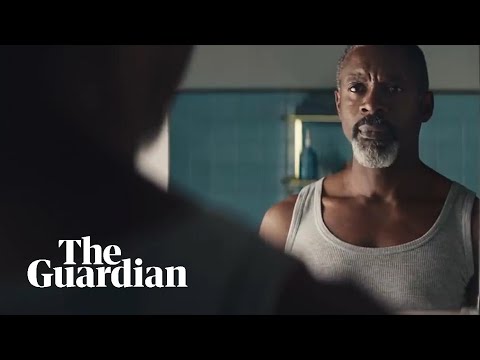
The film, created with advertising agency Grey New York, opens by revisiting the old tagline as a question before showing behaviour that the brand presented as examples of the worst men can get: bullying, catcalling, harassment and condescending behaviour in a boardroom.
One scene stages harassment as a 1950s sitcom, complete with an approving studio audience. The film also features actor Terry Crews, who had publicly spoken about his experience of sexual assault and appeared in congressional testimony discussing the importance of men holding other men accountable.
After roughly the first half of the film, the narrative shifts towards positive behaviour. Men intervene when they see inappropriate conduct, and fathers are shown setting better examples for their children.
The launch was supported by a dedicated website, TheBestMenCanBe.org, which celebrated men acting as advocates, mentors and positive role models in their communities. Gillette also pledged $1 million per year for three years to U.S. non-profit organisations working to inspire and educate men and boys.
The first recipient was the Boys & Girls Clubs of America, which became part of the campaign’s three-year partnership. The commitment was intended to give the campaign a community-action component beyond the advertising itself.
The Backlash: Views, Dislikes and a Boycott Call
The backlash began almost as soon as the film appeared. After early coverage in The Wall Street Journal, conservative commentators and other critics described the campaign as virtue signalling or argued that it portrayed men unfairly as a group.
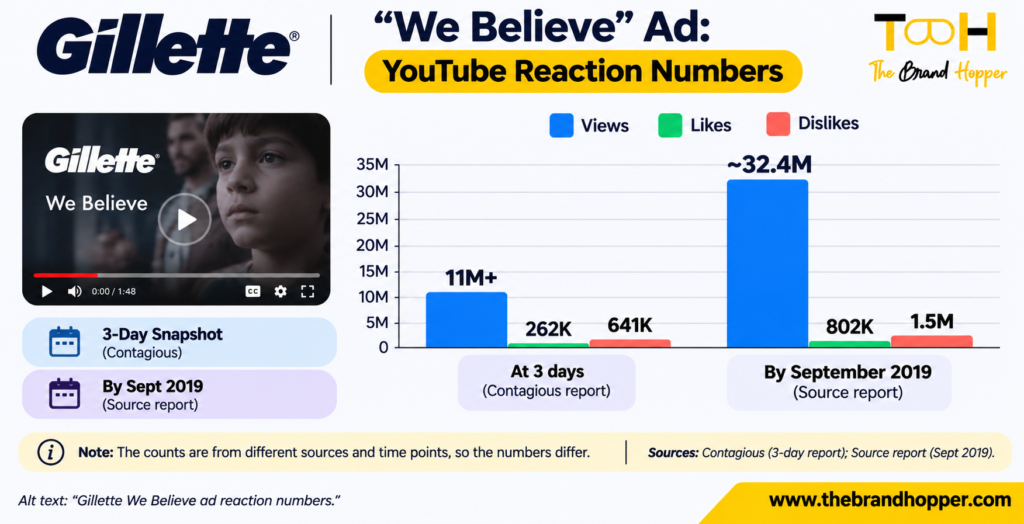
Three days after the film was posted, Contagious reported more than 11 million views, 262,000 likes and 641,000 dislikes. Marketing Dive subsequently reported more than 16.2 million views while the video was trending, illustrating how quickly the campaign became a major online conversation.
Piers Morgan said he might stop using Gillette, while some men’s rights activists called for a boycott of the brand and P&G. The criticism was not limited to YouTube: social-listening firm BrandTotal found that 63% of social-media sentiment was negative and 8% positive in the period it measured.
Another firm, Converseon, reported a less negative split, with 45% negative and 34% positive sentiment. By September 2019, the video had reportedly accumulated around 32.4 million views, with approximately 1.5 million dislikes against 802,000 likes.
Supporters included Bette Midler, Chrissy Teigen and Rainn Wilson. The differing sentiment figures should be read as snapshots from different measurement methods and dates, rather than as a single definitive measure of public opinion.
Importantly, P&G did not announce plans to withdraw the campaign in response to the backlash. The brand continued to stand behind its message, allowing the debate to remain in the public conversation.

The Battle Lingers: Why This Firestorm Lasted
Gillette’s controversy lasted longer than many social-media firestorms. One reason was that the brand and its parent company did not publicly retreat from the campaign, keeping the story alive in the press and in political commentary for months.
The campaign also became a case study in how purpose-led advertising can be interpreted very differently by different audiences. Supporters saw it as an overdue acknowledgment that mass-market brands could use their reach to challenge harmful norms, while critics viewed it as a corporation lecturing its customers.
That divide is one reason the campaign continues to be discussed in marketing classrooms. It also explains why its commercial impact is often debated from strongly held positions.
The Results: Favorability, Sales Claims and the $8 Billion Write-Down
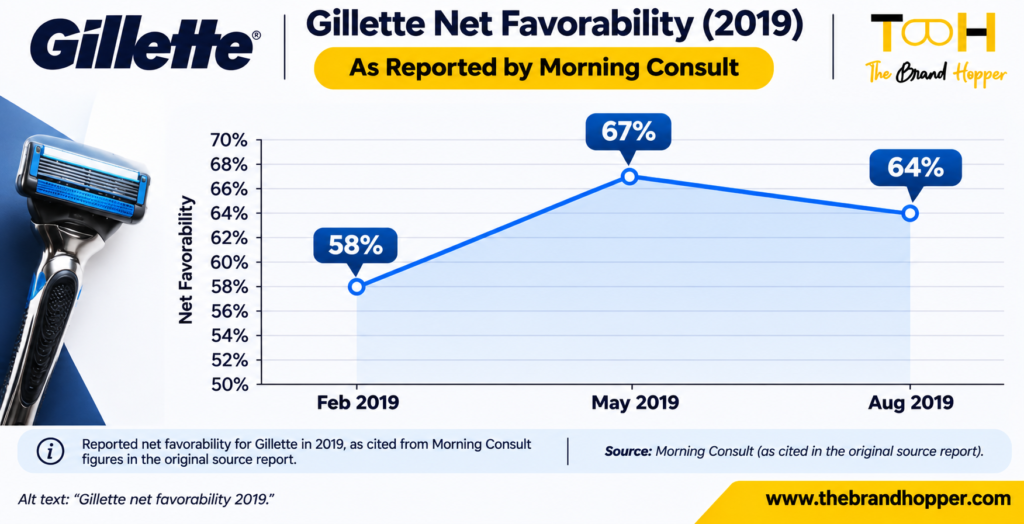
The short-term brand data were mixed. Morning Consult reported showed Gillette’s net favorability falling by around 10 points to 58% by February 2019, before recovering to 67% in May and reaching 64% in August, reportedly the same level as a year earlier.
Coombe described the campaign’s impact as overwhelmingly positive. He pointed to 4% organic sales growth in P&G’s Grooming segment in the April–June 2019 quarter, as well as online sales growth in the months following the launch.
These figures need context: the 4% organic growth figure was for P&G’s broader Grooming segment, not Gillette alone. The same source report cited an Evercore estimate that Gillette held a 76% share of razor sales on Amazon, but that figure should be treated as a reported estimate rather than a directly comparable measure of total market share.
In late July 2019, P&G announced a substantial non-cash impairment charge relating to Gillette’s Shave Care business. The total charge was approximately $8 billion after tax, comprising a $6.8 billion impairment of goodwill and a $1.6 billion pre-tax impairment of Gillette’s indefinite-lived intangible asset.
The impairment contributed to P&G reporting a quarterly net loss of approximately $5.2 billion. P&G attributed the write-down primarily to currency devaluations since the 2005 acquisition, lower shaving frequency and market contraction in developed markets, as well as increased competition in the U.S. and certain other markets.
P&G did not identify the 2019 advertising campaign as a cause of the impairment. Therefore, claims that the “We Believe” campaign caused the $8 billion write-down go beyond the company’s stated explanation.
2019–2020 and Beyond: Expansion, Targeting and Moderation
Gillette continued developing the “The Best Men Can Be” platform after the 2019 launch. The company expanded the campaign’s themes into markets including India, South Africa and Spain, and used the positive-masculinity message in films and community initiatives.
In India, the brand’s “The Barbershop Girls” film told the story of sisters Jyoti and Neha, who took over their father’s barbershop in Uttar Pradesh after he became ill. The film challenged gender stereotypes around a traditionally male occupation and became one of Gillette India’s most visible purpose-led campaigns.

The film was published in April 2019 and has since accumulated more than 16 million YouTube views. It was also part of the wider #ShavingStereotypes initiative, which used stories and community engagement to encourage conversations about gender roles.
The brand also used the positive-masculinity theme in content for Treo, a product line designed to help caregivers shave older or disabled people, and released a Father’s Day film featuring John Legend. These executions extended the campaign beyond the original U.S. film.
Gillette also adjusted how it managed social platforms and audience targeting. The original film’s comments remained open, with offensive comments moderated, while some later videos had comments disabled. The source report also cited BrandTotal data suggesting that sentiment differed between targeted audiences and broader, untargeted audiences.
The reported contrast reinforces an important point: the same message can produce very different responses depending on the market, audience and media strategy. A campaign that creates controversy among a broad audience may be received differently by a carefully selected segment.
Compare Gillette’s approach with Nike’s “I Am Not A Role Model” campaign and Patagonia’s “Don’t Buy This Jacket” campaign, two other brands that used advertising to take a position.
The Critics’ Assessment: Attention Versus Business Impact
A clear-eyed assessment requires more than favourability scores and view counts. In an April 2024 analysis, brand consultancy the brandgym argued that the 2019 campaign generated a short-term increase in visibility but had several weaknesses.
The consultancy noted that the film contained little product news, focused heavily on negative examples rather than celebrating positive behaviour, and relied on a charitable pledge that it considered small relative to Gillette’s business. It also argued that the campaign moved away from distinctive brand assets, including the familiar music and the original focus on masculine achievement.
The brandgym also examined P&G’s Grooming-segment revenue, rather than Gillette’s standalone sales, because brand-level financial figures were not publicly available. It reported that Grooming revenue fell by about 5% (approximately $350 million) in fiscal 2019 and by a further 2% in the following year.
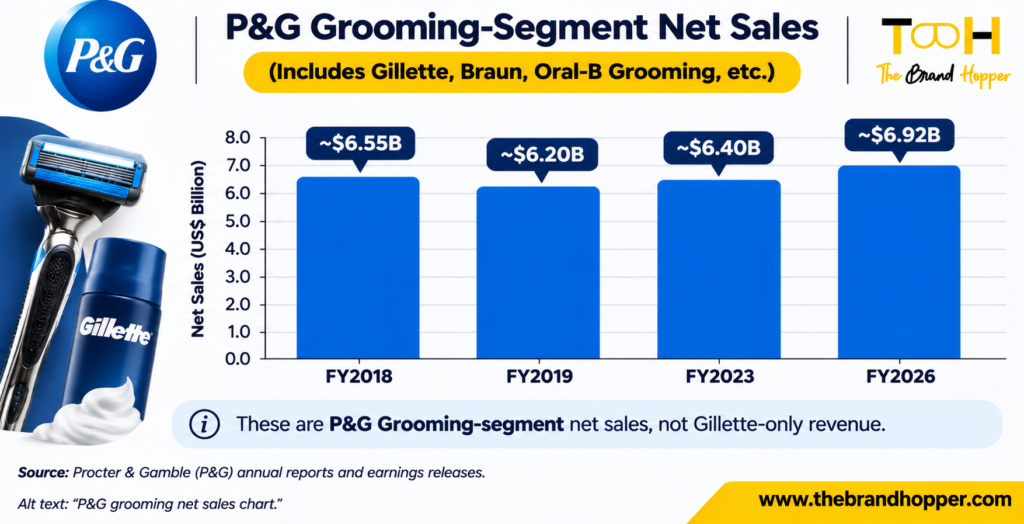
The segment’s fiscal 2023 net sales were approximately $6.4 billion. That was around $150 million below its fiscal 2018 net sales of $6.55 billion, although the comparison does not establish that the 2019 campaign caused the decline.
The consultancy’s criticism is one analyst’s interpretation, not a definitive explanation of the business’s performance. P&G itself attributed the 2019 impairment to currency movements, lower shaving frequency and competition, while the wider Grooming segment’s sales were affected by several factors beyond advertising.
The fair conclusion is that the campaign succeeded in generating attention and conversation, including among younger consumers the brand wanted to reach. However, the available evidence does not establish that it reversed Gillette’s commercial trajectory or produced a sustained increase in sales.
2024: Gillette Returns to “The Best a Man Can Get”
One of the most important developments missing from older write-ups is Gillette’s return to its original tagline. In April 2024, the brand revived “The Best a Man Can Get” in a refreshed campaign that drew on the narrative structure of its 1989 film.
The new work restored the famous theme music in a modern rendition by British singer Tom Grennan and brought the premium Gillette Labs range into the centre of the story. The 1989 film had featured the Atra Plus razor as its hero product.
According to the brandgym’s analysis, the campaign retained recognisable brand assets while updating the portrayal of masculine achievement. It included contemporary depictions of fatherhood, relationships, sport and careers, with a more equal portrayal of men and women in a romantic scene.
The consultancy interpreted the move as a conscious shift away from the direct criticism of toxic masculinity that had defined the 2019 campaign. It also observed that the original “The Best Men Can Be” film was no longer available on Gillette’s own YouTube channel and that the dedicated campaign pages were no longer prominent on the brand’s website.
The brandgym further noted that Gillette no longer appeared on the Boys & Girls Clubs of America’s donor list when it checked in 2024. This observation should be attributed to the consultancy: Gillette’s current website continues to describe community support and donations to organisations focused on the development of young men and boys.
Gillette has not formally described the 2024 campaign as a reversal of its 2019 position. Nevertheless, the creative shift is clear: the brand returned to product-led, achievement-focused advertising built around its historic tagline.
Gillette Today: Fiscal 2027 and the Competitive Landscape
The latest financial picture available as of November 2026 comes from P&G’s first-quarter fiscal 2027 results, released on October 22, 2026. P&G reported Grooming-segment net sales of approximately $1.89 billion for the July–September 2026 quarter, an increase of 4% compared with the previous year.
Organic sales in the segment increased 4.5%. The reported sales drivers included a 3.5% contribution from higher pricing and a 1.5% contribution from favourable mix, partly offset by a 0.4% decline in unit volume and a 0.4% unfavourable foreign-exchange impact.
For the full fiscal year 2026, P&G’s Grooming segment generated approximately $6.92 billion in net sales, up 4%. That annual increase included a 3% contribution from favourable foreign exchange and 2% from higher pricing, partly offset by a 1% decline in unit volume.
These figures cover P&G’s broader Grooming segment, not Gillette alone. Gillette is a major part of the business, but P&G does not report a separate annual revenue figure for the Gillette brand in these results.
The latest figures therefore show a business that is growing in reported sales, but where volume trends remain mixed. Pricing and currency effects have played an important role in the annual result, while the latest quarter’s organic growth also benefited from favourable product mix.
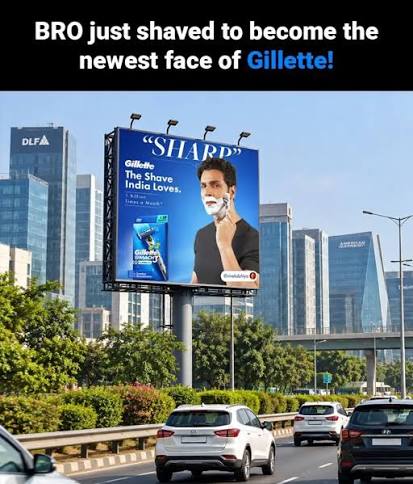
Gillette has continued to invest in regional marketing and product-led campaigns. In India, for example, it ran a 2025 out-of-home campaign for its Fusion5 razor featuring actor Hrithik Roshan, with creative focused on the idea of achieving the “Perfect Shape.”
The competitive landscape has also evolved. In 2020, Edgewell Personal Care abandoned its proposed $1.37 billion acquisition of Harry’s after the U.S. Federal Trade Commission filed a lawsuit seeking to block the deal. Harry’s therefore remained independent of Edgewell following the termination of the agreement.
The current picture is of a major global grooming brand operating in a competitive and changing category. Its parent company’s latest results show growth, but they do not support a simple claim that the business is expanding rapidly through higher shaving demand.

Lessons for Marketers
- Purpose needs proof beyond the film: Gillette’s campaign was supported by a three-year charitable commitment, but critics argued that meaningful action should be larger and more durable than messaging alone.
- Know the audience you are willing to lose: The campaign took a clear position that risked criticism from some existing customers in pursuit of stronger relevance with younger consumers.
- Targeting changes outcomes: The same message can generate very different sentiment among targeted audiences, broader audiences and consumers in different countries.
- Protect distinctive brand assets: The 2019 film moved away from the familiar song and tagline, while the 2024 return to “The Best a Man Can Get” demonstrated the continuing value of those recognisable assets.
- Separate attention from business results: The campaign generated substantial attention and debate, but its direct effect on sales remains unproven. P&G attributed the $8 billion impairment to other financial and market factors.
- Update stories as they develop: A case study written in 2019 or 2024 that ignores the later creative shift and the latest financial results gives readers an incomplete picture.
Frequently Asked Questions
Q: When did Gillette’s “The Best Men Can Be” ad launch?
The “We Believe” film launched on January 13, 2019. It reframed Gillette’s 1989 tagline, “The Best a Man Can Get,” as “The Best Men Can Be,” with themes connected to bullying, harassment, accountability and the wider #MeToo conversation.
Q: Who made the Gillette “We Believe” ad?
The campaign was created by Grey New York for Gillette and P&G. It featured actor Terry Crews, including footage of his congressional testimony about the importance of men holding other men accountable.
Q: Why did people react so negatively to the ad?
Some critics, including conservative commentators, described the film as virtue signalling or argued that it portrayed men unfairly as a group. Within three days of its release, YouTube dislikes significantly outnumbered likes, and some activists called for a boycott.
Q: Did the ad cause Gillette’s $8 billion write-down?
No. P&G announced an approximately $8 billion non-cash, after-tax impairment in July 2019 relating to the goodwill and intangible assets of its Gillette Shave Care business. The company attributed the charge primarily to currency devaluations, lower shaving frequency in developed markets and competition, not to the advertising campaign.
Q: Did Gillette stop using “The Best Men Can Be”?
Gillette returned to its original tagline, “The Best a Man Can Get,” in a refreshed campaign in April 2024. The brandgym consultancy also reported that the 2019 film and dedicated campaign pages were no longer visible on Gillette’s own channels when it reviewed them.
Q: How is Gillette’s grooming business doing now?
P&G’s latest available results as of November 2026 show that its Grooming segment generated approximately $1.89 billion in net sales in the first quarter of fiscal 2027, up 4%. Organic sales increased 4.5%, with pricing and favourable mix contributing to growth while unit volume declined 0.4%. These figures cover the broader P&G Grooming segment, not Gillette alone.
Q: How much did Gillette commit to charity in the 2019 campaign?
Gillette pledged $1 million per year for three years to U.S. non-profit organisations working to inspire and educate men and boys. The first recipient was the Boys & Girls Clubs of America.
Q: Is Gillette still owned by Procter & Gamble?
Yes. P&G acquired Gillette in 2005 in a transaction valued at approximately $57 billion. Gillette remains one of P&G’s major grooming brands.
Conclusion
“The Best Men Can Be” deserves its place among the most discussed advertising campaigns of the 2010s. It demonstrated that a mass-market brand could take a clear social position and withstand the public debate that followed.
However, the full story is more complicated than either the celebratory or dismissive versions suggest. The film generated significant attention and conversation, but its commercial benefit remains disputed, and P&G attributed the $8 billion impairment to currency effects, changing grooming habits and competition rather than the campaign.
By 2024, Gillette had returned to “The Best a Man Can Get” with a product-led and less polarising approach. Its latest financial results show that P&G’s Grooming segment is growing in reported sales, although volume remains under pressure and the figures should not be mistaken for Gillette-only revenue.
For marketers, the lesson is not simply that purpose advertising works or fails. It is that a campaign is more likely to create lasting value when its message, the action behind it and the brand’s core product promise reinforce one another.
Also Read: Pepsi Challenge Case Study: History, Results, Criticism
To read more content like this, subscribe to our newsletter
Go to the full page to view and submit the form.