


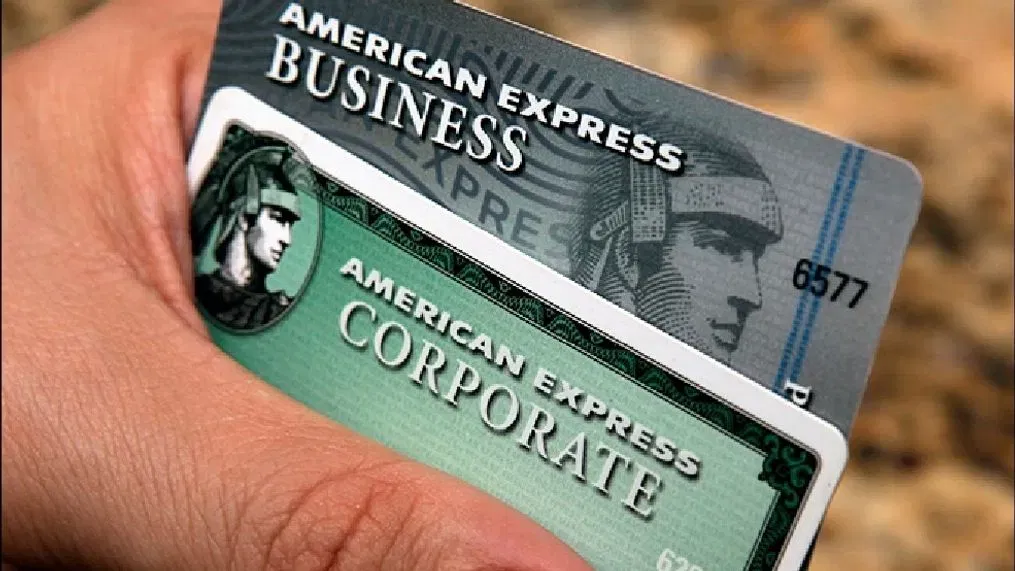
American Express’s “Don’t Leave Home Without It” turns 50 in 2025 — and unlike most advertising anniversaries, this one isn’t just a nostalgia moment. Amex brought the exact phrase back into its marketing in 2018, and the underlying idea (a card so essential you’d feel exposed traveling without it) still shapes how the company talks about itself today. This case study covers the full history in detail: where the line actually came from, the specific ads and spokespeople that carried it for two decades, the campaigns that replaced it, its 2018 comeback, and where American Express’s marketing stands today, backed by current, sourced figures rather than the unverified stats that circulate about this campaign online.
| Quick Answer: What Is “Don’t Leave Home Without It”?
• Originated in the mid-1970s as “Don’t Leave Home Without Them” for American Express Traveler’s Cheques, fronted by Karl Malden. • Adapted to “Don’t Leave Home Without It” for the Card; Malden remained the face of the campaign for roughly two decades. • Retired from primary use through the Seinfeld, De Niro/Scorsese and Tina Fey eras, then revived in 2018 under “Powerful Backing.” • 2025 marks the campaign’s 50th anniversary; Amex posted record FY2025 revenue of $72.2 billion. |
Origins: A Line Written for Traveler’s Cheques, Not Credit Cards
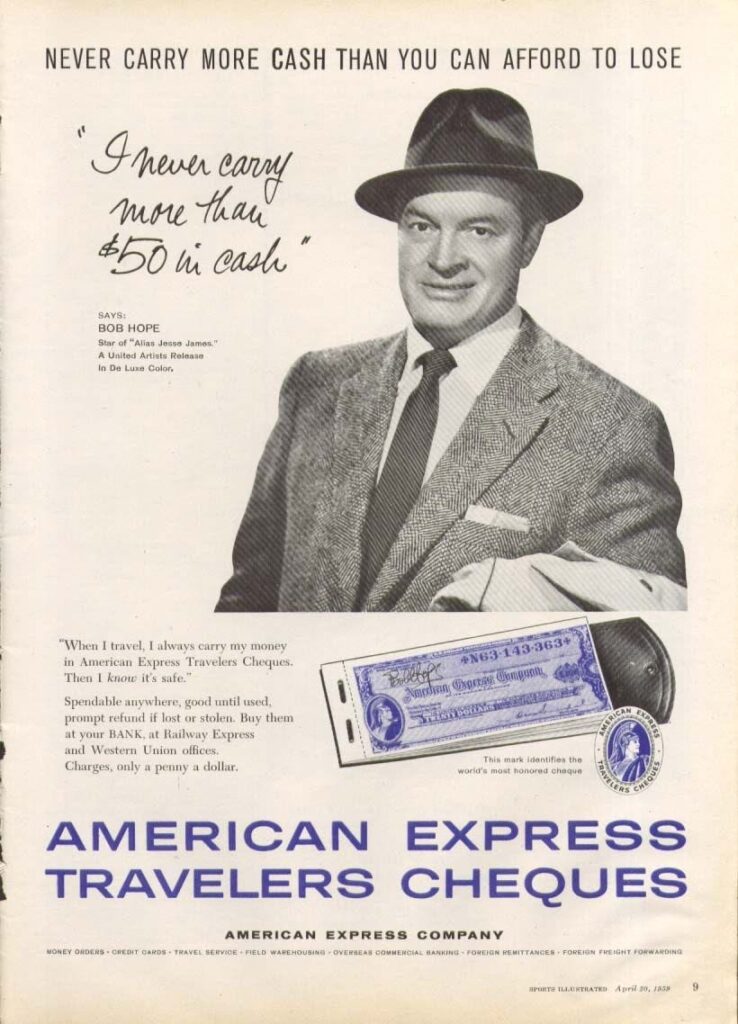
The phrase predates the American Express Card campaign it’s now associated with. Ogilvy & Mather first used “Don’t Leave Home Without Them” in the mid-1970s to sell American Express Traveler’s Cheques, fronted by actor Karl Malden — then at the height of his fame from the TV series The Streets of San Francisco. The line was built on a real product truth: traveler’s cheques were replaceable if lost or stolen, unlike cash, and Malden’s authoritative, trustworthy screen persona made him a credible messenger for that reassurance.

The Revival: From “Them” to “It”
The line was strong enough that Amex revived it a few years later for the American Express Card itself, adapting “them” to “it”: “Don’t Leave Home Without It.” Malden fronted this version too, appearing in Amex advertising for roughly two decades before retiring from the role — one of the longest single-spokesperson runs in American advertising, and a major reason the line became, functionally, Malden’s voice as much as Amex’s slogan.

The Psychology: Selling Risk, Not Reward
The phrase worked on a specific psychological lever: implied risk, not benefit. Most credit card advertising of the era sold status or rewards; “Don’t Leave Home Without It” instead described a bad outcome (being stuck, embarrassed or unprepared) that the card prevented. It borrowed the same anxiety-then-relief structure Malden had already used for traveler’s cheques, which is likely why Amex reused Malden rather than recasting the card campaign from scratch.
The five-word imperative also did double duty as media strategy: it was short enough to work as a TV sign-off, a print headline, and a radio tag read live by a local announcer, so the exact same words could run across every channel Amex bought without a single rewrite — a rare piece of copy that was as media-agnostic as it was memorable.
The Parallel Campaign: “Do You Know Me?”
Running alongside and after the Malden ads, Amex’s “Do You Know Me?” campaign took a different but complementary angle: each spot featured a recognizable-but-not-universally-famous face — authors, athletes and TV personalities like Peter Ustinov, The Who’s Roger Daltrey and horror novelist Stephen King — who explained that despite their fame, they still needed to show ID or a card to be recognized as who they were, except when that card was an American Express. The insight was the same aspirational-exclusivity idea wearing a different outfit: even famous people need proof of status, and the Card was that proof.

1987 Onward: “Membership Has Its Privileges”
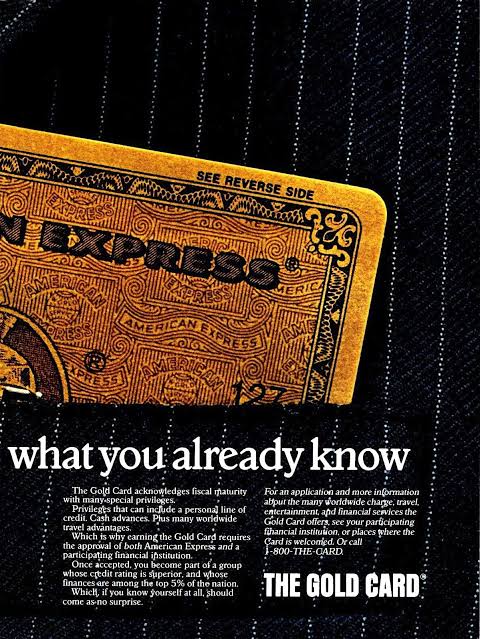
By the late 1980s, Amex layered a second slogan on top of the original: “Membership Has Its Privileges,” which shifted the emotional emphasis from travel-readiness to belonging and exclusivity. The two lines coexisted for years — “Don’t Leave Home Without It” as the functional, travel-anchored promise, and “Membership Has Its Privileges” as the status-anchored one — before Amex gradually let the original tagline fade from primary rotation through the 1990s and 2000s.

Competitive Fire: Visa’s Answer to Amex’s Exclusivity
Amex’s exclusivity came with a real, exploitable weakness: narrower merchant acceptance than Visa or Mastercard, driven by the higher fees Amex charged merchants. Visa’s agency BBDO built an entire campaign around that gap, launching “It’s Everywhere You Want To Be” in 1985 with ads deliberately showing upscale restaurants, Olympic venues and cultural landmarks that didn’t accept American Express — a direct shot at the exclusivity Amex was selling as a virtue.
Amex fired back during its own 1992 Barcelona Olympics sponsorship with print ads punning on Visa’s name to remind travelers they didn’t need “a visa” — the travel document — to visit Spain, only the Card. Visa ran variations of “Everywhere You Want To Be” on and off for roughly 40 years (including a shortened 2014 revival and a 2025 Ryan Reynolds-fronted spin, “and some places you don’t”), making it one of the only rival financial-services taglines with a run nearly as long as Amex’s own.
The 1990s-2010s: Seinfeld, De Niro, Woods and Fey
The spokesperson era didn’t end with Malden. Jerry Seinfeld fronted Amex ads in the 1990s built around his observational stand-up style; the early-to-mid 2000s brought “My Life. My Card.,” a campaign built around a rotating cast that included Robert De Niro directed by Martin Scorsese, plus Tiger Woods, Ellen DeGeneres and Kate Winslet, each narrating a personal story rather than reciting a slogan. Tina Fey later fronted ads in a similar identity-driven register in the 2010s. Across all of these, the specific words “Don’t Leave Home Without It” were mostly retired — the idea survived, the phrase didn’t.

2018: “Powerful Backing” Brings the Words Back
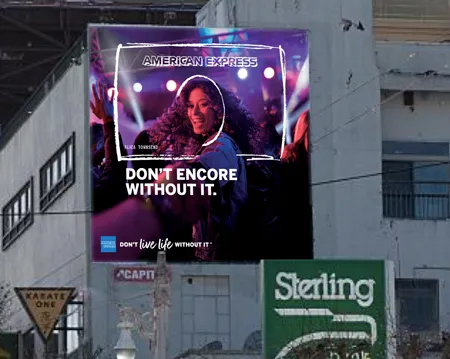
That changed in April 2018, when American Express relaunched its global brand platform as “Powerful Backing,” built by McGarryBowen, Pentagram, Ogilvy, Mindshare and Digitas. The campaign deliberately broke from decades of celebrity-fronted advertising and paired two lines built directly off the 1975 original: “Don’t Do Business Without It” for commercial cardmembers, and “Don’t Live Life Without It” for consumers. Amex framed the platform around “powerful backing” for both business and personal life — an explicit acknowledgment that the two had become harder to separate for its cardmember base.

2025-2026: The 50th Anniversary and What’s Next
“Powerful Backing” is still the umbrella under which American Express operates its brand marketing in 2025-2026, alongside newer, more specific initiatives: American Express Global Business Travel launched “Great Ideas Travel” in June 2025, an omnichannel campaign reframing business travel around in-person connection rather than logistics, and in October 2025 Amex introduced Amex Ads, a commerce media network connecting US cardmembers to offers from premium partner brands — a materially new revenue line, not just a new tagline.
Notably, none of these newer initiatives have replaced “Powerful Backing” or its “Don’t Live Life/Do Business Without It” pairing; they sit underneath it, which is itself consistent with how Amex has handled its marketing architecture since 1975 — layer new campaigns on top of the core promise rather than replace it outright, the one exception being the Seinfeld-to-Fey stretch when the literal words went quiet for two decades.
Data & Results: What’s Actually Verifiable
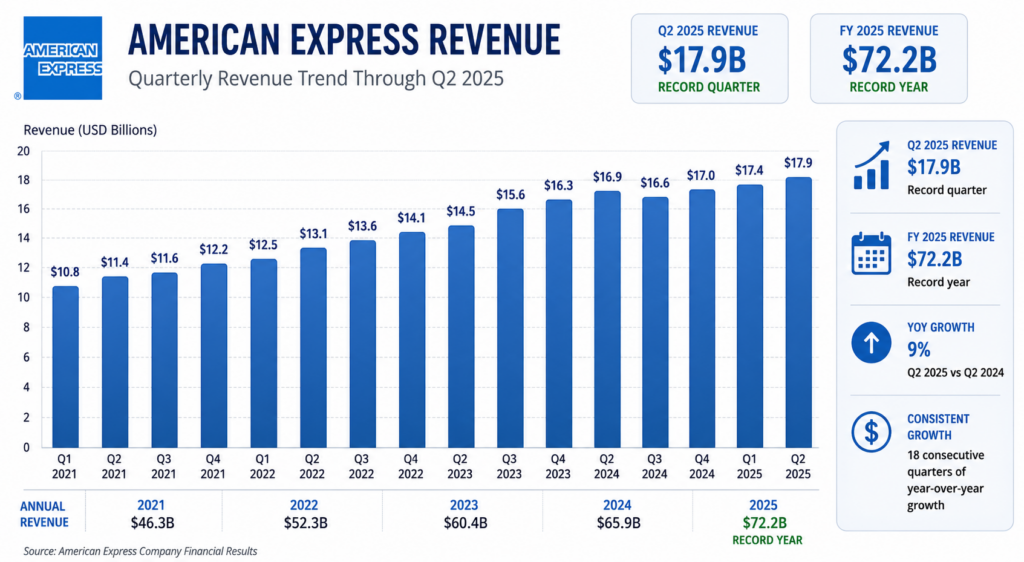
American Express delivered record full-year 2025 revenue of $72.2 billion, with second-quarter 2025 revenue alone hitting a record $17.9 billion, up 9% year-over-year, and a subsequent quarter posting $18.4 billion.
The company reaffirmed full-year 2025 guidance of 8-10% revenue growth and EPS of $15.00-$15.50, alongside a marketing budget reported at roughly $6 billion for 2025 — among the largest of any card network.
2025 marks the 50th anniversary of the original 1975 Karl Malden campaign for American Express Traveler’s Cheques, the direct ancestor of the Card slogan.

A word of caution for anyone reusing older statistics about this campaign: figures like “28% card-usage growth in year one” or “90% slogan-recognition in a 1980 study,” which circulate on several marketing blogs covering this campaign, do not trace back to a citable primary source. Where this update uses numbers, they’re pulled from American Express’s own investor disclosures or named news outlets — worth flagging explicitly, since unsourced statistics are exactly the kind of thing that weakens a page’s credibility with both readers and search engines.
Lessons for Marketers
1. A phrase can outlive the product it was written for. “Don’t Leave Home Without It” started as copy for traveler’s cheques, a product now largely obsolete, and still works as card marketing 50 years later because the underlying promise (preparedness, not humiliation) never depended on the specific product.
2. Retiring a line doesn’t mean retiring the idea. Amex ran without the exact phrase for roughly 25 years (through Seinfeld, De Niro/Scorsese, Tiger Woods and Tina Fey) while keeping the same emotional territory, then found real value in bringing the literal words back in 2018.
3. Let a competitor’s attack become your best ad. Amex’s 1992 “you don’t need a visa” Barcelona Olympics pun turned Visa’s own “Everywhere You Want To Be” campaign into free material, rather than ignoring the attack or matching it feature-for-feature.
4. Pair a consumer line with a business line from the same root. “Don’t Do Business Without It” and “Don’t Live Life Without It” show how one heritage phrase can be forked for two audiences without creating two brands.
5. Cite your data. The gap between this update’s sourced 2025 revenue figures and the unsourced 1980s statistics still circulating about this campaign is itself a lesson in what search engines and readers now expect from a credible case study.
Frequently Asked Questions
Q. Who created American Express’s “Don’t Leave Home Without It”?
A. Ogilvy & Mather created the line in the mid-1970s, first as “Don’t Leave Home Without Them” for American Express Traveler’s Cheques, fronted by actor Karl Malden.
Q. Is “Don’t Leave Home Without It” still American Express’s slogan?
A. The exact phrase was retired from primary use for roughly two decades, then revived in 2018 as “Don’t Live Life Without It” (consumer) and “Don’t Do Business Without It” (commercial) under Amex’s “Powerful Backing” brand platform, which is still active in 2025-2026.
Q. Who was the original American Express spokesperson?
A. Actor Karl Malden, star of The Streets of San Francisco, fronted the campaign for roughly two decades before retiring from the role — one of the longest single-spokesperson runs in advertising history.
Q. What replaced “Don’t Leave Home Without It” after Karl Malden?
A. Amex ran “Do You Know Me?” (featuring recognizable-but-not-famous faces like Peter Ustinov and Stephen King), then “Membership Has Its Privileges” in the late 1980s, followed by Jerry Seinfeld-fronted ads in the 1990s and “My Life. My Card.” (Robert De Niro, Tiger Woods, Ellen DeGeneres, Tina Fey) through the 2000s and 2010s.
Q. What is American Express’s current ad campaign?
A. American Express operates under the “Powerful Backing” platform, launched in 2018, alongside newer initiatives like Global Business Travel’s “Great Ideas Travel” (2025) and Amex Ads, a commerce media network launched in October 2025.
Conclusion
Few advertising lines get a 50th anniversary with the phrase still in active use, but American Express is one of the rare brands that gets to have both: a heritage slogan old enough to have been written for a product (traveler’s cheques) that barely exists anymore, and a 2018 revival specific enough to still show up in current marketing. The throughline across five decades, three spokesperson eras and one platform relaunch is consistent — sell the security of being prepared, not the features of the card — which is exactly why “Don’t Leave Home Without It” survived long enough to be worth writing a case study about in the first place.
It also transformed a piece of plastic into a lifestyle statement — turning a card into something that felt less like a bare-bones financial tool (the kind of stopgap people reach for with emergency loans for bad credit when they’re caught short) and more like a passport to a world of possibilities.
Also Read: A Case Study on BMW’s “The Ultimate Driving Machine” Campaign
To read more content like this, subscribe to our newsletter
Go to the full page to view and submit the form.