


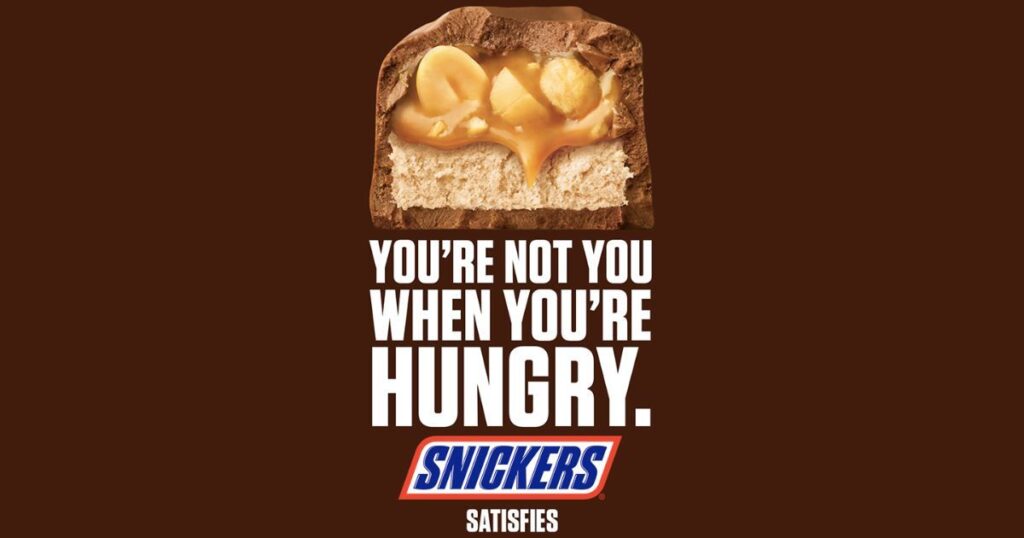
In 2010, Snickers was a well-known chocolate bar with a forgettable ad strategy — sales growth lagged both its biggest rival and the broader candy category.
Sixteen years later, “You’re Not You When You’re Hungry” hasn’t just survived; it’s still Snickers’ active global platform, generating new campaign extensions about AI, air travel, and football as recently as 2024 and 2025.
That kind of longevity is rare in advertising, and it started with a single research insight — that hunger doesn’t just make people uncomfortable, it makes them behave like someone else entirely — turned into an 88-year-old TV icon getting tackled on a football field during Super Bowl XLIV.
This case study covers the full history: the Betty White launch, the numbers behind the turnaround, the campaign’s decade of global expansion, and where Snickers has taken “hungry” as a platform in 2024-2026.
| Quick Answer: What Is the Snickers “Hungry” Campaign?
• Launched during Super Bowl XLIV on February 7, 2010, with agency BBDO New York’s Betty White ad. • Drove 15.9% global sales growth by 2012 and $376 million in incremental sales across 58 markets. • Popularized the word ‘hangry,’ formally added to the Oxford English Dictionary in 2018. • Still active in 2024-2026, extended into air travel (‘Hungry Skies’), AI (‘Don’t AI When You’re Hungry’), and football (‘Off Your Game’) campaigns. |
The Insight Behind the Campaign
By the late 2000s, Snickers had a problem common to long-standing category leaders: it was well known but not well differentiated.
Sales growth had fallen behind both its biggest direct competitor and the broader candy bar category average, a warning sign for a brand that had spent decades as a category staple without a distinctive point of view.
Research commissioned by agency BBDO New York surfaced a consumer insight that seems obvious in hindsight but hadn’t been built into any prior Snickers advertising — hunger doesn’t just cause discomfort, it visibly changes how people act, making them irritable, sluggish, or uncharacteristically difficult to be around.
That insight became the entire creative platform: rather than talk about taste, ingredients, or portion size, the way most confectionery advertising of the era did, Snickers built a campaign around a simple diagnosis (you’re hangry) and an equally simple prescription (eat a Snickers, become yourself again).
The initial target audience was young men aged 18 to 35, historically one of the hardest demographics for food brands to reach with traditional advertising, but the underlying joke proved broad enough that women, families, and older viewers adopted it just as readily.
Launch: Super Bowl XLIV and Betty White
The idea launched on the biggest possible stage: Super Bowl XLIV on February 7, 2010.
The spot, created by BBDO New York, opened on a group of young men playing pickup football, visibly frustrated with a clumsy, complaining teammate named Mike — except Mike was played by 88-year-old actress Betty White, sluggish and short-tempered on the field.
When a teammate says Mike is “playing like Betty White out there,” and his girlfriend runs on to hand him a Snickers bar, White transforms back into a young man mid-bite.
Ipsos ASI’s post-game testing ranked it the most entertaining, most unique, best-liked, and most talked-about ad of the entire 2010 Super Bowl, and it topped USA Today’s Ad Meter — a rare case of a debut campaign spot immediately becoming the industry’s benchmark for the format going forward.
Casting a Golden Girls-era sitcom star to play a bruising amateur football player, rather than a more conventionally ‘appropriate’ celebrity, was itself part of the joke: the more incongruous the transformation, the funnier and more memorable the reveal, a casting logic Snickers would return to again and again over the following decade and a half.
![Snickers - Betty White (Super Bowl 2010 Commercial) - [HD]](https://i.ytimg.com/vi/GkAnLtqWDhc/hqdefault.jpg)
The Formula That Let the Campaign Scale
What made the Betty White ad more than a one-off stunt was the consistent formula Snickers built around it: cast a recognizable, usually older or unexpected celebrity, have them behave like a completely different (usually younger, male, irritable) person, then reveal the “hangry” transformation once a Snickers bar is eaten.
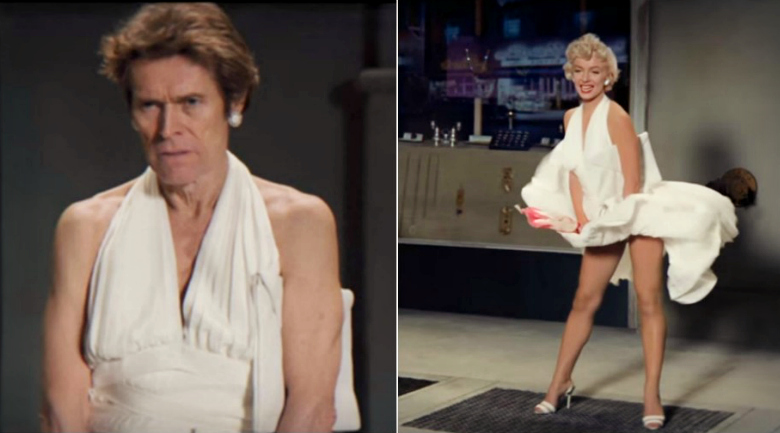
Follow-up spots used the same structure with Joe Pesci, Robin Williams, Aretha Franklin, Roseanne Barr, and later Willem Dafoe as the Ghost of Marilyn Monroe and Adam Driver performing the ad live during Super Bowl LI in 2017 — a genuinely difficult creative execution, since a live TV spot leaves zero room for error, unlike a pre-taped commercial that can be reshot until it’s right.
The consistency of the format, rather than each individual ad’s celebrity casting, is what let “You’re Not You When You’re Hungry” scale into dozens of markets without losing coherence.
Local market teams could cast regionally relevant celebrities or adapt the specific hangry scenario (a road trip, a wedding, a family dinner) to local cultural context, while keeping the underlying mechanic — irritable transformation, Snickers-triggered reversal — completely intact.
That built-in localization flexibility is a big part of why the campaign expanded from 34 markets at launch to 58-plus within two years without requiring a different creative concept for each one.

The Results: Sales, Share, and Internal Confidence
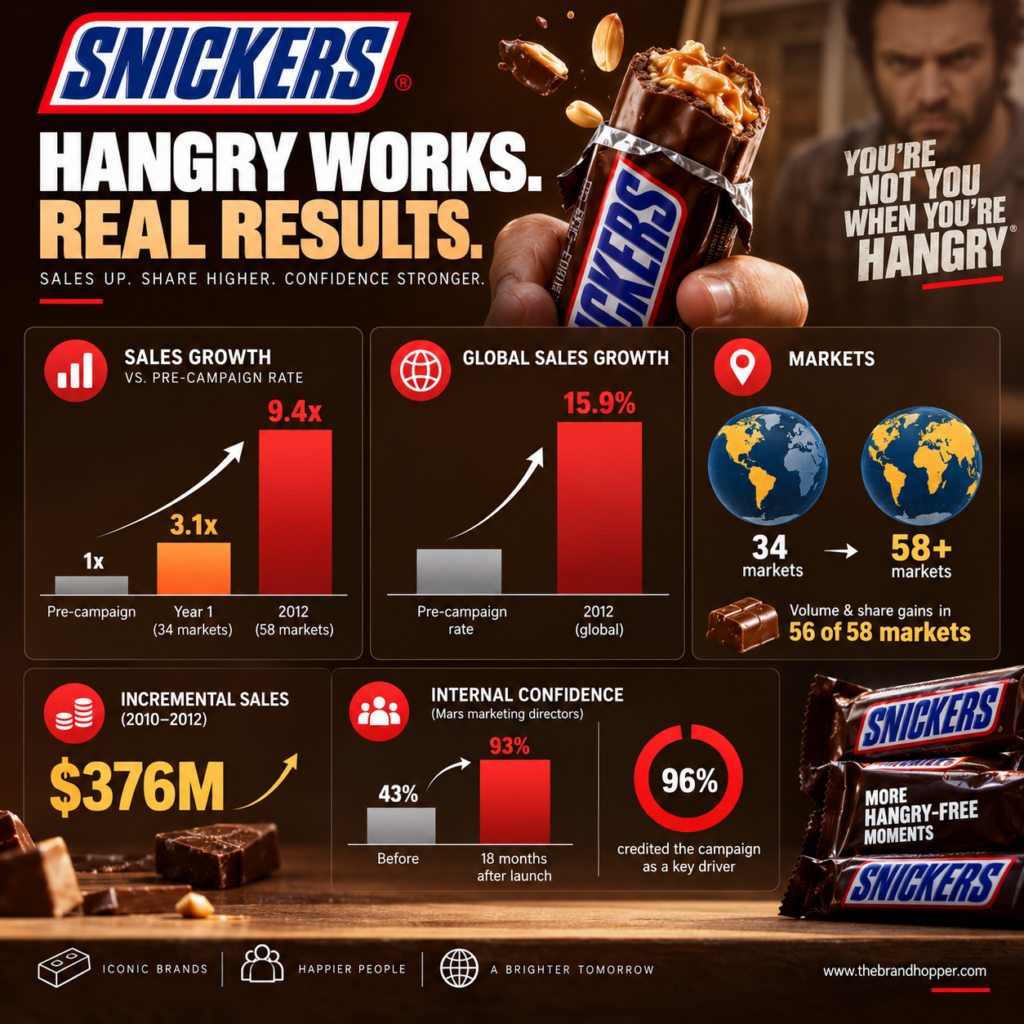
The commercial results were immediate and well documented by Mars itself. In its first year, the campaign drove sales growth 3.1 times higher than Snickers had achieved before launch, as it rolled out to 34 markets.
By 2012, with the platform live in 58 markets, Snickers sales were growing 15.9% globally — 9.4 times the pre-campaign growth rate — with volume and share gains recorded in 56 of those 58 markets.
Between 2010 and 2012, Snickers added a reported $376 million in incremental sales and reclaimed its position as the world’s best-selling chocolate bar by value.
Internally, the campaign’s effect on organizational confidence was just as notable: eighteen months after launch, 93% of Mars marketing directors said Snickers had real market momentum, up from just 43% before the campaign began, and 96% credited the campaign directly as a key driver of that turnaround.
That internal-confidence data point matters for a specific reason: campaigns are often judged purely on external sales metrics, but the willingness of Mars’ own regional marketing leadership to back further investment in the platform — rather than treat it as a one-off Super Bowl stunt — is a large part of why ‘hungry’ survived long enough to become a durable, decade-plus platform instead of a single memorable ad that got replaced within a budget cycle or two.

Cultural Impact: How “Hangry” Entered the Dictionary
“You’re Not You When You’re Hungry” did something few ad campaigns manage: it changed how people actually talk.
“Hangry” — a portmanteau that predates the campaign but was massively popularized by it — was formally added to the Oxford English Dictionary in 2018, explicitly citing its mainstream adoption partly through advertising and everyday use.
That kind of linguistic adoption is an unusually clean signal of cultural penetration: a dictionary editor isn’t tracking ad recall scores, they’re tracking whether ordinary people have started using a word unprompted in speech and writing, which is a much higher bar than simple brand awareness.
The campaign also won recognition on the industry side, picking up Cannes Lions and Effie Awards for both creative execution and proven business effectiveness — a combination, similar to a handful of other landmark campaigns, that validated the work on both artistic and commercial terms rather than just one or the other.
Individual spots have also been widely parodied and referenced across late-night television and social media in the years since, further reinforcing the format’s status as recognizable shorthand rather than just one company’s advertising.
2020: The Tenth Anniversary Return to the Super Bowl
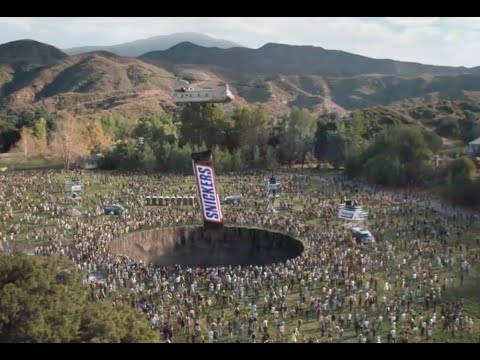
Snickers marked the campaign’s tenth anniversary by returning to the Super Bowl for the first time since 2017, airing “Snickers Fixes the World” during Super Bowl LIV on February 2, 2020 — a spot created by BBDO New York and AMV BBDO that doubled as a wink at Coca-Cola’s iconic 1971 “Hilltop” ad, showing a crowd of people literally lowering a giant Snickers bar by helicopter into a world it called “out of sorts,” featuring Luis Guzmán, Miranda Cosgrove, Bill Walton and WWE star Charlotte Flair.
The timing wasn’t incidental: 2020 was both the campaign’s tenth anniversary and Snickers’ 90th anniversary as a brand, making the ad as much a milestone celebration as a new creative execution.
Rather than simply re-airing or lightly updating the original Betty White concept, the anniversary spot expanded the metaphor from an individual’s bad mood to society’s collective bad mood — a scaled-up version of the same joke that let the campaign mark a decade without feeling like a rerun.
2024-2026: Extending “Hungry” Into Air Travel, AI, and Football
The “hungry” platform is still generating new work today, extended into categories the original 2010 campaign never touched. In April 2024, Snickers launched “Hungry Skies,” a global BBDO New York campaign applying the hangry-transformation format to air travel — in-seat yoga, repeated call-button pressing, and a passenger sharing a seat with an emotional-support snake, each framed as “out-of-sorts” behavior a Snickers bar could fix.
That same month, Snickers Brazil released “Don’t AI When You’re Hungry,” extending the platform into a distinctly 2024-2025 cultural moment by linking hunger-driven bad decisions to AI misuse and prompting errors — reframing the same core diagnosis (you’re not thinking clearly because you’re hungry) around a behavior that didn’t meaningfully exist as a category when the campaign launched in 2010.
In 2025, Snickers ran “Off Your Game,” a football-themed campaign activated across Mars Wrigley’s broader bar portfolio (Snickers, Mars, Twix, and Bounty) running through June 30, 2025, offering fans money-can’t-buy football experiences.
Mars Wrigley India also launched a Snickers Peanut Brownie variant in 2025 with new advertising built on the same hunger-satisfaction message, showing the platform’s continued use to support product-line extensions, not just the core bar.
Taken together, these 2024-2025 extensions show Mars using “hungry” less as a single ad campaign and more as a reusable creative operating system, one flexible enough to be pointed at almost any category where frustration or bad judgment shows up.

Why the Platform Has Lasted 16 Years
A few structural choices explain why “You’re Not You When You’re Hungry” has lasted longer than almost any comparable campaign platform.
First, the insight (hunger changes behavior) is genuinely universal and not tied to any single culture, age group, or market, which is why it scaled cleanly from 34 to 58-plus countries without requiring a different creative concept per region.
Second, the format — celebrity plays someone else, reveal via Snickers bar — is flexible enough to absorb new celebrities, new scenarios, and even entirely new categories (air travel, AI, football) without diluting the core message.
Third, Mars treated the tagline as durable brand infrastructure rather than a single ad campaign, which is why 16 years on it’s still the organizing idea behind new work rather than something replaced every few years the way most FMCG campaigns are.
Compare this to the typical lifecycle of a packaged-goods ad campaign, which is usually refreshed every 18 to 36 months as agencies rotate and internal marketing leadership changes — ‘hungry’ has now outlasted several such cycles at Mars without losing its central creative logic, largely because that logic was never really about a specific joke or actor, but about a genuinely reusable diagnosis-and-cure structure that new creative teams can keep applying to new situations.
Lessons for Marketers
A single, well-researched consumer insight can outlast a decade of creative trends — the underlying truth (hunger changes behavior) hasn’t needed updating since 2010, even as the executions built on it have changed constantly.
A flexible creative format scales better than a flexible message. Snickers kept the exact same structure (celebrity transformation, Snickers reveal) across dozens of markets and yet the campaign never felt repetitive, because casting and scenario did the work of staying fresh.
Live television execution is a legitimate way to generate outsized attention. The 2017 Adam Driver live Super Bowl spot demonstrates that creative risk-taking, done carefully, can extend a well-worn campaign’s cultural relevance rather than diminish it.
A platform can absorb new product lines and categories without a rebrand. Extending ‘hungry’ into air travel, AI, and football in 2024-2025 shows a 2010 insight can still generate genuinely new creative territory 15 years later.
Internal buy-in metrics matter as much as external ones. The jump from 43% to 93% of Mars marketing directors believing in Snickers’ momentum shows successful campaigns build organizational confidence, not just consumer sales — a less-visible but equally important effect.
Frequently Asked Questions
Q: When did the Snickers “You’re Not You When You’re Hungry” campaign launch?
A: It launched during Super Bowl XLIV on February 7, 2010, with a spot starring Betty White created by agency BBDO New York.
Q: Did the Snickers hungry campaign actually work commercially?
A: Yes. Sales growth hit 15.9% globally by 2012 (9.4 times the pre-campaign rate) as the platform expanded to 58 markets, adding a reported $376 million in incremental sales between 2010 and 2012 and making Snickers the world’s best-selling chocolate bar by value.
Q: Is the Snickers “hungry” campaign still running today?
A: Yes. Snickers extended the platform into new campaigns as recently as 2024 (“Hungry Skies,” about air travel, and “Don’t AI When You’re Hungry” in Brazil) and 2025 (“Off Your Game,” a football-themed campaign across Mars Wrigley’s bar portfolio).
Q: Which celebrities have appeared in Snickers ‘hangry’ ads?
A: Betty White (2010), Joe Pesci, Robin Williams, Aretha Franklin, Roseanne Barr, Willem Dafoe as the Ghost of Marilyn Monroe, and Adam Driver, who performed his transformation live during Super Bowl LI in 2017.
Q: Did the Snickers campaign influence the dictionary?
A: Yes. “Hangry,” a portmanteau of hungry and angry, was formally added to the Oxford English Dictionary in 2018, with its mainstream popularization credited in part to the Snickers campaign.
Q: What awards has the campaign won?
A: The campaign has won Cannes Lions and Effie Awards, recognizing both its creative execution and its proven business effectiveness — a combination relatively few campaigns achieve simultaneously.
Q: What was Snickers’ 2020 Super Bowl ad about?
A: “Snickers Fixes the World” aired during Super Bowl LIV on February 2, 2020, marking both the campaign’s 10th anniversary and Snickers’ 90th anniversary as a brand, featuring Luis Guzmán, Miranda Cosgrove, Bill Walton and Charlotte Flair in a spot that riffed on Coca-Cola’s classic ‘Hilltop’ ad.
Conclusion
Most campaigns celebrated as advertising landmarks belong to a specific year or decade; “You’re Not You When You’re Hungry” is unusual in that it’s still doing new work in 2025 and 2026, applying a 2010 insight to problems (AI, air travel, sports fandom) that didn’t exist in their current form when Betty White first got tackled on a football field.
The original numbers — 15.9% global sales growth, $376 million in incremental sales, a word added to the dictionary — would be enough to make this a standard case study.
What makes it a genuinely rare one is that Mars never treated the platform as finished, and 16 years on, “hungry” is still generating new ideas rather than being quietly retired the way most decade-old ad campaigns eventually are.
For any brand marketer studying this case today, the more useful takeaway may not be the specific jokes or celebrities at all, but the discipline of building a platform flexible enough to still have somewhere new to go a decade and a half after it launched.
Also Read
- The Budweiser “Wassup?” Campaign: Full Case Study
- Apple’s Greatest Ad Campaigns: From ‘1984’ to AI Era
- The Cadbury Gorilla Campaign: Complete Case Study
- McDonald’s “I’m Lovin’ It” Campaign: Full Case Study
To read more content like this, subscribe to our newsletter
Go to the full page to view and submit the form.