


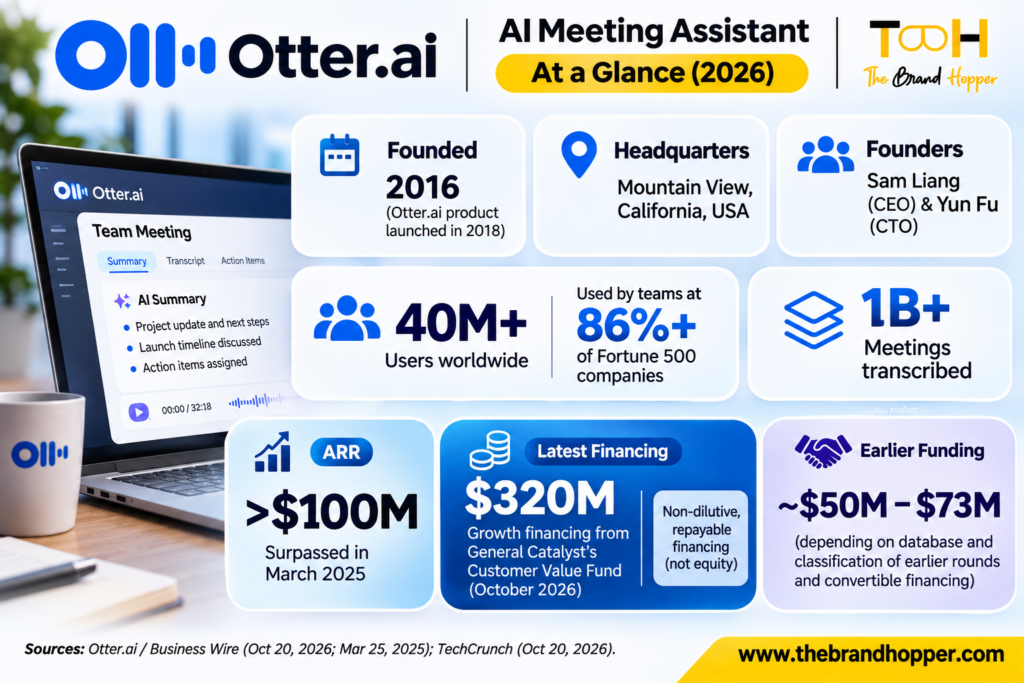
Otter.ai started with a narrow promise: turn spoken words into searchable text in real time. Eight years later, the company has moved well beyond transcription, positioning itself as a conversational knowledge platform for enterprises rather than simply a meeting-notes app. In October 2026, it closed US$320 million in growth financing from General Catalyst’s Customer Value Fund, a major source of capital for its next phase of enterprise expansion.
The numbers behind that pivot are significant. Otter reports more than 40 million users, including users at over 86% of Fortune 500 companies, and more than 1 billion meetings transcribed. It surpassed US$100 million in annual recurring revenue (ARR) in March 2025, making it one of the AI-native productivity startups to reach nine-figure recurring revenue through a largely product-led growth strategy. Its employer brand has also received recognition: Otter was featured on Forbes’ list of Best Startup Employers in 2024.
But the story is no longer just about growth. Otter faces a crowded field of dedicated meeting-notetaking rivals, free or bundled tools from Zoom, Microsoft and Google, and privacy litigation questioning how AI notetakers join and record calls. This analysis covers the founding story, founders, business model, pricing, revenue streams, funding, competitors, competitive advantage and products Otter has shipped.

Founding Story of Otter.ai
Otter.ai was founded in 2016 in Mountain View, California, under the name AISense by Sam Liang and Yun Fu. The spark was personal. Liang, who had experienced the difficulty of keeping track of conversations and information, saw an opportunity to create an assistant that could capture, remember and make spoken discussions searchable.

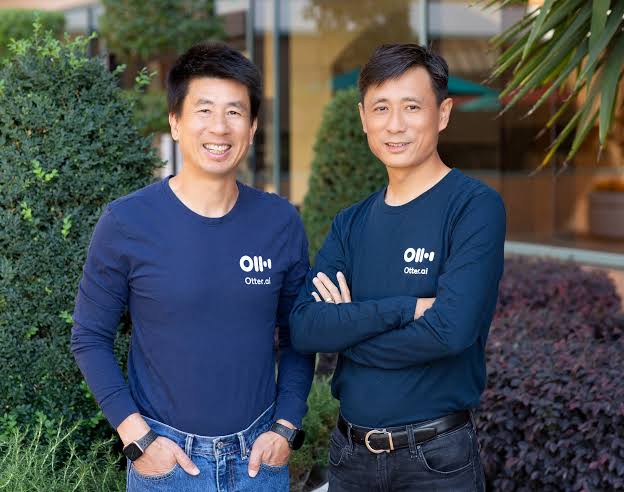
The founders had already worked together. Liang spent several years at Google, where he led location-services work associated with Google Maps and the familiar blue dot that indicates a user’s location. He then founded Alohar Mobile, a context-aware mobile platform acquired by Alibaba in 2013. Fu also worked at Alohar, leading infrastructure engineering. Their experience with processing large streams of real-world data provided a foundation for building speech-recognition technology.
Early on, AISense concentrated on developing its own speech-recognition and speaker-identification technology. The team also worked on collecting and processing the voice data needed to improve its models. In November 2017, AISense announced Otter, and the free version became widely available in February 2018. The name was deliberately approachable, while the free tier made it easy for people to try the product in their next meeting.
The timing helped enormously. When remote work expanded in 2020, online meetings became a standard part of working life. Otter’s calendar-connected assistant, which could automatically join supported calls and produce notes, became a natural fit for teams that needed to capture discussions and decisions.
Otter’s evolution since then has followed a clear pattern. Improvements in speech recognition, large language models and AI agents have allowed the company to move beyond transcription. Transcripts became summaries, summaries became searchable meeting histories, and meeting histories are now being connected to other AI tools and workflows.
Each step builds on the same underlying asset: a growing archive of recorded conversations. That archive can make the platform more useful, but it also raises the importance of privacy, consent, data retention and security as the information becomes more valuable.
Founders of Otter.ai
| Founder | Role | Background |
|---|---|---|
| Sam Liang | Co-founder and CEO | Stanford PhD in electrical engineering; led location-services work at Google Maps associated with the “blue dot”; founded Alohar Mobile, acquired by Alibaba in 2013 |
| Yun Fu | Co-founder and CTO | Led infrastructure engineering at Alohar Mobile; helped develop Otter’s speech-recognition and cloud systems |
Liang is the public face of the company and drives product vision and strategy. His recent messaging is consistent: transcription is a feature, not the product, and the long-term opportunity lies in the knowledge contained within conversations. In the October 2026 financing announcement, the company described its ambition as building an enterprise knowledge layer that connects conversations and turns them into action.
Fu is less publicly visible but remains central to the company’s technology strategy. Otter’s investment in proprietary automatic speech recognition (ASR) and speaker identification gives it greater control over its technology, product development and infrastructure. The company says it develops and operates its speech models in-house rather than simply wrapping a third-party transcription service.
The company has also expanded its leadership team around go-to-market execution. In August 2026, Otter appointed Alex Gay as Chief Marketing Officer, bringing in additional marketing leadership as it prepares to expand enterprise adoption and position itself beyond meeting transcription.
Business Model of Otter.ai
Otter runs a freemium software-as-a-service model that supports product-led growth. An individual signs up for free, connects a calendar and uses Otter to record or transcribe meetings. Colleagues may notice the notetaker in a call, ask about it and try it themselves. This visibility creates an organic distribution channel that has helped the company grow without relying exclusively on traditional paid marketing.
Monetisation comes from usage limits and team features. The free Basic plan limits monthly transcription minutes and the length of individual conversations, so frequent users may upgrade to Pro. Teams that need shared workspaces, administrative controls and higher usage capacity move to Business, while large organisations negotiate Enterprise contracts with additional security, deployment and support requirements.
This land-and-expand model allows Otter to enter a company through one individual user and potentially grow into a wider departmental or organisation-wide deployment. It also gives enterprise sales teams an opportunity to convert existing users into larger contracts.
The US$320 million growth financing announced in October 2026 is designed to accelerate this transition. Management wants to demonstrate value across functions such as sales and customer-facing teams, then expand into broader enterprise deployments where connected context from previous meetings makes future conversations more useful.
The model has clear advantages and tensions. On the positive side, software margins can improve with scale as speech-recognition models become more efficient, while product-led adoption can reduce customer-acquisition costs. The challenge is that a large free user base does not automatically translate into recurring revenue, and enterprise customers require security reviews, procurement support, administrative controls and service commitments.
Closing that gap is a central objective of Otter’s latest financing and enterprise strategy.
Pricing Plans

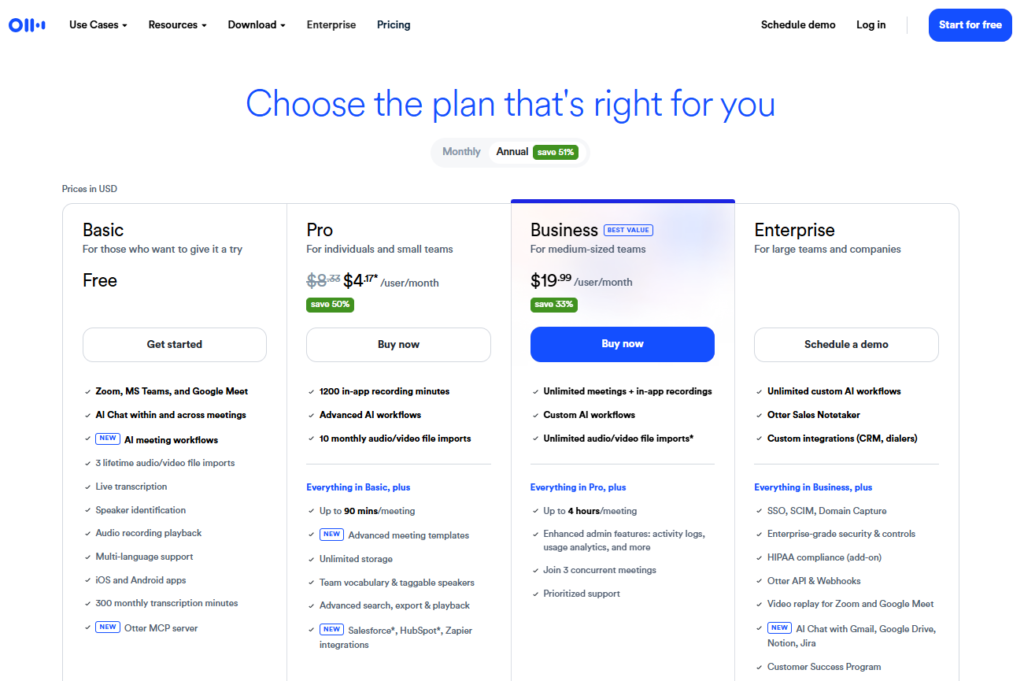
Prices are in US dollars and reflect Otter’s published pricing structure at the time of checking. Promotions, taxes, billing terms and regional pricing may change. Confirm current rates on Otter’s official pricing page before publishing.
Revenue Streams of Otter.ai
Otter’s revenue is primarily recurring subscription income. Its business model centres on individual subscriptions, team plans and enterprise contracts, rather than advertising within the product.
Otter states that it does not sell personal information to third parties or serve third-party advertisements within its products. However, its privacy policy allows the use of de-identified audio recordings and transcriptions to train its proprietary AI technology, subject to the applicable settings and agreements. Enterprise workspaces are opted out of AI model training by default.
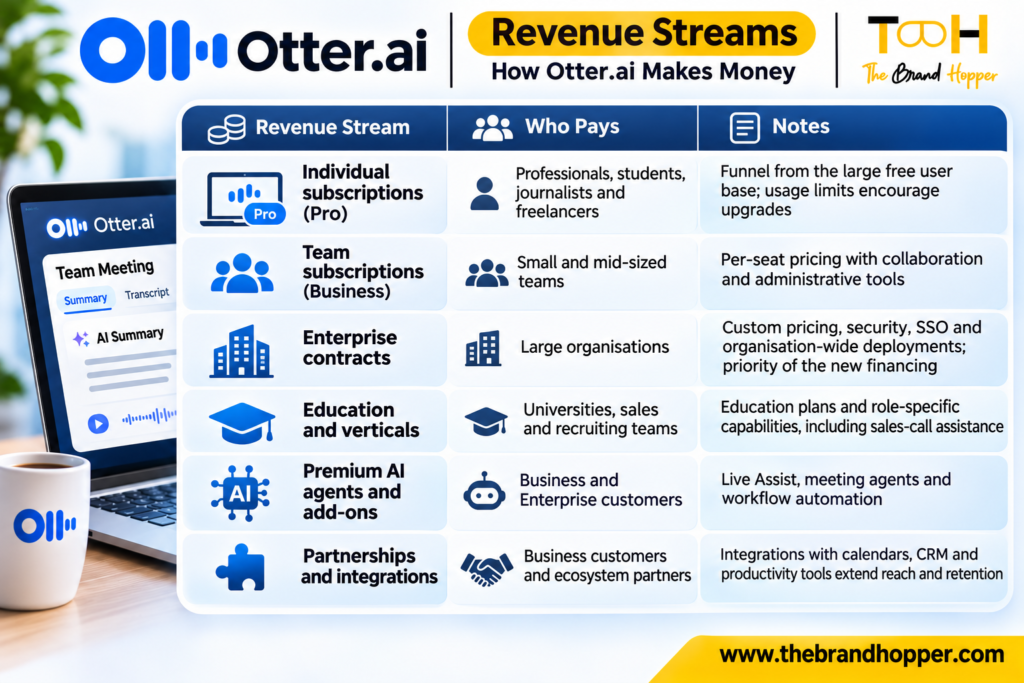
Otter says it has more than 40 million users but does not publicly disclose how many are paying customers. Consequently, its free-to-paid conversion rate and average revenue per paying user cannot be independently calculated from the available user figures.
Sales and customer-facing teams are a major commercial focus. Live Assist is positioned as a real-time sales-call coaching tool, while Work Mode connects meeting context with preparation and follow-up tasks. These capabilities indicate where Otter sees higher enterprise willingness to pay.
Funding of Otter.ai
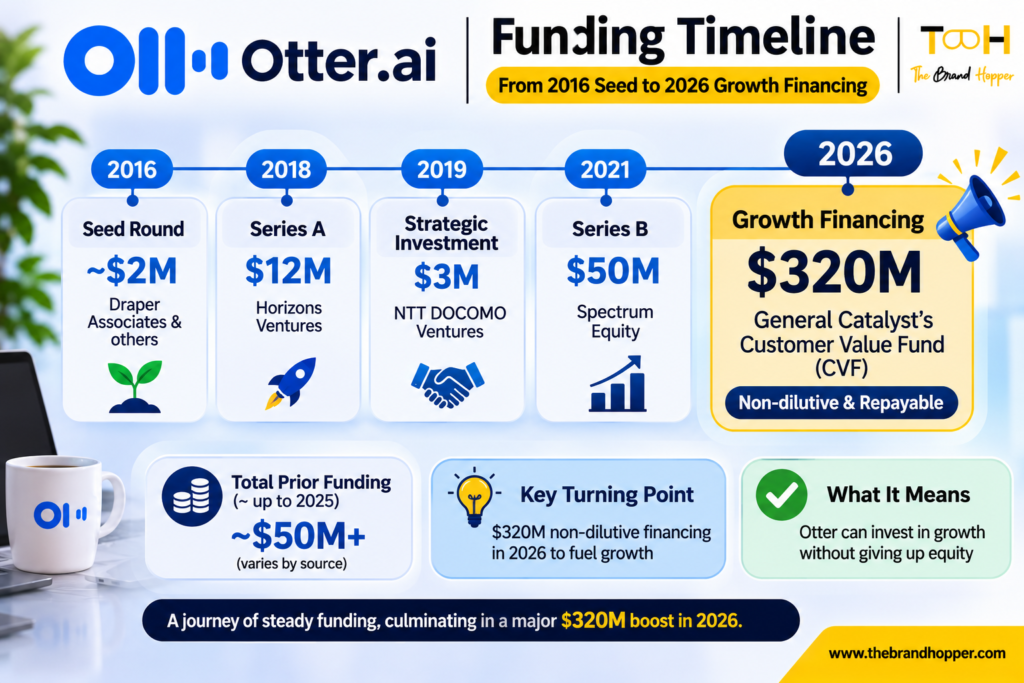
For much of its history, Otter raised relatively modest amounts of conventional venture capital. Early backers included Draper Associates, Draper Dragon and other investors. The company later raised a Series A round led by Horizons Ventures, received a strategic investment from NTT DOCOMO Ventures and announced a US$50 million Series B in 2021 led by Spectrum Equity.
Funding databases report different cumulative totals because they classify some investments and convertible financing differently. TechCrunch cited approximately US$50 million in prior funding in October 2026, while other databases report higher totals. The exact cumulative amount should therefore be treated cautiously.
That changed on 20 October 2026, when Otter announced US$320 million in growth financing from General Catalyst’s Customer Value Fund (CVF). The financing is non-dilutive and repayable, rather than a conventional equity investment. CEO Sam Liang told Reuters that the company would repay the capital with interest as increased sales and marketing spending generated revenue.
This distinction matters: the US$320 million should not be added to Otter’s equity funding total as though it were a new venture-capital round. It is a financing arrangement intended to fund growth without diluting existing shareholders.
The money has several stated uses: enterprise go-to-market expansion, international growth and product innovation. General Catalyst’s Pranav Singhvi described voice as a significant untapped opportunity in enterprise AI.
For Otter, the financing represents a different approach to scaling. A company with established recurring revenue can use performance-linked growth capital to expand customer acquisition and sales capacity without issuing additional equity.
Competitors of Otter.ai
AI meeting notes has become one of the most crowded categories in workplace software. Rivals fall into three broad groups: dedicated notetaker startups, no-bot alternatives that record locally, and meeting platforms with their own integrated AI capabilities.
| Competitor | Type | How It Competes With Otter |
|---|---|---|
| Fireflies.ai | Notetaker startup | Bot-based transcription, meeting summaries and conversation intelligence; announced a valuation exceeding US$1 billion in 2025 |
| Granola | No-bot notetaker | Records locally without a visible meeting bot; raised US$125 million in March 2026 at a reported US$1.5 billion valuation |
| OLVA | AI meeting assistant | Offers transcription and contextual assistance across virtual and in-person meetings; competes through its cross-platform approach and lower-cost plans |
| Fathom | Notetaker startup | Free-first meeting recording and summarisation strategy, with products for sales and customer-facing teams |
| Grain | Notetaker startup | Emphasises video clips, highlights and searchable insights from recorded calls |
| Avoma | Meeting assistant | Meeting notes, conversation intelligence and revenue-team workflows |
| MeetGeek | Notetaker startup | Automated meeting recording, transcription, summaries and workflow integrations |
| Airgram | Notetaker / meeting assistant | Listed among meeting-assistant tools; verify current product availability and positioning before treating it as a major active competitor |
| Read AI | Meeting analytics | Summaries, search and engagement analytics across meetings and communications |
| Zoom AI Companion | Platform native | Integrated AI meeting summaries and assistance for eligible Zoom customers |
| Microsoft Copilot in Teams | Platform native | Meeting recaps, summaries and action items within the Microsoft 365 ecosystem |
| Google Gemini in Meet | Platform native | Meeting notes and summaries through Google Workspace’s Gemini features |
The platform giants pose the sharpest long-term threat. When transcription and summaries are bundled into a tool a company already pays for, standalone notetakers must justify their additional cost through stronger cross-platform functionality, deeper search, better workflows or more advanced AI agents.
Granola demonstrates another competitive pressure. Some professionals dislike bots visibly joining meetings and prefer a quiet, local recording experience. That approach challenges Otter’s visible-assistant distribution model and may appeal to users who prioritise a less intrusive meeting experience.
Fireflies has also reached a reported valuation exceeding US$1 billion, while Granola’s March 2026 financing valued it at US$1.5 billion. These figures show investor interest in the category, although valuations do not necessarily indicate revenue scale or product-market leadership.
Competitive Advantage of Otter.ai
1. Scale and data. Otter reports more than 1 billion meetings transcribed and over 40 million users. That scale gives the company extensive experience processing real-world conversations, including different accents, background noise and overlapping speech. However, a large transcript archive alone does not establish a defensible data moat; the quality, permitted use and protection of that data are equally important.
2. In-house speech technology. Building proprietary ASR and speaker-identification technology gives Otter control over its speech-recognition systems, product roadmap and infrastructure. Its privacy policy states that de-identified audio recordings and transcriptions may be used to train its proprietary AI technology. Enterprise workspaces, however, are opted out of AI model training by default.
3. Cross-platform neutrality. Otter works across Zoom, Microsoft Teams and Google Meet, as well as in-person conversations. Companies that use more than one meeting platform can maintain a searchable record across different environments, something a platform-native feature may not provide as easily.
4. Enterprise reach. Otter reports that users at over 86% of Fortune 500 companies have used its platform. This creates opportunities for the sales team to convert individual or departmental usage into organisation-wide contracts. The new financing is intended to accelerate that process.
Integrations with business tools can also turn transcripts into inputs for workflows rather than static documents. For example, Otter’s sales-related features connect conversation insights with CRM workflows, while recruiting tools can support hiring processes and applicant-tracking systems such as Greenhouse (Otter.ai).
Where the moat is tested. The strongest threats are platform bundling, privacy and enterprise security. A proposed class action filed in August 2025 alleges that Otter’s notetaker recorded conversations without obtaining proper consent from all participants and used meeting content for model training. These remain allegations, not findings of liability.
In August 2026, a federal judge granted Otter’s motion to dismiss in part but denied it in other respects, allowing several core privacy claims to proceed. Some claims were dismissed with leave to amend, while others were withdrawn or dismissed without prejudice. The case therefore remains a material legal and reputational risk for the company.
Otter’s privacy and security controls will also matter to enterprise customers. Its current policy distinguishes between personal accounts and enterprise workspaces, and the company says Enterprise workspaces are opted out of model training by default. Winning in regulated industries will depend on maintaining clear consent practices, appropriate data controls and enterprise-grade security.
Products and Services of Otter.ai
| Product / Feature | What It Does | Status |
|---|---|---|
| Otter Notetaker and transcription | Real-time transcription with speaker labels, searchable transcripts, highlights and sharing across web, iOS, Android and desktop | Core product since 2017–2018 |
| OtterPilot | Automatically joins supported calendar meetings, records, transcribes, captures slides and produces summaries and action items | Introduced February 2023 |
| AI Chat | Lets users ask questions about a meeting or across previous conversations | Introduced in 2023; subsequently expanded |
| Meeting Agent | Voice-activated meeting participant that can answer questions and complete tasks using meeting context | Announced March 2025 |
| Sales and SDR agents | AI-powered sales assistance, coaching and automated product demonstrations | Expanded through 2025–2026 |
| Pre-Meeting Brief | Compiles context from previous meetings and connected applications before a call | Announced as part of Work Mode in October 2026 |
| Live Assist | Provides real-time, private coaching and suggestions during calls on Zoom, Teams and Google Meet | Introduced July 2026; expanded in October 2026 |
| Work Mode | Uses conversation history and connected apps to create pre-meeting briefs, recaps, follow-ups and other work outputs | Announced October 2026 |
| MCP server access | Allows compatible AI tools such as ChatGPT and Claude to access authorised Otter meeting information | Introduced in 2026 |
| Multilingual expansion | 13 new languages available, with 14 additional languages announced for future rollout; multilingual meeting transcription is also being developed | Announced November 2026 |
Taken together, the roadmap shows a deliberate move up the value chain: from capturing what was said, to preparing people before meetings, assisting during them and automating what happens afterward. Work Mode and Live Assist are central to this strategy because they extend Otter’s role beyond producing a transcript.
MCP support is also strategically important. It allows compatible AI applications to retrieve and analyse authorised Otter meeting data, positioning the platform as a source of conversational knowledge for other AI workflows rather than only a destination app.
What to Watch Next
Three signals will show whether the new strategy is working. First, whether Otter discloses paid-customer growth, enterprise contract sizes or other revenue-quality metrics, since user counts alone say little about monetisation. Second, how quickly the 14 announced languages become available and how accurately the platform handles multilingual conversations, because international expansion is one of the stated uses of the new financing.
Third, the outcome of the privacy litigation and any changes to how the notetaker announces itself in meetings will influence how comfortable large and regulated customers feel deploying it widely. Enterprise adoption will depend not only on product performance but also on trust, transparency and data governance.
Conclusion
Otter.ai’s journey from a 2016 speech technology startup to a platform with more than 40 million users is a case study in building distribution into a product. A free tier, a visible meeting assistant and calendar integrations helped it spread from individual users to teams and organisations. That growth engine carried the company past US$100 million in ARR in March 2025, before the October 2026 financing marked a new stage in its expansion.
The US$320 million from General Catalyst represents a significant strategic shift. Otter is no longer simply proving that people want meeting notes; it is trying to establish that conversational data can become a durable enterprise knowledge layer, supported by agents that prepare, assist and act. Success depends on staying meaningfully better than the tools built into Zoom, Microsoft and Google, competing with focused startups such as Granola and Fireflies, and addressing privacy and security concerns that could slow enterprise adoption.
If Otter can demonstrate measurable value across several functions inside large organisations, it has a credible path towards becoming the voice system of record it describes. If platform bundling and privacy pressure win out, the same scale that makes it a leader could leave it defending a feature rather than owning a category.
For founders and marketers studying the company, the lesson is the same either way: product-led growth can get a company into the market, but the next stage demands trust, product depth and enterprise-grade proof.
Also Read: SoundHound AI: Founders, $169M Revenue & What’s Next
To read more content like this, subscribe to our newsletter
Go to the full page to view and submit the form.