


Every marketing team knows the pain: a simple email campaign that should take an hour instead takes two weeks, bouncing between designers, developers, brand reviewers, and agencies before it ever reaches a customer’s inbox.
Stensul, a New York-based marketing technology startup, built its entire business around eliminating that friction.
Rather than chasing the crowded email-sending or marketing-automation categories dominated by giants like Salesforce and HubSpot, Stensul focused narrowly on the creation layer — the process of actually building emails and landing pages — and turned it into a fast, governed, no-code workflow for enterprise marketing teams.
Founded in 2016 by serial entrepreneur Noah Dinkin, Stensul has grown into a recognized name in the marketing operations and MarTech space, counting large enterprises like BlackRock, Cisco, Thomson Reuters, and Equifax among its customers.
The company’s core promise — cutting email production time by as much as 90% — resonated with an industry increasingly obsessed with campaign velocity and operational efficiency.
Stensul’s rise also reflects a broader shift in how enterprises think about marketing operations.
As campaign volumes multiplied across email, social, and web channels, the bottleneck for most large marketing teams stopped being strategy or budget and became simple production capacity: how quickly a team could turn an approved concept into a finished, compliant, on-brand asset.
Stensul built its entire product philosophy around collapsing that bottleneck, treating the creation step as a discipline worthy of dedicated software rather than an afterthought bolted onto a sending platform.
This article examines Stensul’s journey in detail: its founding story, leadership, business model, revenue streams, funding history, competitive landscape, products, and what lies ahead following a significant 2026 leadership transition.
Founding Story of Stensul
Stensul was founded in 2016 by Noah Dinkin, an NYU graduate and repeat entrepreneur who had previously built FanBridge, an email marketing tool designed for musicians and independent artists to communicate directly with their fan bases.


FanBridge gave Dinkin firsthand exposure to the operational pain points of email marketing — and, crucially, to just how broken the process of actually building emails could be, even for relatively small, agile teams.
FanBridge was later acquired by ConvertKit, a well-known email marketing platform for creators, giving Dinkin a successful exit and the credibility to launch his next venture.
When Dinkin turned his attention to Stensul, he identified a specific and underappreciated gap in the martech stack.
Email service providers (ESPs) like Salesforce Marketing Cloud, Adobe Campaign, and Oracle Eloqua were built primarily for sending, automating, and analyzing email campaigns — not for efficiently creating the emails themselves.
While most ESPs technically included some email-building tools, enterprise marketing teams largely avoided them, instead relying on a patchwork of designers, front-end developers, and outside agencies to hand-code every campaign.
This process was slow, expensive, and prone to brand inconsistency and compliance risk, particularly in regulated industries like financial services and healthcare.
Dinkin’s insight was that email creation deserved to be treated as its own distinct software category, separate from sending and automation.
Stensul’s founding thesis was straightforward: give marketers themselves — not developers — the ability to build professional, on-brand, responsive emails in a fraction of the time, using a no-code, drag-and-drop interface built on top of pre-approved, developer-coded content blocks.
Where a traditional agency-driven process might take one to two weeks per email, Stensul’s platform aimed to compress that same process down to about two hours.
Over its first several years, Stensul built a reputation among enterprise marketing operations teams as the platform that could bring “agile” methodology to email production.
As the company matured, it expanded from a pure email-creation tool into what it now calls a “Governed Creation” platform — extending the same no-code, brand-controlled workflow to landing pages and other marketing assets, and later layering in generative AI features to further accelerate content creation and email localization for global brands.
In May 2026, Stensul marked a major turning point: after leading the company for more than a decade, founder Noah Dinkin stepped down as CEO, handing the role to Manlio Carrelli, the former chief executive of CB Insights, a prominent AI-driven market intelligence firm.
The leadership transition signaled Stensul’s ambition to enter a new growth phase, pairing its founder’s original product vision with an experienced operator credentialed in scaling AI-enabled enterprise software businesses.
Founders and Leadership of Stensul
Stensul’s leadership reflects its evolution from a founder-led startup into a more institutionally managed growth-stage company.
| Name | Role | Background |
| Noah Dinkin | Founder (former CEO, 2016–2026) | NYU graduate; previously founded FanBridge, an email marketing tool for musicians, later acquired by ConvertKit; led Stensul as CEO for over a decade before transitioning out of the role in May 2026 |
| Manlio Carrelli | Chief Executive Officer (from May 2026) | Former CEO of CB Insights, a leading AI-powered market intelligence platform; brings deep experience scaling AI and enterprise software companies across public and growth-stage settings |
Noah Dinkin’s background as a two-time founder in the email and messaging space gave Stensul an unusually specific and well-informed founding vision.
Having already lived through the operational headaches of email creation at FanBridge, Dinkin was building Stensul to solve a problem he understood intimately rather than one he had only observed from the outside.
Under his leadership, Stensul grew from a niche email-creation tool into a recognized enterprise marketing platform trusted by Fortune 500 companies.
The appointment of Manlio Carrelli as CEO in 2026 marks a deliberate shift toward professionalized, growth-stage leadership.
Carrelli’s tenure at CB Insights — a company built around delivering AI-driven insights to enterprise strategy and innovation teams — positions him to lead Stensul’s own push to embed generative AI more deeply into its creation platform, while scaling the company’s enterprise sales motion and expanding its total addressable market beyond email and landing pages.
Business Model of Stensul
Stensul operates a business-to-business (B2B) SaaS model, selling its Governed Creation platform directly to enterprise marketing, marketing operations, and brand/compliance teams.
Unlike many martech tools that pursue a self-serve, freemium, or small-business-first strategy, Stensul has deliberately focused on large enterprises and regulated industries — financial services, insurance, healthcare, technology, and retail — where brand governance, legal compliance, and cross-team collaboration around content creation carry outsized importance.
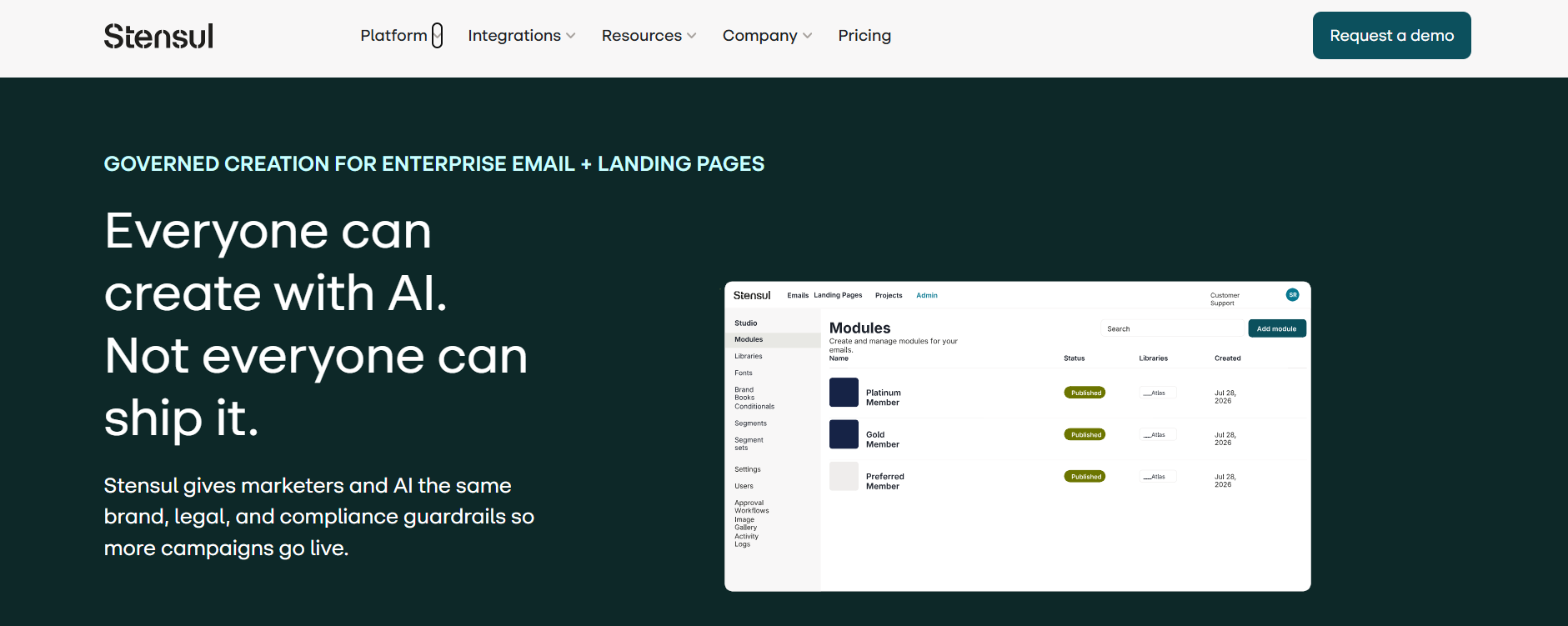

The company sells annual or multi-year subscription contracts, with pricing customized to each organization’s scale, number of users, workflow complexity, and creation volume.
Rather than publishing self-serve pricing tiers, Stensul requires prospective customers to request a quote, reflecting its enterprise sales motion: dedicated account executives, solutions consultants, and a hands-on onboarding process designed to configure the platform around each customer’s brand guidelines, approval workflows, and existing martech stack integrations (such as ESPs, CRM systems, and marketing automation platforms).
This high-touch, enterprise-first model allows Stensul to command premium contract values while building durable, sticky relationships with large marketing organizations — customers who, once they have configured Stensul’s governed content blocks and integrated it into their broader campaign workflows, face significant switching costs to move to a competing platform.
Stensul’s onboarding process itself functions as a form of lock-in and long-term value creation: solutions consultants work with each customer’s brand and legal teams to translate style guides and compliance rules into reusable, pre-approved content blocks.
Once that library exists, ordinary marketers can assemble new campaigns without repeating that governance work each time, which both accelerates future production and reinforces the platform’s role as the system of record for how that enterprise builds marketing assets.
Revenue Streams of Stensul
Stensul’s revenue is generated primarily through recurring subscription contracts, supplemented by services and expansion revenue as customers broaden their use of the platform.

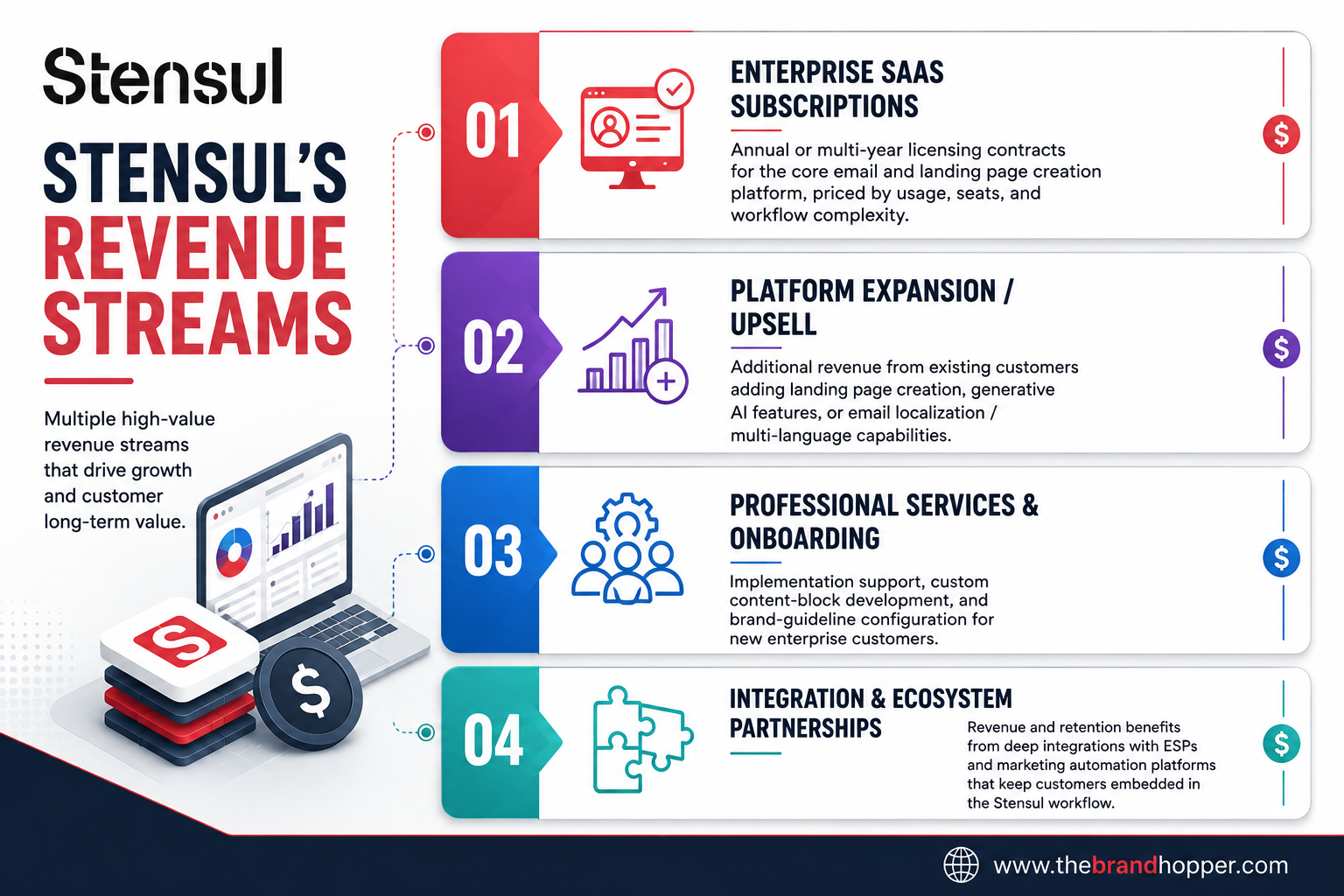
Because Stensul’s customer base skews toward large, well-resourced enterprises, average contract values tend to be significantly higher than those of self-serve, SMB-focused email design tools. This concentration on premium enterprise accounts supports a smaller but higher-value customer base, with growth driven as much by expanding usage within existing large accounts as by acquiring new logos.
Funding of Stensul
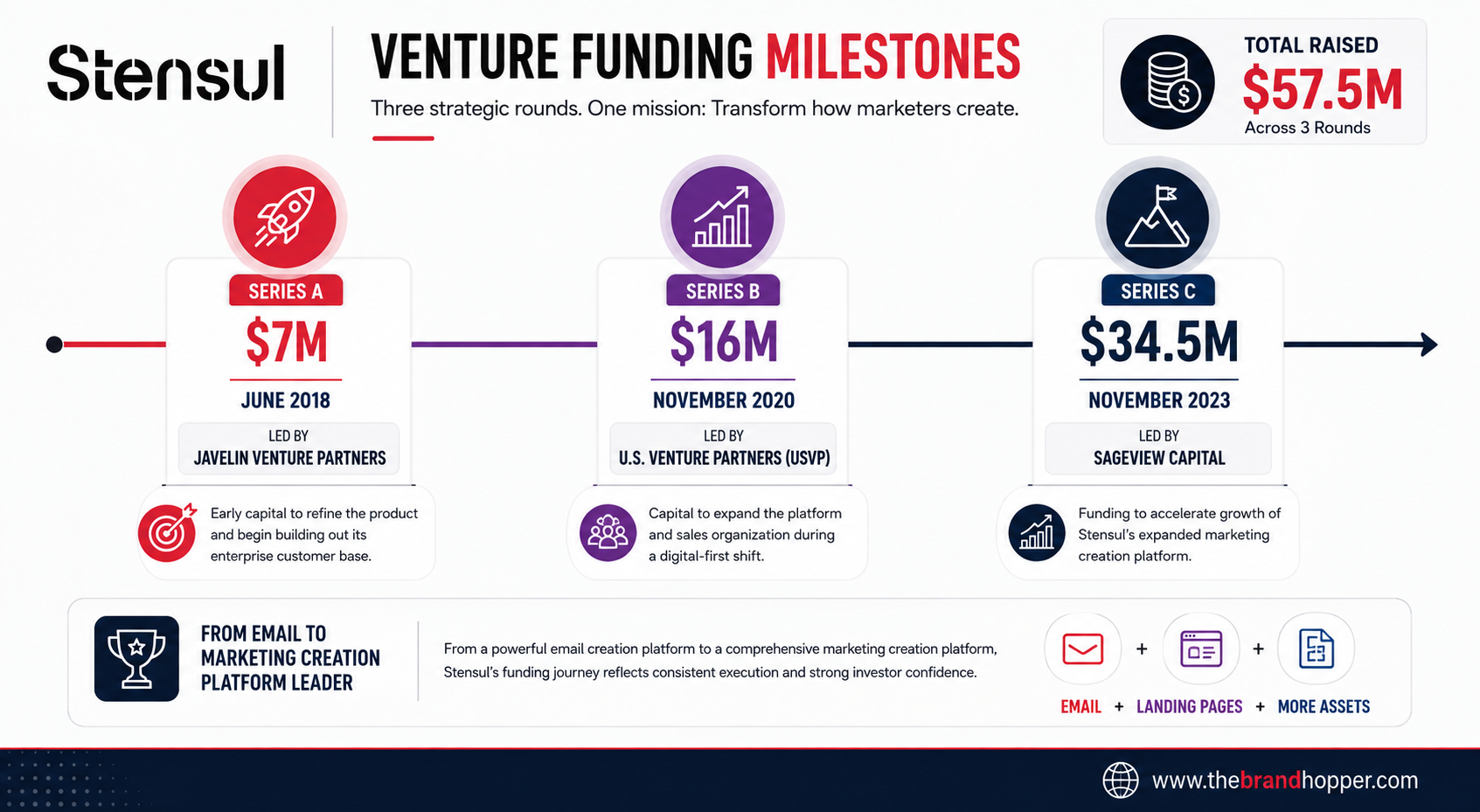
Stensul has raised a total of approximately $57.5 million in disclosed venture funding across three rounds since its founding, according to Crunchbase and Tracxn. The company’s fundraising history reflects a fairly typical enterprise SaaS trajectory: a modest Series A to prove out product-market fit, a larger Series B to scale go-to-market operations, and a Series C aimed at accelerating growth of an expanded, multi-product platform.
Stensul’s Series A, announced in mid-2018, was led by Javelin Venture Partners and raised $7 million, providing early capital to refine the product and begin building out its enterprise customer base. In November 2020, the company closed a $16 million Series B led by U.S. Venture Partners (USVP), capital that helped Stensul expand its platform and sales organization even as many marketing teams grappled with pandemic-driven shifts to digital-first campaigns. The company’s most recent disclosed round, a $34.5 million Series C led by Sageview Capital, closed in November 2023 and was explicitly earmarked to accelerate growth of Stensul’s broader “marketing creation platform” positioning — reflecting its expansion beyond email into landing pages and other marketing assets.
Notable investors across Stensul’s cap table include Javelin Venture Partners, U.S. Venture Partners, Uncork Capital, and Lowercase Capital, alongside individual investors such as Frederic Kerrest, co-founder of Okta, and Edith Harbaugh, co-founder and former CEO of LaunchDarkly. The participation of operator-investors with deep enterprise SaaS experience underscores the confidence placed in Stensul’s enterprise-first strategy.

Funding Rounds of Stensul
The table below summarizes Stensul’s publicly disclosed funding rounds based on data from Crunchbase, TechCrunch, and PR Newswire.
| Round | Date | Amount | Lead Investor(s) |
| Seed / Early Funding | 2016–2017 | Undisclosed | Early angel and seed backers |
| Series A | June 2018 | $7 million | Javelin Venture Partners |
| Series B | November 2020 | $16 million | U.S. Venture Partners (USVP) |
| Series C | November 2023 | $34.5 million | Sageview Capital |
With roughly $57.5 million raised across a decade of operation, Stensul has pursued a comparatively capital-efficient growth path relative to many venture-backed SaaS peers, consistent with an enterprise sales model that generates high-value, sticky contracts rather than requiring heavy consumer-style customer acquisition spend.
Competitors of Stensul
Stensul competes in the broader email and marketing asset creation space, a category that includes both no-code email builders aimed at small and mid-sized businesses and more specialized enterprise-grade governed creation platforms.
| Competitor | Primary Focus | How It Compares to Stensul |
| Beefree | No-code email and page builder | Serves a much broader range of customers from freelancers to enterprises; less specialized in enterprise governance and brand compliance workflows than Stensul |
| Chamaileon | Agile email production platform | Emphasizes speed and simplicity for email teams, reducing production time through a different workflow model than Stensul’s block-based governed creation approach |
| Taxi for Email | Email sending and deliverability platform | Focused more on email deployment and deliverability rather than the front-end creation and design workflow that is Stensul’s core focus |
| Salesforce Marketing Cloud / Adobe Campaign / Oracle Eloqua | Full-suite ESPs and marketing automation platforms | Offer built-in email creation tools, but these are typically less specialized and less efficient than Stensul’s dedicated, no-code creation workflow, which is why enterprises often layer Stensul on top of these platforms |
| Marketing agencies / freelance developers | Custom-coded email and landing page production | Traditional alternative to software-based creation; slower and more expensive than Stensul’s self-service, no-code model |
Stensul’s positioning is distinct in that it does not attempt to compete directly with full-suite ESPs or marketing automation platforms on sending, automation, or analytics. Instead, it complements them, integrating with the marketing stack an enterprise already has in place while replacing the manual, developer-dependent process of actually building each campaign asset.
Competitive Advantage of Stensul
Stensul’s competitive position rests on several factors that have allowed it to build durable relationships with large, complex enterprise customers.
First, deep specialization in the creation layer gives Stensul a level of workflow sophistication that general-purpose ESPs and broader design tools struggle to match. By focusing narrowly on the process of building emails and landing pages — rather than spreading itself across sending, automation, and analytics — Stensul has been able to optimize specifically for speed, brand consistency, and cross-team collaboration.
Second, its “Governed Creation” model directly addresses a pain point that matters enormously to large, regulated enterprises: ensuring that every email or landing page a marketing team produces adheres to brand guidelines, legal disclosures, and compliance requirements, without requiring manual review of every asset from scratch. This is a particularly compelling value proposition in industries like financial services, insurance, and healthcare, where compliance risk is high and Stensul counts customers such as BlackRock and Equifax.
Third, Stensul’s enterprise-first go-to-market strategy — rather than a bottom-up, self-serve approach — has allowed it to build high-value, high-retention contracts with organizations that have complex, multi-stakeholder marketing operations, rather than competing purely on price against lower-cost, SMB-focused email builders.
Fourth, deep integrations with existing ESPs and marketing automation platforms mean Stensul does not ask enterprises to rip out and replace their existing martech stack; it slots in as the creation layer on top of tools they already use, lowering the barrier to adoption and increasing switching costs once implemented.
Finally, the company’s ongoing investment in generative AI features and multi-language email localization signals an effort to stay ahead of a market where AI-assisted content creation is increasingly expected, an initiative likely to accelerate under new CEO Manlio Carrelli given his AI-focused background at CB Insights.
Taken together, these advantages help explain why Stensul has been able to retain marquee logos over multiple contract renewal cycles even as cheaper, more generic email builders have proliferated: the platform is not simply selling a design tool, but a governance and speed layer that becomes more valuable to a customer the longer it is used.


Products & Services of Stensul
Stensul’s product suite has expanded over time from a single-purpose email builder into a broader governed marketing asset creation platform.
| Product / Feature | Description | Primary Use Cases |
| Email Creation Platform | No-code, drag-and-drop builder using pre-approved, developer-coded content blocks to assemble on-brand, responsive emails | Enterprise campaign production, newsletters, promotional and transactional email design |
| Landing Page Creation | Extension of the no-code, block-based creation model to build integrated, on-brand landing pages | Campaign-specific landing pages tied directly to email creative and messaging |
| Governed Creation™ Workflow | Built-in permissions, approval workflows, and brand/compliance controls embedded into the creation process | Ensuring legal, brand, and compliance alignment across large, distributed marketing teams |
| Generative AI Tools | AI-assisted content generation features designed to speed up copywriting and asset creation within the platform | Accelerating first-draft creation and reducing time spent on repetitive copy and design tasks |
| Email Localization | Tools to adapt and translate email content for multiple languages and regions | Global brands running multi-market, multi-language campaigns from a single creative source |
| MarTech Integrations | Connections with ESPs, marketing automation platforms, and CRM systems | Ensuring finished assets flow seamlessly into existing sending and campaign management tools |
Collectively, these capabilities let marketing teams at companies like Cisco, Thomson Reuters, and the Milwaukee Bucks move from campaign concept to finished, on-brand asset in a fraction of the time required by traditional agency- or developer-driven workflows — with Stensul citing campaign creation time reductions of up to 90% for its customers.
Conclusion
Stensul’s story is a case study in the value of specialization within a crowded software category. Rather than competing head-on with entrenched email service providers and marketing automation giants, founder Noah Dinkin identified a narrower, underserved problem — the slow, developer-dependent process of actually creating on-brand marketing assets — and built a decade-long enterprise software business around solving it well. The result is a platform trusted by some of the world’s largest and most regulated brands, built on a capital-efficient path of roughly $57.5 million in venture funding across three disciplined rounds.
The company’s 2026 leadership transition, bringing in former CB Insights CEO Manlio Carrelli, marks a new chapter as Stensul looks to deepen its generative AI capabilities and expand further beyond its email and landing page roots. Whether Stensul can continue growing its enterprise footprint while fending off both nimble no-code challengers and the creeping feature expansion of full-suite marketing clouds will determine how far this next phase can take the company.
What remains clear is that Stensul has already validated a durable thesis: in large, brand-conscious, compliance-sensitive organizations, the process of creating marketing content is just as worthy of dedicated software investment as the process of sending or analyzing it. That insight, first identified by a founder who had lived the pain point himself, continues to anchor Stensul’s place in the modern marketing technology stack.
Also Read: LandingAI Startup Story: Andrew Ng’s Journey Building Visual AI
To read more content like this, subscribe to our newsletter
Go to the full page to view and submit the form.