


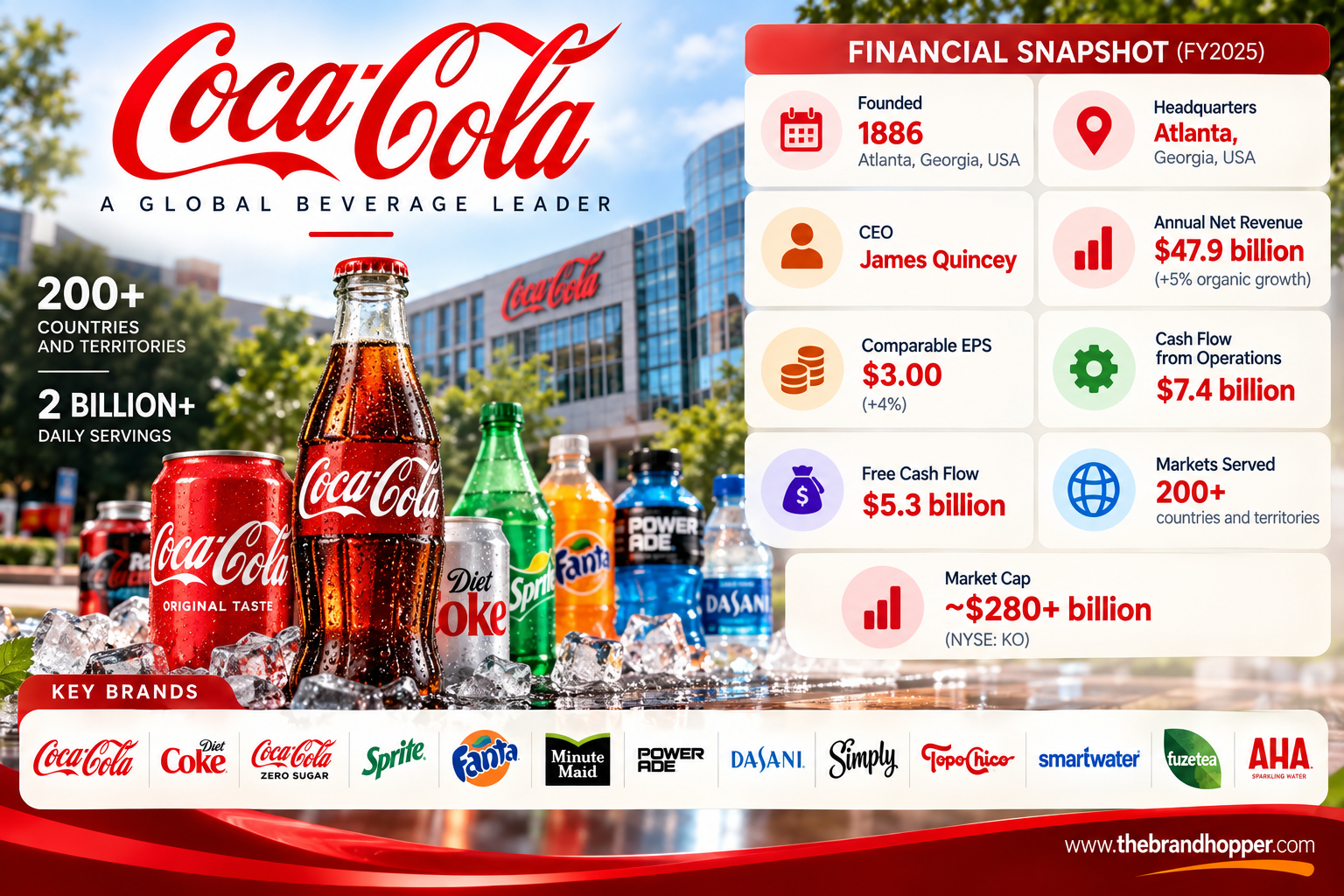
Few brands have ever achieved what Coca-Cola has: a product sold in more than 200 countries, consumed over two billion times every single day, and recognised by an estimated 94% of the world’s population. The scarlet red can, the contour glass bottle, the swirling white script — these are not just design elements but cultural artefacts that have been woven into the fabric of daily life for over a century.
Yet the very scale of Coca-Cola’s dominance has made it a target. Every beverage company in the world — from the $93.9 billion behemoth that is PepsiCo to the craft-focused upstarts disrupting convenience store shelves — competes with Coca-Cola for a share of the consumer’s throat. And in recent years, that competition has intensified dramatically, driven by three powerful forces: the global health-and-wellness movement, the rise of the energy drink and functional beverage category, and the rapid expansion of premium and craft alternatives.
Coca-Cola reported net revenues of $47.9 billion for the full year, with organic revenues growing 5% — a resilient performance in a challenging macro environment. But organic growth alone is not enough. Consumer preferences are shifting, and the companies that are gaining market share are the ones offering something different: less sugar, more function, greater premium appeal, or a more distinctive brand story.
This article profiles 17 of the most significant competitors and alternatives to Coca-Cola, covering the direct cola rivals, the energy drink giants, the premium water and beverage specialists, and the emerging functional drink disruptors who are reshaping the global beverage landscape.

Why Is Coca-Cola Facing Stronger Competition Than Ever?
The competitive pressure on Coca-Cola has never been greater, and the reasons are structural rather than cyclical. Several long-term shifts are reshaping the global beverage market:
The global health-and-wellness movement has permanently altered consumer attitudes to sugar. Decades of medical research linking high sugar consumption to obesity, diabetes, and cardiovascular disease have changed purchasing behaviour across demographics, pushing consumers towards zero-sugar, low-calorie, functional, and naturally sweetened alternatives. Coca-Cola has responded with Diet Coke and Coca-Cola Zero Sugar, but the headroom for growth in traditional carbonated soft drinks is structurally limited.
The energy and functional drinks segment has exploded. Categories that barely existed two decades ago — energy drinks, functional waters, coconut water, electrolyte beverages, and gut-health drinks — have become major consumer trends, capturing billions of dollars in retail spending that might previously have gone to colas and sparkling soft drinks. Red Bull, Monster, and Celsius have built multi-billion-dollar businesses on the back of this shift.
Premiumisation is accelerating. Across every beverage category, consumers are willing to pay more for beverages that offer a premium experience, a clear ingredient story, or an association with wellness and sustainability. Fever-Tree’s rise in the premium mixer category and Vita Coco’s success in coconut water are examples of how premium positioning can carve out significant market share even against a global giant.
Private label is growing. Retailers from Tesco to Walmart to Costco have invested heavily in their own-label beverage ranges, and the market share of branded carbonated soft drinks has declined as a result. This trend benefits private label beverage manufacturers like Refresco, who supply the very products that compete with Coca-Cola on grocery shelves.
Top 17 Coca-Cola Competitors and Alternatives
1. PepsiCo

Website: pepsico.com
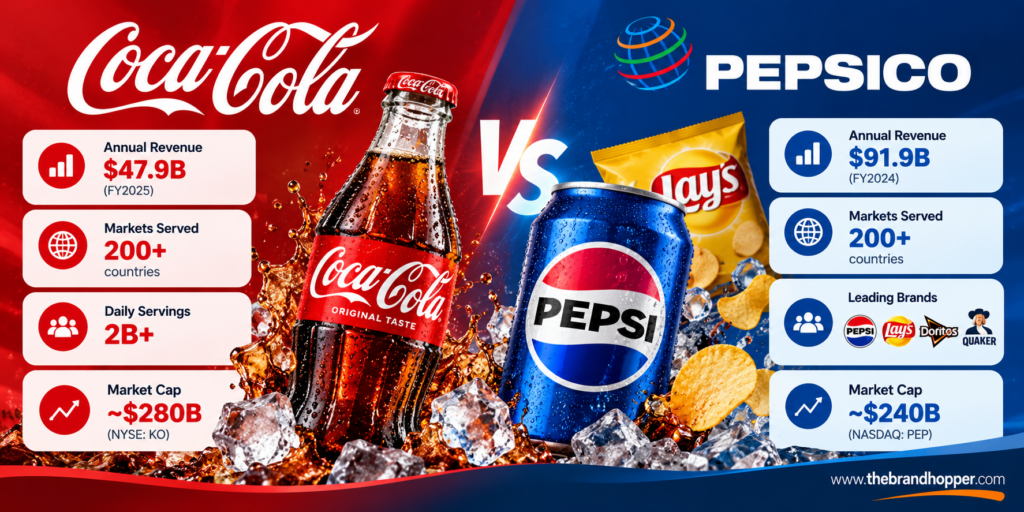
No discussion of Coca-Cola’s competition is complete without PepsiCo. For over a century, these two companies have waged what the marketing world calls the “Cola Wars” — one of the longest-running and most studied brand rivalries in commercial history. PepsiCo, formed in 1965 through the merger of Pepsi-Cola Company and Frito-Lay Inc., stands as Coca-Cola’s most direct and most formidable challenger.
What separates PepsiCo from every other rival is the sheer breadth and profitability of its portfolio. Beyond beverages, PepsiCo owns Frito-Lay, the world’s largest snack company (Lay’s, Cheetos, Doritos, Ruffles), Quaker Foods (oats, granola, cereals), and a broad beverage portfolio that extends well beyond Pepsi to include Mountain Dew, Gatorade (the global sports drink leader), Lipton iced tea (in a joint venture), Propel, bubly sparkling water, and Tropicana (a partial interest via Tropicana Brands Group). This diversification gives PepsiCo a resilience and an earnings base that pure-play beverage companies cannot match.
For its full fiscal year, PepsiCo reported net revenues of $93.9 billion, compared to $91.9 billion in the prior year — a 2% increase. Core earnings per share were $8.14. The company’s beverage division, while facing volume headwinds in some markets due to pricing pressure and shifting consumer preferences, continued to hold significant market share across carbonated drinks, sports drinks, and water categories. PepsiCo’s strategy for growth includes a continued push into better-for-you beverage categories, digital direct-to-consumer channels, and expansion of its presence in emerging markets.
The Coca-Cola vs. PepsiCo rivalry has been a net positive for consumers. Competition between the two has driven constant innovation in product development (new flavours, sugar-free variants, functional formulations), marketing creativity (iconic advertising campaigns from both sides), and distribution efficiency. Where Coca-Cola tends to focus more exclusively on beverages, PepsiCo’s food-and-beverage model gives it a structural advantage in retail negotiations — shelf space for Pepsi products can be linked to the placement of Frito-Lay snacks, giving PepsiCo significant leverage with grocery and convenience store retailers.
2. Keurig Dr Pepper
Website: keurigdrpepper.com
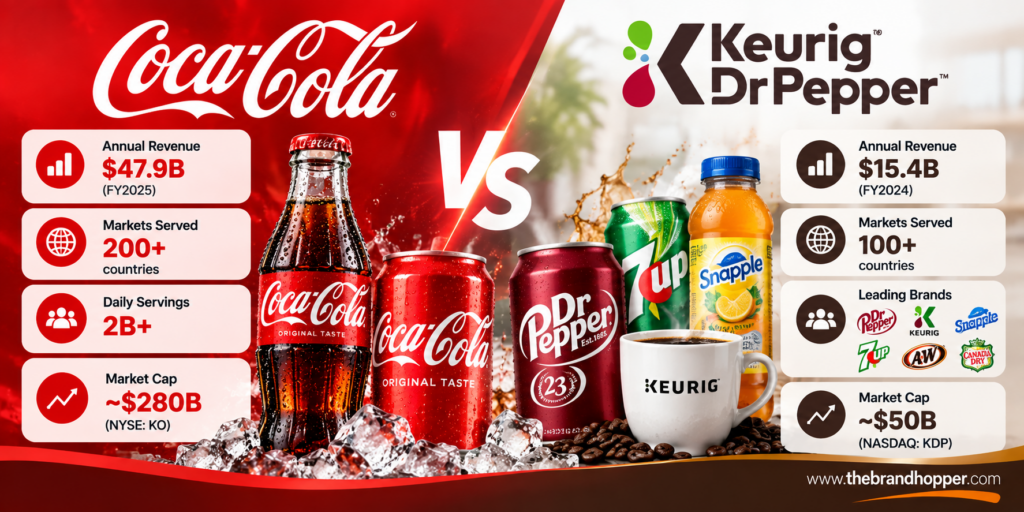
Keurig Dr Pepper (KDP) is one of the most interesting competitive forces in the beverage industry: a company that was created by a merger between two entirely different beverage worlds — single-serve coffee and traditional soft drinks — and has used that combination to build a formidable multi-category platform. Formed in 2018 through the merger of Keurig Green Mountain and Dr Pepper Snapple Group, KDP competes with Coca-Cola across carbonated soft drinks, flavoured beverages, coffee, mixers, and now energy drinks.
KDP’s beverage portfolio is remarkably diverse. Its carbonated soft drink brands include Dr Pepper (a uniquely positioned “23 flavours” proposition), 7UP, Crush, Squirt, RC Cola, Big Red, Sunkist, A&W Root Beer, and Canada Dry. Its mixer range — Schweppes, Canada Dry, Snapple — gives it strong presence in the adult beverage occasion. And its single-serve Keurig coffee system, which commands a major share of the US at-home coffee brewing market, positions KDP in a beverage category where Coca-Cola has minimal presence.
For the full year, KDP reported net sales of $16.6 billion, up 8.2% year-over-year (8.6% on a constant currency basis). Growth was driven by volume/mix up 4.8% and net price realisation up 3.8%. A significant driver of the volume growth was the acquisition of GHOST Energy, a rapidly growing energy drink brand with strong appeal to younger, fitness-conscious consumers. GHOST contributed 3.8 percentage points to volume/mix growth in the period. KDP’s adjusted operating income grew 4.9% to $4.2 billion.
According to Christoffer Nielsen from Nielsen Valuation Texas, companies like Keurig Dr Pepper — rooted in the Dallas area and operating across multiple beverage categories — often derive added valuation strength from diversified revenue streams and strong regional brand equity, factors that can enhance long-term competitive positioning.
KDP’s competitive advantage over Coca-Cola in certain occasions is clear: the ability to serve consumers at home with Keurig coffee machines, at the bar with premium mixers, and at the convenience store with a wide array of flavoured and carbonated beverages. This cross-occasion coverage is difficult for a pure-play cola company to replicate. KDP’s 2025 GHOST Energy acquisition signals that the company is committed to capturing share in the fast-growing energy drink segment, which remains an area of strategic importance for Coca-Cola (via Monster Beverage, in which Coca-Cola holds a significant stake).
3. Monster Beverage Corporation
Website: monsterenergy.com
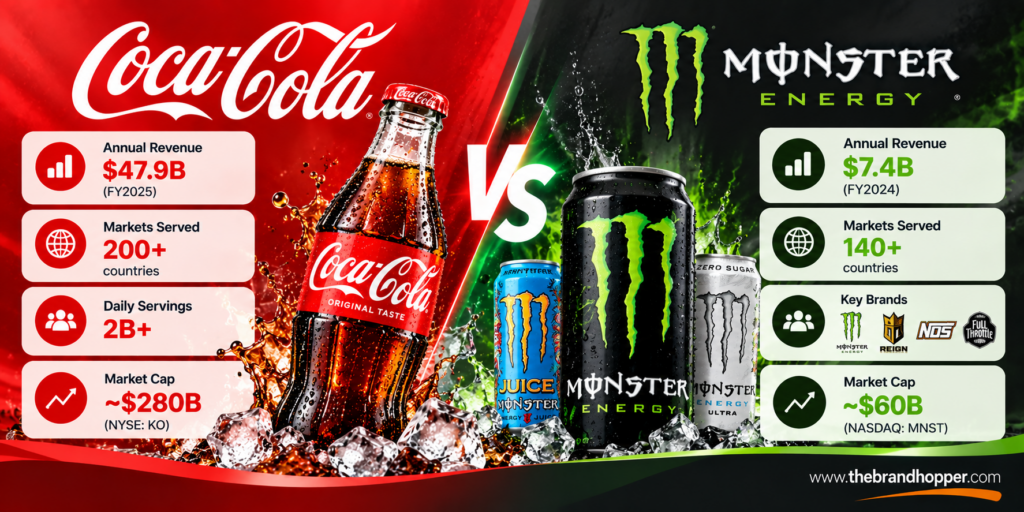
Monster Beverage Corporation occupies a unique position in the Coca-Cola competitive landscape: it is simultaneously one of Coca-Cola’s most significant revenue competitors and a company in which The Coca-Cola Company holds a substantial equity stake. Coca-Cola acquired approximately 16.7% of Monster Beverage in 2015 and has gradually increased this position over time, making Monster a partial ally even as the two companies compete for a share of consumer spending in convenience stores, petrol stations, gyms, and sporting arenas.
Monster does not compete with Coca-Cola in the classic carbonated soft drink market. Its core product — Monster Energy Original — targets a distinct consumer need: high-caffeine, high-energy drinks for consumers who are active, fitness-oriented, or simply need a significant pick-me-up beyond what a cola can provide. Monster’s portfolio has since expanded significantly: Reign Total Body Fuel (positioned for athletes, 300mg caffeine), NOS, Full Throttle, and the Bang Energy brands acquired from Vital Pharmaceuticals in 2023, giving Monster one of the broadest energy drink portfolios in the industry.
For the full year, Monster Beverage Corporation reported net sales of $8.29 billion, up 10.7% from $7.49 billion in the prior year. The fourth quarter was particularly strong, with net sales increasing 17.6% to $2.13 billion. Net income for the full year was $1.91 billion. Monster’s growth reflects continued consumer demand for energy drinks globally — a category that has grown from a niche US product into one of the fastest-growing segments in the global beverage industry.
Monster’s competitive threat to Coca-Cola extends beyond direct sales competition. Monster commands approximately 39% of the US energy drink market by volume, competing directly with Coca-Cola’s own energy drink brands. The global energy drink market is growing rapidly, and Monster’s distribution partnership with Coca-Cola (Coca-Cola handles Monster’s global distribution) gives Monster access to Coca-Cola’s world-class logistics network — a relationship that benefits both parties but also underscores how significant the energy drink category has become.
4. Red Bull
Website: redbull.com/us-en
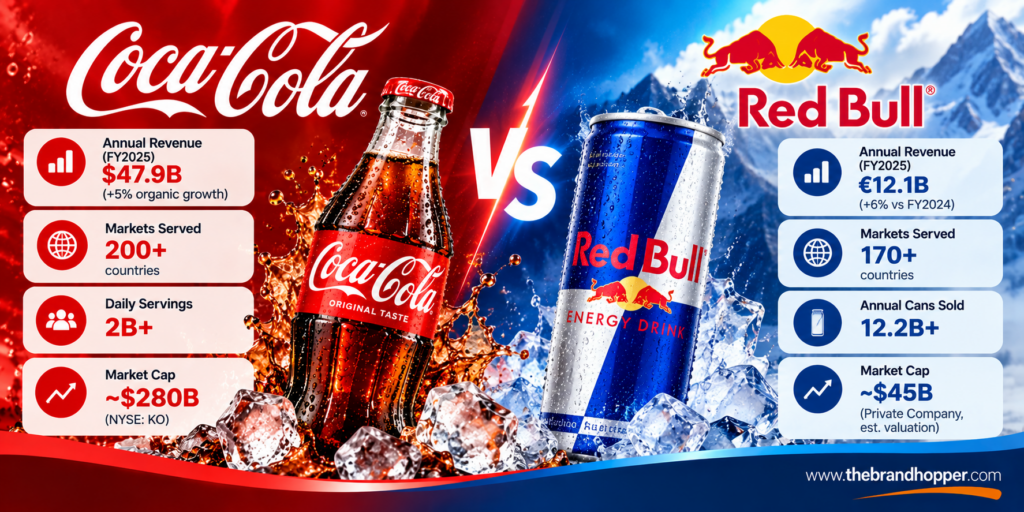
If Monster Beverage is Coca-Cola’s most complex competitive relationship in the energy drink space, Red Bull is its most purely adversarial. Founded in Austria in 1987 by Dietrich Mateschitz (adapting a Thai tonic called Krating Daeng), Red Bull invented the modern energy drink category. It remains, by volume, the world’s best-selling energy drink brand — and has built one of the most powerful and distinctive brand identities in global consumer products.
Red Bull reported global sales of €12.2 billion (approximately $14.3 billion) for the full year, up 8.6% — a record high. The company sold 13.969 billion cans, representing a 10.2% increase versus the prior year. These numbers are extraordinary for a company that, unlike PepsiCo or Coca-Cola, produces a single core product with a handful of variants. Red Bull commands approximately 43% of the global energy drink market by volume, with Monster Energy a close second at around 39%.
In the United States specifically, the market dynamics differ slightly: Monster leads the US market at approximately 35% volume share, with Red Bull at approximately 32% and the fast-rising Celsius at around 10%. Globally, Red Bull’s revenue is nearly double that of Monster, cementing its position as the world’s largest energy drink brand by revenue.
Red Bull’s competitive advantage over Coca-Cola in the energy drink category comes not just from the product but from the brand. Red Bull has built an unparalleled cultural brand through its association with extreme sports, Formula One (Red Bull Racing and Scuderia AlphaTauri/Visa Cash App RB), esports, music, and adventure. Red Bull Media House produces content consumed by hundreds of millions of people globally, making Red Bull one of the few consumer brands that is simultaneously a product, a media company, and a cultural movement.
Red Bull also competes with Coca-Cola in the growing non-alcoholic adult beverage space through Organics by Red Bull — a range of premium sparkling and non-sparkling beverages made with organic ingredients. This extension signals Red Bull’s ambition to expand beyond energy drinks and into the broader premium non-alcoholic beverage category.
5. Nestlé
Website: nestle.com
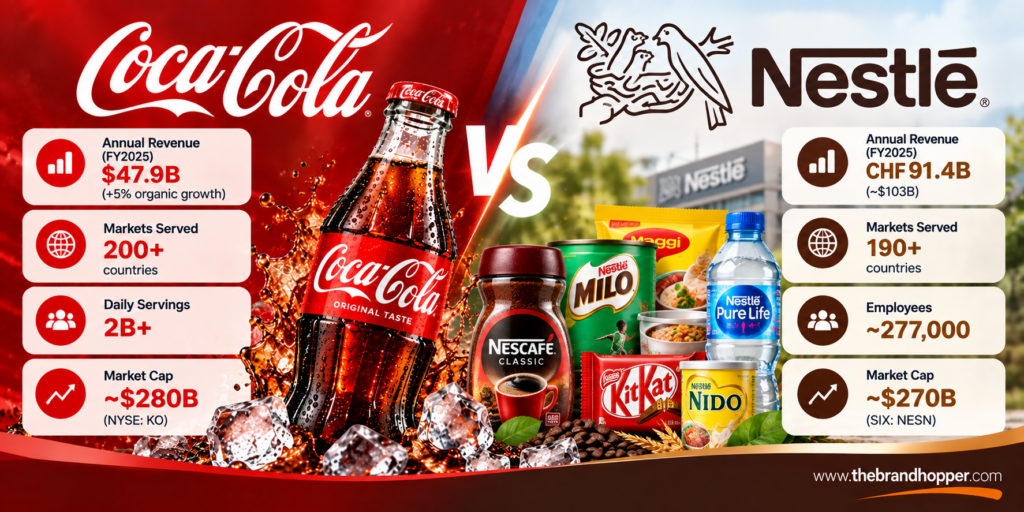
Nestlé, the world’s largest food and beverage company by revenue, competes with Coca-Cola across two major beverage battlegrounds: bottled water and coffee. While Nestlé’s product portfolio extends far beyond beverages — encompassing pet food, infant nutrition, confectionery, and prepared foods — its beverage brands represent some of the most recognised names in the world and generate billions of dollars in annual revenue that directly competes with Coca-Cola’s own water and ready-to-drink beverage portfolio.
In the premium bottled water segment, Nestlé has historically owned some of the world’s most coveted brands: Perrier (the original French sparkling water), San Pellegrino (the Italian premium sparkling mineral water), Acqua Panna (the Tuscan still water), Vittel, Contrex, and Essentia. These brands compete directly with Coca-Cola’s premium water offerings, including Topo Chico (the premium sparkling water brand Coca-Cola acquired in 2017) and Smartwater.
However, Nestlé’s water strategy has undergone a significant transformation. The company has been executing a strategic portfolio rationalisation, divesting mainstream and lower-margin water brands while retaining premium brands. In a landmark transaction, Nestlé sold half of its waters and premium beverages business — including brands like Perrier, San Pellegrino, Acqua Panna, and Source Perrier — to private equity firm Platinum Equity for approximately $3.4 billion, creating a new premium beverage company called Peranel. This strategic shift signals Nestlé’s intent to focus its portfolio on higher-margin premium assets rather than compete head-to-head with Coca-Cola and PepsiCo across all water price points.
Beyond water, Nestlé’s coffee portfolio — Nescafé (the world’s best-selling instant coffee brand) and Nespresso (the premium single-serve coffee system) — competes with Coca-Cola in the at-home and on-the-go hot and cold coffee occasion. While Coca-Cola has made inroads into the coffee category through its Costa Coffee acquisition (2019), Nestlé’s coffee brands remain significantly more established and have deeper distribution globally.
6. Danone
Website: danone.com
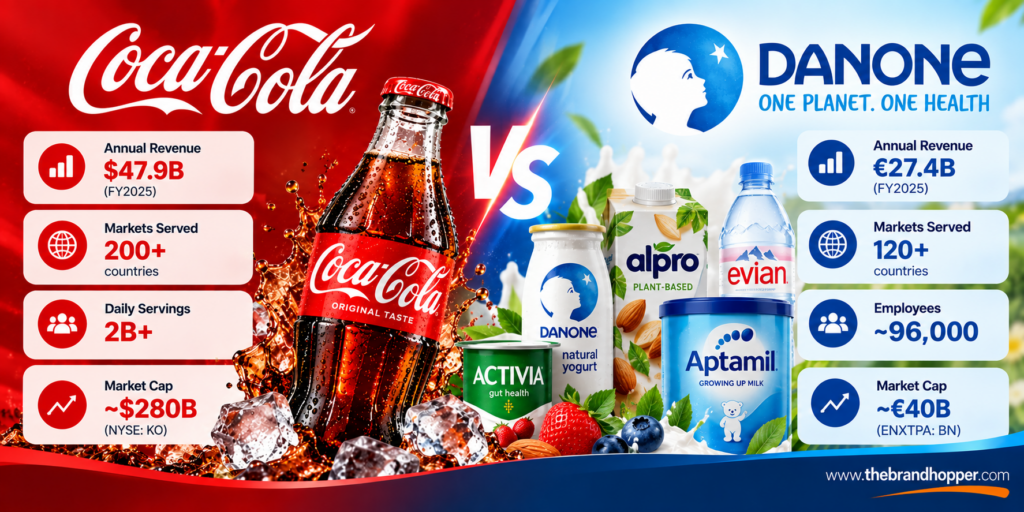
Danone, the French multinational best known for its dairy products and infant nutrition, is also one of the world’s largest bottled water companies — and it is in this segment that Danone competes most directly with Coca-Cola. For the full year, Danone reported total net sales of €27.28 billion, up 4.5% on a like-for-like basis, with volume/mix growth of 2.7% and price growth of 1.8%. Operating income reached €3.67 billion and net income €2.46 billion.
Danone’s water portfolio includes some of the most globally recognised natural mineral water brands: Evian (the premium French alpine water), Volvic (the French volcanic mineral water), Font Vella (the leading Spanish water brand), Bonafont (a major Mexican water brand), and Aqua (the leading packaged water brand in Indonesia). In total, Danone’s waters business serves hundreds of millions of consumers across more than 130 countries.
The competition between Danone and Coca-Cola in bottled water is particularly intense in Europe, Asia-Pacific, and Latin America, where consumers have strong preferences for natural mineral water over purified water (Coca-Cola’s Dasani) or premium sparkling water. Danone has a significant advantage in the natural mineral water category — its brands are able to claim natural origin credentials that Coca-Cola’s Dasani (a filtered tap water product) cannot match.
Beyond water, Danone competes with Coca-Cola in the plant-based beverage segment through Alpro — the leading European plant-based food and drink brand offering oat milk, soy milk, almond milk, and other alternatives to dairy and traditional beverages. As consumers shift from dairy and traditional carbonated beverages to plant-based alternatives, Alpro’s growth in European retail channels comes partly at the expense of traditional beverage categories including soft drinks.
CEO Antoine de Saint-Affrique has led a significant portfolio transformation at Danone since taking the helm, focusing on premiumisation, science-led nutrition, and a “Protein Power” strategy centred on high-protein products. This has reduced Danone’s reliance on commodity dairy and water margins and strengthened its competitive position against global beverage companies including Coca-Cola.
7. Suntory Holdings
Website: suntory.com
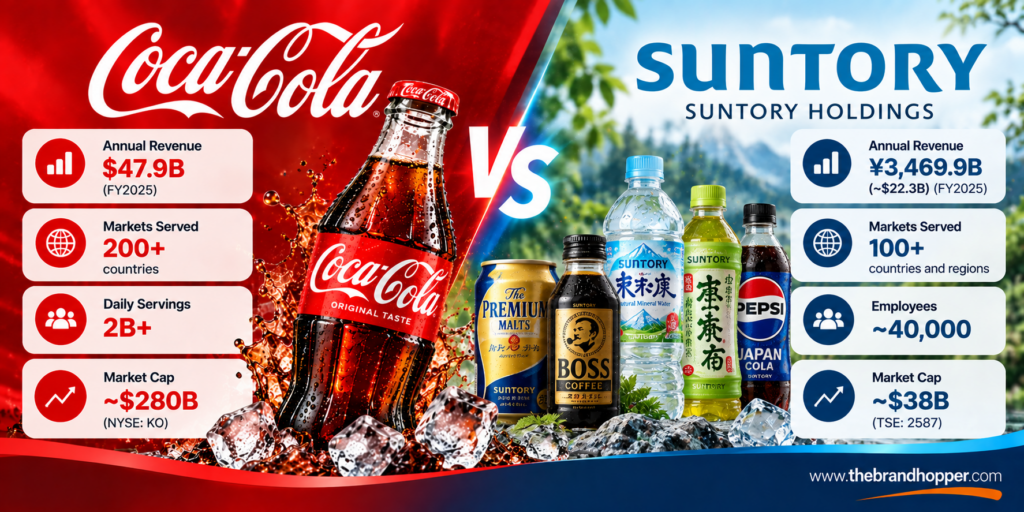
Suntory Holdings is one of Asia’s most powerful beverage companies and, through a series of bold international acquisitions, has become a formidable global competitor to Coca-Cola in both non-alcoholic and alcoholic beverages. Founded in 1899 in Osaka, Japan, Suntory is a privately held company owned by the founding Torii family. Its product portfolio spans whisky, spirits, beer, soft drinks, and ready-to-drink coffee — making it one of the most diversified beverage companies in the world.
For the full year, Suntory Holdings reported total revenues of approximately ¥3.43 trillion (approximately $23 billion at prevailing exchange rates), broadly flat on a reported basis. The company faced profitability headwinds due to rising raw material costs and currency volatility, but its global brand portfolio continued to perform strongly on a volume basis.
In the spirits and whisky segment, Suntory is the undisputed global leader following its $16 billion acquisition of Beam Inc. in 2014 — one of the largest cross-border acquisitions in Japanese corporate history. The combined portfolio includes Jim Beam (the world’s best-selling bourbon), Maker’s Mark, Knob Creek, Courvoisier, Laphroaig, and Teacher’s Scotch, as well as Suntory’s own acclaimed Japanese whiskies Yamazaki and Hakushu.
Where Suntory competes most directly with Coca-Cola is in non-alcoholic ready-to-drink beverages, particularly in Asia-Pacific. Suntory’s BOSS Coffee — a canned and bottled ready-to-drink coffee brand enormously popular in Japan and other Asian markets — competes with Coca-Cola’s Georgia Coffee in Japan and with Coca-Cola’s broader ready-to-drink coffee ambitions through its Costa Coffee brand. Suntory also owns Orangina (the French sparkling citrus drink), Lucozade (the original British energy drink), and Ribena (the British fruit drink brand) — all of which compete with Coca-Cola’s soft drink and energy beverage portfolio in European markets.
In the beer category in Japan, Suntory competes with PepsiCo’s Pepsi Japan licence and with soft drink brands including Mitsuya Cider (Japan’s oldest carbonated drink brand, owned by Asahi) for consumer spending in the non-alcoholic beverage segment. Suntory’s Calpis brand of fermented milk-based soft drinks holds a strong position in Japan and other Asian markets.
8. Unilever
Website: unilever.com
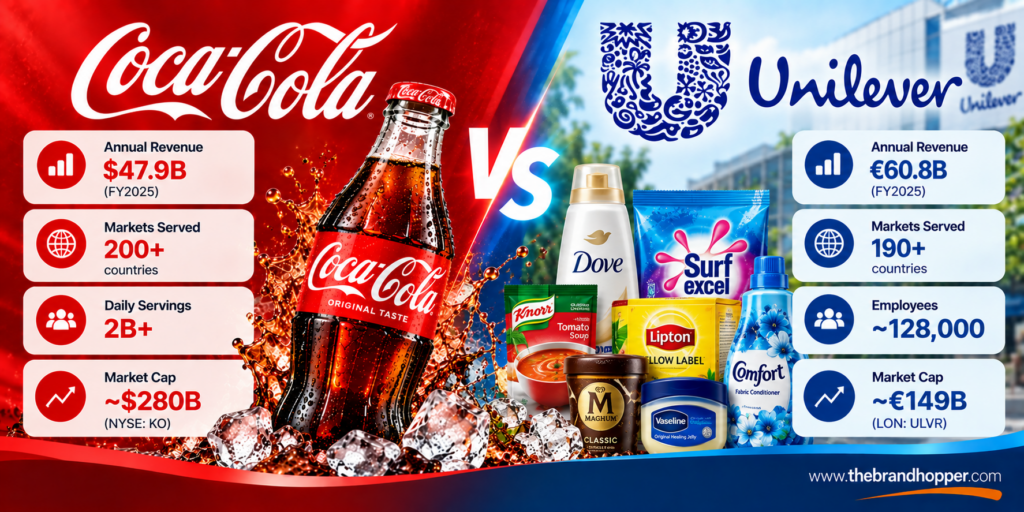
Unilever is one of the world’s largest consumer goods companies, with a product portfolio spanning personal care, home care, food, and beverages. For the full year, Unilever reported turnover of €50.5 billion, with underlying sales growth of 3.5%, driven by 1.5% volume growth. The company achieved a strong underlying operating margin of 20.0%.
Unilever’s historical competition with Coca-Cola in the beverage space was most prominent in the tea category. For decades, Unilever owned Lipton, PG Tips, and Brooke Bond — three of the most recognised tea brands in the world — putting it in direct competition with Coca-Cola’s ready-to-drink tea products (Fuze Tea, Honest Tea, and Georgia Tea). However, in 2022, Unilever completed the sale of its global tea business to CVC Capital Partners, which now operates these brands as “Lipton Teas and Infusions.” This strategic divestiture marked a significant shift in Unilever’s competitive relationship with Coca-Cola in beverages.
Post-divestiture, Unilever still competes with Coca-Cola in the broader consumer goods and retail environment. Both companies invest heavily in shopper marketing, retail shelf negotiations, and brand visibility campaigns. Unilever’s premium health and wellbeing brands — including Hellmann’s, Knorr, and Dove — compete for the same discretionary consumer spending and retail shelf space that Coca-Cola’s beverage brands target.
An important development at Unilever is the demerger of its Ice Cream division in 2025. The business behind Ben & Jerry’s, Magnum, Wall’s, and Cornetto — worth approximately €8 billion in annual revenue — was spun off as a separate publicly listed company (“Unilever Ice Cream”). This further sharpens Unilever’s focus on its core personal care and food brands, changing the nature of its competition with Coca-Cola.
9. Celsius Holdings
Website: celsius.com
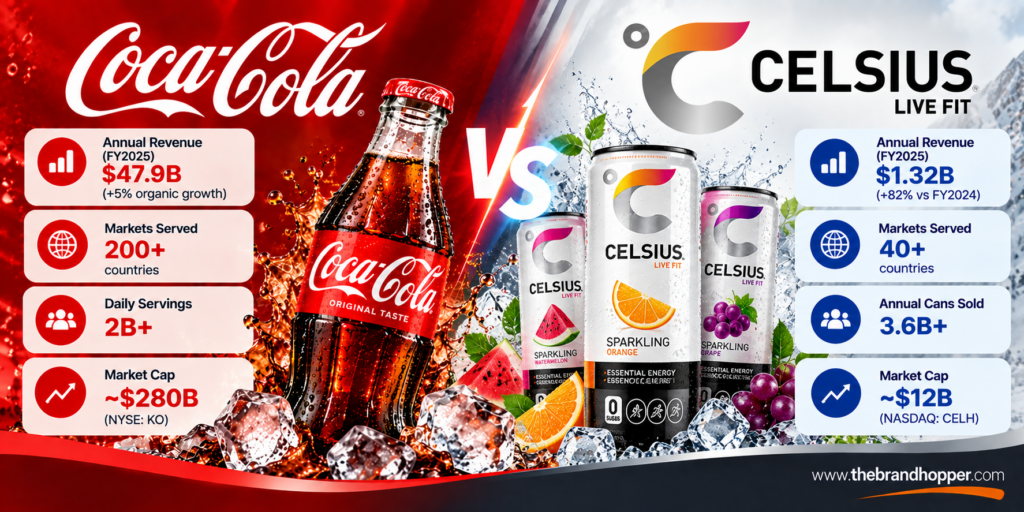
Celsius Holdings is arguably the most disruptive force in the US beverage industry in recent years. What began as a niche functional energy drink brand focused on thermogenesis (the body’s process of burning calories to generate heat) has transformed, through a combination of organic brand momentum and strategic acquisitions, into a genuine multi-brand challenger to the energy drink hegemony of Red Bull and Monster.
For the full year, Celsius Holdings reported revenue of approximately $2.52 billion, up 85.5% year-over-year. This extraordinary growth rate is partly organic — the CELSIUS brand grew 7.5% to $1.46 billion — and partly acquisition-driven. Celsius completed the acquisition of Alani Nu in 2025, a fast-growing women-focused energy drink brand with a distinctive pastel aesthetic and strong social media following. Alani Nu contributed approximately $1 billion in revenue from the second quarter of 2025 onward. International revenue also expanded 24% to $92.8 million.
Celsius competes with Coca-Cola not in the traditional cola segment, but in the broader functional beverage space where Coca-Cola has ambitions through brands like Powerade, Bodyarmor (acquired in 2021 for $5.6 billion), and various energy and hydration products. The CELSIUS brand has made particularly strong inroads with gym-going and health-conscious consumers in their twenties and thirties — a demographic that has historically been underserved by Coca-Cola’s portfolio.
Celsius’s partnership with PepsiCo — struck in 2022 and giving PepsiCo distribution rights for CELSIUS in North America — significantly accelerated the brand’s reach in convenience stores, gyms, and foodservice channels. This distribution muscle, combined with Celsius’s authentic positioning in the fitness community, has made it the third-largest energy drink brand in the United States by value and a genuine challenger to Monster and Red Bull.
The acquisition of Alani Nu further diversifies Celsius’s appeal: while CELSIUS speaks primarily to fitness enthusiasts, Alani Nu targets a lifestyle-oriented, predominantly female consumer segment with flavours like Cosmic Stardust, Hawaiian Shaved Ice, and Mimosa. Together, the two brands give Celsius Holdings a portfolio that addresses a wider slice of the energy and functional beverage market than any single-brand strategy could.
10. National Beverage Corp (LaCroix)
Website: lacroixwater.com
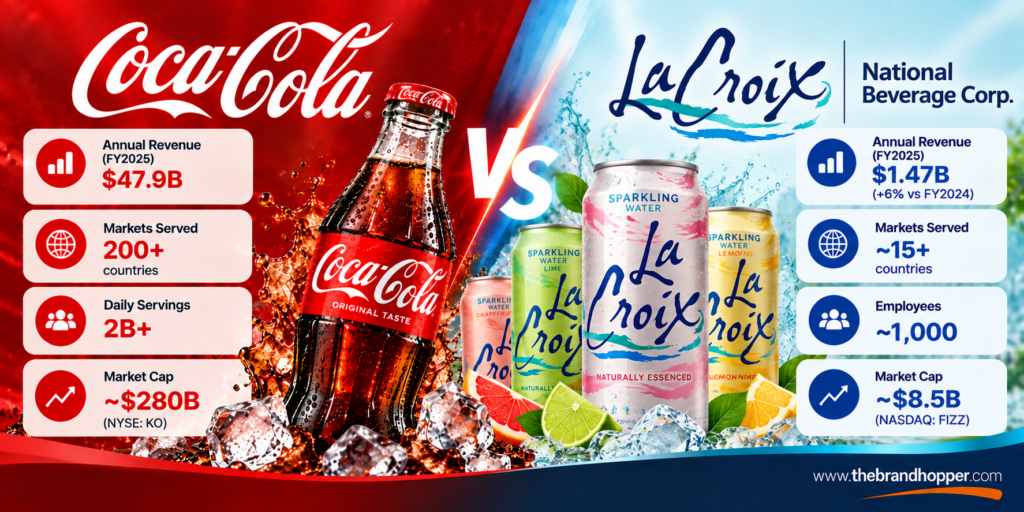
National Beverage Corp, the Fort Lauderdale-based beverage company behind LaCroix sparkling water, is a compelling case study in how a single product innovation can transform a company’s competitive position against a global giant. LaCroix, whose brightly coloured cans and intense focus on natural flavour without sweeteners or sodium became a cultural phenomenon among health-conscious US consumers, competes directly with Coca-Cola’s sparkling water portfolio including Topo Chico, Smartwater Sparkling, and AHA Sparkling Water.
For the full fiscal year, National Beverage Corp reported net revenues of approximately $1.2 billion, driven almost entirely by LaCroix — which accounts for more than 80% of company revenue. The company delivered record first-quarter net sales of $331 million, up from $329 million a year earlier. Earnings per share reached $2.00, with performance supported by strong performance in the club retail channel and continued innovation, including the “Deliciously Magical” variety pack and four newly launched flavours. The company credits LaCroix’s ongoing marketing investment and innovation pipeline with sustaining its growth against both branded competitors and growing private label alternatives.
LaCroix pioneered the flavoured sparkling water category in the United States at a time when the mainstream carbonated beverage market was dominated by colas and flavoured sodas. Its success triggered a wave of competitive responses: Coca-Cola launched AHA Sparkling Water, PepsiCo acquired bubly, and dozens of private label versions flooded the market. Despite the competitive onslaught, LaCroix has maintained meaningful market share, supported by brand loyalty and its distinctive visual identity.
The broader sparkling water category represents one of the clearest examples of consumers trading away from traditional Coca-Cola and Pepsi products: consumers who previously drank Diet Coke or Sprite for the fizzy sensation without calories have increasingly migrated to flavoured sparkling waters. LaCroix’s success in establishing this habit makes National Beverage Corp a persistent competitive threat to Coca-Cola’s volume in the better-for-you carbonated beverage segment.
11. Fever-Tree
Website: fever-tree.com
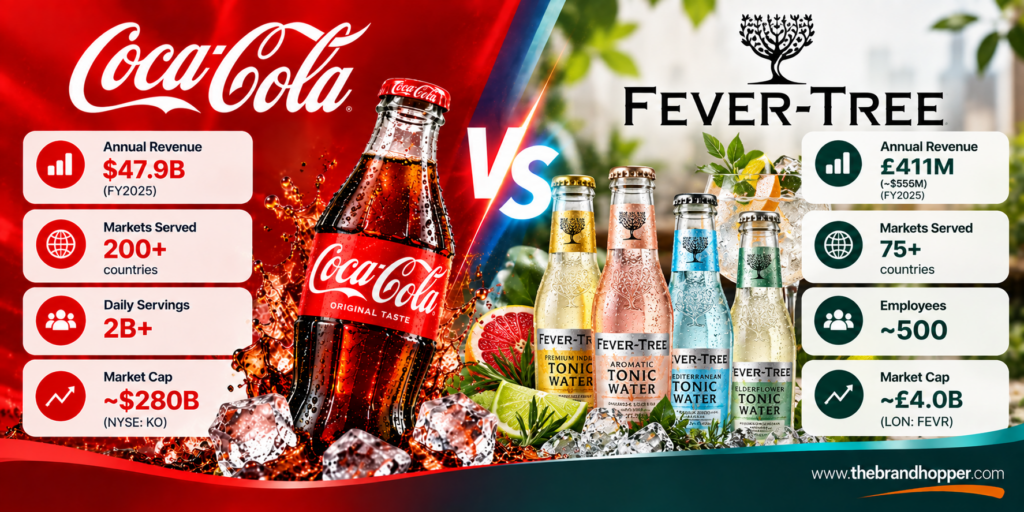
Fever-Tree is one of the great beverage brand success stories of the 21st century. Founded in 2004 by Tim Warrillow and Charles Rolls with a simple insight — that if three-quarters of a gin and tonic is tonic water, the tonic water should be worth drinking — Fever-Tree has built a premium mixer business with global reach and margins that most beverage companies would envy. The company competes with Coca-Cola not in the mainstream carbonated beverage category, but in the premium adult soft drinks and cocktail mixer segment, where Coca-Cola’s Schweppes (licensed to Coca-Cola in some markets) has historically been the dominant player.
For the full year, Fever-Tree reported adjusted revenue of £375.3 million, up approximately 3% year-over-year. Brand revenue grew 4% at constant currency, with growth in the United States, Europe, and rest of world offsetting a softer performance in the UK. Notably, 45% of Fever-Tree’s revenue now comes from products beyond tonic water — including ginger beer, ginger ale, premium lemonade, premium cola, elderflower tonic, and non-alcoholic ready-to-drink lines. This diversification reflects the brand’s successful expansion from cocktail mixers into the broader premium soft drink category.
Fever-Tree’s competitive significance in the context of Coca-Cola goes beyond the direct revenue competition. The brand has defined a new premium tier in the sparkling mixer and soft drink category, demonstrating that quality ingredients, clear brand narrative, and premium positioning can command a significant price premium over mainstream brands. Fever-Tree’s Indian Tonic Water retails at two to four times the price of Schweppes in most markets — and consumers willingly pay the difference. This premium tier is a space that Coca-Cola, with its mass-market brand positioning, has historically struggled to occupy credibly.
Fever-Tree’s US strategy is particularly significant. The United States, where the spirits-with-mixer occasion is growing rapidly alongside the boom in craft cocktail culture and the “cocktail at home” trend, represents Fever-Tree’s largest growth opportunity. As the US on-trade (bars and restaurants) continues to invest in premium mixer offerings, Fever-Tree is capturing a disproportionate share of that growth — largely at the expense of mainstream mixer brands including Schweppes.
12. Tropicana Brands Group
Website: tropicanabrandsgroup.com
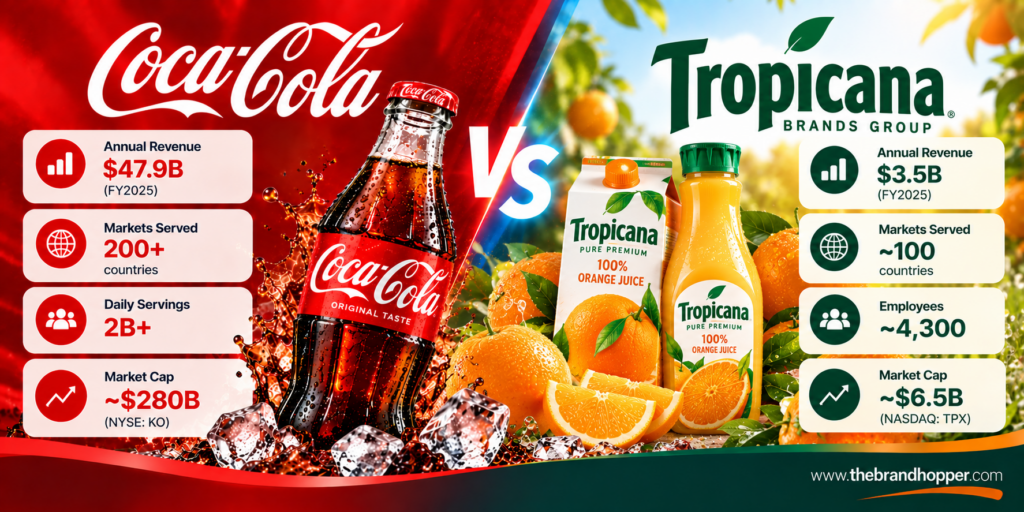
Tropicana Brands Group represents one of the beverage industry’s most significant recent ownership changes. In 2021, PepsiCo divested its juice brands — Tropicana, Naked Juice, KeVita, Dole juice, Copella, Izze, and Punica — to PAI Partners, a European private equity firm, in a transaction that valued the business at $3.3 billion. PepsiCo retained a 39% stake. The resulting entity, Tropicana Brands Group, is now an independent juice-focused company competing with Coca-Cola’s juice portfolio (which includes Minute Maid, Simply, and Innocent, acquired from an earlier investment).
Tropicana Pure Premium remains the leading refrigerated orange juice brand in the United States by volume, a position it has held for decades. The Naked Juice range of cold-pressed and smoothie products competes with Coca-Cola’s Innocent brand in the premium juice segment across European and US markets. KeVita competes with Coca-Cola’s health beverage portfolio in the probiotic and kombucha space.
The juice category has faced structural headwinds in recent years. Orange juice consumption in the US has declined significantly from its peak, driven by health concerns about sugar content, changing breakfast habits, and the rising cost of orange juice concentrate (significantly impacted by citrus disease outbreaks in major growing regions including Florida and Brazil). Tropicana Brands Group has responded with reformulations, innovation into new juice blends and fortified variants, and a focus on its higher-margin Naked and Dole premium brands.
Despite these challenges, Tropicana competes directly with Coca-Cola’s Minute Maid and Simply brands on every major grocery shelf in North America and Europe. The competition in the refrigerated juice section is particularly intense, with brands competing on price, packaging, ingredient credentials, and innovation in flavour and format.
13. Asahi Group Holdings
Website: asahigroup-holdings.com
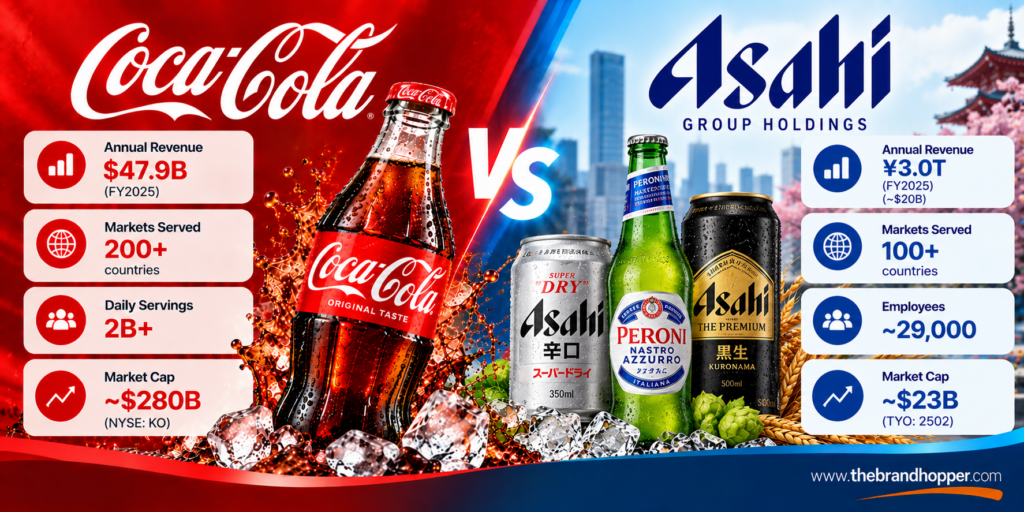
Asahi Group Holdings is one of the largest beverage companies in Asia and, through a series of bold European acquisitions, one of the most rapidly internationalising drinks businesses in the world. While best known globally for Asahi Super Dry beer, Asahi Group competes with Coca-Cola across both non-alcoholic soft drinks in Japan and the broader premium beverage category globally.
Asahi Group Holdings reported full-year revenues that declined 1.5% year-over-year, though global brand volumes showed positive momentum — Asahi Super Dry grew 15% by volume and Peroni Nastro Azzurro grew 6%, supported by the company’s successful premiumisation strategy. The company’s 2026 outlook is significantly more positive, with revenue forecast to grow approximately 11.2% year-over-year.
In the non-alcoholic beverage space, Asahi competes with Coca-Cola through several significant Japanese brands: Mitsuya Cider — Japan’s oldest carbonated beverage brand, founded in 1884, predating even Coca-Cola’s international expansion — and Wonda Coffee, one of Japan’s most popular canned coffee brands. These products compete directly with Coca-Cola’s Japan portfolio, which includes Georgia Coffee (the best-selling canned coffee brand in Japan, a joint venture with Coco-Cola Japan), Aquarius (Coca-Cola’s leading Japanese sports drink), and Fanta.
In the European beer market, Asahi’s premium beer portfolio — which includes Peroni Nastro Azzurro, Pilsner Urquell, Kozel, and Meantime — competes with Coca-Cola not in the traditional beverage sense, but in the consumer “drinking occasion” sense. Both companies are vying for a share of the socialising and entertaining occasion, and as the no/low-alcohol trend reshapes the beverage landscape, premium beer brands and premium soft drinks increasingly compete for the same consumer moment.
14. AB InBev (Anheuser-Busch InBev)
Website: ab-inbev.com
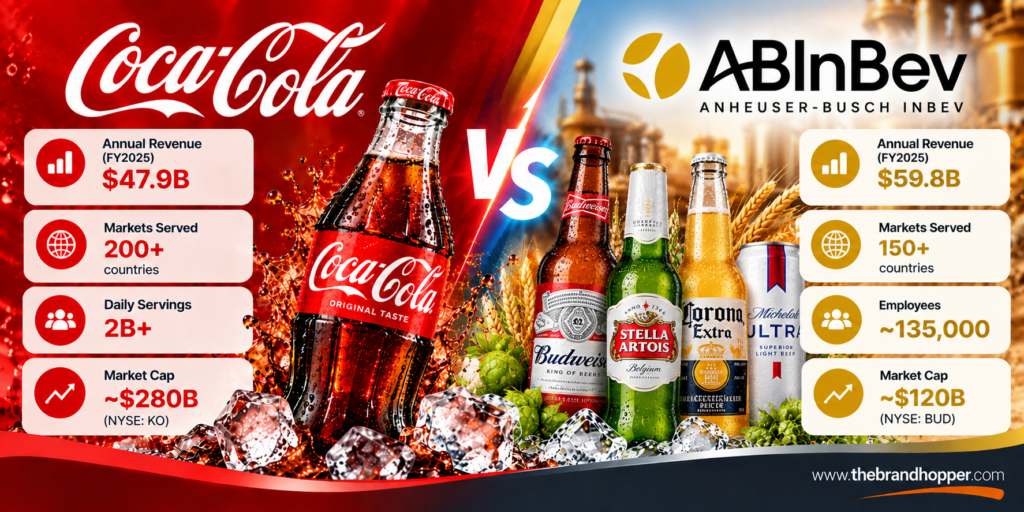
Anheuser-Busch InBev — the world’s largest brewer by volume, behind brands including Budweiser, Corona, Stella Artois, Beck’s, and Leffe — might seem an unlikely competitor to a soft drink company. But the rapid growth of the no- and low-alcohol beverage category has transformed AB InBev into a genuine competitor for the consumer occasions that Coca-Cola has historically dominated.
AB InBev has invested aggressively in its no- and low-alcohol portfolio, including Budweiser Zero, Stella Artois 0.0%, Corona Cero, Beck’s Unalcoholic, and Heineken 0.0 equivalents under its own brands. These products compete directly with Coca-Cola and other soft drink companies for the sober socialising occasion, the designated driver moment, and the growing cohort of younger consumers who are choosing not to drink alcohol but still want a sophisticated, flavourful beverage in a social setting.
AB InBev reported total revenues of approximately $55.9 billion for its most recently reported full year — a scale that dwarfs even Coca-Cola in absolute terms. The company’s distribution network, which reaches virtually every bar, restaurant, and retail outlet in the world, gives its non-alcoholic products an unrivalled route to market. As no/low-alcohol continues to grow as a category — driven by the global health-and-wellness movement and generational shifts in drinking behaviour — AB InBev’s scale advantage in distribution becomes an increasingly significant competitive threat to Coca-Cola in the adult non-alcoholic beverage segment.
Beyond the no/low category, AB InBev’s Beyond Beer division is investing in energy drinks, hard seltzers, and ready-to-drink cocktails under brands like Nutrl, Cutwater, and Babe Wine. While these products are primarily alcoholic, they compete with Coca-Cola’s total beverage strategy for consumer spending in the convenience, on-trade, and e-commerce channels.
15. Vita Coco
Website: vitacoco.com
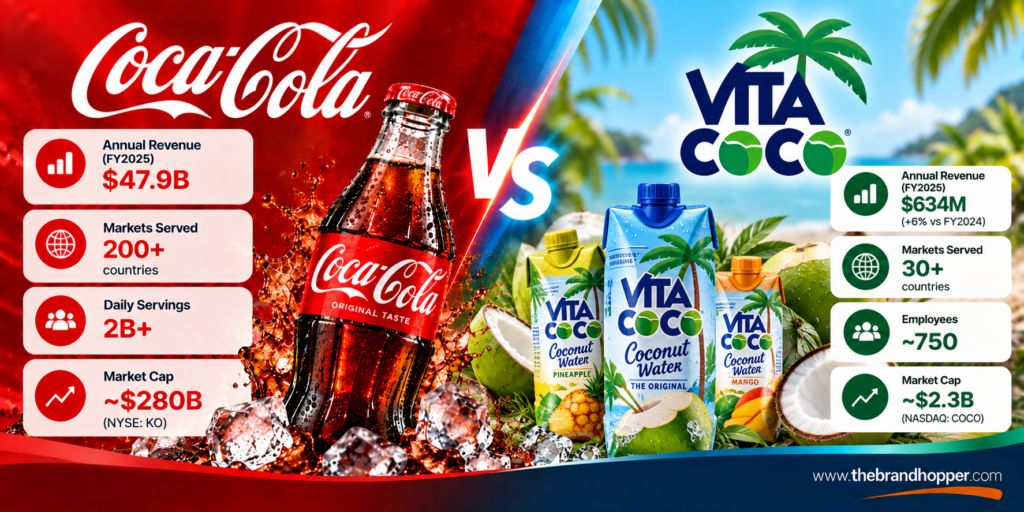
Vita Coco, operated by The All Market Inc. and traded on Nasdaq under the ticker COCO, is the world’s leading coconut water brand and a pioneer of the natural hydration category that has disrupted traditional sports and soft drink brands including Coca-Cola’s Powerade and Dasani water ranges. Founded in 2004 after co-founder Michael Kirban learned about the natural hydration properties of coconut water while travelling in Brazil, Vita Coco has built a brand synonymous with natural, low-calorie hydration.
Vita Coco reported annual net revenues of approximately $460 million for its most recently completed fiscal year — a remarkable achievement for a brand that competes in a category that barely existed two decades ago. The brand holds the leading position in the coconut water category in the United States, United Kingdom, and several other key markets, with approximately 50%+ market share in the US coconut water segment.
Vita Coco’s competition with Coca-Cola is concentrated in the hydration and natural beverage segment. Coconut water is positioned as a natural alternative to sports drinks like Powerade and Gatorade — offering natural electrolytes (particularly potassium), lower sugar content than most sports drinks, and a clean ingredient list that resonates with health-conscious consumers. This positioning has attracted younger consumers who might otherwise reach for a Coca-Cola product.
Beyond its core coconut water business, Vita Coco has diversified into pressed coconut water, coconut water with protein, and more recently adult coconut water cocktails, demonstrating the brand’s ability to expand its occasion coverage. The company also markets coconut oil, coconut milk, and snack products under the Vita Coco brand — positioning it as a broader coconut-centric lifestyle brand rather than a single-product company.
The broader coconut water category, of which Vita Coco controls the leading share, competes for consumer spend in the natural hydration occasion — a category that has grown significantly at the expense of traditional carbonated soft drinks, flavoured waters, and conventional sports drinks. As consumers increasingly seek functional, natural, and minimally processed beverages, Vita Coco represents exactly the kind of challenger that keeps Coca-Cola executives focused on premiumisation and health positioning.
16. Refresco
Website: refresco.com
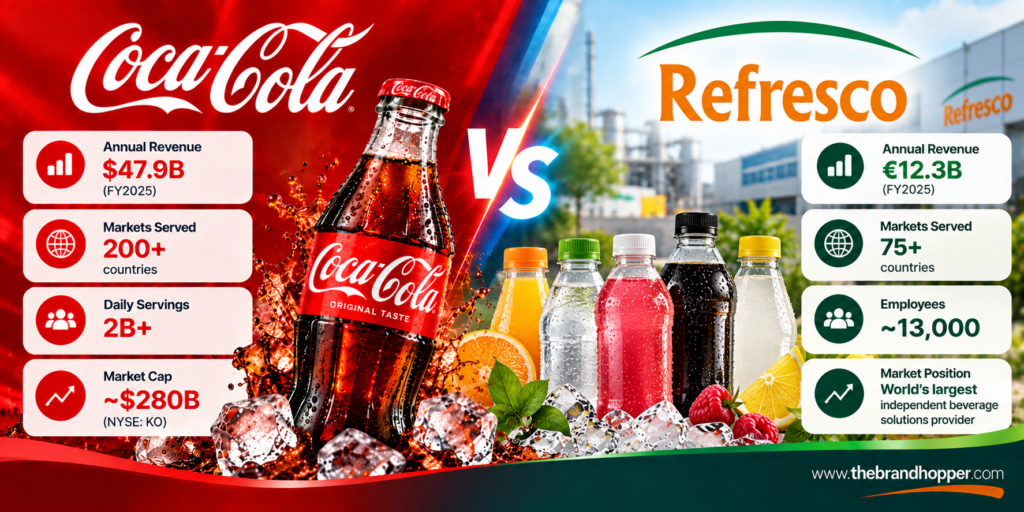
Refresco is one of the least visible but most consequential competitors to Coca-Cola in the global beverage market. As the world’s largest independent soft drink and juice bottler and manufacturer for retailers and branded beverage companies, Refresco produces private label and retailer-brand beverages that compete directly with Coca-Cola’s products on grocery, convenience, and discount retail shelves across Europe, North America, and Australia.
Headquartered in Rotterdam, Netherlands, and backed by private equity firm KKR, Refresco operates more than 80 production facilities across 14 countries and produces an estimated total annual revenue of approximately €4.5 billion (most recently reported estimate; the company is private and does not publish audited financial statements publicly). Refresco’s customers include many of the world’s largest retailers — Tesco, Asda, Carrefour, Lidl, Walmart, and Costco among them — for whom it produces private label cola, lemonade, fruit drinks, sparkling water, and energy drinks that sit beside and compete with Coca-Cola’s branded products.
The competitive dynamic between Refresco and Coca-Cola is structural rather than brand-to-brand. Private label beverage products manufactured by companies like Refresco typically retail at 20-40% below branded products, and their quality has improved dramatically over the past two decades. The growth of hard discounters (Aldi, Lidl) and the shift of grocery spending from high streets to big-box retailers has given private label beverages more retail exposure than ever before.
From Coca-Cola’s perspective, Refresco-supplied private label products are a persistent headwind to branded volume share and pricing power. Consumers who might once have reached for a Coca-Cola or Fanta increasingly choose retailer-label alternatives — particularly in the sparkling water, cola, and fruit drink categories — saving money without a significant sacrifice in product quality. Coca-Cola’s response has been to invest in brand strength, premium innovation, and pack-format innovation to maintain its branded premium positioning.
17. Carlsberg Group (incl. Britvic)
Website: carlsberg.com
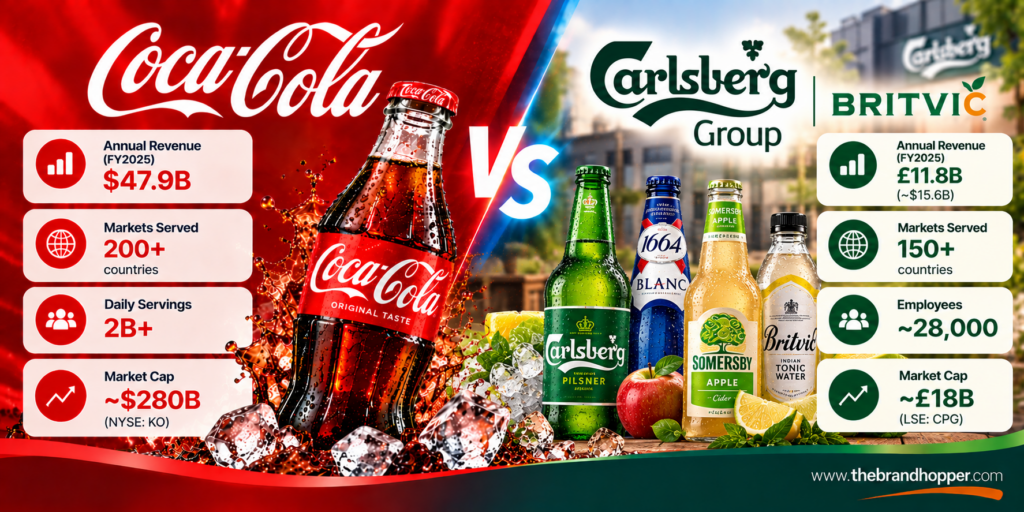
Carlsberg Group — best known as one of the world’s largest international beer companies — acquired the British soft drink company Britvic plc in November 2024 for approximately £3.3 billion, transforming itself into a dual-category beverage company with significant presence in both alcoholic and non-alcoholic soft drinks. This acquisition makes Carlsberg a new and meaningful competitor to Coca-Cola in the UK and Irish soft drink market.
Britvic’s brand portfolio is one of the most distinctive in the British soft drink market. It includes Robinsons (the iconic British squash brand, a fixture of British households for over a century), J2O (the premium adult non-alcoholic juice drink), Drench, Purdeys, and the UK and Ireland licensing rights to PepsiCo brands including Pepsi, 7UP, and Rockstar Energy Drink. These PepsiCo licensed brands place Carlsberg/Britvic in direct competition with Coca-Cola’s UK portfolio across supermarkets, convenience stores, and the on-trade (pubs and restaurants).
For Carlsberg, the Britvic acquisition is part of a broader strategy to reduce its dependence on alcohol revenues and build a resilient, diversified beverage portfolio that can capture growth in the no/low-alcohol trend. Carlsberg is investing in non-alcoholic variants of its beer brands (Carlsberg 0.0, San Miguel 0.0, Kronenbourg 1664 Blanc 0.0%) that compete with Coca-Cola for the adult socialising occasion, while the Britvic brands address the everyday soft drink and juice consumption occasions.
Carlsberg Group reported revenues of approximately DKK 76 billion (approximately $11 billion) for its most recently reported full year. The addition of Britvic’s revenues going forward will make Carlsberg an even more significant player in total beverage market terms. In the UK specifically — one of Coca-Cola’s most important European markets — the combined Carlsberg/Britvic entity represents a substantial competitive force.
Frequently Asked Questions (FAQs)
Q1. Who is Coca-Cola’s biggest competitor?
A: PepsiCo is Coca-Cola’s largest and most direct competitor. With total net revenues of $93.9 billion for the full year compared to Coca-Cola’s $47.9 billion, PepsiCo is nearly twice the size of Coca-Cola in revenue terms — a disparity largely explained by PepsiCo’s massive snack food business (Frito-Lay) and diversified food and beverage portfolio. In the beverage-only comparison, the two are much closer, though PepsiCo’s Pepsi-Cola brand trails Coca-Cola in global cola market share. The two companies have competed directly since the early 20th century in what is known as the “Cola Wars,” a rivalry that has shaped marketing strategies across the global consumer goods industry. Source: PepsiCo Q4 and Full Year 2025 Earnings Release (investors.pepsico.com); Coca-Cola Q4 and Full Year 2025 Earnings Release (investors.coca-colacompany.com).
Q2. Is Pepsi stronger than Coca-Cola?
A: In pure revenue terms, PepsiCo is larger than The Coca-Cola Company — $93.9 billion vs. $47.9 billion for their respective most recently completed full fiscal years. However, this comparison is misleading because PepsiCo’s revenues include a very large snack food business (Frito-Lay) that Coca-Cola does not have a direct equivalent to. In the carbonated soft drink category specifically, Coca-Cola’s flagship Coca-Cola brand holds a larger global market share than Pepsi by volume and value in most major markets. The two brands are close in the United States, with Coca-Cola consistently ahead in supermarket and convenience store data. Globally, Coca-Cola has a broader presence and typically leads in markets across Europe, Asia, and Latin America. Sources: PepsiCo and Coca-Cola official FY2025 earnings releases; Nielsen/Circana US retail market data.
Q3. What are Coca-Cola’s top 5 competitors?
A: Coca-Cola’s five most significant competitors by global reach, brand recognition, and competitive intensity are: (1) PepsiCo — the direct cola rival with $93.9 billion in full-year revenues; (2) Red Bull — the global energy drink leader with €12.2 billion in revenues and 43% global energy drink volume share; (3) Monster Beverage Corporation — the second-largest energy drink company with $8.29 billion in full-year revenues, in which Coca-Cola itself holds an equity stake; (4) Keurig Dr Pepper — a major US carbonated beverage and coffee company with $16.6 billion in full-year net sales; and (5) Nestlé — the world’s largest food and beverage company, which competes with Coca-Cola in premium water, instant coffee, and the broader non-alcoholic beverage occasion. Beyond these five, Danone, Suntory, Celsius Holdings, and National Beverage Corp represent significant category competitors. Sources: Company official FY2025 earnings releases.
Q4. Does Coca-Cola own Monster Energy?
A: The Coca-Cola Company does not own Monster Beverage Corporation, but it holds a significant minority equity stake, originally acquired in 2015 when Coca-Cola invested $2.15 billion for approximately 16.7% of Monster’s outstanding shares. The two companies have a strategic partnership under which Coca-Cola handles Monster’s distribution in many international markets, and Monster has transferred several of its non-energy drink brands to Coca-Cola in exchange. The relationship is a strategic alliance rather than an ownership structure, and Monster remains a separately listed public company (Nasdaq: MNST) with its own management and strategic independence. Source: Coca-Cola official investor relations (investors.coca-colacompany.com); Monster Beverage Corporation investor relations (investors.monsterbevcorp.com).
Q5. How does Coca-Cola compete with health drink brands?
A: Coca-Cola has pursued a multi-pronged strategy to compete in the health and wellness beverage space. Through acquisitions and partnerships, it has built a portfolio of healthier-positioned brands: Bodyarmor (the premium sports drink, acquired for $5.6 billion in 2021), Smartwater (premium hydration), Topo Chico (premium sparkling mineral water), AHA Sparkling Water (zero-calorie flavoured sparkling water), Powerade (sports drink), and a range of no-sugar variants of its core brands (Coca-Cola Zero Sugar, Fanta Zero, Sprite Zero). The company has also invested in Innocent Drinks (European smoothies and juice), fairlife (ultra-filtered milk and protein products), and has expanded its Costa Coffee footprint for the coffee occasion. Despite these efforts, the fastest-growing health drink brands — Celsius, Vita Coco, and Fever-Tree — remain mostly outside Coca-Cola’s portfolio. Source: Coca-Cola Company Annual Report 2025 (coca-colacompany.com).
Q6. What is the fastest-growing competitor to Coca-Cola?
A: Among companies that compete meaningfully with Coca-Cola, Celsius Holdings has shown the most dramatic revenue growth in recent periods — reporting full-year revenues of $2.52 billion, up 85.5% year-over-year (though this growth rate was significantly boosted by the Alani Nu acquisition). Organically, the CELSIUS brand grew 7.5% to $1.46 billion. In the energy drink category, Red Bull also reported strong growth, with full-year revenues of €12.2 billion (up 8.6%) and can sales reaching nearly 14 billion cans. Monster Beverage reported 10.7% revenue growth to $8.29 billion. Among the larger companies, Keurig Dr Pepper’s 8.2% net sales growth to $16.6 billion for the full year also stands out as strong performance for a company of its scale. Source: Company official FY2025 earnings releases as cited throughout this article.
Q7. Why is the energy drink category so important in the Coca-Cola competitive landscape?
A: The energy drink category is strategically significant for Coca-Cola for several reasons. First, it is one of the fastest-growing segments in the global beverage market, with compound annual growth rates in the high single digits globally. Second, energy drinks command significant pricing premiums over traditional carbonated soft drinks, generating higher margins per unit for manufacturers and retailers. Third, the core energy drink consumer — typically 18-35 years old, active, and frequently visiting convenience stores — is a high-lifetime-value consumer who is increasingly choosing energy drinks over colas as their primary carbonated beverage. Coca-Cola’s equity stake in Monster Beverage, and its licensing of the Coca-Cola Energy brand in certain markets, reflect the company’s recognition that the energy category represents both a competitive threat and a growth opportunity. Source: Grand View Research; Mordor Intelligence Global Energy Drinks Market Report; company FY2025 investor presentations.
Also Read: Top PepsiCo Competitors: 16 Brands Fighting for Your Loyalty
Conclusion
Coca-Cola’s position as the world’s most recognised beverage brand is not in doubt. With $47.9 billion in annual revenues, presence in more than 200 countries, and a portfolio that spans colas, juices, sports drinks, water, coffee, and tea, The Coca-Cola Company remains the undisputed benchmark of the global beverage industry. But the landscape it operates in has never been more competitive.
The 17 competitors profiled in this article represent the full spectrum of the challenge facing Coca-Cola: PepsiCo’s formidable distribution and snack-food integration, the energy drink juggernaut of Red Bull and Monster, the premium water and nutrition positioning of Danone and Nestlé, the functional drink disruption of Celsius Holdings and Vita Coco, the craft mixer excellence of Fever-Tree, the private label headwind from Refresco, and the emerging multi-category strategies of AB InBev and Carlsberg. Each of these companies is finding ways to compete for a share of consumer spending that might otherwise go to a Coca-Cola product.
Coca-Cola’s strategic response has been consistent and deliberate: expand beyond colas into a total beverage company, invest in premium and health-oriented brands, build out the no- and low-sugar portfolio, and leverage its unparalleled distribution and marketing capabilities to maintain relevance across every drinking occasion. The results — organic revenue growth of 5% for the full year and resilient free cash flow of $5.3 billion — suggest the strategy is working.
But the competition is not standing still. As consumer preferences evolve, as new categories emerge, and as the global demand for healthier, more functional, and more premium beverages continues to grow, the companies profiled in this article will continue to push Coca-Cola to innovate, adapt, and compete harder for every sip.
Also Read: Who Owns Coca-Cola? Major Shareholders Explained
To read more content like this, subscribe to our newsletter
Go to the full page to view and submit the form.