


“Airbnb or Booking.com?” has become one of the most common questions travelers ask before planning a trip, and for good reason — both platforms now offer an enormous range of accommodation, from traditional hotel rooms to apartments, vacation homes and unique stays. But despite the surface-level overlap, the two companies developed from fundamentally different starting points and have built somewhat different travel businesses.
Airbnb began as a home-sharing marketplace and has expanded into stays, experiences and services. Booking.com began with hotel reservations and has developed into one of the world’s largest online travel platforms, with millions of hotels, homes, apartments and other places to stay.
Here’s a fact-checked, financially grounded comparison of how Airbnb and Booking.com compare today — from their origins and business models to fees, cancellation policies, inventory, financial performance and leadership.
How the Two Platforms Began
Airbnb’s origin story begins in 2007, when Brian Chesky and Joe Gebbia hosted three guests in their San Francisco apartment after opening their home to help pay rent. Nathan Blecharczyk subsequently joined them as a co-founder. Airbnb’s official history records October 2007 as the date of the first guests, while the Airbed & Breakfast service formally launched in March 2008 and its website launched in August 2008.
The company initially operated under the name Airbed & Breakfast before officially becoming Airbnb in 2009. It subsequently expanded from air mattresses and rooms into apartments, entire homes, vacation rentals and increasingly diverse forms of accommodation, alongside experiences and services.
Booking.com’s history stretches further back. Geert-Jan Bruinsma founded Bookings.nl in Amsterdam in 1996. The business subsequently merged with another online hotel-booking company in 2000 and became Booking.com. Priceline Group acquired Booking.com in 2005 for approximately $133 million. Priceline later changed its corporate name to Booking Holdings in 2018.

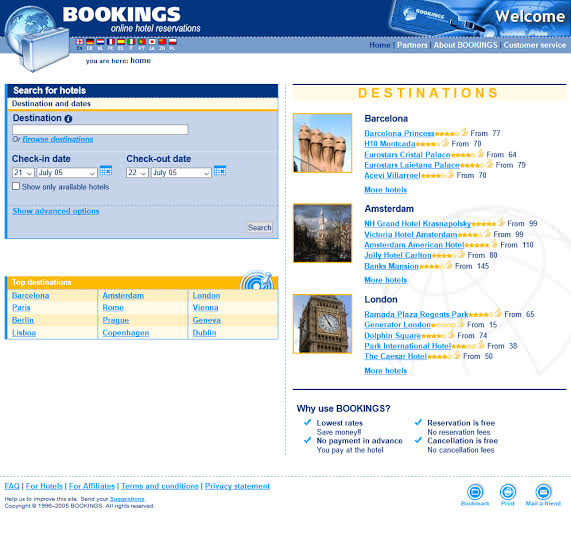
Unlike Airbnb, which started as a home-sharing platform, Booking.com was originally built around online hotel reservations and subsequently expanded substantially into alternative accommodations.
Business Model: Home-Sharing Marketplace vs. Global Travel Platform
The structural difference between the two companies still shapes their businesses today.
Airbnb operates a marketplace connecting guests with hosts and providers of accommodations, experiences and services. Its platform includes individual hosts as well as professional property managers and hospitality operators. Airbnb itself does not own the homes and other accommodations listed on its marketplace. The company now describes itself as a broader travel platform covering stays, experiences and services.
Booking.com is part of Booking Holdings and remains heavily focused on accommodation reservations, while also offering flights, rental cars, attractions and other travel services. Booking.com has expanded significantly into alternative accommodations and now lists millions of homes, apartments and other unique places to stay alongside traditional hotels, motels and resorts.
Booking Holdings also owns several major travel brands, including Priceline, Agoda, KAYAK and OpenTable. This gives the parent company exposure across accommodation, flights, rental cars, metasearch, restaurant reservations and other travel-related services.

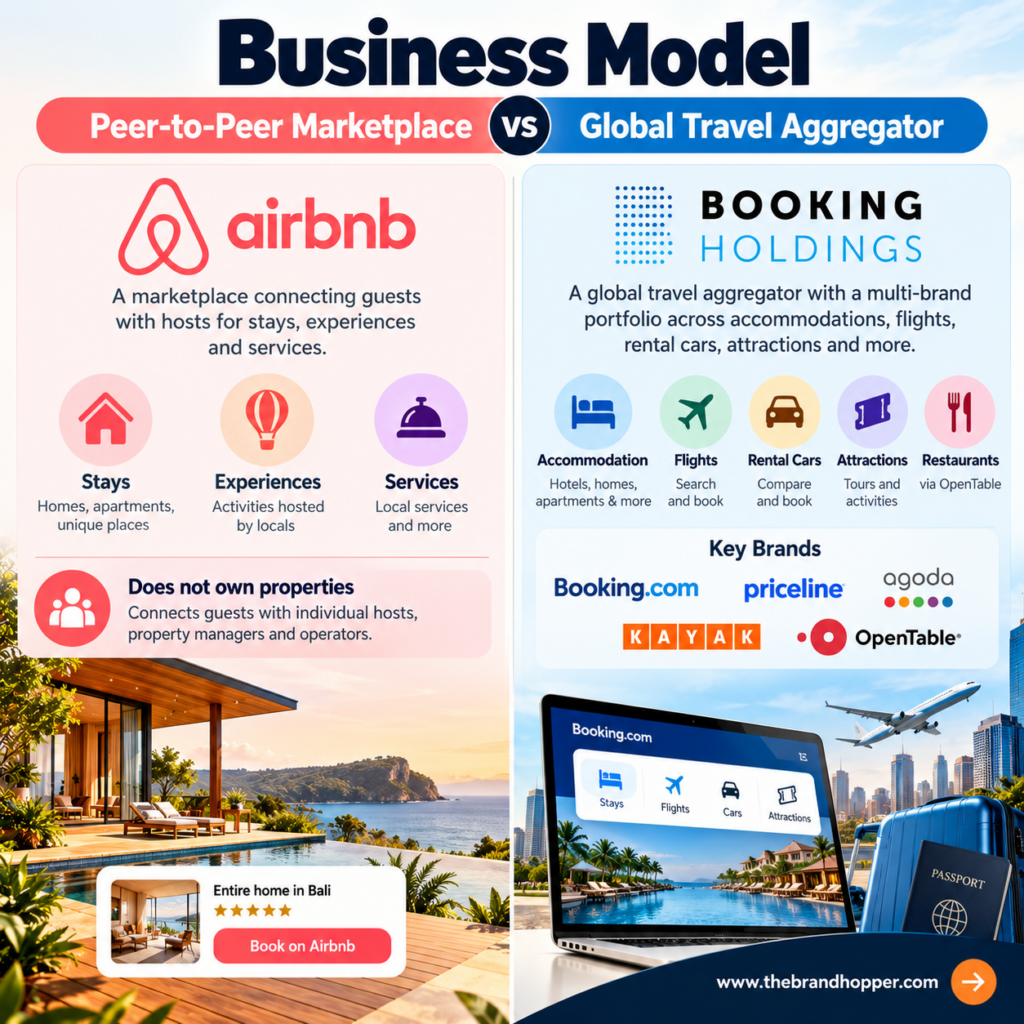
Airbnb, by contrast, remains more concentrated around its own marketplace, although it has broadened beyond accommodation through Experiences and Services.
Fees and Pricing: What Travelers Actually Pay
Fee structures have been changing on both platforms, particularly Airbnb.
Airbnb is currently transitioning home hosts toward a single service-fee structure. Under the single-fee model, the entire Airbnb service fee is deducted from the host’s payout rather than being split between the host and guest.
Airbnb states that most hosts on the single-fee structure pay 15.5%, while remaining hosts typically pay between 14% and 16%. Hosts in Brazil and Mexico generally pay a 16% single fee.
Airbnb is phasing out the traditional split-fee structure. Under that model, most hosts paid approximately 3%, while guests paid a separate service fee generally ranging from 14.1% to 16.5% of the booking subtotal.
Airbnb announced in July 2026 that hosts using property-management or channel-management software who had not already moved to the single-fee model would switch on October 13, 2026.
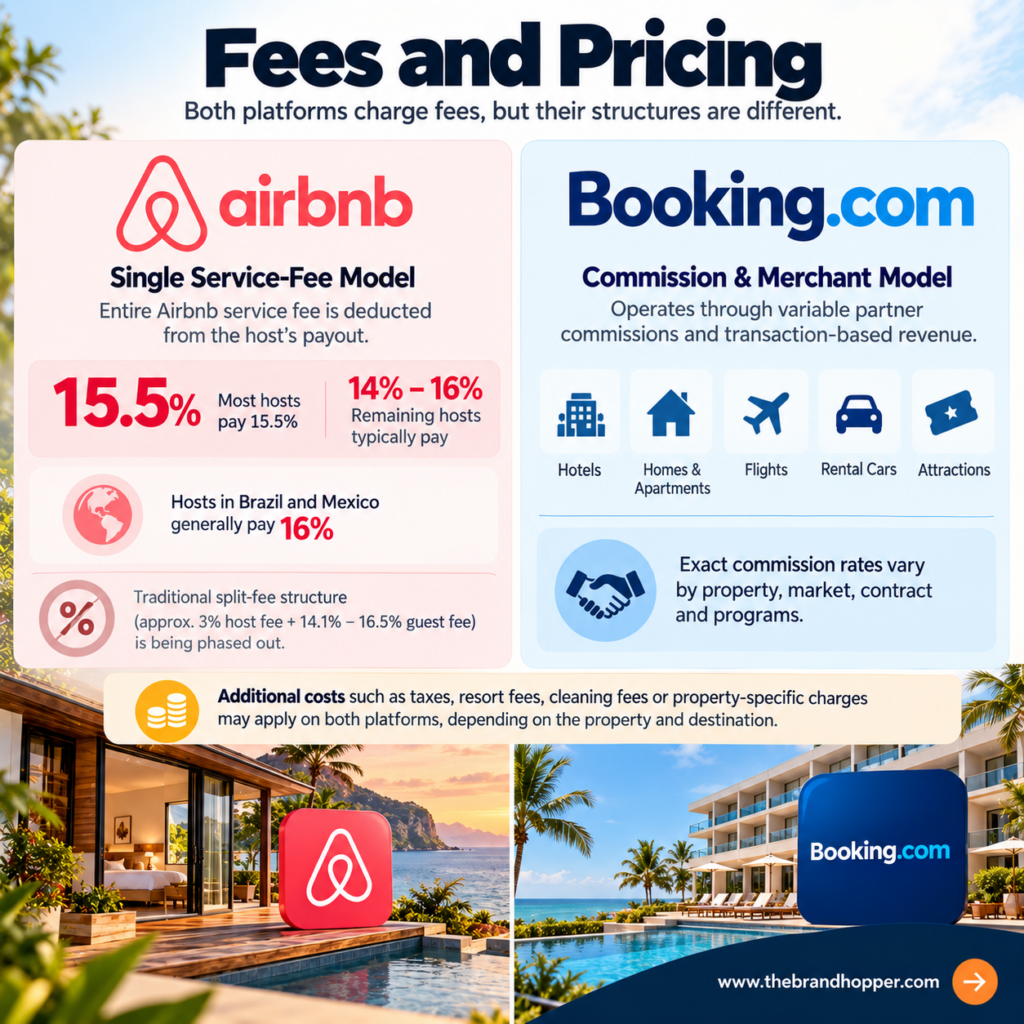
Booking.com operates primarily through commission and merchant arrangements with accommodation partners. The exact commercial terms vary by property, market, contract and participation in particular programs. It is therefore more accurate to describe Booking.com’s economics as variable partner commissions and transaction-based revenue rather than applying a universal 15–18% commission to every property.
Travelers may still encounter taxes, property-specific charges, resort fees, cleaning fees or other costs on either platform, depending on the property and destination. Consequently, the most meaningful comparison is the final price and cancellation terms for the specific booking.
Cancellation Policies: A More Nuanced Difference
Cancellation policies vary by individual property and booking, so neither platform has one universal cancellation policy.
Airbnb introduced updated standard cancellation policies for reservations booked on or after October 1, 2025. For eligible short-term stays of fewer than 28 nights, guests receive a 24-hour cancellation period allowing a full refund when the reservation was confirmed at least seven days before check-in. Airbnb also introduced the Limited policy, under which guests can receive a full refund when cancelling at least 14 days before check-in. The former Strict policy is no longer available for new reservations under the standard policy structure.
The exact policy can still depend on the listing, length of stay, country and applicable Airbnb rules.
Booking.com does not impose one universal cancellation policy either. Individual accommodation providers determine the cancellation conditions attached to specific rates. Many properties offer free cancellation until a specified date, while others offer partially refundable or non-refundable rates.
This means travelers should compare the actual cancellation deadline and refund conditions for the selected rate, rather than assuming that one platform always offers greater flexibility.
Inventory and Global Reach
Both platforms operate at enormous global scale, but their inventory figures are reported differently.
Airbnb currently reports more than 9 million active listings worldwide, across more than 220 countries and regions and more than 150,000 cities and towns.
Booking.com reported approximately 4.7 million properties on its platform as of June 30, 2026. These consisted of more than 4.1 million alternative-accommodation properties — including homes, apartments and other unique places to stay — plus more than 500,000 hotels, motels and resorts.
Booking Holdings also describes its platform as having 32 million+ reported listings, which is a different measurement from the number of properties. One property can therefore correspond to multiple reported listings, such as different room types or accommodation options. The company’s own factsheet currently describes approximately 4.4 million properties alongside 32 million+ reported listings.
The distinction is important: Booking.com does not have 32 million properties. Its reported property count was approximately 4.7 million in Q2 2026, while its broader reported-listing figure exceeds 32 million.
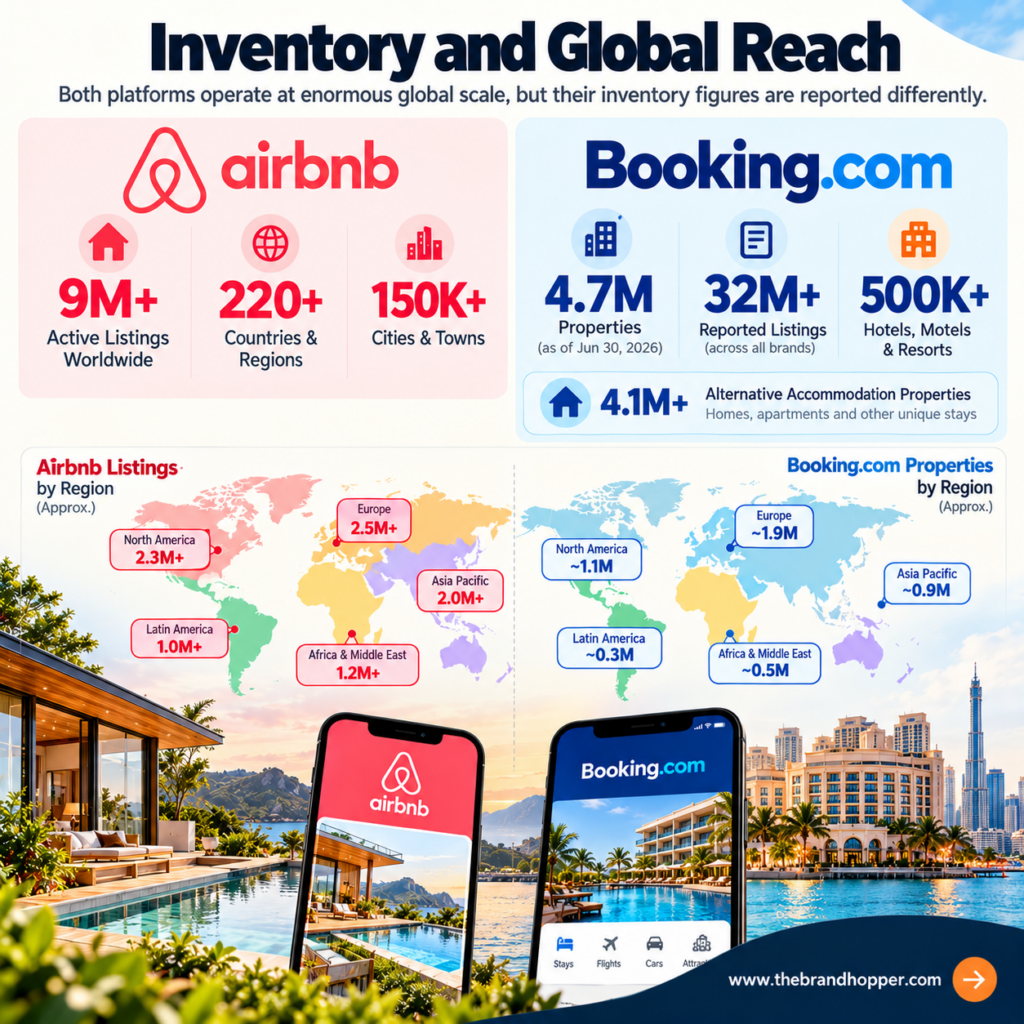
Airbnb and Booking.com therefore cannot be compared simply by taking their headline listing numbers. Airbnb reports active listings, while Booking Holdings separately reports properties and a much larger number of reported listings.
Booking.com also has a substantial traditional hotel inventory, while Airbnb’s marketplace remains more heavily associated with homes, apartments and unique stays.
Financial Performance: Booking Holdings’ Larger Scale
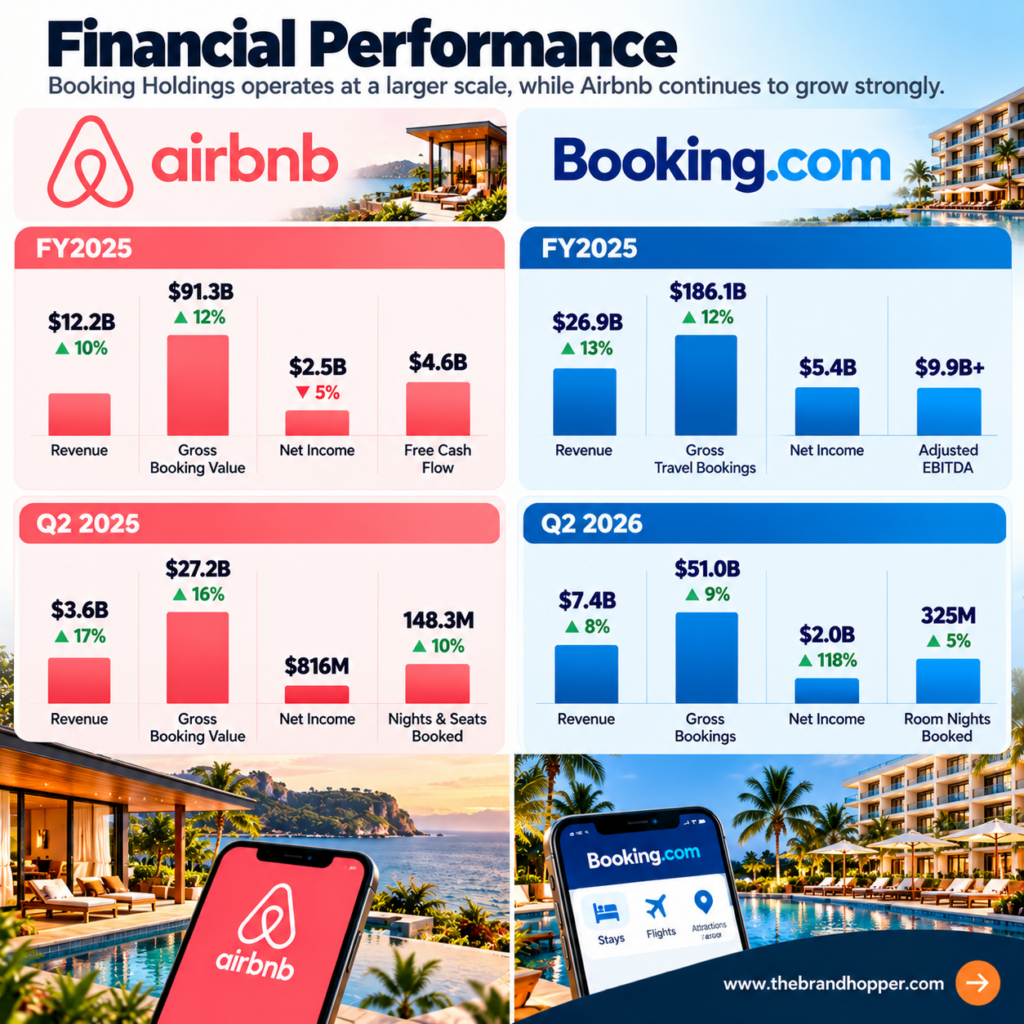
The latest completed full-year results are for fiscal 2025, while both companies have since reported their second-quarter 2026 results.
Leadership: Chesky vs. Fogel
Both companies continue to be led by their long-serving CEOs.
Brian Chesky is Airbnb’s co-founder and Chief Executive Officer. He remains responsible for the company’s overall vision and strategy and continues to serve as Chairman of Airbnb’s Board.
Chesky was one of Airbnb’s original hosts in 2007 and has led the company through its rapid international expansion, 2020 IPO and subsequent development into a broader travel platform.
Glenn Fogel is President and Chief Executive Officer of Booking Holdings and Chief Executive Officer of Booking.com. He has served as CEO and President of Booking Holdings since January 2017 and as CEO of Booking.com since June 2019.
Fogel joined Booking Holdings in 2000 and previously held senior roles in corporate development and worldwide strategy and planning.
The leadership contrast reflects the companies’ different origins: Airbnb remains closely associated with its founder-led product and design culture, while Booking Holdings operates a multi-brand global travel group.
Which Platform Is Actually Better for Travelers?
The answer depends on the specific trip, property and booking requirements.
Airbnb’s marketplace is particularly relevant for travelers looking for homes, apartments, vacation rentals, longer stays, group accommodations and distinctive properties. Airbnb also offers Experiences and Services alongside stays.
Booking.com provides a broad combination of hotels, resorts, apartments, homes and other accommodations, alongside flights, rental cars, attractions and other travel services through the wider Booking Holdings ecosystem.
For a hotel stay, Booking.com’s extensive hotel inventory can provide a large selection of accommodation and rate options. For travelers seeking an entire home, apartment or other distinctive accommodation, Airbnb’s core marketplace remains highly relevant.
Price and flexibility should be evaluated on the specific booking because fees, taxes, cancellation conditions, room or property type and promotions can differ substantially.
Many travelers can reasonably use both platforms depending on the destination and type of accommodation rather than treating the decision as an either-or choice.
Also Read: Airbnb’s “Belong Anywhere” Campaign: The Untold Case Study
Airbnb vs. Booking.com at a Glance
| Category | Airbnb | Booking.com / Booking Holdings |
|---|---|---|
| Founded | 2007; service launched in 2008 | Bookings.nl founded in 1996; Booking.com emerged after the 2000 merger |
| Founders | Brian Chesky, Joe Gebbia, Nathan Blecharczyk | Geert-Jan Bruinsma founded Bookings.nl |
| Core business model | Global marketplace for stays, experiences and services | Global online travel platform with accommodation at its core |
| Parent company | Airbnb, Inc. | Booking Holdings Inc. |
| Major brands / offerings | Airbnb Stays, Experiences, Services | Booking.com, Priceline, Agoda, KAYAK, OpenTable |
| Active / listed inventory | 9M+ active listings | ~4.7M properties as of June 30, 2026 |
| Alternative accommodation | Core marketplace | 4.1M+ properties as of June 30, 2026 |
| Hotels | Hotel and boutique accommodation supply | 500K+ hotels, motels and resorts as of June 30, 2026 |
| Reported listings | 9M+ active listings | 32M+ reported listings according to Booking Holdings |
| Fee model | Transitioning to single 15.5% host fee for most hosts | Partner commission and merchant-based model; terms vary |
| Cancellation | Multiple policies; 24-hour grace period for eligible bookings | Property- and rate-specific cancellation policies |
| FY2025 revenue | $12.2B (+10%) | $26.9B (+13.4%) |
| FY2025 gross bookings / GBV | $91.3B GBV (+12%) | $186.1B gross travel bookings (+12%) |
| FY2025 net income | $2.5B | ~$5.4B |
| Q2 2026 revenue | $3.6B (+17%) | $7.4B (+8%) |
| Q2 2026 gross bookings / GBV | $27.2B GBV (+16%) | $51.0B gross bookings (+9%) |
| Q2 2026 net income | $816M | ~$2.0B |
| Market capitalization, Sept. 28, 2026 | ~$92.8B | ~$123.1B |
| CEO | Brian Chesky | Glenn Fogel |
The inventory figures are based on different company definitions and therefore should not be interpreted as a perfect like-for-like comparison. Booking Holdings’ 32M+ figure refers to reported listings, while its actual property count was approximately 4.7 million at June 30, 2026.
The market-cap figures are based on September 28, 2026 market data: approximately $92.8 billion for Airbnb and $123.1 billion for Booking Holdings.
Key Takeaways
Airbnb and Booking.com began as very different businesses but now compete across a much broader portion of the global accommodation market.
Airbnb originated in San Francisco in 2007 when Brian Chesky and Joe Gebbia hosted three guests in their home, with Nathan Blecharczyk joining as a co-founder soon afterward. The platform subsequently expanded from home-sharing into apartments, entire homes, unique stays, Experiences and Services.
Booking.com’s roots go back to Bookings.nl, founded by Geert-Jan Bruinsma in Amsterdam in 1996. The business became Booking.com after a 2000 merger and was acquired by Priceline in 2005. It remains the flagship accommodation platform within Booking Holdings, whose other major brands include Priceline, Agoda, KAYAK and OpenTable.
The inventory comparison is more nuanced than the original headline figures suggest. Airbnb currently reports 9 million-plus active listings, while Booking.com had approximately 4.7 million properties at June 30, 2026, including more than 4.1 million alternative-accommodation properties and more than 500,000 hotels, motels and resorts. Booking Holdings separately reports 32 million-plus listings, but that figure should not be confused with the number of properties.
Financially, Booking Holdings remains the larger company. In FY2025, Booking Holdings generated $26.9 billion of revenue and $186.1 billion of gross travel bookings, compared with Airbnb’s $12.2 billion of revenue and $91.3 billion of GBV.
The latest Q2 2026 results show both companies continuing to grow. Airbnb generated $3.6 billion of revenue, up 17%, while Booking Holdings generated $7.4 billion, up 8%. Airbnb’s GBV reached $27.2 billion, while Booking Holdings reported $51.0 billion of gross bookings.
Airbnb is also in the process of simplifying its fee structure, with most home hosts moving toward a single 15.5% service fee deducted from the host payout.
For travelers, the practical choice depends on the individual trip. Airbnb offers a large marketplace centered on homes, apartments, unique stays and an expanding range of experiences and services, while Booking.com combines millions of alternative accommodations with a very large hotel inventory and access to the wider Booking Holdings travel ecosystem.
Frequently Asked Questions
Q: Which is cheaper, Airbnb or Booking.com?
A: There is no universal answer. The final price depends on the property, dates, room or accommodation type, taxes, service fees, cleaning or property charges, promotions and cancellation conditions.
The most useful comparison is to check the same or equivalent property, dates and cancellation terms on both platforms and compare the final price.
Q: Which company is bigger, Airbnb or Booking.com?
A: Booking Holdings is larger by revenue and gross travel bookings. In FY2025, Booking Holdings generated $26.9 billion in revenue and $186.1 billion in gross travel bookings, compared with Airbnb’s $12.2 billion in revenue and $91.3 billion in GBV.
Q: Does Airbnb or Booking.com have more listings?
A: Airbnb currently reports more than 9 million active listings worldwide. Booking.com had approximately 4.7 million properties as of June 30, 2026, including more than 4.1 million alternative-accommodation properties and more than 500,000 hotels, motels and resorts.
Booking Holdings separately reports more than 32 million reported listings, but these are not equivalent to properties. A single property can have multiple listings or accommodation options.
Q: Which platform has better cancellation policies?
A: Neither platform has one universal cancellation policy.
Airbnb introduced updated standard cancellation policies for reservations booked from October 1, 2025, including a 24-hour cancellation period for eligible short-term reservations confirmed at least seven days before check-in.
Booking.com cancellation terms are determined by the individual accommodation and rate. Some offer free cancellation until a specified deadline, while others are partially refundable or non-refundable.
Q: Who founded Airbnb and Booking.com?
A: Airbnb was founded by Brian Chesky, Joe Gebbia and Nathan Blecharczyk, with the company’s first guests hosted in San Francisco in October 2007. The Airbed & Breakfast service launched in 2008.
Geert-Jan Bruinsma founded Bookings.nl in Amsterdam in 1996. The business later became Booking.com after a 2000 merger and was acquired by Priceline in 2005.
Q: Who are the CEOs of Airbnb and Booking.com?
A: Brian Chesky is Airbnb’s co-founder and Chief Executive Officer.
Glenn Fogel is President and CEO of Booking Holdings and CEO of Booking.com. He has served as Booking Holdings’ CEO and President since January 2017 and as Booking.com’s CEO since June 2019.
Q: Is Airbnb or Booking.com better for hotels?
A: Booking.com has a very large traditional hotel inventory, with more than 500,000 hotels, motels and resorts reported on its platform as of June 30, 2026. Airbnb also offers hotel and hospitality properties alongside its much larger home and unique-stay marketplace.
For a particular hotel, travelers should compare the available room types, prices, cancellation terms, loyalty benefits and other booking conditions on both platforms.
Q: What other brands does Booking Holdings own?
A: Booking Holdings’ major consumer-facing brands include Booking.com, Priceline, Agoda, KAYAK and OpenTable. The group’s businesses span accommodation, flights, rental cars, metasearch, restaurant reservations and other travel-related services.
Q: What is Airbnb’s service fee?
A: Airbnb is transitioning home hosts to a single service-fee structure. Most hosts on the single-fee model pay 15.5%, while remaining hosts typically pay 14–16%. Under the older split-fee structure, most hosts paid approximately 3% while guests paid a separate service fee.
Q: What is Booking.com’s commission?
A: Booking.com does not publish one universal commission rate applicable to every accommodation partner. Commercial terms vary by market, property, contract and participation in promotional or visibility programs. Booking Holdings generates accommodation revenue through agency commissions as well as merchant arrangements and other transaction-related revenue.
Q: What is Airbnb’s market capitalization?
A: Airbnb’s market capitalization was approximately $92.8 billion on September 28, 2026. Market capitalization changes with the company’s share price.
Q: What is Booking Holdings’ market capitalization?
A: Booking Holdings had a market capitalization of approximately $123.1 billion on September 28, 2026. Market capitalization changes continuously with the company’s share price.
Also Read: Who Owns Airbnb? Ownership & Shareholders
To read more content like this, subscribe to our newsletter
Go to the full page to view and submit the form.