


Walk into any electronics store, open any shopping app or step into a corporate IT department, and two names remain among the dominant PC vendors: Dell and HP. Together, they accounted for nearly 99 million PC shipments worldwide in 2025, according to Gartner. Both companies serve consumers, small businesses and large enterprises, although their product portfolios and business models differ significantly.
The question “Dell or HP?” has become more complicated in 2026. Dell brought back the XPS brand at CES 2026 after replacing its consumer naming architecture in 2025, while HP consolidated OMEN and HyperX under the HyperX gaming brand while retaining OMEN as a product family. At the same time, AI PCs are expanding across both portfolios and a global memory shortage is pushing PC prices higher.
This guide compares Dell and HP across market position, financial strength, product lineups, premium, business, gaming and budget laptops, AI capabilities, security, support and pricing.
Quick Verdict: There is no universal winner.
HP currently has the larger global PC shipment share, a broad consumer and business portfolio, and particularly strong presence in markets such as India.
Dell has a strong premium portfolio through XPS, a major gaming presence through Alienware, and a substantial enterprise business built around configurable commercial systems and support services.
The better choice depends on the specific model, price, workload and support requirements.
Key Takeaways
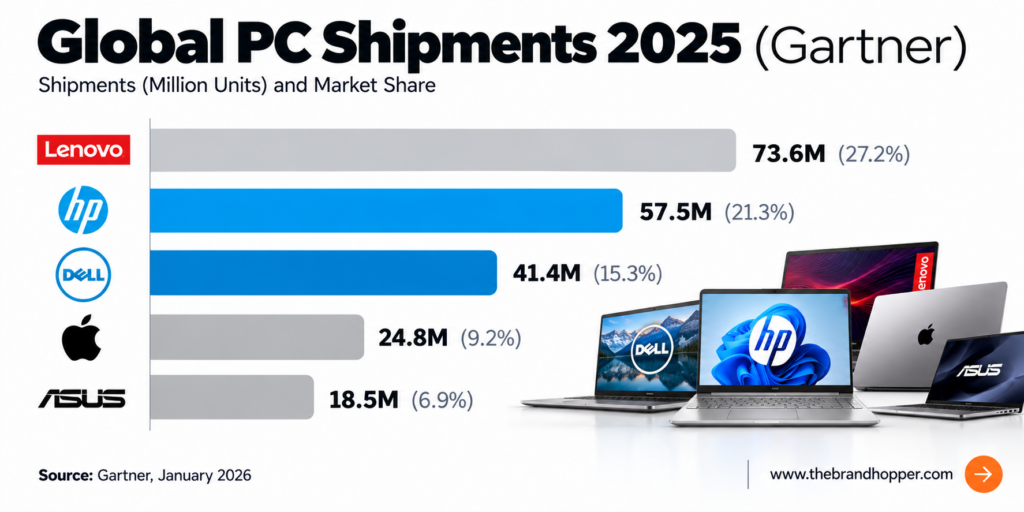
Volume: HP was the world’s No. 2 PC vendor and Dell No. 3 in 2025. Gartner estimated HP shipped 57.5 million PCs (21.3% share) versus Dell’s 41.4 million (15.3%). Lenovo led both.
Latest market trend: In Q2 2026, IDC estimated HP at 13.0 million units / 19.1% share and Dell at 9.3 million / 13.6%, as the global PC market declined 4.9% year over year.
Scale: Dell’s overall business is much larger than its PC business alone because its Infrastructure Solutions Group generated $60.8 billion in FY2026, driven heavily by AI servers.
Premium: Dell brought back the XPS 14 and XPS 16 in January 2026, followed by the new XPS 13 in June. HP’s premium consumer portfolio is led by the OmniBook Ultra.
Business: Both companies have extensive commercial portfolios. Dell uses Dell Pro and Dell Pro Max, while HP offers ProBook and EliteBook.
Gaming: Dell’s gaming portfolio includes Alienware Area-51 and Aurora. HP unified OMEN and HyperX under the HyperX master brand, with OMEN continuing as a gaming product family.
Prices: Memory shortages are putting substantial upward pressure on PC prices. Gartner projected PC prices to rise 17% in 2026, while IDC forecast an 11.3% decline in global PC shipments for the year.
Dell vs HP at a Glance
| Factor | Dell | HP |
|---|---|---|
| Founded | 1984, by Michael Dell | 1939, by Bill Hewlett and Dave Packard; HP Inc. formed in 2015 |
| Headquarters | Round Rock, Texas, USA | Palo Alto, California, USA |
| Leadership | Michael Dell, Chairman & CEO | Bruce Broussard, Interim CEO since February 2026 |
| 2025 global PC shipments | 41.4 million / 15.3% share | 57.5 million / 21.3% share |
| Latest Q2 2026 IDC share | 13.6% | 19.1% |
| Consumer laptops | Dell, Dell Plus, Dell Premium; XPS | OmniBook 3, 5, 7, X and Ultra |
| Business laptops | Dell Pro | ProBook and EliteBook |
| Workstations | Dell Pro Max | HP ZBook |
| Gaming | Alienware | HyperX / OMEN |
| Signature strengths | Premium systems, configurability, enterprise portfolio | Range, retail distribution, business security |
| Best suited to | Premium users, gamers, creators, enterprises | Students, families, SMBs and enterprises |
A Brief History of Two American PC Giants
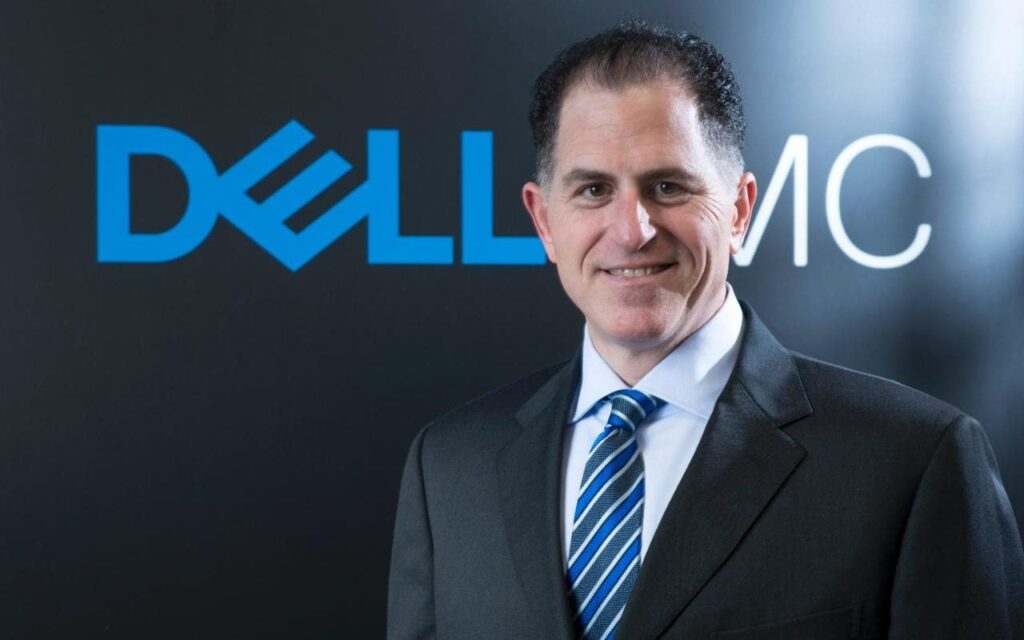
Dell began in 1984 when Michael Dell, then a student at the University of Texas at Austin, started selling computers directly to customers. The direct-sales and build-to-order model became an important part of Dell’s business model. Four decades later, Dell Technologies is headquartered in Round Rock, Texas, and Michael Dell remains Chairman and CEO.

HP has even deeper roots. Bill Hewlett and Dave Packard founded Hewlett-Packard in Palo Alto in 1939. In November 2015, the original company split into two publicly traded companies: Hewlett Packard Enterprise, focused on enterprise technology, and HP Inc., which retained PCs and printing.

HP went through another major leadership change in 2026. Enrique Lores stepped down as HP’s President and CEO in February 2026 and became President and CEO of PayPal effective March 1, 2026. HP board member Bruce Broussard became Interim CEO.
Market Share: Who Sells More Laptops?
On overall PC shipment volume, HP shipped more than Dell in 2025. Gartner’s preliminary full-year data estimated the global PC market at 270.2 million units, with HP at 57.5 million and Dell at 41.4 million. These figures cover PCs including desktops and laptops.

The picture changed in 2026 as the global memory shortage began affecting supply and pricing. IDC estimated that worldwide PC shipments fell 4.9% year over year to 68.2 million units in Q2 2026. HP shipped approximately 13.0 million units, while Dell shipped 9.3 million.
Financial Muscle: How the Two Companies Compare
Financially, Dell and HP have taken very different paths. Dell has become a major AI-infrastructure provider, while HP remains much more concentrated in PCs and printing.
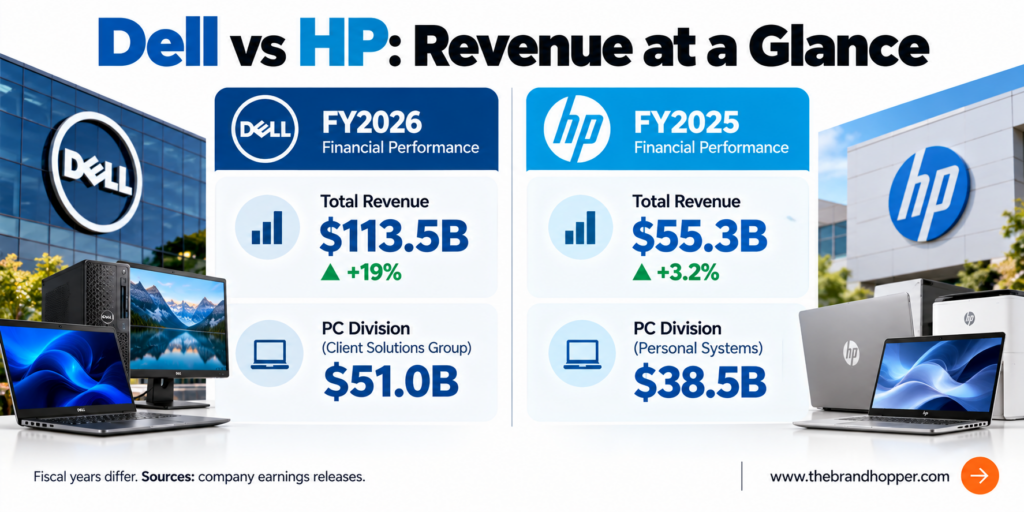
Two things stand out. First, Dell’s Client Solutions Group generated $51.0 billion in FY2026, compared with HP’s approximately $38.5 billion Personal Systems business in FY2025. This reflects differences in product mix and the fact that the companies report on different fiscal calendars.
Second, Dell’s overall growth is being driven heavily by AI infrastructure rather than PCs. Dell’s Infrastructure Solutions Group generated $60.8 billion in FY2026 revenue, up 40%, while Client Solutions Group revenue increased 5%. In Q2 FY2027, Dell’s ISG generated $31.8 billion, including $16.4 billion from AI-optimized servers.
Laptop Lineups Decoded
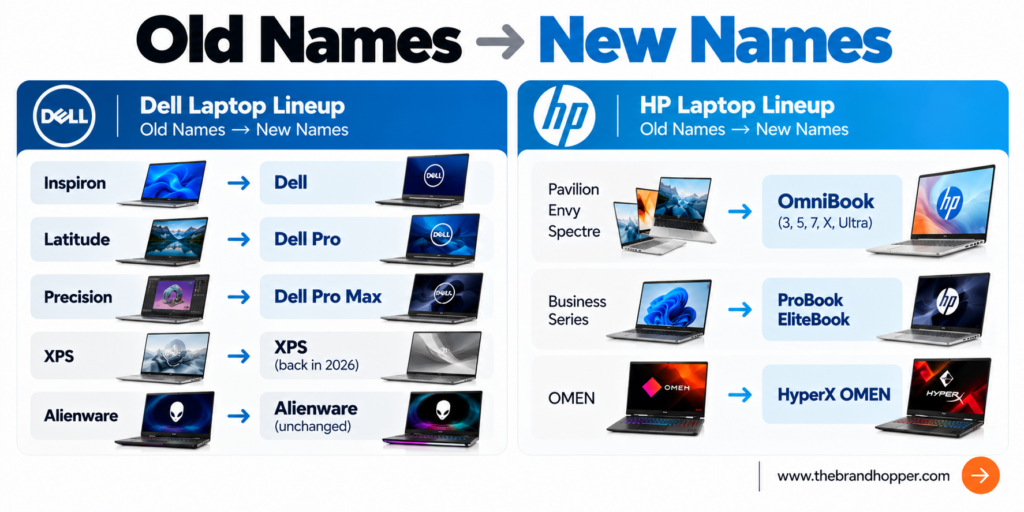
Both companies have significantly changed their product naming in recent years, so older buying guides can be misleading. Here is how the current portfolios are structured.
Dell’s Lineup
Dell: Mainstream consumer laptops, including the Dell, Dell Plus and Dell Premium tiers.
XPS: Dell’s premium consumer line. Dell brought XPS back at CES 2026 with the XPS 14 and XPS 16, followed by the new XPS 13 in June 2026.
Dell Pro: Business PCs with Base, Plus and Premium positioning.
Dell Pro Max: Mobile workstations for professional and technical workloads.
Alienware: Dell’s gaming brand, including Area-51 and Aurora laptop families.
HP’s Lineup
OmniBook: HP’s current consumer laptop portfolio, spanning OmniBook 3, 5, 7, X and Ultra. HP positions these from everyday/student systems through premium creative and professional machines.
ProBook and EliteBook: HP’s main business laptop families, ranging from value-oriented commercial systems to premium business notebooks.
ZBook: HP’s professional mobile workstation family.
HyperX OMEN: HP unified OMEN and HyperX under the HyperX master gaming brand in 2026, while OMEN remains a product family within the gaming portfolio.
Buying tip: Product tiers now provide a useful indication of positioning, but the actual processor, display, memory, storage, battery and GPU configuration matter more than the family name alone.
Premium Showdown: Dell XPS vs HP OmniBook Ultra
The premium ultraportable segment has become particularly competitive in 2026.
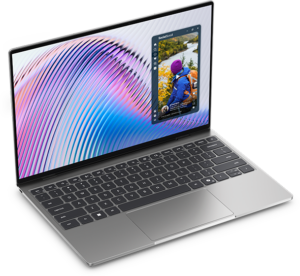
Dell XPS 14 and XPS 16: Introduced at CES 2026, the new XPS models use machined aluminum construction and Intel Core Ultra Series 3 processors. Dell listed launch prices of $2,049.99 for the XPS 14 and $2,199.99 for the XPS 16 in the United States.
Dell XPS 13: The redesigned XPS 13 launched in June 2026 at a starting price of $699.99, with qualifying student pricing from $599. Dell describes it as its thinnest and lightest XPS laptop, weighing approximately 1 kg.

HP OmniBook Ultra 14: HP’s premium consumer lineup includes the OmniBook Ultra 14, available with processors including AMD Ryzen AI, Intel Core Ultra and Snapdragon X2 Elite depending on configuration. HP’s 2026 launch highlighted a Snapdragon X2 Elite configuration with an NPU of up to 85 TOPS.

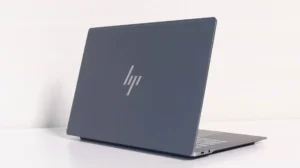
Rather than declaring a universal premium winner, the choice depends on configuration. XPS emphasizes compact design and premium construction, while OmniBook Ultra offers a broad selection of processor platforms and AI-focused configurations.
Business Laptops: Dell Pro vs HP EliteBook
Business laptops remain central to both companies. Dell’s Q2 FY2027 Client Solutions Group revenue reached $15.0 billion, including record Commercial Client revenue of $13.2 billion. HP’s Q3 FY2026 Personal Systems revenue reached $11.8 billion, with Commercial Personal Systems revenue up 22% year over year.
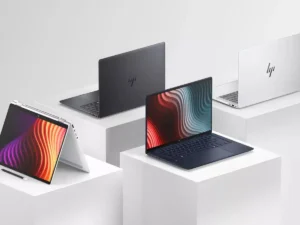
HP EliteBook: HP’s premium business portfolio includes the EliteBook X and EliteBook 6 and 8 families. HP’s 2026 EliteBook X G2 range supports Intel, AMD and Qualcomm processor platforms depending on configuration, with selected Snapdragon configurations offering high NPU performance.

Dell Pro and Dell Pro Max: Dell’s commercial portfolio emphasizes configurable systems, fleet deployment and enterprise support services. Dell Pro covers mainstream business systems, while Pro Max is positioned toward higher-performance professional workloads.

There is no single business-laptop winner. Existing IT management systems, support contracts, security requirements, procurement pricing and configuration needs are usually more important than the brand name.
Gaming Laptops: Alienware vs HyperX OMEN
Alienware remains Dell’s dedicated gaming brand. Its current laptop portfolio includes Area-51 and Aurora families, with the Area-51 positioned at the high-performance end. Current models include the Alienware 16 and 18 Area-51 and Alienware 16/16X Aurora.
HyperX OMEN is HP’s unified gaming architecture following HP’s 2026 decision to bring OMEN and HyperX under the HyperX master brand. OMEN remains part of the product naming. The HyperX OMEN MAX 16 supports up to an NVIDIA GeForce RTX 5090 Laptop GPU and up to 64GB of memory.
For buyers, the more useful comparison is the specific GPU, CPU, cooling system, display and price, rather than the brand alone.
Budget and Student Laptops
For budget buyers, HP’s OmniBook 3 provides a broad entry-level consumer option, while the OmniBook 5 targets a higher performance tier. HP’s current portfolio covers a wide range of configurations and price points.
Dell’s new XPS 13 provides a premium-oriented alternative at a relatively accessible price for the XPS family. Dell currently lists the model from $699.99, with qualifying student pricing from $599.
For students, the decision should depend on budget, screen size, battery life, memory, storage and workload, rather than simply choosing a brand.
AI PCs, Processors and Performance
Both companies now sell Copilot+ PCs and AI PCs with dedicated neural processing units (NPUs). HP’s current OmniBook portfolio spans Intel, AMD and Qualcomm platforms, while Dell also offers multiple processor platforms across its consumer and commercial portfolios.
HP highlighted an OmniBook Ultra 14 configuration using the Snapdragon X2 Elite with up to 85 TOPS NPU performance, while Dell’s 2026 XPS portfolio uses Intel Core Ultra Series 3 processors.
NPU TOPS should not be considered a standalone measure of laptop performance. For buyers, software compatibility, CPU/GPU performance, battery life and the specific AI applications being used remain important.
Build Quality, Design and Durability
Dell’s premium XPS systems use machined aluminum and emphasize thin, minimalist designs. HP’s current OmniBook range also includes aluminum designs, OLED displays and, on selected models, MIL-STD-810H testing. HP states that its OmniBook Ultra has undergone 20 military-standard durability tests.
At the entry level, construction varies substantially between models from both brands, so buyers should evaluate the exact laptop rather than generalize from the manufacturer.
Security and Manageability
Security is an important differentiator in business PCs. HP Wolf Security provides hardware- and firmware-level protections across supported commercial systems, while Dell offers security technologies including SafeBIOS and Trusted Device across applicable commercial products.
For home users, the differences may be less important than Windows security settings and good security practices. For enterprises, the more relevant considerations are firmware protection, endpoint management, identity controls, fleet deployment and compatibility with the company’s existing security stack.
Customer Support and Warranty
Both companies offer limited warranties on many consumer laptops, but coverage varies by country, model and purchase configuration. Dell offers consumer and business support options including Premium Support and ProSupport, while HP offers services and Care Pack extensions.
For business customers, on-site response times and support contracts can be particularly important. For consumers, the availability of authorized service centers and parts in the buyer’s location can matter more than broad global support claims.
Laptop Prices in 2026: The Memory Crunch Effect
The PC industry is facing significant memory-cost pressure in 2026. Gartner projected that combined DRAM and SSD prices could rise 130% by the end of 2026, contributing to a projected 17% increase in PC prices compared with 2025. IDC expects the global PC market to decline 11.3% in 2026, with the memory shortage continuing to affect supply and pricing into 2027.
HP’s own Q3 FY2026 filing illustrates the impact. Commercial PC ASPs increased 41.1% and consumer PC ASPs increased 37.1% year over year, while unit volumes declined 13.6% and 19.4%, respectively. HP attributed the ASP increases primarily to pricing actions, currency effects and product mix, with higher commodity costs also affecting margins.
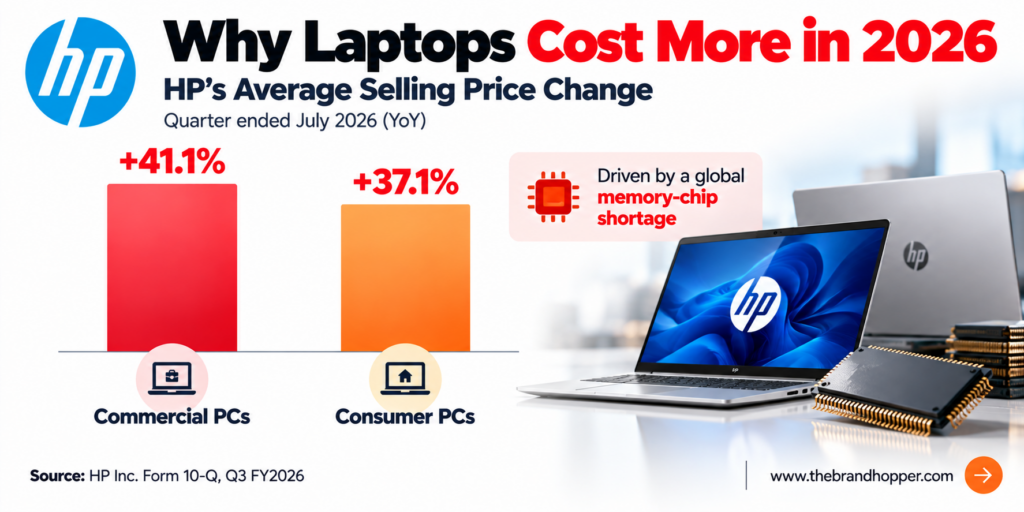
The practical implication is that buyers should compare actual configurations and current prices, rather than assume that older-generation models will automatically become cheaper.
Which Should You Buy? Our Recommendations
| If you are… | Consider | Why |
|---|---|---|
| A student on a budget | HP OmniBook 3/5 or Dell XPS 13 | HP offers a broad mainstream portfolio; XPS 13 offers a premium design at a higher price |
| A creative professional | Dell XPS / Dell Pro Max or HP OmniBook 7/Ultra | Compare display, GPU, CPU, memory and software requirements |
| A business traveller | HP EliteBook or Dell Pro | Both offer business-focused security, manageability and support options |
| A gamer | Alienware or HyperX OMEN | Compare GPU, cooling, display, CPU and price |
| A small business owner | HP ProBook/EliteBook or Dell Pro | Both offer commercial management and security capabilities |
| An enterprise IT buyer | Either | Procurement pricing, support, fleet management and existing IT infrastructure should drive the decision |
| A buyer in India | HP or Dell | HP currently has the larger Indian PC market share, but local pricing and service availability should be checked for the exact model |
Final Verdict: Dell or HP?
In 2026, Dell and HP remain two of the largest PC manufacturers, but their portfolios have different strengths. HP has the larger global PC shipment share and a particularly broad consumer and commercial range, while Dell combines its PC business with a much larger enterprise infrastructure operation and maintains strong XPS and Alienware portfolios.

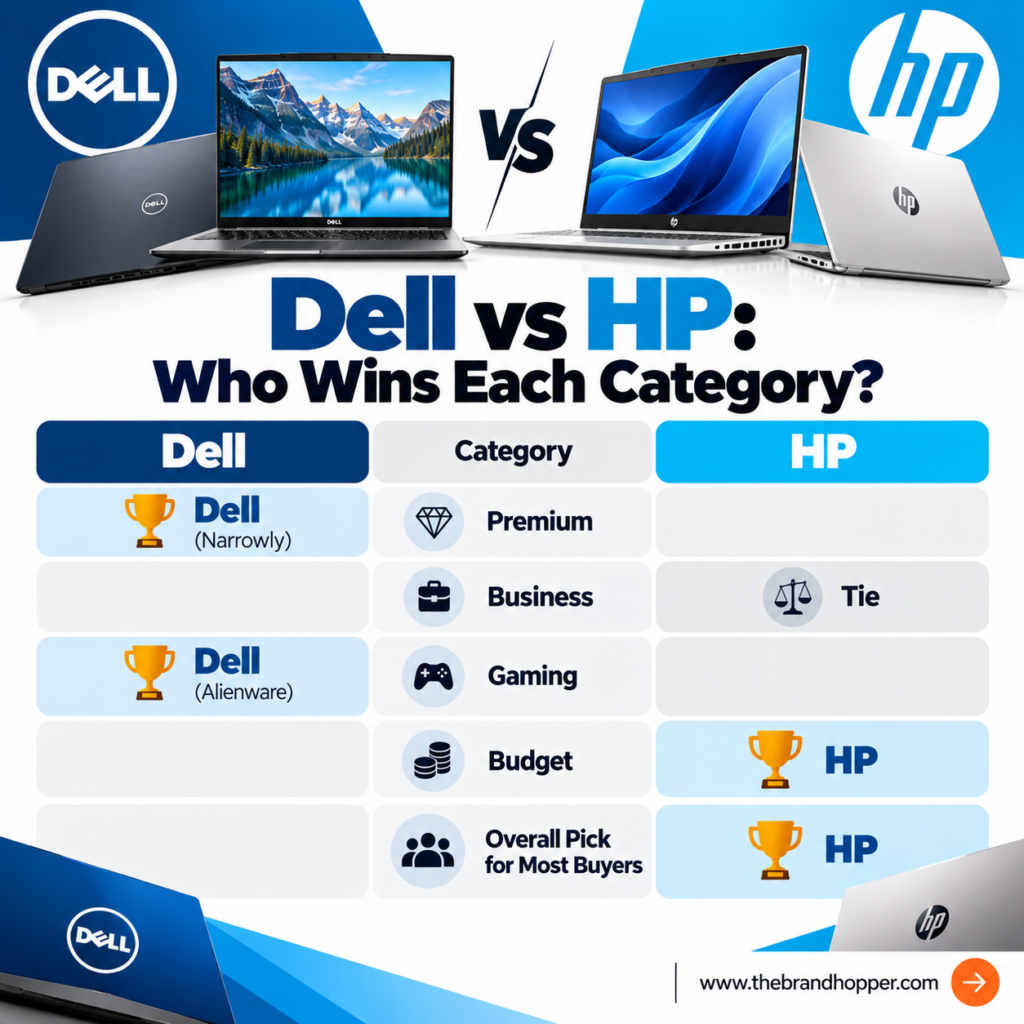
Rather than choosing solely by brand, choose the specific laptop configuration. Compare the processor, GPU, display, memory, storage, battery, thermals, warranty, support availability and current price for the exact models you are considering.
Frequently Asked Questions
Q: Is Dell better than HP for laptops?
A: Neither brand is universally better. Dell’s XPS and Alienware lines target premium and gaming users, while HP’s OmniBook and commercial portfolios cover a particularly broad range of consumer and business requirements. The right choice depends on the specific model and use case.
Q: Which brand sells more laptops, Dell or HP?
A: HP sells more PCs globally than Dell. Gartner estimated 57.5 million HP PCs versus 41.4 million Dell PCs in 2025. In Q2 2026, IDC estimated HP at 13.0 million units and 19.1% share, versus Dell at 9.3 million and 13.6%. These figures cover the broader PC market, including desktops and workstations, not just laptops.
Q: Is Dell or HP better for students?
A: HP offers a broad student-oriented range through OmniBook 3 and OmniBook 5. Dell’s XPS 13 is a more premium alternative, currently listed from $699.99 with qualifying student pricing from $599 in the United States.
Q: Did Dell discontinue the XPS brand?
A: Dell changed its consumer PC naming architecture in 2025 but brought the XPS brand back at CES 2026, launching the XPS 14 and XPS 16 and subsequently introducing the new XPS 13.
Q: What happened to HP OMEN?
A: At CES 2026, HP announced that OMEN and HyperX would be unified under HyperX as the master gaming brand. OMEN continues as a product family, including the HyperX OMEN MAX 16.
Q: Which is better for business laptops, Dell or HP?
A: Both have extensive enterprise portfolios. Dell Pro emphasizes configurable commercial systems and enterprise deployment, while HP EliteBook combines business hardware with HP’s security and manageability ecosystem. Existing IT infrastructure and support contracts should be major factors.
Q: Why are Dell and HP laptops more expensive in 2026?
A: The main industry-wide pressure is the memory shortage and higher DRAM/SSD costs. Gartner projected PC prices to rise 17% in 2026, while HP’s Q3 FY2026 results showed PC ASPs rising sharply as vendors passed higher costs through pricing and product mix.
Q: Who is the CEO of Dell and HP?
A: Michael Dell is Chairman and CEO of Dell Technologies. Bruce Broussard is Interim CEO of HP Inc.; former HP CEO Enrique Lores became PayPal’s President and CEO effective March 1, 2026.
Also Read: Intel vs AMD: Which CPU Brand Is Better?
To read more content like this, subscribe to our newsletter
Go to the full page to view and submit the form.