


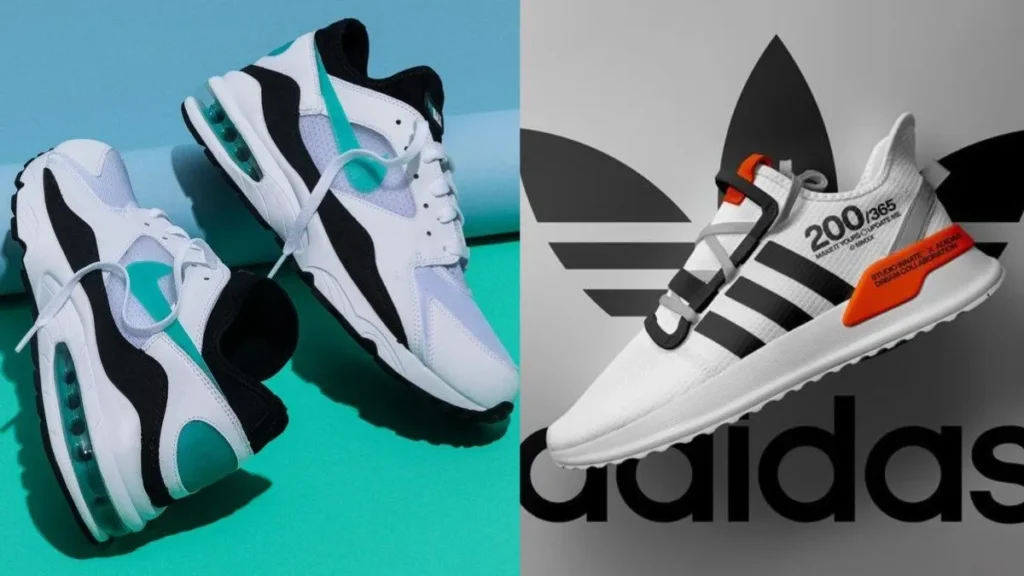
Few rivalries in business are older or more personal than Nike versus Adidas. One brand grew out of a small German workshop in 1949, while the other began as an Oregon-based distributor of Japanese running shoes in 1964. For decades, they have competed for athletes, teams, retailers and consumers around the world.
In 2026, the rivalry has a new dimension. Nike is undergoing a major turnaround under Elliott Hill, while Adidas continues to deliver strong growth, particularly across running, football and lifestyle.
This guide compares the two brands on their financial performance, products, strategies, ownership and the factors likely to shape the competition in the years ahead.
The Origins: Two Very Different Starts
Adidas was founded in 1949 in Herzogenaurach, Germany, by Adi Dassler. Dassler had previously worked with his brother Rudolf Dassler, but the brothers eventually separated and established competing companies, with Rudolf going on to build Puma.


Dassler focused heavily on athletic footwear designed for specific sports and performance needs. Adidas subsequently became one of the most important sports brands in Germany and Europe.
Nike began in 1964 as Blue Ribbon Sports, founded by Phil Knight and University of Oregon track coach Bill Bowerman. The company initially distributed Japanese running shoes in the United States.


Blue Ribbon Sports began developing its own footwear and changed its name to Nike, Inc. in 1971. The company then built its global identity through product innovation, marketing and athlete partnerships, including its landmark relationship with Michael Jordan.
Financial Performance: Who Is Bigger and Who Is Growing?
On pure scale, Nike remains significantly larger than Adidas.
For the fiscal year ended May 31, 2026, NIKE, Inc. reported revenue of $46.4 billion, flat on a reported basis and down 2% on a currency-neutral basis. Net income was approximately $3.1 billion, down 3%, while diluted EPS was $2.10.
The NIKE Brand generated $45.2 billion of revenue in FY2026. Wholesale revenue was $27.5 billion, while NIKE Direct generated $17.7 billion. Converse generated approximately $1.2 billion, down 31%.
Adidas reported record 2025 revenue of €24.811 billion, up 5% in euro terms. On a currency-neutral basis, total revenue increased 10% when including the prior-year Yeezy contribution, while the adidas brand itself grew 13% excluding Yeezy.
Adidas’s gross margin was 51.6%, operating profit increased 54% to €2.056 billion, and net income from continuing operations increased 67% to €1.377 billion.

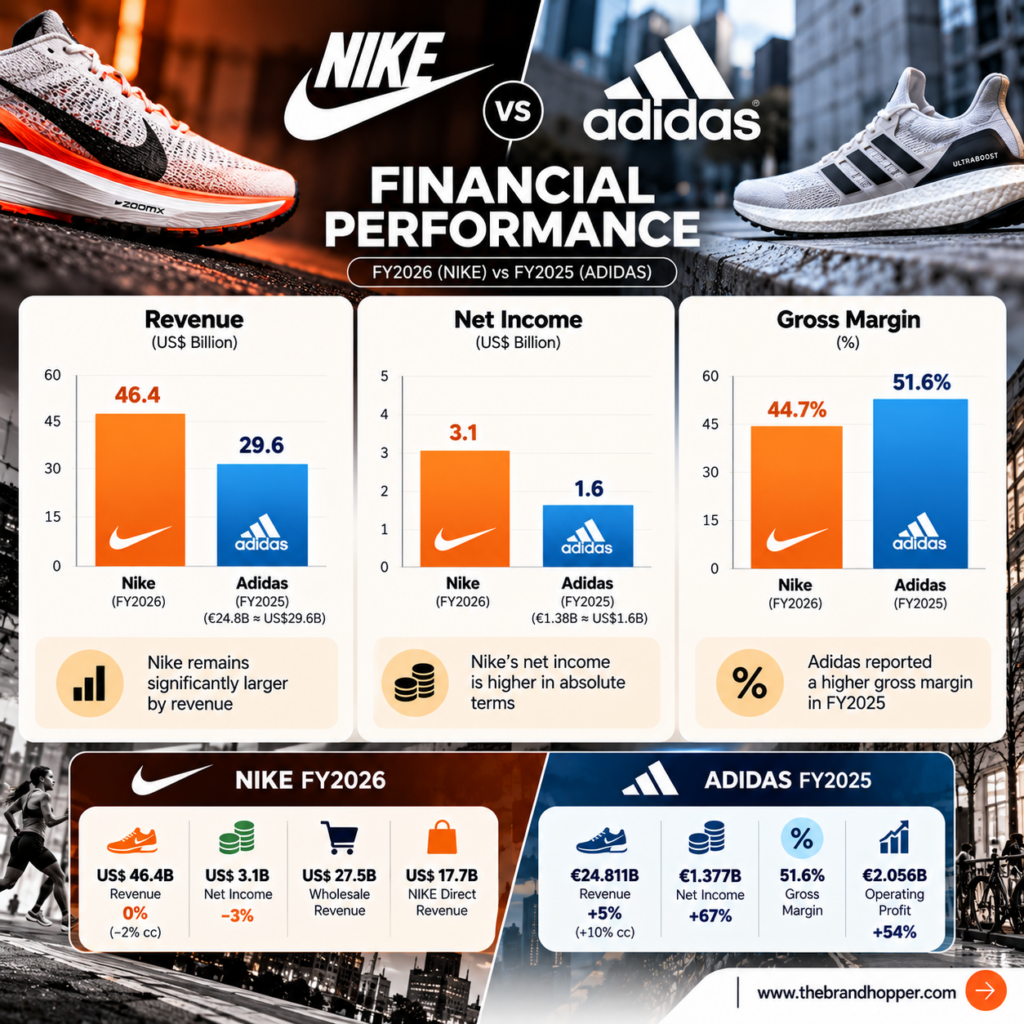
The comparison needs some caution because the companies report in different currencies and use different fiscal calendars. Nike is still much larger by revenue, while Adidas has recently delivered the stronger growth trajectory.
The Latest Quarter: Momentum in 2026
Adidas continued to post strong growth in the first half of 2026.
In the second quarter, Adidas generated record quarterly revenue of €6.743 billion, up 13% in euro terms and 14% in currency-neutral terms. First-half revenue reached a record €13.3 billion, also up 14% currency-neutral.
First-half operating profit increased 11% to €1.279 billion, producing an operating margin of 9.6%. Adidas subsequently raised its full-year 2026 revenue-growth guidance to 9%–10% currency-neutral, while maintaining its operating-profit target of around €2.3 billion.
Football was a major contributor to the momentum around the 2026 FIFA World Cup. Adidas said it had sold close to 18 million jerseys across the World Cup product cycle, including products that entered the market before the tournament itself.
Nike’s latest results were more challenging. For the quarter ended August 31, 2026, NIKE, Inc. reported revenue of $11.213 billion, down 4% reported and 5% currency-neutral. Net income was $712 million, down 2%, and diluted EPS was $0.48.
NIKE Brand wholesale revenue was $6.804 billion, down 1%, while NIKE Direct revenue was $4.142 billion, down 8%. Converse revenue fell 28% to $263 million.
Nike’s gross margin improved 60 basis points to 42.8%, supported partly by lower warehousing and logistics costs. However, Greater China remained a major weakness, with Nike Brand revenue in the region falling 26% on a currency-neutral basis.
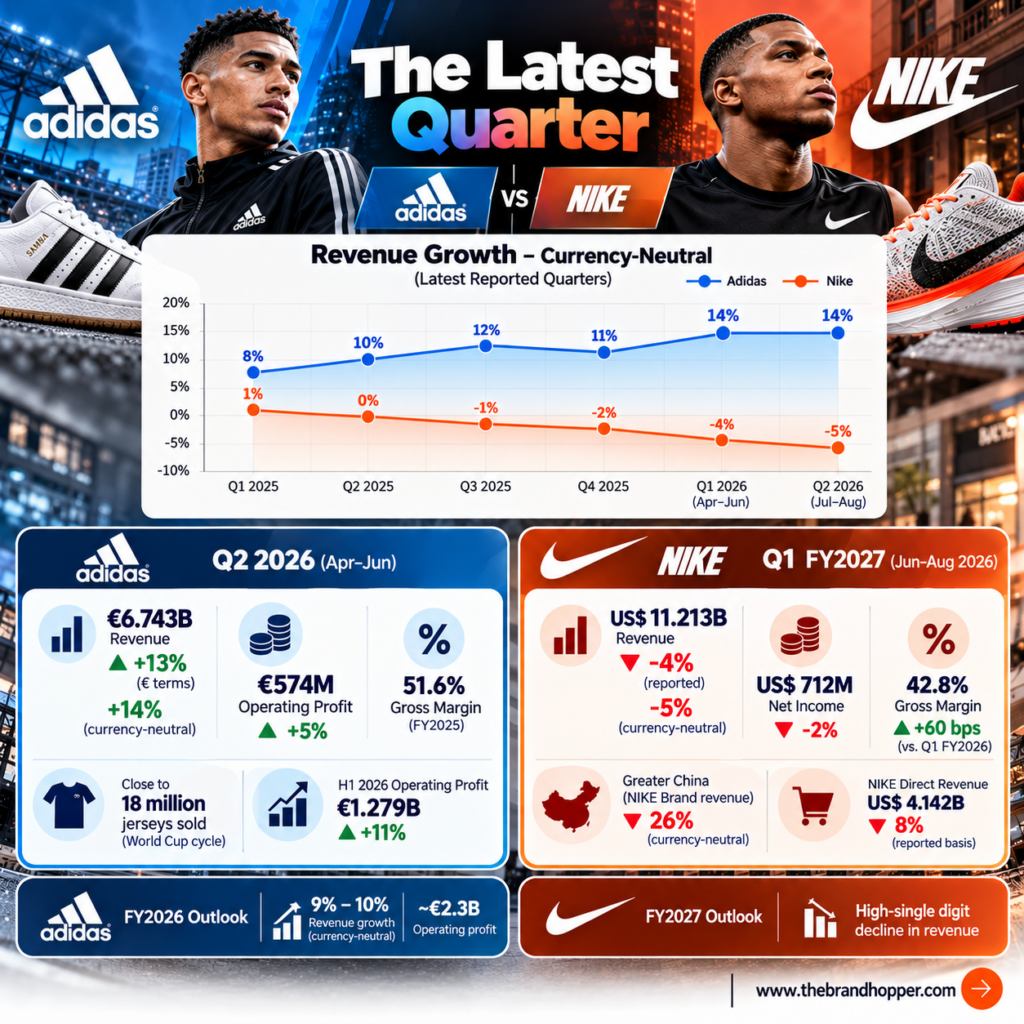
Nike now expects fiscal 2027 revenue to decline by high-single digits, highlighting how much work remains in the turnaround.
Nike’s Turnaround: Sport Offense, Pace and a New CFO
Elliott Hill, a longtime Nike executive, returned as President and CEO in October 2024. His strategy has increasingly centered on the company’s Sport Offense, which places greater emphasis on sport, product innovation, wholesale relationships and stronger connections with consumers.

There are some encouraging signs. Nike Brand wholesale revenue increased 6% in reported terms during FY2026, while North America remained a relative area of strength. However, Nike Direct revenue declined 6% for the year and Nike Brand Digital revenue fell 12%.
In October 2026, Nike announced Pace, a new operating-model transformation designed to accelerate and scale the Sport Offense.
Nike expects Pace to generate approximately $2.5 billion in cumulative savings through fiscal 2031, alongside approximately $1.0 billion in pre-tax charges through fiscal 2031. This is in addition to approximately $0.3 billion of severance costs recognized in FY2026.
The program includes efforts to modernize Nike’s global supply chain, establish a new campus in India, realign the operating model into three geographies, and streamline the organization.
Nike is also taking specific actions to reposition Nike Sportswear, Jordan Brand and Greater China, areas where the company believes the business needs improvement.
Nike’s finance leadership has also changed. Dave Denton is now Nike’s Chief Financial Officer, working alongside Elliott Hill as the company executes its turnaround.
Adidas’s Comeback: Bjørn Gulden’s Playbook
Bjørn Gulden became Adidas CEO in 2023 following a difficult period that included the end of the company’s partnership with Yeezy.

His strategy has focused on rebuilding retailer relationships, improving product availability, emphasizing full-price selling, empowering local markets and increasing investment in sports and culture.
The results have been significant. In 2025, the adidas brand grew 13% on a currency-neutral basis, with double-digit growth across all markets and channels.
Adidas no longer relies on Yeezy. The company completed the sale of its remaining Yeezy inventory in 2024, and its 2025 results contained no Yeezy revenue.
Growth has instead come from areas including running, football, Originals and other lifestyle categories. Running growth accelerated to more than 30% during 2025, driven by the Adizero footwear family.
Adidas has also benefited from products and collaborations associated with Superstar, Tokyo, Taekwondo, Adizero and football, alongside partnerships with names including Pharrell Williams, Bad Bunny and Oasis.
Adidas is returning significant amounts of cash to shareholders. It paid a €2.80-per-share dividend for 2025 and is conducting a €1 billion share-buyback program in 2026.
By June 30, Adidas had executed €525 million of the buyback, while the company had already paid approximately €491 million in dividends.
Adidas also expects to continue growing sales at a high-single-digit currency-neutral rate in both 2027 and 2028, while targeting an operating margin of more than 10% in 2028.
The company’s CFO transition is also underway. Birgit Kretschmer joined the Executive Board on September 1, 2026 and is set to succeed Harm Ohlmeyer as CFO at the end of 2026.
Products Compared: Running, Basketball, Football and Lifestyle
Running is one of the clearest examples of Adidas’s recent momentum.
The Adizero family has delivered strong commercial and sporting results, with Adidas reporting running growth of more than 30% during 2025. Models including the Adios Pro Evo 2 and Adios Pro 4 have also achieved major marathon victories.
Nike remains a major force in running, with established franchises such as the Pegasus, alongside newer performance products that the company is prioritizing as part of its Sport Offense.
Basketball remains a major Nike and Jordan Brand strength. Nike has an extensive basketball portfolio and deep relationships with professional athletes.
Adidas has continued investing in basketball, including its partnership with Anthony Edwards and the AE signature line, but Nike and Jordan retain a particularly strong position in the category.
Football is one of Adidas’s strongest competitive advantages. The company has supplied the official FIFA World Cup match ball since 1970, including the Trionda used for the 2026 tournament.
Adidas also maintains major relationships with national teams, clubs and players, including Argentina and Lionel Messi. Its 2026 World Cup products were an important part of its recent apparel momentum.
In lifestyle, both brands rely heavily on established icons. Nike has Air Force 1, Air Max and Jordan, while Adidas has Superstar, Originals and its terrace-inspired footwear franchises.
Adidas has benefited particularly strongly from the renewed popularity of low-profile and retro footwear, while Nike is currently working to reposition parts of its Sportswear and Jordan portfolios.
Who Owns Nike and Adidas?
Both companies are publicly traded, but their ownership structures are very different.
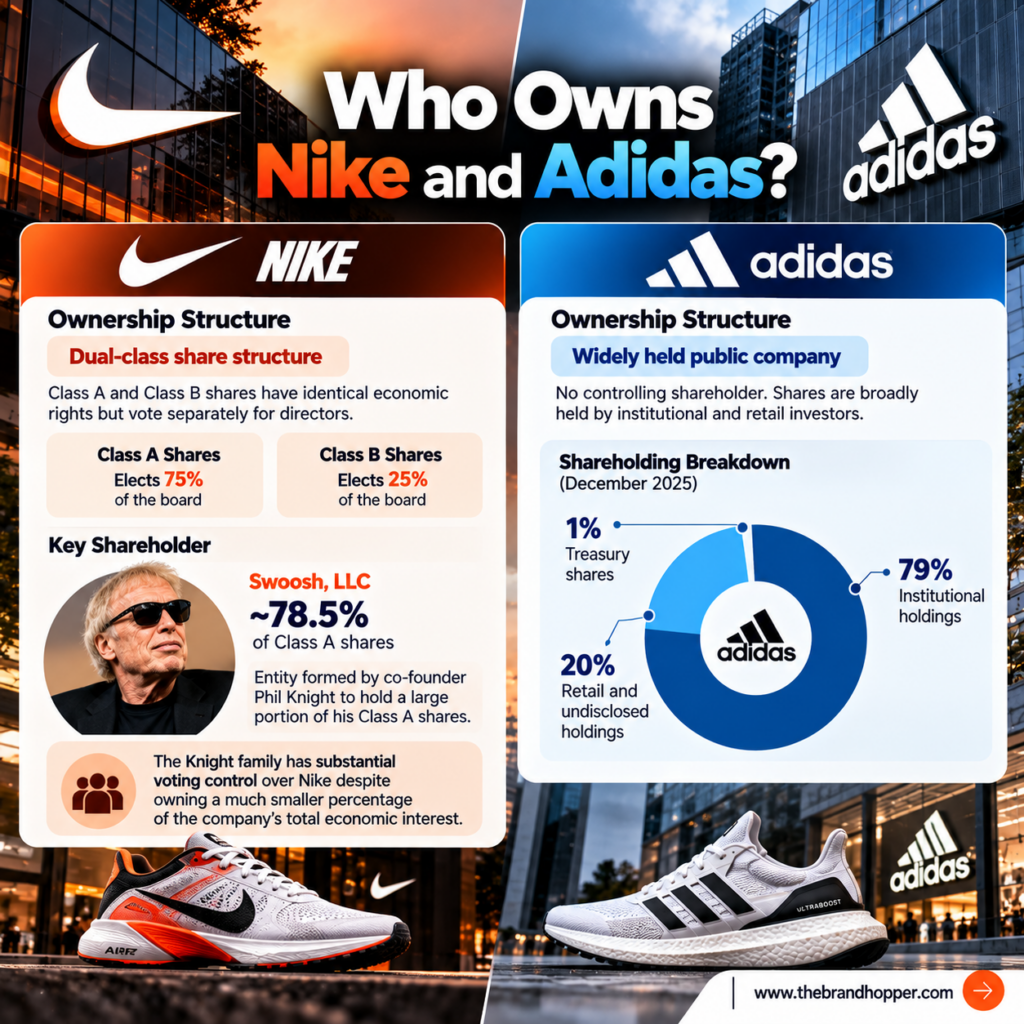
Nike has a dual-class share structure. Class A and Class B shares have identical economic rights, but they vote separately for directors.
Under Nike’s current structure, Class B shareholders elect 25% of the board, while Class A shareholders elect the remaining directors. Class A shares are primarily held through Swoosh, LLC, an entity formed by Nike co-founder Phil Knight to hold a large portion of his Class A shares.
The 2025 Nike proxy showed Swoosh, LLC holding approximately 78.5% of Class A shares, while Phil Knight and Knight-related entities also held significant Class A positions.
As a result, the Knight family has substantial voting control over Nike despite owning a much smaller percentage of the company’s total economic interest.
Adidas has a very different structure. It is a widely held German public company without a controlling shareholder.
Adidas’s December 2025 ownership analysis identified approximately 79% of shares as institutional holdings, 20% as retail and undisclosed holdings, and 1% as treasury shares.
Market Value Today
Market capitalization changes every trading day, so these figures should be treated as snapshots rather than permanent company statistics.
At the October 2, 2026 close, Nike had a market capitalization of approximately $50.2 billion.
Adidas had a market capitalization of approximately €25.1 billion at the October 2, 2026 close.
The two companies therefore remain far apart in market value, although Adidas has recently delivered stronger operating momentum.
Nike vs Adidas at a Glance
| Category | Nike vs Adidas |
|---|---|
| Founded | Nike: 1964 (Blue Ribbon Sports) | Adidas: 1949 |
| Founders | Nike: Phil Knight and Bill Bowerman | Adidas: Adi Dassler |
| CEO | Nike: Elliott Hill (since Oct. 2024) | Adidas: Bjørn Gulden (since 2023) |
| Latest full-year revenue | Nike: $46.4B (FY2026) | Adidas: €24.8B (2025) |
| Revenue change | Nike: flat reported, -2% currency-neutral | Adidas: +5% reported, +10% currency-neutral including prior-year Yeezy |
| Net income | Nike: $3.1B | Adidas: €1.38B from continuing operations |
| Gross margin | Nike: 42.9% | Adidas: 51.6% |
| Latest quarter | Nike Q1 FY2027: $11.2B, -5% currency-neutral | Adidas Q2 2026: €6.74B, +14% currency-neutral |
| 2026 outlook | Nike: revenue expected to decline high-single digits in FY2027 | Adidas: 9%–10% currency-neutral growth, operating profit around €2.3B |
| Ownership | Nike: Knight family controls Class A voting power | Adidas: widely held, no controlling shareholder |
| Market value | Nike: ~$50.2B | Adidas: ~€25.1B at Oct. 2, 2026 |
Nike’s FY2026 figures come from its annual results, while Adidas’s 2025 figures and 2026 outlook come from its annual and Q2 disclosures.
Which Brand Is Better for You?
Choose Nike if you want a broad selection across sports, particularly basketball and training, or if you value the heritage and ecosystem around Jordan. Nike also remains substantially larger in global revenue.
Choose Adidas if you are particularly interested in football, running or retro-inspired lifestyle footwear, or if you prefer the brand’s current growth momentum. Adidas currently has the stronger recent growth rate and higher gross margin.
For comfort and fit, however, there is no universal winner. The right choice ultimately depends on your feet, activity and the specific model, so trying both brands before buying is usually the best approach.
Key Takeaways
Nike remains the larger company, generating $46.4 billion in FY2026 revenue versus Adidas’s €24.8 billion in 2025.
However, Adidas currently has stronger growth momentum. Its adidas brand grew 13% currency-neutral in 2025, while first-half 2026 company revenue increased 14% currency-neutral.
Nike is in the middle of a substantial turnaround under Elliott Hill, with the Sport Offense and newly announced Pace program aimed at restoring product momentum, improving productivity and strengthening the company’s position in sport.
Adidas, meanwhile, is building on its recovery under Bjørn Gulden, with strong momentum in football, running, Originals and other categories.
The competitive picture is therefore straightforward: Nike leads on scale and remains exceptionally strong in basketball and global brand reach, while Adidas currently leads on growth momentum, gross margin and football.
The next few years will show whether Nike’s turnaround can restore sustained growth and whether Adidas can maintain its momentum while expanding profitability.
Frequently Asked Questions
Q: Which is bigger, Nike or Adidas?
A: Nike is bigger. Nike reported $46.4 billion in FY2026 revenue, compared with Adidas’s €24.8 billion in 2025. The companies use different currencies and fiscal calendars, so direct comparisons should be made carefully.
Q: Is Adidas growing faster than Nike?
A: Yes, based on the latest reported results. Adidas’s brand grew 13% currency-neutral in 2025 and company revenue grew 14% currency-neutral in the first half of 2026, while Nike’s FY2026 revenue declined 2% currency-neutral and its Q1 FY2027 revenue declined 5% currency-neutral.
Q: Who is the CEO of Nike?
A: Elliott Hill has been Nike’s President and CEO since October 2024.
Q: Who is the CEO of Adidas?
A: Bjørn Gulden has been Adidas CEO since 2023.
Q: Who owns Nike?
A: Nike is publicly traded, but Phil Knight and Knight-related entities control the majority of Nike’s Class A shares, which elect most of the company’s board. Nike’s Class A and Class B shares have the same economic rights but different director-election rights.
Q: Does Adidas still sell Yeezy?
A: No. Adidas completed the sale of its remaining Yeezy inventory in 2024, and its 2025 results contain no Yeezy revenue.
Q: Which brand is better for running shoes?
A: Both are strong choices. Adidas has recently gained significant momentum through the Adizero family, with running growth exceeding 30% during 2025, while Nike continues to have major running franchises such as Pegasus.
Q: Which brand is better for football?
A: Adidas has the stronger football position historically and commercially. It has supplied the official FIFA World Cup match ball since 1970 and had particularly strong football and apparel momentum around the 2026 World Cup.
Also Read: Who Owns Adidas? Parent Company & Brand Portfolio
Also Read: Who Owns Nike? Parent Company, Revenue & Key Facts
To read more content like this, subscribe to our newsletter
Go to the full page to view and submit the form.