


If you are shopping for a new TV, two South Korean brands will likely be on your shortlist: Samsung and LG. Samsung has ranked as the world’s No. 1 TV brand by revenue for 20 consecutive years, while LG has led the global OLED TV market for 13 consecutive years. Both companies influence the industry through their display technology, product design and smart TV platforms.
The Samsung vs LG debate looks different in 2026. Both brands offer OLED TVs and have entered the premium Micro RGB category, while Chinese manufacturers such as TCL and Hisense are putting pressure on the wider TV market.
This guide compares Samsung and LG across market position, financial performance, display technology, 2026 lineups, prices, smart TV software, gaming, sound, design and support to help you choose a TV for your home.
Key Takeaways
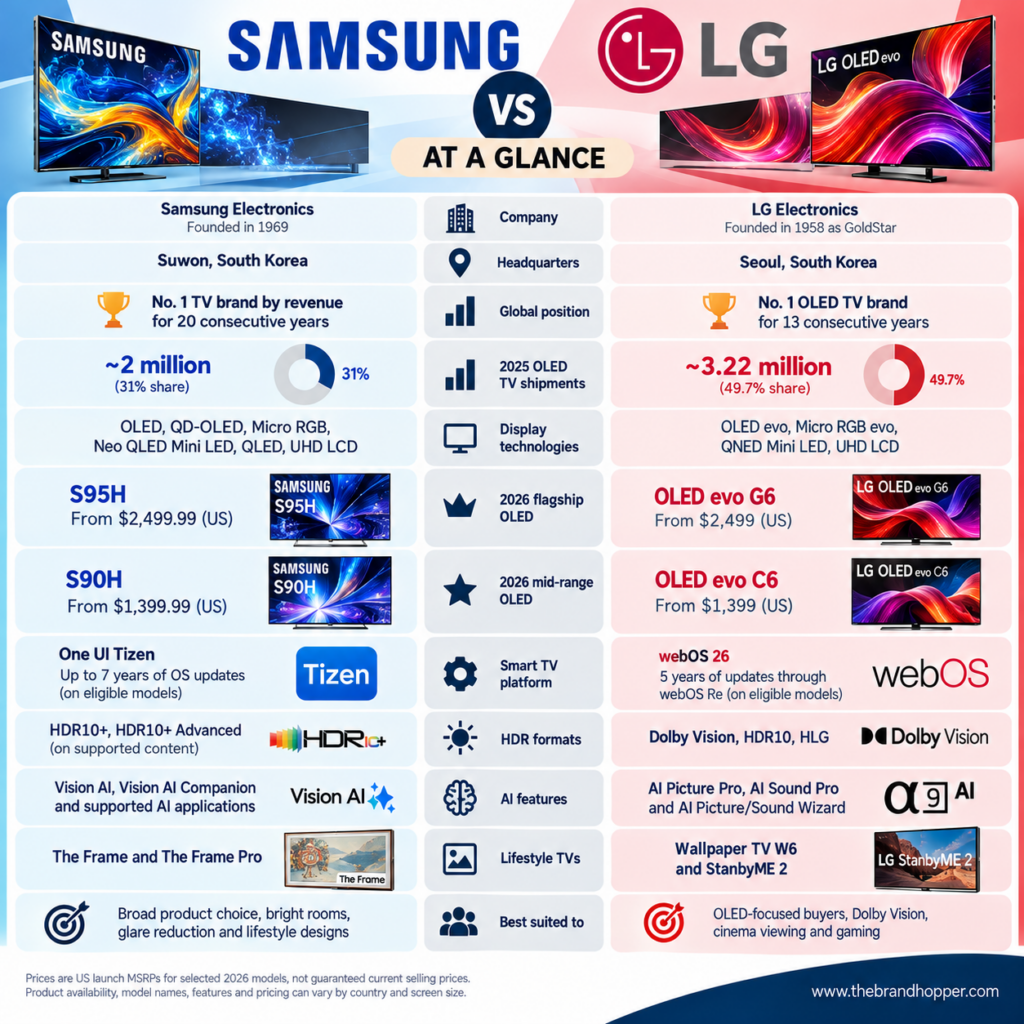
- Market leadership: Samsung held 29.1% of the global TV market by revenue in 2025, according to Omdia data reported by Samsung. It also held 54.3% of the segment priced above $2,500.
- OLED leadership: LG shipped approximately 3.22 million OLED TVs in 2025, representing a reported 49.7% share of the global OLED TV market. Samsung ranked second, with approximately 2 million units and around 31% share.
- Similar OLED starting prices: In the US, the 42-inch LG C6 and Samsung S90H launched at $1,399. The 55-inch LG G6 and Samsung S95H launched at $2,499 and $2,499.99, respectively.
- A new premium category: Samsung and LG introduced Micro RGB televisions in 2026. These use red, green and blue LEDs as an LCD backlight to improve colour reproduction and brightness.
- Software support: Samsung advertises up to seven years of One UI Tizen OS updates on eligible models. LG’s webOS Re programme promises five years of updates on eligible TVs.
- HDR formats: LG OLED TVs support Dolby Vision but not HDR10+. Samsung TVs support HDR10+ and, on supported 2026 models and content, HDR10+ Advanced; Samsung does not support Dolby Vision.
Samsung vs LG at a Glance

A Tale of Two Korean Giants
Samsung Electronics was founded in 1969 and is one of the world’s largest electronics companies, with businesses spanning memory chips, smartphones, appliances and displays. Its Visual Display business has ranked as the world’s leading TV brand by revenue every year since 2006, according to Samsung’s reporting of Omdia data.

Samsung built its TV business through LCD televisions and quantum-dot-enhanced QLED models before expanding its premium portfolio with Neo QLED Mini LED, OLED and Micro RGB products.
LG Electronics began in 1958 as GoldStar and adopted the LG name in 1995. It invested early in OLED televisions, launching its first OLED TV in 2013, and has remained the leading brand in global OLED TV shipments.
LG Display, a separate company within the wider LG corporate group, manufactures large OLED TV panels and supplies panels to multiple TV brands. Samsung’s OLED panel sourcing varies by model and size, with QD-OLED panels supplied by Samsung Display and WOLED panels also used in some products.
Market Share: Who Is Winning?
The answer depends on how market leadership is measured. By revenue, Samsung remains the global TV market leader: Omdia data reported by Samsung showed a 29.1% share of global TV revenue in 2025, including 52.2% of the segment above $1,500 and 54.3% of the segment above $2,500.

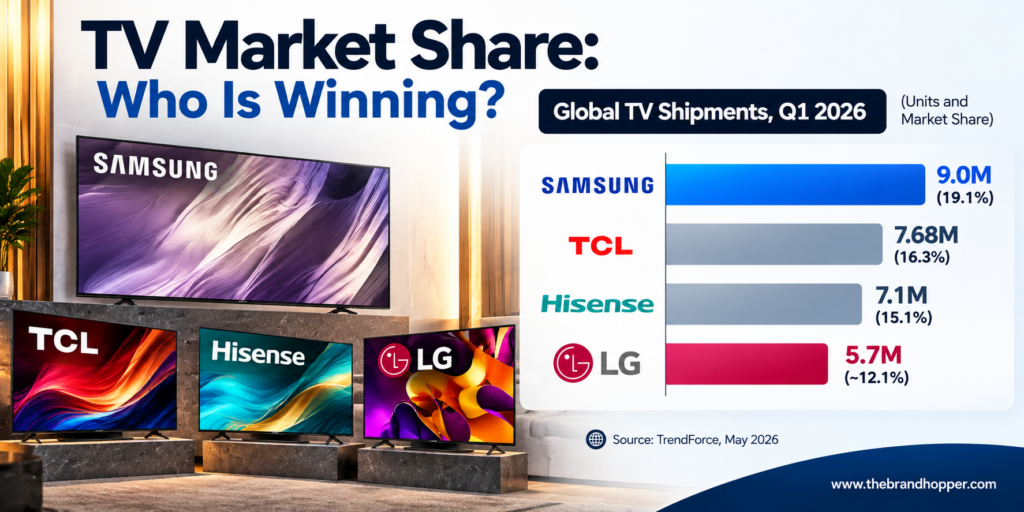
By shipment volume, the competition is closer. TrendForce reported that global branded TV shipments reached approximately 47.12 million units in the first quarter of 2026, with Samsung retaining the top position and TCL, Hisense and LG among the leading brands.
| Brand | Q1 2026 shipments | Approx. unit share | Year-on-year growth |
|---|---|---|---|
| Samsung | Approximately 9.00 million | 19.1% | +4.0% |
| TCL | 7.68 million | 16.3% | +11.3% |
| Hisense | Approximately 7.10 million | 15.1% | +3.8% |
| LG | Approximately 5.70 million | 12.1% | +5.6% |
Source: TrendForce and reported market data for Q1 2026. Figures are rounded; shipment estimates and market shares can differ slightly across research providers.
The OLED Race
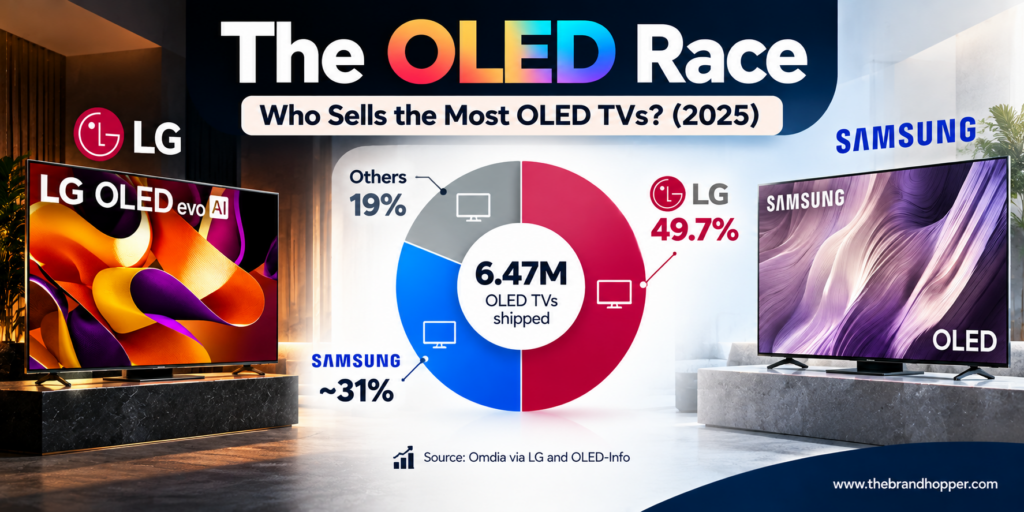
OLED remains LG’s strongest competitive category. According to Omdia data reported by LG, global OLED TV shipments reached approximately 6.47 million units in 2025, up 6.6% year on year, while LG shipped approximately 3.22 million units for a 49.7% share.
LG also reported leading OLED positions in Europe, North America and Asia-Oceania. These regional shares refer specifically to OLED TVs, not the entire TV market.
Samsung is a strong second-place competitor in OLED. Omdia figures reported by OLED-Info put Samsung’s 2025 OLED TV sales at approximately 2 million units, up around 38% from 2024, giving it roughly 31% of the category.
Financial Strength: How the TV Businesses Are Doing
Samsung Electronics and LG Electronics operate across many businesses, so their total revenue and operating profit should not be confused with the performance of their TV operations.
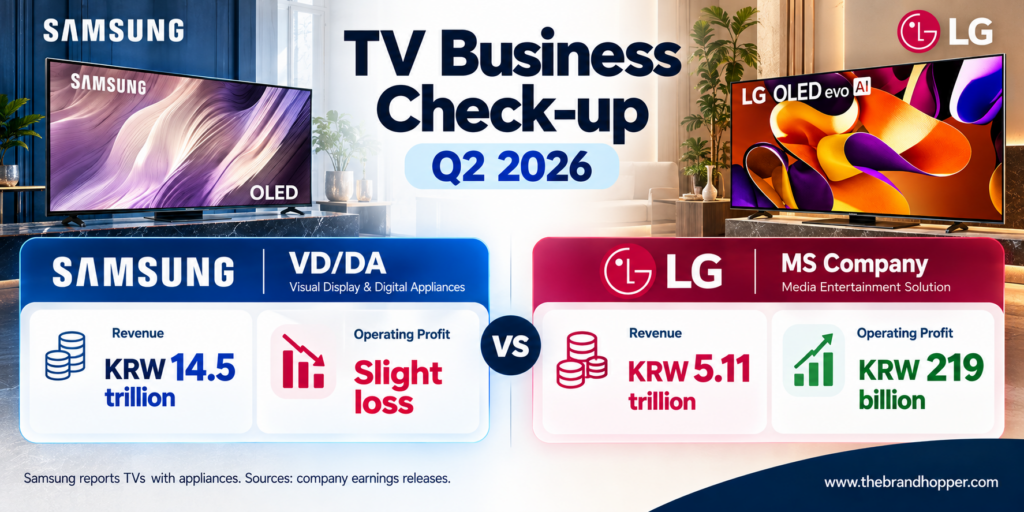
LG’s Media Entertainment Solution business returned to profitability in the second quarter of 2026, supported by premium OLED and QNED sales, growth in emerging markets and its webOS platform business.
Samsung’s combined Visual Display and Digital Appliances businesses reported KRW 14.5 trillion in second-quarter revenue but a slight operating loss. Samsung said demand around major sporting events supported the Visual Display business, while increased costs weighed on earnings.
These figures offer context on each company’s financial position, but they do not establish which brand makes the better TV. For consumers, model-specific picture performance, features, price and after-sales support are more useful buying criteria.
Display Technology Explained
Understanding the technology behind each brand’s product names makes comparisons easier. Samsung and LG use different marketing terms, and products within the same brand can vary significantly by price and model.
1. OLED: QD-OLED vs WOLED
OLED TVs use self-emissive pixels, meaning each pixel can switch off individually. This produces deep blacks, excellent contrast and wide viewing angles, making OLED particularly attractive for film watching in dim rooms.
LG sells OLED televisions under the OLED evo name, using panels whose underlying technology and specifications vary by model and size. Samsung’s premium OLED range includes QD-OLED panels, which combine blue OLED light with quantum dots to produce colour, while panel sourcing can vary across the range.
For 2026, LG’s G6 uses Hyper Radiant Color Technology and Brightness Booster Ultra on specified sizes. LG claims up to 3.9 times the brightness of a regular OLED TV for the relevant G6 models, but that figure is a manufacturer comparison rather than a guarantee that every scene will appear 3.9 times brighter.
Samsung’s S95H and S90H OLED TVs feature Glare Free technology designed to reduce reflections. This can be valuable in rooms with windows or bright lighting, although results depend on the room, screen position and viewing conditions.
2. Micro RGB: The New Premium LED
Micro RGB is one of the major new premium TV categories of 2026. Instead of relying on a conventional white or blue backlight, these televisions use red, green and blue LEDs behind an LCD panel to improve colour reproduction and brightness.
Samsung’s 2026 Micro RGB lineup includes the R95H and R85H series. The R95H is available in 65-, 75- and 85-inch sizes, with US launch prices of $3,199.99, $4,499.99 and $6,499.99, respectively; the R85H starts at $1,599.99 for the 55-inch model. Samsung’s separate 115-inch R95F is a different model, not an R95H size.
LG’s Micro RGB evo MRGB95 launched in 75-, 86- and 100-inch sizes, with US pricing starting at $4,999.99. LG says the set has Intertek certification for full coverage of the BT.2020, DCI-P3 and Adobe RGB colour spaces.
Micro RGB is still an LCD-based display technology, unlike self-emissive OLED or MicroLED. It aims to combine high brightness and wide colour reproduction, but picture quality also depends on local dimming, contrast, viewing angles and screen reflections.
3. Mini LED: Neo QLED vs QNED
Mini LED televisions use many small LEDs in the backlight, combined with local dimming, to control brightness across different areas of the screen. They can reach high brightness levels and are often a good choice for well-lit rooms or buyers who want a large screen at a lower price than a flagship OLED.
Samsung markets its premium Mini LED TVs under the Neo QLED name and also offers more affordable LED and QLED models. LG’s QNED range includes LCD televisions using quantum-dot, colour-filter and Mini LED technologies depending on the model.
Do not assume every QNED or Neo QLED television has the same backlight or dimming performance. Check the exact model’s specifications, independent reviews and local price before comparing sets.
2026 TV Lineups and Prices
The following are US launch prices for selected 2026 models. Retail prices may now be lower, and prices and model availability differ between countries.
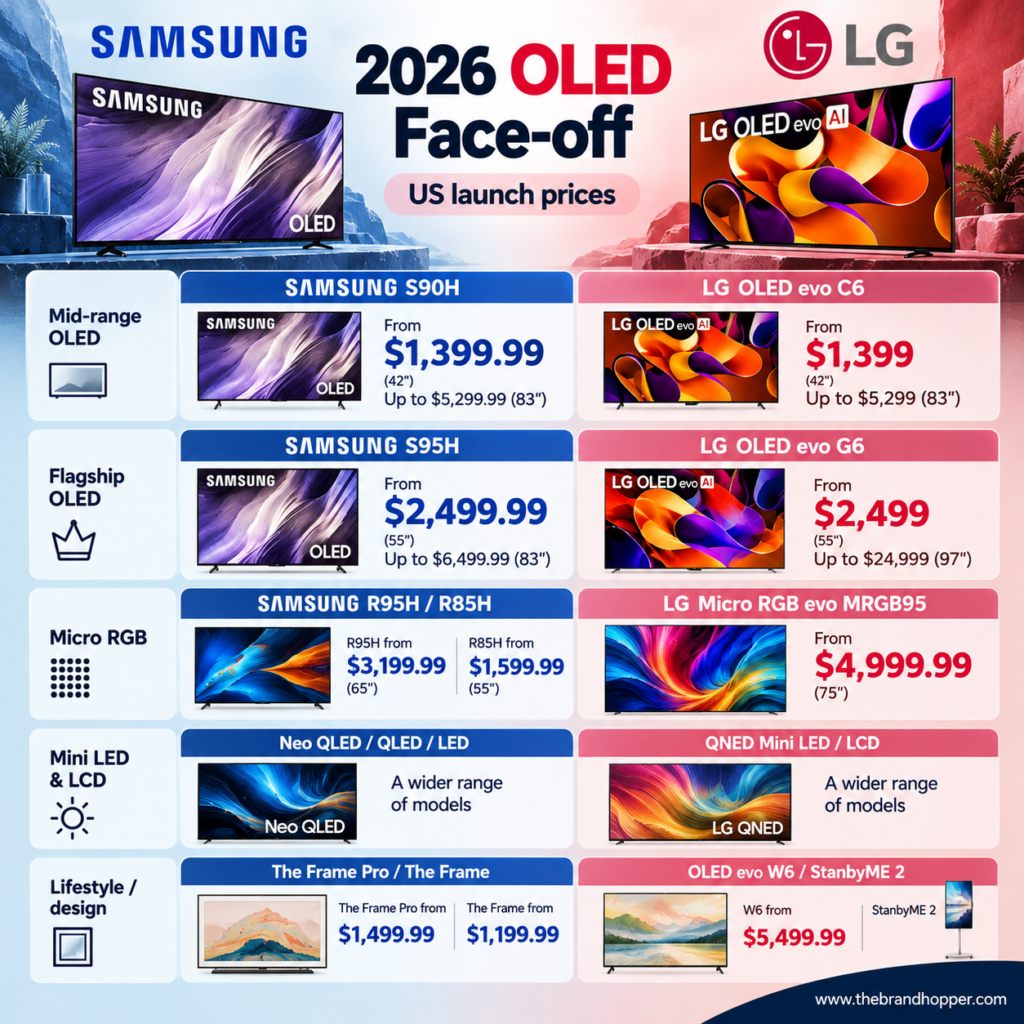
Price check: Samsung and LG launched their main OLED ranges at very similar starting prices in the US. The best value therefore depends on the exact size, panel performance, gaming features, room conditions and discount available.
LG’s G6 range includes a 97-inch model at a much higher price than the smaller sizes. Samsung offers a broad range of non-OLED televisions, giving buyers more options when the budget matters more than OLED’s pixel-level contrast.
Picture Quality: Which Brand Looks Better?
There is no universal winner because the better TV depends on your room, viewing habits and the content you watch.
- Dark rooms and movies: LG’s OLED models are strong choices for cinematic viewing, with deep blacks and Dolby Vision support. Filmmaker Mode is also available, with Ambient Light Compensation supported on specified models.
- Bright rooms: Samsung’s Glare Free OLED models and its high-brightness Neo QLED and Micro RGB televisions are worth considering for rooms with substantial daylight. LG’s 2026 G6 also includes reflection-reduction technology on specified sizes, so glare handling is not exclusive to Samsung.
- Colour: Samsung’s QD-OLED technology is designed for strong colour volume, while LG’s G6 uses Hyper Radiant Color Technology. Results vary by model, picture mode, content and viewing environment.
- HDR formats: Samsung supports HDR10+ and HDR10+ Advanced on supported 2026 TVs and compatible content, but does not support Dolby Vision. LG’s OLED TVs support Dolby Vision but not HDR10+.
Picture recommendation: Consider LG if Dolby Vision and OLED-focused movie viewing are priorities. Consider Samsung if you prefer its reflection-reducing OLED screens, Tizen features or the brighter LED options in its lineup. Compare the exact models rather than relying on brand names alone.
Smart TV Software and AI
Samsung’s 2026 TVs run One UI Tizen. Samsung advertises up to seven years of OS updates on eligible models, and its Vision AI features include Vision AI Companion and supported applications and tools that vary by device, market and software version.
Samsung TV Plus provides free ad-supported streaming channels in supported markets, while SmartThings integration helps connect compatible smart-home devices. Features such as AI Soccer Mode and Live Translate are model- and region-dependent, so check the local specifications before buying.
LG’s 2026 TVs use webOS 26. Through the webOS Re programme, eligible TVs receive five years of software updates and version upgrades. The exact rollout depends on model eligibility and regional availability.
LG’s software includes AI Picture Pro, AI Sound Pro and AI Picture/Sound Wizard on supported models. LG Channels also offers free streaming channels in supported markets.
Software recommendation: Samsung has a longer advertised update period on eligible models and strong smart-home integration. LG offers a broad app platform and a five-year update programme on eligible TVs; interface simplicity is subjective, so try both systems if possible.
Gaming
Both brands offer strong gaming features on their premium 2026 televisions, including low input lag, variable refresh rate (VRR) and high refresh rates. Exact capabilities depend on the model, screen size, connected device and input settings.
LG’s C6 supports 4K at up to 165Hz VRR. The G6 also supports up to 165Hz on specified sizes, but the 97-inch G6 is rated for up to 120Hz VRR. The range includes NVIDIA G-SYNC compatibility and AMD FreeSync support on specified models.
Samsung’s S95H and S90H support Motion Xcelerator up to 165Hz and include NVIDIA G-SYNC Compatible support and AMD FreeSync Premium Pro, according to Samsung. Samsung Gaming Hub also provides access to supported cloud gaming services without a dedicated console.
Gaming recommendation: Both brands are excellent options. Compare HDMI connectivity, supported refresh rates at your chosen size, VRR compatibility, input lag and the gaming features you will actually use. Neither brand is automatically the better choice for every console or PC setup.
Sound Quality
Built-in speakers on thin televisions have physical limitations, so a soundbar or external audio system can improve dialogue clarity, bass and immersion.
Samsung offers features such as Q-Symphony, which lets compatible TV speakers work with compatible Samsung soundbars, and Object Tracking Sound on selected models. LG offers AI Sound Pro and virtualised multichannel audio on supported TVs, alongside compatibility with its soundbars.
Both brands offer Dolby Atmos on selected models. Audio features differ by model, so check whether the TV supports the sound formats and passthrough options needed by your sound system.
Design and Lifestyle TVs
Samsung has a well-established lifestyle TV range. The Frame and The Frame Pro are designed to resemble framed artwork when not being used for regular viewing, with customisable bezels and access to Samsung’s Art Store; screen and connection features differ by model.
LG’s 2026 Wallpaper TV W6 focuses on a slim, flush-to-wall installation. LG describes its body as approximately 9mm thick and uses a separate Zero Connect Box to transmit supported video and audio signals wirelessly to the display. The US launch price starts at $5,499.99 for the 77-inch model.
LG’s StanbyME range targets flexible viewing with a movable stand and battery-powered operation on supported models. These products serve different purposes from a conventional living-room TV, so compare their portability, screen size and price with your intended use.
Warranty and Support
Standard warranties vary by country, model and purchase terms. In the US, LG advertises a five-year limited panel warranty for eligible G-series OLED models: the first year covers the panel, parts and labour, while years two to five cover the panel only, with labour charges potentially applying.
Samsung also offers standard manufacturer warranties and optional extended-care plans, but coverage differs by product and market. In India, check the warranty document for the exact model, including whether the panel has separate coverage and whether any extended warranty is included in the offer.
Both brands have established service networks, but the quality and speed of service can vary by location. Before purchasing, confirm the authorised service options in your area and keep the invoice and warranty details.
Samsung vs LG: Pros and Cons
Samsung Pros
- Global TV market leader by revenue for 20 consecutive years.
- Broad range of screen sizes, display technologies and price points.
- Glare Free technology on selected premium OLED and Micro RGB models.
- Up to seven years of OS updates on eligible models.
- Lifestyle options such as The Frame and The Frame Pro.
- Strong gaming features on selected OLED models.
Samsung Cons
- No Dolby Vision support.
- Glare Free technology is not available on every model.
- Tizen’s recommendations and advertising may not appeal to every user.
- Model-specific features and panel technology can vary across the range.
LG Pros
- World’s leading OLED TV brand by shipments, according to 2025 Omdia data.
- Dolby Vision support on its OLED TVs.
- Strong gaming capabilities, including up to 165Hz VRR on specified C6 and G6 models.
- The C-series offers a comparatively accessible route into premium OLED.
- Five years of webOS updates on eligible TVs through Re.
- Lifestyle and design-led products such as the W6 Wallpaper TV.
LG Cons
- No HDR10+ support on its OLED TVs.
- Five-year software-update commitment is shorter than Samsung’s advertised seven years for eligible models.
- Flagship OLED and Micro RGB models can be expensive.
- The best features and specifications are not available on every screen size or model.
Which Should You Buy? Our Recommendations

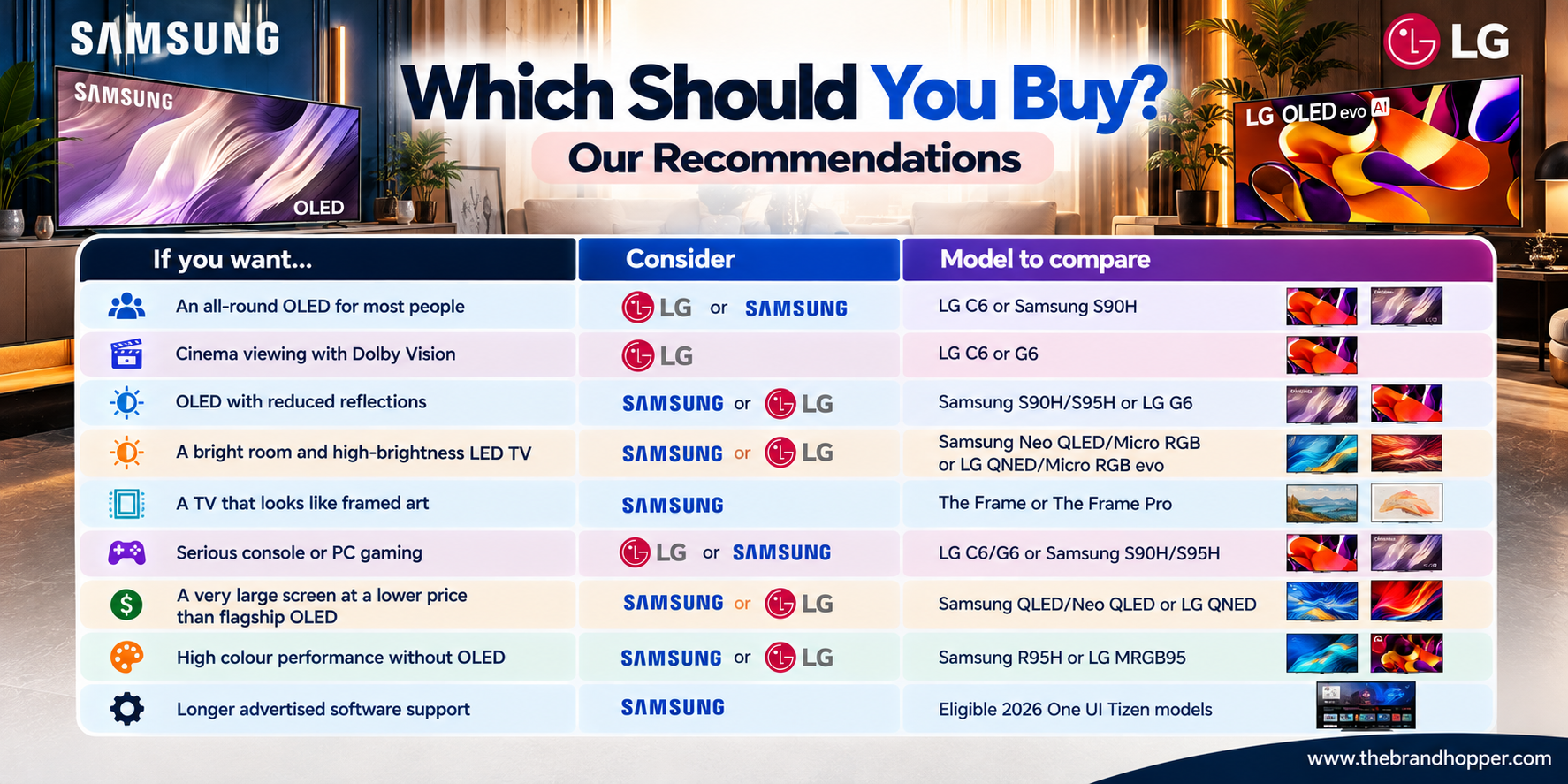
These are starting points, not universal rankings. Compare the same screen size, current selling price, warranty and exact specifications before making a final decision.
Final Verdict: Samsung or LG?
In 2026, Samsung and LG both offer compelling premium televisions, but their strengths are not identical. LG is a strong choice for buyers prioritising OLED, Dolby Vision and gaming features, while Samsung is worth considering for its broad range, glare-reducing OLED models, lifestyle designs and long advertised software support.
If you are deciding between the LG C6 and Samsung S90H, start with your viewing environment and feature requirements. Then compare current prices for the same size, because retailer discounts can change which model offers better value.
For a bright room, do not assume that every Samsung TV is better than every LG TV; compare the reflection handling and brightness of the specific models. For movie watching, consider HDR format support and picture performance alongside the room’s lighting.
Frequently Asked Questions
Q: Is Samsung or LG the better TV brand?
A: Neither brand is better for everyone. Samsung leads the overall TV market by revenue, while LG leads the OLED category by shipments. LG is worth considering for Dolby Vision and OLED-focused viewing, while Samsung offers a wide selection, lifestyle TVs and strong glare-reduction options on selected models.
Q: Which brand sells more TVs, Samsung or LG?
A: Samsung. It has held the top position in the global TV market by revenue for 20 consecutive years, according to Omdia data reported by Samsung. TrendForce also ranked Samsung first in global TV shipments for the first quarter of 2026.
Q: Who makes the best OLED TV?
A: There is no single winner across all sizes and use cases. LG held a reported 49.7% share of global OLED TV shipments in 2025, while Samsung ranked second at approximately 31%. For a purchase decision, compare the LG G6 or C6 with the Samsung S95H or S90H using independent tests and the exact price available to you.
Q: Does Samsung use LG OLED panels?
A: Samsung uses QD-OLED panels from Samsung Display in some of its OLED TVs. Panel sourcing varies across the range, and WOLED panels supplied by LG Display are also used in some Samsung models or sizes.
Q: Do Samsung TVs support Dolby Vision?
A: No. Samsung TVs support HDR10 and HDR10+ formats, including HDR10+ Advanced on supported 2026 models and compatible content. LG OLED TVs support Dolby Vision but not HDR10+.
Q: How long do Samsung and LG TVs get software updates?
A: Samsung advertises up to seven years of One UI Tizen OS updates on eligible TVs. LG’s webOS Re programme offers five years of software updates and version upgrades on eligible models. Check the terms for your exact TV and region.
Q: What is a Micro RGB TV?
A: A Micro RGB TV uses red, green and blue LEDs behind an LCD panel to improve colour reproduction and brightness. Samsung and LG introduced Micro RGB products in 2026, but these are different from self-emissive MicroLED displays.
Q: Which is better for gaming, Samsung or LG?
A: Both offer excellent gaming options. LG’s C6 supports 4K at up to 165Hz VRR, and the G6 supports up to 165Hz on specified sizes, with a 120Hz limit on the 97-inch G6. Samsung’s S95H and S90H also support up to 165Hz and include advanced variable-refresh-rate features; check the exact model and size before buying.
Also Read: Dell vs HP: Which Laptop Brand Is Better?
To read more content like this, subscribe to our newsletter
Go to the full page to view and submit the form.