


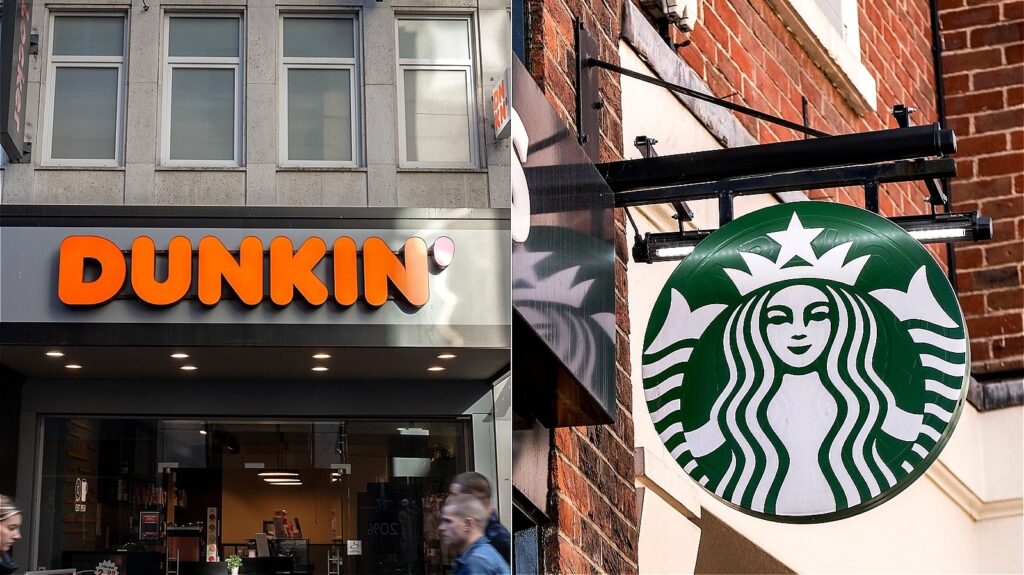
Starbucks vs Dunkin’ is one of America’s best-known coffee rivalries. Starbucks built a global empire by selling the “third place” between home and work, with premium espresso drinks and comfortable cafés. Dunkin’ grew from a single doughnut shop in Massachusetts into a beverage-led chain famous for quick, affordable coffee and the slogan “America Runs on Dunkin’.”
Both brands are in very different places. Starbucks is listed on the stock market and is two years into Brian Niccol’s “Back to Starbucks” turnaround, while privately owned Dunkin’ is part of Inspire Brands, whose parent company has confidentially filed to go public.
In this guide, we compare Starbucks and Dunkin’ on size, ownership, menu, price, experience, rewards, digital ordering, sustainability and their presence in India.

Who Owns Starbucks and Dunkin’?
Starbucks


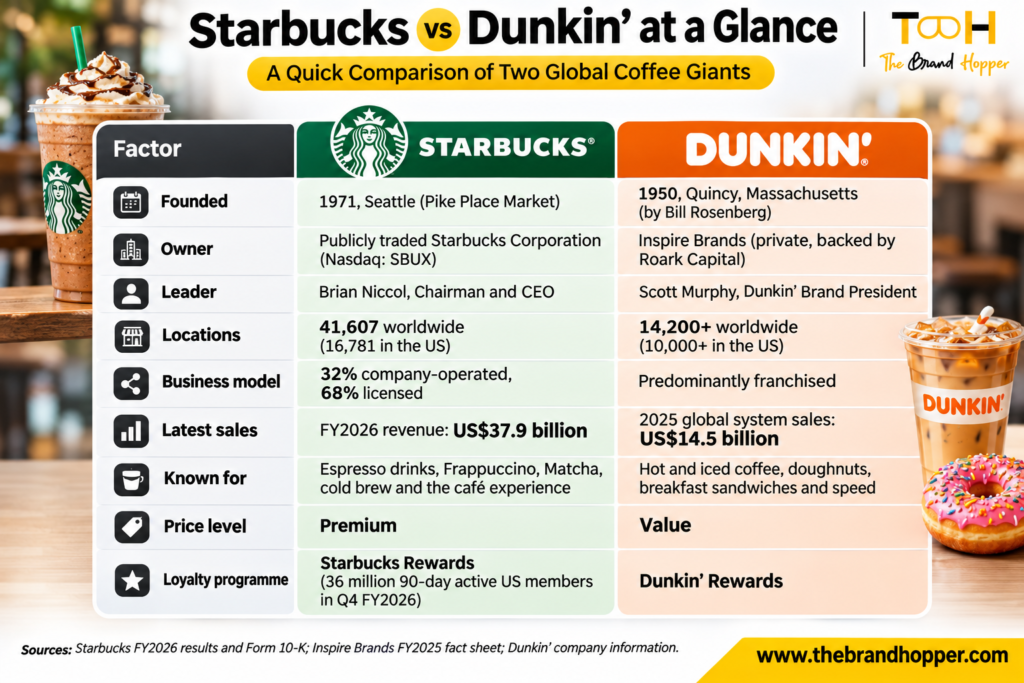
Starbucks was founded in 1971 as a single coffee-bean store in Seattle’s Pike Place Market. Howard Schultz later helped transform it into a global coffeehouse chain, and the company went public in 1992. Today, Starbucks Corporation is a widely held public company traded on Nasdaq under the ticker SBUX. It is led by Brian Niccol, the former Chipotle CEO, who became Chairman and CEO in September 2024, with Cathy Smith serving as Chief Financial Officer.
In April 2026, Starbucks completed a joint venture for its China retail business with investment firm Boyu Capital. Funds managed by Boyu now hold 60% of Starbucks’ China retail operations, while Starbucks retains 40% and continues to own and license the global brand and intellectual property.
Starbucks also licenses its brand for packaged coffee products sold in supermarkets through its Global Coffee Alliance with Nestlé. This allows Starbucks to participate in the consumer packaged-goods market beyond its coffeehouses.
Dunkin’

Dunkin’ began as “Open Kettle” in Quincy, Massachusetts, in 1948 and adopted the Dunkin’ Donuts name in 1950. It was owned by a series of companies and private equity firms before Dunkin’ Brands went public in 2011. In December 2020, Inspire Brands, backed by private equity firm Roark Capital, acquired Dunkin’ Brands (including Baskin-Robbins) for approximately US$11.3 billion, taking it private again.
Inspire also owns Arby’s, Buffalo Wild Wings, Jimmy John’s and SONIC, among other restaurant brands. Across its portfolio, Inspire reported US$33.4 billion in global system sales and more than 33,300 restaurants in its FY2025 fact sheet. Dunkin’ alone accounted for more than 14,200 restaurants and US$14.5 billion in system sales.
In May 2026, Inspire confidentially filed for an initial public offering in the United States. A confidential filing does not mean the company has completed an IPO, and no public listing date or offering price had been announced at the time of writing.
Bottom line: Starbucks is a stand-alone public company; Dunkin’ is one brand within a private, multi-brand restaurant group.
Size and Financial Performance
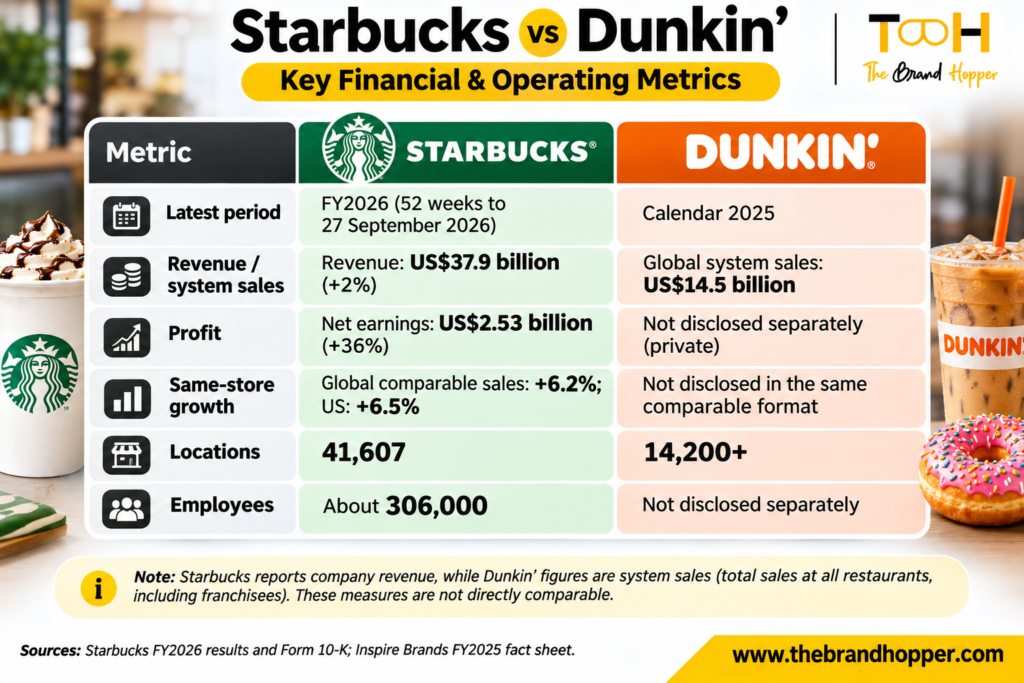
Starbucks is the much larger business by reported revenue and global store count. Its revenue rose 2% to US$37.9 billion in FY2026, while global comparable coffeehouse sales grew 6.2%. Its net earnings increased 36% to US$2.53 billion, although the improvement also reflected the gain from the China transaction.
The company ended FY2026 with 41,607 coffeehouses worldwide, including 16,781 in the United States. Its fourth-quarter comparable sales increased 7.2% globally and 7.7% in the US, indicating stronger customer traffic and spending.
Dunkin’ is smaller but remains a major player in the US coffee market. Inspire Brands reported 14,200+ Dunkin’ restaurants across 39 global markets and US$14.5 billion in 2025 system sales. The company does not publish Dunkin’-only net income or operating profit in the same way Starbucks reports its financial results.
Winner, scale: Starbucks, by a wide margin.
Menu: Coffee, Drinks and Food
Starbucks offers a deep, highly customisable menu: espresso classics such as lattes and cappuccinos, Frappuccino blended drinks, cold brew, Refreshers, Matcha and tea drinks, seasonal favourites such as the Pumpkin Spice Latte, plus pastries, sandwiches and protein boxes. Customers can adjust milk, syrups, espresso shots and toppings to create personalised drinks. Its menu is designed to appeal to customers looking for both familiar coffee choices and more elaborate beverages.
Dunkin’ is built around speed and familiarity. Its menu centres on hot and iced coffee, espresso drinks, cold brew, Refreshers and seasonal flavours, alongside its famous doughnuts, Munchkins, bagels and breakfast sandwiches. Since renaming itself from Dunkin’ Donuts to Dunkin’ in 2019, the brand has positioned itself as beverage-led, while retaining its strong association with doughnuts and convenient breakfast options.
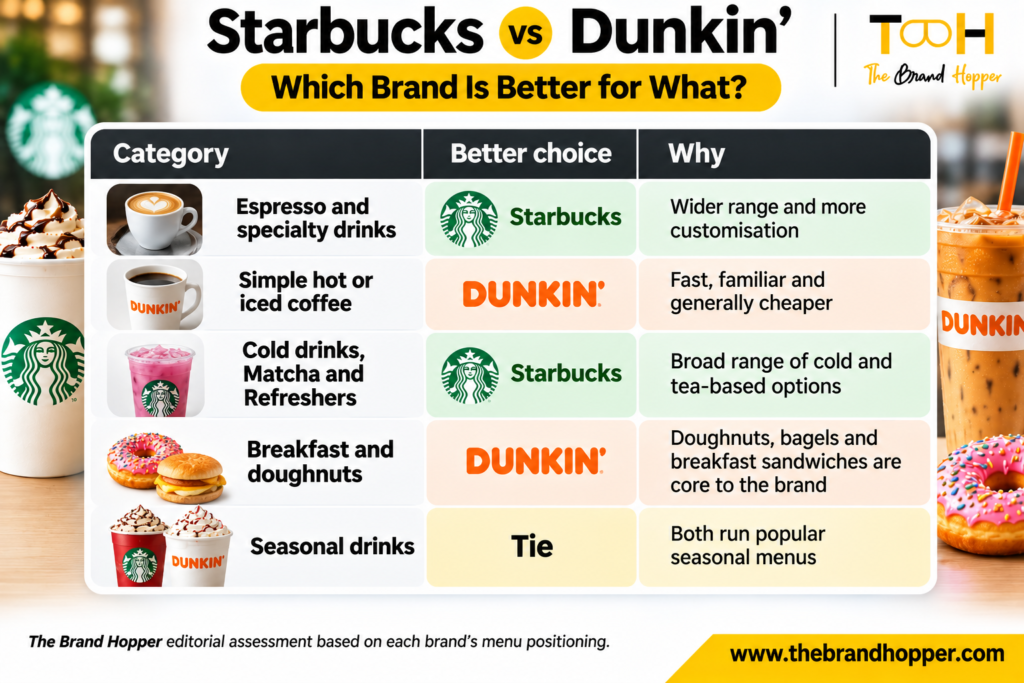
Winner, menu: Starbucks for coffee variety; Dunkin’ for breakfast and doughnuts.
Price and Value
Starbucks positions itself as a premium brand, and its drinks typically cost noticeably more than Dunkin’s equivalents, especially once customisations are added. Starbucks’ US comparable sales in Q4 FY2026 were supported by a 5.2% increase in average ticket, reflecting higher customer spending per transaction.
Dunkin’ competes on value, with generally lower everyday prices on coffee and food and frequent app-based deals. Its menu is designed around accessible, convenient purchases, making it attractive to customers who want a regular coffee without paying premium coffeehouse prices.
Buying tip: Prices vary widely by city and country, and both brands change prices regularly. Check current prices in each brand’s app, and use their loyalty offers to save.
Winner, value: Dunkin’.
Store Experience and Speed
Starbucks’ “Back to Starbucks” plan is designed to restore the coffeehouse feel: warmer seating, handwritten touches on cups, condiment bars, ceramic mugs and the Green Apron Service model. The company is also investing in staffing, scheduling and faster service to improve the customer experience.
By September 2026, Starbucks had announced plans to accelerate its programme towards 1,500 coffeehouse uplifts. It also closed approximately 250 North American coffeehouses in September 2026, representing around 1% of its more than 18,000 North American locations, as part of its portfolio restructuring.
Dunkin’ is designed for speed and convenience. Many of its US restaurants offer drive-thru service, mobile ordering and dedicated pickup arrangements, supporting a grab-and-go model. Most Dunkin’ visits are quick stops rather than extended café experiences for sitting and working.
Winner, experience: Starbucks for sitting and socialising; Dunkin’ for speed.
Rewards, App and Digital Ordering
The Starbucks app is one of the most established restaurant loyalty and ordering platforms. Starbucks Rewards reached a record 36 million 90-day active members in the US in the fourth quarter of FY2026. Members earn Stars on purchases and can order ahead, pay and personalise drinks through the app.
Starbucks has also been evolving its Rewards programme with different membership levels and benefits designed to encourage more frequent visits. The app combines ordering convenience, payment, personalised offers and loyalty rewards in one platform.
Dunkin’ Rewards lets members earn points on purchases, order ahead and access member offers. It is a major part of Dunkin’s value proposition and supports its on-the-go business model. Dunkin’ does not regularly disclose a comparable active-member figure, making a direct membership-size comparison difficult.
Winner, digital and loyalty: Starbucks, based on its publicly reported membership scale and integrated app experience.
Sustainability and Ethical Sourcing
Starbucks has long promoted ethical sourcing through its C.A.F.E. Practices verification programme and farmer support centres, and it publishes detailed sustainability information. C.A.F.E. Practices evaluates coffee suppliers against economic, social and environmental criteria, making responsible sourcing a central part of the company’s public sustainability approach.
Dunkin’ sources its coffee and other ingredients through responsible-sourcing programmes operated within the wider Inspire Brands framework. The brand has also used certified sourcing for selected ingredients and products. Both chains face criticism over single-use cups and packaging, while promoting reusable options in selected markets.
Winner, sustainability transparency: Starbucks, for its more detailed public reporting and established coffee-sourcing verification programme.
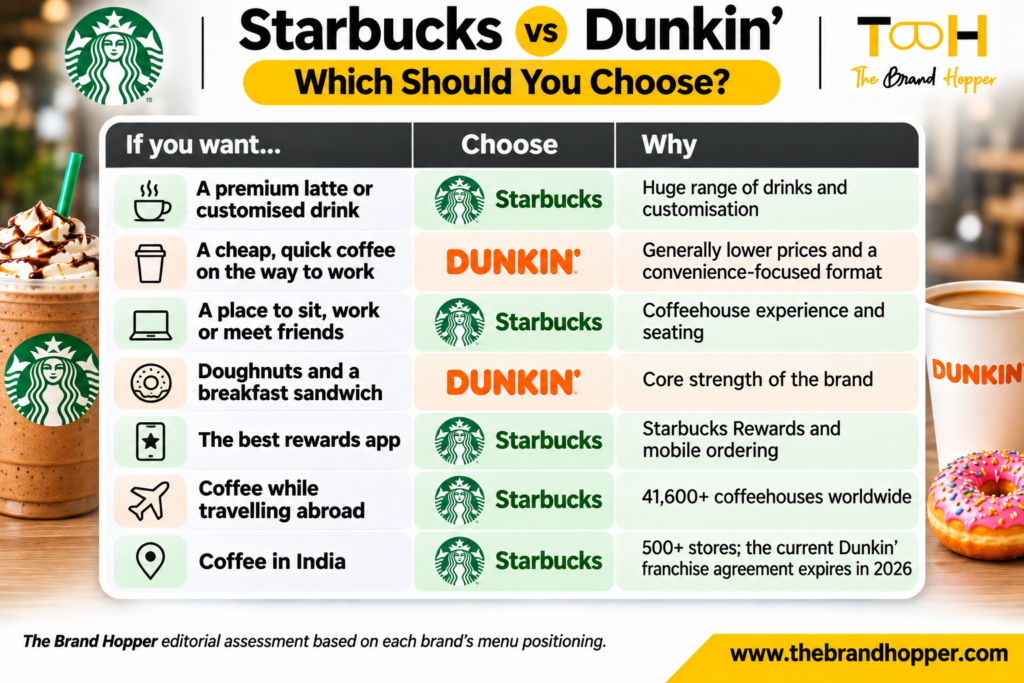
Starbucks vs Dunkin’: Which Should You Choose?
The Bottom Line
Starbucks is the stronger overall coffeehouse brand for customers who value global reach, menu depth, café experience and a sophisticated rewards app. Its “Back to Starbucks” turnaround delivered stronger comparable sales in FY2026, although the company still needs to sustain that progress.
Dunkin’ is the better choice when speed and value matter most, especially for a classic coffee-and-doughnut breakfast in the US. Its large US footprint and beverage-led positioning make it a strong competitor in the convenience coffee market. The right pick depends on whether you want a coffeehouse experience or a quick, affordable caffeine fix.
Frequently Asked Questions
Q: Is Starbucks or Dunkin’ better?
A: Starbucks is better for premium, customisable drinks, café seating and global availability. Dunkin’ is better for fast, affordable coffee and doughnuts, especially in the US.
Q: Which is bigger, Starbucks or Dunkin’?
A: Starbucks is bigger by reported revenue and global coffeehouse count, with 41,607 coffeehouses worldwide and FY2026 revenue of US$37.9 billion. Dunkin’ has more than 14,200 restaurants and US$14.5 billion in 2025 global system sales.
Q: Who owns Dunkin’?
A: Dunkin’ is owned by Inspire Brands, a private restaurant company backed by Roark Capital, which acquired Dunkin’ Brands for approximately US$11.3 billion in 2020.
Q: Who owns Starbucks?
A: Starbucks Corporation is a publicly traded company listed on Nasdaq under the ticker SBUX. It is owned by its shareholders, and Brian Niccol is its Chairman and CEO.
Q: Is Dunkin’ cheaper than Starbucks?
A: Generally, yes. Dunkin’ positions itself as a value-oriented brand, while Starbucks charges premium prices, especially for customised drinks.
Q: Is Dunkin’ going public?
A: Dunkin’s parent company, Inspire Brands, confidentially filed for a US IPO in May 2026. No public listing date or share price had been announced at the time of writing.
Also Read: Who Owns Starbucks? Ownership & Shareholders
To read more content like this, subscribe to our newsletter
Go to the full page to view and submit the form.