


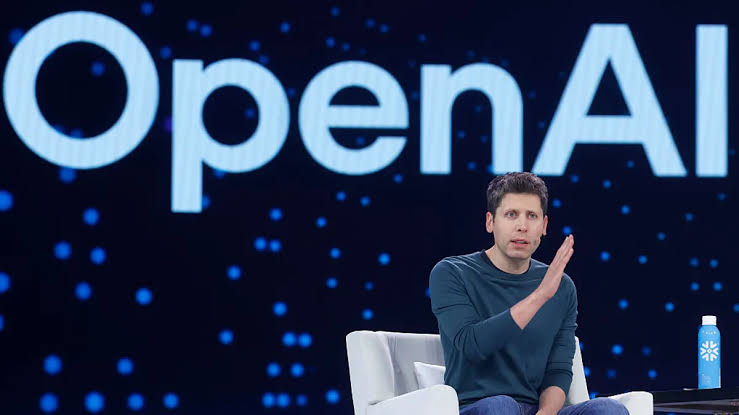
On July 22, 2026, OpenAI opened Advertise in ChatGPT to any business with a credit card, a self-serve Ads Manager that lets companies build campaigns, set a daily budget, and target ChatGPT’s hundreds of millions of users based on the context of their conversations rather than a list of search keywords. The launch was framed as a routine product update, complete with case studies from Best Buy, Lowe’s, and VistaPrint. But it capped one of the fastest and most closely watched reversals in tech industry history: eighteen months earlier, OpenAI’s own leadership was calling advertising inside ChatGPT a line the company had no interest in crossing.
From “last resort” to core business
As recently as 2024, Sam Altman described the idea of advertising blended with an AI assistant’s answers as “uniquely unsettling,” and OpenAI executives spent much of 2025 telling reporters that ads were, at best, a last resort. That posture didn’t survive contact with the cost of running ChatGPT. The first sign of a reversal surfaced in November 2025, when ad-related code strings turned up in an Android beta build. OpenAI made the pivot official in January 2026, and ads went live on February 9 for U.S. users on the Free and Go tiers, priced at roughly $60 per thousand impressions with a $200,000 minimum commitment — a beta gate aimed squarely at large advertisers.
The gate didn’t stay up for long. By March, OpenAI was rolling ads out to all Free and Go users in the U.S. In April, pricing shifted to a more conventional $3–$5 cost-per-click model, and self-serve onboarding opened in a limited beta. May brought full self-serve access with no minimum spend at all, plus product-feed ads for e-commerce sellers. By early July, ads were appearing in 51% of U.S. ChatGPT replies and live in six countries. The July 22 launch was less a new beginning than the final gate coming down: the point at which any business, not just those with an ad rep on retainer, could log into ads.openai.com and start spending.
How it actually works
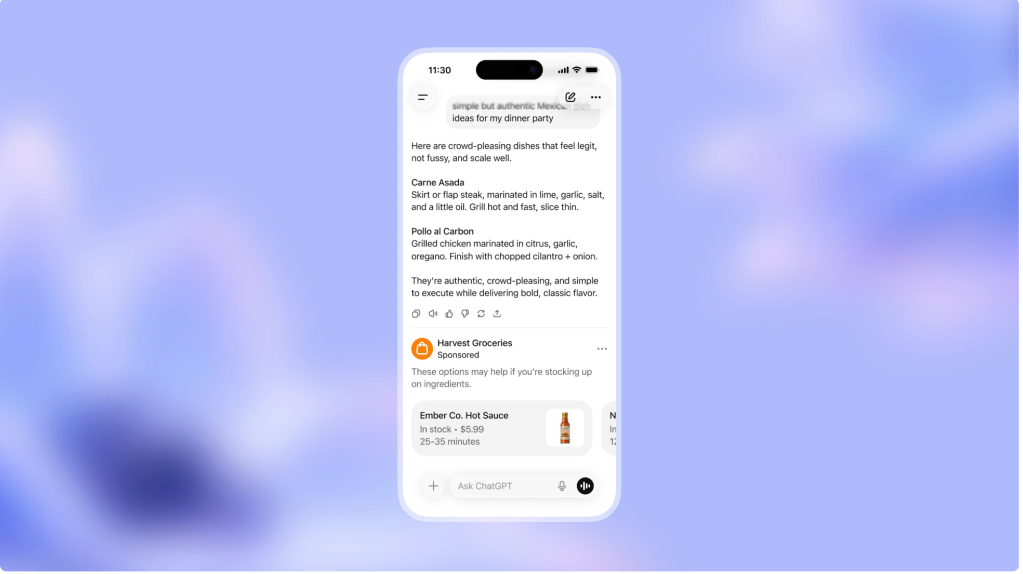
The mechanics are deliberately narrow. Ads appear as a clearly labeled, visually distinct box beneath a ChatGPT response — never blended into the answer itself — and only for logged-in adult users on the Free and $8-a-month Go plans; Plus, Team, Enterprise, and Edu subscribers see nothing. Advertisers don’t target keywords; they set “context hints,” topics or situations in which their ad is eligible to appear, alongside a brand name, logo, a 16-to-24-character headline, 32-to-48-character description, an image, and a destination URL. Signing up requires a legal business name, address, and tax ID, plus a credit card or line of credit — Visa, Mastercard, and Amex are all supported — billed after delivery rather than upfront.
OpenAI has been explicit about the guardrail it thinks matters most: no paid placement can influence the content of ChatGPT’s actual response, and advertisers never see the underlying conversation that triggered an ad. Whether that line holds up to outside scrutiny as the product scales is the open question hanging over the whole launch.

Why now
The business logic is straightforward. Running inference for hundreds of millions of free users is expensive, and subscription revenue alone hasn’t closed the gap. At Cannes Lions this year, OpenAI described itself plainly as an advertising business for the first time, projecting $2.5 billion in ad revenue for 2026 — a target that looked aggressive in January and merely on-schedule by July, given that the business reportedly crossed $100 million in annualized revenue less than two months after its February launch, one of the fastest ad-product ramps ever recorded.
There’s also a competitive dimension. Google is bidding to keep search-style purchase intent inside its own ecosystem as more of that research shifts into chat interfaces; Meta is building its own AI ad tooling; and OpenAI’s launch partners — Best Buy and Lowe’s among them — are effectively hedging by showing up wherever the customer’s research now happens. Best Buy’s VP of Media, Amy Adams, put the rationale in plain terms: the goal is meeting customers “in those moments” of decision-making that increasingly happen inside a chat window instead of a search box.
The pushback
Not everyone is convinced this can be done cleanly. Consumer advocates, including a group of U.S. senators, have raised concerns about embedding advertising in a product many people treat as a confidant or research assistant — warning that the emotional trust users place in a chatbot makes them more susceptible to subtle influence than a traditional search results page, and that the risk is especially acute for younger users. Privacy advocates have separately flagged the broader trend of ads arriving across AI chat products generally, given how much more personal a chat history can be than a search query.
OpenAI has also taken fire from a rival with an obvious incentive to pile on. Anthropic ran a set of ads mocking OpenAI’s advertising pivot, prompting a lengthy public rebuttal from Altman accusing Anthropic of dishonest framing. The exchange says as much about the state of AI industry rivalry as it does about advertising strategy, but it underscores that OpenAI’s monetization pivot is being watched — and contested — by competitors as much as regulators.
What to watch next
The self-serve launch mostly answers the question of access: who can buy ChatGPT ads. It doesn’t yet answer the harder question of trust: whether users tolerate sponsored content inside a tool many have folded into daily decision-making without it curdling the relationship that made ChatGPT valuable in the first place. With ads already showing up in roughly half of U.S. replies, that answer is arriving in real time, not in some hypothetical future OpenAI gets to control.
Also Read: The Rise of Nvidia: Powering the AI Revolution Behind ChatGPT
To read more content like this, subscribe to our newsletter
Go to the full page to view and submit the form.