


A single frustrated customer posts a video complaint about a defective product. Nobody on the brand’s team sees it for four days. By the time someone notices, the clip has been reposted across three platforms, picked up by a niche news account, and turned into a hashtag — and the brand’s first public response reads as defensive rather than accountable, because they’re four days late to a conversation everyone else already had without them.
Compare that to a brand that catches the same complaint within minutes, has a support rep reply publicly within the hour, and resolves the issue before the clip clears a few hundred views. Same complaint, same product flaw, two different outcomes — the only variable that changed was whether anyone was watching.
That gap is why brand monitoring has moved from a nice-to-have to a standing operational discipline. Conversation about any brand is now fragmented across social platforms, review sites, forums, comment sections, and news coverage simultaneously, and sentiment can shift from neutral to hostile in the time it takes one post to go viral. A team relying on manual searches or Google Alerts is always reacting after the fact; a team with real monitoring infrastructure in place responds while an issue is still small — the difference between proactive reputation management and damage control.
The stakes are real and measurable: 97% of consumers read online reviews before deciding whether to buy from a business, according to BrightLocal’s Local Consumer Review Survey, and half of them trust those reviews as much as a personal recommendation from a friend.
What Makes a Great Brand Monitoring Tool?
1. Coverage breadth across social platforms, news outlets, forums, blogs, and review sites determines whether a tool actually sees the full conversation or just the easy-to-crawl slice of it — a tool that misses Reddit threads or niche industry forums will miss exactly the places where product complaints tend to snowball before anyone official notices.
2. Real-time alerts and speed separate tools built for genuine crisis response from ones built for weekly reporting; a mention that surfaces six hours after it posts is nearly useless for containing a fast-moving PR situation, while a tool that pushes a notification within minutes gives a team an actual window to respond before momentum builds.
3. Sentiment analysis accuracy is what turns a firehose of mentions into something usable — a tool that correctly separates genuine complaints from sarcasm, jokes, or neutral mentions saves a team from either missing real problems or chasing false alarms all day.
4. Competitor and share-of-voice tracking lets a brand judge its own reputation against a real baseline rather than an arbitrary internal target, showing whether a dip in sentiment reflects something the brand did or an industry-wide moment everyone is experiencing.
5. Reporting and team collaboration features determine whether monitoring insight actually reaches the people who need to act on it — the ability to assign a mention to a specific team member, tag it by urgency, and export a clean report for leadership is what turns raw data into an operational workflow rather than a dashboard nobody checks.
6. Pricing and scalability matters because the gap between a tool built for a single-location small business and one built for a multinational enterprise is enormous, and paying for enterprise-grade data volume when a brand only needs to watch a few hundred mentions a month is a fast way to overspend on a tool that never gets fully used.
Best Brand Monitoring Tools
1. Brandwatch

Brandwatch built its reputation on a massive, continuously indexed archive of online conversation, and it remains one of the most respected names among enterprise brands and research teams that need consumer intelligence at genuine scale, not just brand mentions.
Its core mechanic pulls from an enormous volume of sources — social platforms, forums, news, blogs, and review sites — and applies AI-driven sentiment analysis, image recognition, and trend detection across that dataset, with crisis alerting that flags unusual spikes in negative conversation volume before they become a full-blown story.
Its standout differentiator is analytical depth: Brandwatch answers “what does the market think about this category” as easily as “what is being said about our brand,” making it as much a market research tool as a monitoring one, with a historical archive that lets teams analyze sentiment shifts over years, not just weeks.
Brandwatch sells entirely through custom quotes across separate suites for consumer intelligence, social media management, and influencer marketing, with no public pricing list; costs scale with data sources, query volume, and seats, and a real deployment typically runs well into five or six figures annually.
| Plan | Price | Key Features |
| Consumer Intelligence | Custom quote | Social listening, audience insights, AI-driven sentiment and trend detection |
| Social Media Management | Custom quote | Multi-channel publishing, social CRM, competitor benchmarking |
| Influencer Marketing | Custom quote | Influencer discovery across a large creator database, campaign reporting |
Brandwatch does not publish list pricing anywhere on its site; every quote is negotiated directly with sales based on data sources, seats, and query volume.
Best for: Enterprise brands and research teams that need deep consumer intelligence and market-wide sentiment tracking, not just reactive mention alerts.
2. Talkwalker

Talkwalker operates in the same enterprise tier as Brandwatch, distinguishing itself primarily through proprietary image and video recognition technology that identifies brand logos and products in visual content across the web, even in posts that never mention the brand by name.
Its core mechanic monitors an enormous footprint of social networks, news sites, and blogs, applying multilingual sentiment analysis and that image-recognition layer to catch mentions a text-only listening tool would simply miss — a photo of a product with no caption still gets flagged and attributed correctly.
Its standout differentiator is genuinely global, multilingual coverage paired with that visual-first detection, making it a strong fit for brands operating across many countries and languages, where a text-search-only tool would miss conversation happening in other languages or purely visual formats.
Talkwalker is sold entirely through custom quotes across tiers moving from core listening through competitive benchmarking up to full enterprise-scale consumer intelligence; like Brandwatch, it’s realistically a budget line for large organizations rather than a self-serve purchase.
| Plan | Price | Key Features |
| Listen | Custom quote | Core social listening and media monitoring |
| Analyze | Custom quote | Adds social benchmarking and larger data volume |
| Business | Custom quote | Enterprise-grade consumer intelligence, scalable across teams |
| Premium | Custom quote | Highest data volume, most advanced AI and image-recognition capabilities |
Talkwalker does not publish pricing publicly; any real figure requires a direct sales quote based on scope, languages, and data volume.
Best for: Global enterprise brands that need multilingual, visual-first brand monitoring across a large international footprint.
3. Meltwater
Meltwater started as a media monitoring service and has expanded into a full media intelligence suite covering social listening, influencer marketing, and PR analytics, with a footprint that spans traditional news coverage as heavily as social conversation.
Its core mechanic combines media monitoring across a huge network of news sources with social listening and AI-powered analysis, letting a PR or comms team track how a story is spreading across both journalism and social platforms simultaneously, rather than treating them as separate monitoring problems.
Its standout differentiator is that news-and-social hybrid coverage — Meltwater is genuinely strong on traditional media monitoring in a way many social-first listening tools aren’t, which matters for brands whose reputation risk comes as much from press coverage as from social virality.
Meltwater is sold through custom quotes across modular tiers, letting a team pick which combination of media monitoring, social listening, and analytics they need; pricing scales with source breadth, regions, and seats, and costs climb quickly once a team wants full-suite access across multiple modules.
| Plan | Price | Key Features |
| Starter | Custom quote | Media, social, and AI visibility intelligence; pre-built dashboards |
| Pro | Custom quote | Advanced AI insights, competitive benchmarking, custom dashboards |
| Enterprise | Custom quote | Unified intelligence platform, API/MCP integrations, governance controls |
| Agency | Custom quote | Multi-brand and multi-client management at scale |
Meltwater’s official pricing page confirms every tier is quote-only — there is no published starting price for any plan, and every proposal is built around chosen modules, regions, and contract length.
Best for: PR and communications teams that need media coverage tracked alongside social conversation in one unified view.
4. Brand24
Brand24 carved out space as a social listening and sentiment tool priced and packaged for small and mid-size businesses rather than enterprise budgets, making genuine sentiment analysis accessible to teams that would otherwise be priced out of platforms like Brandwatch or Talkwalker.
Its core mechanic scans a large volume of online sources in real time — social platforms, review sites, news, forums — and applies AI-driven sentiment classification to every mention, flagging spikes in conversation volume and identifying influential voices through a built-in influence scoring system.
Its standout differentiator is accessibility paired with genuine usefulness: real-time alerts, sentiment analysis, and mention tracking at a price point a small marketing team can actually adopt, plus emerging tracking of how a brand gets mentioned by AI chatbots and assistants, a form of monitoring most competitors in its price range don’t yet offer.
Pricing runs through several named tiers based on keyword count, mention volume, and update frequency, with real-time monitoring reserved for higher tiers — a genuine limitation for teams that specifically need to catch a reputation issue the moment it breaks rather than a few hours later.
| Plan | Price | Key Features |
| Individual | $199/mo (annual); $249 monthly | 3 keywords, 2,000 mentions/mo, 1 user, updates every 12 hours |
| Team | $299/mo (annual); $349 monthly | 7 keywords, 10,000 mentions/mo, unlimited users, hourly updates |
| Pro | $399/mo (annual); $499 monthly | 12 keywords, 40,000 mentions/mo, real-time updates, AI Insights |
| Business | $599/mo (annual); $699 monthly | 25 keywords, 100,000 mentions/mo, advanced reports, dedicated Client Success Lead |
| Enterprise | From $1,499/mo (annual) | Custom keyword/mention limits, unlimited AI Insights, dedicated consulting |
Best for: Small and mid-size businesses that want real sentiment analysis and brand monitoring without an enterprise-scale budget.
5. Mention

Mention, now operated under the same parent company as social management platform Agorapulse, built its name on fast setup and a clean interface for tracking brand and competitor mentions across social media and the open web.
Its core mechanic monitors a broad set of sources — major social platforms, review sites, news, blogs, and forums — with Boolean search capability for precise keyword targeting, sentiment analysis, and share-of-voice reporting that benchmarks a brand’s conversation volume against named competitors.
Its standout differentiator is depth of source coverage relative to setup simplicity: teams can build sophisticated Boolean alerts without needing a data analyst, and its review-monitoring coverage spans dozens of review sites beyond the obvious social channels.
Mention has moved away from published self-serve pricing tiers toward a single custom-quoted plan tailored to an organization’s needs and scale, meaning a prospective buyer now requests a demo rather than self-selecting a plan online — a shift that makes it harder to comparison-shop against competitors that still publish transparent pricing.
| Plan | Price | Key Features |
| Company | Custom quote | Real-time tracking across 1B+ sources, sentiment analysis, review monitoring on 75+ sites, custom reporting, dedicated account manager |
Mention discontinued its published Solo/Pro self-serve tiers; the single remaining “Company” plan is priced entirely through a sales conversation, with no public starting figure.
Best for: Marketing and PR teams that want strong Boolean-search precision and review-site coverage without enterprise-level complexity.
6. Awario

Awario positions itself as an affordable alternative to the bigger listening suites, built around real-time social and web monitoring with an added angle most competitors don’t emphasize: using mention tracking to surface potential sales leads, not just reputation risks.
Its core mechanic monitors social platforms, news, blogs, forums, and review sites in real time, with Boolean search, sentiment analysis, and alerts that can be filtered by influence score, so a team can prioritize a mention from an account with real reach over one from a low-follower account.
Its standout differentiator is that dual reputation-and-lead-generation framing — Awario markets itself as a tool for finding sales opportunities hiding inside mentions just as much as a tool for catching complaints, which broadens its use case beyond pure reputation management.
Pricing runs through a small number of named tiers based primarily on topics tracked and mentions per month, with real-time alerts and deeper historical data reserved for higher tiers; it’s one of the more affordable entries here, though the lowest tier’s mention volume caps out quickly beyond a single brand and a couple of competitors.
| Plan | Price | Key Features |
| Starter | $49/mo monthly; $29/mo billed annually | 3 topics, 5,000 stored mentions/topic, 30,000 new mentions/mo |
| Pro | $149/mo monthly; $89/mo billed annually | 15 topics, 15,000 stored mentions/topic, 300,000 new mentions/mo |
| Enterprise | $399/mo monthly; $249/mo billed annually | 100 topics, 50,000 stored mentions/topic, up to 1M new mentions/mo |
Awario’s own pricing page is not consistently accessible for direct verification, so these figures are cross-checked against multiple independent reviewer sources rather than a single official fetch; confirm current pricing directly with Awario before purchasing.
Best for: Small businesses and solo marketers who want affordable real-time listening with a built-in lead-generation angle.
7. Reputation.com
Reputation.com focuses less on open-web social listening and more on the specific discipline of review and customer-experience management, particularly for multi-location businesses like healthcare networks, auto dealerships, and retail chains.
Its core mechanic centers on aggregating reviews and customer feedback across dozens of review sites and survey channels into a unified score per location, with AI-assisted review responses, sentiment insights, and workflow tools that route negative feedback to the right team member for resolution.
Its standout differentiator is location-level granularity: a brand with hundreds of locations can see exactly which store, branch, or provider is driving reputation problems, rather than one blended score for the whole company — a level of detail few general-purpose listening tools offer.
Reputation.com publishes transparent per-location pricing starting with a foundational review-and-listings tier, moving through mid-tiers that add proactive sentiment analytics and customer surveys, up to a fully custom enterprise tier for large multi-location portfolios — the cost scales directly with location count, so the total climbs quickly even though the per-location price looks modest at first glance.
| Plan | Price | Key Features |
| Rep Core | $80/location/mo | Reviews management (collection, requesting, AI responding), listings & SEO |
| Rep Core + Pulse | $115/location/mo | Adds Reputation Insights (Rep Score), AI Reputation Manager, basic surveys |
| Rep Core + Surveys | $150/location/mo | Adds advanced surveys, email survey requesting, targeted outreach campaigns |
| Enterprise | Custom quote | For 125+ locations; dedicated infrastructure, customer success manager |
Best for: Multi-location businesses — healthcare systems, auto dealer groups, retail chains — that need review management broken down location by location.
8. Podium
Podium built its business around helping local and multi-location businesses collect reviews, manage customer messaging, and convert leads through a single inbox, positioning reputation management as one part of a broader customer-communication platform rather than a standalone listening tool.
Its core mechanic automates review requests via text message after a transaction, consolidates incoming leads and messages from web chat, phone, and social channels into one inbox, and layers in AI-assisted response drafting so a small team can keep up with review and message volume without a dedicated reputation manager on staff.
Its standout differentiator is the tight link between reputation and lead conversion: because reviews, messaging, and payments live in the same platform, a five-star review request and a follow-up sales conversation can happen in the same customer thread — a genuinely different framing than a pure monitoring tool that only watches and reports.
Podium sells entirely through custom, sales-assisted pricing with no public plan list, tailored to a business’s needs and typically bundled around its AI-driven lead-conversion features; a prospective customer can’t self-serve a quote online and has to go through a sales conversation to find out what it actually costs.
| Plan | Price | Key Features |
| All Podium plans | Custom quote (contact sales) | Reviews, Phones, Lead Consolidation, Webchat, Inbox, Payments, Text Marketing, AI Employee add-on |
Podium’s pricing page publishes no tiers or figures of any kind — every plan is quoted directly by the sales team based on business size and selected products.
Best for: Local and multi-location service businesses that want review generation bundled with lead messaging and conversion tools, not just monitoring.
9. Muck Rack

Muck Rack is built specifically for public relations teams, combining media monitoring with a journalist database and pitching tools, making it as much a PR workflow platform as a listening tool.
Its core mechanic tracks media coverage and social mentions across a huge index of news outlets and journalist profiles, letting a PR team see not just that a story ran but who wrote it and how it’s performing — all tied back to a searchable database of journalist contact information and beat history.
Its standout differentiator is that fusion of monitoring and outreach: most listening tools stop at telling a team what’s being said, but Muck Rack connects that insight directly to the journalists who could cover a story next, collapsing monitoring and media relations into one workflow.
Muck Rack sells entirely through custom, seat-based annual contracts with no public pricing list; costs scale with user count and module selection, and a real deployment for a mid-size PR team typically runs into five figures annually, climbing well beyond that for large agencies.
| Plan | Price | Key Features |
| All Muck Rack plans | Custom quote (contact sales) | Media monitoring, journalist database, pitching tools, coverage reporting |
Muck Rack does not publish pricing; unofficial estimates gathered from procurement and reseller sources suggest entry subscriptions often start near the low five figures annually, rising well past that for larger teams — treat any number outside a direct Muck Rack quote as directional only.
Best for: PR and communications teams that want media monitoring tied directly to journalist research and outreach in one platform.
10. Cision

Cision is one of the longest-standing names in the PR technology space, best known for press release distribution through its PR Newswire arm and paired with a media monitoring and database product covering journalists and outlets globally.
Its core mechanic combines a searchable media database and monitoring engine with press release distribution, so a communications team can research and pitch journalists, distribute a release, and track resulting coverage and social conversation from a connected set of tools.
Its standout differentiator is breadth: Cision covers the full PR lifecycle from media list-building through distribution through coverage measurement in one vendor relationship, which appeals to comms teams that would rather manage one contract than stitch together separate tools for each campaign stage.
Cision sells entirely through custom quotes with no public pricing list, priced around named users, selected modules, and geographic coverage; entry-level seats run into the low five figures annually, with full enterprise suites climbing into six figures, and press release distribution is billed separately, per release.
| Plan | Price | Key Features |
| Communications Cloud (entry) | Custom quote | Core media database, monitoring, and reporting seats |
| PR Cloud (mid-market) | Custom quote | Bundled monitoring, distribution, and analytics modules |
| Enterprise Suite | Custom quote | Full monitoring, distribution, and analytics at global scale |
| Press release distribution | Billed per release, separate from platform seats | Wire distribution via PR Newswire, scales with word count and multimedia |
Cision publishes no list pricing; procurement data compiled by third parties suggests real-world contracts commonly land in the five-figure range for smaller deployments and into six figures for full enterprise suites, but only a direct Cision quote reflects actual current pricing.
Best for: Large communications and PR teams that want media monitoring, journalist research, and press release distribution unified under one enterprise vendor.
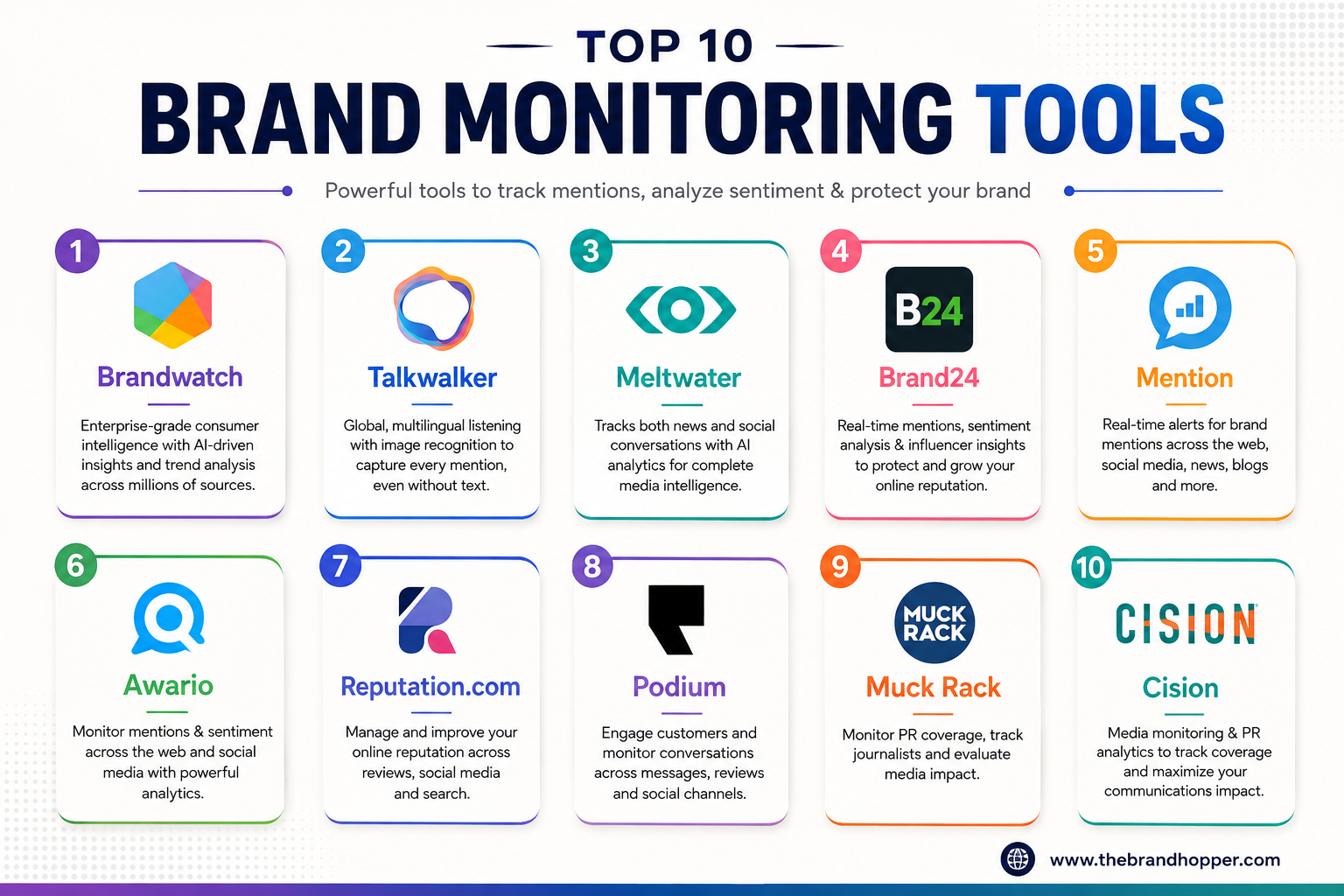
Summarizing the tools

Building Your Brand Monitoring Stack
The right tool depends on who’s watching and what they’re watching for. A small business owner just getting started should look at Awario or Brand24, both offering genuine real-time monitoring at a price a solo operator can justify. A marketing or PR team at a growing brand is well served by Mention or Meltwater, depending on whether the priority is clean social-and-web tracking or a hybrid of media coverage and social conversation. An agency managing multiple clients needs the white-label reporting and multi-brand dashboards that Brand24’s higher tiers or Meltwater provide, since the output has to satisfy someone else’s stakeholders. And an enterprise brand with real reputation stakes — a multinational company, a multi-location chain, or a PR team managing press at scale — should be looking at Brandwatch, Talkwalker, Reputation.com, Muck Rack, or Cision, where the cost is justified by the depth of coverage.
Whatever tool ends up in the stack, the biggest mistake is waiting for a crisis to force the decision. Set up alerts for your brand name, its common misspellings, and your top two or three competitors today — most of these tools let you do that in minutes, on a free trial. A brand that’s already watching when something goes wrong gets to respond in the first hour; a brand that starts building its monitoring setup after the story has spread is always playing catch-up.
Also Read:
To read more content like this, subscribe to our newsletter
Go to the full page to view and submit the form.