


Billd is a fintech startup founded in 2018 in Austin, Texas, that provides working capital solutions for construction subcontractors. It partners with material suppliers and general contractors to offer subcontractors extended payment terms (up to 120 days) and cash advances on work in progress, addressing the chronic cash-flow gaps in the construction industry.
Billd’s mission is to “revolutionize commercial construction finance” by treating construction companies as customers of their own and tailoring financial products to the industry’s unique needs.
Over a large $800+ billion addressable market, Billd has rapidly scaled: by mid-2021 it had surpassed $100 million in annual revenue and achieved over 120% revenue growth from 2021 to 2024. In a sector where slow payments (often 60–90 days) and tight margins threaten projects, Billd’s fintech approach provides crucial liquidity so contractors can bid on larger jobs and complete projects on schedule.
Founding Story of Billd
Billd was co-founded in 2018 by industry veterans Christopher Doyle and Jesse Weissburg out of a shared frustration with the construction industry’s broken payment cycle.
Both founders had deep experience in finance and construction: Doyle had spent his career in construction technology (including as director of solar operations for a building safety institute), while Weissburg had a background in finance (including a stint at Bank of America working with contractors) and in the solar energy business.
They observed that subcontractors – who must front costs for labor and materials – were consistently last to get paid, yet were largely ignored by traditional lenders. This motivated them to bring “the financial power of Wall Street to the construction job site”.
Initially, Doyle and Weissburg focused on partnering with building materials suppliers to distribute financing options. As Weissburg recalls, their early vision was “to bridge the working capital gap for contractors, who were largely relying on supplier terms”.
The first product launched was Material Financing: Billd pays a supplier on behalf of a subcontractor, and the subcontractor then repays Billd over 120 days, eliminating the cash shortfall between buying materials and receiving client payment.
Over time Billd expanded into other products (see Products & Services below) but the founding principle remained the same: give subcontractors control of their cash flow. As Doyle put it in a 2021 interview: contractors are “put in a pretty tough spot…they’re the last in line to get paid in a very unpredictable payment cycle”, and Billd exists to fix that.
In practical terms, Billd raised seed funding from LL Funds (a financial firm) in 2019 to launch its platform, and landed large contracts with national suppliers and general contractors.
By 2021 the company had “rapidly scaled to meet demand” and hit the $100M revenue milestone. Its founding story combines deep industry insight with fintech innovation: the founders’ construction backgrounds informed Billd’s product design, and they leveraged venture financing to grow quickly.
Founders and Leadership of Billd
Christopher Doyle, Co-Founder & CEO


-
An entrepreneur with extensive construction and tech experience, Doyle leads Billd’s strategy and product vision. He has worked in construction since his teens and even oversaw solar-building projects. At Billd he emphasizes a tech-driven, project-level approach: the company’s underwriting uses data from each construction project to assess risk more accurately than traditional credit scores.
-
Doyle often says he launched Billd to “make traditional Wall Street working capital accessible to [construction] business owners”. Under his leadership, Billd has stayed “disciplined” on growth, focusing first on getting the product and underwriting right.
Jesse Weissburg, Co-Founder & Chief Commercial Officer


Weissburg is a finance and business-development leader who drives Billd’s growth initiatives. With a background in corporate finance (Bank of America) and a tenure at a solar startup, he observed that subcontractors were good businesses in need of capital.
At Billd he oversees sales, marketing, and partnerships. Weissburg explains that early on the founders realized traditional banks “had little appetite” for lending to subcontractors, so Billd would instead unlock financing via supplier networks and later directly to subs. He emphasizes educating contractors about financing and building distribution channels: for example, Billd initially sought to “unlock distribution” through partnerships with suppliers, then proved product-market fit with subcontractors directly.
Together Doyle and Weissburg are joined by a management team including a COO and CFO, but their vision and industry grounding set Billd apart. In interviews, the founders stress that Billd was created by contractors for contractors. They champion subcontractors as the “backbone of construction”, promising customized support and flexible terms that traditional financiers won’t match. This founder-led ethos – understanding the field crew’s perspective – is a core part of Billd’s identity and credibility in the market.
Business Model of Billd
Billd operates a supply-chain finance model tailored to construction. Rather than fitting subcontractors into generic loan products, Billd designs financing around specific projects and purchases. Its two primary offerings are:
-
Material Financing: Billd pays a material supplier immediately on behalf of a contractor, then the contractor repays Billd over an extended term (typically 120 days). This bridges the 60–90 day gap between buying materials and getting paid for the job. Billd underwrites the loan based on project details and GC creditworthiness rather than just the subcontractor’s credit score.
-
Pay App Advance: Subcontractors can get an advance on an approved pay application (invoice) from a general contractor. Billd provides the funds today and is repaid when the GC pays out the application. This ensures subs aren’t waiting on slow payment cycles to cover current expenses.
Billd’s business model relies on interest and financing fees earned on these transactions. When Billd advances funds or extends credit, it charges a fee or interest rate commensurate with the project’s risk. (For comparison, Doyle notes that a contractor with any payment delays would normally face interest rates of 12% or higher in traditional credit markets.) Billd’s proprietary risk models allow it to price these loans more competitively by quantifying otherwise “unknown” risks in construction projects. The difference between the yield on Billd’s loans and its cost of capital constitutes its primary revenue.
Billd is funded by a combination of equity and wholesale debt. Equity financing and venture debt (see Funding Rounds below) have supplied capital for growth and product development. Crucially, Billd also operates large debt facilities (i.e. warehouse credit lines) to fund its loans. For example, in 2022 LL Funds provided a $100 million debt facility, and in late 2024 Billd arranged a $144 million facility with Atlas SP Partners. These low-cost capital lines allow Billd to extend large sums as working capital to subcontractors while earning the spread.

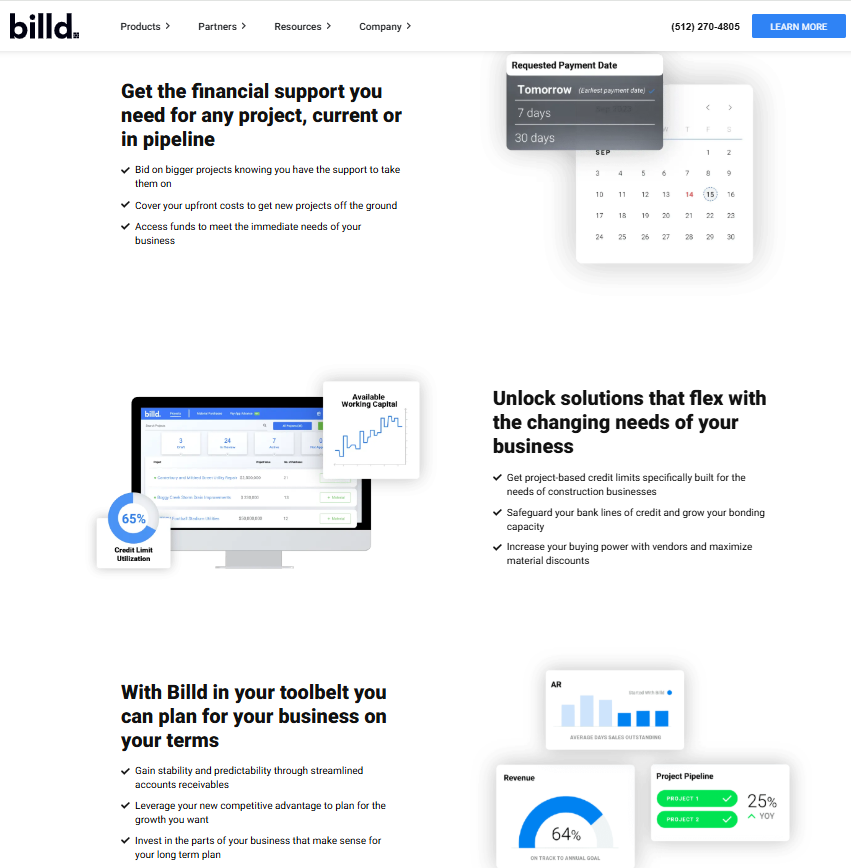
Billd’s go-to-market model combines direct sales and partnership channels. It works directly with subcontracting firms (often via referrals from general contractors or associations) as well as through large suppliers and contractors. A key example is the Turner APP partnership: a joint program with Turner Construction that brings Billd’s pay-app advances to Turner projects. Another is Predictable Pay, an early-payment service designed with general contractors to give subs faster, more predictable pay (see Products & Services). Billd also invests in content and industry education to reach contractors, reflecting founders’ emphasis on treating customers as partners.
In summary, Billd’s core value proposition is to provide subcontractors with same-day access to capital under terms aligned with construction schedules. By owning the technology and underwriting in-house, Billd can execute quickly on capital-intensive projects. The company’s tagline – “we champion the subcontractor” – underlines that its business model is built on aligning interests with the small business construction community.
Revenue Streams of Billd
Billd’s revenue primarily comes from the interest and fees on the financing it provides. Each Material Financing or Pay App Advance generates interest income over the extended payment term, which is calibrated to the credit risk of the project and parties involved. In practice, this means Billd charges subcontractors a finance fee for the convenience of delayed payment – similar to how consumer lenders charge higher rates for higher risk. Billd’s proprietary risk models allow it to offer more competitive pricing than typical subcontractor lenders, but the spread on each loan is the basis of Billd’s profit.
In addition to interest, Billd may earn origination or service fees. For example, there can be small fees for setting up an account or conducting a financing transaction, although specific pricing is tailored case-by-case. Billd’s partnerships also potentially generate revenue: programs like Predictable Pay (early payment for subs) may involve service fees or revenue sharing with general contractors. Over time, as Billd grows, additional services (such as data analytics or subscription tools for cash-flow management) could become new revenue lines, although the bulk of income to date is through finance spreads.
Importantly, Billd’s funding structure leverages institutional capital. Investors and credit partners have infused hundreds of millions of dollars of both equity and debt, which Billd deploys directly to customers. The interest rate “spread” between what Billd charges customers and what it pays to finance its facilities constitutes the margin for Billd. In effect, Billd is a fintech intermediary that matches subcontractor demand for capital with institutional supply of funds. As CEO Chris Doyle notes, Billd’s model allows “smart, scalable working capital” for subcontractors nationwide, meaning the more loans it funds (at healthy interest rates), the more revenue it generates.
Funding History of Billd
Billd has raised substantial capital across equity rounds and credit facilities to fuel its growth. The company’s funding history includes:
-
Series A – Jan 29, 2019: $60 million (debt and equity) led by LL Funds. This seed institutional funding supported the initial launch of Billd’s material-financing platform. As part of this round, LL Funds partner Raj Mundy joined as Executive Chairman, underscoring the strategic tie with a finance-focused investor.
-
Series B – July 13, 2021: $30 million led by LL Funds (along with RJT Credit and Ulysses Management). This round “rapidly scaled” the business, accelerating product development and customer acquisition. Billd’s press release notes it coincided with crossing $100M revenue. LL Funds and RJT repeated as investors, reflecting strong confidence in Billd’s model.
-
Debt Facility – Nov 1, 2022: $100 million warehouse line of credit from LL Funds. This non-equity financing greatly expanded Billd’s capacity to underwrite loans. The facility was explicitly meant to support its Material Financing and new Pay App Advance products, meeting “increased demand”. A key outcome was making Pay App Advance widely available across Billd’s customer base.
-
Series C (Strategic) – Oct 29, 2024: $17.5 million led by LL Funds and MissionOG, with RJT Credit, Ulysses Management and HighSage Ventures also participating. Billd describes this as strategic funding to “supercharge growth” and expand its product suite. Notably, this round was MissionOG’s first investment in Billd, and came on the heels of Billd having achieved 120% revenue growth since 2021.
-
Debt Facility – Dec 2024: $144 million facility with Atlas SP Partners. Reported by PYMNTS, this credit facility was arranged to meet surging subcontractor demand for financing. It suggests an even larger warehouse line (beyond the 2022 figure) to fund Billd’s expanding loan volume.
-
Strategic Raise – Nov 5, 2025: $7.3 million led by MissionOG, with HighSage Ventures and RJT Credit. This latest injection was explicitly earmarked to accelerate new solutions like Predictable Pay (an early-payment program co-created with general contractors). At the time, Billd had nearly $750M in financings funded to date and was approaching “a billion-dollar funding milestone” of total capital deployed.
Each round underscores a specific purpose: equity rounds (Series A/B/C) for product expansion and market growth, and debt lines for customer loan origination. The table below summarizes these major funding events:
| Round | Date | Amount | Lead Investors | Other Investors | Use of Funds / Notes |
|---|---|---|---|---|---|
| Seed/Series A | Jan 29, 2019 | $60M (equity & debt) | LL Funds (lead) | RJT Credit | Launch material-financing platform; expand product capabilities. |
| Series B | July 13, 2021 | $30M | LL Funds (lead) | RJT Credit, Ulysses Mgmt | Scale operations; expand construction finance products; hit $100M rev. |
| Debt Facility | Nov 1, 2022 | $100M | LL Funds (lead) | (debt line, no equity) | Support demand for Material Financing & Pay App Advance; scale loan originations. |
| Strategic (Series C) | Oct 29, 2024 | $17.5M | LL Funds, MissionOG (co-leads) | RJT Credit, Ulysses Mgmt, HighSage Ventures | Accelerate growth and new product development. |
| Debt Facility | Dec 2024 | $144M | Atlas SP Partners | (debt line) | Large financing line to meet surging subcontractor loan demand. |
| Strategic Raise | Nov 5, 2025 | $7.3M | MissionOG (lead) | HighSage Ventures, RJT Credit | Fund launch of Predictable Pay early-payment program and other solutions. |
Each round was reported via press releases or news outlets, reflecting Billd’s transparency. The infusions of capital – now totaling well over $250 million in equity and hundreds of millions more in debt funding – have enabled Billd to scale rapidly while continuously adding services tailored to subcontractors’ needs.
Competitors of Billd
Billd operates in a niche of construction fintech and supply-chain finance. Its direct competitors are other fintech platforms and software providers targeting the payment and cash-flow challenges of contractors and subs. Notable competitors and related solutions include:
-
BlueTape (formerly LinqPal): A mobile finance app offering zero-interest credit and invoicing tools for trades.
-
Flexbase: Provides high-limit, zero-interest corporate credit cards and invoice tracking for contractors.
-
GCPay: A payment-application automation platform for general contractors and subs (acquired by Oracle).
-
Built (formerly Levelset/Payapps): Manages electronic payments, lien waivers, and billing between GCs and subs.
-
Levelset: Helps contractors manage payment processes, lien rights, and financing (even offering material financing options).
-
Briq: Offers workflow automation, forecasting, and a construction debit card for project costs.
-
Mobilization Funding (Posh): A startup providing contract-based working capital (now known as Posh) for contractors.
-
ECL Software: Construction management software that includes payment, contracting and payroll modules.
-
Rabbet: A fintech platform for real estate lenders that automates construction finance (indirectly related).
-
Siteline: Software for automating trade contractor billing and compliance.
-
Oracle Textura: A legacy payment management solution for large construction projects.
A Construction Dive article on payment apps notes, “Billd pays suppliers upfront and offers contractors 120-day terms” as its distinguishing model, while other apps like BlueTape, Flexbase and Built offer alternative forms of credit or payment automation. In essence, Billd’s direct competition consists of any company helping contractors get paid faster or bridge cash gaps. This also includes general financial services – for example, fintech lenders like Fundbox or BlueVine offer working capital to small businesses (though not construction-specific) and large banks that provide short-term loans or credit lines to contractors.
Competitive Advantage
Billd’s competitive edge comes from deep industry focus and technology:
-
Construction Expertise: Unlike general lenders, Billd’s team “understands the specific needs and risks of construction”. Founders and staff often have construction backgrounds, so the company speaks subcontractors’ language and designates them as priority customers. Billd’s whole ethos is “champion the subcontractor” – it markets itself as aligning with sub contractors rather than standard banks or factoring firms.
-
Project-Based Underwriting: Billd evaluates loans based on the details of each construction job – the general contractor’s credit, project type, schedule, contract terms, etc. – rather than just on a sub’s corporate credit score. This proprietary risk model lowers loss rates and allows more favorable terms. As CEO Chris Doyle notes, traditional credit data can misleadingly flag growing contractors as risky (because large suppliers often extend them credit), whereas Billd’s analytics take context into account. The company claims to have funded over $750M across 5,000 projects using these models.
-
Longer Payment Terms: By offering 120-day terms to subcontractors, Billd significantly undercuts the industry norm (suppliers often demand payment in 30 days while subs wait 60+ days). This is a tangible advantage: contractors can take on more work without tying up capital. Billd’s 2021 press release highlights that construction suppliers typically give 30-day terms while contractors get paid in 60–90 days – Billd flips this by extending 120 days to subs.
-
Integrated Products: Billd doesn’t rely on one product. Its suite (Material Financing, Pay App Advance, Turner APP, Predictable Pay) covers multiple pain points. For example, Predictable Pay (launched 2025) is an early-pay program co-designed with top GCs to smooth payment timing. By partnering with GCs as well as suppliers, Billd builds an ecosystem that competitors don’t have. Its Turner partnership is another example: no other fintech has a branded program with a major contractor for subs.
-
Tech Platform & Service: Billd’s mobile and online tools are built for busy contractors. As a BuiltIn Austin interview noted, Billd focuses on a seamless mobile experience and asks minimal data from users (leveraging public data when possible). This user-friendly approach contrasts with clunky bank processes. Additionally, Billd provides education and personalized account management, which many automated lenders do not. In short, its “customer first” culture and tech investment strengthen its position.
-
Capital Backing: Having raised large equity and debt facilities, Billd has substantial lending capacity. Its credit lines (e.g. $100M in 2022, $144M in 2024) ensure it can say “yes” to financing requests that smaller competitors couldn’t. Institutional backing (from LL Funds, MissionOG, etc.) not only provides money but also validates Billd’s model in the eyes of partners and customers. As LL Funds’ Mundy commented, Billd offers “unique financing to an underserved part of the construction sector”.
Together, these factors let Billd stand out in construction finance. It offers more specialized, flexible, and scalable solutions than generic lenders or ad-hoc alternatives. While competitors exist, Billd’s deep domain expertise and full-stack platform give it a durable advantage for reaching and serving subcontractors.
Products & Services
Billd’s product suite revolves around working capital solutions for subcontractors, delivered via an online platform:
-
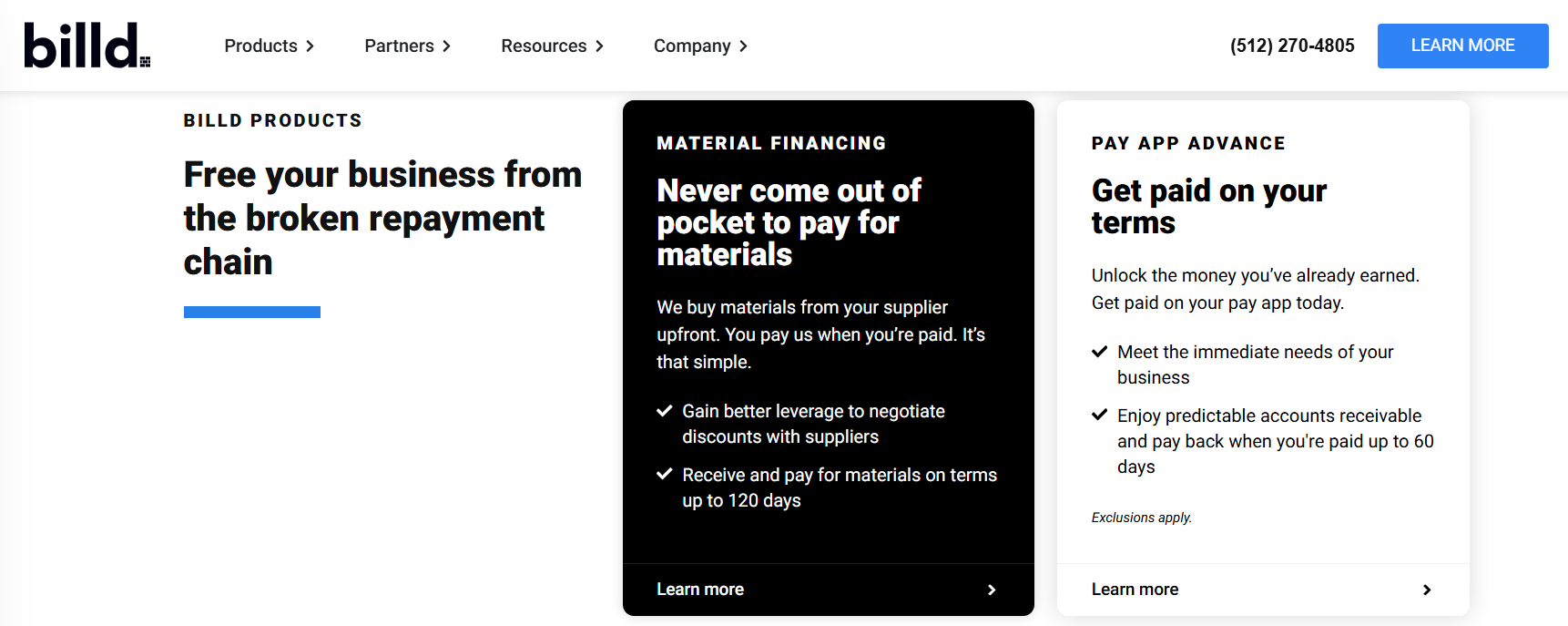
Material Financing: The flagship service. Subcontractors enter a purchase order (PO) or invoice into Billd’s system. Billd then pays the supplier immediately, and the subcontractor repays Billd up to 120 days later. This allows subs to “take that extra project” and grow their business without waiting on client payments. The underwriting is project-specific, using Billd’s patented analytics to set terms. Material Financing covers any cost that suppliers would normally finance – from lumber to fixtures – on any project, with any supplier.
-
Pay App Advance: This service advances cash on an already-approved pay application (the bill submitted by a subcontractor and approved by the general contractor). It turns an invoice that would normally be paid in 30+ days into immediate capital. This is especially useful on larger, multi-month projects. Billd developed Pay App Advance to address public and private projects that were surging after COVID-related slowdowns. The 2022 debt facility explicitly supported scaling this product.
-
Turner APP (Accelerated Payment Program): A co-branded program with Turner Construction. For subcontractors working on Turner projects, Billd provides faster payment and financing services. This specialty offering leverages Turner’s huge national presence – no other fintech has such a named GC partnership. Turner APP was one of Billd’s early innovations in partnering with a lead contractor to embed finance in project workflows.
-
Predictable Pay: Launched in Sept 2025, this is an early-pay program designed alongside general contractors. It allows GCs to accelerate their subs’ payments in exchange for a small financing fee. Subcontractors get faster, more reliable payments and GCs improve project performance. Predictable Pay thus extends Billd’s value proposition to the other side of the contract, cementing GC relationships. PYMNTS reports that Predictable Pay was developed with multiple GCs and launched strategically into the market.

In addition to financing products, Billd offers related services and technology:
-
Online Platform and Mobile App: Subcontractors use Billd’s digital portal to request financing, upload documents, and track repayments. The mobile-friendly platform collects minimal information and integrates with public job data to speed approval. Billd also provides digital payment processing so that after repaying Billd, the subcontractor’s supplier is paid via ACH or check from Billd’s system.
-
Analytics and Reporting: Billd’s backend analytics provide insights to both company and client. Internally, Billd’s risk models analyze each transaction (project type, GC, location, project value) to price financing accurately. For customers, Billd offers tools like a Working Capital Toolkit and periodic reports (e.g. the National Subcontractor Market Report) that help them plan cash flow.
-
Customer Support & Education: Billd positions itself as a partner, not just a lender. Clients can access financial experts and content guides (e.g. “Contractor Financing Guide”) to learn best practices. The company also hosts industry meetups and webinars on capital strategy. This advisory role helps Billd build trust and differentiate from impersonal fintech rivals.
-
Supply-Chain Partnerships: Billd collaborates with material suppliers and other platforms. For example, some distributors now offer Billd financing as an option at checkout, broadening Billd’s reach. It also works with construction software and platforms (like Procore or e-Builder) to integrate financing into project management workflows.
Customer Base: Billd serves thousands of subcontractors across the U.S., primarily in commercial construction trades (electrical, plumbing, HVAC, concrete, etc.). Its clients range from small businesses to mid-sized firms (often $5–50M annual revenue) looking to expand. As of late 2024, Billd had funded financings for over 30,000 purchase orders or pay apps spanning around 5,000 projects. Key partners include national suppliers, larger GCs (like Turner), and trade associations.
Key Metrics: By late 2025, Billd had deployed well over $750 million in financing. Its ability to handle this volume indicates robust operations and significant market penetration. The strategic funding rounds and debt facilities are in line with expanding this product suite even further – for instance, enabling more Predictable Pay programs and covering higher ticket projects.
In sum, Billd’s products and services form a comprehensive platform for subcontractor finance. The combination of flexible credit products, a modern digital experience, and industry-savvy support creates a solution suite that is broader and more tailored than general lending. This breadth and depth of offering – all focused on easing subcontractors’ cash flow – is central to Billd’s market position.
Conclusion: Position, Impact, and Outlook
Billd has established itself as a leading innovator in construction finance. By 2026 the company has become synonymous with subcontractor working capital solutions, backed by strong performance and funding. Its model has shown that fintech can transform an $800+ billion sector historically plagued by slow payments and undercapitalization. With over $750M financed and rapid revenue growth, Billd has proven demand for its products.
The startup’s impact on the industry is tangible: subcontractors report being able to bid on bigger projects and avoid cash crunches thanks to Billd’s financing. General contractors and suppliers see improved project stability when subs have reliable funding. By cultivating partnerships (e.g. with Turner and GCs) and releasing innovative services like Predictable Pay, Billd is also shaping new norms for construction payments.
Looking ahead, Billd appears well-positioned to continue expanding. Its strong balance sheet, investor backing, and broadened product suite suggest it can capture more of the construction financing pie. The company has reiterated its commitment to being the “Champion of the Subcontractor”, and its leadership emphasizes a long-term, sustainable growth approach.
In summary, Billd’s brand story is one of solving a pressing industry problem with financial technology and expertise. It has built momentum through substantial funding, rapid growth, and a clear vision. For investors and analysts, Billd represents a pioneering case of fintech applied to construction, with early success and a clear roadmap for future expansion. Its position as a well-funded specialist gives it every chance to remain a market leader, as construction companies increasingly adopt digital, flexible financing solutions to manage cash flow and scale their businesses.
Also Read: Pathstream – Founders, Business Model, Funding & Competitors
Also Read: Clarity AI – Founders, Business Model, Funding & Competitors
To read more content like this, subscribe to our newsletter
Go to the full page to view and submit the form.