


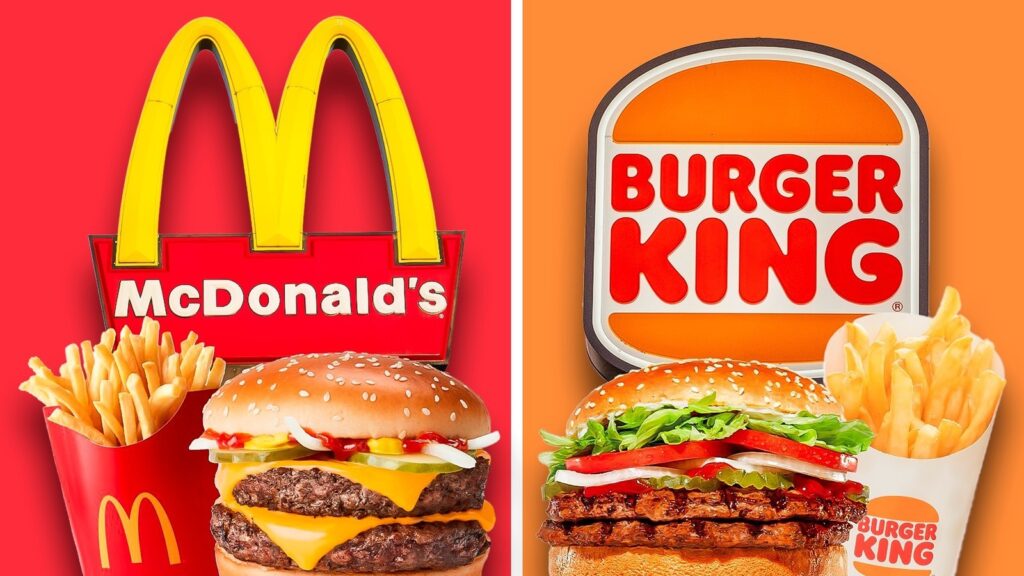
Quick answer: McDonald’s wins on sheer scale, consistency, and profitability — it’s the world’s largest restaurant chain by revenue and store count, run almost entirely through a highly disciplined franchise-and-real-estate model. Burger King, owned by Restaurant Brands International alongside Tim Hortons, Popeyes, and Firehouse Subs, is smaller and has struggled with consistency over the decades, but its flame-grilled Whopper, aggressive value pricing, and a $700 million “Reclaim the Flame” turnaround have it gaining ground faster than McDonald’s in 2025-2026. Which one “wins” depends on whether you’re measuring as an investor, a franchisee, or a hungry customer — this guide breaks down all three angles.
McDonald’s and Burger King have been trading blows for over 60 years, and their rivalry is one of the most studied in modern business: two burger chains, born less than a decade apart in different corners of America, that grew into global symbols of fast food itself.
But behind the Golden Arches and the flame-grilled Whopper are two very different companies, with different owners, different financial engines, and very different recent trajectories.
Here’s the full story of both brands, how they actually make money, and which one comes out ahead depending on what you care about.
How McDonald’s Began: From a Drive-In to a Global Empire
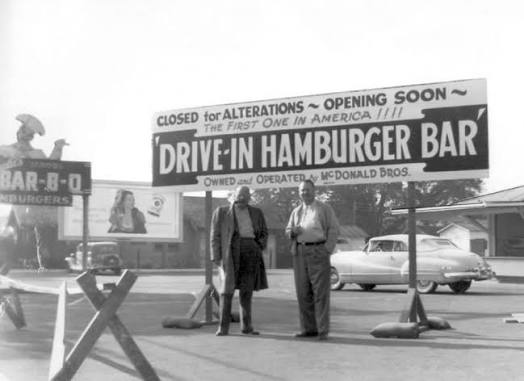
McDonald’s traces back to 1940, when brothers Richard “Dick” and Maurice “Mac” McDonald opened a barbecue drive-in restaurant in San Bernardino, California.
In 1948, the brothers reinvented the business entirely, stripping the menu down to burgers, fries, and shakes and introducing what they called the “Speedee Service System” — an assembly-line approach to food prep that let them serve customers in seconds rather than minutes. It was, in effect, one of the first fast-food kitchens ever built.

The turning point came in 1954, when Ray Kroc, a traveling milkshake-machine salesman, visited the McDonald brothers’ restaurant to see why a single location needed eight of his Multimixer machines.
Impressed by the operation, Kroc convinced the brothers to let him become their franchise agent, and in 1955 he opened his own McDonald’s franchise in Des Plaines, Illinois.
Kroc aggressively expanded the franchise model nationwide, and by 1961 tensions between his vision for the brand and the brothers’ more modest ambitions came to a head.
Kroc bought out Richard and Maurice McDonald for $2.7 million, a sum the brothers reportedly felt shortchanged by given how the brand would go on to grow.
Kroc, not the McDonald brothers, is the one credited with turning the company into the global franchising machine it is today.
How Burger King Began: From Insta-Broilers to the Whopper
Burger King’s origin story is less tidy.
It began on July 23, 1953, in Jacksonville, Florida, when Keith Kramer and Matthew Burns opened a restaurant called Insta-Burger King, built around a novel piece of equipment called the Insta-Broiler oven.
The chain expanded through franchising, and one of its earliest and most important franchisees was David Edgerton, who opened a Miami location in 1954.

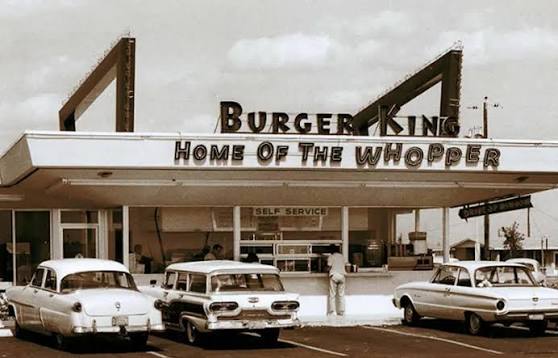
Edgerton grew frustrated with the unreliable Insta-Broiler machines and, working with fellow Miami operator James McLamore, developed a flame-broiling cooking method that would become the brand’s signature.
When the original Insta-Burger King parent company ran into financial trouble, Edgerton and McLamore bought the chain outright in 1959, dropped “Insta” from the name, and rebranded it simply as Burger King.
In 1957, the pair had already introduced the Whopper, a bigger, flame-grilled burger built to directly challenge McDonald’s, and it remains the chain’s signature product nearly 70 years later.
Who Owns McDonald’s Today?
McDonald’s Corporation is a fully public company, listed on the New York Stock Exchange under the ticker MCD, with no single controlling owner. Roughly 74% of its shares are held by institutional investors — pension funds, mutual funds, and index funds — rather than individuals.
The largest shareholders are asset management giants: Vanguard holds around 10% of shares outstanding, BlackRock holds a little over 7%, and State Street holds close to 5%, a stake worth roughly $10 billion at recent prices.

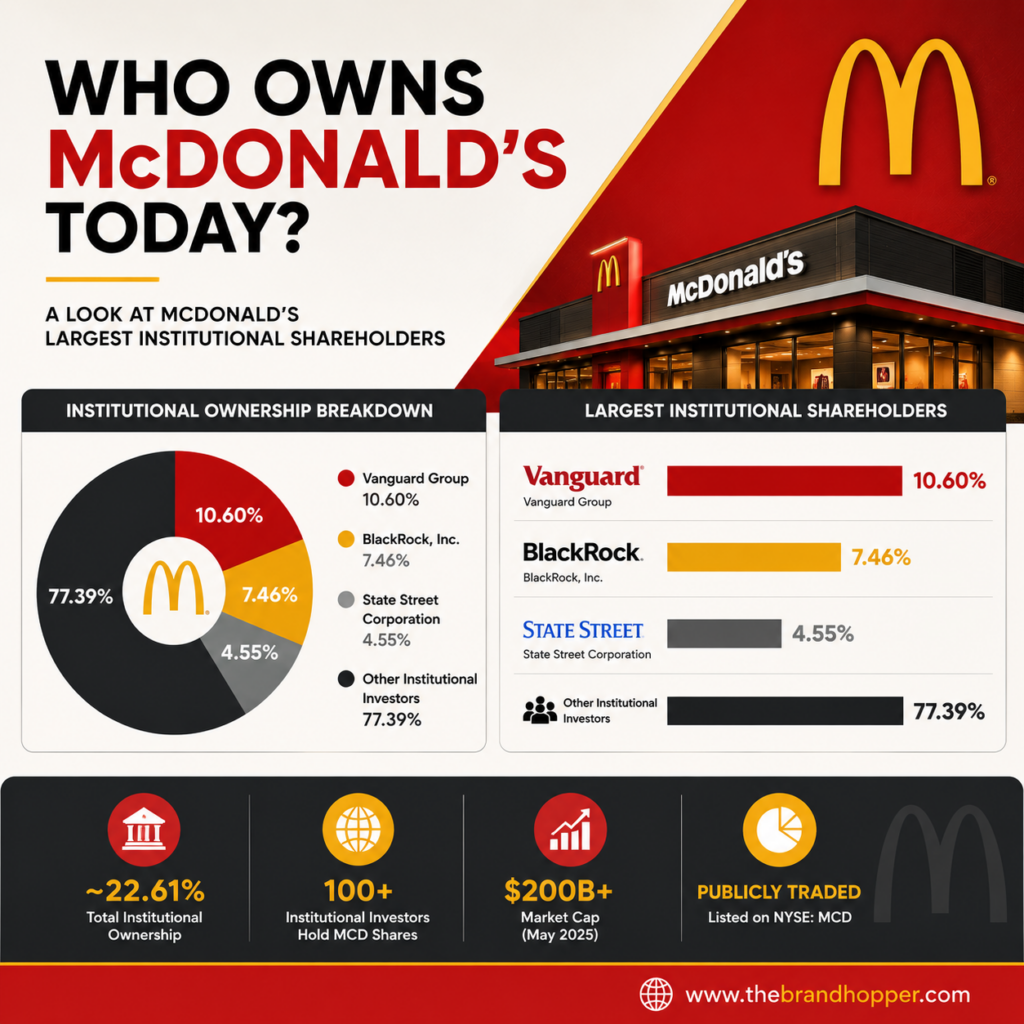
In practice, this means McDonald’s is collectively “owned” by millions of retirement accounts and index funds worldwide rather than by any founder, family, or private equity sponsor.
Chris Kempczinski, who became CEO in 2019, was also named Chairman of the Board in 2024, giving him control over both the company’s daily operations and its board direction.
Who Owns Burger King Today?
Burger King’s ownership structure looks completely different. It’s not an independent public company at all — it’s one of four brands owned by Restaurant Brands International (RBI), a Canadian holding company also traded publicly (NYSE/TSX: QSR), alongside Tim Hortons, Popeyes Louisiana Kitchen, and Firehouse Subs.
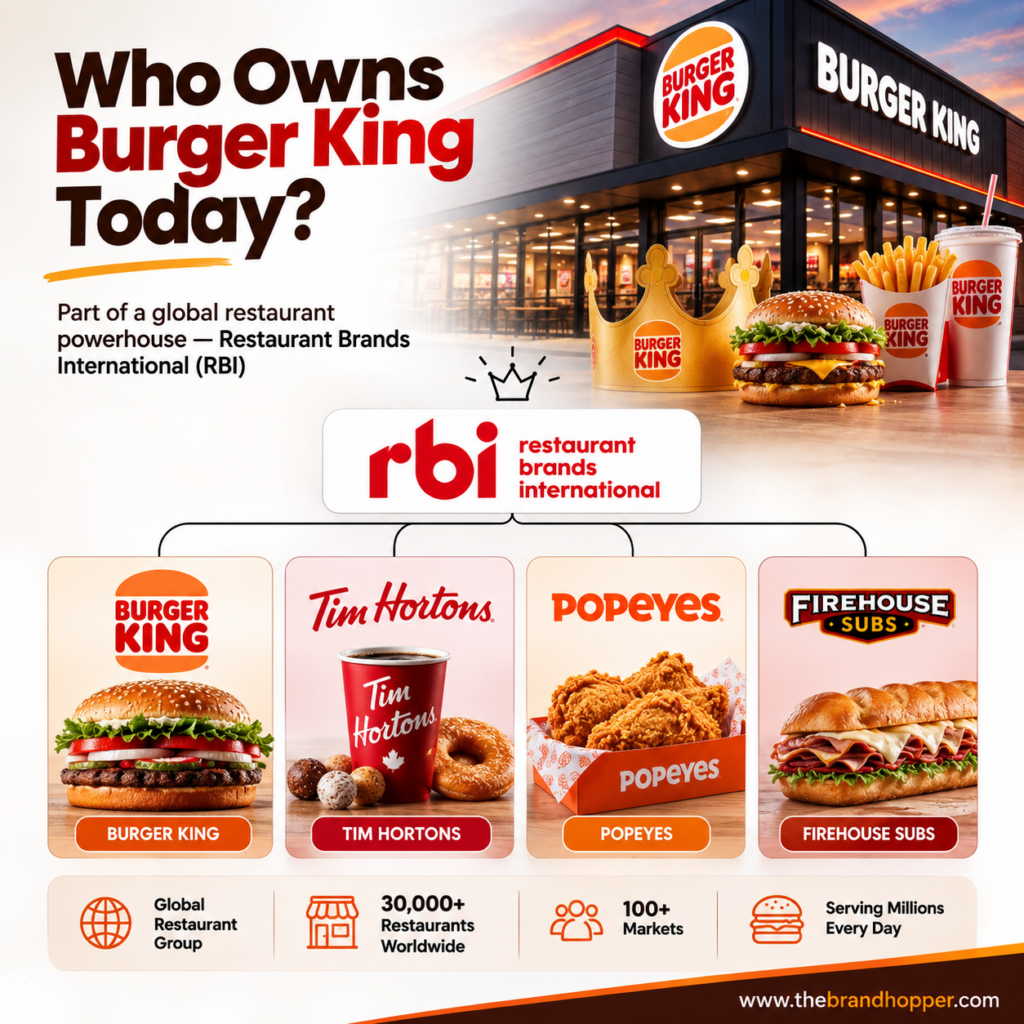
RBI itself was created in 2014, when Brazilian private equity firm 3G Capital orchestrated a merger between Burger King and Tim Hortons.
3G Capital, working through its investment vehicle 3G Restaurant Brands Holdings, remains a major shareholder, holding roughly 10% of RBI as of 2026, alongside Berkshire Hathaway, which helped finance the original merger and has held a long-standing preferred equity stake in the company.
RBI is currently led by CEO Josh Kobza, who was promoted into the role in March 2023 after previously serving as the company’s CFO, CTO, and COO.
Both Are Franchise Machines — But Run Differently
Both companies operate on a heavily franchised model: McDonald’s franchises roughly 95% of its restaurants worldwide, while Burger King franchises an even higher share, close to 100% of its locations.
But the two run their franchise economics quite differently.
McDonald’s is famous — some would say notorious — for owning much of the real estate its franchised restaurants sit on, collecting rent from franchisees in addition to royalty fees.
This “landlord” model is a huge reason McDonald’s is often described less as a burger company and more as a real estate company that happens to sell burgers; it gives McDonald’s exceptionally stable, high-margin cash flow regardless of how any single restaurant’s food sales perform in a given quarter.
Burger King and RBI, by contrast, own comparatively little real estate and rely more heavily on franchise royalties alone, which makes RBI’s earnings lean more directly on how well franchisees are actually running and marketing their restaurants — which is exactly why franchisee profitability has become such a central talking point for RBI’s current leadership.
McDonald’s vs Burger King: Revenue, Scale, and Recent Performance
By sheer size, McDonald’s is not close. McDonald’s generated nearly $140 billion in systemwide sales in 2025, up 5.5% on a constant-currency basis, and is targeting roughly 50,000 restaurants globally by the end of 2027 as part of an aggressive global growth plan.
Restaurant Brands International, across all four of its brands combined, generated around $8.4 billion in company revenue in 2025 — meaning McDonald’s alone dwarfs RBI’s entire four-brand portfolio, let alone Burger King on its own.
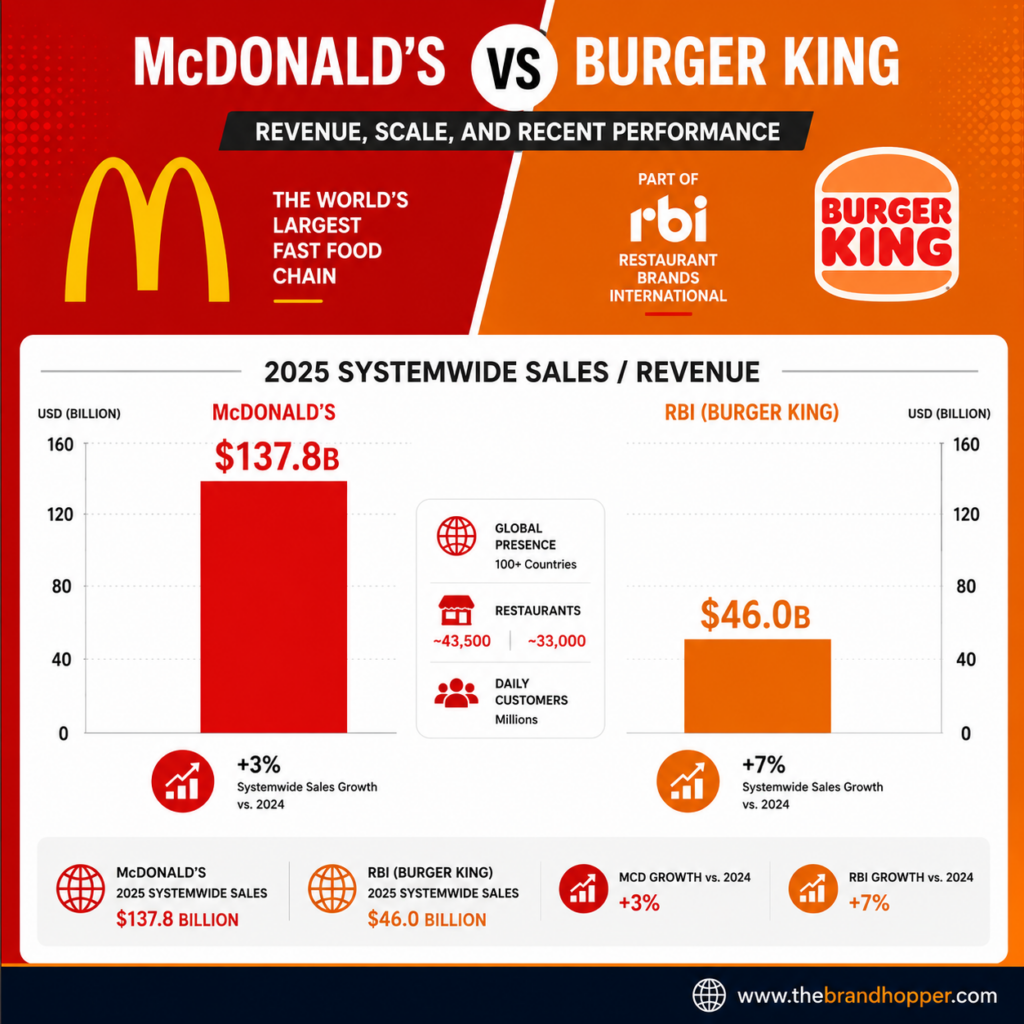
But scale isn’t the same as momentum.
Burger King has been the more exciting growth story in 2025-2026. Backed by RBI’s $700 million-plus “Reclaim the Flame” turnaround plan — split between a “Fuel the Flame” marketing and digital push and a “Royal Reset” remodeling program — Burger King’s U.S. business posted an 8.5% same-store sales gain in one recent period and a 5.8% comparable-sales increase in Q1 2026 alone, roughly double what analysts had projected.
Customer satisfaction scores are reportedly up 40% over an 18-month stretch, and franchisee store-level profits are also up sharply as remodeled locations and simplified menus take hold.
McDonald’s, meanwhile, has faced a tougher stretch with U.S. traffic pressured by value-conscious, lower-income consumers pulling back on fast food spending, forcing the chain to lean harder on its own value meal deals to defend market share.
What Brands Does Each Company Own?
This is one of the sharpest differences between the two rivals. McDonald’s is a single-brand company — virtually all of its revenue comes from the McDonald’s name itself, aside from smaller ventures like its McCafé coffee line.
Burger King, on the other hand, is just one piece of a four-brand portfolio under Restaurant Brands International, which also owns Tim Hortons (the Canadian coffee-and-donuts giant), Popeyes Louisiana Kitchen (fried chicken), and Firehouse Subs (sandwiches).
In 2026, RBI also restructured its international Burger King China business, selling a roughly 83% majority stake to private equity firm CPE for $350 million while retaining a 17% minority interest — a sign of RBI’s growing willingness to bring in outside capital and operating partners for underperforming international markets rather than run every market itself.
Which Brand Is Best for You? A Practical Breakdown
If you’re a customer chasing flavor, the flame-grilled Whopper remains Burger King’s calling card and the reason many people prefer it to McDonald’s griddle-cooked beef, and Burger King’s recent value-menu aggression has made it a genuinely strong choice for budget-conscious diners in 2025-2026.
If you want maximum convenience, consistency, and locations wherever you travel — especially internationally — McDonald’s is very hard to beat, given its dramatically larger global footprint and famously standardized operations.
If you’re evaluating these as an investor, McDonald’s offers a larger, more stable, dividend-aristocrat-style stock built on real estate and royalty income, while RBI offers more of a multi-brand turnaround story, with Burger King’s current momentum as its most interesting growth lever alongside Tim Hortons’ steady cash flow.
And if you’re considering a franchise investment, McDonald’s typically demands significantly higher upfront capital and stricter site/operator standards, while Burger King franchises have a somewhat lower barrier to entry but have historically demanded more hands-on operational turnaround work from franchisees, particularly at older, un-remodeled locations.
The Cultural Rivalry: Advertising Wars and Public Stunts
Beyond the balance sheets, McDonald’s and Burger King have waged one of advertising’s longest-running public feuds.
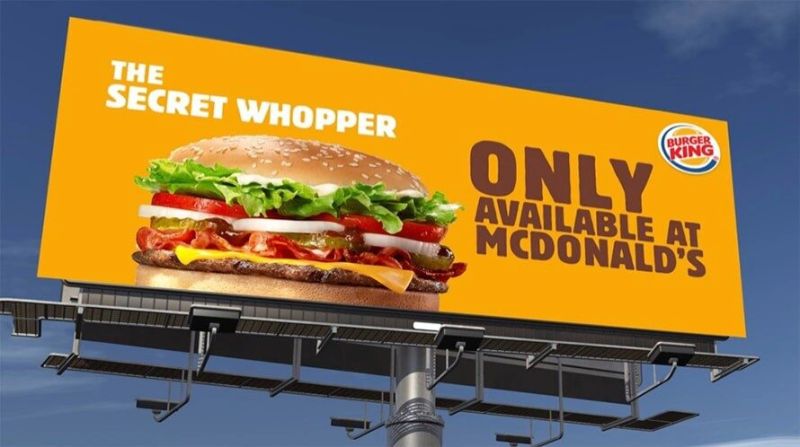
Burger King has built decades of marketing around directly needling its bigger rival — from “Have It Your Way” positioning against McDonald’s standardized menu, to stunts like opening a Burger King inside a renovated former McDonald’s building, to its well-known “Whopper Detour” app promotion that offered a one-cent Whopper only to customers who were physically standing inside a McDonald’s location.

McDonald’s, as the market leader, has generally taken a steadier, less combative marketing approach, leaning on nostalgia, family-friendly branding, and massive-scale campaigns like its long-running Happy Meal and McCafé pushes rather than engaging tit-for-tat with Burger King’s jabs.
McDonald’s vs Burger King at a Glance
| Fact | McDonald’s | Burger King |
| Founded | 1940 (as a drive-in); reinvented 1948 | 1953 (as Insta-Burger King) |
| Founders | Richard & Maurice McDonald; expanded by Ray Kroc | Keith Kramer & Matthew Burns; rebuilt by David Edgerton & James McLamore |
| Parent company | McDonald’s Corporation (independent, publicly traded) | Restaurant Brands International (RBI) |
| Stock listing | NYSE: MCD | NYSE/TSX: QSR (parent RBI) |
| Largest shareholders | Vanguard (~10%), BlackRock (~7%), State Street (~5%) | 3G Restaurant Brands Holdings (~10%), Berkshire Hathaway (preferred equity) |
| CEO | Chris Kempczinski (also Chairman) | Josh Kobza (RBI CEO) |
| Sister brands | None — single-brand company | Tim Hortons, Popeyes, Firehouse Subs |
| 2025 revenue/sales | ~$140 billion systemwide sales | ~$8.4 billion company revenue (all 4 RBI brands) |
| Franchise share | ~95% of restaurants franchised | ~100% of restaurants franchised |
| Real estate model | Owns/leases most restaurant real estate | Franchisees typically control real estate |
| Recent momentum | Softer U.S. traffic, defending with value deals | 8.5% U.S. comp sales gain via “Reclaim the Flame” |
| Signature product | Big Mac | Whopper |
Key Takeaways
McDonald’s and Burger King both trace back to humble, independently invented fast-food concepts in 1940s-50s America, but they’ve evolved into structurally different businesses.
McDonald’s is a single-brand, real-estate-heavy public company with no controlling owner, dominant in scale and profitability but currently facing softer U.S. traffic.
Burger King is one of four brands inside Restaurant Brands International, a company built by 3G Capital’s private-equity playbook, currently in the middle of one of the more successful turnarounds in fast food thanks to its “Reclaim the Flame” investment plan. Neither is going anywhere — but in 2025-2026, Burger King is the one closing the gap.
Frequently Asked Questions
Q: Who owns McDonald’s?
A: No single person or company owns McDonald’s. It’s a publicly traded company (NYSE: MCD) with no controlling shareholder; the largest holders are institutional investors like Vanguard (~10%), BlackRock (~7%), and State Street (~5%).
Q: Who owns Burger King?
A: Burger King is owned by Restaurant Brands International (RBI), a Canadian holding company that also owns Tim Hortons, Popeyes, and Firehouse Subs. RBI was created in 2014 through a merger engineered by Brazilian private equity firm 3G Capital, which still holds roughly 10% of RBI’s shares today.
Q: Is McDonald’s bigger than Burger King?
A: Yes, by a wide margin. McDonald’s generated nearly $140 billion in systemwide sales in 2025, compared to Restaurant Brands International’s roughly $8.4 billion in total company revenue across all four of its brands combined, including Burger King.
Q: Why is Burger King doing better than McDonald’s lately?
A: Burger King’s U.S. business has posted strong same-store sales growth in 2025-2026, driven by RBI’s “Reclaim the Flame” plan — a $700 million-plus investment in remodeling, technology, and marketing — while McDonald’s has faced softer traffic from value-conscious consumers pulling back on fast food.
Q: Did Ray Kroc found McDonald’s?
A: No. Brothers Richard and Maurice McDonald founded the original restaurant in 1940 and created its fast-food format in 1948. Ray Kroc joined as a franchise agent in 1955 and later bought out the brothers for $2.7 million in 1961, turning the brand into a global franchise empire.
Q: What other brands does Burger King’s parent company own?
A: Restaurant Brands International owns four brands total: Burger King, Tim Hortons, Popeyes Louisiana Kitchen, and Firehouse Subs.
Q: Does McDonald’s own the real estate its restaurants sit on?
A: In many cases, yes. McDonald’s owns or leases a large share of the real estate beneath its franchised restaurants and collects rent from franchisees on top of royalty fees, a model that gives it unusually stable, high-margin income compared to most franchise businesses.
Q: Is it more expensive to franchise a McDonald’s or a Burger King?
A: Generally, McDonald’s franchises require significantly higher upfront investment and stricter operator qualifications than Burger King, though Burger King’s older, un-remodeled locations often require more hands-on turnaround work from new franchisees.
Also Read
- GoPro vs DJI: Best Action Camera Brand?
- Intel vs AMD: Which CPU Brand Is Better?
- Rolex vs Omega: Which Luxury Watch Brand Wins?
To read more content like this, subscribe to our newsletter
Go to the full page to view and submit the form.