
Last Updated on February 25, 2025 by Team TBH
Tennis has one of the strangest scoring systems in the entire sports world, but it is also perhaps the most fun form of competition. The good news is that once you learn how to calculate the score, you will have no problem remembering it. In this article, we will explain all aspects of scoring in detail.
Basic Tennis Scoring System
Before you go to the 1xBet site and place your bets, you need to understand the rules of scoring. So, let’s start with the basics. We will start by explaining the difference between a game, a set, and a match. A match is a term that refers to the entire playing time in tennis. It consists of winning three or five sets (depending on your class). Each set is played to at least six winning games.
Main Scoring Principles
Players serve one game at a time. The winner is usually the player (or team, if it is doubles) who wins four balls. Points are scored in this way: one player serves, and the other hits back; the ball is tossed back and forth until one of the opponents hits a strong shot or hits the net. Keep in mind that a game can be played for seven or more balls, for example, when the first player wins three and the second player wins four more. In this case, each ball won is added to the score of the athletes:
- 1st ball won is 15 points;
- 2nd ball won is 30 points;
- 3rd ball won is 40 points;
- 4th ball won means the victory in the game (i.e., its end).
It is also important to understand what “love” is. And no, we are not talking about romantic or even platonic love. In tennis, the word “love” is associated with a zero in the score. For example:
- When you have not scored a single point on your serve, and your opponent has won two balls, then this situation can be called: “love-30”.
- The same applies to games. If you have won three games, and your opponent has not won any, then you need to say: “3-love”.
- At the very beginning of the game, when neither of you has scored a single point, you will be told: “love-all” (which is a great wish before the game begins).
Advantage Scoring
There is also a situation in tennis called deuce. It occurs when the score is 40-40. Then the next player to score gets an advantage. If the same player scores points again, he wins. If the opponent beats him, the situation returns to deuce. This is a fairly simple and intuitive rule, so there are usually no problems with understanding it.
How Many Sets in a Tennis Match?

The number of sets in a match is determined by the tournament. The player himself cannot choose the format. Most often, three sets are played. However, there are exceptions.
- Grand Slam tournaments. In them, men play five sets and women three. The final is held in the best-of-three format for all categories of participants.
- In Masters tournaments, everything is the opposite, in the final the number of sets increases. Thus, men play three and five sets, respectively, and women play two and three.
- At the Olympic Games, an exception is made for women, who play matches in two sets. Men play in a three-set format.
Obviously, the winner is the one who has won more sets, that is, two or three, depending on their total number.
Tiebreak Rules in Tennis
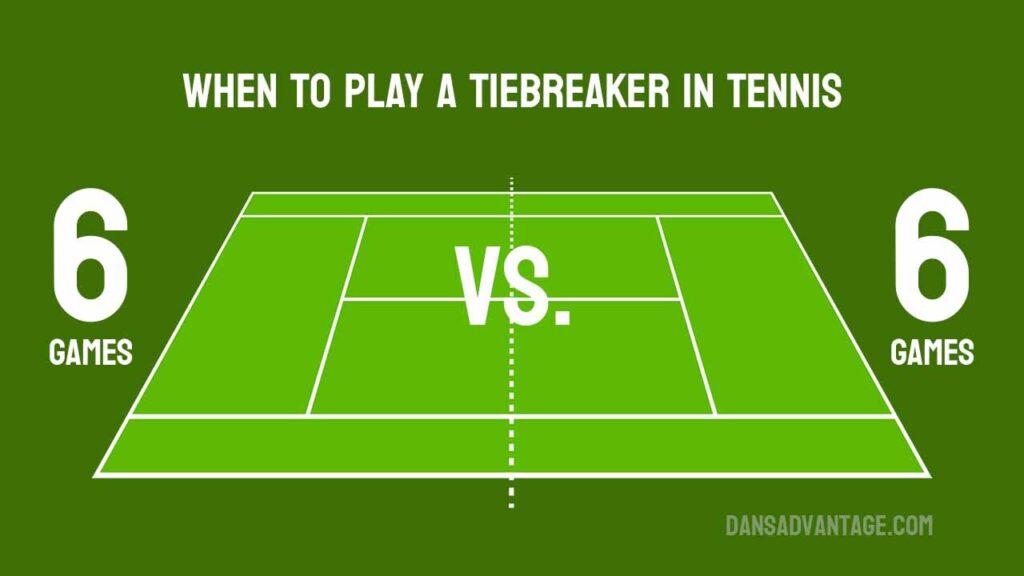
There is a situation when, based on the results of two sets, both opponents receive 6 points. In order to decide which of them will win, a special shortened set called a tiebreak is held. In it, the score goes up to 7 points. In this case, a two-point advantage is enough to win. If the confrontation is so close that two points after reaching 7 points is not enough, the tiebreak continues until one of the opponents receives the necessary advantage.
However, the Grand Slam tournaments, as always, distinguished themselves. There, tennis players play a tiebreak of up to 10 points. However, everything else is the same: a two-point lead is required. If 10 points are scored, and there is still no two-point lead, the game continues.
Tennis Scoring in Different Formats
The scoring system we described earlier is the most common. However, you may come across other scoring methods. Let’s talk about them too.
No-Ad Scoring
This format removes the tie-breaking advantage rule, so the first player to score a point after the deuce is the winner. This shortens the game considerably, so this format is often used for college tennis championships, doubles matches, and other competitions where fast play is preferred.
Super Tiebreaks
We have already written that a tiebreak is held when both opponents have received 6 points. In regular games, the tiebreak is played to 7 points with a gap of two points. However, in Grand Slam tournaments and doubles competitions, the number of points required is increased to 10, although the difference of two points remains unchanged.
Singles vs. Doubles
There are no differences in scoring between singles and doubles tennis, except for those mentioned earlier. However, there are specific rules. For example, if both players touch rackets, the point goes to the opposing team. Obviously, in singles tennis, such a rule would be meaningless.
Common Tennis Scoring Terms and Rules

So, we’ve covered the basics. Now, we need to discuss other terms. They refer to different situations during a match. The first of them is called “Break point.” This is the name given to a situation in which a player can win the opponent’s serve with one hit. It should not be confused with set point, which is when a tennis player can win the entire set with one hit. You’ve probably already guessed that a match point is when one hit can win the entire match.
It is also important to understand the difference between walkover, retirement, and default. All of these phenomena have the same result: a player wins a match because his opponent is unable to play. A walkover is a statement of withdrawal before the match, for example, if a tennis player has not recovered from an injury or has fallen ill. Retirement occurs during the game. The most common reasons are also injury or illness. But the default is the result of a tennis player being disqualified for unsportsmanlike behavior.
Scoring in a tiebreak also has its own specifics. Firstly, points are awarded one at a time. Secondly, players play two serves. The player who served last in the previous set starts.
Conclusion
As you can see, despite the complex rules and unusual system, it is possible to understand how to count points in tennis. And by applying the knowledge in practice, you will easily consolidate it. Therefore, try to count the score yourself when watching matches. This will help you quickly become a real expert.
FAQs About Tennis Scoring
Why does tennis use love, 15, 30, 40 instead of 1, 2, 3, 4?
There are several versions explaining this system. According to one, it is a legacy from the old game from which modern tennis originated. According to another version, the score was originally marked on the clock and the hand moved 15 minutes when winning.
What happens in a 40-40 situation (Deuce)?
In this situation, a tiebreak starts, which determines the winner.
Can a tennis match end in a draw?
No, it is impossible. The winner is always determined by the tiebreak.
How long can a tiebreak last?
Since the tiebreak continues until a winner is determined, it can last a long time. However, it usually lasts 10-15 minutes.
What is a Golden Set?
This is a situation where a player wins without losing a single point.
To read more content like this, explore The Brand Hopper
Subscribe to our newsletter