Some advertising campaigns sell products. A few create desire. But once in a generation, one rewrites culture itself. De Beers’ legendary slogan, “A Diamond is Forever,” didn’t just spark sales—it crafted a mythology. It turned a once-optional gemstone into a global rite of passage, embedding diamonds into the fabric of love, marriage, and social aspiration. This wasn’t a campaign; it was a cultural coup—a masterclass in emotional branding that reshaped how the world expresses commitment. It didn’t just sell diamonds. It sold forever.
But the brilliance began in the shadows—during a time of crisis. In the 1930s, diamond sales were collapsing. The glamour had dulled. The Great Depression left De Beers, then controlling over 90% of global diamond supply, teetering on the edge of irrelevance. Diamonds weren’t considered essential for engagement or romance—they were a luxury for the elite. Enter N.W. Ayer & Son, the American ad agency hired not to promote a product, but to reignite desire. The brief was bold: make the world fall in love with diamonds again. What followed was one of the most iconic campaigns in advertising history.
The Spark Before the Flame: 1930s Crisis and the Need for Reinvention
In the early 20th century, diamonds were not the default gift for engagements. While aristocrats and the wealthy appreciated diamonds, the masses viewed them as optional or extravagant. Then came the Great Depression. By 1938, global diamond sales were plummeting. The South African-based De Beers Consolidated Mines, which controlled more than 90% of the world’s diamond production through a tight monopoly, faced an existential crisis.
Recognizing the need to stimulate demand, De Beers turned to American advertising agency N.W. Ayer & Son. The brief was unusual: the client wasn’t looking to promote a specific brand or product line. Instead, they wanted to make diamonds matter again.
1947: The Birth of a Cultural Movement
It was copywriter Frances Gerety who, in 1947, coined the phrase that would go down in history: “A Diamond is Forever.” Four simple words encapsulated the ideals of eternal love, commitment, and the imperishable nature of the diamond itself. It was an emotional appeal that transcended commercial messaging.
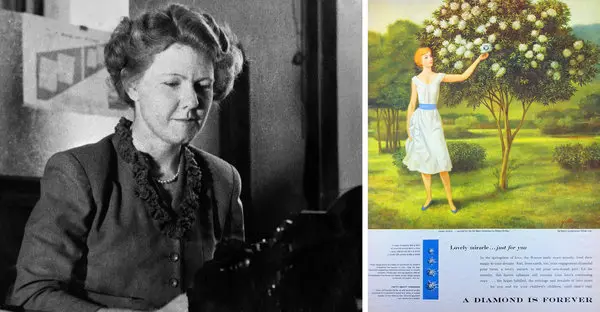
Rather than pitching features or pricing, the campaign sold a story. It asked, “What better way to symbolize your everlasting love than with a stone that never wears out?” It wasn’t just smart marketing; it was genius cultural engineering. And it worked.
From 1939 to 1979, De Beers’ wholesale diamond sales in the United States increased from $23 million to $2.1 billion. By the early 1980s, more than 80% of American engagement rings contained diamonds. In 1940, that number was just 10%.
Emotional Branding and Social Engineering
De Beers didn’t merely advertise—it shaped society. Their strategy was to create emotional associations with the diamond:
- Love and Eternity: With the slogan as the anchor, every advertisement framed the diamond as a manifestation of an unbreakable bond.
- Status Symbol: The campaign associated diamond gifting with masculinity, responsibility, and affluence.
- Ritual Creation: De Beers popularized the concept that a man should spend at least one month’s salary (eventually two) on an engagement ring. This wasn’t tradition; it was invented.
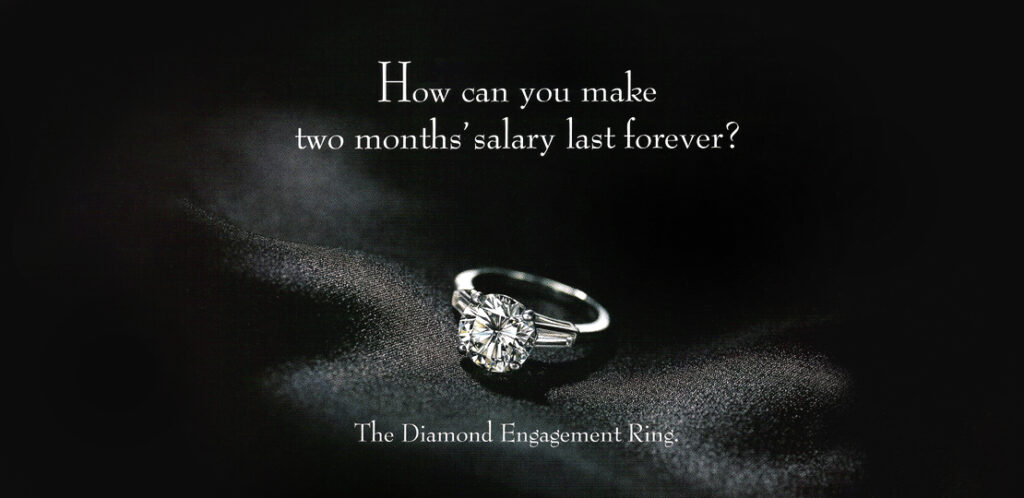
These ideas were disseminated through newspaper ads, cinema tie-ins, radio broadcasts, and eventually television. Rather than focusing on price points or product attributes, the messaging centered around the emotional heft of the gesture.
Visual Storytelling: Selling a Dream
One of the campaign’s visual strengths was how it avoided overt product placement. Early De Beers advertisements seldom featured large, close-up images of the diamond rings. Instead, they portrayed romantic moments—proposals, anniversaries, the quiet intimacy of long-term relationships.
This indirect approach left space for imagination. Viewers were encouraged to project themselves into the scenario, with the diamond ring simply implied as the centerpiece of those life-changing moments.
These ads were often styled in black and white, giving them a timeless, almost editorial quality. The message was not one of commerce but of emotion—diamonds were a vehicle to access a dream.



Global Expansion: The World Falls in Love
Following its overwhelming success in the United States, De Beers turned its focus toward international markets. Japan, in particular, presented both a challenge and an opportunity.
In the 1960s, only about 5% of Japanese brides received diamond engagement rings. By 1981, after a decade of De Beers’ localized advertising, that number had soared to 60%, eventually reaching over 75%. The ads resonated because they married Western ideals of romantic love with Japanese cultural motifs of commitment and legacy.
In China and India, De Beers faced resistance due to different marital traditions and family-oriented wedding planning. But by aligning diamonds with values like prosperity and legacy, and using local celebrities in ads, they achieved market traction. By 2010, De Beers estimated over 30% of middle-class Indian grooms were buying diamond rings.
Sustaining the Shine: Reinvention in the Modern Era
By the 2000s, De Beers was facing new challenges. Millennials were becoming less interested in traditional marriage symbols. At the same time, the industry was rocked by growing awareness of blood diamonds (conflict diamonds), unethical mining practices, and rising environmental concerns.
Rather than resist, De Beers evolved:
- Ethical Sourcing: It spearheaded the Kimberley Process, a certification scheme to prevent the trade in conflict diamonds.
- Lab-Grown Diamonds: In 2018, De Beers launched Lightbox Jewelry, a separate brand offering affordable synthetic diamonds. The move allowed De Beers to tap into the growing demand for ethical and accessible options without diluting its core brand.
- New Audiences: Campaigns like the “Right Hand Ring” encouraged women to buy diamonds for themselves, breaking the tradition of diamonds being gifts from men to women.
Campaign Impact: Numbers Don’t Lie
The sheer scale of success achieved by “A Diamond is Forever” is difficult to overstate:
- 90% of American brides today receive a diamond engagement ring.
- Brand recall of the slogan remains above 90% in many surveys, making it one of the most recognizable taglines globally.
- De Beers’ market share, while diminished today due to market liberalization, stood at a dominant 80-90% during the campaign’s peak.
A 2014 report by Bain & Company found that diamonds accounted for over $80 billion in annual global jewelry sales, a market significantly shaped by De Beers’ early efforts.
Cultural Legacy and Branding Lessons
What De Beers accomplished through this campaign was more than advertising—it was socio-cultural manufacturing. Few brands can claim to have altered global customs. Coca-Cola may have defined Christmas imagery; Apple may have changed how we see technology. But De Beers? They told the world that love isn’t forever unless it comes with a diamond.
Even as societal attitudes shift, and the next generation leans toward minimalism, sustainability, and individuality, the emotional residue of “A Diamond is Forever” remains strong. It persists in wedding traditions, in films, in expectations, and even in resistance to it—proof of its pervasiveness.
This campaign is now studied in MBA classrooms, branding boot camps, and advertising masterclasses as a gold standard for:
- Creating emotional resonance over transactional appeal.
- Using cultural timing to forge new societal norms.
- Reinventing tradition while managing brand longevity over 75+ years.
Final Thoughts: The Greatest Campaign Ever?
In the branding universe, “A Diamond is Forever” remains a north star. It is a study in how emotional storytelling, cultural timing, and symbolic value can converge to create a campaign that doesn’t just sell but defines.
Marketers, advertisers, and brand builders continue to study it not only for its commercial brilliance but for its power to shape human behavior. For a campaign that started during an economic crisis and grew into a multi-billion dollar phenomenon, it truly shows that when you align a message with human desire, even a rock can become priceless.
Also Read: A Case Study on Shell’s “Powering Progress” Campaign
To read more content like this, subscribe to our newsletter